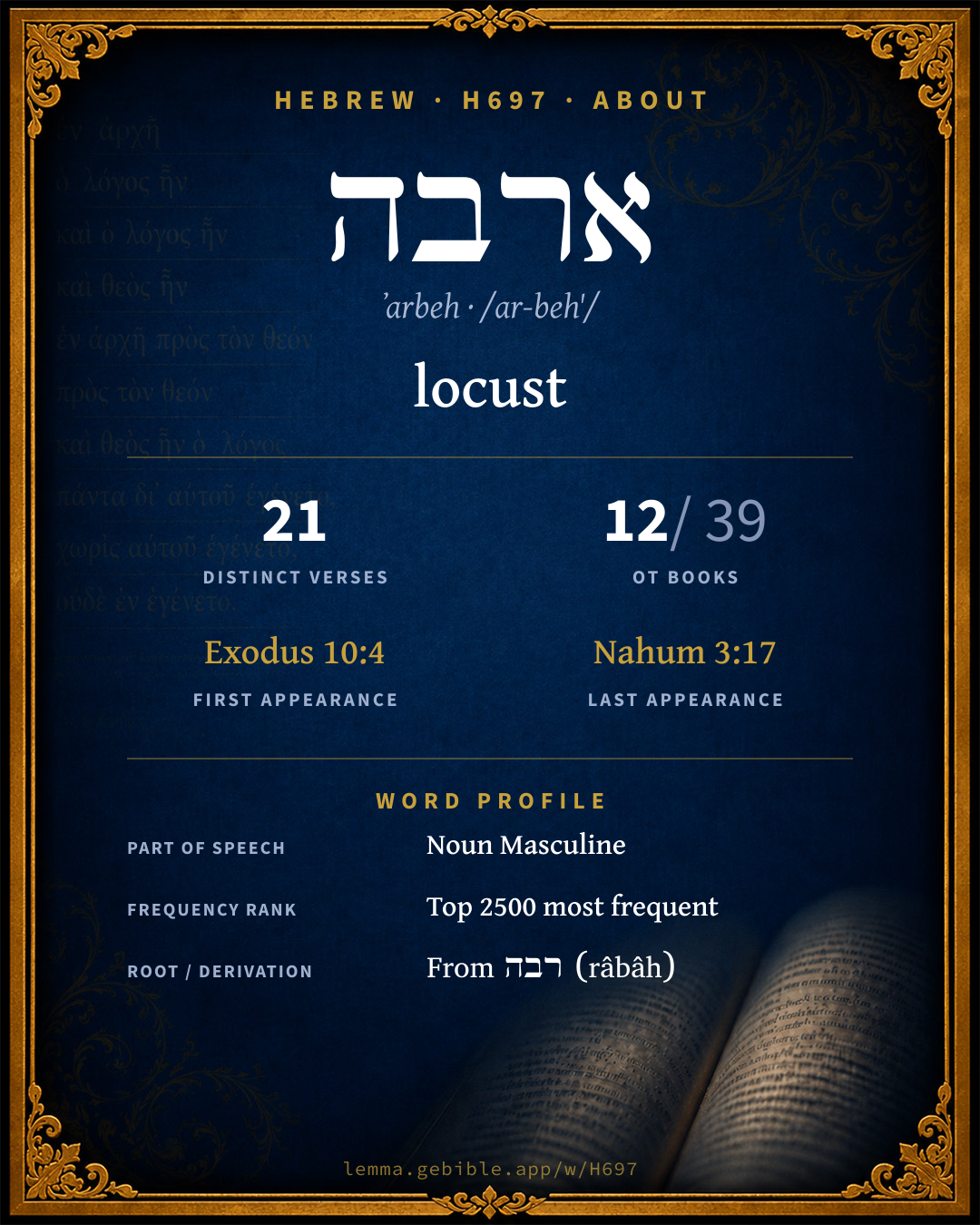
אַרְבֶּה
locust
‘locust’ is one of 4 main senses fuller range ↓
Full lexicon entry — Brown-Driver-Briggs (BDB)
From Brown-Driver-Briggs (BDB)
Where this word appears
Grammar key — what these labels mean
Part of speech
- Noun
- A naming word — a person, place, thing, or idea.
Noun type
- Common
- A common noun — a general class of person, place, or thing (“king,” “city,” “water”), not a specific name.
State
- Absolute
- The independent form of a noun, not bound to a following word.
Gender
- Masculine
- Grammatically masculine.
Number
- Singular
- One.
Every verse where H697 appears — 21 distinct verses across 12 books. Click any verse to open its interlinear word-by-word view. Verse text shown in the World English Bible for context — . Each verse’s Hebrew form is shown with its reference; the English is not keyword-highlighted, since the data carries no word-level English alignment. Use “Compare translations” on any verse to read it across multiple English versions. This concordance covers the Hebrew Bible; Septuagint (Greek Old Testament) occurrences are not indexed here.
Exodus 5 verses
- Exodus 10:4 אַרְבֶּ֖ה n c ms Or else, if you refuse to let my people go, behold, tomorrow I will bring locusts into your country,
- Exodus 10:12 בָּֽ/אַרְבֶּ֔ה prep det + n c ms Yahweh said to Moses, "Stretch out your hand over the land of Egypt for the locusts, that they may come up on the land of Egypt, and eat every herb of the land, even all that the hail has left."
- Exodus 10:13 הָ/אַרְבֶּֽה ptcl def.art + n c ms Moses stretched forth his rod over the land of Egypt, and Yahweh brought an east wind on the land all that day, and all the night; and when it was morning, the east wind brought the locusts.
- Exodus 10:14 הָֽ/אַרְבֶּ֗ה אַרְבֶּה֙ ptcl def.art + n c ms n c ms The locusts went up over all the land of Egypt, and rested in all the borders of Egypt. They were very grievous. Before them there were no such locusts as they, neither after them shall be such.
- Exodus 10:19 הָ֣/אַרְבֶּ֔ה אַרְבֶּ֣ה ptcl def.art + n c ms n c ms Yahweh turned an exceeding strong west wind, which took up the locusts, and drove them into the Red Sea. There remained not one locust in all the borders of Egypt.
Leviticus 1 verse
Deuteronomy 1 verse
Judges 2 verses
- Judges 6:5 אַרְבֶּה֙ n c ms For they came up with their cattle and their tents; they came in as locusts for multitude; both they and their camels were without number: and they came into the land to destroy it.
- Judges 7:12 כָּ/אַרְבֶּ֖ה prep det + n c ms The Midianites and the Amalekites and all the children of the east lay along in the valley like locusts for multitude; and their camels were without number, as the sand which is on the sea-shore for multitude.
1 Kings 1 verse
2 Chronicles 1 verse
Job 1 verse
Psalms 3 verses
- Psalms 78:46 לָ/אַרְבֶּֽה prep det + n c ms He gave also their increase to the caterpillar, And their labor to the locust.
- Psalms 105:34 אַרְבֶּ֑ה n c ms He spoke, and the locusts came, And the grasshoppers, without number,
- Psalms 109:23 כָּֽ/אַרְבֶּֽה prep det + n c ms I fade away like an evening shadow. I am shaken off like a locust.
Proverbs 1 verse
Jeremiah 1 verse
Joel 2 verses
- Joel 1:4 הָֽ/אַרְבֶּ֔ה הָ/אַרְבֶּ֖ה ptcl def.art + n c ms ptcl def.art + n c ms What the swarming locust has left, the great locust has eaten. What the great locust has left, the grasshopper has eaten. What the grasshopper has left, the caterpillar has eaten.
- Joel 2:25 הָֽ/אַרְבֶּ֔ה ptcl def.art + n c ms I will restore to you the years that the swarming locust has eaten, The great locust, the grasshopper, and the caterpillar, My great army, which I sent among you.
Nahum 2 verses
- Nahum 3:15 כָּ/אַרְבֶּֽה prep det + n c ms There the fire will devour you. The sword will cut you off. It will devour you like the grasshopper. Multiply like grasshoppers. Multiply like the locust.
- Nahum 3:17 כָּֽ/אַרְבֶּ֔ה prep det + n c ms Your guards are like the locusts, and your officials like the swarms of locusts, which settle on the walls on a cold day, but when the sun appears, they flee away, and their place is not known where they are.
About this entry
At a glance — auto-summarized from this page’s data, not written by a person. Every figure links to its source below. This summary describes the numbers; it doesn’t interpret them.
At its core, ארבה (ʼarbeh) means “locust.” Catalogued under 4 senses, its meaning is not single-sense. It turns up in 21 verses across 12 books, an uncommon footprint. Scripture first uses it in Exodus 10:4. It shares a root with רבה, מרבה and מרבה. Dig into 21-verse concordance and the renderings breakdown below.
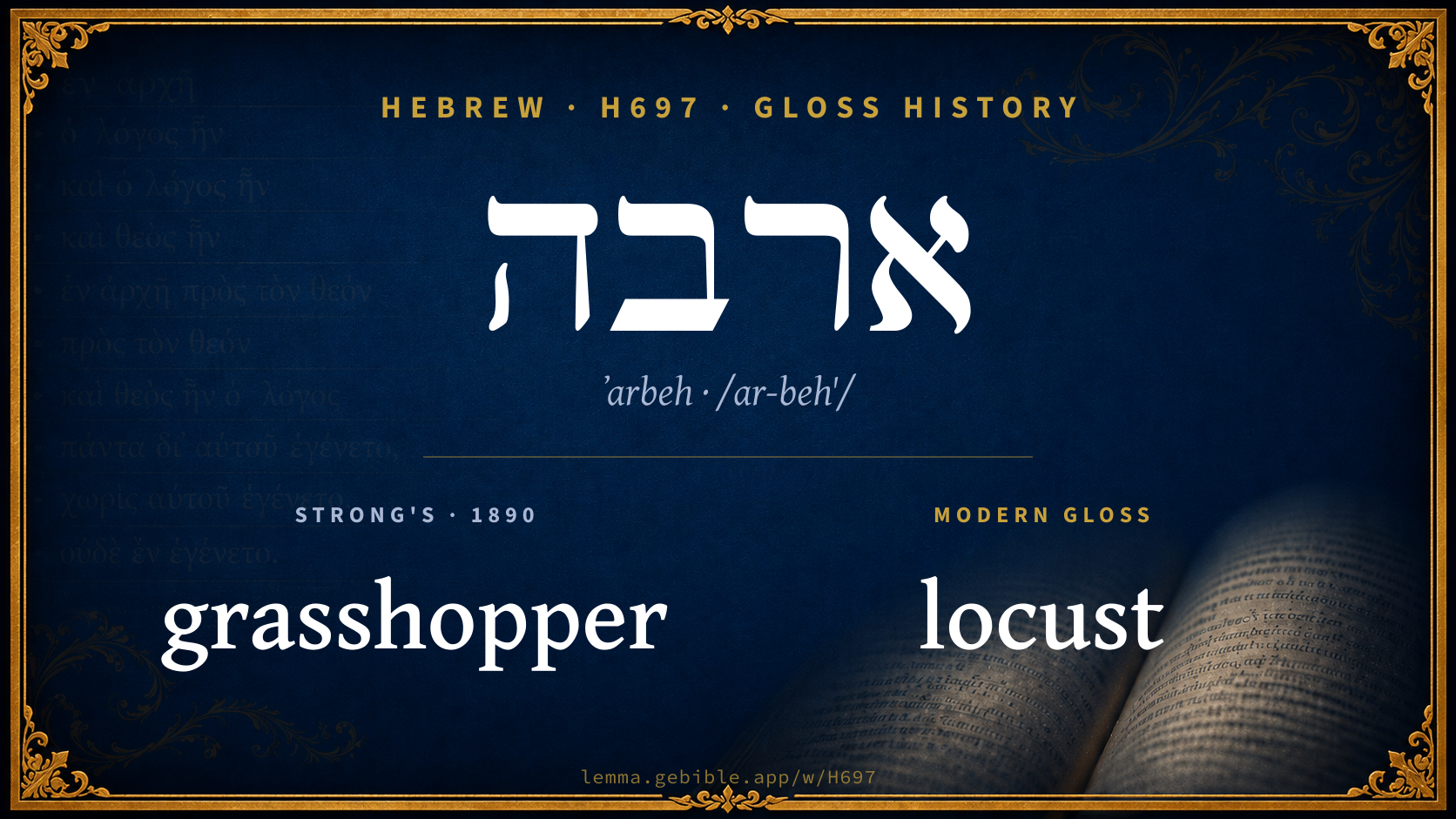
Gloss history
Strong's 1890 vs modern scholarship
About this word
Strong's H697 catalogs a Hebrew word from the Hebrew Old Testament.
These counts are not copied from any lexicon or concordance. They are computed here, from the morphology-tagged Hebrew Old Testament. What Lemma adds →
- 21
- distinct verses
- The word appears in 21 distinct verses.
- 12 / 39
- OT books
- The word appears in 12 of 39 Old Testament books.
- #1,327
- by frequency
- Top 2500 most frequent Hebrew words (rank 1,327 of 8,640 Hebrew words by occurrence).
View all 21 occurrences in the concordance →
By section of the Old Testament
By traditional corpus
Conventional, traditional groupings — biblical authorship is debated, so this is a traditional corpus grouping, not an authorship claim. Each share is this word’s portion of its verses in that division of the Hebrew canon. Each figure is a share of the word’s 21 distinct verses.
- Prophets (Nevi'im) 8 verses · 38%
- Torah (Pentateuch) 7 verses · 33%
- Writings (Ketuvim) 6 verses · 29%
How translations render this word
Counts come from each version’s own published word-to-Strong’s tagging or interlinear alignment — an approximate guide to how each version renders this word, not a word-level alignment the data otherwise carries. Because each total is that version’s own tagged count, the per-version totals vary from one another and need not match the appearance or distinct-verse counts above. These counts may also differ from a printed concordance because Lemma counts each distinctly tagged rendering and does not collapse phrase taggings into a single head-word total. This is a fixed set of word-tagged versions (KJV, ASV, BSB, ULT) and does not change with the reading translation you choose elsewhere. Each version’s license is shown beside its name below (and on Sources).
- King James Version: Locusts 10×, Locust 8×
- American Standard Version: Locust 12×, Locusts 8×
- Berean Standard Bible: Locusts 13×, Locust 3×, Swarming locust 3×
- unfoldingWord Literal Text: Locust 13×, Swarming locust 5×, Like a locust 2×
King James Version Public Domain
Renders H697 across 24 tagged occurrences — most commonly:
Plus 6 renderings that appear only once — usually multi-word phrases or single function words the recovered tagging swept in, not distinct renderings.
American Standard Version Public Domain
Renders H697 across 24 tagged occurrences — most commonly:
Plus 4 renderings that appear only once — usually multi-word phrases or single function words the recovered tagging swept in, not distinct renderings.
Berean Standard Bible Public Domain
Renders H697 across 24 tagged occurrences — most commonly:
Plus 3 renderings that appear only once — usually multi-word phrases or single function words the recovered tagging swept in, not distinct renderings.
unfoldingWord Literal Text CC BY-SA 4.0
Renders H697 across 23 tagged occurrences — most commonly:
Plus 3 renderings that appear only once — usually multi-word phrases or single function words the recovered tagging swept in, not distinct renderings.
Senses in BDB
The 4 senses BDB distinguishes for this word, in lexicon order (not ranked by frequency or importance). The full entry — with sub-senses — is in the Lexicon Entry tab.
- a kind of locust, locust swarm (collective)
- sudden disappearance (figuratively)
- insignificance (figuratively)
- activity (figuratively)
Word origin
Derived from רבה (râbâh) (H7235) — to multiply.
Jastrow Dictionary
A second Hebrew/Aramaic lexicon for comparison, covering Aramaic and post-biblical (Talmudic, Targumic, Midrashic) usage that the biblical-Hebrew BDB does not. Matched by lemma rather than by Strong’s number, so a lemma may carry more than one Jastrow headword (shown separately below), and the entries cover usage well beyond the Bible.
אַרְבֶּה I
- locust(also collect.). Ex. R. s. 13; a. fr. V. כּוֹבֵשׁ.
אַרְבֶּה II
- v. הַרְבָּה
A Dictionary of the Targumim, the Talmud Babli and Yerushalmi, and the Midrashic Literature (Marcus Jastrow; London, Luzac, 1903) — Public Domain. Digitized via Sefaria. Digitized via Sefaria. Full attribution on Sources.
Forms in the corpus
The 20 distinct written forms H697 takes in the Hebrew Bible, most frequent first — each parse links to that state’s occurrences in the concordance. Hebrew forms include their vowel points and cantillation, so a single lemma takes many written forms.
| Form | Parsing | Example | Uses |
|---|---|---|---|
| אַרְבֶּ֤ה | Noun, Common, Masculine, Singular, Absolute | 1 Kings 8:37 | 2 |
| אַרְבֶּה֙ | Noun, Common, Masculine, Singular, Absolute | Exodus 10:14 | 2 |
| הָ/אַרְבֶּֽה | Noun, Common, Masculine, Singular, Absolute | Deuteronomy 28:38 | 2 |
| הָֽ/אַרְבֶּ֔ה | Noun, Common, Masculine, Singular, Absolute | Joel 1:4 | 2 |
| אַרְבֶּ֑ה | Noun, Common, Masculine, Singular, Absolute | Psalms 105:34 | 1 |
| אַרְבֶּ֖ה | Noun, Common, Masculine, Singular, Absolute | Exodus 10:4 | 1 |
| אַרְבֶּ֣ה | Noun, Common, Masculine, Singular, Absolute | Exodus 10:19 | 1 |
| בָּֽ/אַרְבֶּ֔ה | Noun, Common, Masculine, Singular, Absolute | Exodus 10:12 | 1 |
| הָ/אַרְבֶּ֖ה | Noun, Common, Masculine, Singular, Absolute | Joel 1:4 | 1 |
| הָ֣/אַרְבֶּ֔ה | Noun, Common, Masculine, Singular, Absolute | Exodus 10:19 | 1 |
| הָֽ/אַרְבֶּ֗ה | Noun, Common, Masculine, Singular, Absolute | Exodus 10:14 | 1 |
| הָֽ/אַרְבֶּ֣ה | Noun, Common, Masculine, Singular, Absolute | Leviticus 11:22 | 1 |
| כָּ/אַרְבֶּ֑ה | Noun, Common, Masculine, Singular, Absolute | Job 39:20 | 1 |
| כָּ/אַרְבֶּ֖ה | Noun, Common, Masculine, Singular, Absolute | Judges 7:12 | 1 |
| כָּ/אַרְבֶּֽה | Noun, Common, Masculine, Singular, Absolute | Nahum 3:15 | 1 |
| כָּֽ/אַרְבֶּ֔ה | Noun, Common, Masculine, Singular, Absolute | Nahum 3:17 | 1 |
| כָּֽ/אַרְבֶּֽה | Noun, Common, Masculine, Singular, Absolute | Psalms 109:23 | 1 |
| לָ/אַרְבֶּ֑ה | Noun, Common, Masculine, Singular, Absolute | Proverbs 30:27 | 1 |
| לָ/אַרְבֶּֽה | Noun, Common, Masculine, Singular, Absolute | Psalms 78:46 | 1 |
| מֵֽ/אַרְבֶּ֔ה | Noun, Common, Masculine, Singular, Absolute | Jeremiah 46:23 | 1 |
Same root — word family
Other BDB entries built from the same root as H697, grouped by Strong’s listed origin. These share a root / origin per the lexicon — not necessarily a shared meaning. Each links to that word’s own entry.
Derives from
Shares the same root
- מרבה marbeh H4766 abundance
- מרבה mirbâh H4767 much
- מרבית marbîyth H4768 multitude
- רבה rᵉbâh H7236 to grow great
- רבו rᵉbûw H7238 greatness
- תרבות tarbûwth H8635 offspring
- תרבית tarbîyth H8636 interest
Compare all same-root words → Showing 4 of 9 — not the complete family. They share a root, not necessarily a meaning.
Septuagint verse parallels
This word appears in 18 verses that also exist in the Greek Old Testament (Septuagint), out of the 21 Hebrew verses it occurs in. You can read those verses in Greek by switching the Old Testament edition to the Septuagint.
Read these verses in the Septuagint
- Exodus 10:4
- Leviticus 11:22
- Deuteronomy 28:38
- Judges 6:5
- 1 Kings 8:37
- 2 Chronicles 6:28
- Job 39:20
- Psalms 105:34
- Proverbs 30:27
- Joel 1:4
- Nahum 3:15
This is a verse-level parallel only — the same verses exist in both the Hebrew and Greek Old Testaments. No word-level Hebrew↔Greek correspondence is claimed: the data carries no such alignment, so no Greek word is shown as this Hebrew word’s translation. Coverage is not total — the Septuagint omits the deuterocanon and renumbers the Psalms, so some Hebrew verses have no direct Greek parallel.