Isaiah 51:2

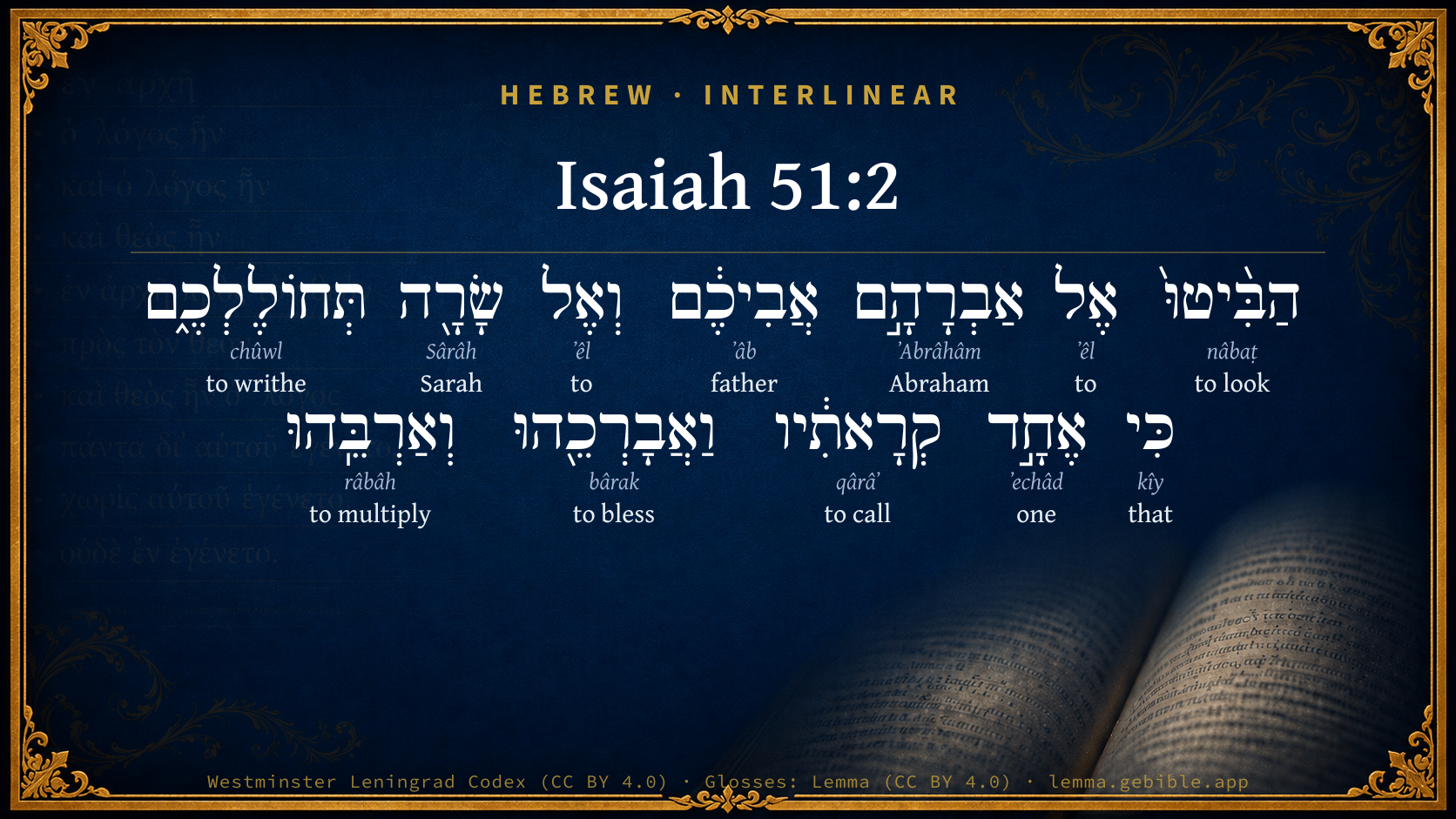
Hebrew (Westminster Leningrad Codex) Isaiah 51:2 appears in the Hebrew Old Testament. The text above is from the Westminster Leningrad Codex. Each word links to its Strong’s number, a concise gloss, and parsing drawn from the Open Scriptures Hebrew Bible morphology. Click any word for its full Brown-Driver-Briggs (BDB) entry.
Download image
Cite this verse

Isaiah 51:2 (World English Bible). Public Domain. Lemma interlinear Bible study tool, https://lemma.gebible.app/v/isaiah/51/2.

Show BibTeX & RIS
BibTeX
RIS
English Translation
Look to Abraham your father, and to Sarah who bore you; for when he was but one I called him, and I blessed him, and made him many.
World English Bible · Public Domain
Download a study sheet

One document with this verse’s original text, its word-by-word gloss line, the meaning frame, cross-references with their text, attributed commentary, and full source and license credits — printable, and it pastes into notes with its structure intact.

This verse Autodidact and up

Study sheet (.html) Plain text (.txt)

A passage Seminary Student

Up to 50 verses in one chapter. A passage sheet keeps up to 6 commentary sources and 12 cross-references per verse, in the order this page ranks them, and says so on the sheet whenever that leaves anything out. Ask for a single verse and you get the Autodidact verse sheet above.

Everything on this page stays free to read, with no account — the sheet is a download of what is already on screen, not access to it.

Want to remove ads? Support Godless Engineer
Compare translations 3

The same verse in 3 English versions, stacked beneath the original-language interlinear above. Click any original word for its lexicon entry.

Each is an independent rendering of the whole verse — the interlinear is not word-aligned to these translations.

Highlighted words mark where these versions differ — a whole-verse word diff, not a word-by-word alignment.

  • World English Bible Public Domain
    Look to Abraham your father, and to Sarah who bore you; for when he was but one I called him, and I blessed him, and made him many.
  • King James Version Public Domain
    Look unto Abraham your father, and unto Sarah that bare you: for I called him alone, and blessed him, and increased him.
  • unfoldingWord Literal Text CC BY-SA 4.0
    Look to Abraham your father and to Sarah, she bore you; for I called him, one, and I blessed him and made him many.”

unfoldingWord Literal Text — © unfoldingWord, licensed CC BY-SA 4.0. Word-aligned USFM3 via Door43 (git.door43.org/unfoldingWord/en_ult).

Versions to compare (up to 4)

3 of 4 selected

Show all 18 translations

Every available English version of this verse, each an independent rendering of the whole verse.

  • World English Bible Public Domain
    Look to Abraham your father, and to Sarah who bore you; for when he was but one I called him, and I blessed him, and made him many.
  • Berean Standard Bible Public Domain
    Look to Abraham your father, and to Sarah who gave you birth. When I called him, he was but one; then I blessed him and multiplied him.
  • Majority Standard Bible Public Domain
    Look to Abraham your father, and to Sarah who gave you birth. When I called him, he was but one; then I blessed him and multiplied him.
  • King James Version Public Domain
    Look unto Abraham your father, and unto Sarah that bare you: for I called him alone, and blessed him, and increased him.
  • American Standard Version (1901) Public Domain
    Look unto Abraham your father, and unto Sarah that bare you; for when he was but one I called him, and I blessed him, and made him many.
  • Revised Version (1885) Public Domain
    Look unto Abraham your father, and unto Sarah that bare you: for when he was but one I called him, and I blessed him, and made him many.
  • Geneva Bible (1599) Public Domain
    Consider Abraham your father, and Sarah that bare you: for I called him alone, and blessed him, and increased him.
  • Douay-Rheims (1899) Public Domain
    Look unto Abraham your father, and to Sara that bore you: for I called him alone, and blessed him, and multiplied him.
  • Young's Literal Translation Public Domain
    Look attentively unto Abraham your father, And unto Sarah -- she bringeth you forth, For -- one -- I have called him, And I bless him, and multiply him.
  • Literal Standard Version CC BY-SA 4.0
    Look attentively to your father Abraham, || And to Sarah—she brings you forth, || For—one—I have called him, || And I bless him, and multiply him.”
  • Unlocked Literal Bible CC BY-SA 4.0
    Look at Abraham, your father, and to Sarah, who bore you; for when he was a lone individual, I called him. I blessed him and made him many.
  • unfoldingWord Literal Text CC BY-SA 4.0
    Look to Abraham your father and to Sarah, she bore you; for I called him, one, and I blessed him and made him many.”
  • Darby Bible Public Domain
    Look unto Abraham your father, and unto Sarah that bore you; for I called him when he was alone, and blessed him, and multiplied him.
  • World Messianic Bible Public Domain
    Look to Abraham your father, and to Sarah who bore you; for when he was but one I called him, I blessed him, and made him many.
  • Webster's Bible Public Domain
    Look to Abraham your father, and to Sarah that bore you: for I called him alone, and blessed him, and increased him.
  • Free Bible Version CC BY-SA 4.0
    Look back at Abraham your father, and Sarah who gave birth to you. When I called him, he was only one man, but then I blessed him and he had many descendants.
  • Bible in Basic English Public Domain
    Let your thoughts be turned to Abraham, your father, and to Sarah, who gave you birth: for when he was but one, my voice came to him, and I gave him my blessing, and made him a great people.
  • JPS Tanakh (1917) Public Domain
    Look unto Abraham your father, and unto Sarah that bore you; for when he was but one I called him, and I blessed him, and made him many.

Literal Standard Version (2020), Covenant Press — licensed CC BY-SA 4.0. Text via the HelloAO Bible API (eBible.org). Unlocked Literal Bible (unfoldingWord) — licensed CC BY-SA 4.0. Text via the HelloAO Bible API (eBible.org). unfoldingWord Literal Text — © unfoldingWord, licensed CC BY-SA 4.0. Word-aligned USFM3 via Door43 (git.door43.org/unfoldingWord/en_ult). Free Bible Version, Dr. Jonathan Gallagher — licensed CC BY-SA 4.0. Text via the HelloAO Bible API (eBible.org).

Word by word

More ways to search: Search by grammar → Find every occurrence → Compare this word →

Practice this passage: Drill this verse → Learn its vocabulary →

שָׂרָ֖ה
Sârâh
H8283
“Sarah”
Noun, Proper
Part of Speech
Noun
Type
Proper
Full BDB Definition

Origin: the same as H8282

TWOT: None

Sarah = "noblewoman" - wife of Abraham and mother of Isaac
  1. הַבִּ֨יטוּ֙ nâbaṭ H5027 “look” Verb, Hiphil, Imperative, 2nd Person, Masculine, Plural
  2. אֶל ʼêl H413 “to” Preposition
  3. אַבְרָהָ֣ם ʼAbrâhâm H85 “Abraham” Noun, Proper
  4. אֲבִיכֶ֔ם ʼâb H1 “father · your” Noun, Common, Masculine, Singular, Construct + Suffix, Personal, 2nd Person, Masculine, Plural
  5. וְאֶל ʼêl H413 “and · to” Conjunction + Preposition
  6. תְּחוֹלֶלְכֶ֑ם chûwl H2342 “to writhe · you” Verb, Polel, Imperfect, 3rd Person, Feminine, Singular + Suffix, Personal, 2nd Person, Masculine, Plural
  7. כִּי kîy H3588 “that” Conjunction
  8. אֶחָ֣ד ʼechâd H259 “one” Adjective, Cardinal number, Masculine, Singular, Absolute
  9. קְרָאתִ֔יו qârâʼ H7121 “to call · him” Verb, Qal, Perfect, 1st Person, Common, Singular + Suffix, Personal, 3rd Person, Masculine, Singular
  10. וַאֲבָרְכֵ֖הוּ bârak H1288 “and · to bless · him” Conjunction + Verb, Piel, Imperfect, 1st Person, Common, Singular + Suffix, Personal, 3rd Person, Masculine, Singular
  11. וְאַרְבֵּֽהוּ râbâh H7235 “and · to multiply · him” Conjunction + Verb, Hiphil, Imperfect, 1st Person, Common, Singular + Suffix, Personal, 3rd Person, Masculine, Singular

About this verse

These counts appear in no published source. They are computed here, from the morphology-tagged text and Lemma’s own curated glosses. What Lemma adds →

12
words
11
distinct lemmas
Prophets
section

Shared distinctive vocabulary

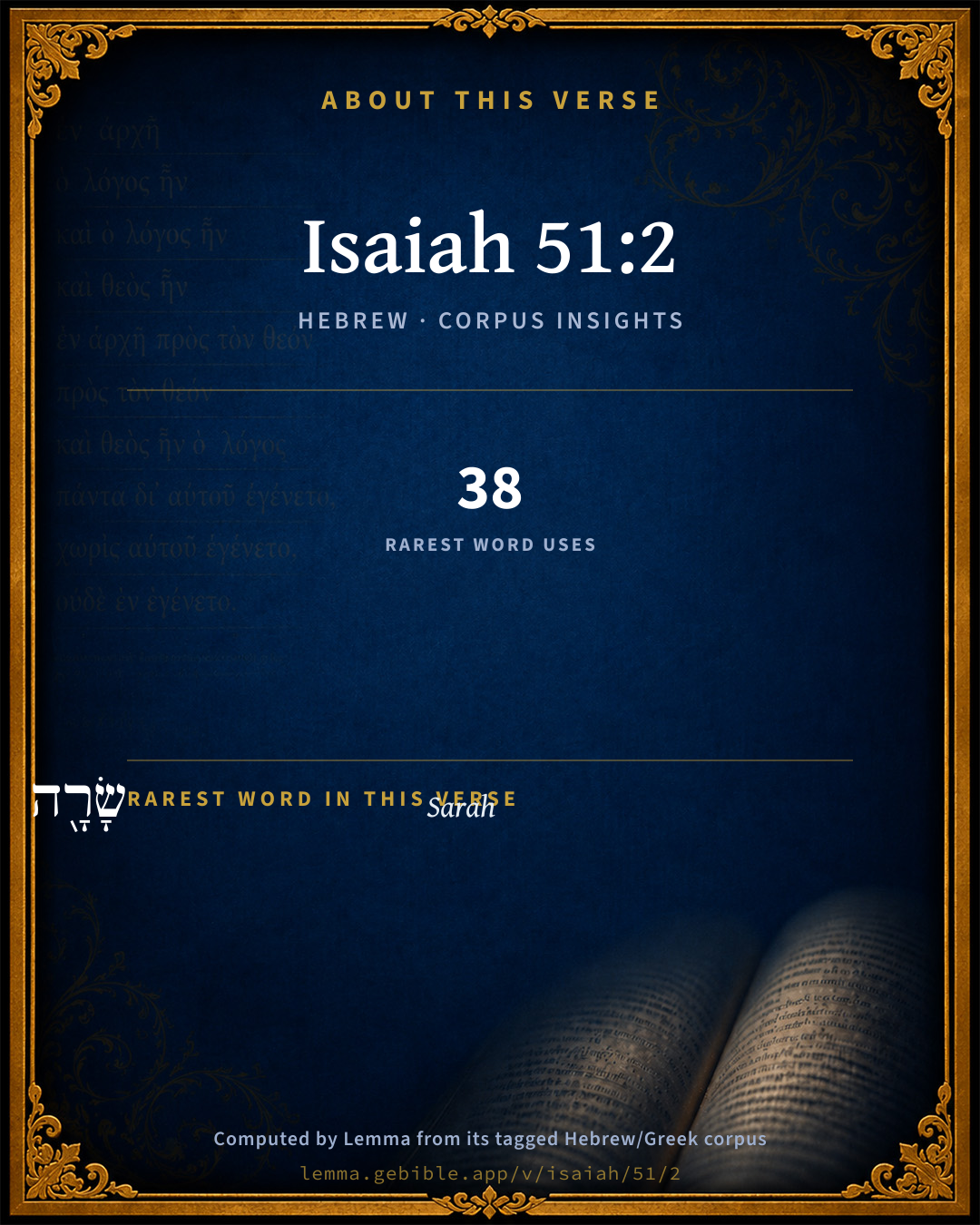
שָׂרָ֖ה Sarah H8283 occurs in 32 verses of the Hebrew Bible. Also found in:

Grammatical profile

  • 5 verbs
  • 3 nouns
  • 1 adjective
  • 2 prepositions
  • 1 conjunction

Verb forms

  • הַבִּ֨יטוּ֙ Hiphil · Imperative
  • תְּחוֹלֶלְכֶ֑ם Polel · Imperfect
  • קְרָאתִ֔יו Qal · Perfect
  • וַאֲבָרְכֵ֖הוּ Piel · Imperfect
  • וְאַרְבֵּֽהוּ Hiphil · Imperfect

Repetition

A word recurs within this verse — often emphatic in Hebrew:

  • אֶל to H413 ×2

Hebrew & Septuagint length

In English translation the verse runs 28 words from the Hebrew and 28 from the Septuagint (LXX English) — the same length.

A rough comparison of the two English renderings, which tokenize alike — not a word-level alignment.

Word counts can differ between the Hebrew and the Greek without any difference in meaning — e.g. the Hebrew direct-object marker אֵת has no separate Greek word, and Greek often adds the article ὁ.

Cross-references

16

Topical passages linked to Isaiah 51:2 in the Treasury of Scripture Knowledge — connected by theme and wording, ordered by reader-vote popularity; previews shown in the World English Bible.

  • Ezekiel 33:24 Son of man, they who inhabit those waste places in the land of Israel speak, saying, Abraham was one, and he inherited the land: but we are many; the land is given us for inheritance.
  • Romans 4:1–5 What then will we say that Abraham, our forefather, has found according to the flesh?
  • Galatians 3:9–14 So then, those who are of faith are blessed with the faithful Abraham.
  • Hebrews 11:8–12 By faith, Abraham, when he was called, obeyed to go out to the place which he was to receive for an inheritance. He went out, not knowing where he went.
  • Genesis 18:11–13 Now Abraham and Sarah were old, well advanced in age. It had ceased to be with Sarah after the manner of women.
  • Genesis 24:1 Abraham was old, and well stricken in age. Yahweh had blessed Abraham in all things.
  • Isaiah 29:22 Therefore thus says Yahweh, who redeemed Abraham, concerning the house of Jacob: Jacob shall not now be ashamed, neither shall his face now wax pale.
  • Genesis 12:1–3 Now Yahweh said to Abram, "Get out of your country, and from your relatives, and from your father's house, to the land that I will show you.
  • Genesis 13:14–17 Yahweh said to Abram, after Lot was separated from him, "Now, lift up your eyes, and look from the place where you are, northward and southward and eastward and westward,
  • Genesis 15:1–2 After these things the word of Yahweh came to Abram in a vision, saying, "Don't be afraid, Abram. I am your shield, your exceedingly great reward."
  • Genesis 15:4–5 Behold, the word of Yahweh came to him, saying, "This man will not be your heir, but he who will come forth out of your own body will be your heir."
  • Genesis 22:17 that in blessing I will bless you, and in multiplying I will multiply your seed as the stars of the heavens, and as the sand which is on the seashore. Your seed will possess the gate of his enemies.
  • Genesis 24:35 Yahweh has blessed my master greatly. He has become great. He has given him flocks and herds, silver and gold, men-servants and maid-servants, and camels and donkeys.
  • Romans 4:16–24 For this cause it is of faith, that it may be according to grace, to the end that the promise may be sure to all the seed, not to that only which is of the law, but to that also which is of the faith of Abraham, who is the father of us all.
  • Joshua 24:3 I took your father Abraham from beyond the River, and led him throughout all the land of Canaan, and multiplied his seed, and gave him Isaac.
  • Nehemiah 9:7–8 You are Yahweh the God, who did choose Abram, and brought him forth out of Ur of the Chaldees, and gave him the name of Abraham,

Cross-references courtesy of OpenBible.info (CC BY 4.0).

Hebrew and Greek witnesses Masoretic Hebrew ↔ Greek Septuagint

The same verse in the two great witnesses to the Old Testament, shown verse-for-verse.

These are two independent witnesses, not word-aligned to each other, and the Septuagint is shown in lemma (dictionary) form.

Hebrew Isaiah 51:2 Masoretic · Westminster Leningrad Codex

הַבִּ֨יטוּ֙ אֶל אַבְרָהָ֣ם אֲבִיכֶ֔ם וְאֶל שָׂרָ֖ה תְּחוֹלֶלְכֶ֑ם כִּי אֶחָ֣ד קְרָאתִ֔יו וַאֲבָרְכֵ֖הוּ וְאַרְבֵּֽהוּ

Look to Abraham your father, and to Sarah who bore you; for when he was but one I called him, and I blessed him, and made him many.

World English Bible · Public Domain

Greek LXX Isaiah 51:2 Septuagint · lemma form

ἐνβλέπω εἰς ἀβραάμ ὁ πατήρ σύ καί εἰς σαρρα ὁ ὠδίνω σύ ὅτι εἷς εἰμί καί καλέω αὐτός καί εὐλογέω αὐτός καί ἀγαπάω αὐτός καί πληθύνω αὐτός

Look to Abraam your father, and to Sarrha that bore you: for he was alone when I called him, and blessed him, and loved him, and multiplied him.

LXX2012 (modern English Septuagint) · Public Domain

On this verse, John Gill's Exposition discusses the Septuagint’s reading. Read the note in Commentary ↓

Hebrew: Westminster Leningrad Codex (CC BY 4.0). Greek: Septuagint (public domain); English from LXX2012 (modern English Septuagint) (Public Domain). How the Septuagint differs from the Hebrew →

Targum (Aramaic paraphrase)

1

The Targum is the ancient Jewish Aramaic paraphrase of the Hebrew Scriptures — an interpretive translation, not the Hebrew text itself. Onkelos (literal) and Pseudo-Jonathan (expansive) render the Torah, and Jonathan the Prophets. Coverage is partial: where no permissively-licensed English translation exists for a verse, only the Aramaic is shown. This is verse-level text, not a word-by-word alignment to the Hebrew.

  1. Targum Jonathan Prophets (Joshua–Malachi)
    אִסְתַּכָּלוּ בְּאַבְרָהָם אֲבוּכוֹן וּבְשָׂרָה דְאַעְדִיאַתְכוֹן אֲרֵי חַד הֲוָה אַבְרָהָם יְחִידִי בְּעַלְמָא קָרֵיבְתֵּהּ לְפוּלְחָנִי וּבֵרַכְתֵּהּ וְאַסְגֵיתֵהּ:

    Consider Abraham your father, and Sarah who conceived you: for Abraham was one alone in the world, and I brought him to my service, I also blessed him, and multiplied him.

    Targum Jonathan — Aramaic: “Mikraot Gedolot” (public domain). English: “Sefaria Community Translation” (CC0 1.0 (public-domain dedication)); “London "Chaldee Paraphrase," 1871” (public domain). Text via Sefaria.

Commentary

Notes on Isaiah 51:2 from classic Christian and Jewish commentators (each source and its license shown beneath its notes). The classic Christian expositions comment on the surrounding passage and are grouped to its opening verse, so a note may address several verses; the Jewish commentaries on the Tanakh (Rashi and others) are per-verse, so they appear only where the commentator wrote on this verse.

Lemma curates 59 commentaries, every one of them public domain or Creative Commons licensed, each selected and text-cleaned for this edition rather than reprinted as found. About our sources →

Trapp's Complete Commentary

John Trapp

Isa 51:2 Look unto Abraham your father, and unto Sarah [that] bare you: for I called him alone, and blessed him, and increased him.

Ver. 2. Look unto Abraham your father.] "Look" and again "look." "Hearken" and again "hearken." These poor Jews, before the coming of Christ in the flesh, were vino somnoque sepulti, drunk with the cup of God’s fury, {Isa 51:17} and so fast asleep, that they needed to be thus roused and raised up to the hope of better times, which now were at hand.

And unto Sarah that bare you.] By the force of her faith also, {Heb 11:11} her son Isaac was emeritae fidel filius. Now these domestic examples are alleged to assure them that God could do the like again in respect of spiritual children, Abraham’s right seed. {Gal 4:22-31}

For I called him alone.] Be not ye therefore troubled at your aloneness.

And blessed him, and increased him.] God’s benediction is his benefaction; the Pope’s is not so; fumos vendit, fumo pereat.

John Trapp, A Commentary or Exposition upon All the Books of the Old and New Testament (1647–1656) — public domain. Text from a community e-Sword module.

The Biblical Illustrator

Joseph S. Exell

Isa_51:2-3

Look unto Abraham your father

Abraham, or the Christians rock

I.

THE DEALINGS OF GOD WITH ABRAHAM.

1. God called him alone. How merciful this call! Our own call to renounce this world, and to seek a better, even a heavenly country, is to be traced, like Abrahams, to the undeserved mercy of our heavenly Father.

2. The Lord blessed Abraham. And has He not blessed us? Has He not given to us many of the blessings of this life? And, what is much more than these, has He not redeemed us from sin and misery by Jesus Christ our Lord?

3. The Lord increased him. The worldly possessions of Abraham were many. But Abraham was increased further in his posterity. But his spiritual descendants are yet more numerous. So likewise is the faithful Christian, the spiritual child of Abraham, increased; not indeed, it may be, in this worlds riches and honours, but in spiritual wealth and dignity.

II. THE CHARACTER AND CONDUCT OF ABRAHAM.

1. His faith. Let us look to Abraham as an example in this point of view.

2. His obedience. Let no one whose works contradict his profession of faith suppose himself to be a believer in God. (W.D. Johnston, M.A.)

Sarah

That Sarah is mentioned chiefly for rhythmical effect may be inferred from the writer s now confining what he says to Abraham alone. (J.A. Alexander.)

Hearken and look; or, encouragement for believers

The second verse contains my actual text. It is the argument by which faith is led to look for the blessings promised in the third verse. It is habitual with some persons to spy out the dark side of every question or fact: they fix their eyes upon the waste places, and they study them till they know every ruin, and are familiar with the dragons and the owls. They sigh most dolorously that the former times were better than these, and that we have fallen upon most degenerate days. The habit of looking continually towards the widernesses is injurious because it greatly discourages; and anything that discourages an earnest worker is a serious, leakage for his strength. My text has near to it three times, Hearken to Me. You have listened long enough to dreary suggestions from within, to gloomy prophecies from desponding friends, to the taunts of foes, and to the horrible whisperings of Satan: now hearken to Him who promises to make the wilderness like Eden, and the desert like the garden of the Lord. O ye whose eyes are quick to discover evil, there are other sights in the world besides waste places and deserts, and hence my text hath near to it twice over the exhortation, Look--Look unto the rock whence ye, are hewn; Look unto Abraham your father, and unto Sarah that bare you; for there we may find comfort.

I. We shall first look towards Abraham that we may see in him THE ORIGINAL OF GODS ANCIENT PEOPLE.

1. The founder of Gods first people was called out of a heathen family. Abraham, the founder of the great system in which God was pleased to reveal Himself for so long a time, and to whose seed the oracles of God were committed, was a dweller in Ur of the Chaldees, the city of the moon-god. We cannot tell to what extent he was actually engrossed in the superstition of his fathers, but it is certain that the family was years afterwards tainted with idolatry; for in Jacobs day the teraph was still venerated, and Rachel stole her fathers images. Abraham, therefore, was called out from the place of his birth, and from the household to which he belonged, that in a separated condition, as a worshipper of the one God, he might keep the truth alive in the world. Why, then, might not the Lord, if the cause of truth were this day reduced to its utmost extremity, again raise up a Church out of one man? Ah, you say, but men are not called now, as Abraham was, by miraculous calls from heaven. Where ordinary means are so plentiful wisdom resorts not to signs and wonders. The same Spirit who called Abraham by a supernatural voice can call others by the word of truth. Ah, say you, but Abraham was naturally a man of noble mould.

Where do you find such a princely spirit as his? I answer, Who made him? He that made him can make another like him.

2. Look again, and observe that Abraham was but one man. If we should ever be reduced, as we shall not be, to one man, yet by one man will God preserve His Church, and work out His great purposes. Think of the power for good or evil which may be enshrined in a single human life.

3. This one man was a lone man. He had no prestige of parentage, rank or title. The fulfilment of his calling rested on his loneliness; for he must get away from his kindred, and wander up and down with his flocks, even as the Church of God now does, dwelling in a strange land, and feeding her flock apart. I called him alone, and blessed him, and increased him. If in the town or district where you live you seem to lose all your helpers; if they die one by one, and it seems as if nobody would be left to you, still persevere, for it is the lone man that God will bless.

4. He was a man who had to be stripped yet further. He must come away from his kindred and his fathers house, and must dwell in Palestine till the promised seed was born. But how long he waited for the expected heir! What a feast there was that Isaac was born, filling the house with laughter. But he must die! The grand old man is sure that even if he should actually slay his son at Gods command the promise would somehow be kept. Look, then, to Abraham your father, and say is he not the grandest human representative of the great Father God Himself, who in the fulness of time spared not His own Son, but freely delivered Him up for us all? If in all these trials Abraham was yet blessed, and God s purposes were accomplished in him, can we not believe that the same God can work by us also, despite our downcastings and humiliations! Here is the sum and substance of this first head of my discourse: in looking to the rock whence we are hewn, we have to see the Lord working the greatest results from apparently inadequate causes. This teaches us to cease from calculating means, possibilities and probabilities, for we have to deal with God, with whom all things are possible.

II. THE MAIN CHARACTERISTIC OF THIS CHOSEN MAN. The text says, Look unto Abraham your father, and unto Sarah that bare you, and it must mean--consider him and see what he was, that you may learn from him. His grand characteristic was his faith. Abrahams faith was such that it led him to obedience. The man of faith is Gods man. Why? Because faith is the only faculty of our spirit which can grasp Gods ideal. Faith, too, has a great power of reception, and therein lies much of her adaptation to the Divine purpose. Then, again, faith always uses the strength that God gives her. Faith, too, can wait the Lord s time and place. God loveth faith and blesseth it, because it giveth Him all the glory.

III. OUR RELATIONSHIP TO THAT ONE MAN. Know ye therefore that they which are of faith, the same are the children of Abraham. Something, surely, is expected of the children of such a man as Abraham. Because we are the seed of Abraham, the apostle declares that the blessing of Abraham has come upon us also. What is it? It is a covenant favour that belongs to all who are the servants of God by faith. Here is the substance of it: Surely blessing, I will bless thee, and in multiplying, I will multiply thee. The blessing is attended with multiplying. The blessing of the Church is the increase of the Church. The success of truth is the battle of the Lord, and the increase of His Church is according to HIS own promise; therefore in quietness we may possess our souls.

IV. OUR POSITION BEFORE ABRAHAMS GOD. Look to Abraham, but only as to the rook from which the Lord quarried His people: your main thought must be Jehovah Himself. I, I called him alone, and blessed him. Let us joyfully recollect that the Lord our God has not changed, nay, not in one jot or tittle. His arm is not shortened that He cannot save, etc. The covenant of God has not changed. Read the covenant words, In blessing I will bless thee, and in multiplying I will multiply thy seed as the stars of the heaven, etc. But there is this also to be added, that this work which we desire the Lord to do is in some respects even less than that which He has done with Abraham. What ask we? Not that He should begin with one man to build up a nation, or create a Church? No, but that Zion being builded, He should comfort her, and cause her waste places to rejoice. What marvellous things hath God done on the face of the earth sines Abrahams days!--the stupendous marvel of incarnation; the wondrous work of redemption, the highest, grandest, Divinest achievement of the Deity--all this is done; what may we not expect after this? You know more of God than Abraham could know. Trust Him, at least up to the level of the patriarch. How shall we forge an excuse if we do not? (C. H. Spurgeon.)

The Biblical Illustrator, edited by Joseph S. Exell (c. 1880s–1900s) — public domain. Text from a community e-Sword module.

The Preacher's Complete Homiletical Commentary

Joseph S. Exell (gen. ed.)

A SIGHT FOR DESPONDING CHRISTIAN WORKERS

(Missionary Sermon.)

Isa_51:2-3. Look unto Abraham your father, and unto Sarah, &c.

It is habitual with some persons to spy out the dark side of every question or fact; they fix their eyes upon the “waste places,” and they study them till they know every ruin, and are familiar with the dragons and the owls. They sigh most dolorously that the former times were better than these, and that we have fallen upon most degenerate days. This habit is injurious, because it greatly discourages; and anything that discourages an earnest worker is a serious leakage for his strength. Depressing views often afford an apology for indifference and inaction. The smallest peg suffices to hang an excuse upon when we are anxious to escape from the stern service of faith. It is therefore a dreadful thing when the Church begins to be discouraged, and means must be used to stay the evil. Such means we would use this day. Lo, we lift the standard of the Divine purpose. Remember, ye that are cast down, that there are other voices besides those of the bittern and owl from the “waste places.” Hearken to Him who promises to make the wilderness like Eden, and the desert like the garden of the Lord. Gaze no longer at the thirsty land and the burning sky; turn your eye where the finger of the Lord points by His word. “Look unto Abraham your father, and unto Sarah that bare you;” for there we may find comfort.

I. THE ORIGINAL OF GOD’S ANCIENT PEOPLE.

1. The founder of God’s first people was called out of a heathen family (Jos_24:2). He was a dweller in Ur of the Chaldees, the city of the moon-god; and was called out from the place of his birth, and from the household to which he belonged, that in a separated condition, as a worshipper of the one God, he might keep the truth alive in the world. Why, then, might not the Lord, if the cause of truth were this day reduced to its utmost extremity, again raise up a church out of one man? He could call out another Abraham, and bless him and increase him, and achieve the whole of His eternal purposes, if all of us should sleep in the dust, and the visibly organised Church of to-day should pass away as the snow of winter at the advent of spring. Is anything too hard for the Lord? Let us never dream that the God of Abraham is short of means for calling out chosen men to build up His Church. Surely Christian people should never doubt His power to raise up lights in dark places, when we remember that the greatest preacher of the gospel, namely, the apostle Paul, was drafted into the army of Christ from the ranks of its direst foes. As Luther came from among the monks, so out of Rome, yea, from the Vatican itself, can God, if He wills, call another Luther. Take this, then, for encouragement, ye who tremble for the ark of God; He can build up a spiritual house for Himself out of dark quarries, and find cedars for His temple in forests untraversed by the feet of missionaries.

2. Abraham was but one man. The Lord has, as a rule, wrought more nobly by one man than by bands and corporations of men. He in whose seed all nations are blessed was but one. “I called him alone, and blessed him, and increased him.” Nor is this a solitary instance. When the earth was utterly corrupt God conserved the race by a solitary preacher of righteousness, who prepared an ark for the saving of his house. One Joseph saved whole nations from famine, and one Moses brought out a race from bondage. Who was there to keep Israel right when Moses fell on sleep but the one man Joshua? What were the prosperous times in the era of the Judges but days when one man was to the front as a leader? One man, standing like a figure at the head of many ciphers, soon headed victorious thousands, through faith in God. The Philistines had triumphed over the land if the one lad had not brought back Goliath’s head, and if the one man had not again and again smitten the uncircumcised in the name of the Lord. Beloved, if we should ever be reduced, as we shall not be, to one man, yet by one man will God preserve His Church, and work out His great purposes. We may rightly measure quantities in reference to many things, but with others it is absurd. It would be ridiculous to measure the power of fire by the quantity which burns on your hearth. Give us fit materials and a single match, and you shall see what fire can do. Ye carry fire, ye servants of God, fire which fell at Pentecost; ye work with a heaven-sent force of boundless energy. Why, therefore, should you despair? If all the lights in the world were put out except a solitary lamp, there is enough fire in one wick to kindle all the lamps in the universe.

3. This one man was a lone man. He had not only to do the work of God, but he had nobody to help him. “I called him alone.” True, he was attended by Lot, costing his noble uncle more trouble than he ever brought him profit. How little did he maintain or adorn the righteousness which, nevertheless, had saved him: true type of many a feeble professor in these days. Abraham was not backed by any society when he crossed the Euphrates and afterwards traversed the desert to sojourn in Canaan as a pilgrim and a stranger. If ever man was fairly cut adrift and cast upon the Lord, it was the great father of the faithful. He certainly found no patronage in his onward course save the all-sufficient patronage of the Lord his God. He had no prestige of parentage, rank, or title. He was in the fullest sense a lone man, unsupported by any of those outward distinctions which enable some men to do more than others.

The fulfilment of his calling rested on his loneliness. When he was alone God blessed Abraham,—“I called him alone, and blessed him, and increased him.” My brother, if in the town or district where you live you seem to lose all your helpers; if they die one by one, and it seems as if nobody would be left to you; if even the prayer meeting fails for want of earnest, pleading men, still persevere, for it is the lone man that God will bless. You are learning sympathy with that lone Man in Gethsemane, with that lone Man upon the cross, who there vanquished all our foes. “I called him alone, and blessed him, and increased him.” Grasp that, ye that dwell remote from human sympathy. Oh that our missionaries abroad my feel the rich comfort of this fact! for they full often, like lone sentinels, keep watch with eyes that long to see a friend. They are separated from intercourse with brethren, they miss the friendships which tend to comfort and confirm, but it is God that calls them alone, and He will bless them and increase them.

Here is the sum and substance of this first head of my discourse: in looking to the rock whence we are hewn, we see the Lord working the greatest results from apparently inadequate causes. This teaches us to cease from calculating means, possibilities, and probabilities, for we have to deal with God, with whom all things are possible. Almighty God can assuredly do whatever He says He will do. If all the things that are have been spoken into existence by God alone, by His mere word, can He not yet build up His Church, even if on her earthly side there should seem to be no material with which to raise her walls?

II. THE MAIN CHARACTERISTIC OF THIS CHOSEN MAN. The text says, “Look,” &c.; and it must mean,—consider him, and see what he was, that you may learn from him. His grand characteristic was his faith. Here is his epitaph:—“Abraham believed God.” That was a mainspring of all his acts, the glory of his life. The men that God will work by, whatever else they have not, must have faith in God. Though it is to be desired that the believer should have every mental and moral qualification, yet it is astounding how, if there be real faith, a multitude of imperfections are swallowed up, and the man is still a power. I would mention Samson as an extreme case. Morally the feeblest of men, and the least fitted to be a judge in Israel; but oh, what faith! And what wonders it achieved!

Abraham’s faith was such that it led him to obedience. He was called to go out, and he went, not knowing whither he went. It led him to perseverance; for once in God’s way he did not leave it, but still abode a sojourner with God. It led him to expectancy; he looked for the promised seed, and not only for an Isaac but for the Messiah. So clear was the vision of his expectancy that before his eyes Christ was set forth, visibly.

The like faith also dwelt in the breast of Sarah; and as we are told in the text to look to Sarah as well as Abraham, let us not fail to do so. The faith of Sarah was not little when she left home with her husband; forsaking her kith and kin from love to God, and to him whom she called “lord.” Nor did the trial of her faith end with the moving; she had to take up with tent life and all its inconveniences. Certain people look upon faith as a fine, airy, sentimental thing with which to roam among the stars, anticipate millenniums, and enjoy yourself in lofty contemplation. I believe far more in a faith which, whether it eats or drinks, does all to the glory of God; faith which like Sarah dwells in the tent and works there; faith which is cheerful over a scanty meal and drives away the fear of want; faith which can come down in life from the mansion to the cottage, if providence so decrees. From Abraham’s comfortable home at Ur to his gipsy wanderings in Palestine the change must have been great, but Abraham may not have felt it one half as much as Sarah, for men can rough it and live out of doors, but the housewife knows all about it, and great was her faith that she never raised a question about the propriety of her husband’s course of life: and though she laughed when she was told that she should bear a son, yet remember that in the eleventh of Hebrews it is written—“Through faith also Sarah herself received strength.” She was the mother of Isaac, not in the power of the flesh, but the energy of faith; therefore look at her, as the text bids you.

Mark well this fact—that the characteristic of the person whom God will bless is that he believes and acts upon his belief. Why is this? Because faith is the only faculty of our spirit which can grasp God’s ideal. The ideas of God are as high above us as the heavens are above the earth: and therefore it is not by any fancied vastness of our feeble minds that we can ever rise into fellowship with God. There is a capacity about faith for grasping Divine promises and purposes, a width, a breadth, a height, a depth, which can hold the infinite truth as no other power can do. Love alone can rival it, for it embraces the infinite God Himself. With the far-reaching plans and promises of God faith alone is fit to deal; carnal reason is altogether out of the lists.

Faith, too, has a great power of reception, and therein lies much of her adaptation to the Divine purpose. Self-confidence, courage, resolution, cool reasoning, whatever else they are good at, are bad at humbly receiving. Those vessels which are full already are of no use as receivers; but faith presents her emptiness to God, and opens her mouth that God may fill it.

Again, faith always uses the strength that God gives her. Pride would vapour with it, and doubt would evaporate it; but faith is practical, and economically uses the talent entrusted to her.

Faith, too, can wait the Lord’s time and place. When faith is weak, men are in a dreadful hurry. “He that believeth shall not make haste”: that is to say, he shall not be ashamed or confounded by present trials so as to rush upon unbelieving actions. Faith leaves times and seasons with God, to whom they belong.

God loveth faith and blesseth it too, because it giveth Him all the glory. You do not believe God, if you boast of what you are doing: least of all do you believe, if you pride yourself in your faith; for faith is not mistrustful of her God but of herself. Faith looks to God to keep her alive as well as to fulfil the promise that He has made to her.

This, then, is the kind of faith which was characteristic of Abraham, and the question is, Have we got it? Have we so much of it that God can largely bless us? The comfort is that, if we have it not, the author of faith can give it to us, and if we have it in scant measure He can increase it.

You who do not believe that missions will succeed; you who readily become discouraged and discourage others; I beg you go home and seek more faith. We cannot go down to the battle with such soldiers as you; you do but encumber the host. The men that lapped are the only ones that Gideon will take to war. Send the fearful ones to the rear and let them take care of the baggage, so that when the battle is won they may have a share of the spoil, according to David’s law. For actual service and warfare we must have men of faith. Cromwell found that when his men came dressed in all sorts of suits and colours they were apt to injure one another in the mêlée, and so he put them all in uniform. The uniform of the Prince Immanuel is faith: no man may call himself a soldier of the Cross who hath it not.

III. God effected His purpose, and raised up a chosen nation out of one man, whose chief characteristic was his faith: now notice OUR RELATIONSHIP TO THAT ONE MAN. There is a relation between us and Abraham: “Know ye therefore that they which are of faith, the same are the children of Abraham.” Something, surely, is expected of the children of such a man as Abraham. Great mountains are often succeeded by low valleys. Perhaps that is the case with you; but it should not be so. The natural seed were cut off because they had no faith: let not those who are grafted in, think to do without it. It is by faith that you are a son at all. You disprove your pedigree, if you stagger at God’s promises.

Because we are the seed of Abraham, the apostle declares that the blessing of Abraham has come upon us also. Friends and labourers in our Missionary Society, grasp the blessing of Abraham! Here is the substance of it—“Surely blessing, I will bless thee; and in multiplying, I will multiply thee.” That is the grand old covenant promise, and it belongs to the Church. The blessing of the Church is the increase of the Church. The two go together.

We long to be multiplied—and we shall be, if we have faith in our God. The success of truth is the battle of the Lord, and the increase of His Church is according to His own promise; therefore in quietness we may possess our souls.

IV. CONSIDER OUR POSITION BEFORE ABRAHAM’S GOD. Do not let anything that I have said about Abraham for a moment take your mind off from the Lord Himself, because the pith of it all lies here—“I called him alone.” Look to Abraham, but only as to the rock from which the Lord quarried His people: your main thought must be Jehovah Himself. Look unto the everlasting God who doeth great wonders, and stay yourselves upon Him.

Joyfully recollect that the Lord our God has not changed. This God of Abraham is still almighty, and still in the midst of the covenanted ones. Our behaviour towards Him, therefore, should resemble that of Abraham; we must never dishonour the Lord by unbelief. Doubt everything but God. This the everlasting decree which none can change—Christ must reign; He shall see of the travail of His soul, and shall be satisfied; the kings of the earth must bow before Him. Do not doubt it, for God has sworn by His own life that all flesh shall see His glory. Here is the grand argument for strong faith.

The covenant of God has not changed. Read the covenant words, and write them upon the door-posts of your Mission House, “In blessing I will bless thee, and in multiplying I will multiply thy seed as the stars of the heaven, and as the sand which is upon the sea-shore; and in thy seed shall all the nations of the earth be blessed.” This is the covenant with the spiritual seed of Abraham, and it has never been revoked. We read it now in clearer light, and understand better the fulness of its provisions. Therefore let us cry, “Remember Thy word unto Thy servant upon which Thou hast caused me to hope.”

You know more of God than Abraham could know; I beseech you then, trust Him, at least up to the level of the patriarch. How shall we forge an excuse, if we do not? What can excuse us if we distrust so glorious a God. Let us then act in daily life as those who do believe Him. Some people have a faith which is for show, a Sunday faith, faith that cannot bear the wear and tear of everyday life; varnished and gilded, but with no pure metal in it. The faith of Abraham could lead strings of camels and flocks of sheep away from Haran to Canaan. His was the faith which could drive the tent-pin into a foreign soil, or roll up the canvas and seek another unknown halting-place. In the Lord’s work of evangelising the world you must have a downright, practical faith; not a faith that will sing when the organ begins to play, and then be so busy fumbling the hymn paper as to forget the collection: not the faith of those who boast of Carey, and Marshman, and Knibb, but whose own names never appear in the subscription list for a single shilling: not a faith which sings—

“Fly abroad, thou mighty Gospel,”

but never lends a bit of down to make a feather for its wings.

“The glory of the Lord shall be revealed, and all flesh shall see it together: for the mouth of the Lord hath spoken it.” If you doubt it, dissolve your Missionary Society, and do not pretend to do a work in which you have no faith; but if you believe in the triumph of God’s work, and that you are called to it, behave worthily to so divine an enterprise.—C. H. Spurgeon: Metropolitan Tabernacle Pulpit, No. 1596.

SARAH AND HER DAUGHTERS

(A Sermon for Christian Households.)

Isa_51:2. “Look unto Abraham your father, and unto Sarah that bare you.”

1Pe_3:6. “Even as Sara obeyed Abraham, calling him lord: whose daughters ye are, as long as ye do well, and are not afraid with any amazement.”

1. What a happy circumstance it is when a godly, gracious man has an equally godly and gracious wife! It is ill when there is a radical difference between husband and wife,—when one fears God, and the other has no regard to Him. What a pain it is to a Christian woman to be yoked with an unbelieving husband. The same must be the case of a husband who has an ungodly wife. However much God may bless him in all other respects, there seems to be a great miss there, as if a part of the sun were eclipsed,—that a part of life which should be all light is left in thick darkness! Oh, let those of us who have the happiness of being joined together in the Lord, thank and bless God every time they remember each other. Abraham had cause to praise God for Sarah, and Sarah was grateful for Abraham. I have not the slightest doubt that Sarah’s character owed its excellence very much to Abraham: I should not wonder, however, if we discover, when all things are revealed, that Abraham owed as much to Sarah. Our first text bids us, “Look to Sarah,” and we do look on her, and we thank God if we, like Abraham, are favoured with holy consorts, whose amiable tempers and loving characters tend to make us better servants of God.

2. God does not forget the lesser lights. Abraham shines like a star of the first magnitude, and we do not at first sight observe that other star, with light so bright and pure, shining with milder radiance but with kindred lustre, close at his side. The light of Mamre, which is known under the name of Abraham, resolves itself into a double star when we apply the telescope of reflection and observation. To the common eye Abraham is the sole character, and ordinary people overlook his faithful spouse, but God does not overlook. Our God never omits the good who are obscure. He who treasures the names of His apostles, notes also the women that followed in His train. He who marks the brave confessors and the bold preachers of the gospel, also remembers those helpers who labour quietly in the gospel in places of retirement into which the hawk’s eye of history seldom pries. Let, therefore, those who count themselves to be of the tribe of Benjamin, to be little in Israel, never be discouraged on that account; for the Lord is too great to despise the little ones.

It would be well for us to imitate God in this: great men are often not good examples. I am sorry when, because men have been clever and successful, they are held up to imitation, though their motives and morals have been questionable. Learn not from the great but from the good: be not dazzled by success, but follow the safer light of truth and right. Some of the choicest virtues are not so much seen in the great as in the quiet, obscure life. Many a Christian woman manifests a glory of character that is to be found in no public man. I am sure that many a flower that is “born to blush unseen,” and, as we think, to “waste its fragrance on the desert air,” is fairer than the beauties which reign in the conservatory, and are the admiration of all. God has ways of producing very choice things on a small scale. As rare pearls and precious stones are never great masses of rock, but always lie within a narrow compass, so full often the fairest and richest virtues are to be found in the humblest individuals. Do not, therefore, always be studying Abraham, the greater character. Does not the text say, “Look unto Abraham, your father, and unto Sarah that bare you?” You have not learned the full lesson of patriarchal life until you have been in the tent with Sarah, as well as among the flocks with her husband.

3. Faith reveals itself in various ways. Faith in Noah makes him a shipbuilder; in Abraham it makes him a pilgrim and a stranger. Faith has many ways of working, and it works according to the condition and position of the person in whom it dwells. Sarah does not become Abraham, nor does Abraham become Sarah. Faith in Isaac does not make him the same royal man as Abraham: he is always tame and gentle rather than great and noble; he comes in like a valley between the two great hills of Abraham and Jacob. God does not by His grace lift us out of our place. A man is made gentle, but he is not made a fool. A woman is made brave, but grace never made her masterful and domineering. Sarah is beautified with the virtues that adorn a woman, while Abraham is adorned with all the excellences which are becoming in a godly man. According as the virtue is required, so is it produced. If Abraham walk before God and is perfect; if he smite the kings that have carried Lot captive, if he does such deeds of prowess as become a man; the selfsame faith makes Sarah walk before God in her perfectness, and she performs the actions which become her womanhood, and she too is written among the worthies of faith who magnified the Lord.

II. We are led by our second text to look at the fruit of faith in Sarah. There were two fruits of faith in Sarah,—she did well, and she was not afraid with any amazement.

1. It is said of her that she did well, “whose daughters ye are, as long as ye do well.”

She did well,

1. As a wife. She was all her husband could desire, and when, at the age of one hundred and twenty-seven years, she at last fell on sleep, it is said that Abraham not only mourned for her, but the old man wept for her most true and genuine tears of sorrow.

2. As a hostess. It was her duty, as her husband was given to hospitality, to be willing to entertain his guests; and the one instance recorded is, no doubt, the representation of her common mode of procedure. She was always ready to lay herself out to perform that which was one of the highest duties of a God-fearing household in those primitive times.

3. As a mother. We are sure she did, because we find that her son Isaac was so excellent a man; and you may say what you will, but in the hand of God the mother forms the boy’s character.

4. As a believer, and that is no mean point. As a believer, when Abraham was called to separate himself from his kindred, Sarah went with him. She would adopt the separated life too, and the same caravan which travelled across the desert with Abraham for its master had Sarah for its mistress. She continued with him, believing in God with perseverance. She believed God’s promise with all her heart, for though she laughed once, because when the promise neared its realisation it overwhelmed her; it was but a slip for the moment, for it is written by the apostle in the eleventh of Hebrews, “Through faith also Sarah herself received strength to conceive seed, and was delivered of a child when she was past age, because she judged Him faithful who had promised.” It was not by nature, but by faith, that Isaac was born.

Oh that all professing Christian people had a faith that showed itself in doing well! Sarah had this testimony from the Lord, that she did well; and her daughters ye are, all of you who believe, if ye do well. Be no discredit to your queenly mother.

5. She proved her faith by a second evidence,—she was “not afraid with any amazement.” She was calm and quiet, and was not put in fear by any terror. There were several occasions in which she might have been much disquieted and put about. The first was in the breaking-up of her house life. When they had to cross the Euphrates and get right away into a land which she knew nothing of; this must have been a sterner trial still. But it mattered not to her, she felt safe with her husband’s God, and calmly journeyed on.

Then, though we do not hear much about her, we know that all those years she had to live in a tent. A very trying life for a housewife. Remember, they were dwelling in tents as pilgrims and strangers, not for one day, or two, not for a few days in a year, but for scores of years at a stretch.

Besides, the tribes around them were all of other religions and of other tastes and ways, and they would have slain Abraham and killed the whole company, if it had not been for a sort of fear that fell upon them, by which Jehovah seemed to say to them, “Touch not mine anointed, and do my prophets no harm.” But if she had not been a believing woman, she must have often been afraid with great amazement.

Then there was a special time when Abraham put on his harness and went to war. She is under no distress that her husband has gone, and all the herdsmen and servants round about the tents all gone, so that she is left alone with her women-servants. No; she sits at home as a queen, and fears no robbers, calmly confident in her God.

Then there came, a little after, that great trial of faith which must have touched Sarah, though its full force fell on Abraham. She observed the sudden disappearance of her husband, her son, and his servant. For a week nearly there was no Abraham and no Isaac. One would have thought she would have wandered about, crying, “Where is my husband, and where is my son?” But not so. She calmly waited, and said within herself, “If he has gone, he has gone upon some necessary errand, and he will be under God’s protection; and God who promised to bless him and to bless his seed will not suffer any evil to harm him.” So she rested quietly, when others would have been in dire dismay. We hear so little said about Sarah that I am obliged to picture what I feel she must have been, because human nature is so like itself, and the effect of events upon us is very like the effect which would have been produced upon the mind of Sarah.

Now, this is a point in which Christian women, and, for the matter of that, Christian men also, should seek to imitate Sarah.

What is this virtue? It is a calm, quiet trusting in God. It is freedom from fear, such as described in another place in these words: “He shall not be afraid of evil tidings: his heart is fixed, trusting in the Lord.” It is composure of mind, freedom from anxiety, the absence of fretfulness, and clean deliverance from alarm; so that, whatever happens, trepidation does not seize upon the spirit, but the heart keeps on at its own quiet pace, delighting itself in a faithful God. This is the virtue which is worth a king’s ransom, and Sarah had it.

Who are to exercise this virtue? We are all to do so; but the text is specially directed to the sisterhood, because some of them are rather excitable, a little hysterical, and apt to be fearfully depressed and utterly carried away.

When is this virtue to be exercised by us? At all times. To keep up an equable frame of mind is a thing to aim at, even as the gardener desires an even temperature for his choice flowers. But this virtue especially serves in time of trouble, when a very serious trial threatens us. Then remember Sarah, “whose daughters ye are if ye are not afraid with any amazement.”

What is the excellence of this virtue?

(1.) It is due to God that we should not be afraid with any amazement. Such a God as we have ought to be trusted. Under the shadow of such a wing, fear becomes a sin.

(2.) It is most impressive to men. I do not think anything is more likely to impress the ungodly than the quiet peace of mind of a Christian in danger or near to death. If we can be happy then, our friends will ask, “What makes them so calm?”

(3.) It is most useful to ourselves; for he who can be calm in time of trouble will be most likely to make his way through it. Napoleon’s victories were to a large extent due to the serenity of that masterly warrior; and, depend upon it, it is so with you Christian people: you will win, if you can wait. Calmness of mind is the mother of prudence and discretion; it gives the firm foothold which is needful for the warrior when he is about to deal a victorious blow.

“How can we obtain it?”

(1.) It is an outgrowth of faith, and you will have it in proportion as you have faith. Have faith in God, and you will not be afraid with any amazement.

(2.) This holy calm comes, also, from walking with God. No spot is so serene as the secret place of the tabernacles of the Most High. Commune with God, and you will forget fear.—C. H. Spurgeon: Metropolitan Tabernacle Pulpit, No. 1633.

THE DEPRESSION, PROSPERITY, AND DELIGHT OF THE CHURCH

Isa_51:3. For the Lord shall comfort Zion, &c.

The doctrine that there is a Divine superintendence over the affairs and interests of man, is one on which every pious mind must fix a devout attention. This principle is especially interesting and important as it regards the Church—that spiritual body chosen by God, in order that, by its spiritual conformity and devotedness to Him, it may show forth His glory and praise.

There have been, and are, many circumstances which, did we regard them only in their immediate aspect, would encourage the complaint that “Zion is forgotten and forsaken.” But along with her present circumstances, we ought to observe the predictions given by the Almighty with regard to her final destiny. Of those predictions the words of the text may furnish a striking instance, and will allow an extended illustration. Attention is here invited to—

I. THE DEPRESSION OF THE CHURCH.

This is presented under the expressions: “the waste places of Zion,” “wilderness,” and a “desert.” In what did it consist? It arose from;

1. The small number of those who belonged to it lived only two centuries. Elijah, who was nearly contemporary with Isaiah, could discover absolutely none who adhered to the public worship of Jehovah (1Ki_19:10). These were the circumstances that called forth the lamentation of Isaiah (Isa_64:6-7). And in these days we are met by deep depression, arising from the fewness of those that believe. Even nominal Christianity has a limited area, and God’s true Zion is in a very small minority. After the lapse of many ages, the confession is painfully true, “We are for God, but the whole world lieth in wickedness.” she number of additions made to God’s people are few and trivial, when compared with the means employed. “The bones are very many, and lo! they are very dry.”

2. A want of spiritual vigour on the part of those who belong to the Church. This is equally characteristic of the time in which our lot is cast. In many instances, the power of the truth over the passions and the life is so slender, that we can scarcely discern the form.

II. THE PROSPERITY OF THE CHURCH.

“For the Lord shall comfort Zion,” &c. It is hard for us, living in a temperate climate, and generally cultivated country, to feel the full force of the prophet’s metaphors. These in the text, and others (Isa_35:1-2; Isa_41:17; Isa_41:20), open to us future periods in the history of the Church of God, when the causes of her depression being removed, she shall enjoy true prosperity. While there have been visits of mercy in times past, the grand time is still future. When it will arrive, we know not (Act_1:7). But in regard to the general truth, we rest upon the authority of the word of God. Observe—

1. The source to which the prosperity of the Church is assigned. “The Lord shall comfort Zion.” There is a regular and uninterrupted affirmation of this grand principle in prophecy (Isa_2:20-21; Isa_9:7; Isa_44:2-5; Zec_4:6-7). In this dispensation we are called upon to remember that Christianity is emphatically “the ministration of the Spirit” (Joh_3:5; Rom_8:9; 1Co_12:3; 1Co_3:5-7). There must be the outpouring of the Spirit of God, or evil will still hold its wide tyranny.

2. The nature of that prosperity by which the Church will be distinguished.

(1.) The increase of numbers will be incalculable (Isa_49:18-23; Isa_60:3-8).

(2.) A great purification and refinement of the character of those who shall pertain to the Church will signalise those future days. The former prosperity would be imperfect without the latter.

3. The means to be adopted by the true friends of the Church, in order that the period of this predicted prosperity may arrive.

(1.) The preaching and teaching of the gospel (Rom_10:13-17).

(2.) United and importunate prayer for the influences of the Spirit of God (Isa_62:6-7; Eze_36:37; Mat_7:7-8).

III. THE DELIGHT OF THE CHURCH.

“Joy and gladness shall be found therein,” &c. (Isa_52:8-10). This emotion may properly arise from contemplating,

1. The wonderful change which shall have been accomplished in the condition of the Church itself. She was depressed; now she is exalted, and sits enthroned as the representative of the Almighty, and of His power to rescue and to redeem.

2. The connection between the prosperity of the Church and the glorification of God. God is glorified by the conversion of every individual sinner; how much more, then, when a nation shall be born in a day, and when the whole earth shall be a Carmel!

3. The connection between the prosperity of the Church and the happiness of mankind (Isa_11:6-9).

CONCLUSION: Do you belong to the Church of God? If so; then labour in all the appointed means of instrumentality, which by the prosperity of the Church is to be secured.—James Parsons: The Pulpit, vol. xviii. pp. 181–191.

The Preacher's Complete Homiletical Commentary (gen. ed. Joseph S. Exell; Funk & Wagnalls, c. 1892) — public domain (pre-1929). A full-Bible homiletical/sermon-outline anthology covering 65 of 66 books (2 John is absent from the source module). Text from a community e-Sword module.

Tyndale Open Study Notes

Tyndale Open Resources

51:2 Abraham . . . became a great nation: The exiled community had decreased in number. They needed to have faith that God could restore them again to a healthy and thriving population.

Tyndale Open Study Notes — © Tyndale Open Resources, licensed CC BY-SA 4.0. Text via the HelloAO Bible API.

Jamieson, Fausset & Brown

Robert Jamieson, A. R. Fausset & David Brown

alone--translate, "I called him when he was but one" (Eze 33:24). The argument is: the same God who had so blessed "one" individual, as to become a mighty nation (Gen 12:1; Gen 22:7), can also increase and bless the small remnant of Israel, both that left in the Babylonish captivity, and that left in the present and latter days (Zac 14:2); "the residue" (Isa 13:8-9).

Jamieson, Fausset & Brown — Commentary Critical and Explanatory on the Whole Bible (1871) — public domain (CC PDM 1.0). Text via the HelloAO Bible API.

Adam Clarke's Commentary

Verse 2. I called him alone] As I have made out of one a great nation; so, although ye are brought low and minished, yet I can restore you to happiness, and greatly multiply your number.

Adam Clarke's Commentary on the Bible (1810–1826) — public domain. Text from a community e-Sword/MySword module.

Ellicott's Commentary for English Readers

(2) I called him alone.—Literally, as one. If so great a nation had sprung from one man (Heb_11:12), so would God out of the faithful remnant once more create a people. (Comp. Eze_33:24, where the exiles arc represented as boastfully inverting the argument: “Abraham was one, and we are many; therefore we shall prosper, the chances are in our favour.”)

A Bible Commentary for English Readers, edited by Charles John Ellicott (1878–1897) — public domain. Text from a community e-Sword module.

The Cambridge Bible for Schools and Colleges

gen. ed. J. J. S. Perowne

2. The explanation of the figure.

I called him alone] lit. “as one,” i.e. a single individual.

blessed him, and increased him] Cf. Gen_12:2-3; Gen_22:17. The strict rendering of the Massoretic text would be “that I might bless” &c.; but the verbs should no doubt be pointed as consec. impfs. Without completing the analogy, the prophet proceeds at once in the next verse to comfort the spiritual children of Abraham with the assurance of the restoration of Zion.

The Cambridge Bible for Schools and Colleges (gen. ed. J. J. S. Perowne; Cambridge University Press, 1878–1918) — public domain. Text from a community e-Sword module.

John Gill's Exposition

Look unto Abraham your father,.... Not only the father of the Jewish nation, but of all them that believe: this explains what is meant by the rock, in the former verse, who is to be looked unto for imitation in the exercise of faith, and performance of duty, and for encouragement in distressed times and circumstances:

and unto Sarah that bare you; signified by the pit or cistern; who was not only the mother of the Jewish nation; but such also are her daughters who do well, and tread in her steps: now the very unpromising circumstances these two persons were in, are proposed to be considered by the church in her present ones, for the encouragement of her faith; that as a numerous issue proceeded from them, so also should she become fruitful and multiply:

for I called him alone, and blessed him, and increased him; he was without issue when he was "called" out of Chaldea into another country, and also the only one of the family; and the Lord "blessed" him not only with flocks and herds, and gold and silver, but with a son in his old age; and so "increased" him, that there sprung from him as many as the stars of the sky in multitude, and as the sand by the sea shore innumerable, Heb 11:12. The Septuagint and Arabic versions, between "blessed" and "increased", insert these words, "and I loved him", which are not in the Hebrew text. The Targum is,

"and one was Abraham, alone in the world, and I brought him to my service, and I blessed him, and multiplied him.''

John Gill's Exposition of the Whole Bible (1746–1763) — public domain (CC PDM 1.0). Text via the HelloAO Bible API.

Albert Barnes' Notes on the Bible

Look unto Abraham - What was figuratively expressed in the former verse is here expressed literally. They were directed to remember that God had taken Abraham and Sarah from a distant land, and that from so humble a beginning he had increased them to a great nation. The argument is, that he was able to bless and increase the exile Jews, though comparatively feeble and few.

For I called him alone - Hebrew, ‘For one I called him;’ that is, he was alone; there was but one, and he increased to a mighty nation. So Jerome, Quia unum vocavi eum. So the Septuagint, Ὅτι εἷς ἦν hoti heis ēn - ‘For he was one.’ The point of the declaration here is, that God had called one individual - Abraham - and that he had caused him to increase until a mighty nation had sprung from him, and that he had the same power to increase the little remnant that remained in Babylon until they should again become a mighty people.

Albert Barnes' Notes on the Bible (1834–1885) — public domain. Text from a community e-Sword/MySword module.

Haydock's Catholic Bible Commentary

Alone, and gave him children when he was grown old, and Sara barren. I can surely save you likewise. (Calmet) --- The example of these great progenitors is set before the Jews. Thus St. Paul says: Remember your prelates, Hebrews xiii. (Worthington)

George Leo Haydock (1774–1849), Haydock's Catholic Family Bible and Commentary, 1859 edition — public domain. Excludes Psalms (Douay-Rheims chapter numbering differs from Protestant) and Deuterocanonical books (Catholic canon only).

Matthew Poole's English Annotations

I called him from his own country and kindred to follow me to an unknown land, where I promised that I would multiply and bless him, as is particularly explained, Gen 12:1-3.

Alone, Heb. one; either,

1. Him only of all his kindred; for though he carried some few of them with him, yet I called none but him. So this notes God’s singular favour to their progenitors above all the rest of the world. Or,

2. Him when he was alone or solitary, to wit, as to any issue; when he neither had nor was likely to have any child by Sarah. And this word alone seems to belong not only to this word wherewith it is joined, but also unto the two following words, especially if we consider the order of rite words in the Hebrew text, where they lie thus; for one (or alone, or when he was alone, or but one)

I called him, and blessed him, and increased him. Increased him into a vast multitude, when his condition was desperate in the eye of reason. And therefore God can as easily raise and deliver his church when they are in the most forlorn condition, and seem to be dead, and buried, and consumed, so that nothing but dry bones remain of them, as it is declared at large, Eze 37.

Matthew Poole's English Annotations on the Holy Bible (1683–1685) — public domain. Text from a community e-Sword/MySword module.

Whedon's Commentary on the Bible

Daniel D. Whedon

2, 3. I called him alone — Or, one alone. I called him when he was but a single person — antithetical to what now appears in his descendants — “a great multitude.” I…

blessed… increased him — The futures, here, are past tenses, made so by laws of Hebrew grammar, from following a past, or, in the words, “I called him:” rather, they are neither past nor future, but in process of passing from the past continually into the future, containing thus a promise continually under fulfilment.

Shall comfort Zion — Kay says, “Zion is correlative with Sarah,” meaning, probably, as Sarah was comforted, so shall Zion be. This seems an ill-weighted correlation, yet there is this truth in it: as Sarah in her degree or measure was comforted, in corresponding degree shall Zion so be; and this proportion gives great wealth of blessings to her.

Make her wilderness — In exile times Judea was such a waste.

Like Eden — The strongest possible expression of a joyful change from total barrenness to the highest pitch of fertility and beauty. (Alexander.) Gen_2:8; Gen_13:10; and copied in Eze_31:9, where the ideal garden of Jehovah is the illustrative term employed. Wherein are also joy and gladness… thanksgiving, and the voice of melody — Rhetoric is quite exhausted of words descriptive of the cumulative glory of the Messianic work.

Daniel D. Whedon (gen. ed.), Commentary on the Old and New Testaments (1874–1909) — public domain. Text from a community e-Sword module.

The Pulpit Commentary

I called him alone; or, I called him when he was but ode; i.e. before he had any children. (comp. Eze_33:24, "Abraham was one, and he inherited the land And blessed him. (see Gen_24:1, Gen_24:35) And increased him; i.e. "made him a father of many nations". (Gen_17:5) If God could multiply the progeny of ode man, much more could he make a flourishing nation out of the exiles, who, though but a "remnant" of the pro-Captivity Israel, were yet many thousands in number. (see Ezr_2:64)

HOMILIES BY W.M. STATHAM Ver. 2. Ancient memories.

"Look unto Abraham your father." It is wise to surround the young with the statues of great and brave and wise men, and to have hanging in the halls of a nation the portraits of their true leaders. So in the Hebrews we are in a chamber of inspired images of the heroes and heroines of faith.

I THE EYE IS ALWAYS ON SOME OBJECT. We are looking always to objects that elevate or that debase us. Israel at this time was looking to military leaders, longing for some Messiah who should gather together a power sufficient to break the iron yoke of oppression. They were looking, not to the faithful Abrahams, but to the warrior Sauls. The eye thus becomes a window to the heart.

II THEY HAD FORGOTTEN THEIR ANCIENT POWER. Abraham was a man of faith. He believed in God, and he lived a life of faith in God. When the spirit of Abraham filled their hearts, then they acted as men who believed that "righteousness exalteth a nation." The true Hebrew power was righteousness. Their psalms glorified, not the sword, but the moral Law of God. The right hand of the Most High was with them when they were a nation that loved righteousness and hated iniquity. "Therefore God, thy God, hath exalted thee above thy fellows." The call to all godly men in every age is, "Look to Abraham. W.M.S.

The Pulpit Commentary (1880–1919), ed. H.D.M. Spence-Jones & Joseph S. Exell — public domain. Text from a community e-Sword module.

John Wesley's Explanatory Notes

Him alone - To follow me to an unknown land: him only of all his kindred. Increased - Into a vast multitude, when his condition was desperate in the eye of reason. And therefore God can as easily raise his church when they are in the most forlorn condition.

John Wesley, Explanatory Notes Upon the Whole Bible (1754–1765) — public domain. Text via the GEBible commentary corpus.

J. A. Alexander on Isaiah

Joseph Addison Alexander

“Look unto Abraham your father and unto Sarah (that) bare you.” That Sarah is mentioned chiefly for rhythmical effect, may be inferred from the writer’s now confining what he says to Abraham alone. Instead of speaking further of both parents, he now says, “For I have called him one”; which does not mean, I have declared him to be such or so described him, but ‘I have called (i.e., chosen, designated) him, when he was only one,’ (i.e., a solitary individual, although the destined father of a great nation (Gen 12:2)). This sense of the word ‘one’ is clear from Eze 33:24, where, with obvious allusion to this verse, it is put in opposition to ‘many’. Abraham was ONE, and he inherited the land; and we are MANY, (much more then) is the land given to us for an inheritance. The same antithesis is far more obvious and appropriate in this place, than that between Abraham, as sole heir of the promise, and the rest of men, who were excluded from it. The design of the Prophet is not so much to magnify the honor put upon Abraham by choosing him out of the whole race to be the father of the faithful, as it is to show the power and faithfulness of God in making this one man a nation like the stars of heaven for multitude, according to the promise (Gen 15:5). Interpreters, with almost perfect unanimity, explain the two verbs at the end of this verse as expressing past time (and I blessed him and caused him to increase), although the preterit translation is entirely gratuitous and therefore ungrammatical. The masoretic pointing, it is true, is not of absolute authority, but it is of the highest value as the record of an ancient critical tradition; and the very fact that it departs in this case from the sense which all interpreters have felt to be most obvious and natural, creates a strong presumption that it rests upon some high authority or some profound view of the Prophet’s meaning. And we find accordingly that by adhering to the strict sense of the future, we not only act in accordance with almost important general principle of exegesis, but obtain a sense which, though less obvious than the common one, is really better in itself and better suited to the context.

According to the usual interpretation, this verse simply asserts the fulfillment of the promise to Abraham, leaving the reader to connect it with what follows as he can. But by a strict translation of the futures, they are made to furnish an easy and natural transition from the one case to the other, from the great historical example cited to the subject which it was intended to illustrate. The concise phrase, ‘one I called him’; really includes a citation of the promise made to Abraham, and suggests the fact of its fulfillment, so far as this had yet taken place. The Prophet, speaking in Jehovah’s name, then adds a declaration that the promise should be still more gloriously verified. As if he had said, I promised to bless him and increase him, and I did so, and I will bless him and increase him (still). But how? ‘By showing mercy to his seed, as I have determined and begun to do.’ This last idea is expressed in the first clause of the next verse, which is then no longer incoherent or abrupt, but in the closest and most natural connection with what goes before. This consideration might have less force if the illustration had been drawn from the experience of another race, for instance from the history of Egypt or Assyria, or even from the increase of the sons of Lot or Ishmael. But when the promise which he wished to render credible is really a repetition or continuation of the one which he cites as an illustrative example, the intimate connection thus established or revealed between them is a strong proof that the explanation which involves it is the true one.

Joseph Addison Alexander, The Prophecies of Isaiah (1846–1847; New York: Scribner, 1870–1878) — public domain. Text from a community e-Sword module.

unfoldingWord translationNotes

Door43 World Missions Community

General Information:

Yahweh continues speaking to the people of Israel.

Abraham, your father

God speaks of their ancestor as if he were their father. AT: "Abraham, your forefather" or "Abraham, your ancestor" (See: Metonymy)

Sarah, who bore you

God speaks of Abraham's wife as if she were their mother and had given birth to them. AT: "Abraham's wife, Sarah, of whom you are all descendants" (See: Metonymy)

when he was a lone individual

This means when he did not have any children yet. This can be stated clearly. AT: "when he had no children" (See: Assumed Knowledge and Implicit Information)

made him many

God speaks of Abraham's descendants being many as if Abraham were many. AT: "made his descendants many" or "made him have many descendants" (See: Metonymy)

translationWords

Abraham

ancestor

Sarah

call

bless

unfoldingWord translationNotes — © Distant Shores Media and the Door43 World Missions Community, licensed CC BY-SA 4.0. Source: git.door43.org/Door43/en_tn.

Rashi

Rabbi Shlomo Yitzchaki (Rashi)

who bore you Heb. תְּחוֹלֶלְכֶם [lit. shall bear you.]

for when he was but one I called him For he was one single person in the land of Canaan where I exiled him from his land and from his birthplace. I called him, meaning that I raised him and exalted him. An expression [similar to] (Num. 1:16) “Those called of (קְרִיאֵי) the congregation.” And just as he was a single person and I exalted him, so will I exalt you, who are singled out to Me.

Rashi on the Tanakh — English translations: “The Judaica Press complete Tanach with Rashi, translated by A. J. Rosenberg” (CC BY 4.0); “Pentateuch with Rashi's commentary by M. Rosenbaum and A.M. Silbermann, 1929-1934” (public domain); “The Metsudah Tanach series, Lakewood, N.J” (CC BY 4.0); and “The Book of Joshua, Metsudah Publications, 1997” (CC BY 4.0). Text via Sefaria.

Ibn Ezra

Rabbi Abraham ibn Ezra

תחוללכם That bare you. According to R. Jonah, it is future, like,תשובבכם instead of the past חוללתכם. R. Moses Hakkohen believes it to be an adjective, although there is no other adjective of the same form.

וַאֲבׇרְכֵהוּ And blessed him. The ו has Pathah, because ואברכהו is future: it means, I told him that I should bless him; and so it was. In the same way.

Ibn Ezra on the Tanakh — English translations: “Sefaria Community Translation” (CC0 1.0 (public-domain dedication)); “Yalkut, Sifsei Chachomim Chumash, Metsudah Publications, 2009” (CC BY 4.0); and “Commentary of Ibn Ezra on Isaiah - trans. by M. Friedlander, 1873” (public domain). Text via Sefaria.

Lesson kit

Teaching starters — assembled from the data on this page, not authored interpretation. Every prompt links to the verse data it draws on. Edit before teaching.

Isaiah, in the Prophets, opens this verse with 12 words (11 distinct Hebrew lemmas). Its most distinctive word is Sârâh (“Sarah”). A historical commentator’s framing appears above. Read the whole chapter for the surrounding context.

Discussion questions

  1. The word Sârâh carries the sense “Sarah.” How does it shape the verse?
  2. How does Genesis 17:15, which shares the word «Sarah», read alongside this verse?
  3. What does the repetition of “to” (2× in this one verse) do in this verse?
  4. These translations render this verse differently. What is at stake in choosing one wording over another?
  5. «הַבִּ֨יטוּ֙» is a Hiphil Imperative verb. How does that grammatical form shape the action described?
  6. Compare how Trapp's Complete Commentary and The Biblical Illustrator read this verse. Where do they agree or differ?

Things to notice

Reading settings

Reading text

Shown beneath each verse's original-language words.

Old Testament
Old Testament edition

Read the OT as the Masoretic Hebrew (MT) or the Greek Septuagint (LXX).

English shown for the Greek Septuagint (in the Hebrew ↔ Greek comparison).

Comparing translations? Open the Compare panel on any verse page to stack up to four side by side.