Exodus 11:9

Hebrew (Westminster Leningrad Codex) Exodus 11:9 appears in the Hebrew Old Testament. The text above is from the Westminster Leningrad Codex. Each word links to its Strong’s number, a concise gloss, and parsing drawn from the Open Scriptures Hebrew Bible morphology. Click any word for its full Brown-Driver-Briggs (BDB) entry.
Download image
Cite this verse

Exodus 11:9 (World English Bible). Public Domain. Lemma interlinear Bible study tool, https://lemma.gebible.app/v/exodus/11/9.

Show BibTeX & RIS
BibTeX
RIS
English Translation
Yahweh said to Moses, "Pharaoh won't listen to you, that my wonders may be multiplied in the land of Egypt."
World English Bible · Public Domain
Download a study sheet

One document with this verse’s original text, its word-by-word gloss line, the meaning frame, cross-references with their text, attributed commentary, and full source and license credits — printable, and it pastes into notes with its structure intact.

This verse Autodidact and up

Study sheet (.html) Plain text (.txt)

A passage Seminary Student

Up to 50 verses in one chapter. A passage sheet keeps up to 6 commentary sources and 12 cross-references per verse, in the order this page ranks them, and says so on the sheet whenever that leaves anything out. Ask for a single verse and you get the Autodidact verse sheet above.

Everything on this page stays free to read, with no account — the sheet is a download of what is already on screen, not access to it.

Want to remove ads? Support Godless Engineer
Compare translations 3

The same verse in 3 English versions, stacked beneath the original-language interlinear above. Click any original word for its lexicon entry.

Each is an independent rendering of the whole verse — the interlinear is not word-aligned to these translations.

Highlighted words mark where these versions differ — a whole-verse word diff, not a word-by-word alignment.

  • World English Bible Public Domain
    Yahweh said to Moses, "Pharaoh won't listen to you, that my wonders may be multiplied in the land of Egypt."
  • King James Version Public Domain
    And the LORD said unto Moses, Pharaoh shall not hearken unto you; that my wonders may be multiplied in the land of Egypt.
  • unfoldingWord Literal Text CC BY-SA 4.0
    And Yahweh said to Moses, “Pharaoh will not listen to you, in order to multiply my miracles in the land of Egypt.”

unfoldingWord Literal Text — © unfoldingWord, licensed CC BY-SA 4.0. Word-aligned USFM3 via Door43 (git.door43.org/unfoldingWord/en_ult).

Versions to compare (up to 4)

3 of 4 selected

Show all 18 translations

Every available English version of this verse, each an independent rendering of the whole verse.

  • World English Bible Public Domain
    Yahweh said to Moses, "Pharaoh won't listen to you, that my wonders may be multiplied in the land of Egypt."
  • Berean Standard Bible Public Domain
    The LORD said to Moses, “Pharaoh will not listen to you, so that My wonders may be multiplied in the land of Egypt.”
  • Majority Standard Bible Public Domain
    The LORD said to Moses, “Pharaoh will not listen to you, so that My wonders may be multiplied in the land of Egypt.”
  • King James Version Public Domain
    And the LORD said unto Moses, Pharaoh shall not hearken unto you; that my wonders may be multiplied in the land of Egypt.
  • American Standard Version (1901) Public Domain
    And Jehovah said unto Moses, Pharaoh will not hearken unto you; that my wonders may be multiplied in the land of Egypt.
  • Revised Version (1885) Public Domain
    And the LORD said unto Moses, Pharaoh will not hearken unto you: that my wonders may be multiplied in the land of Egypt.
  • Geneva Bible (1599) Public Domain
    And the Lord saide vnto Moses, Pharaoh shall not heare you, that my wonders may bee multiplied in the land of Egypt.
  • Douay-Rheims (1899) Public Domain
    And he went out from Pharao exceeding angry. But the Lord said to Moses: Pharao will not hear you, that many signs may be done in the land of Egypt.
  • Young's Literal Translation Public Domain
    And Jehovah saith unto Moses, `Pharaoh doth not hearken unto you, so as to multiply My wonders in the land of Egypt;'
  • Literal Standard Version CC BY-SA 4.0
    And YHWH says to Moses, “Pharaoh does not listen to you, so as to multiply My wonders in the land of Egypt”;
  • Unlocked Literal Bible CC BY-SA 4.0
    Yahweh said to Moses, “Pharaoh will not listen to you. This is so that I will do many amazing things in the land of Egypt.”
  • unfoldingWord Literal Text CC BY-SA 4.0
    And Yahweh said to Moses, “Pharaoh will not listen to you, in order to multiply my miracles in the land of Egypt.”
  • Darby Bible Public Domain
    And Jehovah had said to Moses, Pharaoh shall not hearken to you; that my wonders may be multiplied in the land of Egypt.
  • World Messianic Bible Public Domain
    The LORD said to Moses, “Pharaoh won’t listen to you, that my wonders may be multiplied in the land of Egypt.”
  • Webster's Bible Public Domain
    And the LORD said to Moses, Pharaoh will not hearken to you; that my wonders may be multiplied in the land of Egypt.
  • Free Bible Version CC BY-SA 4.0
    The Lord said to Moses, “Pharaoh is refusing to listen to you so I can do even more miracles in Egypt.”
  • Bible in Basic English Public Domain
    And the Lord said to Moses, Pharaoh will not give ear to you, so that my wonders may be increased in the land of Egypt.
  • JPS Tanakh (1917) Public Domain
    And the LORD said unto Moses: 'Pharaoh will not hearken unto you; that My wonders may be multiplied in the land of Egypt.'

Literal Standard Version (2020), Covenant Press — licensed CC BY-SA 4.0. Text via the HelloAO Bible API (eBible.org). Unlocked Literal Bible (unfoldingWord) — licensed CC BY-SA 4.0. Text via the HelloAO Bible API (eBible.org). unfoldingWord Literal Text — © unfoldingWord, licensed CC BY-SA 4.0. Word-aligned USFM3 via Door43 (git.door43.org/unfoldingWord/en_ult). Free Bible Version, Dr. Jonathan Gallagher — licensed CC BY-SA 4.0. Text via the HelloAO Bible API (eBible.org).

Word by word

More ways to search: Search by grammar → Find every occurrence → Compare this word →

Practice this passage: Drill this verse → Learn its vocabulary →

מוֹפְתַ֖י
môwphêth
H4159
“signs · my”
Noun, Common, Masculine, Plural, Construct + Suffix, Personal, 1st Person, Common, Singular
Part of Speech
Noun
Type
Common
Gender
Masculine
Number
Plural
State
Construct
Full BDB Definition

Origin: from H3302 in the sense of conspicuousness

TWOT: 152a

wonder, sign, miracle, portent - wonder (as a special display of God's power) - sign, token (of future event)
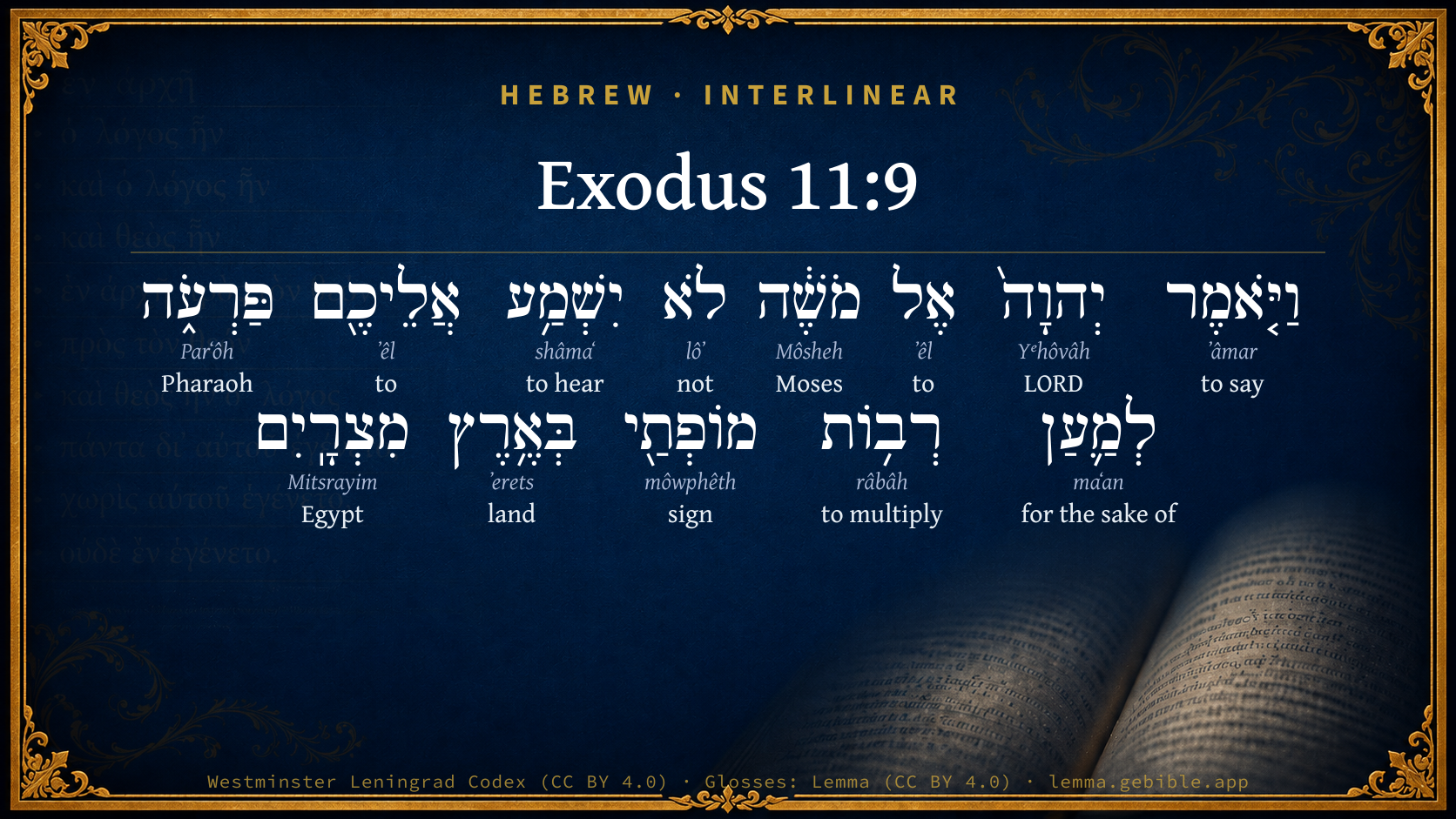
  1. וַיֹּ֤אמֶר ʼâmar H559 “and · to say” Conjunction + Verb, Qal, Sequential Imperfect, 3rd Person, Masculine, Singular
  2. יְהוָה֙ Yᵉhôvâh H3068 “LORD” Noun, Proper
  3. אֶל ʼêl H413 “to” Preposition
  4. מֹשֶׁ֔ה Môsheh H4872 “Moses” Noun, Proper
  5. לֹא lôʼ H3808 “not” Particle, Negative
  6. יִשְׁמַ֥ע shâmaʻ H8085 “to hear” Verb, Qal, Imperfect, 3rd Person, Masculine, Singular
  7. אֲלֵיכֶ֖ם ʼêl H413 “to · you” Preposition + Suffix, Personal, 2nd Person, Masculine, Plural
  8. פַּרְעֹ֑ה Parʻôh H6547 “Pharaoh” Noun, Proper
  9. לְמַ֛עַן maʻan H4616 “for the sake of” Preposition
  10. רְב֥וֹת râbâh H7235 “to multiply” Verb, Qal, Infinitive Construct
  11. בְּאֶ֥רֶץ ʼerets H776 “in/at · land of” Preposition + Noun, Common, Both, Singular, Construct
  12. מִצְרָֽיִם Mitsrayim H4714 “Egypt” Noun, Proper

About this verse

These counts appear in no published source. They are computed here, from the morphology-tagged text and Lemma’s own curated glosses. What Lemma adds →

13
words
12
distinct lemmas
Pentateuch
section

Shared distinctive vocabulary

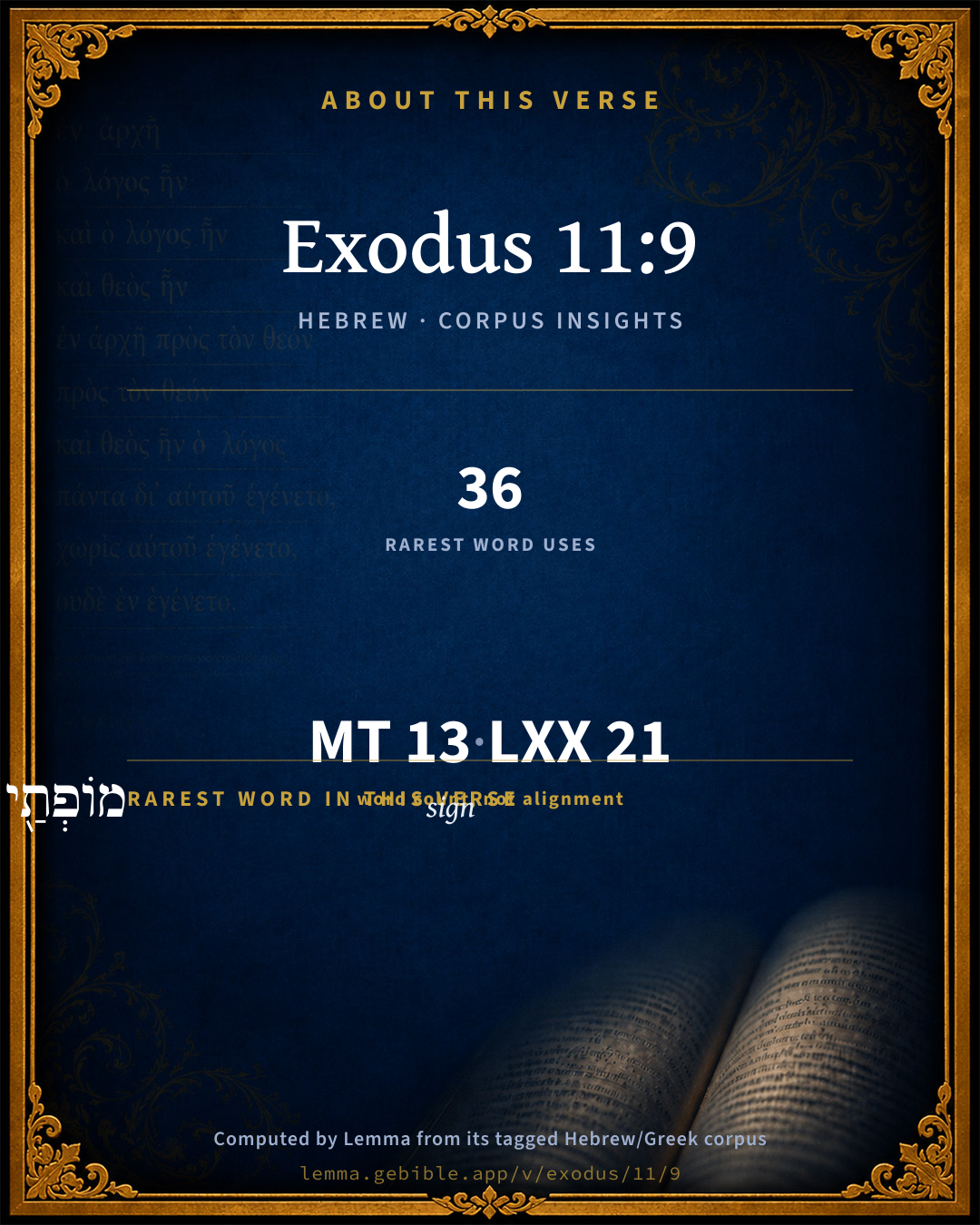
מוֹפְתַ֖י sign H4159 occurs in 35 verses of the Hebrew Bible. Also found in:

Grammatical profile

  • 3 verbs
  • 6 nouns
  • 3 prepositions
  • 1 particle

Verb forms

  • וַיֹּ֤אמֶר Qal · Sequential Imperfect
  • יִשְׁמַ֥ע Qal · Imperfect
  • רְב֥וֹת Qal · Infinitive Construct

Repetition

A word recurs within this verse — often emphatic in Hebrew:

  • אֶל to H413 ×2

Hebrew & Septuagint length

In English translation the verse runs 20 words from the Hebrew and 34 from the Septuagint (LXX English) — the Septuagint runs noticeably longer here. See the side-by-side →

A rough comparison of the two English renderings, which tokenize alike — not a word-level alignment.

Word counts can differ between the Hebrew and the Greek without any difference in meaning — e.g. the Hebrew direct-object marker אֵת has no separate Greek word, and Greek often adds the article ὁ.

In the original languages it is 13 Hebrew tokens and 21 Greek tokens — but the two are counted differently (Hebrew bundles its prefixes and suffixes into one token; the Greek is in lemma form), so that isn’t a like-for-like length.

Cross-references

4

Topical passages linked to Exodus 11:9 in the Treasury of Scripture Knowledge — connected by theme and wording, ordered by reader-vote popularity; previews shown in the World English Bible.

  • Exodus 7:3–4 I will harden Pharaoh's heart, and multiply my signs and my wonders in the land of Egypt.
  • Exodus 3:19 I know that the king of Egypt won't give you permission to go, no, not by a mighty hand.
  • Exodus 10:1 Yahweh said to Moses, "Go in to Pharaoh, for I have hardened his heart, and the heart of his servants, that I may show these my signs in the midst of them,
  • Romans 9:16–18 So then it is not of him who wills, nor of him who runs, but of God who has mercy.

Cross-references courtesy of OpenBible.info (CC BY 4.0).

Hebrew and Greek witnesses Masoretic Hebrew ↔ Greek Septuagint

The same verse in the two great witnesses to the Old Testament, shown verse-for-verse.

Here the Septuagint runs noticeably longer than the Hebrew — LXX2012 (modern English Septuagint) 34 words vs World English Bible 20. A rough length comparison of the two English translations, not a word-level alignment — read both below.

These are two independent witnesses, not word-aligned to each other, and the Septuagint is shown in lemma (dictionary) form.

Hebrew Exodus 11:9 Masoretic · Westminster Leningrad Codex

וַיֹּ֤אמֶר יְהוָה֙ אֶל מֹשֶׁ֔ה לֹא יִשְׁמַ֥ע אֲלֵיכֶ֖ם פַּרְעֹ֑ה לְמַ֛עַן רְב֥וֹת מוֹפְתַ֖י בְּאֶ֥רֶץ מִצְרָֽיִם

Yahweh said to Moses, "Pharaoh won't listen to you, that my wonders may be multiplied in the land of Egypt."

World English Bible · Public Domain

Greek LXX Exodus 11:9 Septuagint · lemma form

εἶπον δέ κύριος πρός μωυσῆς οὐ εἰςἀκούω σύ φαραώ ἵνα πληθύνω πληθύνω ἐγώ ὁ σημεῖον καί ὁ τέρας ἐν γῆ αἴγυπτος

And Moses went forth from Pharao with wrath. And the Lord said to Moses, Pharao will not listen to you, that I may greatly multiply my signs and wonders in the land of Egypt.

LXX2012 (modern English Septuagint) · Public Domain

Hebrew: Westminster Leningrad Codex (CC BY 4.0). Greek: Septuagint (public domain); English from LXX2012 (modern English Septuagint) (Public Domain). How the Septuagint differs from the Hebrew →

Targum (Aramaic paraphrase)

2

The Targum is the ancient Jewish Aramaic paraphrase of the Hebrew Scriptures — an interpretive translation, not the Hebrew text itself. Onkelos (literal) and Pseudo-Jonathan (expansive) render the Torah, and Jonathan the Prophets. Coverage is partial: where no permissively-licensed English translation exists for a verse, only the Aramaic is shown. This is verse-level text, not a word-by-word alignment to the Hebrew.

  1. Targum Onkelos Torah (Genesis–Deuteronomy)
    וַאֲמַר יְיָ לְמשֶׁה לָא יְקַבֵּל מִנְכוֹן פַּרְעֹה בְּדִיל לְאַסְגָאָה מוֹפְתַי בְּאַרְעָא דְמִצְרָיִם:

    (no public-domain English translation for this verse)

    Targum Onkelos — Aramaic: “Onkelos Genesis” (public domain); “Onkelos Exodus” (public domain); “Onkelos Leviticus” (public domain); “Onkelos Numbers” (public domain); “Onkelos Deuteronomy” (public domain). English: “Sefaria Community Translation” (CC0 1.0 (public-domain dedication)); “J.W. Etheridge. The Targums of Onkelos and Jonathan Ben Uzziel on the Pentateuch. London: Longmans, Green, 1862” (public domain). Text via Sefaria.

  2. Targum Pseudo-Jonathan Torah (Genesis–Deuteronomy)
    וַאֲמַר יְיָ לְמשֶׁה לָא יְקַבֵּיל מִנְכוֹן פַּרְעה מִן בִּגְלַל לְאַסְגָאָה תִּמְהַיַי בְּאַרְעָא דְמִצְרָיִם

    But the Lord said to Mosheh, Pharoh will not hearken to you; that I may multiply My wonders in the land of Mizraim.

    Targum Pseudo-Jonathan — Aramaic: “Targum Jonathan on Genesis” (public domain); “Targum Jonathan on Exodus” (public domain); “Targum Jonathan on Leviticus” (public domain); “Targum Jonathan on Numbers” (public domain); “Targum Jonathan on Deuteronomy” (public domain). English: “The Targum of Jonathan ben Uzziel, trans. J. W. Etheridge, London, 1862” (public domain). Text via Sefaria.

Commentary

Notes on Exodus 11:9 from classic Christian and Jewish commentators (each source and its license shown beneath its notes). The classic Christian expositions comment on the surrounding passage and are grouped to its opening verse, so a note may address several verses; the Jewish commentaries on the Tanakh (Rashi and others) are per-verse, so they appear only where the commentator wrote on this verse.

Lemma curates 59 commentaries, every one of them public domain or Creative Commons licensed, each selected and text-cleaned for this edition rather than reprinted as found. About our sources →

Trapp's Complete Commentary

John Trapp

Exo 11:9 And the LORD said unto Moses, Pharaoh shall not hearken unto you; that my wonders may be multiplied in the land of Egypt.

Ver. 9. That my wonders.] {See Trapp on "Rom 9:17"]

John Trapp, A Commentary or Exposition upon All the Books of the Old and New Testament (1647–1656) — public domain. Text from a community e-Sword module.

Keil & Delitzsch

C. F. Keil & F. Delitzsch

In Exo 11:9 and Exo 11:10 the account of Moses' negotiations with Pharaoh, which commenced at Exo 7:8, is brought to a close. What God predicted to His messengers immediately before sending them to Pharaoh (Exo 7:3), and to Moses before his call (Exo 4:21), had now come to pass. And this was the pledge that the still further announcement of Jehovah in Exo 7:4 and Exo 4:23, which had already been made known to the hardened king (Exo 11:4.), would be carried out. As these verses have a terminal character, the vav consecutive in ויּאמר denotes the order of thought and not of time, and the two verses are to be rendered thus: "As Jehovah had said to Moses, Pharaoh will not hearken unto you, that My wonders may be multiplied in the land of Egypt, Moses and Aaron did all these wonders before Pharaoh; and Jehovah hardened Pharaoh's heart, so that he did not let the children of Israel go out of his land."

Keil & Delitzsch — Biblical Commentary on the Old Testament (1861–1891) — public domain (CC PDM 1.0). Text via the HelloAO Bible API. (Old Testament only.)

Geneva Bible (1599)

Geneva Bible translators

God hardeneth the hearts of the reprobate, that his glory thereby might be the more set forth, Rom. 9:17.

Geneva Bible (1599) marginal notes — public domain. Text via Bolls.life.

Adam Clarke's Commentary

Verse 9. Pharaoh shall not hearken unto you] Though shall and will are both reputed signs of the future tense, and by many indiscriminately used, yet they make a most essential difference in composition in a variety of cases. For instance, if we translate לא ישמע lo yishma, Pharaoh SHALL not hearken, as in our text, the word shall strongly intimates that it was impossible for Pharaoh to hearken, and that God had placed him under that impossibility: but if we translate as we should do, Pharaoh WILL not hearken, it alters the case most essentially, and agrees with the many passages in the preceding chapters, where he is said to have hardened his own heart; as this proves that he, without any impulsive necessity, obstinately refused to attend to what Moses said or threatened; and that God took the advantage of this obstinacy to work another miracle, and thus multiply his wonders in the land.

Pharaoh WILL not hearken unto you; and because he would not God hardened his heart - left him to his own obstinacy.

To most critics it is well known that there are in several parts of the Pentateuch considerable differences between the Hebrew and Samaritan copies of this work. In this chapter the variations are of considerable importance, and competent critics have allowed that the Samaritan text, especially in this chapter, is fuller and better connected than that of the Hebrew.

1. It is evident that the eighth verse in the present Hebrew text has no natural connection with the seventh. For in the seventh verse Moses delivers to the Israelites what God had commanded him to say: and in the eighth he appears to continue a direct discourse unto Pharaoh, though it does not appear when this discourse was begun. This is quite contrary to the custom of Moses, Who always particularly notes the commencement of his discourses.

2. It is not likely that the Samaritans have added these portions, as they could have no private interest to serve by so doing; and therefore it is likely that these additions were originally parts of the sacred text, and might have been omitted, because an ancient copyist found the substance of them in other places. It must however be granted, that the principal additions in the Samaritan are repetitions of speeches which exist in the Hebrew text.

3. The principal part of these additions do not appear to have been borrowed from any other quarter. Interpolations in general are easily discerned from the confusion they introduce; but instead of deranging the sense, the additions here made it much more apparent; for should these not be admitted it is evident that something is wanting, without which the connection is incomplete.-See Calmet. But the reader is still requested to observe, that the supplementary matter in the Samaritan is collected from other parts of the Hebrew text; and that the principal merit of the Samaritan is, that it preserves the words in a better arrangement.

Dr. Kennicott has entered into this subject at large, and by printing the two texts in parallel columns, the supplementary matter in the Samaritan and the hiatus in the Hebrew text will be at once perceived. It is well known that he preferred the Samaritan to the Hebrew Pentateuch; and his reasons for that preference in this case I shall subjoin. As the work is extremely scarce from which I select them, one class of readers especially will be glad to meet with them in this place.

"Within these five chapters. vii., viii., ix., x., and xi., are seven very great differences between the Hebrew and Samaritan Pentateuchs, relating to the speeches which denounced seven out of the ten judgments upon the Egyptians, viz., waters into blood, frogs, flies, murrain, hail, locusts and destruction of the first-born. The Hebrew text gives the speeches concerning these judgments only once at each; but the Samaritan gives each speech TWICE. In the Hebrew we have the speeches concerning the five first as in command from GOD to Moses, without reading that Moses delivered them; and concerning the two last, as delivered by Moses to Pharaoh, without reading that GOD had commanded them. Whereas in the Samaritan we find every speech TWICE: GOD commands Moses to go and speak thus or thus before Pharaoh; Moses goes and denounces the judgment; Pharaoh disobeys, and the judgment takes place. All this is perfectly regular, and exactly agreeable to the double speeches of Homer in very ancient times. I have not the least doubt that the Hebrew text now wants many words in each of the seven following places: chap. vii., between verses 18 and 19; Ex 7:18-19 end of chap. vii.; Ex 7:25 chap. viii., between 19 and 20; Ex 8:19-20 chap. x., between 2 and 3; Ex 10:2-3 chap. xi., at verses 3 and 4. Ex 11:3-4 The reader will permit me to refer him (for all the words thus omitted) to my own edition of the Hebrew Bible, (Oxford 1780, 2 vols. fol.,) where the whole differences are most clearly described. As this is a matter of very extensive consequence, I cannot but observe here, that the present Hebrew text of Exod. xi. did formerly, and does still appear to me to furnish a demonstration against itself, in proof of the double speech being formerly recorded there, as it is now in the Samaritan. And some very learned men have confessed the impossibility of explaining this chapter without the assistance of the Samaritan Pentateuch. I shall now give this important chapter as I presume it stood originally, distinguishing by italics all such words as are added to or differ from our present translation. And before this chapter must be placed the two last verses of the chapter preceding, Ex 10:28-29: And Pharaoh said unto him, Get thee from me, take heed to thyself, see my face no more; for in that day thou seest my face thou shalt die. And Moses said, Thou hast well spoken, I will see thy face again no more.

EXODUS XI

HEBREW TEXT AND PRESENT VERSION

SAMARITAN TEXT AND NEW VERSION

1. And the Lord said unto Moses, Yet will I bring one plague more upon Pharaoh and upon Egypt, afterwards he will let you go hence: when he shall let you go, he shall surely thrust you out hence altogether.

1. Then Jehovah said unto Moses, Yet will I bring one plague more upon Pharaoh and upon Egypt, and afterwards he will send you out hence: when he will send you away, he will surely drive you hence altogether.

2. Speak now in the ears of the people; and let every man BORROW of his neighbour, and every woman of her neighbour, jewels of silver, and jewels of gold.

2. Speak now in the ears of the people; and let every man ASK of his neighbour, and every woman of her neighbour, vessels of silver, and vessels of gold and raiment.

3. And the LORD GAVE the people favour in the sight of the Egyptians.

3. And I will give this people favour in the sight of the Egyptians, so that they shall give them what they ask.

4. For about midnight I wilt go forth into the midst of the land of Egypt.

5. And every first-born in the land of Egypt shalt die, from the first-born of Pharaoh who sitteth upon his throne, unto the first-born of the maid-servant that is behind the mill; and even unto the first-born of every beast.

6. And there shall be a great cry through all the land of Egypt, such as there was none like it, nor shall be like it any more.

7. But against any of the children of Israel shall not a dog move his tongue, against man or even against beast; that thou mayest know that Jehovah doth put a difference between the Egyptians and Israel.

Moreover the man Moses was very great in the land of Egypt, in the sight of Pharaoh's servants, and in the sight of the people.

8. And thou also shalt be greatly honoured in the land of Egypt, in the sight of Pharaoh's servants, and in the sight of the people.

9. THEN Moses said unto Pharaoh, Thus saith Jehovah, Israel is my son, my first-born; and I said unto thee, Let my son go that he may serve me.

10. But thou hast refused to let him go; behold, Jehovah slayeth thy son, thy first-born.

4. And Moses said, Thus saith the Lord, About midnight will I go out into the midst of Egypt.

11. And Moses said, Thus saith Jehovah, About midnight will I go forth into the midst of the land of Egypt.

5. And all the first-born in the land of Egypt shall die, from the first-born of Pharaoh that sitteth upon his throne, even unto the first-born of the maid-servant that is behind the mill-and all the first-born of beasts.

12. And every first-born in the land of Egypt shall die, from the first-born of Pharaoh that sitteth upon his throne, unto the first-born of the maid-servant that is behind the mill; and even unto the first-born of every beast.

6. And there shall be a great cry through all the land of Egypt, such as there was none like it, nor shall be like it any more.

13. And there shall be a great cry through all the land of Egypt, such as there was none like it, nor shall be like it any more.

7. But against any of the children of Israel shall not a dog move his

tongue, against man or beast; that ye may know how that the Lord doth put a difference between the Egyptians and Israel.

14. But against any of the children of Israel shall not a dog move his tongue, against man or even against beast: that thou mayest know that the Lord doth put a difference between the Egyptians and Israel.

8. And all these thy servants shall come down unto me, and bow down themselves unto me, saying, Get thee out and all the people that follow thee; and after that I will go out. And he went out from Pharaoh in great anger.

15. And all these thy servants shall come down to me, and bow down themselves to me, saying, Go forth, thou and all the people that follow thee; and then I will go forth.

16. Then went he forth from before Pharaoh in great indignation.

9. And the Lord said unto Moses, Pharaoh shall not hearken unto you, that my wonders may be multiplied in the land of Egypt.

17. And Jehovah said unto Moses, Pharaoh doth not hearken unto you, that my wonders may be multiplied in the land of Egypt.

10. And Moses and Aaron did all these wonders before Pharaoh: and the Lord hardened Pharoah's heart, so that he would not let the children of Israel go out of his land.

18. And Moses and Aaron performed all these wonders before Pharaoh: but Jehovah hardened Pharaoh's heart, so that he would not let the children of Israel go out of his land.

"The reader has now the whole of this chapter before him. When, therefore, he has first read the 28th and 29th verses of the preceding chapter, and has then observed with due surprise the confusion of the Hebrew text in chap. xi., he will be prepared to acknowledge with due gratitude the regularity and truth of the Samaritan text, through these many and very considerable differences." - REMARKS on select passages in the Old Testament, 8vo., Oxford, 1787.

The reader will pass his own judgment on the weight of this reasoning, and the importance of the additions preserved in the Samaritan text; a conviction of their utility has induced me to insert them.

Adam Clarke's Commentary on the Bible (1810–1826) — public domain. Text from a community e-Sword/MySword module.

Ellicott's Commentary for English Readers

(9, 10) And. the Lord said . . . —The series of the nine wonders wrought by Moses and Aaron is terminated by this short summary, of which the main points are—(1) God had said (Exo_4:21) that the miracles would fail to move Pharaoh; (2) He had assigned as the reason for this failure His own will that the wonders should be multiplied (Exo_7:3); (3) the miracles had now been wrought; (4) Pharaoh had not been moved by them; (5) God had hardened his heart, as a judgment upon him, after he had first himself hardened it. The result had been a series of manifestations calculated to impress the Israelites with a sense of God’s protecting care, the Egyptians and the neighbouring nations with a sense of His power to punish.

A Bible Commentary for English Readers, edited by Charles John Ellicott (1878–1897) — public domain. Text from a community e-Sword module.

The Cambridge Bible for Schools and Colleges

gen. ed. J. J. S. Perowne

9. wonders] portents, as Exo_7:3 (see on Exo_4:21). The whole verse is nearly the same as Exo_7:4 a, 3b; but, if it is in its right place, the ‘portents’ here can be only those which happened subsequently to the ninth plague. (The rend. as a pluperfect, had said, is contrary to grammar.)

9–10. The close of P’s account of the ‘portents’ hitherto done before the Pharaoh. They had failed to produce any effect upon king; and more, and more convincing ones, must in consequence follow.

The Cambridge Bible for Schools and Colleges (gen. ed. J. J. S. Perowne; Cambridge University Press, 1878–1918) — public domain. Text from a community e-Sword module.

John Gill's Exposition

And the Lord said unto Moses,.... Not at this time when he went out from Pharaoh, but some time before this, for the words may be rendered, "the Lord had said" (x), for so he had, as is related, Exo 7:3, but the historian makes mention of it here, to show that Moses was not ignorant of the event of things; he knew that Pharaoh's heart would be hardened from time to time, and that one plague after another must be inflicted, before he would let the people go; and therefore when he prayed for the removal of any, it was not in expectation that he would abide by his promise, but to do the will of God, and the duty of his calling:

Pharaoh shall not hearken unto you; to Moses and Aaron, and let the people of Israel go as required of him:

that my wonders may be multiplied in the land of Egypt; which Jarchi interprets of the smiting of the firstborn, dividing the waters of the Red sea, and the destruction of Pharaoh and his host in it; but since these words were said before any of the plagues, were inflicted, it may refer to them all.

(x) "dixerat autem", Junius & Tremellius, Piscator, Rivet.

John Gill's Exposition of the Whole Bible (1746–1763) — public domain (CC PDM 1.0). Text via the HelloAO Bible API.

Haydock's Catholic Bible Commentary

Angry, at such obstinacy. (Menochius)

George Leo Haydock (1774–1849), Haydock's Catholic Family Bible and Commentary, 1859 edition — public domain. Excludes Psalms (Douay-Rheims chapter numbering differs from Protestant) and Deuterocanonical books (Catholic canon only).

Whedon's Commentary on the Bible

Daniel D. Whedon

9, 10. These verses review and recapitulate the whole series of judgments, recording the fulfilment of the prediction made when Moses was first commissioned. Exo_7:2-3.

Daniel D. Whedon (gen. ed.), Commentary on the Old and New Testaments (1874–1909) — public domain. Text from a community e-Sword module.

The Pulpit Commentary

Vers. 9-10. Before proceeding to relate the last and greatest of the plagues, the author allows himself a momentary pause while he casts his eye back on the whole series of miracles hitherto wrought in Egypt, on the circumstances under which they had been wrought, their failure to move the stubborn will of Pharaoh, and the cause of that failure, the hardening of his heart, which hardening the author once more ascribes to Jehovah. With this summary he terminates the second great division of his work, that which began with ch. 2., and which traces the history of Moses from his birth to the close of his direct dealings with Pharaoh.

And the Lord said. Rather, "had said." God had forewarned Moses that Pharaoh"s heart would be hardened, (Exo_4:21 Exo_7:3) and that, in spite of all the miracles which he was empowered to perform before him, he would not let the people go. (Exo_3:19 Exo_4:21) It was not until God took Pharaoh"s punishment altogether into his own hands, and himself came down and smote all the first-born, that the king"s obstinacy was overcome, and he proceeded to "thrust the people out." That my wonders may be multiplied. Compare Exo_3:20 Exo_7:3. If Pharaoh had yielded at the first, or even after two or three miracles, God"s greatness and power would not have been shown forth very remarkably. Neither the Egyptians nor the neighbouring nations would have been much impressed. The circumstances would soon have been forgotten. As it was, the hardness of Pharaoh"s heart, while it delayed the departure of the Israelites for a year, and so added to their sufferings, was of advantage to them in various ways:

1. It gave them time to organise them elves, and make all necessary preparations for a sudden departure.

2. It deeply impressed the Egyptians, and led them to abstain from allinterference with the Israelites for above three centuries.

3. It impressed the neighbouring nations also to.some extent, and either prevented them from offering opposition to the Israelites, or made them contend with less heart, and so with less success against them.

HOMILETICS.

Man"s ill-doing but causes God"s wonders to be multiplied

God"s wonders are either such as occur in the general course of his providence, or such as are abnormal and extraordinary. It is these last of which Moses especially speaks to us in the Book of Exodus. But the same law which applies to the abnormal wonders, applies also to those which are constant and ordinary. Men"s perverseness leads to their multiplication.

I PARDON OF SIN IS MULTIPLIED THROUGH HUMAN TRANSGRESSION. Nothing is a greater marvel than God"s pardon of sin. How "the High and Holy One who inhabiteth eternity he who "is of purer eyes than to behold iniquity can pardon sin, is one of those mysteries which must ever remain in this life, at any rate unfathomable. Man pardons his fellow-sinner without much difficulty, because he is his fellow-sinner because he feels that he is himself so much in need of forgiveness. But for a perfect Being to pardon what is utterly alien to his own nature, what he must despise and abhor, what in his eyes is vile, base, mean, wicked, despicable, detestable is a truth which faith may accept, but which reason is quite incompetent to understand. Yet God does pardon. St. Paul must have been pardoned his persecution of the saints, before he was called to be "a chosen vessel." God bids us ask for pardon, and he would not bid us ask for that which he could not or would not give. And the marvel of pardon is being daily augmented, heaped up, multiplied, by the ever-increasing sum of human transgression.

II GOD THE SPIRIT"S CONDESCENSION GROWS AND INCREASES THROUGH THE SAME. God the Father declared once upon a time, "My Spirit shall not always strive with man". (Gen_6:3) Yet near five thousand years have elapsed, and his Spirit strives still. Man turns away from his Spirit, "grieves" him, vexes him, is deaf to his pleadings, sets at nought his counsel, wills none of his reproof (Pro_1:25) yet he does not withdraw himself. He "gives us the comfort of his help again he "will not leave us, nor forsake us." We may, no doubt, if we persist in evil courses, and set to work determinedly to drive him from us, in course of time cause him to withdraw, alienate him wholly, "quench" him. But, short of such alienation, our sins do but cause him to multiply the wonders of his love and his long-suffering, to be ever more gracious and more merciful, to plead with us more persuasively, more constantly, and save us, as it were, in spite of ourselves.

III CHRIST"S PROTECTION OF HIS CHURCH IS SHOWN MORE AND MORE MARVELOUSLY AS ITS ASSAILANTS INCREASE IN POWER AND BOLDNESS. In prosperous times God seems to do little for his Church; but let danger come, let men rise up against it, let Gebal and Ammon and Amalek be confederate together, and raise the cry, "Down with it, down with it, even to the ground," and the wonders which he proceeds to work on its behalf are simply astounding. Arius would corrupt its doctrine with the Court at his back, and Arius is smitten in the dead of the night by a death as silent, sudden, and inscrutable as that which came in the time of Moses on all the first-born of the Egyptians. Julian would crush it by depriving its ministers of support and its members of education, and Julian is cut off in the flower of his age by the javelin of an unknown enemy. Atheism, Agnosticism, Rationalism, Materialism, and often immorality league themselves against it at the present day, and lo! from without evidences are made to rise up out of crumbling heaps of rubbish in Assyria, Babylonia, and Egypt; while from within is developed a new life, a new zeal, a new vigour and activity, which give sure promise of triumph over the coalition. Man"s opposition to God provokes God to arise and show forth his might, to confound and scatter his foes. So men may be led at last to know that he, whose name is Jehovah, is truly "the Most High over all the earth". (Psa_83:18)

The Pulpit Commentary (1880–1919), ed. H.D.M. Spence-Jones & Joseph S. Exell — public domain. Text from a community e-Sword module.

unfoldingWord translationNotes

Door43 World Missions Community

Yahweh hardened Pharaoh's heart

Here "heart" refers to Pharaoh. His stubborn attitude is spoken of as if his heart was hard. See how you translated this phrase in Exodus 9:12. AT: "Yahweh caused Pharaoh to became more defiant" (See: Synecdoche and Metaphor)

translationWords

Aaron

miracle

heart

unfoldingWord translationNotes — © Distant Shores Media and the Door43 World Missions Community, licensed CC BY-SA 4.0. Source: git.door43.org/Door43/en_tn.

Rashi

Rabbi Shlomo Yitzchaki (Rashi)

למען רבות מופתי SO THAT MY WONDERS MAY BE MULTIPLIED (more lit., so that my wonders may be many) — referring not to one wonder alone (the slaying of the firstborn) but to the slaying of the firstborn, the division of the Red Sea and the overthrowing of the Egyptians in it.

Rashi on the Tanakh — English translations: “The Judaica Press complete Tanach with Rashi, translated by A. J. Rosenberg” (CC BY 4.0); “Pentateuch with Rashi's commentary by M. Rosenbaum and A.M. Silbermann, 1929-1934” (public domain); “The Metsudah Tanach series, Lakewood, N.J” (CC BY 4.0); and “The Book of Joshua, Metsudah Publications, 1997” (CC BY 4.0). Text via Sefaria.

Ramban (Nachmanides)

Rabbi Moshe ben Nachman (Ramban / Nachmanides)

AND THE ETERNAL SAID UNTO MOSES: PHARAOH WILL NOT HEARKEN UNTO YOU. It was to be expected that Pharaoh and his servants should dread the plague of the firstborn and be in consternation thereof moreso than for anything that had happened to them — indeed they had previously seen all the words of Moses fulfilled. G-d therefore informed Moses that it is He Who is hardening his [Pharaoh’s] heart, so that His wonders would be multiplied through the plague of the firstborn in both man and beast and the judgments He will execute against their gods. Rashi commented: “So that My wonders may be multiplied. This refers to the slaying of the firstborn, the division of the Red Sea, and the overthrowing of the Egyptians in it.” This explanation is not possible, because of the verse after that which states, And the Eternal hardened Pharaoh’s heart, and he did not let the children of Israel go out of his land., which was mentioned in Verse 9, refers only to those wonders which took place before the exodus, as Verse 10 clearly indicates that on account of the hardening of Pharaoh’s heart he did not let the people go. It thus cannot refer to the division of the Red Sea and the overthrowing of the Egyptians in it, as these wonders happened after the exodus (Mizrachi).

Ramban (Nachmanides) on the Tanakh — English translation: “Commentary on the Torah by Ramban (Nachmanides). Translated and annotated by Charles B. Chavel. New York, Shilo Pub. House, 1971-1976” (CC BY 4.0). Text via Sefaria.

Lesson kit

Teaching starters — assembled from the data on this page, not authored interpretation. Every prompt links to the verse data it draws on. Edit before teaching.

Exodus, in the Pentateuch, opens this verse with 13 words (12 distinct Hebrew lemmas). Its most distinctive word is môwphêth (“sign”). The Greek Septuagint runs longer here. A historical commentator’s framing appears above. Read the whole chapter for the surrounding context.

Discussion questions

  1. How does “sign” (môwphêth) shape what this verse is saying?
  2. How does Exodus 4:21, which shares the word «sign», read alongside this verse?
  3. What does the repetition of “to” (2× in this one verse) do in this verse?
  4. The Septuagint runs longer here than the Hebrew. What might account for the difference?
  5. The translations on this page render this verse differently — a whole-verse word diff, not a word-by-word alignment. What might account for the different wordings?
  6. «וַיֹּ֤אמֶר» is a Qal Sequential Imperfect verb. How does that grammatical form shape the action described?
  7. Compare how Trapp's Complete Commentary and Keil & Delitzsch read this verse. Where do they agree or differ?

Things to notice

Reading settings

Reading text

Shown beneath each verse's original-language words.

Old Testament
Old Testament edition

Read the OT as the Masoretic Hebrew (MT) or the Greek Septuagint (LXX).

English shown for the Greek Septuagint (in the Hebrew ↔ Greek comparison).

Comparing translations? Open the Compare panel on any verse page to stack up to four side by side.