
Proverbs 28:8

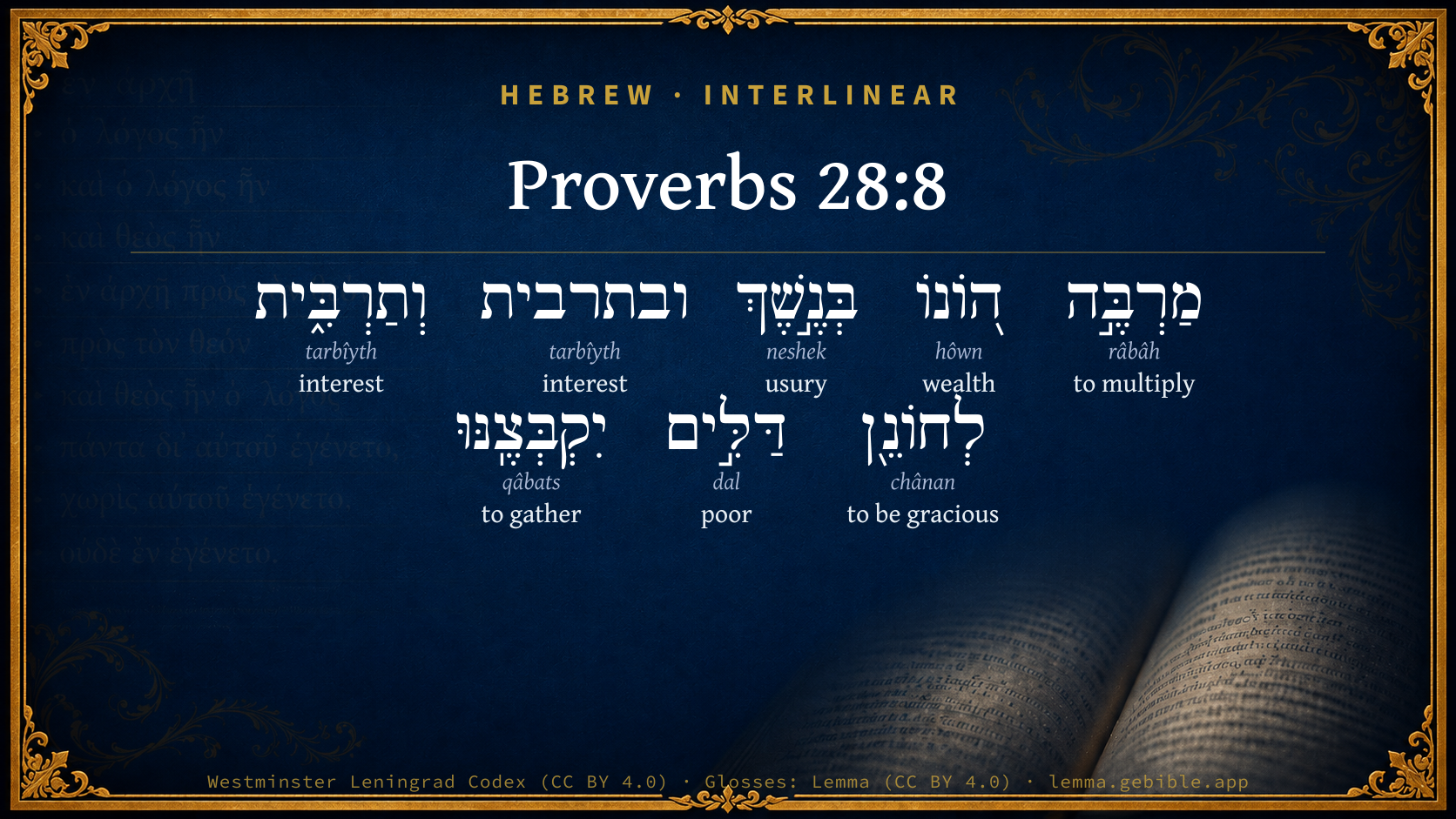
Hebrew (Westminster Leningrad Codex) Proverbs 28:8 appears in the Hebrew Old Testament. The text above is from the Westminster Leningrad Codex. Each word links to its Strong’s number, a concise gloss, and parsing drawn from the Open Scriptures Hebrew Bible morphology. Click any word for its full Brown-Driver-Briggs (BDB) entry.
Download image
Cite this verse

Proverbs 28:8 (World English Bible). Public Domain. Lemma interlinear Bible study tool, https://lemma.gebible.app/v/proverbs/28/8.

Show BibTeX & RIS
BibTeX
RIS
English Translation
He who increases his wealth by excessive interest Gathers it for one who has pity on the poor.
World English Bible · Public Domain
Download a study sheet

One document with this verse’s original text, its word-by-word gloss line, the meaning frame, cross-references with their text, attributed commentary, and full source and license credits — printable, and it pastes into notes with its structure intact.

This verse Autodidact and up

Study sheet (.html) Plain text (.txt)

A passage Seminary Student

Up to 50 verses in one chapter. A passage sheet keeps up to 6 commentary sources and 12 cross-references per verse, in the order this page ranks them, and says so on the sheet whenever that leaves anything out. Ask for a single verse and you get the Autodidact verse sheet above.

Everything on this page stays free to read, with no account — the sheet is a download of what is already on screen, not access to it.

Want to remove ads? Support Godless Engineer
Compare translations 3

The same verse in 3 English versions, stacked beneath the original-language interlinear above. Click any original word for its lexicon entry.

Each is an independent rendering of the whole verse — the interlinear is not word-aligned to these translations.

Highlighted words mark where these versions differ — a whole-verse word diff, not a word-by-word alignment.

  • World English Bible Public Domain
    He who increases his wealth by excessive interest Gathers it for one who has pity on the poor.
  • King James Version Public Domain
    He that by usury and unjust gain increaseth his substance, he shall gather it for him that will pity the poor.
  • unfoldingWord Literal Text CC BY-SA 4.0
    One increasing his wealth by interest and usury gathers it for one showing favor the lowly.

unfoldingWord Literal Text — © unfoldingWord, licensed CC BY-SA 4.0. Word-aligned USFM3 via Door43 (git.door43.org/unfoldingWord/en_ult).

Versions to compare (up to 4)

3 of 4 selected

Show all 18 translations

Every available English version of this verse, each an independent rendering of the whole verse.

  • World English Bible Public Domain
    He who increases his wealth by excessive interest Gathers it for one who has pity on the poor.
  • Berean Standard Bible Public Domain
    He who increases his wealth by interest and usury lays it up for one who is kind to the poor.
  • Majority Standard Bible Public Domain
    He who increases his wealth by interest and usury lays it up for one who is kind to the poor.
  • King James Version Public Domain
    He that by usury and unjust gain increaseth his substance, he shall gather it for him that will pity the poor.
  • American Standard Version (1901) Public Domain
    He that augmenteth his substance by interest and increase, Gathereth it for him that hath pity on the poor.
  • Revised Version (1885) Public Domain
    He that augmenteth his substance by usury and increase, gathereth it for him that hath pity on the poor.
  • Geneva Bible (1599) Public Domain
    He that increaseth his riches by vsurie and interest, gathereth them for him that will be mercifull vnto the poore.
  • Douay-Rheims (1899) Public Domain
    He that heapeth together riches by usury and loan, gathereth them for him that will be bountiful to the poor.
  • Young's Literal Translation Public Domain
    Whoso is multiplying his wealth by biting and usury, For one favouring the poor doth gather it.
  • Literal Standard Version CC BY-SA 4.0
    Whoever is multiplying his wealth by biting and usury, || Gathers it for one favoring the poor.
  • Unlocked Literal Bible CC BY-SA 4.0
    The one who makes his fortune by charging too much interest gathers his wealth for another who will have pity on poor people.
  • unfoldingWord Literal Text CC BY-SA 4.0
    One increasing his wealth by interest and usury gathers it for one showing favor the lowly.
  • Darby Bible Public Domain
    He that by usury and unjust gain increaseth his substance gathereth it for him that is gracious to the poor.
  • World Messianic Bible Public Domain
    He who increases his wealth by excessive interest gathers it for one who has pity on the poor.
  • Webster's Bible Public Domain
    He that by usury and unjust gain increaseth his substance, he shall gather it for him that will pity the poor.
  • Free Bible Version CC BY-SA 4.0
    Anyone who gets rich through charging interest and profiteering is only storing it up for someone who is kind to the poor.
  • Bible in Basic English Public Domain
    He who makes his wealth greater by taking interest, only gets it together for him who has pity on the poor.
  • JPS Tanakh (1917) Public Domain
    He that augmenteth his substance by interest and increase, gathereth it for him that is gracious to the poor.

Literal Standard Version (2020), Covenant Press — licensed CC BY-SA 4.0. Text via the HelloAO Bible API (eBible.org). Unlocked Literal Bible (unfoldingWord) — licensed CC BY-SA 4.0. Text via the HelloAO Bible API (eBible.org). unfoldingWord Literal Text — © unfoldingWord, licensed CC BY-SA 4.0. Word-aligned USFM3 via Door43 (git.door43.org/unfoldingWord/en_ult). Free Bible Version, Dr. Jonathan Gallagher — licensed CC BY-SA 4.0. Text via the HelloAO Bible API (eBible.org).

Word by word

More ways to search: Search by grammar → Find every occurrence → Compare this word →

Practice this passage: Drill this verse → Learn its vocabulary →

ובתרבית
tarbîyth
H8636
“and · in/at · interest”
Conjunction + Preposition + Noun, Common, Feminine, Singular, Absolute
Part of Speech
Conjunction + Preposition + Noun
Type
Common
Gender
Feminine
Number
Singular
State
Absolute
Full BDB Definition

Origin: from H7235

TWOT: 2103f

increment, usury, interest, bonus
  1. מַרְבֶּ֣ה râbâh H7235 “multiplying” Verb, Hiphil, Participle Active, Masculine, Singular, Absolute
  2. ה֭וֹנוֹ hôwn H1952 “wealth · his” Noun, Common, Masculine, Singular, Construct + Suffix, Personal, 3rd Person, Masculine, Singular
  3. בְּנֶ֣שֶׁךְ neshek H5392 “in/at · usury” Preposition + Noun, Common, Masculine, Singular, Absolute
  4. וְתַרְבִּ֑ית tarbîyth H8636 “and · interest” Conjunction + Noun, Common, Feminine, Singular, Absolute
  5. לְחוֹנֵ֖ן chânan H2603 “to/for · being gracious” Preposition + Verb, Qal, Participle Active, Masculine, Singular, Absolute
  6. דַּלִּ֣ים dal H1800 “poor” Adjective, Adjective, Masculine, Plural, Absolute
  7. יִקְבְּצֶֽנּוּ qâbats H6908 “to gather · him” Verb, Qal, Imperfect, 3rd Person, Masculine, Singular + Suffix, Personal, 3rd Person, Masculine, Singular

About this verse

These counts appear in no published source. They are computed here, from the morphology-tagged text and Lemma’s own curated glosses. What Lemma adds →

8
words
7
distinct lemmas
Wisdom
section

Notable vocabulary

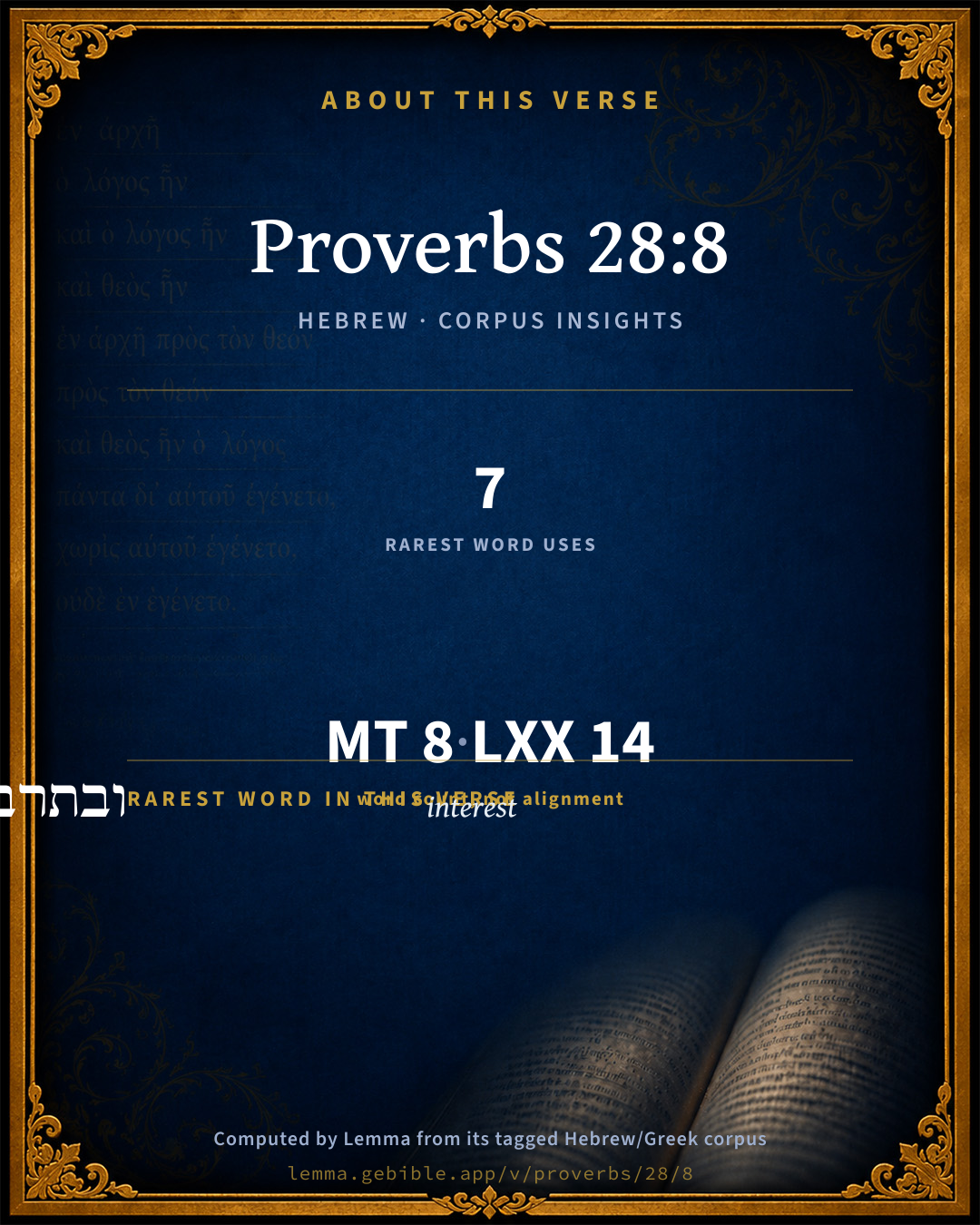
The rarest word here is ובתרבית interest H8636 — appearing just 7 times in the whole Hebrew Bible.

Shared distinctive vocabulary

ובתרבית interest H8636 occurs in 6 verses of the Hebrew Bible. Also found in:

Grammatical profile

  • 3 verbs
  • 4 nouns
  • 1 adjective

Verb forms

  • מַרְבֶּ֣ה Hiphil · Participle Active
  • לְחוֹנֵ֖ן Qal · Participle Active
  • יִקְבְּצֶֽנּוּ Qal · Imperfect

Repetition

A word recurs within this verse — often emphatic in Hebrew:

  • ובתרבית interest H8636 ×2

Hebrew & Septuagint length

In English translation the verse runs 18 words from the Hebrew and 18 from the Septuagint (LXX English) — the same length.

A rough comparison of the two English renderings, which tokenize alike — not a word-level alignment.

Word counts can differ between the Hebrew and the Greek without any difference in meaning — e.g. the Hebrew direct-object marker אֵת has no separate Greek word, and Greek often adds the article ὁ.

In the original languages it is 8 Hebrew tokens and 14 Greek tokens — but the two are counted differently (Hebrew bundles its prefixes and suffixes into one token; the Greek is in lemma form), so that isn’t a like-for-like length.

Cross-references

11

Topical passages linked to Proverbs 28:8 in the Treasury of Scripture Knowledge — connected by theme and wording, ordered by reader-vote popularity; previews shown in the World English Bible.

  • Job 27:16–17 Though he heap up silver as the dust, And prepare clothing as the clay;
  • Proverbs 13:22 A good man leaves an inheritance to his children's children, But the wealth of the sinner is stored for the righteous.
  • Ecclesiastes 2:26 For to the man who pleases him, God gives wisdom, knowledge, and joy; but to the sinner he gives travail, to gather and to heap up, that he may give to him who pleases God. This also is vanity and a chasing after wind.
  • Exodus 22:25 "If you lend money to any of my people with you who is poor, you shall not be to him as a creditor; neither shall you charge him interest.
  • Leviticus 25:36 Take no interest from him or profit, but fear your God; that your brother may live among you.
  • Ezekiel 18:17 who has withdrawn his hand from the poor, who has not received interest nor increase, has executed my ordinances, has walked in my statutes; he shall not die for the iniquity of his father, he shall surely live.
  • Proverbs 14:31 He who oppresses the poor shows contempt for his Maker, But he who is kind to the needy honors him.
  • Ezekiel 18:8 he who has not given forth on interest, neither has taken any increase, who has withdrawn his hand from iniquity, has executed true justice between man and man,
  • Ezekiel 18:13 has given forth on interest, and has taken increase; shall he then live? he shall not live: he has done all these abominations; he shall surely die; his blood shall be on him.
  • Proverbs 19:7 All the relatives of the poor shun him: How much more do his friends avoid him! He pursues them with pleas, but they are gone.
  • 2 Samuel 12:6 He shall restore the lamb fourfold, because he did this thing, and because he had no pity!"

Cross-references courtesy of OpenBible.info (CC BY 4.0).

Hebrew and Greek witnesses Masoretic Hebrew ↔ Greek Septuagint

The same verse in the two great witnesses to the Old Testament, shown verse-for-verse.

These are two independent witnesses, not word-aligned to each other, and the Septuagint is shown in lemma (dictionary) form.

Hebrew Proverbs 28:8 Masoretic · Westminster Leningrad Codex

מַרְבֶּ֣ה ה֭וֹנוֹ בְּנֶ֣שֶׁךְ ובתרבית וְתַרְבִּ֑ית לְחוֹנֵ֖ן דַּלִּ֣ים יִקְבְּצֶֽנּוּ

He who increases his wealth by excessive interest Gathers it for one who has pity on the poor.

World English Bible · Public Domain

Greek LXX Proverbs 28:8 Septuagint · lemma form

ὁ πληθύνω ὁ πλοῦτος αὐτός μετά τόκος καί πλεονασμός ὁ ἐλεάω πτωχός συνἄγω αὐτός

He that increases his wealth by usuries and unjust gains, gathers it for him that pities the poor.

LXX2012 (modern English Septuagint) · Public Domain

On this verse, The Cambridge Bible for Schools and Colleges discusses the Septuagint’s reading. Read the note in Commentary ↓

Hebrew: Westminster Leningrad Codex (CC BY 4.0). Greek: Septuagint (public domain); English from LXX2012 (modern English Septuagint) (Public Domain). How the Septuagint differs from the Hebrew →

Commentary

Notes on Proverbs 28:8 from classic Christian and Jewish commentators (each source and its license shown beneath its notes). The classic Christian expositions comment on the surrounding passage and are grouped to its opening verse, so a note may address several verses; the Jewish commentaries on the Tanakh (Rashi and others) are per-verse, so they appear only where the commentator wrote on this verse.

Lemma curates 59 commentaries, every one of them public domain or Creative Commons licensed, each selected and text-cleaned for this edition rather than reprinted as found. About our sources →

Trapp's Complete Commentary

John Trapp

Pro 28:8 He that by usury and unjust gain increaseth his substance, he shall gather it for him that will pity the poor.

Ver. 8. He that by usury and unjust gain, &c.] Usury is condemned by the very heathens (Aristot. Ethic., lib. iv. cap. 1). The ancient law of the Romans make the usurer a thief and worse; the Hebrews make him a biting thief, who gnaweth the debtor to the very bones; yea, the most toothless usury, that usual plea, hath sharp gums, which bite as sore as an old dog or a hungry fly; and under show of licking whole, sucks out the heart blood. Let those who plead for it consider that God dispenseth with no usury, {Eze 18:8} whether neshec or tarbith, biting or toothless; that the lender deals not as he would be dealt with it; that the gospel makes these sinners worse than other sinners when it saith, "Sinners lend to sinners to receive the like," {Luk 6:34} but these to receive more; that at Rome this day all usurers are excommunicated monthly; that the canon law drives them from the sacrament, denies them burial, makes their will no will, as though their goods were not their own; that no man of note in all antiquity - Jews and Manichees excepted - for 1500 years after Christ, hath ever undertaken the defence of usury; that Chrysostom is very fierce against it, comparing it to the stinging of an asp, which casts a man into a sleep, whereof he dies, &c.

He shall gather it for him that will pity the poor.] God will provide him an executor never mentioned in his will; or his heir, being a better man, shall freely distribute what he hath wrongfully raked together. {Ecc 2:21 Job 27:16}

John Trapp, A Commentary or Exposition upon All the Books of the Old and New Testament (1647–1656) — public domain. Text from a community e-Sword module.

The Biblical Illustrator

Joseph S. Exell

Pro_28:8

He that by usury and unjust gain increaseth his substance, he shall gather it for him that will pity the poor.

Dishonesty

A matter-of-fact Englishman, writing about the uselessness of abstract preaching, says that, during ten years residence in a country parish, he became well acquainted with the characteristic temptations, failings, tricks and vices, and crimes of the people, and he longed to hear something from the pulpit calculated to meet the emergencies of the case. Ten long years the drowsy pulpit poured forth its dull platitudes; the clergyman never coming down from the clouds long enough to let the dishonest, the cruel, and the dissipated understand that they know nothing practically concerning the imitation of Christ until they have asked themselves how He would have acted if He had vegetables to sell or horses to drive. Wealth, in days of undefiled English, meant well-being, and is now used to describe money--money more than all beside; and worth, or worthiness, has degenerated into a term to express how much of filthy lucre that one has contrived to get hold of. The cool contempt of money which some old cynics and philosophers expressed was little more than affectation. Had they been lucky enough to have any, their estimate of it might have been different. A man of wealth, who behaves himself properly, and puts on no airs, is as much to be respected as his poorest neighbours. Let this be remembered, however, it must be wealth honestly come by. When greed of gain has secured a lodgment in the heart, it imperiously demands satisfaction. In countries where civilisation is unknown it turns freebooter, and leagues with bands of kindred spirits; while in Christian lands it puts on more respectable shapes, not so shocking to the casual observer. The rude robber stops his victim on the highway, and holds midnight revels on the spoil; and the cunning accountant defrauds his creditors, and rides in his carriage. Does a just God see much difference between them? Christian integrity will, in the end, always receive its merited reward. Instead of worldly maxims, based on low and unworthy principles, let the solemn question of our Lord keep us from evil ways--What shall it profit a man, if he shall gain the whole world and lose his own soul? (John N. Norton.)

Usury

Usury is here to be understood of every description of oppressive, unrighteous, and rigorous exaction. The providence of a just and merciful God is evidently here referred to. That providence transfers wealth from the hand of grasping and griping selfishness to that of humanity and generous kindness, to that of the man who pities the poor. Men may not mark the Divine hand in occurrences of this kind; and it is always a delicate matter for us--one to which we are hardly equal--to interpret providence judicially. But there are cases at times in which the transference is so striking that it would be impiety not to see and own God in it. (R. Wardlaw, D.D.)

The Biblical Illustrator, edited by Joseph S. Exell (c. 1880s–1900s) — public domain. Text from a community e-Sword module.

Joseph Benson's Commentary

Pro 28:8. He that by usury, &c., increaseth his substance — Hebrew, By usury and increase, that is, by any kind of usury whereby the poor are oppressed, or by any unrighteous practices; he shall gather it, &c. — It shall not long continue with him or his, but shall, by God’s righteous and powerful providence, be committed to more just and merciful hands, who will pity, and relieve the poor.

Joseph Benson's Commentary on the Old and New Testaments (1811–1818) — public domain. Text from a community e-Sword module.

Tyndale Open Study Notes

Tyndale Open Resources

28:8 The law prohibited charging needy Israelites interest on loans (Exod 22:25; Lev 25:36; Deut 23:19). The rich were instructed to lend generously to the poor (Prov 3:27-28; 11:24; 28:27; 29:7, 14).

Tyndale Open Study Notes — © Tyndale Open Resources, licensed CC BY-SA 4.0. Text via the HelloAO Bible API.

Geneva Bible (1599)

Geneva Bible translators

For God will take away the wicked usurer, and give his goods to him that shall bestow them well.

Geneva Bible (1599) marginal notes — public domain. Text via Bolls.life.

Matthew Henry's Commentary

Note, 1. That which is ill-got, though it may increase much, will not last long. A man may perhaps raise a great estate, in a little time, by usury and extortion, fraud, and oppression of the poor, but it will not continue; he gathers it for himself, but it shall prove to have been gathered for somebody else that he has no kindness for. His estate shall go to decay, and another man's shall be raised out of the ruins of it. 2. Sometimes God in his providence so orders it that that which one got unjustly another uses charitably; it is strangely turned into the hands of one that will pity the poor and do good with it, and so cut off the entail of the curse which he brought upon it who got it by deceit and violence. Thus the same Providence that punishes the cruel, and disables them to do any more hurt, rewards the merciful, and enables them to do so much the more good. To him that has the ten pounds give the pound which the wicked servant hid in the napkin; for to him that has, and uses it well, more shall be given, Luk 19:24. Thus the poor are repaid, the charitable are encouraged, and God is glorified.

Matthew Henry's Commentary on the Whole Bible (1708–1710) — public domain (CC PDM 1.0). Text via the HelloAO Bible API.

Jamieson, Fausset & Brown

Robert Jamieson, A. R. Fausset & David Brown

usury . . . unjust gain--(Compare Margin). The two terms, meaning nearly the same, may denote excessive interest. God's providence directs the proper use of wealth.

Jamieson, Fausset & Brown — Commentary Critical and Explanatory on the Whole Bible (1871) — public domain (CC PDM 1.0). Text via the HelloAO Bible API.

Adam Clarke's Commentary

Verse 8. He that by usury - increaseth his substance] By taking unlawful interest for his money; lending to a man in great distress, money, for the use of which he requires an exorbitant sum. O that the names of all those unfeeling, hard-hearted, consummate villains in the nation, who thus take advantage of their neighbour's necessities to enrich themselves, were published at every market cross; and then the delinquents all sent to their brother savages in New Zealand. It would be a happy riddance to the country.

Adam Clarke's Commentary on the Bible (1810–1826) — public domain. Text from a community e-Sword/MySword module.

Ellicott's Commentary for English Readers

(8) He that by usury . . . increaseth his substance.—See above on Pro_6:1.

He shall gather it for him that will pity the poor.—The “pound” is taken from him who knows not how to use it (Luk_19:24), and given to one who does. (Comp. 1Sa_15:28.)

A Bible Commentary for English Readers, edited by Charles John Ellicott (1878–1897) — public domain. Text from a community e-Sword module.

The Cambridge Bible for Schools and Colleges

gen. ed. J. J. S. Perowne

8. unjust gain] Rather, increase, as A.V. marg. and R.V. text, μετὰ τόκων καὶ πλεονασμῶν, LXX. Comp. Lev_25:36-37.

The idea of its being “unjust” is implied by the word “usury” with which it is associated. The R.V. gives augmenteth, instead of increaseth, in the former part of the verse, as the Heb. word is not the same, as it there renders increase.

The Cambridge Bible for Schools and Colleges (gen. ed. J. J. S. Perowne; Cambridge University Press, 1878–1918) — public domain. Text from a community e-Sword module.

John Gill's Exposition

He that by usury and unjust gain increaseth his substance,.... By biting and oppressing the poor; letting him have money at an exorbitant interest, and goods at an exorbitant price, and so increases his substance in this scandalous manner; hence usury is in Lev 25:36, called "increase", and by the Greeks a "birth", because money is the birth of money, as Aristotle (e) observes; and so by the Latins "foenus", as if it was "foetus" (f), "a birth". The word for usury here signifies biting; and so usury, with classical writers (g), is said to bite; and while it increases the substance of the usurer, it lessens and devours that of others;

he shall gather it for him that will pity the poor; not for himself, nor for his posterity; but for such, though not intentionally but eventually, as will make a good use of it, and distribute it to the necessities of the poor. The meaning is, that things should be so overruled by the providence of God, that what such an avaricious man gets in his dishonest way should not be enjoyed by him or his; but should be taken out of his hands, and put into the hands of another, that will do good with it, by showing mercy to the poor; see Job 27:16.

(e) Politic. l. 1. c. 10. (f) A. Gell. Noct. Attic. l. 16. c. 12. (g) Plauti Pseudolos, Act. 4. Sc. 7. v. 23, 24. "Habet argentum jam admordere hune mihi lubet", Lucan. l. 1. v. 131. "Vorax usura."

John Gill's Exposition of the Whole Bible (1746–1763) — public domain (CC PDM 1.0). Text via the HelloAO Bible API.

Albert Barnes' Notes on the Bible

Unjust gain - Omit “unjust:” “usury and gain” make up the notion of “gain derived from usury.” Ill-gotten gains do not prosper, after a time they pass into hands that know how to use them better.

Albert Barnes' Notes on the Bible (1834–1885) — public domain. Text from a community e-Sword/MySword module.

Haydock's Catholic Bible Commentary

Poor. It seldom happens that the unjust leave their riches to their children, chap. xiii. 22., and Job xxvii. 16.

George Leo Haydock (1774–1849), Haydock's Catholic Family Bible and Commentary, 1859 edition — public domain. Excludes Psalms (Douay-Rheims chapter numbering differs from Protestant) and Deuterocanonical books (Catholic canon only).

Matthew Poole's English Annotations

By usury and unjust gain, Heb. by usury and (or, or) increase, i.e. by any kind of usury, whereby the poor are oppressed, as is implied from the opposite clause; or by any unrighteous practices. See more of these words and of this thing on Exo 22:25; Lev 25:35,36; Psa 15:5; Eze 18:8.

Shall gather it for him that will pity the poor; it shall not long continue with him or his, but shall by God’s righteous and powerful providence be disposed into more just and merciful hands.

Matthew Poole's English Annotations on the Holy Bible (1683–1685) — public domain. Text from a community e-Sword/MySword module.

Whedon's Commentary on the Bible

Daniel D. Whedon

8. Usury and unjust gain — The first word is נשׁךְ, (neshek), from נשׁךְ, (nashak,) to bite — a bite, or biting. So the Latins called it usura vorax, devouring usury. Leigh’s Critica Sacra says: “The increase of usury is called neshek, because it resembles the biting of a serpent; for as this is so small as to be scarcely perceptible at first, but its venom soon spreads and diffuses itself till it reaches the vitals, so the increase of usury, which at first is not felt, at length grows so much, as by degrees to devour another’s substance.” The second word is תרבית, (tarbith,) from רבה, (rabhah,) to increase; and it usually means lawful or moderate interest for the use of money, in opposition to neshek, which means unlawful, exorbitant, or compound interest. This position can hardly be sustained, as both were forbidden to the Hebrews. Comp. Pro_13:22; Lev_25:35-37; Job_27:17; Exo_22:24; Deu_23:19-20; Eze_18:8; Eze_18:13; Eze_18:17; Eze_22:12. The proverb is founded on the Mosaic law, which forbade the taking of interest from “their brethren,” (some confine the precept to poor brethren.) “Usury” in its original sense is simply interest, or the premium paid for the use of money. In this sense it is used in the Bible. Its modern meaning is unlawful, or exorbitant, interest.

Zockler translates: “He that increases his wealth by interest and usury;” and says that neshek is interest, and tarbith, usury; the former term being applied to revenue from money, the latter to exaction in other things.

Shall gather it for him that will pity the poor — Or, for compensating the weak or feeble. Providence will so order it that it shall benefit the poor.

Daniel D. Whedon (gen. ed.), Commentary on the Old and New Testaments (1874–1909) — public domain. Text from a community e-Sword module.

The Pulpit Commentary

He that by usury and unjust gain increaseth his substance. "Usury" (neshek) is interest on money lent taken in money; "unjust gain" (tarbith) is interest taken in kind, as if a man, having lent a bushel of corn, exacted two bushels in return. All such transactions were forbidden by the Law of Moses, at any rate between Israelites. (see Lev_25:36, Lev_25:37, "Thou shalt not give thy brother thy money upon usury (neshek) nor lend him thy victuals for increase marbith, equivalent to tarbith, which is used in ver. 36 Septuagint, Meta tokwn kai pleonasmwn , "With interest and usury." (For censure of usury, see Psa_109:11 Eze_18:13; and, contrast Psa_15:5 Eze_18:8) He shall gather it for him that will pity the poor. He shall never enjoy it himself, and shall fall into the hands of one who will hake a better use of it. (see on Pro_22:16; and comp Pro_13:22Jo Pro_27:16, etc.) In our Lord"s parable the pound is taken from one who made no good use of it and is given to a more profitable servant. (Luk_19:24)

See homily on vers. 20, 22. C.

The Pulpit Commentary (1880–1919), ed. H.D.M. Spence-Jones & Joseph S. Exell — public domain. Text from a community e-Sword module.

Keil & Delitzsch

C. F. Keil & F. Delitzsch

This verse continues a series of proverbs (commencing in Pro 28:7) beginning with a participle:

He who increaseth his wealth by interest and usury,

Gathereth it for one who is benevolent toward the lowly.

Wealth increased by covetous plundering of a neighbour does not remain with him who has scraped it together in so relentless a manner, and without considering his own advantage; but it goes finally into the possession of one who is merciful towards the poor, and thus it is bestowed in a manner that is pleasing to God (cf. Pro 13:22; Job 22:16.). The Kerı̂, which drops the second ב, appears to wish to mitigate the sharpness of the distinction of the second idea supposed in its repetition. But Lev 25:35-37, where an Israelite is forbidden to take usury and interest from his brother, the two are distinguished; and Fleischer rightly remarks that there נשׁך means usury or interest taken in money, and תרבית usury or interest taken in kind; i.e., of that which one has received in loan, such as grain, or oil, etc., he gives back more than he has received. In other words: נשׁך is the name of the interest for the capital that is lent, and מרבּית, or, as it is here called תרבית, the more, the addition thereto, the increase (Luther: ubersatz). This meaning of gain by means of lending on interest remains in נשׁך; but תרבית, according to the later usus loq., signifies gain by means of commerce, thus business-profit, vid., Baba Meza, v. 1. Instead of יקבּצנּוּ, more recent texts have the Kal

(Note: If, as Hitzig, after J. H. Michaelis, remarks, the word were Ben-Asher's יקבּצנּוּ, then it would be thus rightly punctuated by Clodius and the moderns. Kimchi, in the Wrterbuch under קבץ, adduces this word as Ben-Asher's. But the Masora knows nothing of it. It marks יקבּצנּוּ, Jer 31:10, with לית as unicum, and thus supposes for the passages before us יקבּצנּוּ, which certainly is found in MSS, and is also marked on the margin with לית as unicum.)

יקבּצנּוּ. לחונן also is, as Pro 14:31; Pro 19:17, part. Kal, not inf. Poel: ad largiendum pauperibus (Merc., Ewald, Bertheau), for there the person of him who presents the gift is undefined; but just this, that it is another and better-disposed, for whom, without having it in view, the collector gathers his stores, is the very point of the thought.

Keil & Delitzsch — Biblical Commentary on the Old Testament (1861–1891) — public domain (CC PDM 1.0). Text via the HelloAO Bible API. (Old Testament only.)

Bridges on Proverbs

Charles Bridges

What a deadly curse is it to be under the spell of covetousness! Everything that is "honest, just, pure, lovely, and of good report," is sacrificed to this idolatrous principle. No laws can bind it. God had fenced in the rights of his poor people with solemn and plain obligations.†1 And he will not suffer their rights to be lightly regarded. "I know" — saith the man of God — "that the LORD will maintain the cause of the afflicted, and the right of the poor." (Psa 140:12 .) As a God of equity, often does he make selfishness to punish itself, and even to turn to the advantage of the oppressed.†2 Ill-gotten gains are a dangerous and uncertain possession.†3 A man labors for himself, and his harvest falls into better hands; ’not intending anything of himself; but it is so done through God’s secret Providence.’†4 In this, as in every view, godliness "has the promise of the life that now is." (1Ti 4:8 .) It brings "the great gain of contentment" (1Ti 6:6 ), and restrains those inordinate desires for wealth, which ruin all right principles, and "drown men in destruction and perdition." (1Ti 6:9 .) "A man’s life consisteth not in the abundance of the things which he possesseth." (Luk 12:15 .) Why should we seek to increase our substance by unjust gain, when we have our Father’s promise — "All things shall be added to you" (Mat 6:33 ) — yea, when his divine power hath given unto us all things pertaining unto life and godliness? (2Pe 1:3 .)

Footnotes:

†1 Exo 22:24. Lev 25:36 . Deu 23:19-20 . Eze 18:13 .

†2 Pro 13:22. Job 27:13, Job 27:16-17 .

†3 Pro 10:2; Pro 21:6 .

†4 Diodati. Ecc 2:26 .

Charles Bridges, An Exposition of the Book of Proverbs (1846) — public domain. Text from a community e-Sword module.

Rashi

Rabbi Shlomo Yitzchaki (Rashi)

He who increases his riches with usury and interest...for him who is gracious to the poor The government hears about him, that he is becoming wealthy by illegal means, and they confiscate his money, with which they build bridges and repair highways. This is being gracious to the poor. In this manner, Rabbi Tanhuma expounded on it.

Rashi on the Tanakh — English translations: “The Judaica Press complete Tanach with Rashi, translated by A. J. Rosenberg” (CC BY 4.0); “Pentateuch with Rashi's commentary by M. Rosenbaum and A.M. Silbermann, 1929-1934” (public domain); “The Metsudah Tanach series, Lakewood, N.J” (CC BY 4.0); and “The Book of Joshua, Metsudah Publications, 1997” (CC BY 4.0). Text via Sefaria.

Lesson kit

Teaching starters — assembled from the data on this page, not authored interpretation. Every prompt links to the verse data it draws on. Edit before teaching.

Proverbs, in the Wisdom, opens this verse with 8 words (7 distinct Hebrew lemmas). Its most distinctive word is tarbîyth (“interest”). A historical commentator’s framing appears above. Read the whole chapter for the surrounding context.

Discussion questions

  1. What does “interest” (tarbîyth) contribute to the verse as a whole?
  2. How does Leviticus 25:36, which shares the word «interest», read alongside this verse?
  3. What does the repetition of “interest” (2× in this one verse) do in this verse?
  4. These translations render this verse differently; the difference is in the English rendering, not the original. What questions does that raise?
  5. «מַרְבֶּ֣ה» is a Hiphil Participle Active verb. How does that grammatical form shape the action described?
  6. Compare how Trapp's Complete Commentary and The Biblical Illustrator read this verse. Where do they agree or differ?

Things to notice

Reading settings

Reading text

Shown beneath each verse's original-language words.

Old Testament
Old Testament edition

Read the OT as the Masoretic Hebrew (MT) or the Greek Septuagint (LXX).

English shown for the Greek Septuagint (in the Hebrew ↔ Greek comparison).

Comparing translations? Open the Compare panel on any verse page to stack up to four side by side.