
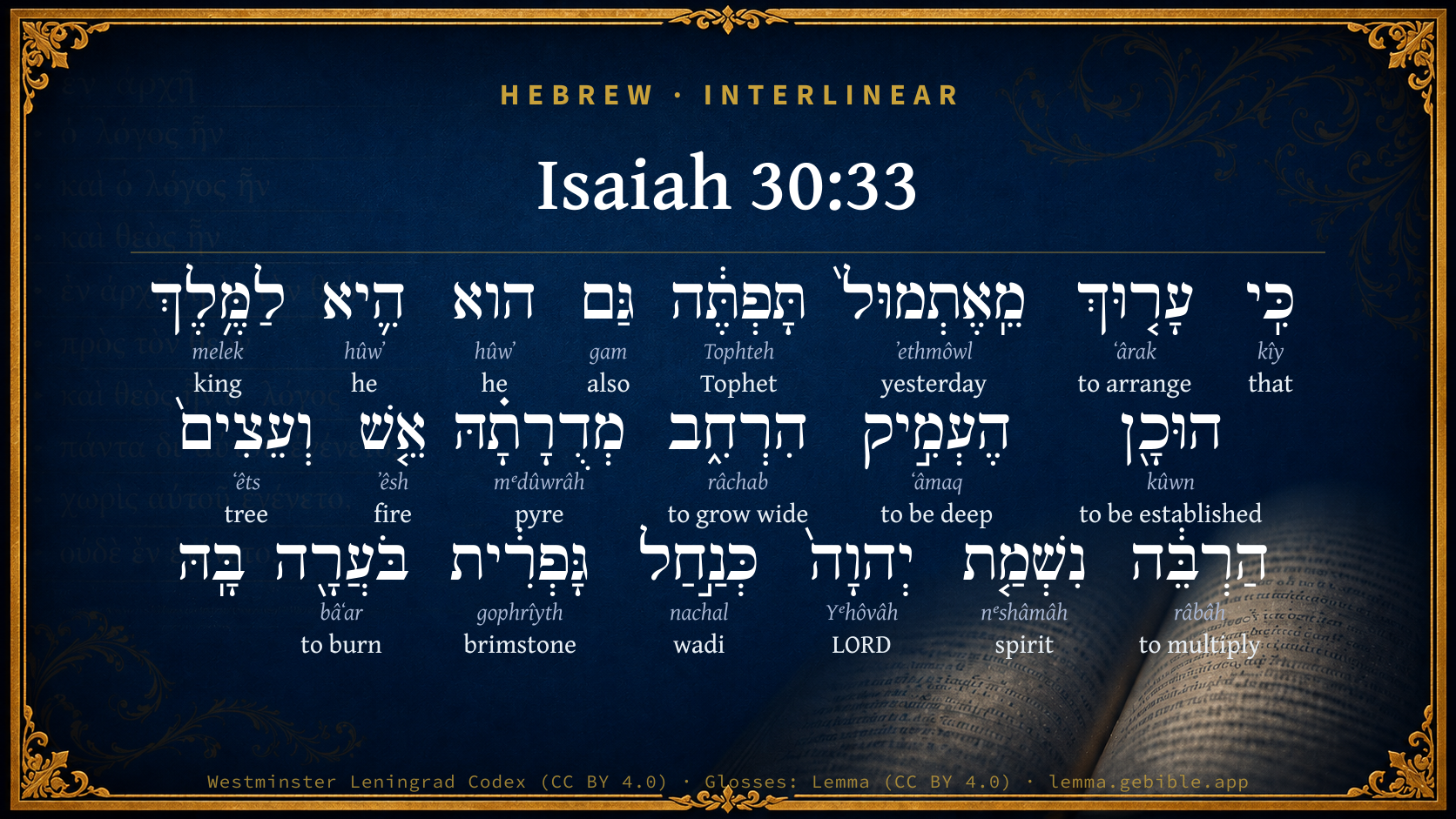
Isaiah 30:33

Hebrew (Westminster Leningrad Codex) Isaiah 30:33 appears in the Hebrew Old Testament. The text above is from the Westminster Leningrad Codex. Each word links to its Strong’s number, a concise gloss, and parsing drawn from the Open Scriptures Hebrew Bible morphology. Click any word for its full Brown-Driver-Briggs (BDB) entry.
Download image
Cite this verse

Isaiah 30:33 (World English Bible). Public Domain. Lemma interlinear Bible study tool, https://lemma.gebible.app/v/isaiah/30/33.

Show BibTeX & RIS
BibTeX
RIS
English Translation
For a Topheth is prepared of old; yes, for the king it is made ready; he has made it deep and large; the pile of it is fire and much wood; the breath of Yahweh, like a stream of sulfur, does kindle it.
World English Bible · Public Domain
Highlights
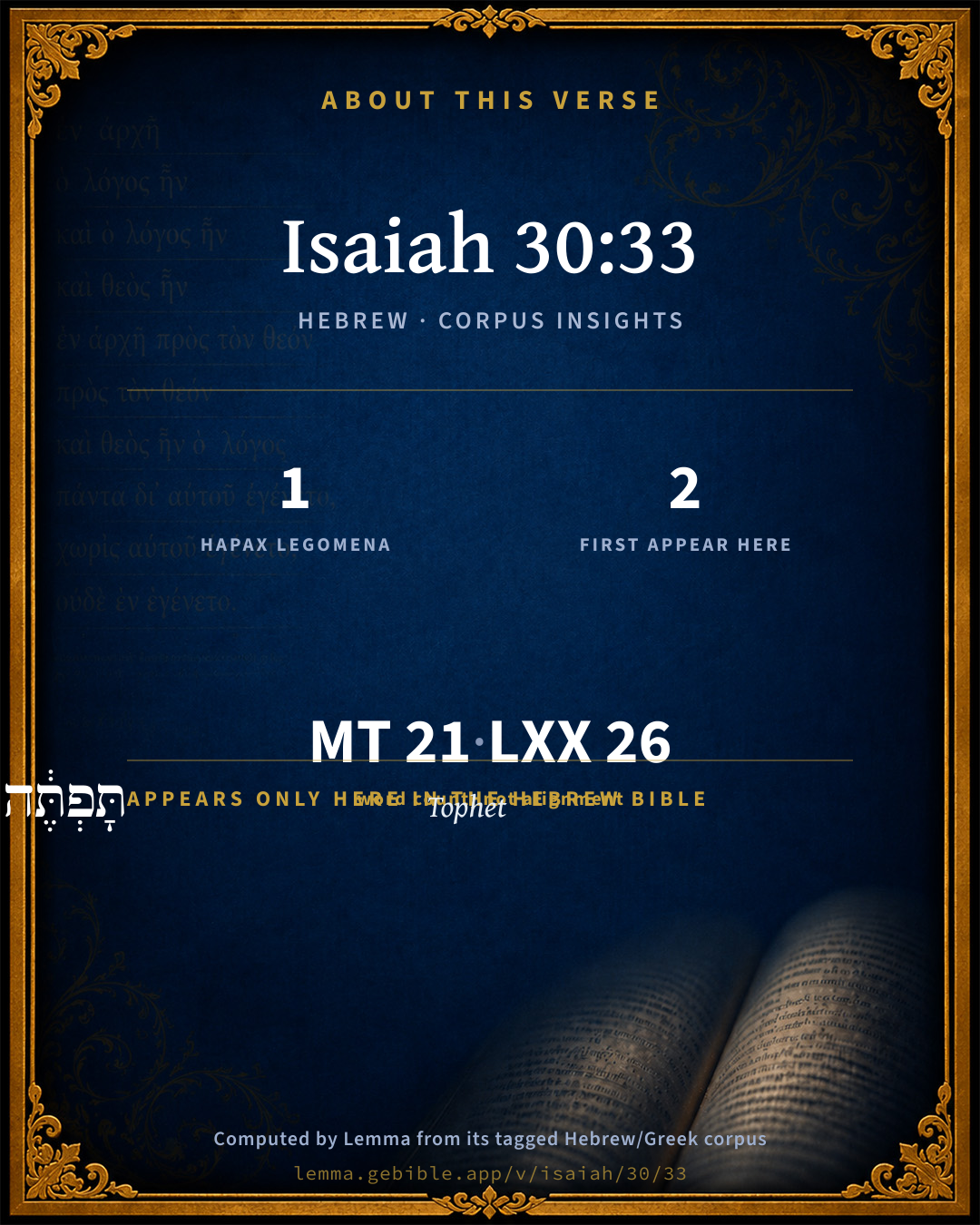
  • 1 hapax legomenon — only here in the Hebrew Bible
  • 2 first appearances in the Hebrew Bible
Full analysis ↓
Download a study sheet

One document with this verse’s original text, its word-by-word gloss line, the meaning frame, cross-references with their text, attributed commentary, and full source and license credits — printable, and it pastes into notes with its structure intact.

This verse Autodidact and up

Study sheet (.html) Plain text (.txt)

A passage Seminary Student

Up to 50 verses in one chapter. A passage sheet keeps up to 6 commentary sources and 12 cross-references per verse, in the order this page ranks them, and says so on the sheet whenever that leaves anything out. Ask for a single verse and you get the Autodidact verse sheet above.

Everything on this page stays free to read, with no account — the sheet is a download of what is already on screen, not access to it.

Want to remove ads? Support Godless Engineer
Compare translations 3

The same verse in 3 English versions, stacked beneath the original-language interlinear above. Click any original word for its lexicon entry.

Each is an independent rendering of the whole verse — the interlinear is not word-aligned to these translations.

Highlighted words mark where these versions differ — a whole-verse word diff, not a word-by-word alignment.

  • World English Bible Public Domain
    For a Topheth is prepared of old; yes, for the king it is made ready; he has made it deep and large; the pile of it is fire and much wood; the breath of Yahweh, like a stream of sulfur, does kindle it.
  • King James Version Public Domain
    For Tophet is ordained of old; yea, for the king it is prepared; he hath made it deep and large: the pile thereof is fire and much wood; the breath of the LORD, like a stream of brimstone, doth kindle it.
  • unfoldingWord Literal Text CC BY-SA 4.0
    For Topheth has been arrayed from long ago; indeed, it, it has been prepared for the king. He has deepened, he has widened, its pile; he makes fire and wood abundant. The breath of Yahweh, like a torrent of brimstone, will be kindling it.

unfoldingWord Literal Text — © unfoldingWord, licensed CC BY-SA 4.0. Word-aligned USFM3 via Door43 (git.door43.org/unfoldingWord/en_ult).

Versions to compare (up to 4)

3 of 4 selected

Show all 18 translations

Every available English version of this verse, each an independent rendering of the whole verse.

  • World English Bible Public Domain
    For a Topheth is prepared of old; yes, for the king it is made ready; he has made it deep and large; the pile of it is fire and much wood; the breath of Yahweh, like a stream of sulfur, does kindle it.
  • Berean Standard Bible Public Domain
    For Topheth has long been prepared; it has been made ready for the king. Its funeral pyre is deep and wide, with plenty of fire and wood. The breath of the LORD, like a torrent of burning sulfur, sets it ablaze.
  • Majority Standard Bible Public Domain
    For Topheth has long been prepared; it has been made ready for the king. Its funeral pyre is deep and wide, with plenty of fire and wood. The breath of the LORD, like a torrent of burning sulfur, sets it ablaze.
  • King James Version Public Domain
    For Tophet is ordained of old; yea, for the king it is prepared; he hath made it deep and large: the pile thereof is fire and much wood; the breath of the LORD, like a stream of brimstone, doth kindle it.
  • American Standard Version (1901) Public Domain
    For a Topheth is prepared of old; yea, for the king it is made ready; he hath made it deep and large; the pile thereof is fire and much wood; the breath of Jehovah, like a stream of brimstone, doth kindle it.
  • Revised Version (1885) Public Domain
    For a Topheth is prepared of old; yea, for the king it is made ready; he hath made it deep and large: the pile thereof is fire and much wood; the breath of the LORD, like a stream of brimstone, doth kindle it.
  • Geneva Bible (1599) Public Domain
    For Tophet is prepared of olde: it is euen prepared for the King: hee hath made it deepe and large: the burning thereof is fire and much wood: the breath of the Lord, like a riuer of brimstone, doeth kindle it.
  • Douay-Rheims (1899) Public Domain
    For Topheth is prepared from yesterday, prepared by the king, deep, and wide. The nourishment thereof is fire and much wood: the breath of the Lord as a torrent of brimstone kindling it.
  • Young's Literal Translation Public Domain
    For, arranged from former time is Tophet, Even it for the king is prepared, He hath made deep, He hath made large, Its pile `is' fire and much wood, The breath of Jehovah, As a stream of brim stone, is burning in it!
  • Literal Standard Version CC BY-SA 4.0
    For Tophet is arranged from former time, || Even it is prepared for the king, || He has made deep, || He has made large, || Its pile [is] fire and much wood, || The breath of YHWH, || As a stream of brimstone, is burning in it!
  • Unlocked Literal Bible CC BY-SA 4.0
    For a place of burning was prepared long ago. Indeed, it is prepared for the king, and God has made it deep and wide. The pile is ready with a fire and much wood. The breath of Yahweh, like a stream of brimstone, will set it on fire.
  • unfoldingWord Literal Text CC BY-SA 4.0
    For Topheth has been arrayed from long ago; indeed, it, it has been prepared for the king. He has deepened, he has widened, its pile; he makes fire and wood abundant. The breath of Yahweh, like a torrent of brimstone, will be kindling it.
  • Darby Bible Public Domain
    For Topheth is prepared of old; for the king also it is prepared: he hath made it deep and large; its pile is fire and much wood; the breath of Jehovah, like a stream of brimstone, doth kindle it.
  • World Messianic Bible Public Domain
    For his burning place has long been ready. Yes, it is prepared for the king. He has made its pyre deep and large with fire and much wood. The LORD’s breath, like a stream of sulfur, kindles it.
  • Webster's Bible Public Domain
    For Tophet is ordained of old; yes, for the king it is prepared; he hath made it deep and large: the pile of it is fire and much wood; the breath of the LORD, like a stream of brimstone, doth kindle it.
  • Free Bible Version CC BY-SA 4.0
    The place of burning has been prepared a long time ago, ready for the king. Its funeral pyre is deep and wide, and has plenty of fire and wood. The breath of the Lord, like a flood of burning sulfur, sets it on fire.
  • Bible in Basic English Public Domain
    For a place of fire has long been ready; yes, it has been made ready for the king; he has made it deep and wide: it is massed with fire and much wood; the breath of the Lord, like a stream of fire, puts a light to it.
  • JPS Tanakh (1917) Public Domain
    For a hearth is ordered of old; yea, for the king it is prepared, deep and large; the pile thereof is fire and much wood; the breath of the LORD, like a stream of brimstone, doth kindle it.

Literal Standard Version (2020), Covenant Press — licensed CC BY-SA 4.0. Text via the HelloAO Bible API (eBible.org). Unlocked Literal Bible (unfoldingWord) — licensed CC BY-SA 4.0. Text via the HelloAO Bible API (eBible.org). unfoldingWord Literal Text — © unfoldingWord, licensed CC BY-SA 4.0. Word-aligned USFM3 via Door43 (git.door43.org/unfoldingWord/en_ult). Free Bible Version, Dr. Jonathan Gallagher — licensed CC BY-SA 4.0. Text via the HelloAO Bible API (eBible.org).

Word by word

More ways to search: Search by grammar → Find every occurrence → Compare this word →

Practice this passage: Drill this verse → Learn its vocabulary →

תָּפְתֶּ֔ה
Tophteh
H8613
“Tophet”
Noun, Proper
Part of Speech
Noun
Type
Proper
Full BDB Definition

Origin: probably a form of H8612

TWOT: None

Tophet = "place of fire" - a place in the southeast end of the valley of the son of Hinnom south of Jerusalem - same as H8612
  1. כִּֽי kîy H3588 “that” Conjunction
  2. עָר֤וּךְ ʻârak H6186 “arranged” Verb, Qal, Participle Passive, Masculine, Singular, Absolute
  3. מֵֽאֶתְמוּל֙ ʼethmôwl H865 “from · yesterday” Preposition + Noun, Common, Masculine, Singular, Absolute
  4. גַּם gam H1571 “also” Particle, Accusative
  5. הוא hûwʼ H1931 “he” Pronoun, Personal, 3rd Person, Masculine, Singular
  6. הִ֛יא hûwʼ H1931 “he” Pronoun, Personal, 3rd Person, Feminine, Singular
  7. לַמֶּ֥לֶךְ melek H4428 “to/for the · king” Preposition, Determined + Noun, Common, Masculine, Singular, Absolute
  8. הוּכָ֖ן kûwn H3559 “to be established” Verb, Hophal, Perfect, 3rd Person, Masculine, Singular
  9. הֶעְמִ֣יק ʻâmaq H6009 “to be deep” Verb, Hiphil, Perfect, 3rd Person, Masculine, Singular
  10. הִרְחִ֑ב râchab H7337 “to grow wide” Verb, Hiphil, Perfect, 3rd Person, Masculine, Singular
  11. מְדֻרָתָ֗הּ mᵉdûwrâh H4071 “pyre · her” Noun, Common, Feminine, Singular, Construct + Suffix, Personal, 3rd Person, Feminine, Singular
  12. אֵ֤שׁ ʼêsh H784 “fire” Noun, Common, Both, Singular, Absolute
  13. וְעֵצִים֙ ʻêts H6086 “and · trees” Conjunction + Noun, Common, Masculine, Plural, Absolute
  14. הַרְבֵּ֔ה râbâh H7235 “to multiply” Verb, Hiphil, Infinitive Absolute
  15. נִשְׁמַ֤ת nᵉshâmâh H5397 “spirit of” Noun, Common, Feminine, Singular, Construct
  16. יְהוָה֙ Yᵉhôvâh H3068 “LORD” Noun, Proper
  17. כְּנַ֣חַל nachal H5158 “like/as · wadi of” Preposition + Noun, Common, Masculine, Singular, Construct
  18. גָּפְרִ֔ית gophrîyth H1614 “brimstone” Noun, Common, Feminine, Singular, Absolute
  19. בֹּעֲרָ֖ה bâʻar H1197 “burning” Verb, Qal, Participle Active, Feminine, Singular, Absolute

About this verse

These counts appear in no published source. They are computed here, from the morphology-tagged text and Lemma’s own curated glosses. What Lemma adds →

21
words
19
distinct lemmas
Prophets
section

Notable vocabulary

1 hapax legomenon — a word that appears only here in the entire Hebrew Bible:

  • תָּפְתֶּ֔ה Tophet H8613

First appearance in Scripture

These words make their first canonical appearance in the Hebrew Bible here:

  • תָּפְתֶּ֔ה Tophet H8613
  • מְדֻרָתָ֗הּ pyre H4071

Shared distinctive vocabulary

מְדֻרָתָ֗הּ pyre H4071 occurs in 2 verses of the Hebrew Bible. Also found in:

Grammatical profile

  • 6 verbs
  • 10 nouns
  • 2 pronouns
  • 1 preposition
  • 1 conjunction
  • 1 particle

Verb forms

  • עָר֤וּךְ Qal · Participle Passive
  • הוּכָ֖ן Hophal · Perfect
  • הֶעְמִ֣יק Hiphil · Perfect
  • הִרְחִ֑ב Hiphil · Perfect
  • הַרְבֵּ֔ה Hiphil · Infinitive Absolute
  • בֹּעֲרָ֖ה Qal · Participle Active

Repetition

A word recurs within this verse — often emphatic in Hebrew:

Hebrew & Septuagint length

In English translation the verse runs 43 words from the Hebrew and 45 from the Septuagint (LXX English) — closely comparable.

A rough comparison of the two English renderings, which tokenize alike — not a word-level alignment.

Word counts can differ between the Hebrew and the Greek without any difference in meaning — e.g. the Hebrew direct-object marker אֵת has no separate Greek word, and Greek often adds the article ὁ.

In the original languages it is 21 Hebrew tokens and 26 Greek tokens — but the two are counted differently (Hebrew bundles its prefixes and suffixes into one token; the Greek is in lemma form), so that isn’t a like-for-like length.

Cross-references

18

Topical passages linked to Isaiah 30:33 in the Treasury of Scripture Knowledge — connected by theme and wording, ordered by reader-vote popularity; previews shown in the World English Bible.

  • 2 Kings 23:10 He defiled Topheth, which is in the valley of the children of Hinnom, that no man might make his son or his daughter to pass through the fire to Molech.
  • Genesis 19:24 Then Yahweh rained on Sodom and on Gomorrah sulfur and fire from Yahweh out of the sky.
  • Jeremiah 19:6 therefore, behold, the days come, says Yahweh, that this place shall no more be called Topheth, nor The valley of the son of Hinnom, but The valley of Slaughter.
  • Hebrews 13:8 Jesus Christ is the same yesterday, today, and forever.
  • 1 Peter 1:8 whom not having known you love; in whom, though now you don't see him, yet believing, you rejoice greatly with joy unspeakable and full of glory--
  • Jeremiah 7:31–32 They have built the high places of Topheth, which is in the valley of the son of Hinnom, to burn their sons and their daughters in the fire; which I didn't command, neither came it into my mind.
  • Jeremiah 19:11–14 and shall tell them, Thus says Yahweh of Hosts: Even so will I break this people and this city, as one breaks a potter's vessel, that can't be made whole again; and they shall bury in Topheth, until there be no place to bury.
  • Matthew 4:22 They immediately left the boat and their father, and followed him.
  • Revelation 14:10–11 he also will drink of the wine of the wrath of God, which is prepared unmixed in the cup of his anger. He will be tormented with fire and sulfur in the presence of the holy angels, and in the presence of the Lamb.
  • Revelation 19:18–20 that you may eat the flesh of kings, the flesh of captains, the flesh of mighty men, and the flesh of horses and of those who sit on them, and the flesh of all men, both free and slave, and small and great."
  • Isaiah 14:9–20 Sheol from beneath is moved for you to meet you at your coming; it stirs up the dead for you, even all the chief ones of the earth; it has raised up from their thrones all the kings of the nations.
  • Isaiah 30:27–28 Behold, the name of Yahweh comes from far, burning with his anger, and in thick rising smoke: his lips are full of indignation, and his tongue is as a devouring fire;
  • Isaiah 37:38 It happened, as he was worshipping in the house of Nisroch his god, that Adrammelech and Sharezer his sons struck him with the sword; and they escaped into the land of Ararat. Esar Haddon his son reigned in his place.
  • Ezekiel 32:22–23 Asshur is there and all her company; her graves are round about her; all of them slain, fallen by the sword;
  • Matthew 18:8–9 If your hand or your foot causes you to stumble, cut it off, and cast it from you. It is better for you to enter into life maimed or crippled, rather than having two hands or two feet to be cast into the eternal fire.
  • Matthew 25:41 Then he will say also to those on the left hand, 'Depart from me, you cursed, into the eternal fire which is prepared for the devil and his angels;
  • Jude 1:4 For there are certain men who crept in secretly, even those who were long ago written about for this condemnation: ungodly men, turning the grace of our God into lasciviousness, and denying our only Master, God, and Lord, Jesus Christ.
  • Psalms 40:5–6 Many, Yahweh, my God, are the wonderful works which you have done, And your thoughts which are toward us. They can't be set in order to you; If I would declare and speak of them, they are more than can be numbered.

Cross-references courtesy of OpenBible.info (CC BY 4.0).

Hebrew and Greek witnesses Masoretic Hebrew ↔ Greek Septuagint

The same verse in the two great witnesses to the Old Testament, shown verse-for-verse.

These are two independent witnesses, not word-aligned to each other, and the Septuagint is shown in lemma (dictionary) form.

Hebrew Isaiah 30:33 Masoretic · Westminster Leningrad Codex

כִּֽי עָר֤וּךְ מֵֽאֶתְמוּל֙ תָּפְתֶּ֔ה גַּם הוא הִ֛יא לַמֶּ֥לֶךְ הוּכָ֖ן הֶעְמִ֣יק הִרְחִ֑ב מְדֻרָתָ֗הּ אֵ֤שׁ וְעֵצִים֙ הַרְבֵּ֔ה נִשְׁמַ֤ת יְהוָה֙ כְּנַ֣חַל גָּפְרִ֔ית בֹּעֲרָ֖ה בָּֽהּ

For a Topheth is prepared of old; yes, for the king it is made ready; he has made it deep and large; the pile of it is fire and much wood; the breath of Yahweh, like a stream of sulfur, does kindle it.

World English Bible · Public Domain

Greek LXX Isaiah 30:33 Septuagint · lemma form

σύ γάρ πρό ἡμέρα ἀποαἰτέω μή καί σύ ἑτοιμάζω βασιλεύω φάραγξ βαθύς ξύλον κεῖμαι πῦρ καί ξύλον πολύς ὁ θυμός κύριος ὡς φάραγξ ὑπό θεῖος καίω

For you shall be required before your time: has it been prepared for you also to reign? nay, God has prepared for you a deep trench, wood piled, fire and much wood: the wrath of the Lord shall be as a trench kindled with sulphur.

LXX2012 (modern English Septuagint) · Public Domain

Hebrew: Westminster Leningrad Codex (CC BY 4.0). Greek: Septuagint (public domain); English from LXX2012 (modern English Septuagint) (Public Domain). How the Septuagint differs from the Hebrew →

Targum (Aramaic paraphrase)

1

The Targum is the ancient Jewish Aramaic paraphrase of the Hebrew Scriptures — an interpretive translation, not the Hebrew text itself. Onkelos (literal) and Pseudo-Jonathan (expansive) render the Torah, and Jonathan the Prophets. Coverage is partial: where no permissively-licensed English translation exists for a verse, only the Aramaic is shown. This is verse-level text, not a word-by-word alignment to the Hebrew.

  1. Targum Jonathan Prophets (Joshua–Malachi)
    אֲרֵי מְסִדְרָא מִן עַלְמִין לָקֳבֵיל חוֹבֵיהוֹן גֵהִנָם אַף הִיא מְלַךְ עָלְמַיָא אַתְקָנָא לַעֲמִיקָא וּלְאַפְתָּאָה מְדוּרָא דְאֶשְׁתָּא דָלְקָא בָהּ כַּד בָּאָעִין סַגִיאִין מֵימְרָא דַייָ כְּנַחַל מַגְבַּר גָפְרִית דָלְקָא בָהּ:

    For hell is made ready from eternity on account of their sins; yea, the eternal King hath prepared it deep and wide: a fiery pyre as of abundance of fuel burns in it: the WORD of the Lord, like an overwhelming torrent of brimstone, shall kindle it.

    Targum Jonathan — Aramaic: “Mikraot Gedolot” (public domain). English: “Sefaria Community Translation” (CC0 1.0 (public-domain dedication)); “London "Chaldee Paraphrase," 1871” (public domain). Text via Sefaria.

Commentary

Notes on Isaiah 30:33 from classic Christian and Jewish commentators (each source and its license shown beneath its notes). The classic Christian expositions comment on the surrounding passage and are grouped to its opening verse, so a note may address several verses; the Jewish commentaries on the Tanakh (Rashi and others) are per-verse, so they appear only where the commentator wrote on this verse.

Lemma curates 59 commentaries, every one of them public domain or Creative Commons licensed, each selected and text-cleaned for this edition rather than reprinted as found. About our sources →

Trapp's Complete Commentary

John Trapp

Isa 30:33 For Tophet [is] ordained of old; yea, for the king it is prepared; he hath made [it] deep [and] large: the pile thereof [is] fire and much wood; the breath of the LORD, like a stream of brimstone, doth kindle it.

Ver. 33. For Tophet is ordained.] Heb., Tophteh which some derive of Pathah, to entice or seduce, because hell draweth customers; and is called also infernus ab inferendo, from the great resort that is to it. But others fetch the name from toph, a drum, because those idolaters who sacrificed their children to Moloch or Saturn, in the valley of Hinnom, struck up drums to drown the cries of those poor tortured children. Hence it is here used for hell, together with that eternity of extremity which the damned there endure; and this the Assyrians are here threatened with, yea, their very king, whose preservation from the stroke of the angel was but a reservation to a worse mischief here and hereafter. For patentes potenter torquebunter, great men, if not good, shall be greatly tormented; and the more they have of the fat of the earth, the more they are sure to fry in hell. Such, therefore, had need to add true grace to their high places, else they shall prove but as a high gibbet to bring them to more disgrace in this world, and torment in the next.

Of old.] Heb., From yesterday. Hence some infer that hell torments are always fresh and new, as if they had begun but yesterday; and "every sacrifice there is salted with fire," {Mar 9:49} that is, it burneth, but consumeth not; fire being of a burning, but salt of a preserving nature.

He hath made it deep and large.] Capacious enough to receive a world full of wicked ones. {Psa 9:17}

The pile thereof is fire and much wood.] Hell fire is no metaphorical thing, but a material, true, proper, real, and corporeal fire. {Mat 18:9; Mat 25:41 Luk 16:23} For vehemency of heat, saith Augustine, it exceedeth ours as far as our fire doth exceed fire painted on the wall. That friar said too little of it who said that one might feel it burn seven miles off. Etna, Vesuvius, Pietra Mala (which is a mountain in the highest part of the Apennines that perpetually burns), come not near it. Some gross Papists have imagined Etna to be the place of purgatory. Odilo, abbot of Cluniscum, persuaded Pope John XIX that he had there seen the tormented souls wailing: whereupon that pope appointed the feast of All-souls.

The breath of the Lord, as a stream of brimstone.] This formidable fire, then, is fed with most tormenting temper, rivers of brimstone, and kindled with the breath of the Almighty throughout all eternity. Simile quiddam videmus in thermis, ubi sulphureae scaturigines magno fremitu effervescunt. Some resemblance hereof we have in the hot baths, &c.

John Trapp, A Commentary or Exposition upon All the Books of the Old and New Testament (1647–1656) — public domain. Text from a community e-Sword module.

The Biblical Illustrator

Joseph S. Exell

Isa_30:33

For Tophet is ordained of old

The annihilation of the Assyrian power

The annihilation of the Assyrian power is graphically set forth as one great funeral obsequy, such as were well known among Eastern nations.

The Divine command prepares the Tophet or pyre; and in its flames all the glory of Assyria shall consume away. What had been prepared by human wisdom for the idolatrous worship of Moloch, shall now by Divine decree be used for Assyrias destruction: her king shall be the great victim. (Buchanan Blake, B. D.)

The destruction of Assyria in Tophet

The description is, of course, figurative; and the details, as is often the case in prophecy, are not to be understood literally; they merely constitute the drapery in which the prophet clothes his idea. No such scene as is here described was ever actually enacted; Sennacherib, in point of fact, perished twenty years after his invasion of Judah, in his own land being assassinated by his own sons Isa_37:38). (Prof. S. R. Driver, D. D.)

The wicked man warned

I. The first doctrine that we have is--that THERE IS A HELL.

1. Justice requires it. If a man sins, doth not justice require that he should be punished?

2. But more than this, doth not Divine benevolence require it? Would it be benevolent in any man to propose to take away our police, to pull down our gaols, to abolish our penal settlements, and to stop forever all imprisonment and punishments for sin? It might appear to be liberal and charitable, but the fate of the rest of the community would be so direful that verily we might say, Build up the gaols once more! Let it be seen that sin cannot go unpunished here, and that the ruler beareth not the sword in vain!

3. We ask, If there were no hell for the wicked, where are they to be put to? The answer is, Why, let them all go to Heaven. But have you never heard me expose the absurdity of the idea of a wicked man being carried to Heaven as he is?

4. O sinner! why need I argue that Tophet is ordained of old? Is there not something within thyself which tells thee that there is such a place?

5. How is it that so many people in the world are always laughing at the idea of hell? I will tell you. The worse men are, the less they like hell. Scorning is sweet to the mouth, but it is bitter afterwards.

II. THE SIZE OF THIS PLACE. It is deep and large. We do delight in the thought that Heaven is great and large; that there will be more saved than there will be lost. But this is a sad thought to us--that hell is deep and large. Persons say that if the heathen lives up to his light and knowledge, will he not be saved by the blood of Christ? The heathen does not live up to his light and knowledge, and, therefore, it is an assumption that is not correct. Tophet is deep and large. There is room for you great sinners, room for you rich sinners, room for you proud, stiff-necked sinners, room for the whole mass of sinners, for though you should join in hand, yet shall not the wicked go unpunished.

III. THE FUEL OF IT. The pile thereof is fire and much wood. The wicked are their own woodmen; they find their own fuel for their own flame.

IV. THE FLAME OF IT. The breath of the Lord, like a stream of brimstone, doth kindle it. What kind of breath will that be?

1. It will be His condemning breath. God on high will breathe out sentences of condemnation against the wicked perpetually.

2. His reproving breath. For He will be always saying, Son, remember, remember such s time you heard a sermon; such a time you sinned; such a time your conscience smote you; such a time in your life you attended Sabbath school; such a time you cursed Me to My face; such a time you blasphemed My day; such a time you spoke ill of My servants; such a time you did this; such a time you did that.

3. The eternal life of God Himself shall kindle the flame breath of God shall keep the flame burning. (C. H. Spurgeon.)

.

The Biblical Illustrator, edited by Joseph S. Exell (c. 1880s–1900s) — public domain. Text from a community e-Sword module.

Joseph Benson's Commentary

Isa 30:33. For Tophet is ordained of old — “Tophet is a valley very near to Jerusalem, to the southeast, called also the valley of Hinnom, or Gehenna; where the Canaanites, and afterward the Israelites, sacrificed their children, by making them pass through the fire; that is, by burning them in the fire, to Moloch.” It is supposed to have been called Tophet, from the drums, timbrels, or tabrets, which sounded there, to drown the cries of the children thus inhumanly murdered: see notes on Lev 18:21; 2Ki 23:10; and Jos 15:8. Hence the word “is used for a place of punishment by fire, and by our Saviour in the gospel for hell-fire, as the Jews themselves had applied it.” As the place had been thus polluted by idolatry, Josiah, to render it as despicable and abominable as possible, ordered the filth of the city and dead carcasses to be thrown there, and made it a common burying-place. There also fires were kept continually burning, as the Jews say, to consume dead bodies, bones, and such sordid things. Vitringa justly observes, “that Tophet must be understood here, not in a literal, but in a figurative sense, for the place of punishment to be inflicted upon the Assyrians, by the burning indignation of God; in the same manner as gehenna denotes the place of punishment of the reprobate: that the fire and much wood denote the matter of the punishment destined for the king of Assyria and his army, as well with respect to its nature and effect, as its cause: see Rev 19:20. The making the valley deep and large, signifies the same as the pile constructed of much wood; namely, the greatness of the destruction to be spread through the extensive army of the Assyrian; and indeed it was necessary this valley and this pile should be large, to contain one hundred and eighty-five thousand men. The meaning of the phrase, ordained of old, is, that God had absolutely fixed and determined this event. It was prepared for the king; whereby the prophet shows, that his army first, and Sennacherib himself afterward, should become obnoxious to the divine judgment. And the last phrase, the breath of the Lord, &c., alludes to the destroying angel, the executors of his judgment: see Isa 10:17. This is the literal interpretation of the words, wherein the prophet represents the Assyrian destruction as the type of that of all the enemies and persecutors of the church; and further, these destructions as a figure of the infernal fire, wherein the unbelieving and cruel persecutors of the church shall be tormented for ever, and which is said to be prepared for the devil and his angels,” Mat 25:41.

Joseph Benson's Commentary on the Old and New Testaments (1811–1818) — public domain. Text from a community e-Sword module.

The Preacher's Complete Homiletical Commentary

Joseph S. Exell (gen. ed.)

TOPHET ORDAINED OF OLD

Isa_30:33. For Tophet is ordained of old, &c.

Some of us have often admired the expression, “Knowing the terrors of the Lord, we persuade men;” implying that the law of persuasion should be the law of the Christian pulpit. Some would alarm men, some would bitterly rail, and others thunder at them; as though the human heart could never be prevailed upon to capitulate, but must always be taken by storm. Paul shows us the more excellent way. When he proclaims “the terrors of the Lord,” it is “to persuade men;” to persuade them to escape the ruin and to accept the remedy. Observe, he does not hide them, for the truth must be told, sin must be condemned, the wicked must be warned.

I. Let us examine the local allusion and literal meaning of this verse. “This allusion to Tophet is the earliest which appears in the Scriptures. Additional particulars appear in the history of Josiah’s reformation (2Ki_23:10; Jer_7:31). The prophet Isaiah here represents Tophet as a place prepared for the burning of the Assyrian king. Made deep and large, with fire and wood in abundance, prepared for the king, and he being thrown into it, the breath of the Lord kindles it into fearful conflagration. This is, of course, a figurative description, Tophet being made the central point in the figure because it was a well-known place, a valley just outside the city, the valley of Hinnom, used for burning all the offal and filth of the city of Jerusalem.” Isaiah was commissioned to utter this prophecy of the overthrow and consuming of the Assyrian army, in order to inspirit Hezekiah and the people against the threatened invasion. “Tophet is ordained of old” as that fiery place which would consume the dead bodies of these unjust invaders. Hence the Chaldee paraphrase says, “It was called the valley of the carcases and of the ashes or of the dead bodies for this reason, because the dead bodies of the camp of the Assyrians fell there;” to which Josephus gives testimony when he relates that the place was called the Assyrian camp. What force these recollections would give to our Lord’s threatenings of hell to the Jews who saw the smoke of this valley always rising before their eyes (compare Isa_66:24 with Mar_9:43-48).

II. Note some of those solemn and awakening truths suggested by this verse.

1. The same record which provides for the security of the Church, provides for the final overthrow of its enemies. This was the time of Jacob’s extremity; he was saved, and his enemies consumed.

2. In the enjoyment of our highest privileges, we are surrounded by the most solemn terrors. Tophet lay not only near, but at the very foot of Mount Zion. From the heights of Zion might be seen the smoke, the fire, and the worm in the valley of Tophet! A dreadful thought this! Hell is set full in our view when worshipping in Zion (1Pe_4:17-18). Bunyan says, “So I saw a man may go by profession to heaven’s gate and yet be cast away.” Our Lord (Luk_13:25).

3. While no combination of power can shield the wicked, the believer has always a source of safety and a song of joy.—Samuel Thodey.

The Preacher's Complete Homiletical Commentary (gen. ed. Joseph S. Exell; Funk & Wagnalls, c. 1892) — public domain (pre-1929). A full-Bible homiletical/sermon-outline anthology covering 65 of 66 books (2 John is absent from the source module). Text from a community e-Sword module.

Tyndale Open Study Notes

Tyndale Open Resources

30:33 Topheth was a pagan altar in the valley of Ben-Hinnom outside Jerusalem where child sacrifices were offered to the Ammonite god Molech by burning (2 Kgs 23:9-10).

Tyndale Open Study Notes — © Tyndale Open Resources, licensed CC BY-SA 4.0. Text via the HelloAO Bible API.

Geneva Bible (1599)

Geneva Bible translators

By these figurative speeches he declareth the condition of the wicked after this life.

Here it is taken for hell, where the wicked are tormented, read 2 Kings 23:10.

So that their estate or degree cannot exempt the wicked.

Geneva Bible (1599) marginal notes — public domain. Text via Bolls.life.

Jamieson, Fausset & Brown

Robert Jamieson, A. R. Fausset & David Brown

Tophet--literally, "A place of abomination"; the valley of the sons of Hinnom, southeast of Jerusalem, where Israel offered human sacrifices to Moloch by fire; hence a place of burning (Kg2 23:10; Jer 7:31). Latterly Gehinnom or Gehenna, that is, valley of Hinnom, was the receptacle of the refuse of the city, to consume which fires were constantly burning. Hence it came to express hell, the place of torment. In the former sense it was a fit place to symbolize the funeral pyre of the Assyrian army (not that it actually perished there); the Hebrews did not burn, but buried their dead, but the heathen Assyrians are to be burnt as a mark of ignominy. In the latter sense Tophet is the receptacle "prepared for the devil (antitype to the king, Isa 14:12-15) and his angels," and unbelieving men (Mat 5:22; Mat 25:41; Mar 9:43-44).

Next: Isaiah Chapter 31

Jamieson, Fausset & Brown — Commentary Critical and Explanatory on the Whole Bible (1871) — public domain (CC PDM 1.0). Text via the HelloAO Bible API.

Adam Clarke's Commentary

Verse 33. For Tophet is ordained] Tophet is a valley very near to Jerusalem, to the southeast, called also the valley of Hinnom or Gehenna; where the Canaanites, and afterwards the Israelites, sacrificed their children, by making them pass through the fire, that is, by burning them in the fire, to Molech, as some suppose. It is therefore used for a place of punishment by fire; and by our blessed Saviour in the Gospel for hell-fire, as the Jews themselves had applied it. See Chald. on Isa 33:14, where מוקדי עלם mokedey olam is rendered "the Gehenna of everlasting fire." Here the place where the Assyrian army was destroyed is called Tophet by a metonymy; for the Assyrian army was destroyed probably at a greater distance from Jerusalem, and quite on the opposite side of it: for Nob is mentioned as the last station, from which the king of Assyria should threaten Jerusalem, Isa 10:32, where the prophet seems to have given a very exact chorographical description of his march in order to attack the city; which however he never reached. - L.

Adam Clarke's Commentary on the Bible (1810–1826) — public domain. Text from a community e-Sword/MySword module.

Ellicott's Commentary for English Readers

(33) Tophet is ordained of old.—Literally, the Tophet, or place of burning, with perhaps the secondary sense of “a place of loathing.” Tophet was the name given to the Valley of Hinnom, outside Jerusalem, where, within the memory of living men, Ahaz had made his son to pass through the fire to Moloch (2Ki_16:3), and where like sacrifices had taken place up to the time of Hezekiah’s accession. “The king” is, of course, the king of Assyria; but the Hebrew, “for the melek,” suggests a sarcastic reference to the god there worshipped, as if it were “for Moloch.” There was to be a great sacrifice of the Melek to the Moloch, who was as a mighty king (the name of the Ammonite god being a dialectic form of the Hebrew Melek) exulting in his victims. (Comp. for the idea Isa_31:9.)

The pile thereof is fire and much wood.—The word seems partly literal, and partly figurative. The king of Assyria, though he did not die at Jerusalem, is represented as burnt with stately ceremonial in Tophet. Probably, as a matter of fact, it was the burial place of the corpses that were lying round the city after the pestilence had destroyed the Assyrian army, and they were literally burnt there. For such a Moloch funeral, making the valley of Hinnom then, as it afterwards became, a fit type of Gehenna, a trench deep and wide and a mighty pyre were needed. Comp. Jer_19:12, where like words are spoken of Jerusalem.

A Bible Commentary for English Readers, edited by Charles John Ellicott (1878–1897) — public domain. Text from a community e-Sword module.

The Cambridge Bible for Schools and Colleges

gen. ed. J. J. S. Perowne

33. For Tophet is ordained of old] Render: For a burning-place is already laid out. Tophet is the name of a spot in the valley of the son of Hinnom, south of Jerusalem, where human sacrifices were offered to the god Melek or Molek (2Ki_23:10; Jer_7:31 f., Isa_19:6; Isa_19:13). According to Prof. Robertson Smith (Religion of the Semites, p. 377) the word was originally pronounced Tìphath, and, like its equivalents in Aramaic and Arabic, meant simply “fireplace.” This view seems preferable to the common derivation, which explains it as a term of contempt (“spitting” Job_17:6); and it accounts for the generic sense which the word undoubtedly has in this passage (where, however, a bye-form tophteh is used). “The Tophet” was so-called because the most distinctive feature of the revolting rites there practised was the burning of the victims in a great pit dug in the ground, which constituted the “fireplace.”

yea, for the king it is prepared] lit. “even it is prepared for the king” (not “even for the king it is prepared”). The “king” might be either the king of Assyria, or the god “Melek” (Molech), or a play of words alluding to both. But a “witty allusion” in such a passage leads us to suspect the hand of a glossator. The objection to understanding it of the king of Assyria is that the emphasis rests on “it” and not on “the king.”

the pile thereof] Cf. Eze_24:9. For “fire” some other word must have been used; perhaps “coals of fire” (נחלי omitted before אשׁ).

The Cambridge Bible for Schools and Colleges (gen. ed. J. J. S. Perowne; Cambridge University Press, 1878–1918) — public domain. Text from a community e-Sword module.

John Gill's Exposition

For Tophet is ordained of old,.... The place long ago appointed for the ruin of the Assyrian army, which pitched here: this was a valley near Jerusalem, the valley of the son of Hinnom; so called, from the drums and tabrets beat upon here, to prevent parents hearing the cries of their infants offered to Molech: into it was brought the filth and dung of the city; here malefactors were buried, it is said; and such as were condemned to burning were burned here; and such as had no burial were cast here; so that it was an image and picture of hell itself: and the word "Gehenna", used for hell, comes from "Gehinnom", or the valley of Hinnom, the name of this place; and some think that is here meant, which from all eternity was appointed as the place of torment for wicked men, So the Targum,

"for hell is ordained from the worlds (or before the worlds), because of their sins.''

It is in the original, "from yesterday": hence Jarchi interprets it of the second day of the creation, which had a yesterday; on which day the Jews suppose hell was made: and so it is interpreted in the Talmud (p), where it is said to be one of the seven things created before the world was, and is proved from this text; and said to be called Tophet, because whoever is deceived by his imagination (or evil concupiscence) falls into it; See Gill on Mat 25:41 with this compare Jde 1:4,

yea, for the king it is prepared; for Sennacherib king of Assyria; that is, for his army, which perished here, though he did not; or for kings, the singular for the plural; for his princes, which, as he boastingly said, were "altogether kings", Isa 10:8 and particularly for Rabshakeh, the general of his army, who might be so called, and was eminently one of these kings. Understood of hell, it may not only be interpreted of Satan, the king and prince of devils, for whom and his angels the everlasting fire of hell is prepared, Mat 25:41 but also of antichrist, the king of the bottomless pit, and of all antichristian kings; see Rev 11:9. Some render it, "by the king it is prepared"; so the Vulgate Latin version; by whom may be meant either Hezekiah, who cleared it from idols and idolatrous worship, and so eventually prepared it to make room for the Assyrian army; or else the King of kings. So the Targum,

"the King of worlds (of all worlds) prepared it;''

and he seems manifestly designed in the next clause:

he hath made it deep and large; to hold the whole army alive, and to bury them when dead; and so hell is large and deep enough to hold Satan and all his angels, antichrist and all his followers; yea, all the wicked that have been from the beginning of the world, and will be to the end of it:

the pile thereof is fire and much wood; alluding to the burning of bodies in this place, and particularly of infants sacrificed to Molech; and refers to the burning of the Assyrian army, either by lightning from heaven, or by the Jews when they found them dead the next morning. In hell, the "fire" is the wrath of God; the "wood" or fuel ungodly men:

the breath of the Lord, like a stream of brimstone, doth kindle it; the pile of fire and wood. The Targum is,

"the word of the Lord, like an overflowing torrent of brimstone, shall kindle it;''

it shall be done by his order, at his word of command. In hell, the wrath of God will be like a continual stream of brimstone, keeping up the fire of it, so that it shall ever burn, and never be quenched; hence it is called a lake burning with fire and brimstone; into which Satan, the beast, and false prophet, and the worshippers of antichrist, will be cast, Rev 14:10. The allusion is to the fire and brimstone rained by Jehovah, from Jehovah, upon Sodom and Gomorrah, Gen 19:24.

(p) T. Bab. Pesachim, fol. 54. 1. Nedarim, fol. 39. 2. & Erubim, fol. 19. 1.

Next: Isaiah Chapter 31

John Gill's Exposition of the Whole Bible (1746–1763) — public domain (CC PDM 1.0). Text via the HelloAO Bible API.

Albert Barnes' Notes on the Bible

For Tophet - The same idea is conveyed in this verse as in the preceding, but under another form, and with a new illustration. The sense is, that the army of the Assyrians would be completely destroyed, as if it were a large pile of wood in the valley of Hinnom that should be fired by the breath of God. The word (תפתה tâpeteh) with the ה (h) paragogic), denotes properly what causes loathing or abhorrence; that which produces disgust and vomiting (from the Chaldee תיף tūph to spit out); Job 17:6, ‘I was an “abhorrence’” (תפת tôpheth), improperly rendered in our version, ‘I was among them as a tabret.’ The word occurs only in 2Ki 23:10; Jer 7:31-32; Jer 19:6, Jer 19:11, Jer 19:13-14, and in this place. It is applied to a deep valley on the southeast of Jerusalem, celebrated as the seat of idolatry, particularly of the worship of Moloch. The name also of ‘the valley of Hinnom’ was given to it; and hence, the name “Gehenna” γέεννα geenna, Mat 5:22, Mat 5:29-30; Mat 10:28; Mat 18:9; Mat 23:15, Mat 23:33; Mar 9:43, Mar 9:45, Mar 9:47; Luk 12:5; Jam 3:6), as denoting the place of future torments, of which the valley of Hinnom, or Tophet, was a striking emblem.

This valley was early selected as the seat of the worship of Moloch, where his rites were celebrated by erecting a huge brass image with a hollow trunk and arms, which was heated, and within which, or on the arms of which, children were placed as a sacrifice to the horrid idol. To drown their cries, drums were beaten, which were called תף tôph, or תפים tôphiym, and many suppose the name Tophet was given to the place on this account (see 2Ki 16:3; 2Ki 21:6; 2Ki 23:10). The name ‘valley of Hinnom,’ or Gehenna, was probably from the former possessor or occupier of that name. In subsequent times, however, this place was regarded with deep abhorrence. It became the receptacle of all the filth of the city; and hence, in order to purify the atmosphere, and prevent contagion, it was needful to keep fires there continually burning. It was thus a most striking emblem of hell-fire, and as such is used in the New Testament. Hezekiah was firmly opposed to idolatry; and it is not improbable that he had removed the images of Moloch, and made that valley the receptacle of filth, and a place of abomination, and that the prophet refers to this tact in the passage before us.

Is ordained - Was fitted up, appointed, constituted. The prophet by a figure represents Hezekiah as having fitted up this place as if for the appropriate punishment of the Assyrians.

Of old - Margin, as in Hebrew, ‘From yesterday.’ This expression may mean simply ‘formerly, some time since,’ as in Exo 4:10; 2Sa 3:17. The idea here seems to be, that Tophet had been formerly, or was already prepared as if for the destruction of Sennacherib and his army. His ruin would be as certain, and as sudden, “as if,” in the valley of Tophet, the breath of Yahweh should set on fire the vast materials that had been collected, and were ready to be kindled. It does not mean that Tophet had actually been prepared “for” the army of Sennacherib; it does not mean that his army would actually be destroyed there - for it was on the other side of the city that they were cut off (see the notes at Isa 10:32); it does not mean that they would be consigned to hell-fire; but it means that that place had been fitted up as if to be an emblematic representation of his ruin; that the consuming fires in that valley were a striking representation of the sudden and awful manner in which the abhorred enemies of God would be destroyed.

For the king is prepared - For Hezekiah; as if the place had been fitted up for his use in order to consume and destroy his enemies. It is not meant that Hezekiah actually had this in view, but the whole language is figurative. It was as if that place had been fitted up by Hezekiah as a suitable place in which entirely to destroy his foes.

He hath made it deep and large - Vast; as if able to contain the entire army that was to be destroyed.

The pile thereof - The wood that was collected there to be consumed.

The breath of the Lord - As if Yahweh should breathe upon it, and enkindle the whole mass, so that it should burn without the possibility of being extinguished. The meaning is, that the destruction of the Assyrian would as really come from Yahweh as if he should, by his own agency, ignite the vast piles that were collected in the valley of Hinnom.

Like a stream of brimstone - Brimstone, or sulphur, is used in the Scriptures to denote a fire of great intensity, and one that cannot be extinguished Gen 19:24; Psa 11:6; Eze 38:22; Rev 9:17-18. Hence, it is used to denote the eternal torments of the wicked in hell Rev 14:10; Rev 19:20; Rev 21:8.

Doth kindle it - The army of the Assyrians would be destroyed in a manner which would be well represented by Yahweh’S sending down upon a vast pile collected in the valley of Hinnom, a burning stream of sulphurous flame that should ignite and consume all before it (see the notes at Isa 37:36).

Albert Barnes' Notes on the Bible (1834–1885) — public domain. Text from a community e-Sword/MySword module.

Haydock's Catholic Bible Commentary

Topheth. ’Tis the same as Gehenna, and is taken for hell. (Challoner) --- The Assyrians perish amid horrid cries (Haydock) and thunders, which resembled the noise made by drums, and by children who were burning in the arms of Moloc, 4 Kings xviii. 4., and xxiii. 10., and 2 Paralipomenon xxix. 16. Some think that the carcasses of the Assyrians were to be burnt in this common sewer of Jerusalem. But they were too far distant, chap. xxxvii. 33. (Calmet)

George Leo Haydock (1774–1849), Haydock's Catholic Family Bible and Commentary, 1859 edition — public domain. Excludes Psalms (Douay-Rheims chapter numbering differs from Protestant) and Deuterocanonical books (Catholic canon only).

Matthew Poole's English Annotations

Tophet was a place near Jerusalem, in which the idolatrous Israelites used cruelly to offer up their children to Moloch, 2Ch 28:3; 33:6; see also Jer 7:31; 19:6; and it may be put synecdochically for any place of torment or misery; and particularly it is put for hell, as well in the writings of the ancient Jewish doctors as in Holy Scripture, as Mat 18:8,9; 23:15; Mar 9:43,44. And so this place may be understood either,

1. Literally, of Tophet in the valley of Hinnom, in which the Assyrian host was either slain by the angel, as Josephus reports, or buried or burnt. For although the Assyrians did not make any great attempt upon Jerusalem, Isa 37:36, yet Rabshakeh came very near it with a great army, Isa 36:2. Or,

2. Figuratively, of hell. Is ordained; or, was ordered or prepared. And it might be said, in some sort, to be prepared by Hezekiah for this end, by the care which he took to purge this and other places abused to idolatry, which made them more fit to receive so great a favour mid deliverance from God. But for hell, that doubtless was ordained or prepared by God for the punishment of impenitent sinners.

Of old, Heb. from yesterday; which phrase is sometimes used of a time but lately past, as 2Sa 15:20; Job 8:9, and sometimes of any time past, without limitation.

For the king; for the king of Assyria; either,

1. For the kings, the singular number being put for the plural, whereby he may understand the princes or chief commanders of the host, by comparing Isa 10:8, Are not my princes altogether kings? Or,

2. For Rabshakeh, the general of this army, who, according to the style of Scripture, might very well be called king. Or,

3. Sennacherib, for whom this place might be said to be ordained or prepared, partly because it was ordained for the destruction of his host; nothing being more ordinary, both in sacred and profane writers, than to entitle the king or general of the army to all the victories procured, or losses or slaughter sustained, by his army; and partly because the sudden destruction of the Assyrian army, supposed to be in this place, was the occasion of the conspiracy of that king’s sons, and so of the king’s death. But if this Tophet design hell, this is emphatically denounced against him, to intimate, that although he escaped that sudden plague which cut off his army, yet there was a more terrible judgment appointed for him, which he should be utterly unable to escape. He; the Lord, who is oft designed by this pronoun, as in the next foregoing verse, and elsewhere; and who is expressed in the following words. Or it is an indefinite expression, for, it is made deep and large. Hath made it deep and large, capable of receiving vast numbers; whereby he intimates that he designed to make a great and general destruction of the Assyrians; and withal, that it was a vain and foolish confidence which the Assyrians had in their numerous host, seeing the greatest numbers of God’s enemies are wholly unable, either to oppose him, or to save themselves from his wrath and power. The pile thereof is fire and much wood; whereby he further implies that he intended to make a great slaughter among them. And he alludes in this phrase to the ancient custom, either of burning sacrifices, and particularly of burning children to Moloch, or of burning the dead bodies of men.

The breath of the Lord, the immediate hand of God, or his word of anger: See Poole "Isa 30:28".

Like a stream of brimstone; he seems to allude to that shower of fire and brimstone, Gen 19:24.

Doth kindle it; the pile of fire and wood now mentioned.

Matthew Poole's English Annotations on the Holy Bible (1683–1685) — public domain. Text from a community e-Sword/MySword module.

Whedon's Commentary on the Bible

Daniel D. Whedon

33. Tophet — This word occurs here possibly because “tabret” had just been used, from a habit of our prophet of indulging in paronomasia. Both words are from the same root, or from roots nearly identical. Originally “tophet” probably meant a music grove, or a place where the tambourine was prominent in the music. The king’s garden, near by in the deep valley, just southeast of Jerusalem, may have had some relation to the music grove or tophet. The place afterward became abominable by being made the place for consuming the offals of animals offered in sacrifice on the altar. The worshippers of Moloch are also said to have made it still more abominable by the sacrifice of children in the burning furnace into which the huge image of Moloch in that place had been constructed. The perpetual burning loathsomeness, from the consuming offal, made the place an image of eternal torture in the New Testament associations of the spot. Its name in Greek is gehenna, from the Hebrew word rendered valley of Hinnom. For a full description see SMITH’S Bible Dictionary.

The figure here is, that “tophet” has been prepared to receive the king of Assyria; that for this purpose it has been enlarged, made deep and broad, with a mouth vast enough to swallow up his whole army. Wood has been massed for a huge burning; the breath of Jehovah is to fire this mass; which, like a stream of brimstone, is to burn with an intense and inextinguishable heat. The figures of Rev_21:8; Rev_21:10 are hence derived, to signify the everlasting torments of hell.

Daniel D. Whedon (gen. ed.), Commentary on the Old and New Testaments (1874–1909) — public domain. Text from a community e-Sword module.

The Pulpit Commentary

For Tophet is ordained of old; rather, for a Tophet has been long since prepared. A "Tophet" is a place of burning, probably derived from the Aryan root tap or taph, found in Greek tafov tefra , Latin tep idus, Sanskrit tap, Persian taphtan. The name was specially attached to a particular spot in the Valley of Hinnom, where sacrifices were offered to Moloch; (2Ki_23:10 Jer_7:31 Jer_19:6, Jer_19:11, etc.) but Isaiah seems to use it generically, as if there were many Tophets. For the king it is prepared; literally, it also is prepared for the king in the Hebrew "for the moloch," which is the same word as "Moloch," who was looked upon by his worshippers as "the king" kat exochn . Isaiah means to say, "As the Tophet of the Vale of Hinnom is prepared for a king (Moloch), so this new Tophet is prepared for another king (the King of Assyria)." He hath made it deep and large a vast burning-place for a vast multitude, (2Ki_19:35) with the fire and the wood ready, only awaiting the breath of Jehovah to kindle it. As the bodies of great malefactors were burnt, (Jos_7:25) and not buried, so the prophet consigns to a great burning the hundred and eighty-five thousand Assyrian corpses, of which it would soon be necessary to dispose in some way.

The mission of Tophet.

"Fire, being the most destructive of all the elements, is chosen by the sacred writers to symbolize the agency by which God punishes or destroys the wicked. We are not to assume from prophetical figures that material fire is the precise agent to be used. It was not the agency employed in the destruction of Sennacherib, who is the king mentioned in the text. He was killed by his two sons, whilst worshipping in the house of Nisroch his god. (Isa_37:38) Tophet properly begins just where the Valley of Hinnom bends round to the east, having the cliffs of Zion on the north, the Hill of Evil Counsel on the south. It terminates at Beer Ayub, where it joins the Valley of Jehoshaphat. The cliffs on the south side especially abound in ancient tombs. Here the dead caresses of beasts, and every offal and abomination, were cast, and left to be either devoured by that worm that never died, or consumed by that fire that was never quenched. Hinnom was condemned to this infamous service, perhaps, because in it, when Israel fell into idolatry, they offered their children in sacrifice to Baal." Tophet came to represent the place of punishment, especially that kind of punishment which is destructive rather than remedial.

I DIVINE PUNISHMENTS OF THE INDIVIDUAL ARE REMEDIAL. We are not able to fit together the fatherly relation and the hopeless destruction of any of his sons. Much of our difficulty in dealing with the conditions of the future life arises from our failing to distinguish between the individual and the corporate life of men. Nations, sects, classes, families even, can be destroyed. Their corporate life may once for all cease. God"s judgments may reach them in this form for the sake of, and for the duo impression of, the individual. We understand the destruction of an army or of a city, but not the destruction of a man.

II DIVINE PUNISHMENTS OF THE NATION OR THE CLASS MAY BE DESTRUCTIVE. Tophet here is the figure for the destruction of the army of Sennacherib, and of him as king, not as man. Tophet tells of material destructions, and such only can concern man in human and earthly relations. Sodom and Gomorrah may be burned up in the fires of God, destroyed from off the face of the earth; But we know nothing of the standing of individual Sodomites before God. The Canaanite race was to be swept from the earth, but we are sure the Judge of all the earth will do right by each Canaanite. God"s temporal destructions for corporate sins are part of the world"s education, but are no basis for belief in any everlasting material punishments for individuals. R.T.

The Pulpit Commentary (1880–1919), ed. H.D.M. Spence-Jones & Joseph S. Exell — public domain. Text from a community e-Sword module.

John Wesley's Explanatory Notes

Tophet - This was a place near Jerusalem, in which the idolatrous Israelites used to offer up their children to Moloch. It may be put, for any place of torment; and particularly it is put for hell. For the king - For the king of Assyria. Fire - He alludes to the ancient custom, of burning sacrifices, and particularly of burning children to Moloch. The breath - The immediate hand of God, or his word of anger. Brimstone - He seems to allude to that shower of fire and brimstone, Gen. xix, 24.

John Wesley, Explanatory Notes Upon the Whole Bible (1754–1765) — public domain. Text via the GEBible commentary corpus.

J. A. Alexander on Isaiah

Joseph Addison Alexander

“For arranged since yesterday is Tophet; even it for the king is prepared; he has deepened, he has widened (it); its pile fire and wood in plenty; the breath of Jehovah, like a stream of brimstone, kindles it.” It is universally agreed that the destruction of the Assyrian king is here described as a burning of his body at a stake or on a funeral-pile. But whether the king mentioned be an individual king or an ideal representative of all, and whether this be a mere figurative representation of his temporal destruction or a premonition of his doom hereafter, are disputed questions. Tophet is well known to have been the name of a place in the valley of Hinnom where children were sacrificed to Moloch, and on that account afterwards defiled by the deposit of the filth of the city, to consume which constant fires were maintained. Hence, by a natural association, Tophet, as well as the more general name, Valley of Hinnom, was applied by the later Jews to the place of future torment. The question whether it is here used to describe the place of future torments or as a mere poetical description of the temporal destruction of the king of Assyria, is the less important, as the language must in either case be figurative, and can teach us nothing therefore as to the real circumstances either of the first or second death. Considering however the appalling grandeur of the images presented: and our Savior’s use of similar expressions to describe the place of everlasting punishment, and also the certainty deducible from other scriptures, that a wicked king, destroyed in the act of fighting against God, must be punished in the other world as well as this, we need not hesitate to understand the passage as at least including a denunciation of eternal misery, although the general idea which the figures were intended to express is that of sudden terrible destruction.

Joseph Addison Alexander, The Prophecies of Isaiah (1846–1847; New York: Scribner, 1870–1878) — public domain. Text from a community e-Sword module.

Scofield Reference Notes

C. I. Scofield

Tophet

See Jer 7:31; Jer 19:6; 2Ki 23:10

Historically a place in the valley of Hinnom where human sacrifices were offered. The word means "place of fire." The symbolic reference is to the lake of fire and the doom of the Beast. Rev 19:20.

The Scofield Reference Bible (1917 edition), notes by C. I. Scofield — public domain. Text from a community e-Sword module.

unfoldingWord translationNotes

Door43 World Missions Community

For a place of burning was prepared long ago

This can be stated in active form. AT: "For long ago Yahweh prepared a place for burning" (See: Active or Passive)

a place of burning

This phrase is the meaning of the word "Topheth." Topheth is a place in the Hinnom Valley, south of Jerusalem, where at one time people burned their children as sacrifices to a false god. (See: Assumed Knowledge and Implicit Information)

it is prepared for the king

It is implied that this refers to the king of Assyria. This can be stated in active form. AT: "Yahweh prepared it for the king of Assyria" (See: Assumed Knowledge and Implicit Information and Active or Passive)

The pile is ready with a fire and much wood

"The pile is ready with much wood to make a fire"

The breath of Yahweh, like a stream of brimstone, will set it on fire

This speaks of Yahweh's breath as if it were a river of fire that will set the pile on fire. (See: Simile)

translationWords

king

God

Yahweh

sulfur

unfoldingWord translationNotes — © Distant Shores Media and the Door43 World Missions Community, licensed CC BY-SA 4.0. Source: git.door43.org/Door43/en_tn.

Rashi

Rabbi Shlomo Yitzchaki (Rashi)

For...is set up from yesterday The second day of the Creation of the world a day that has a yesterday but not a day before yesterday.

Tophteh Gehinnom, for whoever is enticed (מִתְפַּתֶּה) by his temptation falls into there.

has been prepared for the king For the necessity of Sennacherib and his army.

its pile (מְדֻרָתָהּ) an expression of a heated fire. An arrangement of wood on the fire is called מְדוּרָה.

the breath of the Lord the blowing of His breath.

burning (בֹּעֲרָה) equivalent to בּוֹעֶרֶת.

Rashi on the Tanakh — English translations: “The Judaica Press complete Tanach with Rashi, translated by A. J. Rosenberg” (CC BY 4.0); “Pentateuch with Rashi's commentary by M. Rosenbaum and A.M. Silbermann, 1929-1934” (public domain); “The Metsudah Tanach series, Lakewood, N.J” (CC BY 4.0); and “The Book of Joshua, Metsudah Publications, 1997” (CC BY 4.0). Text via Sefaria.

Ibn Ezra

Rabbi Abraham ibn Ezra

מאהמוֹל═מאתמוּל Of old.

תפתה Tophet. The name of a squalid place near Jerusalem, where all refuse was cast, and whence a continual smoke was rising. The meaning of the sentence is: Tophet is prepared by the Lord for the King of Assyria.

גם הוא למלך הוכן. Yea, for the king it is prepared. For all his officers and princes have already perished. According to others the pronoun הוא refers to the King of Assyria.

מדרתה The pile thereof. Comp. מדורה fireplace (Ez. 24:9).

The breath of the Lord, the breath that cometh out quickly; it expresses figuratively the immediate fulfilment of the divine decrees.

Ibn Ezra on the Tanakh — English translations: “Sefaria Community Translation” (CC0 1.0 (public-domain dedication)); “Yalkut, Sifsei Chachomim Chumash, Metsudah Publications, 2009” (CC BY 4.0); and “Commentary of Ibn Ezra on Isaiah - trans. by M. Friedlander, 1873” (public domain). Text via Sefaria.

Lesson kit

Teaching starters — assembled from the data on this page, not authored interpretation. Every prompt links to the verse data it draws on. Edit before teaching.

Isaiah, in the Prophets, opens this verse with 21 words (19 distinct Hebrew lemmas). Its most distinctive word is Tophteh (“Tophet”). A historical commentator’s framing appears above. Read the whole chapter for the surrounding context.

Discussion questions

  1. The word Tophteh carries the sense “Tophet.” How does it shape the verse?
  2. This verse holds 1 word here found nowhere else in the Hebrew Bible. What might the rare word draw attention to?
  3. 2 words here appear for the first time in Scripture. What is being introduced at this debut?
  4. Ezekiel 24:9 shares the word «pyre» with this verse. How do the two illuminate each other?
  5. “he” occurs 2× in this one verse. What is the effect of the repetition?
  6. These translations render this verse differently. What is at stake in choosing one wording over another?
  7. The verb «עָר֤וּךְ» is Qal Participle Passive. How does its form color the action?
  8. Reading how Trapp's Complete Commentary and The Biblical Illustrator read this verse, where do the two commentators agree and where do they part?

Things to notice

  • 1 word in this verse appears nowhere else in the Hebrew Bible.
  • 2 words make their first canonical appearance in Scripture here.
  • This verse counts 21 Hebrew ↔ 26 Greek words.
  • These translations choose different wording for 32 words in this verse.
  • “he” occurs 2× in this single verse.

Reading settings

Reading text

Shown beneath each verse's original-language words.

Old Testament
Old Testament edition

Read the OT as the Masoretic Hebrew (MT) or the Greek Septuagint (LXX).

English shown for the Greek Septuagint (in the Hebrew ↔ Greek comparison).

Comparing translations? Open the Compare panel on any verse page to stack up to four side by side.