Ezekiel 24:10

Hebrew (Westminster Leningrad Codex) Ezekiel 24:10 appears in the Hebrew Old Testament. The text above is from the Westminster Leningrad Codex. Each word links to its Strong’s number, a concise gloss, and parsing drawn from the Open Scriptures Hebrew Bible morphology. Click any word for its full Brown-Driver-Briggs (BDB) entry.
Download image
Cite this verse

Ezekiel 24:10 (World English Bible). Public Domain. Lemma interlinear Bible study tool, https://lemma.gebible.app/v/ezekiel/24/10.

Show BibTeX & RIS
BibTeX
RIS
English Translation
Heap on the wood, make the fire hot, boil well the flesh, and make thick the broth, and let the bones be burned.
World English Bible · Public Domain
Download a study sheet

One document with this verse’s original text, its word-by-word gloss line, the meaning frame, cross-references with their text, attributed commentary, and full source and license credits — printable, and it pastes into notes with its structure intact.

This verse Autodidact and up

Study sheet (.html) Plain text (.txt)

A passage Seminary Student

Up to 50 verses in one chapter. A passage sheet keeps up to 6 commentary sources and 12 cross-references per verse, in the order this page ranks them, and says so on the sheet whenever that leaves anything out. Ask for a single verse and you get the Autodidact verse sheet above.

Everything on this page stays free to read, with no account — the sheet is a download of what is already on screen, not access to it.

Want to remove ads? Support Godless Engineer
Compare translations 3

The same verse in 3 English versions, stacked beneath the original-language interlinear above. Click any original word for its lexicon entry.

Each is an independent rendering of the whole verse — the interlinear is not word-aligned to these translations.

Highlighted words mark where these versions differ — a whole-verse word diff, not a word-by-word alignment.

  • World English Bible Public Domain
    Heap on the wood, make the fire hot, boil well the flesh, and make thick the broth, and let the bones be burned.
  • King James Version Public Domain
    Heap on wood, kindle the fire, consume the flesh, and spice it well, and let the bones be burned.
  • unfoldingWord Literal Text CC BY-SA 4.0
    Stack up the wood and kindle the fire. Cook the meat well and mix in the spices and let the bones be charred.

unfoldingWord Literal Text — © unfoldingWord, licensed CC BY-SA 4.0. Word-aligned USFM3 via Door43 (git.door43.org/unfoldingWord/en_ult).

Versions to compare (up to 4)

3 of 4 selected

Show all 18 translations

Every available English version of this verse, each an independent rendering of the whole verse.

  • World English Bible Public Domain
    Heap on the wood, make the fire hot, boil well the flesh, and make thick the broth, and let the bones be burned.
  • Berean Standard Bible Public Domain
    Pile on the logs and kindle the fire; cook the meat well and mix in the spices; let the bones be burned.
  • Majority Standard Bible Public Domain
    Pile on the logs and kindle the fire; cook the meat well and mix in the spices; let the bones be burned.
  • King James Version Public Domain
    Heap on wood, kindle the fire, consume the flesh, and spice it well, and let the bones be burned.
  • American Standard Version (1901) Public Domain
    Heap on the wood, make the fire hot, boil well the flesh, and make thick the broth, and let the bones be burned.
  • Revised Version (1885) Public Domain
    Heap on the wood, make the fire hot, boil well the flesh, and make thick the broth, and let the bones be burned.
  • Geneva Bible (1599) Public Domain
    Heape on much wood: kindle the fire, consume the flesh, and cast in spice, and let the bones be burnt.
  • Douay-Rheims (1899) Public Domain
    Heap together the bones, which I will burn with Are: the flesh shall be consumed, and the whole composition shall be sodden, and the bones shall be consumed.
  • Young's Literal Translation Public Domain
    Make abundant the wood, Kindle the fire, consume the flesh, And make the compound, And let the bones be burnt.
  • Literal Standard Version CC BY-SA 4.0
    Make the wood abundant, || Kindle the fire, consume the flesh, || And make the compound, || And let the bones be burned.
  • Unlocked Literal Bible CC BY-SA 4.0
    Stack up the wood and kindle the fire. Cook the meat well and mix in the spices and let the bones be charred.
  • unfoldingWord Literal Text CC BY-SA 4.0
    Stack up the wood and kindle the fire. Cook the meat well and mix in the spices and let the bones be charred.
  • Darby Bible Public Domain
    Heap on the wood, kindle the fire, boil thoroughly the flesh, and spice it well, and let the bones be burned.
  • World Messianic Bible Public Domain
    Heap on the wood. Make the fire hot. Boil the meat well. Make the broth thick, and let the bones be burned.
  • Webster's Bible Public Domain
    Heap on wood, kindle the fire, consume the flesh, and spice it well, and let the bones be burned.
  • Free Bible Version CC BY-SA 4.0
    Put on plenty of wood and light the fire. Make sure the meat is well cooked and add spices. Burn the bones.
  • Bible in Basic English Public Domain
    Put on much wood, heating up the fire, boiling the flesh well, and making the soup thick, and let the bones be burned.
  • JPS Tanakh (1917) Public Domain
    heaping on the wood, kindling the fire, that the flesh may be consumed; and preparing the mixture, that the bones also may be burned;

Literal Standard Version (2020), Covenant Press — licensed CC BY-SA 4.0. Text via the HelloAO Bible API (eBible.org). Unlocked Literal Bible (unfoldingWord) — licensed CC BY-SA 4.0. Text via the HelloAO Bible API (eBible.org). unfoldingWord Literal Text — © unfoldingWord, licensed CC BY-SA 4.0. Word-aligned USFM3 via Door43 (git.door43.org/unfoldingWord/en_ult). Free Bible Version, Dr. Jonathan Gallagher — licensed CC BY-SA 4.0. Text via the HelloAO Bible API (eBible.org).

Word by word

More ways to search: Search by grammar → Find every occurrence → Compare this word →

Practice this passage: Drill this verse → Learn its vocabulary →

הַמֶּרְקָחָ֔ה
merqâchâh
H4841
“the · seasoning”
Particle, Definite Article + Noun, Common, Feminine, Singular, Absolute
Part of Speech
Particle + Noun
Type
Common
Gender
Feminine
Number
Singular
State
Absolute
Full BDB Definition

Origin: from H4840

TWOT: 2215g

a seasoning, compounding, spice-seasoning - ointment pot
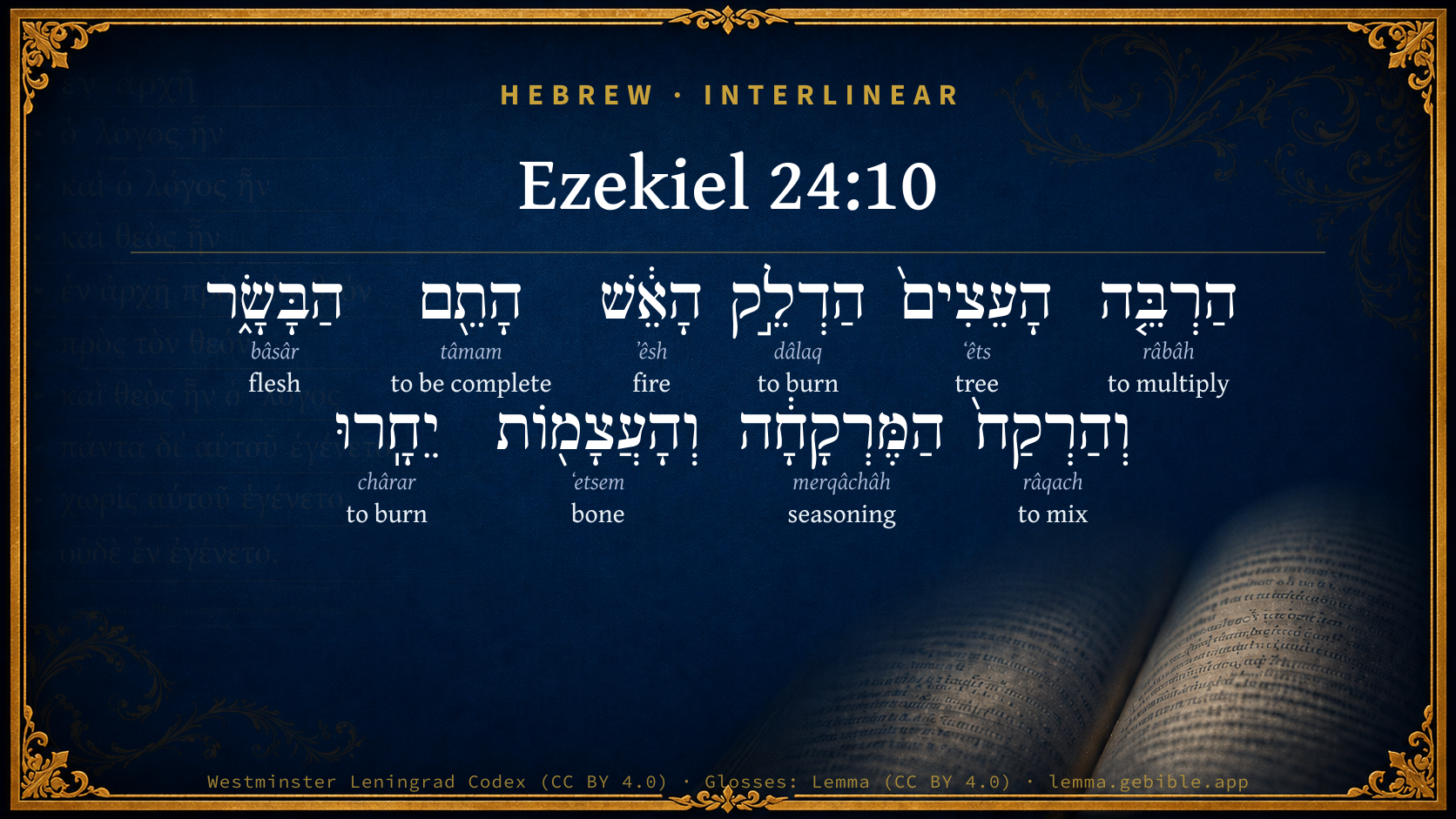
  1. הַרְבֵּ֤ה râbâh H7235 “multiply” Verb, Hiphil, Imperative, 2nd Person, Masculine, Singular
  2. הָעֵצִים֙ ʻêts H6086 “the · trees” Particle, Definite Article + Noun, Common, Masculine, Plural, Absolute
  3. הַדְלֵ֣ק dâlaq H1814 “burn” Verb, Hiphil, Imperative, 2nd Person, Masculine, Singular
  4. הָאֵ֔שׁ ʼêsh H784 “the · fire” Particle, Definite Article + Noun, Common, Both, Singular, Absolute
  5. הָתֵ֖ם tâmam H8552 “to be complete” Verb, Hiphil, Infinitive Absolute
  6. הַבָּשָׂ֑ר bâsâr H1320 “the · flesh” Particle, Definite Article + Noun, Common, Masculine, Singular, Absolute
  7. וְהַרְקַח֙ râqach H7543 “and · mix” Conjunction + Verb, Hiphil, Imperative, 2nd Person, Masculine, Singular
  8. וְהָעֲצָמ֖וֹת ʻetsem H6106 “and · the · bones” Conjunction + Particle, Definite Article + Noun, Common, Feminine, Plural, Absolute
  9. יֵחָֽרוּ chârar H2787 “to burn” Verb, Niphal, Imperfect, 3rd Person, Masculine, Plural

About this verse

These counts appear in no published source. They are computed here, from the morphology-tagged text and Lemma’s own curated glosses. What Lemma adds →

10
words
10
distinct lemmas
Prophets
section

Notable vocabulary

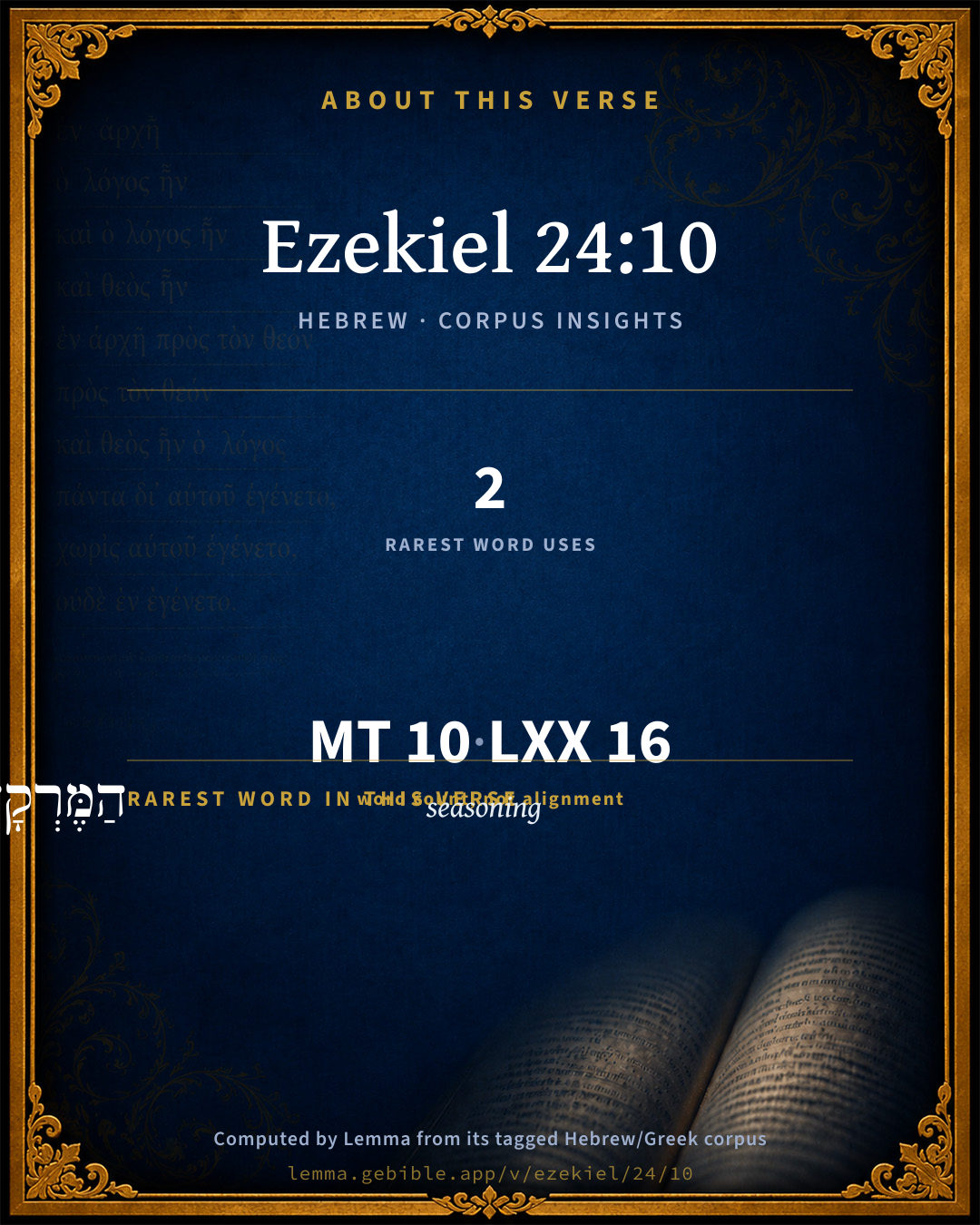
The rarest word here is הַמֶּרְקָחָ֔ה seasoning H4841 — appearing just 2 times in the whole Hebrew Bible.

Shared distinctive vocabulary

הַמֶּרְקָחָ֔ה seasoning H4841 occurs in 2 verses of the Hebrew Bible. Also found in:

Grammatical profile

  • 5 verbs
  • 5 nouns

Verb forms

  • הַרְבֵּ֤ה Hiphil · Imperative
  • הַדְלֵ֣ק Hiphil · Imperative
  • הָתֵ֖ם Hiphil · Infinitive Absolute
  • וְהַרְקַח֙ Hiphil · Imperative
  • יֵחָֽרוּ Niphal · Imperfect

Hebrew & Septuagint length

In English translation the verse runs 23 words from the Hebrew and 21 from the Septuagint (LXX English) — closely comparable.

A rough comparison of the two English renderings, which tokenize alike — not a word-level alignment.

Word counts can differ between the Hebrew and the Greek without any difference in meaning — e.g. the Hebrew direct-object marker אֵת has no separate Greek word, and Greek often adds the article ὁ.

In the original languages it is 10 Hebrew tokens and 16 Greek tokens — but the two are counted differently (Hebrew bundles its prefixes and suffixes into one token; the Greek is in lemma form), so that isn’t a like-for-like length.

Cross-references

4

Topical passages linked to Ezekiel 24:10 in the Treasury of Scripture Knowledge — connected by theme and wording, ordered by reader-vote popularity; previews shown in the World English Bible.

  • Jeremiah 17:3 My mountain in the field, I will give your substance and all your treasures for a spoil, [and] your high places, because of sin, throughout all your borders.
  • Jeremiah 20:5 Moreover I will give all the riches of this city, and all the gains of it, and all the precious things of it, yes, all the treasures of the kings of Judah will I give into the hand of their enemies; and they shall make them a prey, and take them, and carry them to Babylon.
  • Lamentations 1:10 The adversary has spread out his hand on all her pleasant things: For she has seen that the nations are entered into her sanctuary, Concerning whom you did command that they should not enter into your assembly.
  • Lamentations 2:16 All your enemies have opened their mouth wide against you; They hiss and gnash the teeth; they say, We have swallowed her up; Certainly this is the day that we looked for; we have found, we have seen it.

Cross-references courtesy of OpenBible.info (CC BY 4.0).

Hebrew and Greek witnesses Masoretic Hebrew ↔ Greek Septuagint

The same verse in the two great witnesses to the Old Testament, shown verse-for-verse.

These are two independent witnesses, not word-aligned to each other, and the Septuagint is shown in lemma (dictionary) form.

Hebrew Ezekiel 24:10 Masoretic · Westminster Leningrad Codex

הַרְבֵּ֤ה הָעֵצִים֙ הַדְלֵ֣ק הָאֵ֔שׁ הָתֵ֖ם הַבָּשָׂ֑ר וְהַרְקַח֙ הַמֶּרְקָחָ֔ה וְהָעֲצָמ֖וֹת יֵחָֽרוּ

Heap on the wood, make the fire hot, boil well the flesh, and make thick the broth, and let the bones be burned.

World English Bible · Public Domain

Greek LXX Ezekiel 24:10 Septuagint · lemma form

καί πληθύνω ὁ ξύλον καί ἀνακαίω ὁ πῦρ ὅπως τήκω ὁ κρέας καί ἐλαττόω ὁ ζωμός

and I will multiply the wood, and kindle the fire, that the flesh may be consumed, and the liquor boiled away;

LXX2012 (modern English Septuagint) · Public Domain

On this verse, The Cambridge Bible for Schools and Colleges discusses the Septuagint’s reading. Read the note in Commentary ↓

Hebrew: Westminster Leningrad Codex (CC BY 4.0). Greek: Septuagint (public domain); English from LXX2012 (modern English Septuagint) (Public Domain). How the Septuagint differs from the Hebrew →

Targum (Aramaic paraphrase)

1

The Targum is the ancient Jewish Aramaic paraphrase of the Hebrew Scriptures — an interpretive translation, not the Hebrew text itself. Onkelos (literal) and Pseudo-Jonathan (expansive) render the Torah, and Jonathan the Prophets. Coverage is partial: where no permissively-licensed English translation exists for a verse, only the Aramaic is shown. This is verse-level text, not a word-by-word alignment to the Hebrew.

  1. Targum Jonathan Prophets (Joshua–Malachi)
    אַסְגֵי מַלְכַיָא כְּנִישׁ מַשִׁרְיָתָא טַקֵיס סוּמְכְוָתָא וְזַמִין עֲלָהּ עָבְדֵי קְרָבָא וְגִבָּרָהָא יִשְׁתַּבְּשׁוּן:

    (no public-domain English translation for this verse)

    Targum Jonathan — Aramaic: “Mikraot Gedolot” (public domain). English: “Sefaria Community Translation” (CC0 1.0 (public-domain dedication)); “London "Chaldee Paraphrase," 1871” (public domain). Text via Sefaria.

Commentary

Notes on Ezekiel 24:10 from classic Christian and Jewish commentators (each source and its license shown beneath its notes). The classic Christian expositions comment on the surrounding passage and are grouped to its opening verse, so a note may address several verses; the Jewish commentaries on the Tanakh (Rashi and others) are per-verse, so they appear only where the commentator wrote on this verse.

Lemma curates 59 commentaries, every one of them public domain or Creative Commons licensed, each selected and text-cleaned for this edition rather than reprinted as found. About our sources →

Trapp's Complete Commentary

John Trapp

Eze 24:10 Heap on wood, kindle the fire, consume the flesh, and spice it well, and let the bones be burned.

Ver. 10. Heap on wood, &c.] See on Eze 24:3.

And spice it well.] Vulgate, Coquatur tota compositio; let the whole composition be boiled, till all the virtue be boiled out; a metaphor from apothecaries.

John Trapp, A Commentary or Exposition upon All the Books of the Old and New Testament (1647–1656) — public domain. Text from a community e-Sword module.

Geneva Bible (1599)

Geneva Bible translators

Meaning, that the city should be utterly destroyed, and that he would give the enemies an appetite thereunto.

Geneva Bible (1599) marginal notes — public domain. Text via Bolls.life.

Jamieson, Fausset & Brown

Robert Jamieson, A. R. Fausset & David Brown

spice it well--that the meat may be the more palatable, that is, I will make the foe delight in its destruction as much as one delights in well-seasoned, savory meat. GROTIUS, needlessly departing from the obvious sense, translates, "Let it be boiled down to a compound."

Jamieson, Fausset & Brown — Commentary Critical and Explanatory on the Whole Bible (1871) — public domain (CC PDM 1.0). Text via the HelloAO Bible API.

Adam Clarke's Commentary

Verse 10. Heap on wood] Let the siege be severe, the carnage great, and the ruin and catastrophe complete.

Adam Clarke's Commentary on the Bible (1810–1826) — public domain. Text from a community e-Sword/MySword module.

Ellicott's Commentary for English Readers

(10) Spice it well.—With Eze_24:9 the second part of the application of the parable begins, and is marked by great energy of description. In this verse the sense of the word translated “spice” is doubtful. If this be its true meaning, the idea must be, Go on thoroughly with the cooking; but the word is always used in connection with the preparation of compound incense or spices, and seems therefore to refer to the thoroughness of the work, and thus to mean, Boil thoroughly. In Job_41:31 (Heb. 23) its derivative is used as a simile for the raging sea. The process is to be continued until the water in the cauldron is all evaporated, the flesh consumed, and even the bones burned.

A Bible Commentary for English Readers, edited by Charles John Ellicott (1878–1897) — public domain. Text from a community e-Sword module.

The Cambridge Bible for Schools and Colleges

gen. ed. J. J. S. Perowne

10. consume the flesh] boil (or, do) well, as R.V.

spice it well] Probably: make thick (stew) the broth.

bones be burnt] Either “burnt” is used inexactly of the powerful action of the heat in boiling, or, less naturally, the contents of the pot are supposed to suffer directly from the fire. LXX. omits.

The Cambridge Bible for Schools and Colleges (gen. ed. J. J. S. Perowne; Cambridge University Press, 1878–1918) — public domain. Text from a community e-Sword module.

John Gill's Exposition

Heap on wood, kindle the fire,.... This is said either to the prophet, to do this in an emblematic way; or to the Chaldean army, to prepare for the siege, encompass the city, begin their attacks, and throw in their stones out of their slings and engines, and arrows from their bows:

consume the flesh; not entirely, since it is afterwards to be spiced; but thoroughly boil it; denoting the severe sufferings the inhabitants should undergo before their utter ruin:

spice it well; pepper them off; batter their walls, beat down their houses, distress them by all manner of ways and means; signifying that this would be grateful to the Lord, as his justice would be glorified in the destruction of this people; and as the plunder of them would be like a spiced and sweet morsel to the enemy; whose appetites would hereby be sharpened and become keen, and to whom the sacking and plundering the city would be as agreeable as well seasoned meat to a hungry man:

and let the bones be burnt; either under it, or rather in it; even the strongest and most powerful among the people destroyed, who should hold out the longest in the siege. The Targum of the whole is,

"multiply kings; gather an army; order the auxiliaries, and prepare against her warriors, and let her mighty ones be confounded.''

John Gill's Exposition of the Whole Bible (1746–1763) — public domain (CC PDM 1.0). Text via the HelloAO Bible API.

Albert Barnes' Notes on the Bible

Consume ... spice it well - i. e., “dress the flesh, and make it froth and bubble, that the bones and the flesh may be all boiled up together.”

Albert Barnes' Notes on the Bible (1834–1885) — public domain. Text from a community e-Sword/MySword module.

Haydock's Catholic Bible Commentary

And the. Hebrew, "put in the seasoning and the bones," &c.

George Leo Haydock (1774–1849), Haydock's Catholic Family Bible and Commentary, 1859 edition — public domain. Excludes Psalms (Douay-Rheims chapter numbering differs from Protestant) and Deuterocanonical books (Catholic canon only).

Matthew Poole's English Annotations

This is God’s word, either what he will do pursuant of the 8th verse; or his word to the prophet, to typify to the people what should be done, or to the Chaldean army, to hasten what they were to do in destroying the city. Heap on wood; make full preparations.

Kindle the fire; begin the execution of judgment.

Compare the flesh: it is a fire, not gently to dress or prepare meat, but to destroy, and burn up.

Spice it well; either to take away the noisome smell, or to express the pleasing savour of this justice to God, and men whom he appointed to this work.

Let the bones be burned: in such fires the bones hold out longest, but this fire shall at last consume these also, that the destruction may be universal the greatest, strongest, and firmest of these Jews shall perish in this fiery indignation.

Matthew Poole's English Annotations on the Holy Bible (1683–1685) — public domain. Text from a community e-Sword/MySword module.

Whedon's Commentary on the Bible

Daniel D. Whedon

10. Consume the flesh, and spice it well — R.V., “boil well the flesh, and make thick the broth.”

The pot (Jerusalem) is empty (seemingly depopulated), yet the fire burns till even its filthiness and rust is consumed, 11-13.

Daniel D. Whedon (gen. ed.), Commentary on the Old and New Testaments (1874–1909) — public domain. Text from a community e-Sword module.

The Pulpit Commentary

Spice it well; better, make thick the broth (Revised Version). The verb is used in Exo_30:33, Exo_30:35, of the concoction of the anointing oil, and the cognate adjective in Job_41:31 for the "boiling" of the water caused by the crocodile. We are reminded of the "bubble, bubble" of the witches" cauldron in "Macbeth."

The Pulpit Commentary (1880–1919), ed. H.D.M. Spence-Jones & Joseph S. Exell — public domain. Text from a community e-Sword module.

John Wesley's Explanatory Notes

And spice it well - To express this justice, that is acceptable to God and men. The bones - The greatest, strongest, and firmest of the Jews shall perish in this fiery indignation.

John Wesley, Explanatory Notes Upon the Whole Bible (1754–1765) — public domain. Text via the GEBible commentary corpus.

Rashi

Rabbi Shlomo Yitzchaki (Rashi)

pile on the wood, kindle the fire And to pile on the wood, to kindle the fire.

and to consume the meat and prepare the mixture When the meat is consumed off the bones and it shrivels and becomes mingled with the liquid, and one stirs it with a spoon, it resembles a mixture of a compounding of spices, which they mix very thoroughly; and through the shriveling of the meat, its smoke is turned back into it, which is called aorser in Old French, to burn. And this is what [the following verse] says: and the bones will be scorched [Heb. יִחָרוּ.] They will be cooked and smoked, an expression of (Job 30:30): “dried out (חָרָה) from the heat.” Similarly (verse 11), “in order that it be heated, that its base be scorched (וְחַרָה),” as happens with a pot whose water has evaporated through its boiling: it heats up, its shards burn, and the cooked food spoils.

Rashi on the Tanakh — English translations: “The Judaica Press complete Tanach with Rashi, translated by A. J. Rosenberg” (CC BY 4.0); “Pentateuch with Rashi's commentary by M. Rosenbaum and A.M. Silbermann, 1929-1934” (public domain); “The Metsudah Tanach series, Lakewood, N.J” (CC BY 4.0); and “The Book of Joshua, Metsudah Publications, 1997” (CC BY 4.0). Text via Sefaria.

Lesson kit

Teaching starters — assembled from the data on this page, not authored interpretation. Every prompt links to the verse data it draws on. Edit before teaching.

Ezekiel, in the Prophets, opens this verse with 10 words (10 distinct Hebrew lemmas). Its most distinctive word is merqâchâh (“seasoning”). A historical commentator’s framing appears above. Read the whole chapter for the surrounding context.

Discussion questions

  1. The word merqâchâh carries the sense “seasoning.” How does it shape the verse?
  2. Job 41:31 shares the word «seasoning» with this verse. How do the two illuminate each other?
  3. These translations render this verse differently; the difference is in the English rendering, not the original. What questions does that raise?
  4. The verb «הַרְבֵּ֤ה» is Hiphil Imperative. How does its form color the action?
  5. Reading how Trapp's Complete Commentary and Geneva Bible (1599) read this verse, where do the two commentators agree and where do they part?

Things to notice

Reading settings

Reading text

Shown beneath each verse's original-language words.

Old Testament
Old Testament edition

Read the OT as the Masoretic Hebrew (MT) or the Greek Septuagint (LXX).

English shown for the Greek Septuagint (in the Hebrew ↔ Greek comparison).

Comparing translations? Open the Compare panel on any verse page to stack up to four side by side.