

Proverbs 25:27

Hebrew (Westminster Leningrad Codex) Proverbs 25:27 appears in the Hebrew Old Testament. The text above is from the Westminster Leningrad Codex. Each word links to its Strong’s number, a concise gloss, and parsing drawn from the Open Scriptures Hebrew Bible morphology. Click any word for its full Brown-Driver-Briggs (BDB) entry.
Download image
Cite this verse

Proverbs 25:27 (World English Bible). Public Domain. Lemma interlinear Bible study tool, https://lemma.gebible.app/v/proverbs/25/27.

Show BibTeX & RIS
BibTeX
RIS
English Translation
It is not good to eat much honey; Nor is it honorable to seek one's own honor.
World English Bible · Public Domain
Download a study sheet

One document with this verse’s original text, its word-by-word gloss line, the meaning frame, cross-references with their text, attributed commentary, and full source and license credits — printable, and it pastes into notes with its structure intact.

This verse Autodidact and up

Study sheet (.html) Plain text (.txt)

A passage Seminary Student

Up to 50 verses in one chapter. A passage sheet keeps up to 6 commentary sources and 12 cross-references per verse, in the order this page ranks them, and says so on the sheet whenever that leaves anything out. Ask for a single verse and you get the Autodidact verse sheet above.

Everything on this page stays free to read, with no account — the sheet is a download of what is already on screen, not access to it.

Want to remove ads? Support Godless Engineer
Compare translations 3

The same verse in 3 English versions, stacked beneath the original-language interlinear above. Click any original word for its lexicon entry.

Each is an independent rendering of the whole verse — the interlinear is not word-aligned to these translations.

Highlighted words mark where these versions differ — a whole-verse word diff, not a word-by-word alignment.

  • World English Bible Public Domain
    It is not good to eat much honey; Nor is it honorable to seek one's own honor.
  • King James Version Public Domain
    It is not good to eat much honey: so for men to search their own glory is not glory.
  • unfoldingWord Literal Text CC BY-SA 4.0
    To eat much honey not good, also the searching out their honor, honor.

unfoldingWord Literal Text — © unfoldingWord, licensed CC BY-SA 4.0. Word-aligned USFM3 via Door43 (git.door43.org/unfoldingWord/en_ult).

Versions to compare (up to 4)

3 of 4 selected

Show all 18 translations

Every available English version of this verse, each an independent rendering of the whole verse.

  • World English Bible Public Domain
    It is not good to eat much honey; Nor is it honorable to seek one's own honor.
  • Berean Standard Bible Public Domain
    It is not good to eat too much honey or to search out one’s own glory.
  • Majority Standard Bible Public Domain
    It is not good to eat too much honey or to search out one’s own glory.
  • King James Version Public Domain
    It is not good to eat much honey: so for men to search their own glory is not glory.
  • American Standard Version (1901) Public Domain
    It is not good to eat much honey: So `for men' to search out their own glory is grievous.
  • Revised Version (1885) Public Domain
    It is not good to eat much honey: so for men to search out their own glory is not glory.
  • Geneva Bible (1599) Public Domain
    It is not good to eate much hony: so to search their owne glory is not glory.
  • Douay-Rheims (1899) Public Domain
    As it is not good for a man to eat much honey, so he that is a searcher of majesty, shall be overwhelmed by glory.
  • Young's Literal Translation Public Domain
    The eating of much honey is not good, Nor a searching out of one's own honour -- honour.
  • Literal Standard Version CC BY-SA 4.0
    The eating of much honey is not good, || Nor a searching out of one’s own honor—honor.
  • Unlocked Literal Bible CC BY-SA 4.0
    It is not good to eat too much honey; that is like searching for honor after honor.
  • unfoldingWord Literal Text CC BY-SA 4.0
    To eat much honey not good, also the searching out their honor, honor.
  • Darby Bible Public Domain
    It is not good to eat much honey; and to search into weighty matters is [itself] a weight.
  • World Messianic Bible Public Domain
    It is not good to eat much honey, nor is it honorable to seek one’s own honor.
  • Webster's Bible Public Domain
    It is not good to eat much honey: so for men to search their own glory is not glory.
  • Free Bible Version CC BY-SA 4.0
    It's not good to eat too much honey, or to want too much praise.
  • Bible in Basic English Public Domain
    It is not good to take much honey: so he who is not looking for honour will be honoured.
  • JPS Tanakh (1917) Public Domain
    It is not good to eat much honey; so for men to search out their own glory is not glory.

Literal Standard Version (2020), Covenant Press — licensed CC BY-SA 4.0. Text via the HelloAO Bible API (eBible.org). Unlocked Literal Bible (unfoldingWord) — licensed CC BY-SA 4.0. Text via the HelloAO Bible API (eBible.org). unfoldingWord Literal Text — © unfoldingWord, licensed CC BY-SA 4.0. Word-aligned USFM3 via Door43 (git.door43.org/unfoldingWord/en_ult). Free Bible Version, Dr. Jonathan Gallagher — licensed CC BY-SA 4.0. Text via the HelloAO Bible API (eBible.org).

Word by word

More ways to search: Search by grammar → Find every occurrence → Compare this word →

Practice this passage: Drill this verse → Learn its vocabulary →

About this verse

These counts appear in no published source. They are computed here, from the morphology-tagged text and Lemma’s own curated glosses. What Lemma adds →

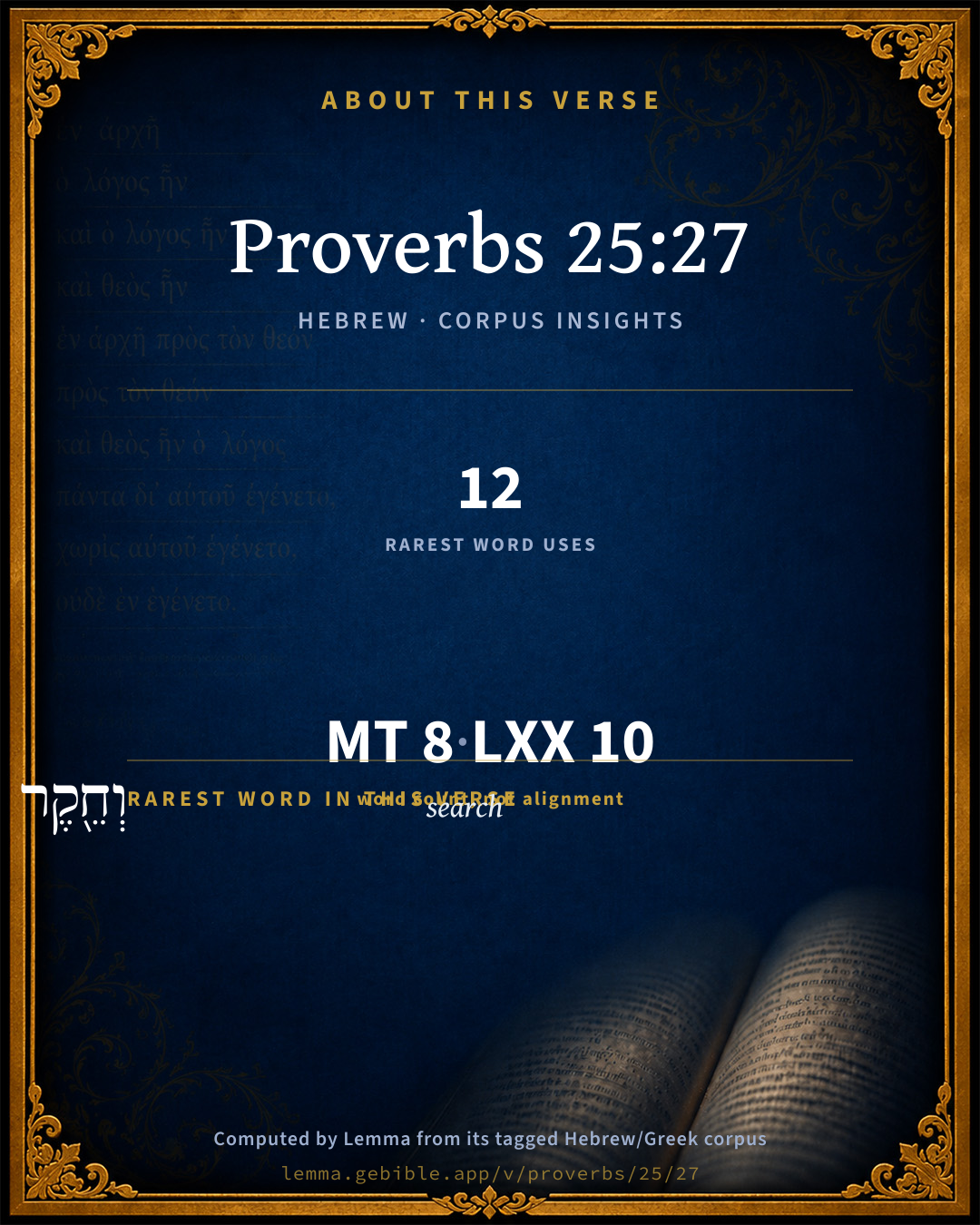
8
words
7
distinct lemmas
Wisdom
section

Notable vocabulary

The rarest word here is וְחֵ֖קֶר search H2714 — appearing just 12 times in the whole Hebrew Bible.

Shared distinctive vocabulary

וְחֵ֖קֶר search H2714 occurs in 12 verses of the Hebrew Bible. Also found in:

Grammatical profile

  • 2 verbs
  • 4 nouns
  • 1 adjective
  • 1 particle

Verb forms

  • אָ֘כֹ֤ל Qal · Infinitive Absolute
  • הַרְבּ֣וֹת Hiphil · Infinitive Construct

Repetition

A word recurs within this verse — often emphatic in Hebrew:

  • כְּבֹדָ֣ם glory H3519 ×2

Hebrew & Septuagint length

In English translation the verse runs 17 words from the Hebrew and 16 from the Septuagint (LXX English) — closely comparable.

A rough comparison of the two English renderings, which tokenize alike — not a word-level alignment.

Word counts can differ between the Hebrew and the Greek without any difference in meaning — e.g. the Hebrew direct-object marker אֵת has no separate Greek word, and Greek often adds the article ὁ.

In the original languages it is 8 Hebrew tokens and 10 Greek tokens — but the two are counted differently (Hebrew bundles its prefixes and suffixes into one token; the Greek is in lemma form), so that isn’t a like-for-like length.

Cross-references

6

Topical passages linked to Proverbs 25:27 in the Treasury of Scripture Knowledge — connected by theme and wording, ordered by reader-vote popularity; previews shown in the World English Bible.

  • Proverbs 27:2 Let another man praise you, And not your own mouth; A stranger, and not your own lips.
  • John 5:44 How can you believe, who receive glory from one another, and you don't seek the glory that comes from the only God?
  • Philippians 2:3 doing nothing through rivalry or through conceit, but in humility, each counting others better than himself;
  • Proverbs 25:16 Have you found honey? Eat as much as is sufficient for you, Lest you eat too much, and vomit it.
  • 2 Corinthians 12:1 It is doubtless not profitable for me to boast. For I will come to visions and revelations of the Lord.
  • 2 Corinthians 12:11 I have become foolish in boasting. You compelled me, for I ought to have been commended by you, for in nothing was I inferior to the very best apostles, though I am nothing.

Cross-references courtesy of OpenBible.info (CC BY 4.0).

Hebrew and Greek witnesses Masoretic Hebrew ↔ Greek Septuagint

The same verse in the two great witnesses to the Old Testament, shown verse-for-verse.

These are two independent witnesses, not word-aligned to each other, and the Septuagint is shown in lemma (dictionary) form.

Hebrew Proverbs 25:27 Masoretic · Westminster Leningrad Codex

אָ֘כֹ֤ל דְּבַ֣שׁ הַרְבּ֣וֹת לֹא ט֑וֹב וְחֵ֖קֶר כְּבֹדָ֣ם כָּבֽוֹד

It is not good to eat much honey; Nor is it honorable to seek one's own honor.

World English Bible · Public Domain

Greek LXX Proverbs 25:27 Septuagint · lemma form

ἐσθίω μέλι πολύς οὐ καλός τιμάω δέ χρή λόγος ἔνδοξος

It is not good to eat much honey; but it is right to honor venerable sayings.

LXX2012 (modern English Septuagint) · Public Domain

On this verse, Haydock's Catholic Bible Commentary discusses the Septuagint’s reading. Read the note in Commentary ↓

Hebrew: Westminster Leningrad Codex (CC BY 4.0). Greek: Septuagint (public domain); English from LXX2012 (modern English Septuagint) (Public Domain). How the Septuagint differs from the Hebrew →

Commentary

Notes on Proverbs 25:27 from classic Christian and Jewish commentators (each source and its license shown beneath its notes). The classic Christian expositions comment on the surrounding passage and are grouped to its opening verse, so a note may address several verses; the Jewish commentaries on the Tanakh (Rashi and others) are per-verse, so they appear only where the commentator wrote on this verse.

Lemma curates 59 commentaries, every one of them public domain or Creative Commons licensed, each selected and text-cleaned for this edition rather than reprinted as found. About our sources →

Trapp's Complete Commentary

John Trapp

Pro 25:27 [It is] not good to eat much honey: so [for men] to search their own glory [is not] glory.

Ver. 27. It is not good to eat too much honey.] For it breeds choler and brings diseases.

So for men to search their own glory,] i.e., To be "desirous of vain glory"; {Gal 5:26} to seek the praise of men; to hunt after the world’s plaudite; to say to it, as Tiberius once answered Justinus, Si tu volueris ego sum, si tu non vis ego non sum - I am wholly thine, I am only thy clay and wax; this is base and inglorious; this is to be Gloriae animal, popularis aurae vile mancipium, the creature of vain glory, a base slave to popular applause, as Jerome {a} calls Crates, the philosopher, who cast his goods into the sea merely for a name. Some do all for a name, as Jehu and the Pharisees; like kites, they flutter up a little, but their eye is upon the carrion. The Chaldee paraphrast by "their glory," understands the majesty of the Scriptures - which to David were sweeter than honey. These we must search, but not too curiously. Ne qui scrutatur maiestam, opprimatur a gloria, as the Vulgate here hath it; lest prying into God’s majesty we be oppressed by his glory.

{a} Jer., Epist. ad Julian. Consolator.

John Trapp, A Commentary or Exposition upon All the Books of the Old and New Testament (1647–1656) — public domain. Text from a community e-Sword module.

The Biblical Illustrator

Joseph S. Exell

Pro_25:27

It is not good to eat much honey.

Natural desires running too far

Man is a creature of manifold desires. These desires may be divided into two grand classes--

1. Those that can never go too far. Such are the desires for knowledge, holiness, assimilation to God.

2. Those that often run too far. Such are the desires for wealth; the desire for power, which often runs into tyranny; the desire for pleasure, which often runs into licentiousness. Here is running too far--

I. The desire for animal pleasure. It is not good to eat much honey. It is not good for the body. It is not good for the intellect. The rise of the animal is the fall of the mental. It is not good for the soul. The pampering of the senses is the death of the soul. It is not good to eat much honey. Here we have running too far--

II. The desire for human praise. So for men to search their own glory is not glory. The word not which is here in italics, is not in the original; it has been supplied by our translators. In doing so they have evidently expressed the idea intended. A desire for the praise of our fellow-men is natural, innocent, and useful. It is very true that the praise of corrupt society is seldom of much worth, and often indeed contemptible. There are men whose desire for human praise becomes a passion; popularity is the god at whose shrine they are always paying their devotions. Be master of your desires. (D. Thomas, D.D.)

Pleasure and glory

The ordinary mind consents to this statement unwillingly. There is a natural reluctance to stop short in the pursuit of enjoyment. What glory can there be in getting a man to limit his own glory?

I. Our best interests are not served by living chiefly on earthly pleasures. Our highest being cannot be nourished by giving the chief place to earthly distinction and attainments. Life is not intended to be made up entirely of bank holidays and national festivals. Observe the point of emphasis in this verse. It is not good to eat much honey. A little is all very well. The question of recreation and amusement resolves itself into a question about the desires and impulses which are allowed to rule mens lives. Let a man understand his true position He is face to face with a long history of good and evil principles working on the one hand sublimity, and on the other disaster, in the lives of millions. He has to take his place--carefully discovering his right place--in a world that is darkened by the shadow of the crime and ignorance of ages, and torn to the hearts depth by the cruel wails of passion, and avarice, and remorse.

II. God has something better for us to do, and something nobler for us to enjoy. He has called to us to seek the knowledge of Himself; to grow up into this knowledge of Himself; and to use the knowledge of Him, as it comes to us, for the benefit of the world. Learn to think soberly and proportionately of all the pleasures and distinctions of this life; ever having respect unto the recompense of the reward. (W. H. Jackson.)

The Biblical Illustrator, edited by Joseph S. Exell (c. 1880s–1900s) — public domain. Text from a community e-Sword module.

Joseph Benson's Commentary

Pro 25:27. It is not good to eat much honey — Namely, for the health of the body; so for men to search their own glory — Industriously to seek for honour and applause from men; is not glory — Is not only sinful, but shameful also, and a sign of a vain and mean spirit.

Joseph Benson's Commentary on the Old and New Testaments (1811–1818) — public domain. Text from a community e-Sword module.

The Preacher's Complete Homiletical Commentary

Joseph S. Exell (gen. ed.)

CRITICAL NOTES.—

Pro_25:27. The last phrase in this verse is variously rendered. The words is not are not in the Hebrew. Stuart reads, “Searching after one’s own glory is burdensome”—i.e., Honour, like honey, is good only when sought in moderation. Zöckler renders “To search out the difficulty, brings difficulty”—i.e., “Too strenuous occupation of the mind with difficult things is injurious.” Delitzsch translates:—“But, as an inquirer, to enter on what is difficult, is honour”—i.e., To overdo oneself in eating honey is not good, but the searching into difficult things is nothing less than an eating of honey, but an honour. The word translated glory is literally weight, and is often used to mean excellence and honour. But it will bear the opposite meaning of a burden or difficulty.

MAIN HOMILETICS OF Pro_25:27

TOO MUCH OF A GOOD THING

For Homiletics on the first clause of this verse, see on Pro_25:16, page 703. A reference to the Critical Notes will show that, owing partly to its elliptical form, the rendering of the second clause has been much disputed. The reading found in our version is, however, quite admissible on the principles of Hebrew interpretation, and accords well with the first clause. The analogy teaches—

I. That a desire for the good opinion of others is right and salutary. As honey is not only a pleasant but a wholesome article of food, so the wish to stand well with our fellow-men is a God-implanted feeling which is very beneficial both to the individual man and to society as a whole. He is a churlish being who does not care what other people think about him, who sets at nought their esteem or their blame, while a right regard to their judgment of us insensibly produces a beneficial influence upon our conduct and temper.

II. But it is a desire which must not rule our life. Just as honey must not be substituted for plainer food, or made the staple article of diet, so a desire for the good opinion of others must not be put before higher motives—must not be made the ruling principle of life. This proverb may be linked with the preceding one to some extent, for the lack of firmness which good men sometimes display in the society and under the influence of worse men than themselves is often due to a desire not to lose their good opinion—not to be thought obstinate, or morose, or conceited. But when any question of right or wrong is at stake the approval or disapproval even of those whose goodwill is most precious to us must be cast aside.

OUTLINES AND SUGGESTIVE COMMENTS

There is such a thing as vain glory. There is such a thing as a person’s indulging an insatiable appetite for applause and honour. There is such a thing as “searching it out,” looking ever after it, eager to get it, and touchily jealous of every omission to bestow it and every deficiency in its amount; exploring for it in every possible direction; listening with an ear on the alert to catch every breathing of adulation; fishing for praise; throwing out hints to draw it forth; eulogising others, to tempt a return; saying things in disparagement of oneself, for the sake of having them contradicted—things which, said by another, would stir the hottest of his blood. The temper of mind may be put in exercise, in regard to greater and to smaller matters. It may assume the form of a proud ambition, or of a weak-minded vanity. But in either case it may with truth be said that “it is not glory.” A man’s honour should rather come to him, than be eagerly solicited and searched for. It should not be made his object.—Wardlaw.

The Preacher's Complete Homiletical Commentary (gen. ed. Joseph S. Exell; Funk & Wagnalls, c. 1892) — public domain (pre-1929). A full-Bible homiletical/sermon-outline anthology covering 65 of 66 books (2 John is absent from the source module). Text from a community e-Sword module.

Bridges on Proverbs

Charles Bridges

27 It is not good to eat much honey: so for men to search their own glory is not glory.†a}

Honey is good; but in moderation. (Pro 24:13 .) It is not good to eat much honey. (Pro 25:16 .) A man’s own name and reputation is honey to him. Let him carefully preserve it from "the dead fly that spoils it."†1 The honor of God is connected with the honorable profession of his people. But this carefulness is a virtue on the brink of vice; a duty on the borders of imminent danger. To be puffed up by our own endowments, to listen to our praise; to force ourselves upon public attention,†2 thus to search out our own glory,†3 is not glory. As unseemly is it to seek our own glory, as to ascribe to ourselves our own being.

Yet is there no danger of seeking the fame, rather than the substance, of godliness, a well-known name in the Church, rather than an unknown name in the book of life? Few ministers, but have been severely exercised here; identifying their usefulness with their honor; cherishing the desire for public approbation, rather than for unnoticed fruitfulness; dreading to be counted upon an ordinary level, as "vessels of wood and earth," rather than of "gold and silver." (2Ti 2:20 .) Oh! it is a mighty victory over self, to trample man’s judgment under foot, and eye only God’s approval. Nothing is right except it be wrought in the true spirit of the gospel; "doing nothing in vain-glory, but in lowliness of mind each esteeming others better than himself."†4 The great apostle spoke of matters of glorying only by compulsion.†5 A vain-glorious spirit cankers many a plausible profession. (Joh 5:44 ; Joh 12:43 .) Did we turn from the flattering glass of self-love to the pure and faithful mirror of the law, the inconceivable deformities opening to view would constrain us to take the lowest place among the most unworthy. Most wholesome is the recollection — "That which is highly esteemed among men is abomination in the sight of God." (Luk 16:15 .)

Footnotes:

†a Critics seem much perplexed by the difficulty of supplying a negative in the last clause. Yet Professor Lee observes (Heb. Gram. 242:13), ’The most frequent ellipsis is of the negatives, e.g. Psa 9:19 . Deu 33:6 . 1Sa 2:3 . Psa 44:17 . Pro 25:27 ; Pro 30:3, &c.’

†1 Php 4:8, with Ecc 10:1 .

†2 Pro 20:6; Pro 27:2 .

†3 Gen 11:4; 2Ki 10:16 . Dan 4:30 .

†4 Php 2:3. Gal 5:26 .

†5 2Co 12:1-11 . See Lyttleton on Conversion of St. Paul.

Charles Bridges, An Exposition of the Book of Proverbs (1846) — public domain. Text from a community e-Sword module.

Tyndale Open Study Notes

Tyndale Open Resources

25:27-28 The wise have self-control and cannot easily be dominated.

Tyndale Open Study Notes — © Tyndale Open Resources, licensed CC BY-SA 4.0. Text via the HelloAO Bible API.

Matthew Henry's Commentary

I. Two things we must be graciously dead to: - 1. To the pleasures of sense, for it is not good to eat much honey; though it pleases the taste, and, if eaten with moderation, is very wholesome, yet, if eaten to excess, it becomes nauseous, creates bile, and is the occasion of many diseases. It is true of all the delights of the children of men that they will surfeit, but never satisfy, and they are dangerous to those that allow themselves the liberal use of them. 2. To the praise of man. We must not be greedy of that any more than of pleasure, because, for men to search their own glory, to court applause and covet to make themselves popular, is not their glory, but their shame; every one will laugh at them for it; and the glory which is so courted is not glory when it is got, for it is really no true honour to a man.

II. Some give another sense of this verse: To eat much honey is not good, but to search into glorious and excellent things is a great commendation, it is true glory; we cannot therein offend by excess. Others thus: "As honey, though pleasant to the taste, if used immoderately, oppresses the stomach, so an over-curious search into things sublime and glorious, though pleasant to us, if we pry too far, will overwhelm our capacities with a greater glory and lustre than they can bear." Or thus: "You may be surfeited with eating too much honey, but the last of glory, of their glory, the glory of the blessed, is glory; it will be ever fresh, and never pall the appetite."

Matthew Henry's Commentary on the Whole Bible (1708–1710) — public domain (CC PDM 1.0). Text via the HelloAO Bible API.

Jamieson, Fausset & Brown

Robert Jamieson, A. R. Fausset & David Brown

Satiety surfeits (Pro 25:16); so men who are self-glorious find shame.

is not glory--"not" is supplied from the first clause, or "is grievous," in which sense a similar word is used (Pro 27:2).

Jamieson, Fausset & Brown — Commentary Critical and Explanatory on the Whole Bible (1871) — public domain (CC PDM 1.0). Text via the HelloAO Bible API.

Adam Clarke's Commentary

Verse 27. It is not good to eat much honey] Coverdale translates the whole passage thus: "Like as it is not good to eat to muche hony; even so, he that wyll search out hye thinges, it shal be to hevy for him." As he that etith myche honye, and it is not to him goode; so, that is a sercher of mageste, schal ben oppressid of glorie - Old MS. Bible. He that searches too much into mysteries, is likely to be confounded by them. I really think this is the meaning of the place; and shall not puzzle either myself or my reader with the discordant explanations which have been brought forward with the hope of illustrating this passage.

Adam Clarke's Commentary on the Bible (1810–1826) — public domain. Text from a community e-Sword/MySword module.

Ellicott's Commentary for English Readers

(27) So for men to search their own glory is not glory.—The sense of this passage is very doubtful. It may mean, “But to search into difficult matters is an honour.” Self-indulgence and study are here contrasted.

A Bible Commentary for English Readers, edited by Charles John Ellicott (1878–1897) — public domain. Text from a community e-Sword module.

The Cambridge Bible for Schools and Colleges

gen. ed. J. J. S. Perowne

27. is not glory] The words is not are not in the Heb., but are supplied both in A.V. and R.V. text. The R.V. marg. has, “But for men to search out their own glory is glory. The Hebrew text is obscure.”

It would seem as though the author of the proverb threw down in the second clause the terms of the comparison and left us to adjust them: “so is it with searching out your own glory, and glory”; q.d. Glory, like honey, is a good thing, but to be too much engrossed with your own share of the one is like eating too much of the other.

The Cambridge Bible for Schools and Colleges (gen. ed. J. J. S. Perowne; Cambridge University Press, 1878–1918) — public domain. Text from a community e-Sword module.

John Gill's Exposition

He that hath no rule over his own spirit,.... His affections and passions, puts no restraint, unto them, as the word signifies; no guard against them, no fence about them, to curb his curiosity, to check his pride and vanity, to restrain his wrath and anger and revenge, and keep within due bounds his ambition and itch of vainglory;

is like a city that broken down and without walls; into which the may go with pleasure, and which is exposed to the rapine and violence of everyone; and so a man that has no command of himself and passions, but gives the reins to them, is exposed to the enemy of souls, Satan and is liable to every sin, snare and temptation.

Next: Proverbs Chapter 26

John Gill's Exposition of the Whole Bible (1746–1763) — public domain (CC PDM 1.0). Text via the HelloAO Bible API.

Albert Barnes' Notes on the Bible

So for men ... - A difficult sentence, the text of which is probably defective. The words are not in the original. Many commentators render: so to search into weighty matters is itself a weight, i. e., people soon become satiated with it as with honey. Possibly a warning against an over-curious searching into the mysteries of God’s word or works.

Albert Barnes' Notes on the Bible (1834–1885) — public domain. Text from a community e-Sword/MySword module.

Haydock's Catholic Bible Commentary

Majesty, viz., of God. For to search into that incomprehensible Majesty, and to pretend to sound the depths of the wisdom of God, is exposing our weak understanding to be blinded with an excess of light and glory, which hit cannot comprehend. (Challoner) --- When the Church proposes to us any mystery, we have only to believe. Hebrew, "but it is glorious to sound their glory," and see where the wicked end, that we may not envy them, chap. iii. 31., and Psalm xxxvi. 7. (Calmet) --- Protestants, "so for men to search their own glory, is not glory," but a sin. (Haydock) --- "It is not good to eat too much honey," (Chaldean) or to sound the glorious words of God and wisdom, or the mysteries of religion. Septuagint, "But it is right to reverence glorious speeches," (Calmet) with esteem and humility. (Cat. Græc.)

George Leo Haydock (1774–1849), Haydock's Catholic Family Bible and Commentary, 1859 edition — public domain. Excludes Psalms (Douay-Rheims chapter numbering differs from Protestant) and Deuterocanonical books (Catholic canon only).

Matthew Poole's English Annotations

Not good, to wit, for the health of the body.

For men; which words are easily understood, both out of the foregoing clause, where the honey is supposed to be eaten by men, and out of the following words, which are evidently meant of them.

To search their own glory; industriously to seek for honour and applause from men.

Is not glory; is not only sinful, but shameful also, and a sign of a vain and mean spirit. The negative particle not is here understood out of the former part of the verse, as it is Psa 1:5; 9:18.

Matthew Poole's English Annotations on the Holy Bible (1683–1685) — public domain. Text from a community e-Sword/MySword module.

Whedon's Commentary on the Bible

Daniel D. Whedon

27. Not good to eat much honey — “Delicious as it is to an Eastern palate, yet, taken to excess, it is injurious. Pro_25:16. Sanutus tells us, that the English who attended Edward I. into the Holy Land died in great numbers as they marched in June to demolish a place, which he ascribes to the excessive heat, and their intemperate eating of fruits and honey.” — Harmer, vol. ii, p. 60. Search their own glory — For men to search for (seek after) their own glory is burdensome. Glory, honour, is good, and a legitimate object of desire; but an over-desire, leading to overaction, is as burdensome to the mind as too much honey is to the stomach, and far more injurious in its consequences.

Daniel D. Whedon (gen. ed.), Commentary on the Old and New Testaments (1874–1909) — public domain. Text from a community e-Sword module.

The Pulpit Commentary

It is not good to eat much honey. The ill effects of a surfeit of honey have been already mentioned (Ver. 16); but here the application is different, and occasions some difficulty. The Authorized Version, in order to clear up the obscurity of the text, inserts a negative, So for men to search their own glory is not glory, which seems to be a warning against conceit and self-adulation. This is hardly warranted by the present Hebrew text, which is literally, as Venetian renders, Ereuna te doxav autwn doxa , "The search of their glory is glory." But who are meant by "their"? No persons are mentioned in the verse to whom the suffix in can be referred, and it is not improbable that some words have dropped out of the text. At the same time, we might naturally in thought supply "for men" after "it is not good," such omissions being not uncommon in proverbial sayings; the suffix then would refer to them. Commentators have endeavoured to amend the text by alterations which do not commend themselves. Schultens supposes that the suffix had reference to the Divine law and revelations, and, as dbk may mean both "glory" and "weight," translates, "Vestigatio gravitatis eorum, gravitas." Bertheau takes kabod in two different senses, "The searching out of their glory is a burden." So Delitzsch, by little manipulation of the pointing ( obtains the rendering, "But to search out hard things is an honour." Taken thus, the maxim says that bodily pleasures sicken and cloy, but diligent study brings honour. This, however, is not satisfactory; it gives a word two different senses in the same clause, and it affords a very feeble contrast. One would naturally expect the proverb to say that the excess, which was deprecated in the first hemistich as regards one department, must be equally rejected in another sphere. This is somewhat the idea given by Jerome, Sic qui scrutator est majestatis opprimetur a gloria. The truth here stated will be explained by translating our text, "The investigation of weighty matters is a weight." Thus the clauses are shown to be well poised. Honey is good, study is good; but both may be used so as to be prejudicial. Eating may be carried to excess; study may attempt to investigate things too hard or too high. That this is a real danger we know well from the controversies about predestination and elation in time past, and those concerning spiritualism and theurgy in our own day (see Jeremy Taylor, "Certainty of Salvation," 3:176, edit. Hebrews; and "Holy Living," ch. 3, This is the view taken of the passage by St. Gregory ("Moral," 14:32), "If the sweetness of honey be taken in greater measure than there is occasion for, from the same source whence the palate is gratified, the life of the eater is destroyed." The "searching into majesty" is also sweet; but he that seeks to dive into it deeper than the cognizance of human nature admits, finds the mere gloriousness thereof by itself oppresses him, in that, like honey taken in excess, it bursts the sense of the searcher which is not capable of holding it." And again (ibid., 20:18), "For the glory of the invisible Creator, which when searched into with moderation lifts us up, being dived into beyond our powers bears us down" (Oxford transl.). (Comp. Deu_29:29; Ecc_3:21, etc.) Septuagint, "To eat much honey is not good, but it behoves us to honor glorious sayings."

The Pulpit Commentary (1880–1919), ed. H.D.M. Spence-Jones & Joseph S. Exell — public domain. Text from a community e-Sword module.

John Wesley's Explanatory Notes

Not good - For health. To search - Industriously to seek for applause. Is not - Is not only sinful, but shameful also.

John Wesley, Explanatory Notes Upon the Whole Bible (1754–1765) — public domain. Text via the GEBible commentary corpus.

Keil & Delitzsch

C. F. Keil & F. Delitzsch

This verse, as it stands, is scarcely to be understood. The Venet. translates 27b literally: ἔρευνά τε δόξας αὐτῶν δόξα; but what is the reference of this כּבדם? Euchel and others refer it to men, for they translate: "to set a limit to the glory of man is true glory;" but the "glory of man" is denoted by the phrase כּבד אדם, not by כּבדם; and, besides, חקר does not mean measure and limit. Oetinger explains: "To eat too much honey is not good; whereas the searching after their glory, viz., of pleasant and praiseworthy things, which are likened to honey, is glory, cannot be too much done, and is never without utility and honour;" but how can כּבדם be of the same meaning as כּבד הדברים אשׁר or הנמשׁלים כּדּבשׁ - such an abbreviation of the expression is impossible. Schultens, according to Rashi: vestigatio gravitatis eorum est gravitas, i.e., the searching out of their difficulty is a trouble; better Vitringa (since כבוד nowhere occurs in this sense of gravitas molesta ac pondere oppressura): investigatio praestantiae eorum est gloriosa; but Vitringa, in order to gain a connection to 27a, needs to introduce etiamsi, and in both explanations the reference of the כּבדם is imaginary, and it by no means lies near, since the Scripture uses the word כבוד of God, and His kingdom and name, but never of His law or His revelation. Thus also is an argument against Bertheau, who translates: the searching out of their glory (viz., of the divine law and revelation) is a burden, a strenuous occupation of the mind, since חקר does not in itself mean searching out, and is equivocally, even unintelligibly, expressed, since כבוד denotes, it is true, here and there, a great multitude, but never a burden (as כּבד). The thought which Jerome finds in 27b: qui scrutator est majestatis opprimetur a gloria, is judicious, and connects itself synonym. with 27a; but such a thought is unwarranted, for he disregards the suff. of כּבדם, and renders כבוד in the sense of difficulty (oppression). Or should it perhaps be vocalized כּבדם (Syr., Targ., Theodotion, δεδοξασμένα = נכבּדות)? Thus vocalized, Umbreit renders it in the sense of honores; Elster and Zckler in the sense of difficultates (difficilia); but this plur., neither the biblical, nor, so far as I know, the post-bibl. usage of the word has ever adopted. However, the sense of the proverb which Elster and Zckler gain is certainly that which is aimed at. We accordingly translate:

To surfeit oneself in eating honey is not good,

But as an inquirer to enter on what is difficult is honour.

We read כּבדם instead of כּבדם. This change commends itself far more than כּבד מכּבוד (וחקר), according to which Gesenius explains: nimium studium honoris est sine honore - impossible, for חקר does not signify nimium studium, in the sense of striving, but only that of inquiry: one strives after honour, but does not study it. Hitzig and Ewald, after the example of J. D. Michaelis, Arnoldi, and Ziegler, betake themselves therefore to the Arabic; Ewald explains, for he leaves the text unchanged: "To despise their honour (that is, of men) is honour (true, real honour);" Hitzig, for he changes the text like Gesenius: "To despise honour is more than honour," with the ingenious remark: To obtain an order [insigne ordinis] is an honour, but not to wear it then for the first time is its bouquet. Nowhere any trace either in Hebrew or in Aramaic is to be found of the verb חקר, to despise (to be despised), and so it must here remain without example.

(Note: The Hebrew meaning investigare, and the equivalent Arabic ḥaḳr, contemnere (contemtui esse), are derivations from the primary meaning (R. חק): to go down from above firmly on anything, and thus to press in (to cut in), or also to press downward.)

Nor have we any need of it. The change of כּבדם into כּבדם is enough. The proverb is an antithetic distich; 27a warns against inordinate longing after enjoyments, 27b praises earnest labour. Instead of דּבשׁ הרבּות, if honey in the mass were intended, the words would have been דּבשׁ הרבּה (Ecc 5:11; Kg1 10:10), or at least הרבּות דּבשׁ (Amo 4:9); הרבות can only be a n. actionis, and אכל דּבשׁ its inverted object (cf. Jer 9:4), as Bttcher has discerned: to make much of the eating of honey, to do much therein is not good (cf. Pro 25:16). In 27b Luther also partly hits on the correct rendering: "and he who searches into difficult things, to him it is too difficult," for which it ought to be said: to him it is an honour. כּבדם, viz., דברים, signifies difficult things, as ריקים, Pro 12:11, vain things. The Heb. כּבד, however, never means difficult to be understood or comprehended (although more modern lexicons say this),

(Note: Cf. Sir. 3:20f. with Ben-Sira's Heb. text in my Gesch. der jd. Poesie, p. 204 (vv. 30-32); nowhere does this adj. כבד appears here in this warning against meditating over the transcendental.)

but always only burdensome and heavy, gravis, not difficilis. כבדם are also things of which the חקר, i.e., the fundamental searching into them (Pro 18:17; Pro 25:2.), costs an earnest effort, which perhaps, according to the first impression, appears to surpass the available strength (cf. Exo 18:18). To overdo oneself in eating honey is not good; on the contrary, the searching into difficult subjects is nothing less than an eating of honey, but an honour. There is here a paronomasia. Fleischer translates it: explorare gravia grave est; but we render grave est not in the sense of molestiam creat, but gravitatem parit (weight = respect, honour).

Keil & Delitzsch — Biblical Commentary on the Old Testament (1861–1891) — public domain (CC PDM 1.0). Text via the HelloAO Bible API. (Old Testament only.)

unfoldingWord translationNotes

Door43 World Missions Community

It is not good to eat too much honey; that is like searching for honor after honor.

Both wanting others to honor you and eating honey are good, but you can eat too much honey, and you can try too hard to have people honor you. (See: Simile)

It is not good

This can be stated positively. AT: "It is a bad thing" (See: Litotes)

that is like searching for honor after honor

"that is like always thinking about how others should honor you." The meaning of the original language is uncertain. Some versions of the Bible translate this as "that is like speaking too many compliments to people."

A person without self-control is like a city breached and without walls.

Both a person without self-control and a city without walls are weak and vulnerable. (See: Simile)

breached and without walls

"whose walls an army has knocked down and destroyed"

translationWords

honey

honor

self-control

unfoldingWord translationNotes — © Distant Shores Media and the Door43 World Missions Community, licensed CC BY-SA 4.0. Source: git.door43.org/Door43/en_tn.

Rashi

Rabbi Shlomo Yitzchaki (Rashi)

Eating honey To eat honey to excess. The topic symbolizes one who expounds on the account of the Merkavah and the account of the Creation to the public; the ignoramuses will ridicule the words and ask what is above and what is below.

but fathoming their honor is honor But when is fathoming appropriate? In the words of the Sages, whose honor is honor: We may ask why they decreed such and such a decree, and why they enacted a safeguard in each decree.

Rashi on the Tanakh — English translations: “The Judaica Press complete Tanach with Rashi, translated by A. J. Rosenberg” (CC BY 4.0); “Pentateuch with Rashi's commentary by M. Rosenbaum and A.M. Silbermann, 1929-1934” (public domain); “The Metsudah Tanach series, Lakewood, N.J” (CC BY 4.0); and “The Book of Joshua, Metsudah Publications, 1997” (CC BY 4.0). Text via Sefaria.

Lesson kit

Teaching starters — assembled from the data on this page, not authored interpretation. Every prompt links to the verse data it draws on. Edit before teaching.

Proverbs, in the Wisdom, opens this verse with 8 words (7 distinct Hebrew lemmas). Its most distinctive word is chêqer (“search”). A historical commentator’s framing appears above. Read the whole chapter for the surrounding context.

Discussion questions

  1. How does “search” (chêqer) shape what this verse is saying?
  2. How does Judges 5:16, which shares the word «search», read alongside this verse?
  3. What does the repetition of “glory” (2× in this one verse) do in this verse?
  4. The translations on this page render this verse differently — a whole-verse word diff, not a word-by-word alignment. What might account for the different wordings?
  5. «אָ֘כֹ֤ל» is a Qal Infinitive Absolute verb. How does that grammatical form shape the action described?
  6. Compare how Trapp's Complete Commentary and The Biblical Illustrator read this verse. Where do they agree or differ?

Things to notice

Reading settings

Reading text

Shown beneath each verse's original-language words.

Old Testament
Old Testament edition

Read the OT as the Masoretic Hebrew (MT) or the Greek Septuagint (LXX).

English shown for the Greek Septuagint (in the Hebrew ↔ Greek comparison).

Comparing translations? Open the Compare panel on any verse page to stack up to four side by side.