
Jeremiah 42:2

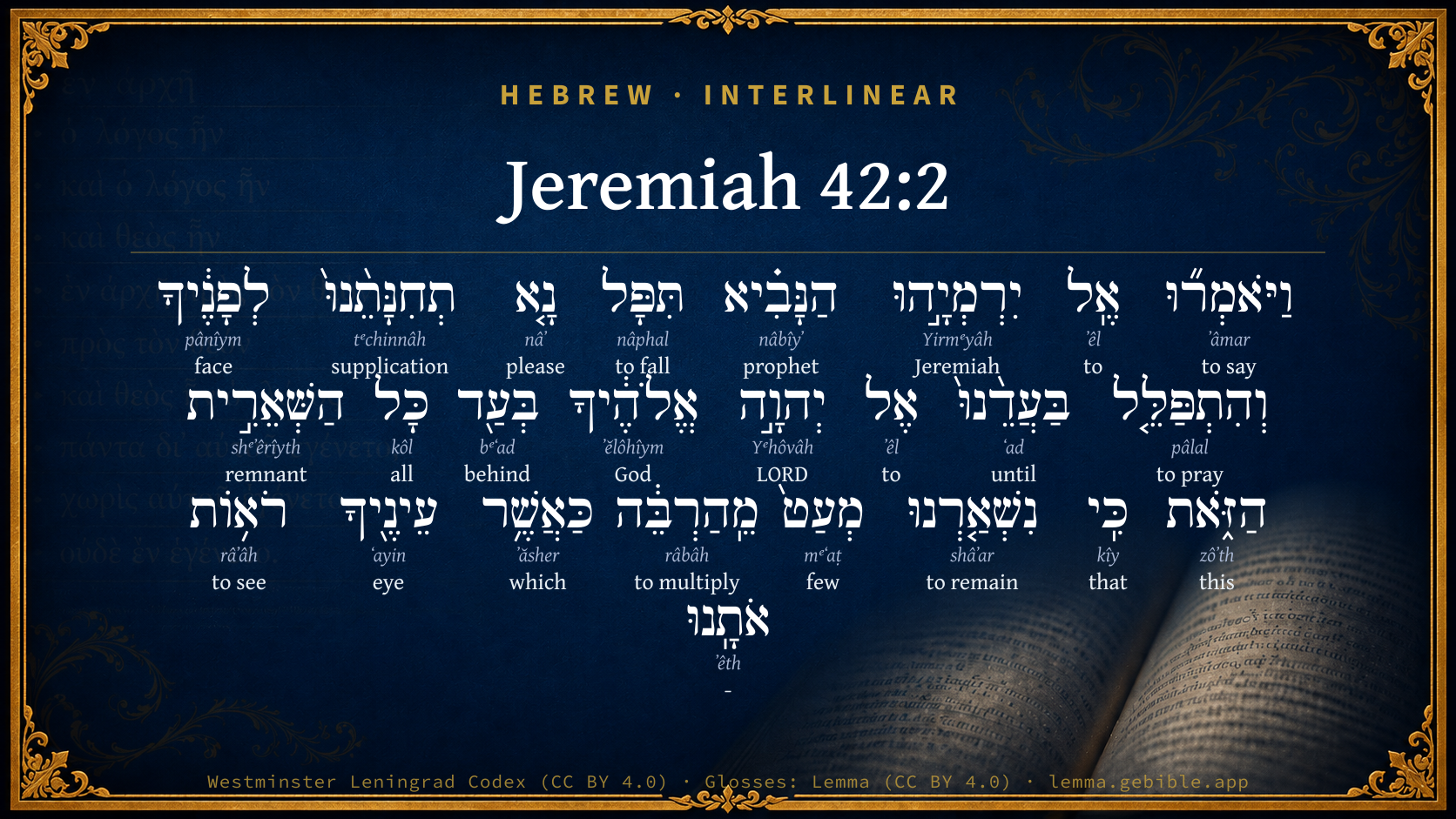
Hebrew (Westminster Leningrad Codex) Jeremiah 42:2 appears in the Hebrew Old Testament. The text above is from the Westminster Leningrad Codex. Each word links to its Strong’s number, a concise gloss, and parsing drawn from the Open Scriptures Hebrew Bible morphology. Click any word for its full Brown-Driver-Briggs (BDB) entry.
Download image
Cite this verse

Jeremiah 42:2 (World English Bible). Public Domain. Lemma interlinear Bible study tool, https://lemma.gebible.app/v/jeremiah/42/2.

Show BibTeX & RIS
BibTeX
RIS
English Translation
and said to Jeremiah the prophet, Let, we pray you, our supplication be presented before you, and pray for us to Yahweh your God, even for all this remnant; for we are left but a few of many, as your eyes do see us:
World English Bible · Public Domain
Download a study sheet

One document with this verse’s original text, its word-by-word gloss line, the meaning frame, cross-references with their text, attributed commentary, and full source and license credits — printable, and it pastes into notes with its structure intact.

This verse Autodidact and up

Study sheet (.html) Plain text (.txt)

A passage Seminary Student

Up to 50 verses in one chapter. A passage sheet keeps up to 6 commentary sources and 12 cross-references per verse, in the order this page ranks them, and says so on the sheet whenever that leaves anything out. Ask for a single verse and you get the Autodidact verse sheet above.

Everything on this page stays free to read, with no account — the sheet is a download of what is already on screen, not access to it.

Want to remove ads? Support Godless Engineer
Compare translations 3

The same verse in 3 English versions, stacked beneath the original-language interlinear above. Click any original word for its lexicon entry.

Each is an independent rendering of the whole verse — the interlinear is not word-aligned to these translations.

Highlighted words mark where these versions differ — a whole-verse word diff, not a word-by-word alignment.

  • World English Bible Public Domain
    and said to Jeremiah the prophet, Let, we pray you, our supplication be presented before you, and pray for us to Yahweh your God, even for all this remnant; for we are left but a few of many, as your eyes do see us:
  • King James Version Public Domain
    And said unto Jeremiah the prophet, Let, we beseech thee, our supplication be accepted before thee, and pray for us unto the LORD thy God, even for all this remnant; (for we are left but a few of many, as thine eyes do behold us:)
  • unfoldingWord Literal Text CC BY-SA 4.0
    They said to him, “Let our pleas come before you. Pray for us to Yahweh your God for these people who remain since we are so few in number, as you see.

unfoldingWord Literal Text — © unfoldingWord, licensed CC BY-SA 4.0. Word-aligned USFM3 via Door43 (git.door43.org/unfoldingWord/en_ult).

Versions to compare (up to 4)

3 of 4 selected

Show all 18 translations

Every available English version of this verse, each an independent rendering of the whole verse.

  • World English Bible Public Domain
    and said to Jeremiah the prophet, Let, we pray you, our supplication be presented before you, and pray for us to Yahweh your God, even for all this remnant; for we are left but a few of many, as your eyes do see us:
  • Berean Standard Bible Public Domain
    Jeremiah the prophet and said, “May our petition come before you; pray to the LORD your God on behalf of this entire remnant. For few of us remain of the many, as you can see with your own eyes.
  • Majority Standard Bible Public Domain
    Jeremiah the prophet and said, “May our petition come before you; pray to the LORD your God on behalf of this entire remnant. For few of us remain of the many, as you can see with your own eyes.
  • King James Version Public Domain
    And said unto Jeremiah the prophet, Let, we beseech thee, our supplication be accepted before thee, and pray for us unto the LORD thy God, even for all this remnant; (for we are left but a few of many, as thine eyes do behold us:)
  • American Standard Version (1901) Public Domain
    and said unto Jeremiah the prophet, Let, we pray thee, our supplication be presented before thee, and pray for us unto Jehovah thy God, even for all this remnant; for we are left but a few of many, as thine eyes do behold us:
  • Revised Version (1885) Public Domain
    and said unto Jeremiah the prophet, Let, we pray thee, our supplication be accepted before thee, and pray for us unto the LORD thy God, even for all this remnant; for we are left but a few of many, as thine eyes do behold us:
  • Geneva Bible (1599) Public Domain
    And saide vnto Ieremiah the Prophete, Heare our prayer, we beseeche thee, and pray for vs vnto the Lord thy God, euen for all this remnant (for we are left, but a fewe of many, as thine eyes doe beholde)
  • Douay-Rheims (1899) Public Domain
    And they said to Jeremias the prophet: Let our supplication fall before thee: and pray thou for us to the Lord thy God for all this remnant, for we are left but a few of many, as thy eyes do behold us.
  • Young's Literal Translation Public Domain
    and they say unto Jeremiah the prophet, `Let, we pray thee, our supplication fall before thee, and pray for us unto Jehovah thy God, for all this remnant; for we have been left a few out of many, as thine eyes do see us;
  • Literal Standard Version CC BY-SA 4.0
    and they say to Jeremiah the prophet, “Please let our supplication fall before you, and pray for us to your God YHWH for all this remnant; for we have been left a few out of many, as your eyes see us;
  • Unlocked Literal Bible CC BY-SA 4.0
    They said to him, “Let our pleas come before you. Pray for us to Yahweh your God for these people who remain since we are so few in number, as you see.
  • unfoldingWord Literal Text CC BY-SA 4.0
    They said to him, “Let our pleas come before you. Pray for us to Yahweh your God for these people who remain since we are so few in number, as you see.
  • Darby Bible Public Domain
    came near and said unto Jeremiah the prophet, Let, we beseech thee, our supplication come before thee, and pray for us unto Jehovah thy God, for all this remnant (for we are left a few of many, as thine eyes do behold us);
  • World Messianic Bible Public Domain
    and said to Jeremiah the prophet, “Please let our supplication be presented before you, and pray for us to the LORD your God, even for all this remnant, for we are left but a few of many, as your eyes see us,
  • Webster's Bible Public Domain
    And said to Jeremiah the prophet, We beseech thee, let our supplication be accepted before thee, and pray for us to the LORD thy God, even for all this remnant; (for we are left but a few of many, as thy eyes do behold us:)
  • Free Bible Version CC BY-SA 4.0
    Jeremiah the prophet and said, “Please listen to our request.
  • Bible in Basic English Public Domain
    And said to Jeremiah the prophet, Let our request come before you, and make prayer for us to the Lord your God, even for this small band of us; for we are only a small band out of what was a great number, as your eyes may see:
  • JPS Tanakh (1917) Public Domain
    and said unto Jeremiah the prophet: 'Let, we pray thee, our supplication be accepted before thee, and pray for us unto the LORD thy God, even for all this remnant; for we are left but a few of many, as thine eyes do behold us;

Literal Standard Version (2020), Covenant Press — licensed CC BY-SA 4.0. Text via the HelloAO Bible API (eBible.org). Unlocked Literal Bible (unfoldingWord) — licensed CC BY-SA 4.0. Text via the HelloAO Bible API (eBible.org). unfoldingWord Literal Text — © unfoldingWord, licensed CC BY-SA 4.0. Word-aligned USFM3 via Door43 (git.door43.org/unfoldingWord/en_ult). Free Bible Version, Dr. Jonathan Gallagher — licensed CC BY-SA 4.0. Text via the HelloAO Bible API (eBible.org).

Word by word

More ways to search: Search by grammar → Find every occurrence → Compare this word →

Practice this passage: Drill this verse → Learn its vocabulary →

תְחִנָּתֵ֨נוּ֙
tᵉchinnâh
H8467
“supplication · our”
Noun, Common, Feminine, Singular, Construct + Suffix, Personal, 1st Person, Common, Plural
Part of Speech
Noun
Type
Common
Gender
Feminine
Number
Singular
State
Construct
Full BDB Definition

Origin: from H2603

TWOT: 694f

favour, supplication, supplication for favour - favour - supplication for favour
  1. וַיֹּאמְר֞וּ ʼâmar H559 “and · to say” Conjunction + Verb, Qal, Sequential Imperfect, 3rd Person, Masculine, Plural
  2. אֶֽל ʼêl H413 “to” Preposition
  3. יִרְמְיָ֣הוּ Yirmᵉyâh H3414 “Jeremiah” Noun, Proper
  4. הַנָּבִ֗יא nâbîyʼ H5030 “the · prophet” Particle, Definite Article + Noun, Common, Masculine, Singular, Absolute
  5. תִּפָּל nâphal H5307 “to fall” Verb, Qal, Jussive, 3rd Person, Feminine, Singular
  6. נָ֤א nâʼ H4994 “please” Particle, Exhortation
  7. לְפָנֶ֔יךָ pânîym H6440 “to/for · face(s) · your” Preposition + Noun, Common, Both, Plural, Construct + Suffix, Personal, 2nd Person, Masculine, Singular
  8. וְהִתְפַּלֵּ֤ל pâlal H6419 “and · pray” Conjunction + Verb, Hithpael, Imperative, 2nd Person, Masculine, Singular
  9. בַּעֲדֵ֨נוּ֙ ʻad H5704 “until · us” Preposition + Suffix, Personal, 1st Person, Common, Plural
  10. אֶל ʼêl H413 “to” Preposition
  11. יְהוָ֣ה Yᵉhôvâh H3068 “LORD” Noun, Proper
  12. אֱלֹהֶ֔יךָ ʼĕlôhîym H430 “God(s) · your” Noun, Common, Masculine, Plural, Construct + Suffix, Personal, 2nd Person, Masculine, Singular
  13. בְּעַ֖ד bᵉʻad H1157 “behind” Preposition
  14. כָּל kôl H3605 “all of” Noun, Common, Masculine, Singular, Construct
  15. הַשְּׁאֵרִ֣ית shᵉʼêrîyth H7611 “the · remnant” Particle, Definite Article + Noun, Common, Feminine, Singular, Absolute
  16. הַזֹּ֑את zôʼth H2063 “the · this” Particle, Definite Article + Pronoun, Demonstrative, Feminine, Singular
  17. כִּֽי kîy H3588 “that” Conjunction
  18. נִשְׁאַ֤רְנוּ shâʼar H7604 “to remain” Verb, Niphal, Perfect, 1st Person, Common, Plural
  19. מְעַט֙ mᵉʻaṭ H4592 “few” Noun, Common, Masculine, Singular, Absolute
  20. מֵֽהַרְבֵּ֔ה râbâh H7235 “from · to multiply” Preposition + Verb, Hiphil, Infinitive Absolute
  21. כַּאֲשֶׁ֥ר ʼăsher H834 “like/as · which” Preposition + Particle, Relative
  22. עֵינֶ֖יךָ ʻayin H5869 “eyes · your” Noun, Common, Both, Dual, Construct + Suffix, Personal, 2nd Person, Masculine, Singular
  23. רֹא֥וֹת râʼâh H7200 “seeing” Verb, Qal, Participle Active, Feminine, Plural, Absolute
  24. אֹתָֽנוּ ʼêth H853 “- · us” Particle, Direct Object + Suffix, Personal, 1st Person, Common, Plural

About this verse

These counts appear in no published source. They are computed here, from the morphology-tagged text and Lemma’s own curated glosses. What Lemma adds →

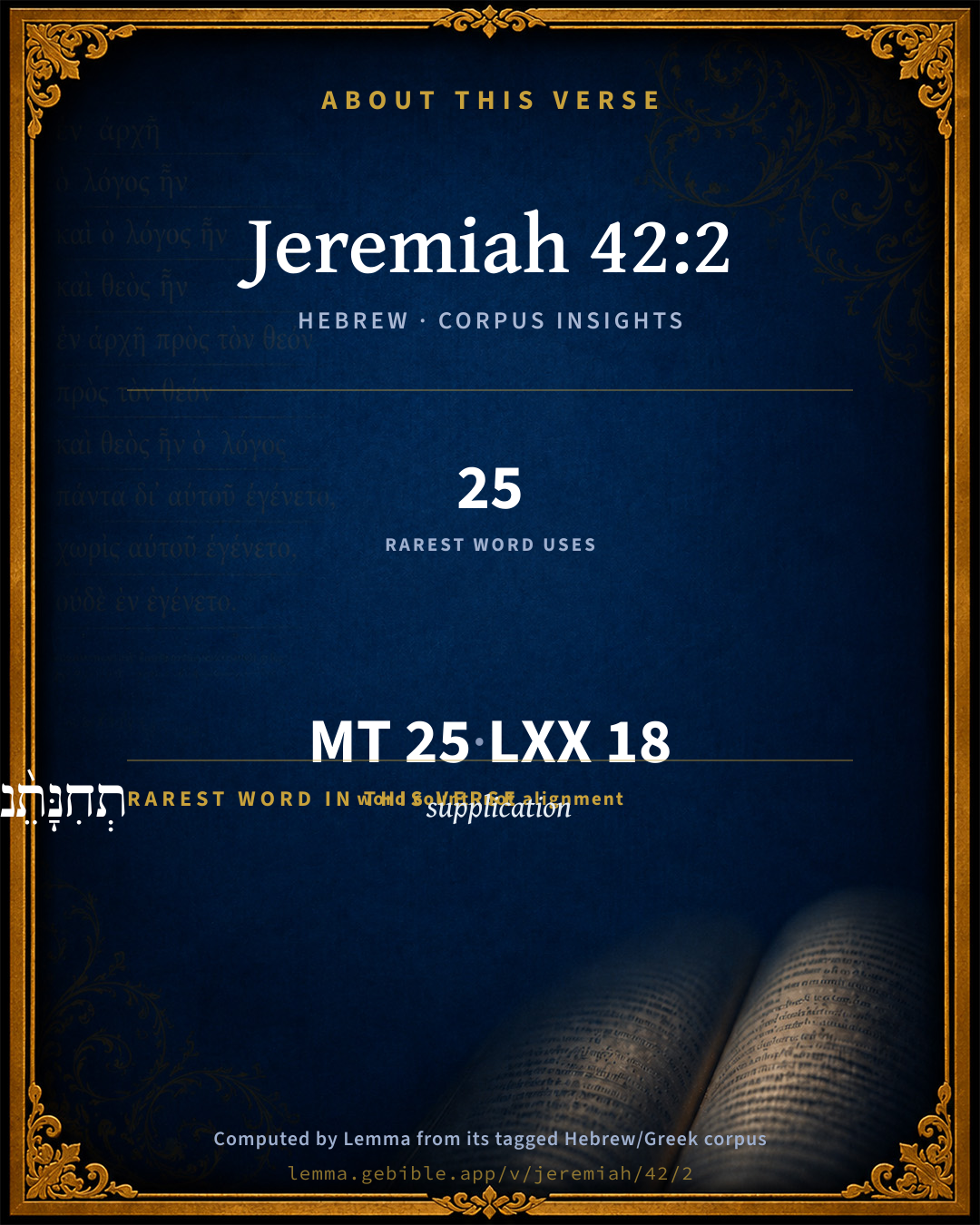
25
words
24
distinct lemmas
Prophets
section

Notable vocabulary

The rarest word here is תְחִנָּתֵ֨נוּ֙ supplication H8467 — appearing just 25 times in the whole Hebrew Bible.

Shared distinctive vocabulary

תְחִנָּתֵ֨נוּ֙ supplication H8467 occurs in 24 verses of the Hebrew Bible. Also found in:

Grammatical profile

  • 6 verbs
  • 10 nouns
  • 1 pronoun
  • 4 prepositions
  • 1 conjunction
  • 3 particles

Verb forms

  • וַיֹּאמְר֞וּ Qal · Sequential Imperfect
  • תִּפָּל Qal · Jussive
  • וְהִתְפַּלֵּ֤ל Hithpael · Imperative
  • נִשְׁאַ֤רְנוּ Niphal · Perfect
  • מֵֽהַרְבֵּ֔ה Hiphil · Infinitive Absolute
  • רֹא֥וֹת Qal · Participle Active

Repetition

A word recurs within this verse — often emphatic in Hebrew:

  • אֶֽל to H413 ×2

Hebrew & Septuagint length

In the original languages it is 25 Hebrew tokens and 18 Greek tokens — but the two are counted differently (Hebrew bundles its prefixes and suffixes into one token; the Greek is in lemma form), so that isn’t a like-for-like length.

Cross-references

25

Topical passages linked to Jeremiah 42:2 in the Treasury of Scripture Knowledge — connected by theme and wording, ordered by reader-vote popularity; previews shown in the World English Bible.

  • Jeremiah 36:7 It may be they will present their supplication before Yahweh, and will return everyone from his evil way; for great is the anger and the wrath that Yahweh has pronounced against this people.
  • Leviticus 26:22 I will send the wild animals among you, which will rob you of your children, destroy your cattle, and make you few in number; and your roads will become desolate.
  • 1 Samuel 7:8 The children of Israel said to Samuel, "Don't cease to cry to Yahweh our God for us, that he will save us out of the hand of the Philistines."
  • 1 Samuel 12:19 All the people said to Samuel, Pray for your servants to Yahweh your God, that we not die; for we have added to all our sins [this] evil, to ask us a king.
  • Isaiah 1:9 Unless Yahweh of hosts had left to us a very small remnant, We would have been as Sodom; We would have been like Gomorrah.
  • Isaiah 37:4 It may be Yahweh your God will hear the words of Rabshakeh, whom the king of Assyria his master has sent to defy the living God, and will rebuke the words which Yahweh your God has heard. Therefore lift up your prayer for the remnant that is left.
  • Jeremiah 37:3 Zedekiah the king sent Jehucal the son of Shelemiah, and Zephaniah the son of Maaseiah, the priest, to the prophet Jeremiah, saying, Pray now to Yahweh our God for us.
  • Lamentations 1:1 How does the city sit solitary, that was full of people! She has become as a widow, who was great among the nations! She who was a princess among the provinces is become tributary!
  • Acts 8:24 Simon answered, "Pray for me to the Lord, that none of the things which you have spoken happen to me."
  • James 5:16 Confess your offenses to one another, and pray one for another, that you may be healed. The effective, earnest prayer of a righteous man is powerfully effective.
  • Exodus 8:28 Pharaoh said, "I will let you go, that you may sacrifice to Yahweh your God in the wilderness, only you shall not go very far away. Pray for me."
  • Deuteronomy 28:62 You shall be left few in number, whereas you were as the stars of the sky for multitude; because you didn't listen to the voice of Yahweh your God.
  • 1 Kings 13:6 The king answered the man of God, Entreat now the favor of Yahweh your God, and pray for me, that my hand may be restored me again. The man of God entreated Yahweh, and the king's hand was restored him again, and became as it was before.
  • Jeremiah 37:20 Now please hear, my lord the king: please let my supplication be presented before you, that you not cause me to return to the house of Jonathan the scribe, lest I die there.
  • Exodus 9:28 Pray to Yahweh; for there has been enough of mighty thunderings and hail. I will let you go, and you shall stay no longer."
  • Deuteronomy 4:27 Yahweh will scatter you among the peoples, and you shall be left few in number among the nations, where Yahweh shall lead you away.
  • 1 Samuel 12:23 Moreover as for me, far be it from me that I should sin against Yahweh in ceasing to pray for you: but I will instruct you in the good and the right way.
  • Isaiah 1:15 When you spread forth your hands, I will hide my eyes from you; Yes, when you make many prayers, I will not hear. Your hands are full of blood.
  • Jeremiah 17:15–16 Behold, they tell me, Where is the word of Yahweh? let it come now.
  • Jeremiah 21:2 Please inquire of Yahweh for us; for Nebuchadrezzar king of Babylon makes war against us: peradventure Yahweh will deal with us according to all his wondrous works, that he may go up from us.
  • Jeremiah 42:20 For you have dealt deceitfully against your own souls; for you sent me to Yahweh your God, saying, Pray for us to Yahweh our God; and according to all that Yahweh our God shall say, so declare to us, and we will do it:
  • Ezekiel 5:3–4 You shall take of it a few in number, and bind them in your skirts.
  • Ezekiel 12:16 But I will leave a few men of them from the sword, from the famine, and from the pestilence; that they may declare all their abominations among the nations where they come; and they shall know that I am Yahweh.
  • Zechariah 13:8–9 It shall happen that in all the land," says Yahweh, Two parts in it will be cut off and die; But the third will be left in it.
  • Matthew 24:22 Unless those days had been shortened, no flesh would have been saved. But for the sake of the chosen ones, those days will be shortened.

Cross-references courtesy of OpenBible.info (CC BY 4.0).

Hebrew and Greek witnesses Masoretic Hebrew ↔ Greek Septuagint

The same verse in the two great witnesses to the Old Testament, shown verse-for-verse.

These are two independent witnesses, not word-aligned to each other, and the Septuagint is shown in lemma (dictionary) form.

Hebrew Jeremiah 42:2 Masoretic · Westminster Leningrad Codex

וַיֹּאמְר֞וּ אֶֽל יִרְמְיָ֣הוּ הַנָּבִ֗יא תִּפָּל נָ֤א תְחִנָּתֵ֨נוּ֙ לְפָנֶ֔יךָ וְהִתְפַּלֵּ֤ל בַּעֲדֵ֨נוּ֙ אֶל יְהוָ֣ה אֱלֹהֶ֔יךָ בְּעַ֖ד כָּל הַשְּׁאֵרִ֣ית הַזֹּ֑את כִּֽי נִשְׁאַ֤רְנוּ מְעַט֙ מֵֽהַרְבֵּ֔ה כַּאֲשֶׁ֥ר עֵינֶ֖יךָ רֹא֥וֹת אֹתָֽנוּ

and said to Jeremiah the prophet, Let, we pray you, our supplication be presented before you, and pray for us to Yahweh your God, even for all this remnant; for we are left but a few of many, as your eyes do see us:

World English Bible · Public Domain

Greek LXX Structure differs

In the Septuagint, Jeremiah is about an eighth shorter than the Hebrew and arranges its material differently — the Oracles Against the Nations (Hebrew chapters 46–51) appear in the middle of the Greek book, after 25:13. Because the chapter and verse boundaries do not line up, a verse-for-verse comparison with the Hebrew is not shown.

A verse-for-verse comparison isn’t shown here because the chapters and verses don’t line up. Switch to the LXX edition with the MT / LXX toggle above to read the Greek directly.

Hebrew: Westminster Leningrad Codex (CC BY 4.0). Greek: Septuagint (public domain); English from a public-domain English Septuagint. How the Septuagint differs from the Hebrew →

Targum (Aramaic paraphrase)

1

The Targum is the ancient Jewish Aramaic paraphrase of the Hebrew Scriptures — an interpretive translation, not the Hebrew text itself. Onkelos (literal) and Pseudo-Jonathan (expansive) render the Torah, and Jonathan the Prophets. Coverage is partial: where no permissively-licensed English translation exists for a verse, only the Aramaic is shown. This is verse-level text, not a word-by-word alignment to the Hebrew.

  1. Targum Jonathan Prophets (Joshua–Malachi)
    וַאֲמָרוּ לְיִרְמְיָה נְבִייָא תִּתְקַבֵּיל כְּעַן בָּעוּתָנָא קָדָמָךְ וְצַלֵי עֲלָנָא קֳדָם יְיָ אֱלָהָךְ עַל כָּל שְׁאָרָא הָדֵין אֲרֵי אִשְׁתְּאַרְנָא זְעִיר מִסְגֵי כְּמָא דְעֵינָךְ חֶזְיָן יָתָנָא:

    (no public-domain English translation for this verse)

    Targum Jonathan — Aramaic: “Mikraot Gedolot” (public domain). English: “Sefaria Community Translation” (CC0 1.0 (public-domain dedication)); “London "Chaldee Paraphrase," 1871” (public domain). Text via Sefaria.

Commentary

Notes on Jeremiah 42:2 from classic Christian and Jewish commentators (each source and its license shown beneath its notes). The classic Christian expositions comment on the surrounding passage and are grouped to its opening verse, so a note may address several verses; the Jewish commentaries on the Tanakh (Rashi and others) are per-verse, so they appear only where the commentator wrote on this verse.

Lemma curates 59 commentaries, every one of them public domain or Creative Commons licensed, each selected and text-cleaned for this edition rather than reprinted as found. About our sources →

Trapp's Complete Commentary

John Trapp

Jer 42:2 And said unto Jeremiah the prophet, Let, we beseech thee, our supplication be accepted before thee, and pray for us unto the LORD thy God, [even] for all this remnant; (for we are left [but] a few of many, as thine eyes do behold us:)

Ver. 2. Let, we beseech thee, our supplication be accepted before thee.] Here they seem to humble themselves before Jeremiah the prophet; which, because King Zedekiah did not, he came to ruin. {2Ch 36:12}

And pray for us unto the Lord thy God.] Good words may be found even in a hellish mouth sometimes. Who would think but these men had spoken what they did unfeignedly, and from their very hearts? whenas it soon after appeared that all was no better than deep dissimulation. They had made their conclusion beforehand to go down to Egypt, only in a pretence of piety, and for greater credit, they would have had God’s approbation; which, since they cannot, they will go on with their design however, fall back, fall edge. O most hateful hypocrisy! O contumacy worthy of all men’s execration!

John Trapp, A Commentary or Exposition upon All the Books of the Old and New Testament (1647–1656) — public domain. Text from a community e-Sword module.

Geneva Bible (1599)

Geneva Bible translators

Hebrew, Let our prayer fall before thee, as Jer. 36:7

Geneva Bible (1599) marginal notes — public domain. Text via Bolls.life.

John Calvin's Commentaries

It is added, that they said, as though they were ready to obey, Let our prayer fall before thee. This, as we have said, when addressed to God, is an evidence of humility; but it is applied here to man; and when the Hebrews make a humble request, they say, “Let my prayer fall before thee,” that is, Hear what I suppliantly and humbly ask. Pray, they said, to Jehovah thy God for us They called him the God of Jeremiah, not that they intended to exempt themselves from his authority; they did not mean that they were alienated from God; but in this way they extolled Jeremiah, and acknowledged him to be God’s true and lawful Prophet. In short, this saying refers to the prophetic office, as though they had said, that Jeremiah had hitherto confirmed his vocation, so that it was clearly evident that he had been sent from above.

We hence see why they called Jehovah the God of Jeremiah, not as though they had rejected God, and as though he was not their God in common with Jeremiah, but they allowed that the Prophet possessed a higher honor, and that his faithfulness and integrity were beyond controversy.

But this admission justly recoiled on their own head; for if Jeremiah was God’s Prophet, why did they not instantly obey him, after knowing that what he faithfully told them he had received from God? and why did they insolently and ferociously resist him and accuse him of falsehood? Their own admission then was not sincere, but a fallacious flattery, as is the case with all hypocrites, who never speak in sincerity and truth.

They afterwards added, Pray for all this remnant, for we are left, a few from many This they added to produce pity, in order that they might more easily obtain from Jeremiah what they asked; nor was that difficult; but as they felt conscious of wrong, they sought the favor of the Prophet by flatteries, Had they asked him without disguise, they knew that he was of himself disposed to seek the well being of the people; but as they were of a double mind, they set before him their miserable state, which might; have roused the Prophet still more to make intercession to God for them. And for this reason they added, as thine eyes see us And they set before him this sad spectacle, to create sympathy in the Prophet. And it then follows, And may Jehovah thy God shew us the way in which we are to walk. They now explained more clearly why they wished prayer to be made for them, even that God might answer and shew what he wished them to do.

John Calvin's Commentaries (1540-1563) — public domain. Text from the Calvin Translation Society English edition (1840s-50s) via the Christian Classics Ethereal Library (ccel.org). Calvin's coverage is partial (roughly two-thirds of the Bible); uncommented books and verses are honest gaps, never fabricated. The 19th-century editor's footnotes and remarks are omitted so the notes are faithfully Calvin's own voice.

Ellicott's Commentary for English Readers

(2) Pray for us unto the Lord thy God.—The prophet had gone to Gedaliah at Mizpah (Jer_40:6), and would seem to have been among the captives whom Ishmael was carrying off when they were rescued by Johanan at Gibeon (Jer_41:13-14). The people now turn to him, acknowledging him as a true prophet, and, trusting to his patriotism. ask for his guidance. Their position was difficult and dangerous. Would he not pray to Jehovah for wisdom, that they might see their way—the way to escape from the threatening peril—clearly? He complies with their wishes, and they, on their side, promise to follow the guidance for which they ask.

A Bible Commentary for English Readers, edited by Charles John Ellicott (1878–1897) — public domain. Text from a community e-Sword module.

The Cambridge Bible for Schools and Colleges

gen. ed. J. J. S. Perowne

2. be accepted] For mg. See on Jer_36:7.

2. then spake Azariah] See on ch. Jer_42:1.

all the proud men, saying] The word in MT. (’ômĕrim) corresponding to “saying” here does not represent the ordinary Hebrew idiom. We should therefore, by a slight change in the original, read the proud and defiant (hammôrim) men.

Thou speakest falsely, etc.] The attack upon Baruch, and only indirectly and through him upon the prophet, may have arisen from their being reluctantly compelled to acknowledge that Jeremiah himself at any rate was possessed of integrity of purpose. This he had shewn by his refusal to seek protection and honourable treatment from the Chaldaeans, whose favour the worse section of his countrymen always suspected him of seeking.

The Cambridge Bible for Schools and Colleges (gen. ed. J. J. S. Perowne; Cambridge University Press, 1878–1918) — public domain. Text from a community e-Sword module.

John Gill's Exposition

And said unto Jeremiah the prophet,.... That is, some one of them, as the mouth of the whole body, very probably Johanan:

let, we beseech thee, our supplication be accepted before thee; they treat the prophet with great respect, and are very humble and submissive, as if they were very hearty and sincere in their request:

and pray for us unto the Lord thy God; as if they were conscious of their own inability to pray for themselves, and of their unworthiness to call God their God; and as if they had a high opinion of, he prophet, as having an interest in God, and great power with him in prayer, whom he could not well deny anything:

even for all this remnant; this poor remnant, this handful of people, left of the sword, famine, and pestilence, left in the land by the Chaldeans, and who had escaped the cruelty of Ishmael; and for whom it might be hoped the Lord would still have a regard, since he had so mercifully and wonderfully preserved them:

for we are left but a few of many, as thine eyes do behold us; the number of the people had been very large, but by the judgments of the sword, famine, and pestilence, and captivity, they were greatly reduced; here was their whole number before the prophet; his eyes beheld them, and the condition they were in: this they said to move his compassion, and very likely to suggest to him how improbable it was that they should ever be able to continue in their own land; but that it would be better to put themselves under the protection of a neighbouring nation, Egypt, whither they were inclined to go; and hoped to have a word from the Lord by the prophet, to direct them thither.

John Gill's Exposition of the Whole Bible (1746–1763) — public domain (CC PDM 1.0). Text via the HelloAO Bible API.

Haydock's Catholic Bible Commentary

Pray; consult, ver. 4., and chap. xxxvii. 3. (Haydock) --- Few; comparatively, though there was a great number, chap. xliii. 5.

George Leo Haydock (1774–1849), Haydock's Catholic Family Bible and Commentary, 1859 edition — public domain. Excludes Psalms (Douay-Rheims chapter numbering differs from Protestant) and Deuterocanonical books (Catholic canon only).

Matthew Poole's English Annotations

These men (though wretched hypocrites) yet come to the prophet with great respect and reverence, first desiring that he would allow them to make their request to him: probably the evidence they had had so lately of his being a prophet of the Lord, by the fulfilling of all that he had foretold against both the city and the temple, might in some measure occasion this. Their request was, that he would put up his prayer to God for the remnant, for now there was but a small remnant of Jews left, a few of many.

Matthew Poole's English Annotations on the Holy Bible (1683–1685) — public domain. Text from a community e-Sword/MySword module.

Whedon's Commentary on the Bible

Daniel D. Whedon

2. Pray for us — Nagelsbach regards this as a piece of hypocrisy, since their mind seems to have been already strongly set to go to Egypt. But this is by no means necessary. They may have been sincerely desirous to know God’s will, even though they greatly preferred that it should be in a given direction. It is not unusual for honest people to consult God or his servants, not so much to know the right as to secure approval for that already determined on.

Daniel D. Whedon (gen. ed.), Commentary on the Old and New Testaments (1874–1909) — public domain. Text from a community e-Sword module.

The Pulpit Commentary

Said unto Jeremiah the prophet. Jeremiah, we have been already told, was one of the refugees at Mizpah, (Jer_40:6) and consequently was forced into the train of Ishmael. (Jer_41:16) Pray for us. This petition has been accused of hypocrisy, but the prophecy of Jeremiah assumes throughout that it was made in earnest (ver. 20 proven nothing to the contrary). The "captains" never supposed it possible that Jeremiah could direct them to stay in Judah; the only question with them was as to the best direction for flight.

The Pulpit Commentary (1880–1919), ed. H.D.M. Spence-Jones & Joseph S. Exell — public domain. Text from a community e-Sword module.

Lesson kit

Teaching starters — assembled from the data on this page, not authored interpretation. Every prompt links to the verse data it draws on. Edit before teaching.

Jeremiah, in the Prophets, opens this verse with 25 words (24 distinct Hebrew lemmas). Its most distinctive word is tᵉchinnâh (“supplication”). A historical commentator’s framing appears above. Read the whole chapter for the surrounding context.

Discussion questions

  1. How does “supplication” (tᵉchinnâh) shape what this verse is saying?
  2. How does Joshua 11:20, which shares the word «supplication», read alongside this verse?
  3. What does the repetition of “to” (2× in this one verse) do in this verse?
  4. The translations on this page render this verse differently — a whole-verse word diff, not a word-by-word alignment. What might account for the different wordings?
  5. «וַיֹּאמְר֞וּ» is a Qal Sequential Imperfect verb. How does that grammatical form shape the action described?
  6. Compare how Trapp's Complete Commentary and Geneva Bible (1599) read this verse. Where do they agree or differ?

Things to notice

Reading settings

Reading text

Shown beneath each verse's original-language words.

Old Testament
Old Testament edition

Read the OT as the Masoretic Hebrew (MT) or the Greek Septuagint (LXX).

English shown for the Greek Septuagint (in the Hebrew ↔ Greek comparison).

Comparing translations? Open the Compare panel on any verse page to stack up to four side by side.