
Hosea 8:14

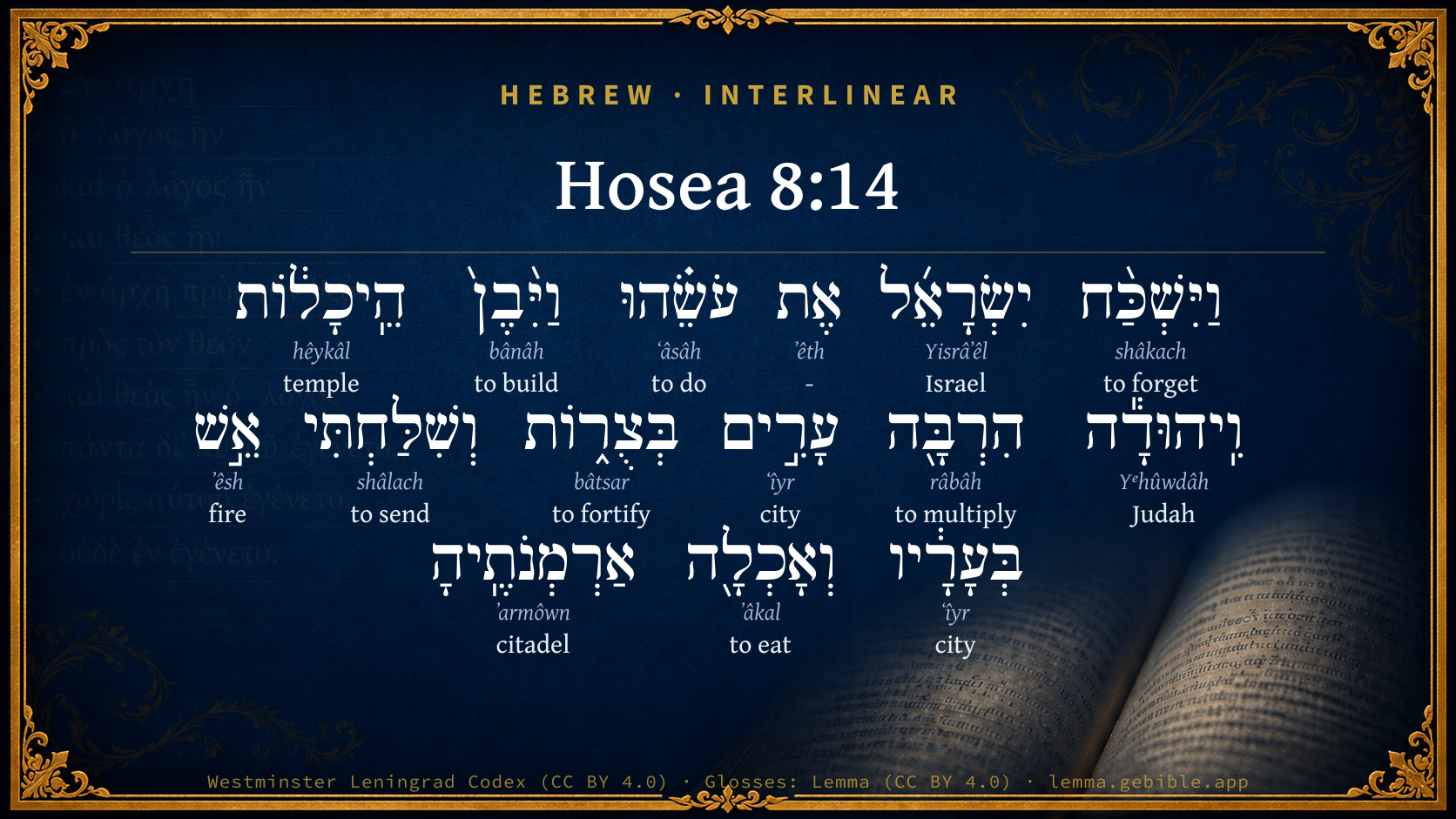
Hebrew (Westminster Leningrad Codex) Hosea 8:14 appears in the Hebrew Old Testament. The text above is from the Westminster Leningrad Codex. Each word links to its Strong’s number, a concise gloss, and parsing drawn from the Open Scriptures Hebrew Bible morphology. Click any word for its full Brown-Driver-Briggs (BDB) entry.
Download image
Cite this verse

Hosea 8:14 (World English Bible). Public Domain. Lemma interlinear Bible study tool, https://lemma.gebible.app/v/hosea/8/14.

Show BibTeX & RIS
BibTeX
RIS
English Translation
For Israel has forgotten his Maker and built palaces; And Judah has multiplied fortified cities; But I will send a fire on his cities, And it will devour its fortresses."
World English Bible · Public Domain
Download a study sheet

One document with this verse’s original text, its word-by-word gloss line, the meaning frame, cross-references with their text, attributed commentary, and full source and license credits — printable, and it pastes into notes with its structure intact.

This verse Autodidact and up

Study sheet (.html) Plain text (.txt)

A passage Seminary Student

Up to 50 verses in one chapter. A passage sheet keeps up to 6 commentary sources and 12 cross-references per verse, in the order this page ranks them, and says so on the sheet whenever that leaves anything out. Ask for a single verse and you get the Autodidact verse sheet above.

Everything on this page stays free to read, with no account — the sheet is a download of what is already on screen, not access to it.

Want to remove ads? Support Godless Engineer
Compare translations 3

The same verse in 3 English versions, stacked beneath the original-language interlinear above. Click any original word for its lexicon entry.

Each is an independent rendering of the whole verse — the interlinear is not word-aligned to these translations.

Highlighted words mark where these versions differ — a whole-verse word diff, not a word-by-word alignment.

  • World English Bible Public Domain
    For Israel has forgotten his Maker and built palaces; And Judah has multiplied fortified cities; But I will send a fire on his cities, And it will devour its fortresses."
  • King James Version Public Domain
    For Israel hath forgotten his Maker, and buildeth temples; and Judah hath multiplied fenced cities: but I will send a fire upon his cities, and it shall devour the palaces thereof.
  • unfoldingWord Literal Text CC BY-SA 4.0
    And Israel forgot his maker and built palaces. And Judah has multiplied fortified cities, but I will send fire on his cities, and it will devour her citadels.”

unfoldingWord Literal Text — © unfoldingWord, licensed CC BY-SA 4.0. Word-aligned USFM3 via Door43 (git.door43.org/unfoldingWord/en_ult).

Versions to compare (up to 4)

3 of 4 selected

Show all 18 translations

Every available English version of this verse, each an independent rendering of the whole verse.

  • World English Bible Public Domain
    For Israel has forgotten his Maker and built palaces; And Judah has multiplied fortified cities; But I will send a fire on his cities, And it will devour its fortresses."
  • Berean Standard Bible Public Domain
    Israel has forgotten his Maker and built palaces; Judah has multiplied its fortified cities. But I will send fire upon their cities, and it will consume their citadels.
  • Majority Standard Bible Public Domain
    Israel has forgotten his Maker and built palaces; Judah has multiplied its fortified cities. But I will send fire upon their cities, and it will consume their citadels.
  • King James Version Public Domain
    For Israel hath forgotten his Maker, and buildeth temples; and Judah hath multiplied fenced cities: but I will send a fire upon his cities, and it shall devour the palaces thereof.
  • American Standard Version (1901) Public Domain
    For Israel hath forgotten his Maker, and builded palaces; and Judah hath multiplied fortified cities: but I will send a fire upon his cities, and it shall devour the castles thereof.
  • Revised Version (1885) Public Domain
    For Israel hath forgotten his Maker, and builded palaces; and Judah hath multiplied fenced cities: but I will send a fire upon his cities, and it shall devour the castles thereof.
  • Geneva Bible (1599) Public Domain
    For Israel hath forgotten his maker, and buildeth Temples, and Iudah hath increased strong cities: but I will sende a fire vpon his cities, and it shall deuoure the palaces thereof.
  • Douay-Rheims (1899) Public Domain
    And Israel hath forgotten his Maker, and hath built temples: and Juda hath built many fenced cities: and I will send a fire upon his cities, and it shall devour the houses thereof.
  • Young's Literal Translation Public Domain
    And forget doth Israel his Maker, and buildeth temples, And Judah hath multiplied cities of defence, And I have sent a fire into his cities, And it hath consumed their palaces!
  • Literal Standard Version CC BY-SA 4.0
    And Israel forgets his Maker, and builds temples, || And Judah has multiplied cities of defense, || And I have sent a fire into his cities, || And it has consumed their palaces!”
  • Unlocked Literal Bible CC BY-SA 4.0
    Israel has forgotten me, his Maker, and has built palaces. Judah has fortified many cities, but I will send fire on his cities; it will destroy his fortresses.
  • unfoldingWord Literal Text CC BY-SA 4.0
    And Israel forgot his maker and built palaces. And Judah has multiplied fortified cities, but I will send fire on his cities, and it will devour her citadels.”
  • Darby Bible Public Domain
    For Israel hath forgotten his Maker, and buildeth temples; and Judah hath multiplied fenced cities: but I will send a fire upon his cities, and it shall devour the palaces thereof.
  • World Messianic Bible Public Domain
    For Israel has forgotten his Maker and built palaces; and Judah has multiplied fortified cities; but I will send a fire on his cities, and it will devour its fortresses.”
  • Webster's Bible Public Domain
    For Israel hath forgotten his Maker, and buildeth temples; and Judah hath multiplied fortified cities: but I will send a fire upon his cities, and it shall devour the palaces thereof.
  • Free Bible Version CC BY-SA 4.0
    Israel has forgotten his maker, and built palaces; Judah has built many fortified cities. But I will rain fire down on their cities and burn up their fortresses.
  • Bible in Basic English Public Domain
    For Israel has no memory of his Maker, and has put up the houses of kings; and Judah has made great the number of his walled towns. But I will send a fire on his towns and put an end to his great houses.
  • JPS Tanakh (1917) Public Domain
    For Israel hath forgotten his Maker, and builded palaces, and Judah hath multiplied fortified cities; but I will send a fire upon his cities, and it shall devour the castles thereof.

Literal Standard Version (2020), Covenant Press — licensed CC BY-SA 4.0. Text via the HelloAO Bible API (eBible.org). Unlocked Literal Bible (unfoldingWord) — licensed CC BY-SA 4.0. Text via the HelloAO Bible API (eBible.org). unfoldingWord Literal Text — © unfoldingWord, licensed CC BY-SA 4.0. Word-aligned USFM3 via Door43 (git.door43.org/unfoldingWord/en_ult). Free Bible Version, Dr. Jonathan Gallagher — licensed CC BY-SA 4.0. Text via the HelloAO Bible API (eBible.org).

Word by word

More ways to search: Search by grammar → Find every occurrence → Compare this word →

Practice this passage: Drill this verse → Learn its vocabulary →

אַרְמְנֹתֶֽיהָ
ʼarmôwn
H759
“citadels · her”
Noun, Common, Masculine, Plural, Construct + Suffix, Personal, 3rd Person, Feminine, Singular
Part of Speech
Noun
Type
Common
Gender
Masculine
Number
Plural
State
Construct
Full BDB Definition

Origin: from an unused root (meaning to be elevated)

TWOT: 164a

citadel, palace, fortress
  1. וַיִּשְׁכַּ֨ח shâkach H7911 “and · to forget” Conjunction + Verb, Qal, Sequential Imperfect, 3rd Person, Masculine, Singular
  2. יִשְׂרָאֵ֜ל Yisrâʼêl H3478 “Israel” Noun, Proper
  3. אֶת ʼêth H853 “-” Particle, Direct Object
  4. עֹשֵׂ֗הוּ ʻâsâh H6213 “doing · him” Verb, Qal, Participle Active, Masculine, Singular, Construct + Suffix, Personal, 3rd Person, Masculine, Singular
  5. וַיִּ֨בֶן֙ bânâh H1129 “and · to build” Conjunction + Verb, Qal, Sequential Imperfect, 3rd Person, Masculine, Singular
  6. הֵֽיכָל֔וֹת hêykâl H1964 “temples” Noun, Common, Masculine, Plural, Absolute
  7. וִֽיהוּדָ֕ה Yᵉhûwdâh H3063 “and · Judah” Conjunction + Noun, Proper
  8. הִרְבָּ֖ה râbâh H7235 “to multiply” Verb, Hiphil, Perfect, 3rd Person, Masculine, Singular
  9. עָרִ֣ים ʻîyr H5892 “cities” Noun, Common, Feminine, Plural, Absolute
  10. בְּצֻר֑וֹת bâtsar H1219 “fortified” Adjective, Adjective, Feminine, Plural, Absolute
  11. וְשִׁלַּחְתִּי shâlach H7971 “and · to send” Conjunction + Verb, Piel, Sequential Perfect, 1st Person, Common, Singular
  12. אֵ֣שׁ ʼêsh H784 “fire” Noun, Common, Both, Singular, Absolute
  13. בְּעָרָ֔יו ʻîyr H5892 “in/at · cities · his” Preposition + Noun, Common, Feminine, Plural, Construct + Suffix, Personal, 3rd Person, Masculine, Singular
  14. וְאָכְלָ֖ה ʼâkal H398 “and · to eat” Conjunction + Verb, Qal, Sequential Perfect, 3rd Person, Feminine, Singular

About this verse

These counts appear in no published source. They are computed here, from the morphology-tagged text and Lemma’s own curated glosses. What Lemma adds →

15
words
14
distinct lemmas
Prophets
section

Shared distinctive vocabulary

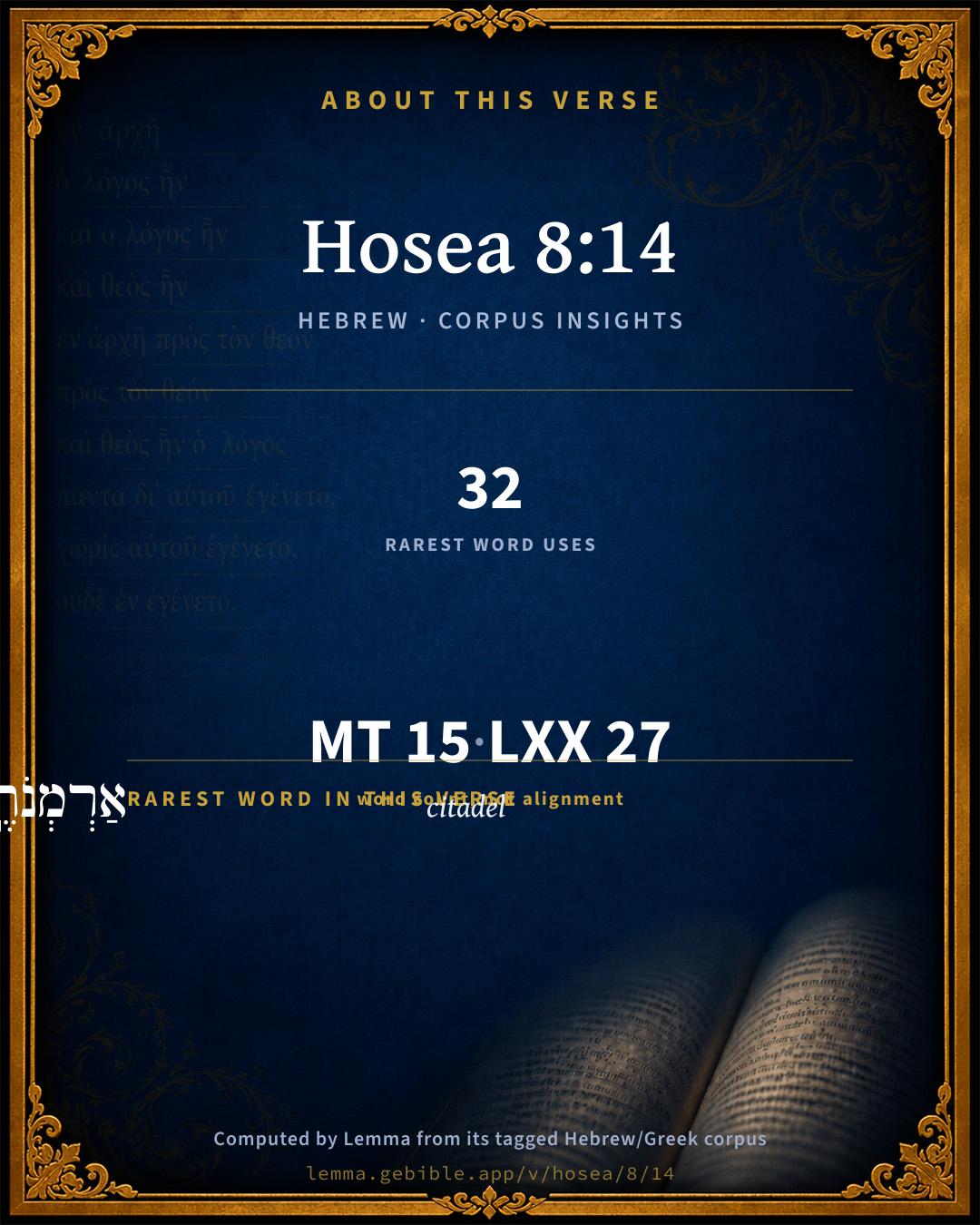
אַרְמְנֹתֶֽיהָ citadel H759 occurs in 31 verses of the Hebrew Bible. Also found in:

Grammatical profile

  • 6 verbs
  • 7 nouns
  • 1 adjective
  • 1 particle

Verb forms

  • וַיִּשְׁכַּ֨ח Qal · Sequential Imperfect
  • עֹשֵׂ֗הוּ Qal · Participle Active
  • וַיִּ֨בֶן֙ Qal · Sequential Imperfect
  • הִרְבָּ֖ה Hiphil · Perfect
  • וְשִׁלַּחְתִּי Piel · Sequential Perfect
  • וְאָכְלָ֖ה Qal · Sequential Perfect

Repetition

A word recurs within this verse — often emphatic in Hebrew:

  • עָרִ֣ים city H5892 ×2

Hebrew & Septuagint length

In English translation the verse runs 30 words from the Hebrew and 33 from the Septuagint (LXX English) — closely comparable.

A rough comparison of the two English renderings, which tokenize alike — not a word-level alignment.

Word counts can differ between the Hebrew and the Greek without any difference in meaning — e.g. the Hebrew direct-object marker אֵת has no separate Greek word, and Greek often adds the article ὁ.

In the original languages it is 15 Hebrew tokens and 27 Greek tokens — but the two are counted differently (Hebrew bundles its prefixes and suffixes into one token; the Greek is in lemma form), so that isn’t a like-for-like length.

Cross-references

25

Topical passages linked to Hosea 8:14 in the Treasury of Scripture Knowledge — connected by theme and wording, ordered by reader-vote popularity; previews shown in the World English Bible.

  • Deuteronomy 32:18 Of the Rock that became your father, you are unmindful, Have forgotten God who gave you birth.
  • Jeremiah 17:27 But if you will not listen to me to make the Sabbath day holy, and not to bear a burden and enter in at the gates of Jerusalem on the Sabbath day; then will I kindle a fire in the gates of it, and it shall devour the palaces of Jerusalem, and it shall not be quenched.
  • Isaiah 17:10 For you have forgotten the God of your salvation, and have not been mindful of the rock of your strength; therefore you plant pleasant plants, and set it with strange slips.
  • Hosea 13:6 According to their pasture, so were they filled; They were filled, and their heart was exalted. Therefore they have forgotten me.
  • Amos 2:5 But I will send a fire on Judah, And it will devour the palaces of Jerusalem."
  • Psalms 106:21 They forgot God, their Savior, Who had done great things in Egypt,
  • Jeremiah 2:32 Can a virgin forget her ornaments, or a bride her attire? yet my people have forgotten me days without number.
  • Amos 1:10 But I will send a fire on the wall of Tyre, And it will devour its palaces."
  • Ephesians 2:10 For we are his workmanship, created in Christ Jesus for good works, which God prepared before that we would walk in them.
  • 1 Kings 12:31 He made houses of high places, and made priests from among all the people, who were not of the sons of Levi.
  • 1 Kings 16:31 It happened, as if it had been a light thing for him to walk in the sins of Jeroboam the son of Nebat, that he took as wife Jezebel the daughter of Ethbaal king of the Sidonians, and went and served Baal, and worshiped him.
  • 2 Chronicles 26:10 He built towers in the wilderness, and hewed out many cisterns, for he had much cattle; in the lowland also, and in the plain: [and he had] farmers and vineyard keepers in the mountains and in the fruitful fields; for he loved farming.
  • 2 Chronicles 27:4 Moreover he built cities in the hill-country of Judah, and in the forests he built castles and towers.
  • Isaiah 22:8–11 He took away the covering of Judah; and you did look in that day to the armor in the house of the forest.
  • Isaiah 29:23 But when he sees his children, the work of my hands, in the midst of him, they shall sanctify my name; yes, they shall sanctify the Holy One of Jacob, and shall stand in awe of the God of Israel.
  • Isaiah 42:13 Yahweh will go forth as a mighty man; he will stir up [his] zeal like a man of war: he will cry, yes, he will shout aloud; he will do mightily against his enemies.
  • Isaiah 42:25 Therefore he poured on him the fierceness of his anger, and the strength of battle; and it set him on fire round about, yet he didn't know; and it burned him, yet he didn't lay it to heart.
  • Isaiah 43:21 the people which I formed for myself, that they might set forth my praise.
  • Jeremiah 3:21 A voice is heard on the bare heights, the weeping [and] the petitions of the children of Israel; because they have perverted their way, they have forgotten Yahweh their God.
  • Jeremiah 23:27 who think to cause my people to forget my name by their dreams which they tell every man to his neighbor, as their fathers forgot my name for Baal.
  • Hosea 2:13 I will visit on her the days of the Baals, To which she burned incense, When she decked herself with her earrings and her jewels, And went after her lovers, And forgot me," says Yahweh.
  • Amos 1:4 But I will send a fire into the house of Hazael, And it will devour the palaces of Ben Hadad.
  • Amos 1:12 But I will send a fire on Teman, And it will devour the palaces of Bozrah."
  • Amos 1:14 But I will kindle a fire in the wall of Rabbah, And it will devour its palaces, With shouting in the day of battle, With a tempest in the day of the whirlwind;
  • 2 Kings 18:13 Now in the fourteenth year of king Hezekiah did Sennacherib king of Assyria come up against all the fortified cities of Judah, and took them.

Cross-references courtesy of OpenBible.info (CC BY 4.0).

Hebrew and Greek witnesses Masoretic Hebrew ↔ Greek Septuagint

The same verse in the two great witnesses to the Old Testament, shown verse-for-verse.

These are two independent witnesses, not word-aligned to each other, and the Septuagint is shown in lemma (dictionary) form.

Hebrew Hosea 8:14 Masoretic · Westminster Leningrad Codex

וַיִּשְׁכַּ֨ח יִשְׂרָאֵ֜ל אֶת עֹשֵׂ֗הוּ וַיִּ֨בֶן֙ הֵֽיכָל֔וֹת וִֽיהוּדָ֕ה הִרְבָּ֖ה עָרִ֣ים בְּצֻר֑וֹת וְשִׁלַּחְתִּי אֵ֣שׁ בְּעָרָ֔יו וְאָכְלָ֖ה אַרְמְנֹתֶֽיהָ

For Israel has forgotten his Maker and built palaces; And Judah has multiplied fortified cities; But I will send a fire on his cities, And it will devour its fortresses."

World English Bible · Public Domain

Greek LXX Hosea 8:14 Septuagint · lemma form

καί ἐπιλανθάνω ἰσραήλ ὁ ποιέω αὐτός καί οἰκοδομέω τέμενος καί ἰούδας πληθύνω πόλις τειχίζω καί ἐκ ἀποστέλλω πῦρ εἰς ὁ πόλις αὐτός καί καταἐσθίω ὁ θεμέλιον αὐτός

And Israel has forgotten him that made him, and they have built fanes, and Juda has multiplied walled cities: but I will send fire on his cities, and it shall devour their foundations.

LXX2012 (modern English Septuagint) · Public Domain

On this verse, Haydock's Catholic Bible Commentary discusses the Septuagint’s reading. Read the note in Commentary ↓

Hebrew: Westminster Leningrad Codex (CC BY 4.0). Greek: Septuagint (public domain); English from LXX2012 (modern English Septuagint) (Public Domain). How the Septuagint differs from the Hebrew →

Targum (Aramaic paraphrase)

1

The Targum is the ancient Jewish Aramaic paraphrase of the Hebrew Scriptures — an interpretive translation, not the Hebrew text itself. Onkelos (literal) and Pseudo-Jonathan (expansive) render the Torah, and Jonathan the Prophets. Coverage is partial: where no permissively-licensed English translation exists for a verse, only the Aramaic is shown. This is verse-level text, not a word-by-word alignment to the Hebrew.

  1. Targum Jonathan Prophets (Joshua–Malachi)
    וּשְׁבַק יִשְׂרָאֵל יַת פּוּלְחַן עָבְדֵיהּ וּבְנָא הֵיכְלִין לְטַעֲוָתָא וּדְבֵית יְהוּדָה אַסְגִיאוּ קִרְוִין כְּרִיכָן וְאֶשְׁלַח אֶשְׁתָּא בְּקִרְווֹהִי וּתְשֵׁיצֵי בִּרְנָיָתָהָא:

    (no public-domain English translation for this verse)

    Targum Jonathan — Aramaic: “Mikraot Gedolot” (public domain). English: “Sefaria Community Translation” (CC0 1.0 (public-domain dedication)); “London "Chaldee Paraphrase," 1871” (public domain). Text via Sefaria.

Commentary

Notes on Hosea 8:14 from classic Christian and Jewish commentators (each source and its license shown beneath its notes). The classic Christian expositions comment on the surrounding passage and are grouped to its opening verse, so a note may address several verses; the Jewish commentaries on the Tanakh (Rashi and others) are per-verse, so they appear only where the commentator wrote on this verse.

Lemma curates 59 commentaries, every one of them public domain or Creative Commons licensed, each selected and text-cleaned for this edition rather than reprinted as found. About our sources →

Trapp's Complete Commentary

John Trapp

Hos 8:14 For Israel hath forgotten his Maker, and buildeth temples; and Judah hath multiplied fenced cities: but I will send a fire upon his cities, and it shall devour the palaces thereof.

Ver. 14. For Israel hath forgotten his maker] Not more his factor than his benefactor, as, 1Sa 12:6, the Lord made Moses and Aaron, i.e. he advanced them to that honour in his Church. So our Saviour is said to have made twelve, when he ordained them to the apostleship, Mar 3:14. And the apostle saith of Israel, that God exalted the people, when they dwelt as strangers in the land of Egypt, Act 13:17, sc. to the privilege of his peculiar people, the possession of the promised land, the custody of his oracles and services, &c., besides the many benefits and deliverances wrought for them. All which they are said to have forgotten: 1. Because they laid them not to heart, see Isa 57:11, they saw not God in them; 2. Because their lives were not answerable; they walked not worthy of such a God; but said (in effect), "We are delivered to do all these abominations," Jer 7:10. God challengeth remembrance, and well he may, Ecc 12:1, for he hath created us for his glory, Isa 43:7, he hath formed us, yea, he hath made us (as it followeth there, and all that we might remember him): the word (made) is used for a degree of grace after creation. Those that are his workmanship, his artificial facture (ποιημα), created in Christ Jesus (who is the beginning of this creation of God, Rev 3:14) unto good works, Eph 2:10, if ever they should forget God (which is the character of a wicked man, Psa 50:22); if they should forsake God that made them, and lightly esteem tha Rock of their salvation, Deu 32:15, as Solomon did the Lord that had appeared unto him twice; if they should not prefer him above their chief joy, or make him ascend above the head of their joy (as the Hebrew hath it, Psa 137:6), and set him over all, as Pharaoh did Joseph (causing sun, moon, and stars to do obeisance to him), I mean, all their natural, moral, temporal, and spiritual abilities to be subject and serviceable to him; he would have an unanswerable action against them, and both heaven and earth Would have cause to blush at their disingenuity and unthankfulness. Let it ever be remembered, that of all things God cannot abide to be forgotten.

And buildeth temples] To God, no doubt; and yet, because they worshipped him not in his own way they are said to have forgotten him: so do Papists in all their structures, vowed presents, and memories (as they call them). In King Stephen’s time here, notwithstanding all the miseries of war, there were more Abbeys built than in a hundred years before. But who required those things at their hands? Christus opera nostra non tam actibus quam finibus pensat (Zanchius). Now the end why those temples and monasteries were built appears in stories to be pro remissione et redemptione peccatorum, pro remedio et liberatione animae: pro amore coelestis patriae: in honorem gloriosae Virginis, in eleemosynam animae, &c., for remission of sins, redemption of souls, honour of the Virgin Mary, and other superstitious ends and uses.

And Judah hath multiplied fenced cities] As thinking thereby to fence themselves against God’s wrath, to mott themselves up against his fire that had burnt up the ten tribes, and threatened them. Strong cities and munitions may be lawfully built; but then their foundations must not be laid upon fireworks. If sin be at the bottom (as the voice from heaven is said to have told Phocas), though they build as high as heaven it will not do. Babylon’s thick walls and large provisions could not secure her from the enemy; Samaria held out for two or three years, but was surprised at last by the Assyrian; so was Jerusalem by the Babylonians, and then by the Romans, Isa 22:8-10. Great fault is found with this people, for their warlike preparations with neglects of God, Hos 8:11, and of deep and downright humiliation, Hos 8:12-14. The name of the Lord is the strongest tower, Pro 18:10. But cursed is he that maketh flesh his arm, that trusteth in men, though never so great; or means, though never so likely, Jer 17:5, those were never true to those that trusted them. The Jebusites were beaten out of their fort, though they presumed it impregnable. The men of Shechem were burned out, Jdg 9:49 : so shall Judah be; for,

I will send a fire upon his cities, and it shall devour the palaces thereof] The enemy did this, but not without the Lord; who cannot brook it that men should trust in palaces and strongholds; and as Luther well observeth, in this whole chapter is fully set forth whence it is that strong palaces and flourishing kingdoms come to nought; it is because men believe not in God, but trust to their own strength, Deu 28:52; they fortify themselves against an enemy, but do not pacify God’s displeasure; who is himself a devouring fire, and can quickly quash all our forces, and confute our confidences.

John Trapp, A Commentary or Exposition upon All the Books of the Old and New Testament (1647–1656) — public domain. Text from a community e-Sword module.

The Biblical Illustrator

Joseph S. Exell

Hos_8:14

For Israel hath forgotten his Maker, and buildeth temples; and Judah hath multiplied fenced cities.

Neither the religion nor security of a nation to be judged by appearances

The temples are the idolatrous temples built after the models from Syrophoenicia. Fenced cities are fortified places erected against foreign invaders.

1. The multiplicity of temples is no infallible proof of the growth of religion in a country. When we think of the moral causes that often lead to the erection of temples, they rather prove our forgetfulness of God. They are greed, spite, sectism.

2. The increase of national defences is no proof of the increase of national security. The safety of a people is in the moral excellence of their character, and in the guardianship of heaven. (Homilist.)

God forgotten

Prosperous men become dangerously independent, and in their pride they forget God, and exclaim with Nebuchadnezzar, Is not this great Babylon that I have built? As Daniel Quorm quaintly says, The devil is called in the Bible Beelzebub--that do mean, the god o flies--and youre sure to find em a-buzzin about the honey-pots o prosperity. Nothing so completely blinds a man as gold-dust, for he cannot even see God--he is a practical atheist. Affluence leads first to indifference, then to coldness, then to unbelief, then to cynicism, and then to godlessness! Henry IV. once asked the Duke of Alva if he had observed certain eclipses which had occurred that year. No, was the reply, I have had so much business to attend to upon earth, that I have had no time even to look up to heaven. This is one of the perils of prosperity--to forget God, and leave heaven out of account. (Helping Words.)

.

The Biblical Illustrator, edited by Joseph S. Exell (c. 1880s–1900s) — public domain. Text from a community e-Sword module.

Joseph Benson's Commentary

Hos 8:14. For Israel hath forgotten his Maker — Hath forgotten him who formed them into a people, preserved and advanced them, and conferred on them all those privileges wherein they excelled all other nations: either they have not remembered him at all, or have done it without reverence, gratitude, love, or consideration of the duty and service which they owe him. And buildeth temples — For idolatrous worship. And Judah hath multiplied fenced cities — To secure themselves from the invasion of the enemy. When the Jews saw what incursions were made upon the Israelites, or the ten tribes, by the Assyrians, they diligently set about fortifying their cities, thinking to find security in so doing, and putting greater confidence in their fortifications than in God’s protection. But I will send afire upon his cities — My judgments shall destroy them, as surely as if a fire had been kindled in them. Or the threatening may be interpreted literally; for when Sennacherib took all the fenced cities of Judah, except Jerusalem, he undoubtedly set fire to many of them, as conquerors were wont to do in those days.

Joseph Benson's Commentary on the Old and New Testaments (1811–1818) — public domain. Text from a community e-Sword module.

The Preacher's Complete Homiletical Commentary

Joseph S. Exell (gen. ed.)

CRITICAL NOTES.—

Hos_8:14. Forgotten] Deu_32:18. Israel reared idol temples: Judah increased fortified cities; the sin of both, forgetfulness of God and deification of self as displayed in their buildings. God would destroy all these castles of security (Jer_17:27; Amo_2:5). Nothing can protect in judgment but the refuge, the hiding-place which he has provided.

HOMILETICS

CASTLES OF FALSE SECURITY.—Hos_8:14

The sin of Judah and Israel is here traced to one cause—forgetfulness of God. Though he made and established them as a nation, their self-confidence and idolatry led them to forsake and offend God, to build temples and palaces, which he destroyed by fire.

I. Men build temples in forgetfulness of God. “Israel hath forgotten his Maker, and buildeth temples.” There was only one temple, to build more was to disobey God. Yet they build in professed recognition of God, act religiously, but sin wilfully. Giving land, building churches and benevolent institutions, not always a proof of religious prosperity.

1. Temples are built in superstition. Like the monasteries of the middle ages, for the remission of sins, the redemption of souls, and the honour of saints.

2. Temples are built in spite. Men have grievances, secede from other places and build for themselves.

3. Temples are built in the interests of sectarianism. All sects rival each other in this respect, and seek to cover the land with their churches and chapels. Temples built in forgetfulness of God, to commemorate man, are not required at our hands. “Ye have not looked unto the Maker thereof, neither had respect unto him that fashioned it long ago.”

II. Men increase national defences in forgetfulness of God. “Judah hath multiplied defenced cities.” Nebuchadnezzar erected Babylon in self-confidence and pride. Samaria and Jerusalem were strongly fortified, but destroyed at last. The strength of a nation depend not upon the skill of its parliament and the splendour of its fleets; nor the valour of its soldiers and the number of its fortifications. God alone is our defence; for he can “impoverish the fenced cities, wherein thou trustedst.” Men who found empires and build cities in opposition to him can never succeed. The Roman Empire crumbled away by the weight of its greatness. The kingdoms of Alexander, Cæsar, and Napoleon came to nought. Babylon and Carthage, Macedon and Persia, Greece and Rome were built, prospered for a while, and then declined. The safety of a nation is in the moral conduct of its people and the guardianship of God. “Except the Lord build the house, they labour in vain that build it: except the Lord keep the city, the watchman waketh but in vain.”

ILLUSTRATIONS TO CHAPTER 8

Hos_8:14. Defence. When Nicephorus Phocas had built a strong wall about his palace for his own security, in the night time, he heard a voice crying to him, “O Emperor! though thou build thy wall as high as the clouds, yet, if sin be within, it will overthrow it” [Foster].

The Preacher's Complete Homiletical Commentary (gen. ed. Joseph S. Exell; Funk & Wagnalls, c. 1892) — public domain (pre-1929). A full-Bible homiletical/sermon-outline anthology covering 65 of 66 books (2 John is absent from the source module). Text from a community e-Sword module.

Tyndale Open Study Notes

Tyndale Open Resources

8:14 Israel has forgotten its Maker: See 2:13. • God’s judgment is often described as fire sent upon the royal palaces and fortresses (see Amos 1:4, 7).

Tyndale Open Study Notes — © Tyndale Open Resources, licensed CC BY-SA 4.0. Text via the HelloAO Bible API.

Jamieson, Fausset & Brown

Robert Jamieson, A. R. Fausset & David Brown

forgotten . . . Maker-- (Deu 32:18).

temples--to idols.

Judah . . . fenced cities--Judah, though less idolatrous than Israel, betrayed lack of faith in Jehovah by trusting more to its fenced cities than to Him; instead of making peace with God, Judah multiplied human defenses (Isa 22:8; Jer 5:17; Mic 5:10-11).

I will send . . . fire upon . . . cities--Sennacherib burned all Judah's fenced cities except Jerusalem (Kg2 18:13).

palaces thereof--namely, of the land. Compare as to Jerusalem, Jer 17:27.

Next: Hosea Chapter 9

Jamieson, Fausset & Brown — Commentary Critical and Explanatory on the Whole Bible (1871) — public domain (CC PDM 1.0). Text via the HelloAO Bible API.

Adam Clarke's Commentary

Verse 14. Israel hath forgotten his Maker] And therefore built temples to other gods. Judah had lost all confidence in the Divine protection, and therefore built many fenced cities. But the fire of God's anger burnt up both the temples and the fortified cities.

Adam Clarke's Commentary on the Bible (1810–1826) — public domain. Text from a community e-Sword/MySword module.

John Calvin's Commentaries

Here the Prophet concludes his foregoing observations. It is indeed probable that he preached them at various times; but, as I have already said, the heads of the sermons which the Prophet delivered are collected in this book, so that we may know what his teaching was. He then discoursed daily on idolatry, on superstitions, and on the other corruptions which then prevailed among the people; he often repeated the same threatenings, but afterwards collected into certain chapters the things which he had spoken. The conclusion, then, of his former teaching was this, that Israel had forgotten his Maker, whilst for himself he had been building temples He says, that he forgot his Maker by building temples because he followed not the directions of the law. We hence see that God will have himself to be known by his word. Israel might have objected and said, that no such thing was intended, when he built temples in Dan and Bethel, but that he wished by these to retain the remembrance of God. But the Prophet here shows that God is not truly known, and that men do not really remember him, except when they worship him according to what the law prescribes, except when they submit themselves wholly to his word, and undertake nothing, and attempt nothing, but what he has commanded. What then the superstitious say is remembrance, the Prophet here plainly testifies is forgetfullness. The case is the same at this day, when we blame the Papists for their idols; their excuse is this, that what they set forth is in pictures and statues the image of God, and that images, as they say, are the books of the illiterate. But what does the Prophet answer here? That Israel forgot his Maker There was an altar in Bethel, and there Israel was wont to offer sacrifices, and they called this the worship of God; but the Prophet shows that each worship was accursed before God, and that it had no other effect than wholly to obliterate the holy name of God from the minds of men, so that the whole of religion perished.

Remarkable then is this passage; for the Prophet says, that the people forgot God their Maker, when they built temples for themselves But what was in the temples so vicious, as to take away the remembrance of God from the world? Even because God would have but one temple and altar. If a reason was asked, a reason might indeed have been given; but the people ought to have acquiesced in the command of God. Though God may not show why he commands this or that, it is enough that we ought to obey his word. Now, then, it appears, that when Israel built for himself various temples, he departed from God, and for this reason, because he followed not the rule of the law, and kept not himself within the limits of the divine command. Hence it was to forget God. We now apprehend the object of the Prophet.

Though then they were wont to glory in their temples, and there to display their pomp and splendor, and proudly to delight in their superstitions, yet the Prophet says, that they had forgotten their Creator, and for this reason only, because they had not continued in his law. He says, that they had forgotten God their Maker; by the word Maker, the Prophet alludes not to God as the framer of the world and the creator of men, but he applies it to the condition of the people. For, as we well know, the favor of God had been peculiar towards that people; he had not only made them, as a part of the human race, but also formed them a people to himself. Since then God had thus intended them to be devoted to him, the Prophet here increases and enhances their sin, when he says, that they obeyed not his word, but followed their own devices and depraved imaginations.

John Calvin's Commentaries (1540-1563) — public domain. Text from the Calvin Translation Society English edition (1840s-50s) via the Christian Classics Ethereal Library (ccel.org). Calvin's coverage is partial (roughly two-thirds of the Bible); uncommented books and verses are honest gaps, never fabricated. The 19th-century editor's footnotes and remarks are omitted so the notes are faithfully Calvin's own voice.

Ellicott's Commentary for English Readers

(14) Temples.—The word here used for temple is used sixty times for Jehovah’s temple. The building of these temple-palaces was a distinct sin against the unity of the Godhead.

Judah hath multiplied fenced cities.—Referred to by Sennacherib, in the inscription relating to the campaign of 701 B.C. “Forty-six of his (Hezekiah’s) strong cities, fortresses . . . I besieged, I captured.” These were erected by Uzziah and Jotham (2Ch_26:10; 2Ch_27:4). With the allusions to Israel’s temples (palaces) compare Amo_3:11; Amo_3:15.

A Bible Commentary for English Readers, edited by Charles John Ellicott (1878–1897) — public domain. Text from a community e-Sword module.

The Cambridge Bible for Schools and Colleges

gen. ed. J. J. S. Perowne

14. A fresh reason for the ‘swallowing up’ of which the prophet has spoken (Hos_8:8)—Israel’s worldliness and self-dependence.

buildeth temples] It seems doubtful however whether Hosea would have laid such stress on the wickedness of many temples and many altars (see Hos_8:11). More probably ‘temples’ should be palaces (the primitive meaning of the Assyrian cognate is ‘great house’), in which case for ‘palaces’ at the close of the verse we had better substitute castles. It is not so much the ‘palaces’ and the ‘castles’ themselves as the worldliness and the tyranny of those who lived in them that Hosea denounces.

but I will send a fire …] Referring to both Israel and Judah. Remarkably enough, we find these words repeated seven times in Amos as a refrain to as many denunciations (Amo_1:4 to Amo_2:5). It seems hardly likely that so original a prophet should have quoted these words; perhaps they were a well-known prophetic commonplace.

The Cambridge Bible for Schools and Colleges (gen. ed. J. J. S. Perowne; Cambridge University Press, 1878–1918) — public domain. Text from a community e-Sword module.

John Gill's Exposition

For Israel hath forgotten his Maker,.... The Creator and Preserver of everyone of them, and who had raised them up to a state and kingdom, and had made them great and rich, and populous, and bestowed many favours and blessings on them; and yet they forgot him, to give him glory, and to serve and worship him:

and buildeth temples; to idols, as the Targum adds; to the calves at Dan and Bethel, at which places, as there were altars set up, and priests appointed, so temples and houses of high places built to worship in; see Kg1 12:31;

and Judah hath multiplied fenced cities; to protect them from their enemies, which was not unlawful; but that they should put their trust and confidence in them, and not in the Lord their God, which was their sin; when they saw the ten tribes carried captive by the Assyrians, they betook themselves to such methods for their security, but were not careful to avoid those sins which brought ruin upon Israel:

but I will send a fire upon his cities, and it shall devour the palaces thereof; that is, an enemy, that should set fire to their cities, particularly Jerusalem their chief city, and burn the temple of the Lord, the palaces of their king and nobles, and all the fine houses of the great men; which was done many years after this prophecy, by Nebuchadnezzar king of Babylon, Jer 52:13.

Next: Hosea Chapter 9

John Gill's Exposition of the Whole Bible (1746–1763) — public domain (CC PDM 1.0). Text via the HelloAO Bible API.

Albert Barnes' Notes on the Bible

For Israel hath forgotten his Maker - God was his Maker, not only as the Creator of all things, but as the Author of his existence as a people, as He saith, “hath he not made thee, and established thee?” Deu 32:6.

And buildeth temples - as for the two calves, at Bethel and at Dan. Since God had commanded to build one temple only, that at Jerusalem, to “build temples” was in itself sin. The sin charged on Ephraim is idolatry; that of Judah is self-confidence ; from where Isaiah blames them, that they were busy in repairing the breaches of the city, and cutting off the supplies of water from the enemy; “but ye have not looked unto the Maker thereof, neither had respect unto Him, that fashioned it long ago Isa 22:11. Jeremiah also says, “that they shall impoverish (or, crush) the fenced cities, wherein thou trustedst, with the sword” Jer 5:17.

But I will send a fire upon his cities - In the letter, the words relate to Judah; but in substance, the whole relates to both. Both had forgotten God; both had offended Him. In the doom of others, each sinner may read his own. Of the cities of Judah, Isaiah says, “your country is desolate, your cities are burned with fire Isa 1:7 and in the fourteenth year of Hezekiah,” (some twelve years probably after the death of Hosea) “Sennacherib came up against all the cities of Judah and took them” 2Ki 18:13; and of Jerusalem it is related, that Nebuchadnezzar “burnt the house of the Lord, and the king’s house, and all the houses of Jerusalem, and every great man’s house he burnt with fire” 2Ki 25:8-9. Man set them on fire; God brought it to pass; and, in order to teach us that He doeth all things, giving all good, overruling all evil, saith that He was the doer of it.

Albert Barnes' Notes on the Bible (1834–1885) — public domain. Text from a community e-Sword/MySword module.

Haydock's Catholic Bible Commentary

Temples, or "palaces." (Calmet) --- Cities. The two tribes, witnessing the calamities of their brethren, will not avoid a similar conduct, but trust in their fortifications. (Worthington) --- Fire of war destroys both kingdoms. --- Thereof. Septuagint of St. Jerome adds, "and among the Assyrians they have eaten unclean things," which may be taken from chap. ix. 3. (Haydock) --- It is not found in the present Hebrew or Greek copies. (Calmet)

George Leo Haydock (1774–1849), Haydock's Catholic Family Bible and Commentary, 1859 edition — public domain. Excludes Psalms (Douay-Rheims chapter numbering differs from Protestant) and Deuterocanonical books (Catholic canon only).

Matthew Poole's English Annotations

Israel; the ten revolted idolatrous tribes.

Hath forgotten; the same with Hos 2:5, which see; or Hos 4:1,6. Either remembers not at all, or it is without love, thankfulness, and consideration what becomes him towards God. His Maker; who made, who preserved, who advanced them, and gave them all those privileges wherein they excel other nations; who brought them out of Egypt, &c.

Buildeth temples; the word will bear palaces, or towers. It is like their idol temples were magnificent, that they might boast of them, and strong like towers, that they might for need garrison and fortify them, and trust in their strength in a day of war and trouble.

Judah hath multiplied fenced cities; on like designs and motives doth Judah multiply strong holds, fortifying against threatened judgments, making flesh their arm, whilst their heart (as at this time of Ahaz’s reign and apostacy) did depart from the living God.

Send a fire upon his cities; bring an enemy upon them that shall besiege them in their cities, and burn them, which was effected by Nebuchadnezzar and his armies about one hundred and thirty years after.

It shall devour the palaces; the stately palaces of their princes and nobles in their cities, these shall be burnt too. Judah hath imitated Israel, and made himself like to Israel in sin, and God will make them like in sufferings; the fire which their sin hath kindled shall consume both.

Matthew Poole's English Annotations on the Holy Bible (1683–1685) — public domain. Text from a community e-Sword/MySword module.

The Pulpit Commentary

Israel and Judah both in the transgression.

In this closing verse of the chapter God takes Judah to task as well as Israel for forgetfulness of God; while that forgetfulness of his Maker on the part of Israel manifested itself in idolatry, and so in building idol-temples, but on the part of Judah by carnal confidences, and so in multiplying fenced cities. The one set up idols m the place of God, the other confided in outward means of defense and safety instead of trusting in God; thus the heart of both was far from God and the remembrance of his Name. The sin here recorded occurred in the reign of Ahaz, who sought to secure Judah by fortified cities, dreading the incursions of Assyria. (Isa_22:8-11) The punishment was inflicted by Sennacherib. (Isa_36:1)

The Maker forgotten.

It is not an uncommon case that one who has received very substantial benefits from a fellow-man forgets his benefactor, and, when raised to a higher position in life, ignores those who by their exertions, sacrifices, and sympathy have contributed to his elevation. We deem such ingratitude reprehensible and almost monstrous. Yet how lightly do we regard those who are guilty of forgetfulness of their Creator and Redeemer! And yet this has been a common fault from the days of Israel of old down to the present time.

I THE GUILT OF FORGETTING GOD, GENERALLY CONSIDERED. This appears when it is borne in mind:

1. That God is our Maker. To him we owe our existence; and to be unmindful of our Creator is the grossest sin.

2. That God has not forgotten us. He did not create man to leave him to himself, to live or to die. On the contrary, his care is ever over us, his love is always towards us. The tokens of his remembrances are always around us, in the bounties of his providence and in the proffers of his gospel.

3. That God has done much to keep himself in our memory. This is condescension indeed on the part of him who is the theme of heaven"s eternal song; whom they praise day and night in his temple. Yet on every side we see tokens of God"s presence, we hear the tones of his voice. He is not far from every one of us. Unnumbered suggestions of his presence, unnumbered reminders of his Fatherly love, aggravate the guilt of the unreflecting and ungrateful

II THE SPECIAL GUILT OF FORGETTING GOD ON THE PART OF ISRAEL OF OLD AND ON THE PART OF CHRISTIANS NOW. To the children of Abraham God was a covenant God; he had done great things for their fathers and for them. To forget One who had the highest claims upon their memory, their fidelity, their devotion, this was guilt indeed. Yet not comparable to the guilt of those who enjoy the advantages secured to such as live under the sound of the gospel, and in the midst of the privileges of the Church. How, if we forget God, can we hope, can we ask, that he should remember us in mercy and for good? T.

Neither the religion nor security of a nation to be judged by appearances.

"For Israel bath forgotten," etc. The "temples" referred to here are the idolatrous temples which Israel had built after the models of those built by the Syro-phoenicians; and the "fenced cities" refers to those fortified places which they had erected against foreign invaders. The words imply that neither the temples nor the "fenced cities" were any proof either of their religion or their security.

I THE MULTIPLICATION OF TEMPLES IS NO INFALLIBLE PROOF OF THE GROWTH OF RELIGION IN A COUNTRY. Temples were now multiplied in Israel. And the reason assigned is forgetfulness of their Maker. When strangers visit England and witness the number of our churches of all sects, and measures of beauty and size, their first impression would be What a religious people these English are! But when we think of the moral causes that often lead to the erection of temples, they rather prove our forgetfulness of God.

1. There is greed. Churches are sometimes built as an investment.

2. There is spite. One or two, or more, have received a grievance at the neighboring Church, and, inspired by spite, they set to the erection of another.

3. There is sectism. Episcopalians, Wesleyans, Congregationalists, all seek to rival each other in this respect; so that the multiplication of temples, we fear, must not be taken as a proof of the growth of religion.

II THE INCREASE OF NATIONAL DEFENSES IS NO PROOF OF THE INCREASE OF NATIONAL SECURITY. "I will send a fire upon his cities." When noble foreigners visit our shores, we, with our national vanity, seek to impress them with the greatness of our national defenses. We exhibit our fleets, our standing armies, our fortifications; we have our naval and military reviews. What fools are they who think that national security is in these things! The safety of a people is in the moral excellence of their character and the guardianship of Heaven. D.T.

The Pulpit Commentary (1880–1919), ed. H.D.M. Spence-Jones & Joseph S. Exell — public domain. Text from a community e-Sword module.

John Wesley's Explanatory Notes

Temples - Idol temples. Devour the palaces - This was fulfilled when all the cities of Judah and Israel were laid in ashes by the king of Assyria.

John Wesley, Explanatory Notes Upon the Whole Bible (1754–1765) — public domain. Text via the GEBible commentary corpus.

Lesson kit

Teaching starters — assembled from the data on this page, not authored interpretation. Every prompt links to the verse data it draws on. Edit before teaching.

Hosea, in the Prophets, opens this verse with 15 words (14 distinct Hebrew lemmas). Its most distinctive word is ʼarmôwn (“citadel”). A historical commentator’s framing appears above. Read the whole chapter for the surrounding context.

Discussion questions

  1. The word ʼarmôwn carries the sense “citadel.” How does it shape the verse?
  2. How does 1 Kings 16:18, which shares the word «citadel», read alongside this verse?
  3. What does the repetition of “city” (2× in this one verse) do in this verse?
  4. These translations render this verse differently; the difference is in the English rendering, not the original. What questions does that raise?
  5. «וַיִּשְׁכַּ֨ח» is a Qal Sequential Imperfect verb. How does that grammatical form shape the action described?
  6. Compare how Trapp's Complete Commentary and The Biblical Illustrator read this verse. Where do they agree or differ?

Things to notice

Reading settings

Reading text

Shown beneath each verse's original-language words.

Old Testament
Old Testament edition

Read the OT as the Masoretic Hebrew (MT) or the Greek Septuagint (LXX).

English shown for the Greek Septuagint (in the Hebrew ↔ Greek comparison).

Comparing translations? Open the Compare panel on any verse page to stack up to four side by side.