
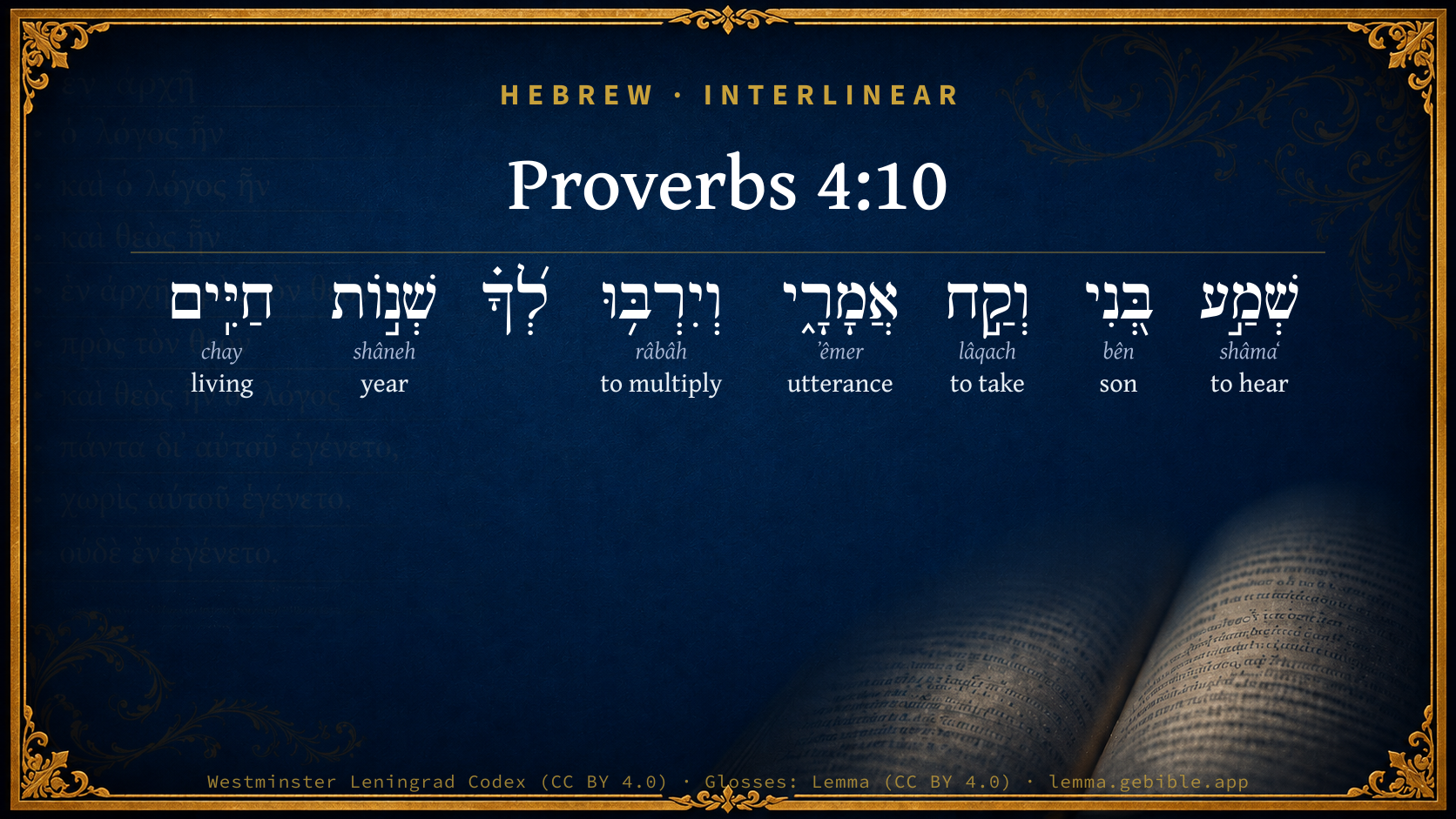
Proverbs 4:10

Hebrew (Westminster Leningrad Codex) Proverbs 4:10 appears in the Hebrew Old Testament. The text above is from the Westminster Leningrad Codex. Each word links to its Strong’s number, a concise gloss, and parsing drawn from the Open Scriptures Hebrew Bible morphology. Click any word for its full Brown-Driver-Briggs (BDB) entry.
Download image
Cite this verse

Proverbs 4:10 (World English Bible). Public Domain. Lemma interlinear Bible study tool, https://lemma.gebible.app/v/proverbs/4/10.

Show BibTeX & RIS
BibTeX
RIS
English Translation
Listen, my son, and receive my sayings. The years of your life will be many.
World English Bible · Public Domain
Download a study sheet

One document with this verse’s original text, its word-by-word gloss line, the meaning frame, cross-references with their text, attributed commentary, and full source and license credits — printable, and it pastes into notes with its structure intact.

This verse Autodidact and up

Study sheet (.html) Plain text (.txt)

A passage Seminary Student

Up to 50 verses in one chapter. A passage sheet keeps up to 6 commentary sources and 12 cross-references per verse, in the order this page ranks them, and says so on the sheet whenever that leaves anything out. Ask for a single verse and you get the Autodidact verse sheet above.

Everything on this page stays free to read, with no account — the sheet is a download of what is already on screen, not access to it.

Want to remove ads? Support Godless Engineer
Compare translations 3

The same verse in 3 English versions, stacked beneath the original-language interlinear above. Click any original word for its lexicon entry.

Each is an independent rendering of the whole verse — the interlinear is not word-aligned to these translations.

Highlighted words mark where these versions differ — a whole-verse word diff, not a word-by-word alignment.

  • World English Bible Public Domain
    Listen, my son, and receive my sayings. The years of your life will be many.
  • King James Version Public Domain
    Hear, O my son, and receive my sayings; and the years of thy life shall be many.
  • unfoldingWord Literal Text CC BY-SA 4.0
    Hear, my son, and receive my sayings, and they will multiply for you the years of life.

unfoldingWord Literal Text — © unfoldingWord, licensed CC BY-SA 4.0. Word-aligned USFM3 via Door43 (git.door43.org/unfoldingWord/en_ult).

Versions to compare (up to 4)

3 of 4 selected

Show all 18 translations

Every available English version of this verse, each an independent rendering of the whole verse.

  • World English Bible Public Domain
    Listen, my son, and receive my sayings. The years of your life will be many.
  • Berean Standard Bible Public Domain
    Listen, my son, and receive my words, and the years of your life will be many.
  • Majority Standard Bible Public Domain
    Listen, my son, and receive my words, and the years of your life will be many.
  • King James Version Public Domain
    Hear, O my son, and receive my sayings; and the years of thy life shall be many.
  • American Standard Version (1901) Public Domain
    Hear, O my son, and receive my sayings; And the years of thy life shall be many.
  • Revised Version (1885) Public Domain
    Hear, O my son, and receive my sayings; and the years of thy life shall be many.
  • Geneva Bible (1599) Public Domain
    Heare, my sonne, and receiue my wordes, and the yeeres of thy life shalbe many.
  • Douay-Rheims (1899) Public Domain
    Hear, O my son, and receive my words, that years of life may be multiplied to thee.
  • Young's Literal Translation Public Domain
    Hear, my son, and receive my sayings, And years of life `are' multiplied to thee.
  • Literal Standard Version CC BY-SA 4.0
    Hear, my son, and receive my sayings, || And years of life [are] multiplied to you.
  • Unlocked Literal Bible CC BY-SA 4.0
    Listen, my son, and pay attention to my words, and you will have many years in your life.
  • unfoldingWord Literal Text CC BY-SA 4.0
    Hear, my son, and receive my sayings, and they will multiply for you the years of life.
  • Darby Bible Public Domain
    Hear, my son, and receive my sayings, and the years of thy life shall be multiplied.
  • World Messianic Bible Public Domain
    Listen, my son, and receive my sayings. The years of your life will be many.
  • Webster's Bible Public Domain
    Hear, O my son, and receive my sayings; and the years of thy life shall be many.
  • Free Bible Version CC BY-SA 4.0
    Listen, my son, if you accept what I tell you, then you will live a long life.
  • Bible in Basic English Public Domain
    Give ear, O my son, and let your heart be open to my sayings; and long life will be yours.
  • JPS Tanakh (1917) Public Domain
    Hear, O my son, and receive my sayings; and the years of thy life shall be many.

Literal Standard Version (2020), Covenant Press — licensed CC BY-SA 4.0. Text via the HelloAO Bible API (eBible.org). Unlocked Literal Bible (unfoldingWord) — licensed CC BY-SA 4.0. Text via the HelloAO Bible API (eBible.org). unfoldingWord Literal Text — © unfoldingWord, licensed CC BY-SA 4.0. Word-aligned USFM3 via Door43 (git.door43.org/unfoldingWord/en_ult). Free Bible Version, Dr. Jonathan Gallagher — licensed CC BY-SA 4.0. Text via the HelloAO Bible API (eBible.org).

Word by word

More ways to search: Search by grammar → Find every occurrence → Compare this word →

Practice this passage: Drill this verse → Learn its vocabulary →

About this verse

These counts appear in no published source. They are computed here, from the morphology-tagged text and Lemma’s own curated glosses. What Lemma adds →

8
words
7
distinct lemmas
Wisdom
section

Shared distinctive vocabulary

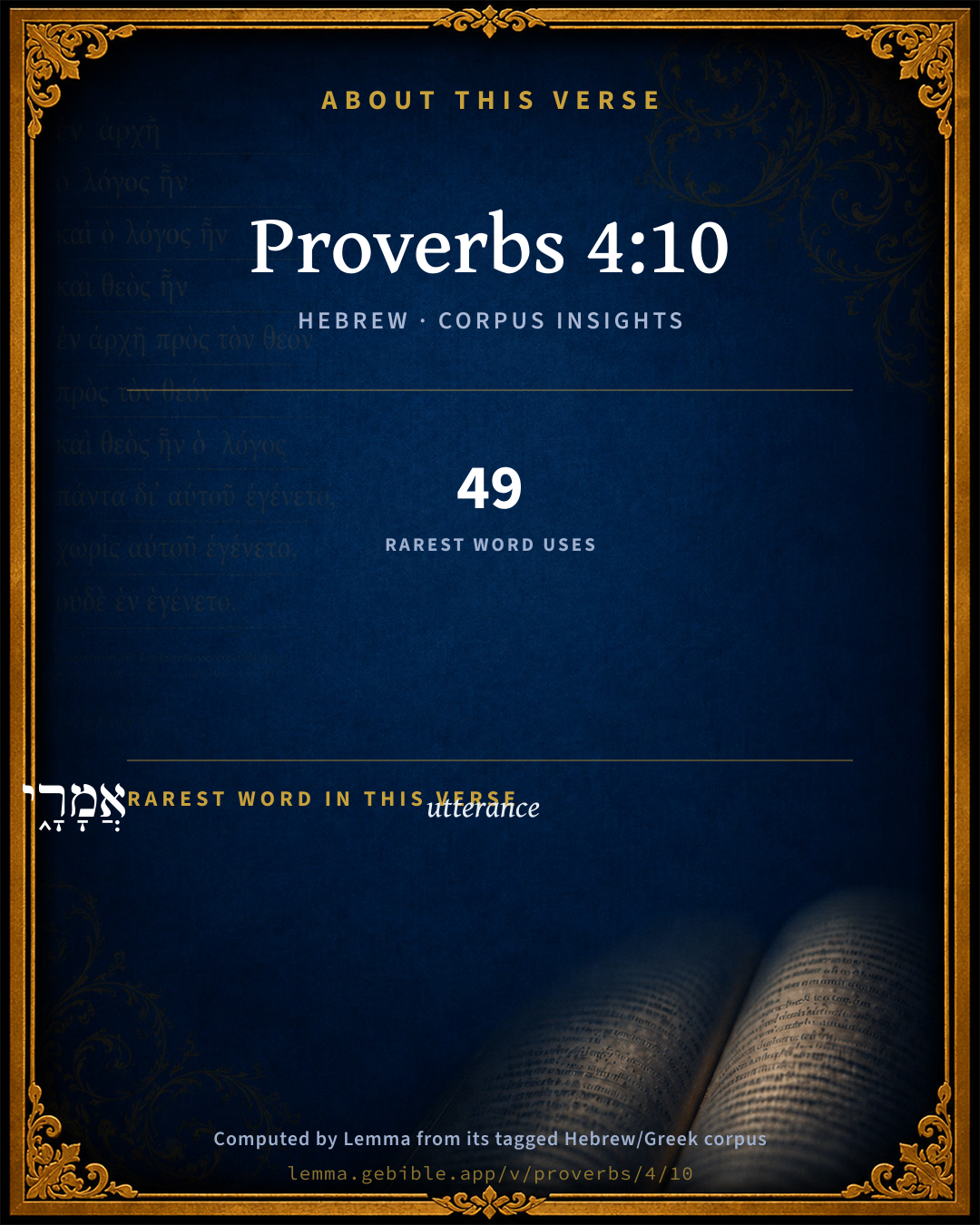
אֲמָרָ֑י utterance H561 occurs in 47 verses of the Hebrew Bible. Also found in:

Grammatical profile

  • 3 verbs
  • 4 nouns
  • 1 preposition

Verb forms

  • שְׁמַ֣ע Qal · Imperative
  • וְקַ֣ח Qal · Imperative
  • וְיִרְבּ֥וּ Qal · Imperfect

Hebrew & Septuagint length

In English translation the verse runs 15 words from the Hebrew and 25 from the Septuagint (LXX English) — the Septuagint runs noticeably longer here. See the side-by-side →

A rough comparison of the two English renderings, which tokenize alike — not a word-level alignment.

Word counts can differ between the Hebrew and the Greek without any difference in meaning — e.g. the Hebrew direct-object marker אֵת has no separate Greek word, and Greek often adds the article ὁ.

Cross-references

12

Topical passages linked to Proverbs 4:10 in the Treasury of Scripture Knowledge — connected by theme and wording, ordered by reader-vote popularity; previews shown in the World English Bible.

  • 1 Thessalonians 2:13 For this cause we also thank God without ceasing, that, when you received from us the word of the message of God, you accepted it not as the word of men, but, as it is in truth, the word of God, which also works in you who believe.
  • Proverbs 3:2 For length of days, and years of life, And peace, will they add to you.
  • Deuteronomy 6:2 that you might fear Yahweh your God, to keep all his statutes and his commandments, which I command you, you, and your son, and your son's son, all the days of your life; and that your days may be prolonged.
  • Jeremiah 9:20 Yet hear the word of Yahweh, you women, and let your ear receive the word of his mouth; and teach your daughters wailing, and everyone her neighbor lamentation.
  • Proverbs 3:16 Length of days is in her right hand. In her left hand are riches and honor.
  • Proverbs 8:10 Receive my instruction rather than silver; Knowledge rather than choice gold.
  • John 3:32–33 What he has seen and heard, of that he testifies; and no one receives his witness.
  • 1 Timothy 1:15 The saying is faithful and worthy of all acceptance, that Christ Jesus came into the world to save sinners; of whom I am chief.
  • Job 22:22 Please receive instruction from his mouth, And lay up his words in your heart.
  • Proverbs 2:1 My son, if you will receive my words, And store up my commandments within you;
  • Proverbs 19:20 Listen to counsel and receive instruction, That you may be wise in your latter end.
  • Deuteronomy 5:16 "Honor your father and your mother, as Yahweh your God commanded you; that your days may be long, and that it may go well with you, in the land which Yahweh your God gives you.

Cross-references courtesy of OpenBible.info (CC BY 4.0).

Hebrew and Greek witnesses Masoretic Hebrew ↔ Greek Septuagint

The same verse in the two great witnesses to the Old Testament, shown verse-for-verse.

Here the Septuagint runs noticeably longer than the Hebrew — LXX2012 (modern English Septuagint) 25 words vs World English Bible 15. A rough length comparison of the two English translations, not a word-level alignment — read both below.

These are two independent witnesses, not word-aligned to each other, and the Septuagint is shown in lemma (dictionary) form.

Hebrew Proverbs 4:10 Masoretic · Westminster Leningrad Codex

שְׁמַ֣ע בְּ֭נִי וְקַ֣ח אֲמָרָ֑י וְיִרְבּ֥וּ לְ֝ךָ֗ שְׁנ֣וֹת חַיִּֽים

Listen, my son, and receive my sayings. The years of your life will be many.

World English Bible · Public Domain

Greek LXX Proverbs 4:10 Septuagint · lemma form

ἀκούω υἱός καί δέχομαι ἐμός λόγος καί πληθύνω ἔτος ζωή σύ ἵνα σύ γίγνομαι πολύς ὁδός βίος

Hear, my son, and receive my words; and the years of your life shall be increased, that the resources of your life may be many.

LXX2012 (modern English Septuagint) · Public Domain

Hebrew: Westminster Leningrad Codex (CC BY 4.0). Greek: Septuagint (public domain); English from LXX2012 (modern English Septuagint) (Public Domain). How the Septuagint differs from the Hebrew →

Commentary

Notes on Proverbs 4:10 from classic Christian and Jewish commentators (each source and its license shown beneath its notes). The classic Christian expositions comment on the surrounding passage and are grouped to its opening verse, so a note may address several verses; the Jewish commentaries on the Tanakh (Rashi and others) are per-verse, so they appear only where the commentator wrote on this verse.

Lemma curates 59 commentaries, every one of them public domain or Creative Commons licensed, each selected and text-cleaned for this edition rather than reprinted as found. About our sources →

Trapp's Complete Commentary

John Trapp

Pro 4:10 Hear, O my son, and receive my sayings; and the years of thy life shall be many.

Ver. 10. Hear, O my son, and receive.] How slippery an age youth is, and how easily it slips into sinful courses and companies the wise man well knew; and therefore ceaseth not to inculcate and repeat the same thing over and over. Liquidae sunt puerorum memoriae.

John Trapp, A Commentary or Exposition upon All the Books of the Old and New Testament (1647–1656) — public domain. Text from a community e-Sword module.

The Biblical Illustrator

Joseph S. Exell

Pro_4:10-11

I have taught thee in the way of wisdom; I have led thee in right paths

Precept and example

Teaching and leading are closely allied, but are not identical.

It is possible and common to have the first in large measure where the second is wanting. It is easier to tell another the right way than to walk in it yourself. Only a godly man can bring up his child for God. Many will do evil; few dare to teach it to their own offspring. This is the unwilling homage which the evil are constrained to pay to goodness. Great is the effect when parents consistently and steadfastly go before their children, giving them a daily example of their daily precepts. An example of some kind parents must exhibit in their families. If it be not such as to help, it will certainly hinder the education of the young. God in the providential laws permits no neutrality in the family. There you must either be for or against Him. (W. Arnot, D. D.)

The true parental aim

What is the prime object we should seek for our children? It is to have them fixed and established in ways of wisdom and right paths. What are the means of securing this object? It is teaching them and leading them. This father had trained his son in character for wisdom and righteousness. Some fathers are only concerned for the physical wants of their households. Others are most concerned for the intellectual culture of their children. Yet others look chiefly after traits of character. The true aim of parents should be the culture of a God-fearing, God-obeying, God-loving character. In the world there is a woeful lack of character. Then--

I. Teach children right views of life.

2. Teach children right habits. You lead them into right paths--

(1) By your example.

(2) By prayer.

(3) By keeping them under the influence of the sanctuary. (W. F.V. Bartlett, D. D.)

The Biblical Illustrator, edited by Joseph S. Exell (c. 1880s–1900s) — public domain. Text from a community e-Sword module.

Joseph Benson's Commentary

Pro 4:10-13. Hear, O my son, and receive my sayings — Diligently attend to and imbibe my instructions, as the earth drinks in the rain that drops upon it. I have taught thee in the way of wisdom — Either, 1st, The way which procureth wisdom; or, 2d, Which wisdom directs thee to walk in. Thy steps shall not be straitened — Thou shalt manage thine affairs with great facility, safety, and success. It is a metaphor taken from those who walk in a strait and uneven path, where they are apt to stumble and fall. Thou shalt not stumble — No miscarry. Take fast hold of instruction — As being resolved to keep thy hold, and never to let it go. Keep her, for she is thy life — The conductor, preserver, and comforter of thy life.

Joseph Benson's Commentary on the Old and New Testaments (1811–1818) — public domain. Text from a community e-Sword module.

MacLaren's Expositions of Holy Scripture

Alexander MacLaren

Proverbs

THE TWO PATHS

Pro 4:10 - Pro 4:19.

This passage includes much more than temperance or any other single virtue. It is a perfectly general exhortation to that practical wisdom which walks in the path of righteousness. The principles laid down here are true in regard to drunkenness and abstinence, but they are intended to receive a wider application, and to that wider application we must first look. The theme is the old, familiar one of the two paths, and the aim is to recommend the better way by setting forth the contrasted effects of walking in it and in the other.

The general call to listen in Pro 4:10 is characteristically enforced by the Old Testament assurance that obedience prolongs life. That is a New Testament truth as well; for there is nothing more certain than that a life in conformity with God’s will, which is the same thing as a life in conformity with physical laws, tends to longevity. The experience of any doctor will show that. Here in England we have statistics which prove that total abstainers are a long-lived people, and some insurance offices construct their tables accordingly.

After that general call to listen comes, in Pro 4:11, the description of the path in which long life is to be found. It is ‘the way of Wisdom’-that is, that which Wisdom prescribes, and in which therefore it is wise to walk. It is always foolish to do wrong. The rough title of an old play is The Devil is an Ass, and if that is not true about him, it is absolutely true about those who listen to his lies. Sin is the stupidest thing in the universe, for it ignores the plainest facts, and never gets what it flings away so much to secure.

Another aspect of the path is presented in the designation ‘paths of uprightness,’ which seems to be equivalent to those which belong to, or perhaps which consist of, uprightness. The idea of straightness or evenness is the primary meaning of the word, and is, of course, appropriate to the image of a path. In the moral view, it suggests how much more simple and easy a course of rectitude is than one of sin. The one goes straight and unswerving to its end; the other is crooked, devious, intricate, and wanders from the true goal. A crooked road is a long road, and an up-and-down road is a tiring road. Wisdom’s way is straight, level, and steadily approaches its aim.

In Pro 4:13 the image of the path is dropped for the moment, and the picture of the way of uprightness and its travellers is translated into the plain exhortation to keep fast hold of ‘instruction,’ which is substantially equivalent to the queenly Wisdom of these early chapters of Proverbs. The earnestness of the repeated exhortations implies the strength of the forces that tend to sweep us, especially those of us who are young, from our grasp of that Wisdom. Hands become slack, and many a good gift drops from nerveless fingers; thieves abound who will filch away ‘instruction,’ if we do not resolutely hold tight by it. Who would walk through the slums of a city holding jewels with a careless grasp, and never looking at them? How many would he have left if he did? We do not need to do anything to lose instruction. If we will only do nothing to keep it, the world and our own hearts will make sure that we lose it. And if we lose it, we lose ourselves; for ‘she is thy life,’ and the mere bodily life, that is lived without her, is not worth calling the life of a man.

Pro 4:14 - Pro 4:17 give the picture of the other path, in terrible contrast with the preceding. It is noteworthy that, while in the former the designation was the ‘path of uprightness’ or of ‘wisdom,’ and the description therefore was mainly of the characteristics of the path, here the designation is ‘the path of the wicked,’ and the description is mainly of the travellers on it. Righteousness was dealt with, as it were, in the abstract; but wickedness is too awful and dark to be painted thus, and is only set forth in the concrete, as seen in its doers. Now, it is significant that the first exhortation here is of a negative character. In contrast with the reiterated exhortations to keep wisdom, here are reiterated counsels to steer clear of evil. It is all about us, and we have to make a strong effort to keep it at arm’s-length. ‘Whom resist’ is imperative. True, negative virtue is incomplete, but there will be no positive virtue without it. We must be accustomed to say ‘No,’ or we shall come to little good. An outer belt of firs is sometimes planted round a centre of more tender and valuable wood to shelter the young trees; so we have to make a fence of abstinences round our plantation of positive virtues. The decalogue is mostly prohibitions. ‘So did not I, because of the fear of God’ must be our motto. In this light, entire abstinence from intoxicants is seen to be part of the ‘way of Wisdom.’ It is one, and, in the present state of England and America, perhaps the most important, of the ways by which we can ‘turn from’ the path of the wicked and ‘pass on.’

The picture of the wicked in Pro 4:16 - Pro 4:17 is that of very grossly criminal sinners. They are only content when they have done harm, and delight in making others as bad as themselves. But, diabolical as such a disposition is, one sees it only too often in full operation. How many a drunkard or impure man finds a fiendish pleasure in getting hold of some innocent lad, and ‘putting him up to a thing or two,’ which means teaching him the vices from which the teacher has ceased to get much pleasure, and which he has to spice with the condiment of seeing an unaccustomed sinner’s eagerness! Such people infest our streets, and there is only one way for a young man to be safe from them,-’avoid, pass not by, turn from, and pass on.’ The reference to ‘bread’ and ‘wine’ in Pro 4:17 seems simply to mean that the wicked men’s living is won by their ‘wickedness,’ which procures bread, and by their ‘violence,’ which brings them wine. It is the way by which these are obtained that is culpable. We may contrast this foul source of a degraded living with Pro 4:13, where ‘instruction’ is set forth as ‘the life’ of the upright.

Pro 4:18 - Pro 4:19 bring more closely together the two paths, and set them in final, forcible contrast. The phrase ‘the perfect day’ might be rendered, vividly though clumsily, ‘the steady of the day’-that is, noon, when the sun seems to stand still in the meridian. So the image compares the path of the just to the growing brightness of morning dawn, becoming more and more fervid and lustrous, till the climax of an Eastern midday. No more sublime figure of the continuous progress in goodness, brightness, and joy, which is the best reward of walking in the paths of uprightness, can be imagined; and it is as true as it is sublime. Blessed they who in the morning of their days begin to walk in the way of wisdom; for, in most cases, years will strengthen their uprightness, and to that progress there will be no termination, nor will the midday sun have to decline westward to diminishing splendour or dismal setting, but that noontide glory will be enhanced, and made eternal in a new heaven. The brighter the light, the darker the shadow. That blaze of growing glory, possible for us all, makes the tragic gloom to which evil men condemn themselves the thicker and more doleful, as some dungeon in an Eastern prison seems pitch dark to one coming in from the blaze outside. ‘How great is that darkness!’ It is the darkness of sin, of ignorance, of sorrow, and what adds deeper gloom to it is that every soul that sits in that shadow of death might have been shining, a sun, in the spacious heaven of God’s love.

Alexander MacLaren, Expositions of Holy Scripture (1904–1910) — public domain. Text from a community e-Sword module.

Tyndale Open Study Notes

Tyndale Open Resources

4:10-19 The father again lays two paths before his children, encouraging them to avoid evil with its horrible consequences and to embrace good with its promise of blessing.

4:10 Not every wise person lives longer than every evil person, but obedience and wise living make a long, good life much more likely (see also 5:1-14, 21-23; 23:29-35; cp. Eccl 2:12-17).

Tyndale Open Study Notes — © Tyndale Open Resources, licensed CC BY-SA 4.0. Text via the HelloAO Bible API.

Jamieson, Fausset & Brown

Robert Jamieson, A. R. Fausset & David Brown

(Compare Pro 2:1; Pro 3:2).

Jamieson, Fausset & Brown — Commentary Critical and Explanatory on the Whole Bible (1871) — public domain (CC PDM 1.0). Text via the HelloAO Bible API.

Adam Clarke's Commentary

Verse 10. The years of thy life shall be many.] Vice and intemperance impair the health and shorten the days of the wicked; while true religion, sobriety, and temperance, prolong them. The principal part of our diseases springs from "indolence, intemperance, and disorderly passions." Religion excites to industry, promotes sober habits, and destroys evil passions, and harmonizes the soul; and thus, by preventing many diseases, necessarily prolongs life.

Adam Clarke's Commentary on the Bible (1810–1826) — public domain. Text from a community e-Sword/MySword module.

John Gill's Exposition

Hear, O my son, and receive my sayings,.... Some think David is still speaking to his son Solomon, or Solomon continues relating what his father said to him; though I rather think these are Solomon's words to his son, to everyone of his children that came to him for instruction, or he took upon him to teach; whom he advises to listen to what he had further to say, and to embrace, and not reject, his doctrines;

and the years of thy life shall be many; see Pro 3:1; long life here, and length of days for ever and ever, or eternal life hereafter; which must be a very forcible argument to engage attention to his sayings.

John Gill's Exposition of the Whole Bible (1746–1763) — public domain (CC PDM 1.0). Text via the HelloAO Bible API.

Whedon's Commentary on the Bible

Daniel D. Whedon

10. Shall be many — Better, shall increase to thee the years of life. Miller says, “They [the instructions of wisdom] shall grow greater to thee through years of life.”

Daniel D. Whedon (gen. ed.), Commentary on the Old and New Testaments (1874–1909) — public domain. Text from a community e-Sword module.

The Pulpit Commentary

Many commentators, e.g. Jerome, Bede, Ewald, Bertheau, and Hitzig, suppose that the father"s instruction closes in the preceding verse, but it seems more appropriate to consider the father as here passing to another branch of his instruction, which is to point out the way of wisdom, and so to prepare for his warnings which follow from ver. 14 to ver. 19. Receive; kakh, from lakah, "to receive". (on the force of this verb, see Pro_1:3) He who shows a delighter willingness in admitting the words of Wisdom for such a character the father claims for his teaching, as we see from, the next verse shall receive a blessing. It is a sign of grace when any even show themselves open to listen to instruction; but it is a greater sign when this instruction is received with readiness and pleasure (Muffet). The years of thy life (sh"noth khayyim); literally, years of thy lives. The plural "lives" expresses the idea of life in the abstract. There is no absolute statement of a future life here, though by the Christian this idea may be indulged in on the ground of a fuller revelation. The promise is one that not only implies the prolongation of life, but also a life of prosperity and enjoyment. Shall be many; literally, shall be multiplied.

The Pulpit Commentary (1880–1919), ed. H.D.M. Spence-Jones & Joseph S. Exell — public domain. Text from a community e-Sword module.

Keil & Delitzsch

C. F. Keil & F. Delitzsch

There is no reason for the supposition that the warning which his father gave to the poet now passes over into warnings given by the poet himself (Hitzig); the admonition of the father thus far refers only in general to the endeavour after wisdom, and we are led to expect that the good doctrines which the father communicates to the son as a viaticum will be further expanded, and become more and more specific when they take a new departure.

10 Hearken, my son, and receive my sayings,

So shall the years of life be increased to thee.

11 In the way of wisdom have I taught thee,

Guided thee in the paths of rectitude.

12 When thou goest, thy step shall not be straitened;

And if thou runnest, thou shalt not stumble.

Regarding קח (of לקח) of appropriating reception and taking up in succum et sanguinem, vid., Pro 1:3; regarding שׁנות חיּים, years not merely of the duration of life, but of the enjoyment of life, Pro 3:2; regarding מעגּל (מעגּלה), path (track), Pro 2:9; regarding the בּ of הורה, of the department and subject of instruction, Psa 25:8. The perfects, Pro 4:11, are different from נתתּי, 2a: they refer to rules of life given at an earlier period, which are summarily repeated in this address. The way of wisdom is that which leads to wisdom (Job 28:23); the paths of rectitude, such as trace out the way which is in accordance with the rule of the good and the right. If the youth holds to this direction, he will not go on in darkness or uncertainty with anxious footsteps; and if in youthful fervour he flies along his course, he will not stumble on any unforeseen obstacle and fall. יצר is as a metaplastic fut. to צרר or צוּר, to be narrow, to straiten, formed as if from יצר. The Targ. after Aruch,

(Note: R. Nathan ben Jechiel, a.d. 1106, who is usually styled by the Jewish writers בּעל ערוּך, Auctor Aruch, author of a Talmudical Lexicon.)

לא תשנק ארחך, thou shalt not need to bind together (constringere) or to hedge up thy way.

Keil & Delitzsch — Biblical Commentary on the Old Testament (1861–1891) — public domain (CC PDM 1.0). Text via the HelloAO Bible API. (Old Testament only.)

Bridges on Proverbs

Charles Bridges

It is instructive to see a king (whether David or Solomon) not forgetting in the midst of his royal cares his domestic responsibilities. We are told — ’Youth will have its swing.’ ’So’ — adds an old Commentator solemnly — ’it may — to hell.’†1 For where else can a wayward will lead? Let us see the need of guidance of every step, both to take and to avoid. The ways of wisdom assure a happy life in the favor of God. (1Ti 4:8, with Pro 3:1-2 . Psa 34:12-14 . 1Pe 3:10-12 .) And what rest to the parent’s conscience on the deathbed will be the recollection of children, not brought up for the world, but taught in these ways! Yet this cannot be, if the rod, when needed, has been spared; if the will has been indulged; the love of the world cherished. This will be — if godly discipline has been exercised; if the Bible has been laid down as the rule of life; if habits of prayer, love to the service of God, fellowship with his people, have been encouraged. The path, though rough and sometimes lonely, is a right path, and a path of liberty. (Psa 119:32, Psa 119:45 .) The single eye will preserve a steady walk. (Pro 10:9 . Isa 48:17-18 . Mat 6:22 .) Thou shalt run, and shalt not stumble. (Pro 3:21-26 . Hos 14:9 .)

And yet the animated exhortation to take fast hold, shows the struggle necessary to retain our principles. Feeble, indeed, is our hold, when connected merely with the excitement of novelty (Mat 13:20-21 ), temporary convictions (Psa 78:34-36 ; Psa 106:12-13 ), the restraint of education (2Ch 12:1 ; 2Ch 24:2, 2Ch 24:15-18 ), unestablished knowledge (Gal 3:1-4 ), or the indulgence of sin. (Mar 6:18-26 .) Truths received only in the understanding, not becoming the daily nourishment of the soul, never fix on the heart. The fast hold of instruction is by a personal living faith; including an intense interest, and persevering pursuit; "continuing in the things which we have heard and been assured of;" cleaving with purpose of heart unto the Lord. (2Ti 3:14 . Act 11:23 ; Act 2:42 .) As Jacob detained the angel (Gen 32:26-29 ); as the spouse held fast hold of her Beloved (Song of Son 3:4 ); as the disciples "constrained the Savior to abide with them" (Luk 24:28-29 ) — So — young Christian — let her not go, Keep her, as the man "for joy" guarded his precious treasure. (Mat 13:44 .) So let thy heavenly treasure stand above every earthly blessing. Thus will it be thy life. (Pro 3:18 . Ecc 7:12 .) And while others "turn back, and walk no more" in the way, thine heart will turn to its only spring of happiness — "Lord, to whom shall I go? Thou hast the words of eternal life." (Joh 6:67-69 .)

Footnotes

†1 Taylor.

Charles Bridges, An Exposition of the Book of Proverbs (1846) — public domain. Text from a community e-Sword module.

unfoldingWord translationNotes

Door43 World Missions Community

pay attention to my words

"listen carefully to what I teach you"

you will have many years in your life

"you will live many years"

I direct you in the way of wisdom; I lead you down straight paths

The writer speaks of teaching his son to live wisely as if he were leading his son along the paths where one may find wisdom. AT: "I am teaching you how to live wisely; I am explaining the right way to live" (See: Metaphor)

When you walk, no one will stand in your way and if you run, you will not stumble

These two lines share similar meanings. The writer speaks of the decisions and actions that a person makes as if that person were walking or running along a path and of the person being successful as if the path were free of obstacles that might make the person stumble. AT: "When you plan something, you will succeed in doing it" (See: Metaphor and Parallelism)

translationWords

word

life

wise

walk

run

stumble

unfoldingWord translationNotes — © Distant Shores Media and the Door43 World Missions Community, licensed CC BY-SA 4.0. Source: git.door43.org/Door43/en_tn.

Lesson kit

Teaching starters — assembled from the data on this page, not authored interpretation. Every prompt links to the verse data it draws on. Edit before teaching.

Proverbs, in the Wisdom, opens this verse with 8 words (7 distinct Hebrew lemmas). Its most distinctive word is ʼêmer (“utterance”). The Greek Septuagint runs longer here. A historical commentator’s framing appears above. Read the whole chapter for the surrounding context.

Discussion questions

  1. What does “utterance” (ʼêmer) contribute to the verse as a whole?
  2. Genesis 49:21 shares the word «utterance» with this verse. How do the two illuminate each other?
  3. Compared with the Hebrew, the Septuagint runs longer here. What questions does that raise?
  4. These translations render this verse differently. What is at stake in choosing one wording over another?
  5. The verb «שְׁמַ֣ע» is Qal Imperative. How does its form color the action?
  6. Reading how Trapp's Complete Commentary and The Biblical Illustrator read this verse, where do the two commentators agree and where do they part?

Things to notice

Reading settings

Reading text

Shown beneath each verse's original-language words.

Old Testament
Old Testament edition

Read the OT as the Masoretic Hebrew (MT) or the Greek Septuagint (LXX).

English shown for the Greek Septuagint (in the Hebrew ↔ Greek comparison).

Comparing translations? Open the Compare panel on any verse page to stack up to four side by side.