Genesis 7:18

Hebrew (Westminster Leningrad Codex) Genesis 7:18 appears in the Hebrew Old Testament. The text above is from the Westminster Leningrad Codex. Each word links to its Strong’s number, a concise gloss, and parsing drawn from the Open Scriptures Hebrew Bible morphology. Click any word for its full Brown-Driver-Briggs (BDB) entry.
Download image
Cite this verse

Genesis 7:18 (World English Bible). Public Domain. Lemma interlinear Bible study tool, https://lemma.gebible.app/v/genesis/7/18.

Show BibTeX & RIS
BibTeX
RIS
English Translation
The waters prevailed, and increased greatly on the earth; and the ark floated on the surface of the waters.
World English Bible · Public Domain
Highlights
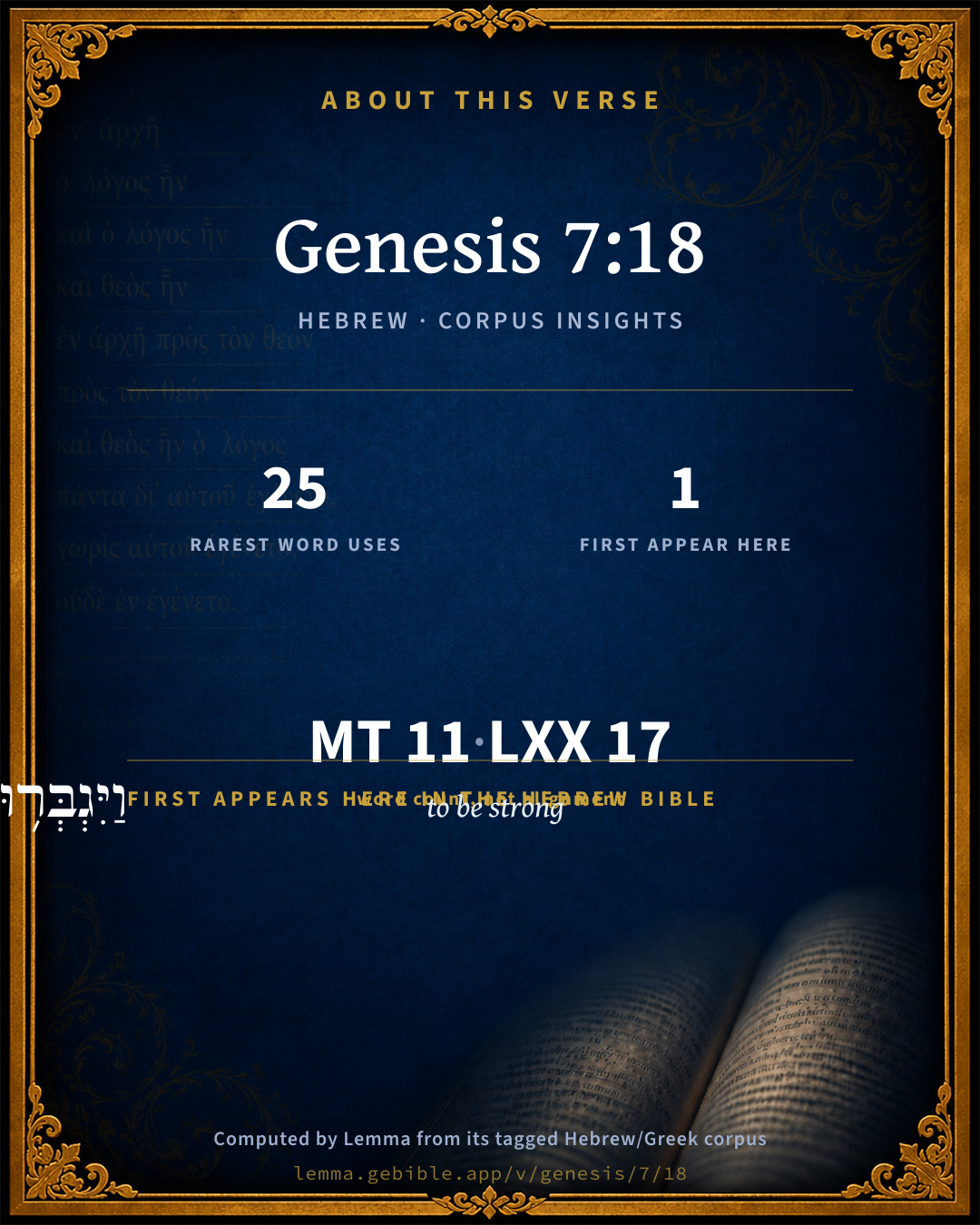
  • 1 first appearance in the Hebrew Bible
Full analysis ↓
Download a study sheet

One document with this verse’s original text, its word-by-word gloss line, the meaning frame, cross-references with their text, attributed commentary, and full source and license credits — printable, and it pastes into notes with its structure intact.

This verse Autodidact and up

Study sheet (.html) Plain text (.txt)

A passage Seminary Student

Up to 50 verses in one chapter. A passage sheet keeps up to 6 commentary sources and 12 cross-references per verse, in the order this page ranks them, and says so on the sheet whenever that leaves anything out. Ask for a single verse and you get the Autodidact verse sheet above.

Everything on this page stays free to read, with no account — the sheet is a download of what is already on screen, not access to it.

Want to remove ads? Support Godless Engineer
Compare translations 3

The same verse in 3 English versions, stacked beneath the original-language interlinear above. Click any original word for its lexicon entry.

Each is an independent rendering of the whole verse — the interlinear is not word-aligned to these translations.

Highlighted words mark where these versions differ — a whole-verse word diff, not a word-by-word alignment.

  • World English Bible Public Domain
    The waters prevailed, and increased greatly on the earth; and the ark floated on the surface of the waters.
  • King James Version Public Domain
    And the waters prevailed, and were increased greatly upon the earth; and the ark went upon the face of the waters.
  • unfoldingWord Literal Text CC BY-SA 4.0
    And the waters rose and increased greatly on the earth, and the ark went on the surface of the waters.

unfoldingWord Literal Text — © unfoldingWord, licensed CC BY-SA 4.0. Word-aligned USFM3 via Door43 (git.door43.org/unfoldingWord/en_ult).

Versions to compare (up to 4)

3 of 4 selected

Show all 18 translations

Every available English version of this verse, each an independent rendering of the whole verse.

  • World English Bible Public Domain
    The waters prevailed, and increased greatly on the earth; and the ark floated on the surface of the waters.
  • Berean Standard Bible Public Domain
    So the waters continued to surge and rise greatly on the earth, and the ark floated on the surface of the waters.
  • Majority Standard Bible Public Domain
    So the waters continued to surge and rise greatly on the earth, and the ark floated on the surface of the waters.
  • King James Version Public Domain
    And the waters prevailed, and were increased greatly upon the earth; and the ark went upon the face of the waters.
  • American Standard Version (1901) Public Domain
    And the waters prevailed, and increased greatly upon the earth; and the ark went upon the face of the waters.
  • Revised Version (1885) Public Domain
    And the waters prevailed, and increased greatly upon the earth; and the ark went upon the face of the waters.
  • Geneva Bible (1599) Public Domain
    The waters also waxed strong, and were increased exceedingly vpon the earth, and the Arke went vpon the waters.
  • Douay-Rheims (1899) Public Domain
    For they overflowed exceedingly: and filled all on the face of the earth: and the ark was carried upon the waters.
  • Young's Literal Translation Public Domain
    and the waters are mighty, and multiply exceedingly upon the earth; and the ark goeth on the face of the waters.
  • Literal Standard Version CC BY-SA 4.0
    and the waters are mighty and multiply exceedingly on the earth; and the Ark goes on the face of the waters.
  • Unlocked Literal Bible CC BY-SA 4.0
    The waters completely covered over the earth, and the ark floated upon the surface of the water.
  • unfoldingWord Literal Text CC BY-SA 4.0
    And the waters rose and increased greatly on the earth, and the ark went on the surface of the waters.
  • Darby Bible Public Domain
    And the waters prevailed and increased greatly on the earth; and the ark went on the face of the waters.
  • World Messianic Bible Public Domain
    The waters rose, and increased greatly on the earth; and the ship floated on the surface of the waters.
  • Webster's Bible Public Domain
    And the waters prevailed, and were increased greatly upon the earth: and the ark moved upon the face of the waters.
  • Free Bible Version CC BY-SA 4.0
    The floodwaters surged and grew deeper and deeper over the earth, but the ark floated along on the surface.
  • Bible in Basic English Public Domain
    And the waters overcame everything and were increased greatly on the earth, and the ark was resting on the face of the waters.
  • JPS Tanakh (1917) Public Domain
    And the waters prevailed, and increased greatly upon the earth; and the ark went upon the face of the waters.

Literal Standard Version (2020), Covenant Press — licensed CC BY-SA 4.0. Text via the HelloAO Bible API (eBible.org). Unlocked Literal Bible (unfoldingWord) — licensed CC BY-SA 4.0. Text via the HelloAO Bible API (eBible.org). unfoldingWord Literal Text — © unfoldingWord, licensed CC BY-SA 4.0. Word-aligned USFM3 via Door43 (git.door43.org/unfoldingWord/en_ult). Free Bible Version, Dr. Jonathan Gallagher — licensed CC BY-SA 4.0. Text via the HelloAO Bible API (eBible.org).

Word by word

More ways to search: Search by grammar → Find every occurrence → Compare this word →

Practice this passage: Drill this verse → Learn its vocabulary →

וַיִּגְבְּר֥וּ
gâbar
H1396
“and · to be strong”
Conjunction + Verb, Qal, Sequential Imperfect, 3rd Person, Masculine, Plural
Part of Speech
Conjunction + Verb
Stem
Qal
Form
Sequential Imperfect
Person
3rd Person
Gender
Masculine
Number
Plural
Full BDB Definition

Origin: a primitive root

TWOT: 310

to prevail, have strength, be strong, be powerful, be mighty, be great - (Qal) - to be strong, mighty - to prevail - (Piel) to make strong, strengthen - (Hiphil) - to confirm, give strength - to confirm (a covenant) - (Hithpael) - to show oneself mighty - to act proudly (toward God)
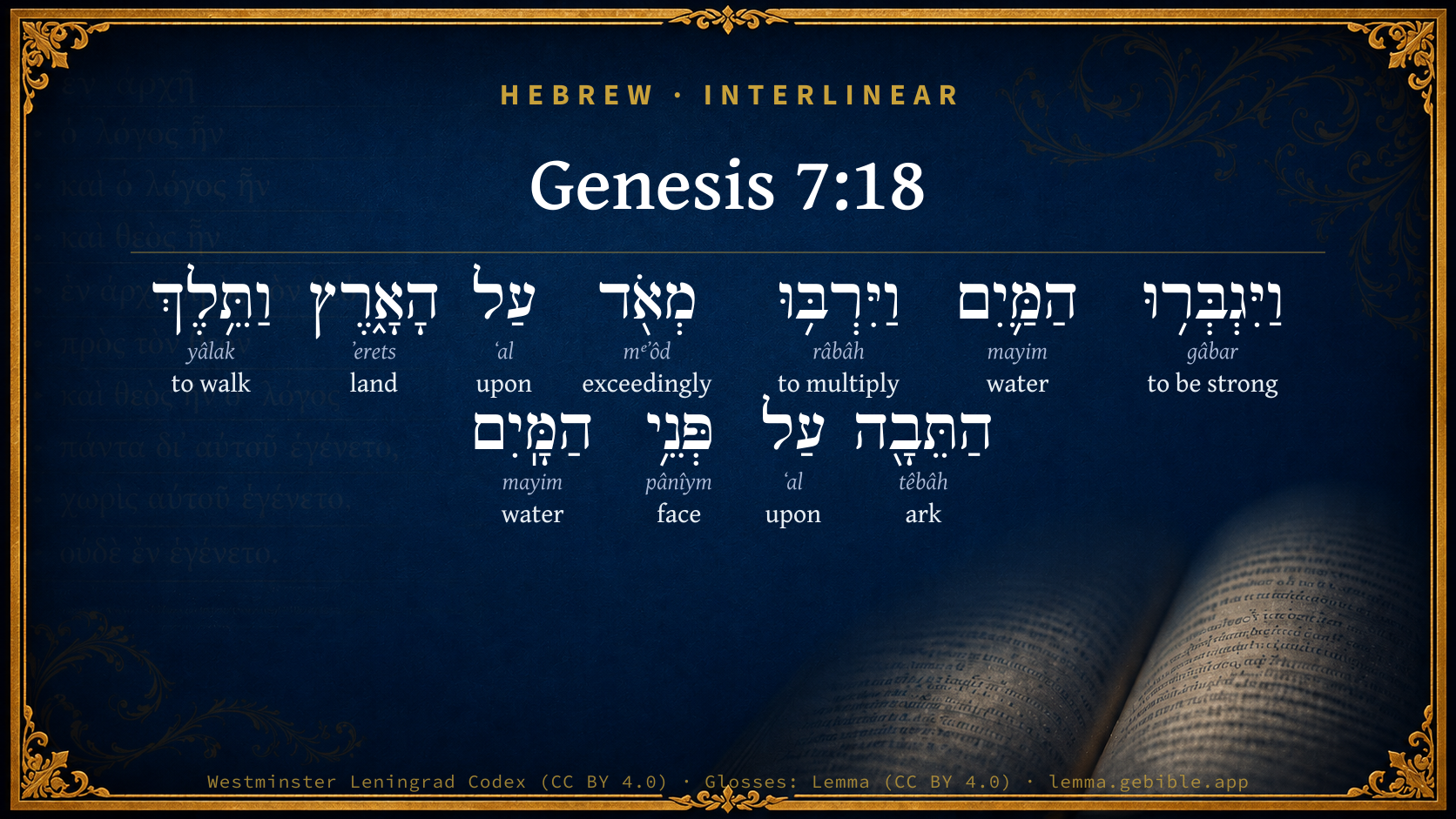
  1. הַמַּ֛יִם mayim H4325 “the · water(s)” Particle, Definite Article + Noun, Common, Masculine, Plural, Absolute
  2. וַיִּרְבּ֥וּ râbâh H7235 “and · to multiply” Conjunction + Verb, Qal, Sequential Imperfect, 3rd Person, Masculine, Plural
  3. מְאֹ֖ד mᵉʼôd H3966 “exceedingly” Adverb
  4. עַל ʻal H5921 “upon” Preposition
  5. הָאָ֑רֶץ ʼerets H776 “the · land” Particle, Definite Article + Noun, Common, Both, Singular, Absolute
  6. וַתֵּ֥לֶךְ yâlak H3212 “and · to walk” Conjunction + Verb, Qal, Sequential Imperfect, 3rd Person, Feminine, Singular
  7. הַתֵּבָ֖ה têbâh H8392 “the · ark” Particle, Definite Article + Noun, Common, Feminine, Singular, Absolute
  8. עַל ʻal H5921 “upon” Preposition
  9. פְּנֵ֥י pânîym H6440 “face(s) of” Noun, Common, Both, Plural, Construct
  10. הַמָּֽיִם mayim H4325 “the · water(s)” Particle, Definite Article + Noun, Common, Masculine, Plural, Absolute

About this verse

These counts appear in no published source. They are computed here, from the morphology-tagged text and Lemma’s own curated glosses. What Lemma adds →

11
words
9
distinct lemmas
Pentateuch
section

Notable vocabulary

The rarest word here is וַיִּגְבְּר֥וּ to be strong H1396 — appearing just 25 times in the whole Hebrew Bible.

First appearance in Scripture

This word makes its first canonical appearance in the Hebrew Bible here:

  • וַיִּגְבְּר֥וּ to be strong H1396

Shared distinctive vocabulary

וַיִּגְבְּר֥וּ to be strong H1396 occurs in 24 verses of the Hebrew Bible. Also found in:

Grammatical profile

  • 3 verbs
  • 5 nouns
  • 2 prepositions
  • 1 adverb

Verb forms

  • וַיִּגְבְּר֥וּ Qal · Sequential Imperfect
  • וַיִּרְבּ֥וּ Qal · Sequential Imperfect
  • וַתֵּ֥לֶךְ Qal · Sequential Imperfect

Repetition

Words recur within this verse — often emphatic in Hebrew:

  • הַמַּ֛יִם water H4325 ×2
  • עַל upon H5921 ×2

Hebrew & Septuagint length

In English translation the verse runs 19 words from the Hebrew and 18 from the Septuagint (LXX English) — closely comparable.

A rough comparison of the two English renderings, which tokenize alike — not a word-level alignment.

Word counts can differ between the Hebrew and the Greek without any difference in meaning — e.g. the Hebrew direct-object marker אֵת has no separate Greek word, and Greek often adds the article ὁ.

In the original languages it is 11 Hebrew tokens and 17 Greek tokens — but the two are counted differently (Hebrew bundles its prefixes and suffixes into one token; the Greek is in lemma form), so that isn’t a like-for-like length.

Cross-references

4

Topical passages linked to Genesis 7:18 in the Treasury of Scripture Knowledge — connected by theme and wording, ordered by reader-vote popularity; previews shown in the World English Bible.

  • Exodus 14:28 The waters returned, and covered the chariots and the horsemen, even all Pharaoh's army that went in after them into the sea. There remained not so much as one of them.
  • Job 22:16 Who were snatched away before their time, Whose foundation was poured out as a stream,
  • Psalms 69:15 Don't let the flood waters overwhelm me, Neither let the deep swallow me up. Don't let the pit shut its mouth on me.
  • Psalms 104:26 There the ships go, And leviathan, whom you formed to play there.

Cross-references courtesy of OpenBible.info (CC BY 4.0).

Hebrew and Greek witnesses Masoretic Hebrew ↔ Greek Septuagint

The same verse in the two great witnesses to the Old Testament, shown verse-for-verse.

These are two independent witnesses, not word-aligned to each other, and the Septuagint is shown in lemma (dictionary) form.

Hebrew Genesis 7:18 Masoretic · Westminster Leningrad Codex

וַיִּגְבְּר֥וּ הַמַּ֛יִם וַיִּרְבּ֥וּ מְאֹ֖ד עַל הָאָ֑רֶץ וַתֵּ֥לֶךְ הַתֵּבָ֖ה עַל פְּנֵ֥י הַמָּֽיִם

The waters prevailed, and increased greatly on the earth; and the ark floated on the surface of the waters.

World English Bible · Public Domain

Greek LXX Genesis 7:18 Septuagint · lemma form

καί ἐπικρατέω ὁ ὕδωρ καί πληθύνω σφόδρα ἐπί ὁ γῆ καί ἐπιφέρω ὁ κιβωτός ἐπάνω ὁ ὕδωρ

And the water prevailed and abounded exceedingly upon the earth, and the ark was borne upon the water.

LXX2012 (modern English Septuagint) · Public Domain

Hebrew: Westminster Leningrad Codex (CC BY 4.0). Greek: Septuagint (public domain); English from LXX2012 (modern English Septuagint) (Public Domain). How the Septuagint differs from the Hebrew →

Targum (Aramaic paraphrase)

2

The Targum is the ancient Jewish Aramaic paraphrase of the Hebrew Scriptures — an interpretive translation, not the Hebrew text itself. Onkelos (literal) and Pseudo-Jonathan (expansive) render the Torah, and Jonathan the Prophets. Coverage is partial: where no permissively-licensed English translation exists for a verse, only the Aramaic is shown. This is verse-level text, not a word-by-word alignment to the Hebrew.

  1. Targum Onkelos Torah (Genesis–Deuteronomy)
    וּתְקִיפוּ מַיָּא וּסְגִיאוּ לַחֲדָא עַל אַרְעָא וּמְהַלְּכָא תֵבוֹתָא עַל אַפֵּי מַיָּא

    And the waters prevailed and increased mightily upon the earth, and the ark went upon the faces of the waters.

    Targum Onkelos — Aramaic: “Onkelos Genesis” (public domain); “Onkelos Exodus” (public domain); “Onkelos Leviticus” (public domain); “Onkelos Numbers” (public domain); “Onkelos Deuteronomy” (public domain). English: “Sefaria Community Translation” (CC0 1.0 (public-domain dedication)); “J.W. Etheridge. The Targums of Onkelos and Jonathan Ben Uzziel on the Pentateuch. London: Longmans, Green, 1862” (public domain). Text via Sefaria.

  2. Targum Pseudo-Jonathan Torah (Genesis–Deuteronomy)
    וְתַקִיפוּ מַיָא וּסְגִיאוּ לַחֲדָא עַל אַרְעָא וַהֲוַת תֵּיבוּתָא מְהַלְכָא סַחֲיָא עַל אַפֵּי מַיָא

    And the waters waxed mighty and increased greatly upon the earth, and the ark went floating upon the face of the waters.

    Targum Pseudo-Jonathan — Aramaic: “Targum Jonathan on Genesis” (public domain); “Targum Jonathan on Exodus” (public domain); “Targum Jonathan on Leviticus” (public domain); “Targum Jonathan on Numbers” (public domain); “Targum Jonathan on Deuteronomy” (public domain). English: “The Targum of Jonathan ben Uzziel, trans. J. W. Etheridge, London, 1862” (public domain). Text via Sefaria.

Commentary

Notes on Genesis 7:18 from classic Christian and Jewish commentators (each source and its license shown beneath its notes). The classic Christian expositions comment on the surrounding passage and are grouped to its opening verse, so a note may address several verses; the Jewish commentaries on the Tanakh (Rashi and others) are per-verse, so they appear only where the commentator wrote on this verse.

Lemma curates 59 commentaries, every one of them public domain or Creative Commons licensed, each selected and text-cleaned for this edition rather than reprinted as found. About our sources →

Trapp's Complete Commentary

John Trapp

Gen 7:18 And the waters prevailed, and were increased greatly upon the earth; and the ark went upon the face of the waters.

Ver. 18. And the ark went upon the face of the waters.] Where now were those profane scoffers that asked what the old fool meant to build such a vessel? and whether, when he had made his ship, he would also make a sea for it to swim in?

John Trapp, A Commentary or Exposition upon All the Books of the Old and New Testament (1647–1656) — public domain. Text from a community e-Sword module.

John Gill's Exposition

Fifteen cubits upwards did the waters prevail,.... Either to such an height above the earth, upwards from that, or from the high hills; for though the words do not necessarily imply that, yet it may be allowed, since there was water enough to cover the highest of them; and fifteen cubits of water were enough to drown the tallest man, or largest beast that should be upon the top of any of them:

and the mountains were covered, with water, even it may be allowed fifteen cubits high; nor will this furnish out so considerable an objection to the history of the flood as may be thought at first sight, since the highest mountains are not near so high as they are by some calculated. Sir Walter Raleigh allows thirty miles for the height of the mountains, yet the highest in the world will not be found to be above six direct miles in height. Olympus, whose height is so extolled by the poets, does not exceed a mile and a half perpendicular, and about seventy paces. Mount Athos, said to cast its shade into the isle of Lemnos (according to, Pliny eighty seven miles) is not above two miles in height, nor Caucasus much more; nay, the Peak of Teneriff, reputed the highest mountain in the world, may be ascended in three days (according to the proportion of eight furlongs to a day's journey), which makes about the height of a German mile perpendicular; and the Spaniards affirm, that the Andes, those lofty mountains of Peru, in comparison of which they say the Alps are but cottages, may be ascended in four days' compass (o).

(o) See the Universal History, vol. 1. p. 218. marg. Bedford's Scripture Chronology, ch. 12. p. 152, 153.

John Gill's Exposition of the Whole Bible (1746–1763) — public domain (CC PDM 1.0). Text via the HelloAO Bible API.

Matthew Poole's English Annotations

The waters were increased greatly upon the earth; overthrowing men, and houses, and trees, where possibly they did or thought to secure themselves.

Matthew Poole's English Annotations on the Holy Bible (1683–1685) — public domain. Text from a community e-Sword/MySword module.

Rashi

Rabbi Shlomo Yitzchaki (Rashi)

ויגברו [AND THE WATERS] PREVAILED — by themselves (without any external aid).

Rashi on the Tanakh — English translations: “The Judaica Press complete Tanach with Rashi, translated by A. J. Rosenberg” (CC BY 4.0); “Pentateuch with Rashi's commentary by M. Rosenbaum and A.M. Silbermann, 1929-1934” (public domain); “The Metsudah Tanach series, Lakewood, N.J” (CC BY 4.0); and “The Book of Joshua, Metsudah Publications, 1997” (CC BY 4.0). Text via Sefaria.

Ramban (Nachmanides)

Rabbi Moshe ben Nachman (Ramban / Nachmanides)

AND THE WATERS PREVAILED (‘Vayigb’ru’). AND THE WATERS ‘GAVRU’ (PREVAILED). This means that they increased exceedingly, for the Hebrew language calls great abundance gvurah (strength, power). So too, And their transgressions which ‘yithgavru’ (have prevailed), meaning increased exceedingly; His mercy ‘gavar’ (has prevailed) toward them that fear Him, meaning increased. And so also: If ‘bigvuroth’ four-score years, 90:10. meaning with great abundance.It is conceivable that the meaning of vayigb’ru is that the rains came in a rushing downpour, uprooting trees and toppling buildings, since power is called in Hebrew gvurah (strength) because strength lies in power. In a similar sense are the verses: They also ‘gavru’ (wax mighty) in power; ‘Vehigbir brith’ (And he shall make a strong covenant) with many for one week, meaning he will establish the covenant with firmness. And in the words of the Sages, [we find the expression], gvuroth geshamim (the powers of the rains), because they come down with strength. It is possible that the verse, If ‘bigvuroth’ four-score years, 90:10. is of the same sense, i.e., if his bones and body be strong, and he is a man of power, he will live four-score years. And if so, ‘gavru’ upon the earth will mean that the waters were in their complete strength, overcoming even the high mountains and inundating them.

Ramban (Nachmanides) on the Tanakh — English translation: “Commentary on the Torah by Ramban (Nachmanides). Translated and annotated by Charles B. Chavel. New York, Shilo Pub. House, 1971-1976” (CC BY 4.0). Text via Sefaria.

Radak

Rabbi David Kimhi (Radak)

ויגברו המים, this verse adds a new dimension to what we have been told already, i.e. that the waters became turbulent. This is why the Torah adds the word מאד מאד twice, something most unusual. The repeated statement וירבו, that the waters still kept increasing in volume, is meant to tell us that the waters did not only increase in turbulence but also kept increasing in quantity. Whereas originally, the waters could only raise the ark, now, thanks to the turbulence, the ark was driven in different directions from where it had stood originally.

Radak on the Tanakh — English translations: “Sefaria Community Translation” (CC0 1.0 (public-domain dedication)); “Eliyahu Munk, HaChut Hameshulash” (CC BY 4.0); “Rabbi Mike Feuer, Jerusalem Anthology” (CC BY 4.0); and “R. David Kimhi on the first book of Psalms, Translated by R.G. Finch, London, 1919” (public domain). Text via Sefaria.

Lesson kit

Teaching starters — assembled from the data on this page, not authored interpretation. Every prompt links to the verse data it draws on. Edit before teaching.

Genesis, in the Pentateuch, opens this verse with 11 words (9 distinct Hebrew lemmas). Its most distinctive word is gâbar (“to be strong”). A historical commentator’s framing appears above. Read the whole chapter for the surrounding context.

Discussion questions

  1. How does “to be strong” (gâbar) shape what this verse is saying?
  2. The word “to be strong” first appears here in Scripture. What is being introduced at this debut?
  3. Genesis 7:19 shares the word «to be strong» with this verse. How do the two illuminate each other?
  4. “water” occurs 2× in this one verse. What is the effect of the repetition?
  5. The translations on this page render this verse differently — a whole-verse word diff, not a word-by-word alignment. What might account for the different wordings?
  6. The verb «וַיִּגְבְּר֥וּ» is Qal Sequential Imperfect. How does its form color the action?
  7. Reading how Trapp's Complete Commentary and John Gill's Exposition read this verse, where do the two commentators agree and where do they part?

Things to notice

Reading settings

Reading text

Shown beneath each verse's original-language words.

Old Testament
Old Testament edition

Read the OT as the Masoretic Hebrew (MT) or the Greek Septuagint (LXX).

English shown for the Greek Septuagint (in the Hebrew ↔ Greek comparison).

Comparing translations? Open the Compare panel on any verse page to stack up to four side by side.