
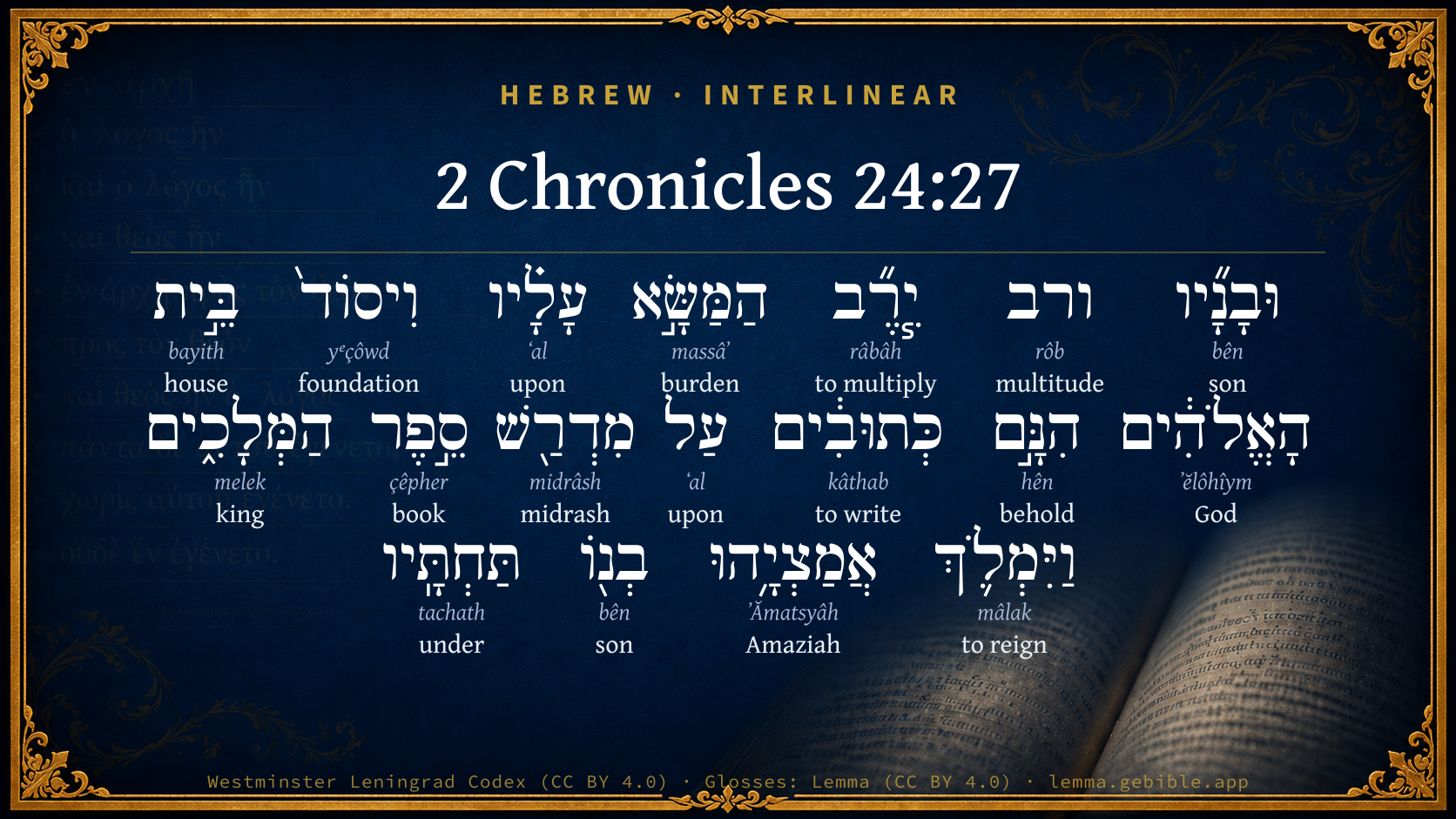
2 Chronicles 24:27

Hebrew (Westminster Leningrad Codex) 2 Chronicles 24:27 appears in the Hebrew Old Testament. The text above is from the Westminster Leningrad Codex. Each word links to its Strong’s number, a concise gloss, and parsing drawn from the Open Scriptures Hebrew Bible morphology. Click any word for its full Brown-Driver-Briggs (BDB) entry.
Download image
Cite this verse

2 Chronicles 24:27 (World English Bible). Public Domain. Lemma interlinear Bible study tool, https://lemma.gebible.app/v/2-chronicles/24/27.

Show BibTeX & RIS
BibTeX
RIS
English Translation
Now concerning his sons, and the greatness of the burdens [laid] on him, and the rebuilding of the house of God, behold, they are written in the commentary of the book of the kings. Amaziah his son reigned in his place.
World English Bible · Public Domain
Download a study sheet

One document with this verse’s original text, its word-by-word gloss line, the meaning frame, cross-references with their text, attributed commentary, and full source and license credits — printable, and it pastes into notes with its structure intact.

This verse Autodidact and up

Study sheet (.html) Plain text (.txt)

A passage Seminary Student

Up to 50 verses in one chapter. A passage sheet keeps up to 6 commentary sources and 12 cross-references per verse, in the order this page ranks them, and says so on the sheet whenever that leaves anything out. Ask for a single verse and you get the Autodidact verse sheet above.

Everything on this page stays free to read, with no account — the sheet is a download of what is already on screen, not access to it.

Want to remove ads? Support Godless Engineer
Compare translations 3

The same verse in 3 English versions, stacked beneath the original-language interlinear above. Click any original word for its lexicon entry.

Each is an independent rendering of the whole verse — the interlinear is not word-aligned to these translations.

Highlighted words mark where these versions differ — a whole-verse word diff, not a word-by-word alignment.

  • World English Bible Public Domain
    Now concerning his sons, and the greatness of the burdens [laid] on him, and the rebuilding of the house of God, behold, they are written in the commentary of the book of the kings. Amaziah his son reigned in his place.
  • King James Version Public Domain
    Now concerning his sons, and the greatness of the burdens laid upon him, and the repairing of the house of God, behold, they are written in the story of the book of the kings. And Amaziah his son reigned in his stead.
  • unfoldingWord Literal Text CC BY-SA 4.0
    And his sons, and many oracles against him, and the establishing of the house of God, behold, they are written in the exposition of the scroll of the Kings. And Amaziah his son became king in his place.

unfoldingWord Literal Text — © unfoldingWord, licensed CC BY-SA 4.0. Word-aligned USFM3 via Door43 (git.door43.org/unfoldingWord/en_ult).

Versions to compare (up to 4)

3 of 4 selected

Show all 18 translations

Every available English version of this verse, each an independent rendering of the whole verse.

  • World English Bible Public Domain
    Now concerning his sons, and the greatness of the burdens [laid] on him, and the rebuilding of the house of God, behold, they are written in the commentary of the book of the kings. Amaziah his son reigned in his place.
  • Berean Standard Bible Public Domain
    The accounts of the sons of Joash, as well as the many pronouncements about him and about the restoration of the house of God, are indeed written in the Treatise of the Book of the Kings. And his son Amaziah reigned in his place.
  • Majority Standard Bible Public Domain
    The accounts of the sons of Joash and the many pronouncements about him, and of the restoration of the house of God, are indeed written in the Treatise of the Book of the Kings. And his son Amaziah reigned in his place.
  • King James Version Public Domain
    Now concerning his sons, and the greatness of the burdens laid upon him, and the repairing of the house of God, behold, they are written in the story of the book of the kings. And Amaziah his son reigned in his stead.
  • American Standard Version (1901) Public Domain
    Now concerning his sons, and the greatness of the burdens `laid' upon him, and the rebuilding of the house of God, behold, they are written in the commentary of the book of the kings. And Amaziah his son reigned in his stead.
  • Revised Version (1885) Public Domain
    Now concerning his sons, and the greatness of the burdens laid upon him, and the rebuilding of the house of God, behold, they are written in the commentary of the book of the kings. And Amaziah his son reigned in his stead.
  • Geneva Bible (1599) Public Domain
    But his sonnes, and the summe of the taxe gathered by him, and the foundation of the house of God, behold, they are written in the storie of the booke of the Kings. And Amaziah his sonne reigned in his steade.
  • Douay-Rheims (1899) Public Domain
    And concerning his sons, and the sum of money which was gathered under him, and the repairing the house of God; they are written more diligently in the book of kings: and Amasias his son reigned in his stead.
  • Young's Literal Translation Public Domain
    As to his sons, and the greatness of the burden upon him, and the foundation of the house of God, lo, they are written on the `Inquiry' of the book of the Kings; and reign doth Amaziah his son in his stead.
  • Literal Standard Version CC BY-SA 4.0
    As for his sons, and the greatness of the burden on him, and the foundation of the house of God, behold, they are written on the commentary of the scroll of the Kings; and his son Amaziah reigns in his stead.
  • Unlocked Literal Bible CC BY-SA 4.0
    Now the accounts about his sons, the important prophecies that were spoken about him, and the rebuilding of the house of God, see, they are written in the commentary on the book of the kings. Amaziah his son became king in his place.
  • unfoldingWord Literal Text CC BY-SA 4.0
    And his sons, and many oracles against him, and the establishing of the house of God, behold, they are written in the exposition of the scroll of the Kings. And Amaziah his son became king in his place.
  • Darby Bible Public Domain
    And as to his sons, and the greatness of the burdens [laid] upon him, and the building of the house of God, behold, they are written in the treatise of the book of the kings. And Amaziah his son reigned in his stead.
  • World Messianic Bible Public Domain
    Now concerning his sons, the greatness of the burdens laid on him, and the rebuilding of God’s house, behold, they are written in the commentary of the book of the kings. Amaziah his son reigned in his place.
  • Webster's Bible Public Domain
    Now concerning his sons, and the greatness of the burdens laid upon him, and the repairing of the house of God, behold, they are written in the story of the book of the kings. And Amaziah his son reigned in his stead.
  • Free Bible Version CC BY-SA 4.0
    The story of the sons of Joash, as well as the many prophecies about him and about the restoration of God's Temple, are recorded in the Commentary on the Book of the Kings. His son Amaziah took over as king.
  • Bible in Basic English Public Domain
    Now the story of his sons, and all the words said by the prophet against him, and the building up again of the Lord's house, are recorded in the account in the book of the kings. And Amaziah his son became king in his place.
  • JPS Tanakh (1917) Public Domain
    Now concerning his sons, and the multitude of the burdens against him, and the rebuilding of the house of God, behold, they are written in the commentary of the book of the kings. And Amaziah his son reigned in his stead.

Literal Standard Version (2020), Covenant Press — licensed CC BY-SA 4.0. Text via the HelloAO Bible API (eBible.org). Unlocked Literal Bible (unfoldingWord) — licensed CC BY-SA 4.0. Text via the HelloAO Bible API (eBible.org). unfoldingWord Literal Text — © unfoldingWord, licensed CC BY-SA 4.0. Word-aligned USFM3 via Door43 (git.door43.org/unfoldingWord/en_ult). Free Bible Version, Dr. Jonathan Gallagher — licensed CC BY-SA 4.0. Text via the HelloAO Bible API (eBible.org).

Word by word

More ways to search: Search by grammar → Find every occurrence → Compare this word →

Practice this passage: Drill this verse → Learn its vocabulary →

מִדְרַ֖שׁ
midrâsh
H4097
“midrash of”
Noun, Common, Masculine, Singular, Construct
Part of Speech
Noun
Type
Common
Gender
Masculine
Number
Singular
State
Construct
Full BDB Definition

Origin: from H1875

TWOT: 455a

study, exposition, midrash, record, story - writings of a didactic nature - midrash - transliteration of the Hebrew word
  1. וּבָנָ֞יו bên H1121 “and · sons · his” Conjunction + Noun, Common, Masculine, Plural, Construct + Suffix, Personal, 3rd Person, Masculine, Singular
  2. ורב rôb H7230 “and · multitude of” Conjunction + Noun, Common, Both, Singular, Construct
  3. יִ֧רֶ֞ב râbâh H7235 “to multiply” Verb, Qal, Imperfect, 3rd Person, Masculine, Singular
  4. הַמַּשָּׂ֣א massâʼ H4853 “the · burden” Particle, Definite Article + Noun, Common, Masculine, Singular, Absolute
  5. עָלָ֗יו ʻal H5921 “upon · him” Preposition + Suffix, Personal, 3rd Person, Masculine, Singular
  6. וִיסוֹד֙ yᵉçôwd H3247 “and · foundation” Conjunction + Verb, Qal, Infinitive Construct
  7. בֵּ֣ית bayith H1004 “house of” Noun, Common, Masculine, Singular, Construct
  8. הָאֱלֹהִ֔ים ʼĕlôhîym H430 “the · God(s)” Particle, Definite Article + Noun, Common, Masculine, Plural, Absolute
  9. הִנָּ֣ם hên H2005 “behold · them” Particle, Demonstrative + Suffix, Personal, 3rd Person, Masculine, Plural
  10. כְּתוּבִ֔ים kâthab H3789 “written” Verb, Qal, Participle Passive, Masculine, Plural, Absolute
  11. עַל ʻal H5921 “upon” Preposition
  12. סֵ֣פֶר çêpher H5612 “book of” Noun, Common, Masculine, Singular, Construct
  13. הַמְּלָכִ֑ים melek H4428 “the · kings” Particle, Definite Article + Noun, Common, Masculine, Plural, Absolute
  14. וַיִּמְלֹ֛ךְ mâlak H4427 “and · to reign” Conjunction + Verb, Qal, Sequential Imperfect, 3rd Person, Masculine, Singular
  15. אֲמַצְיָ֥הוּ ʼĂmatsyâh H558 “Amaziah” Noun, Proper
  16. בְנ֖וֹ bên H1121 “son · his” Noun, Common, Masculine, Singular, Construct + Suffix, Personal, 3rd Person, Masculine, Singular
  17. תַּחְתָּֽיו tachath H8478 “under · him” Preposition + Suffix, Personal, 3rd Person, Masculine, Singular

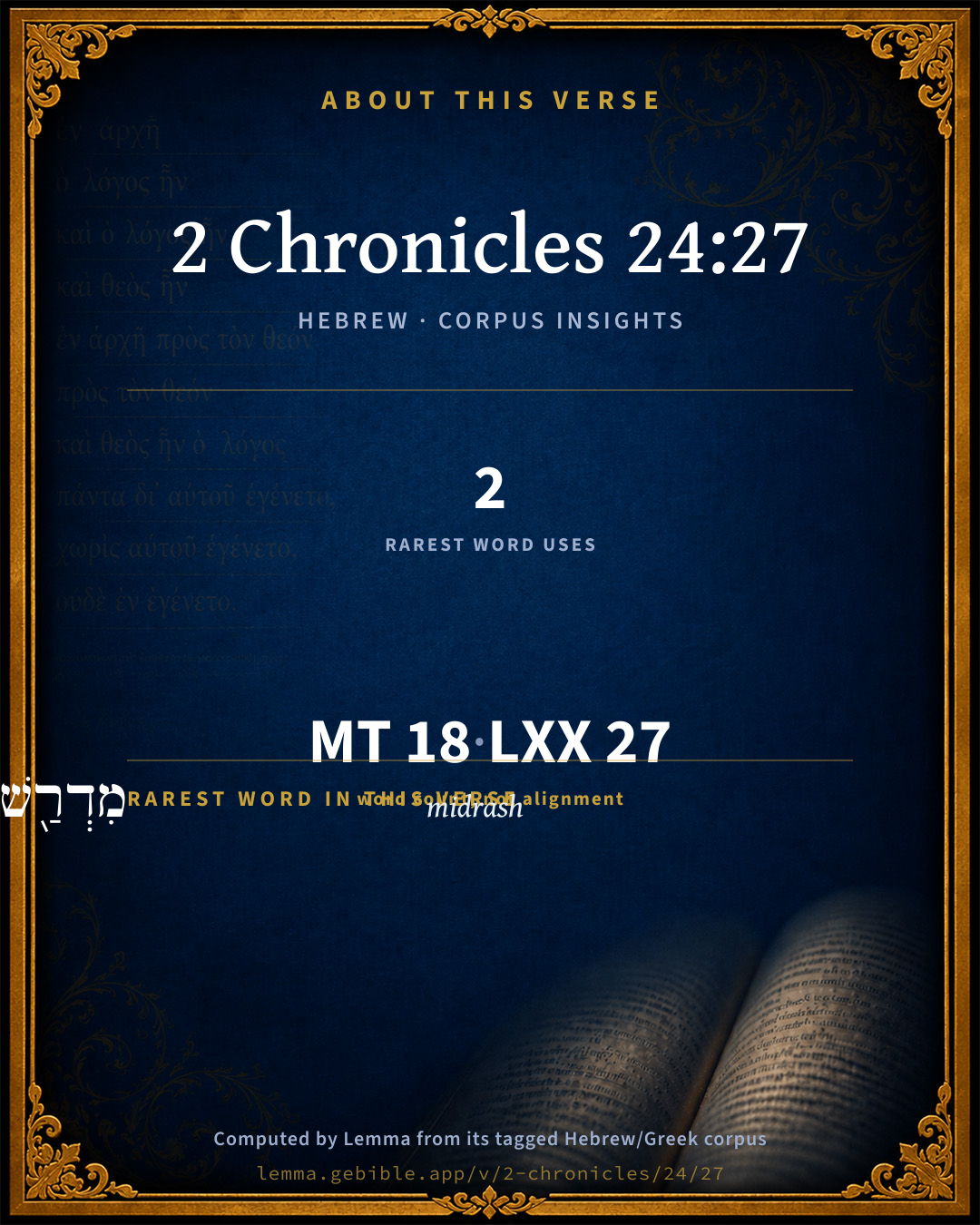
About this verse

These counts appear in no published source. They are computed here, from the morphology-tagged text and Lemma’s own curated glosses. What Lemma adds →

18
words
16
distinct lemmas
Historical
section

Notable vocabulary

The rarest word here is מִדְרַ֖שׁ midrash H4097 — appearing just 2 times in the whole Hebrew Bible.

Shared distinctive vocabulary

מִדְרַ֖שׁ midrash H4097 occurs in 2 verses of the Hebrew Bible. Also found in:

Grammatical profile

  • 4 verbs
  • 10 nouns
  • 3 prepositions
  • 1 particle

Verb forms

  • יִ֧רֶ֞ב Qal · Imperfect
  • וִיסוֹד֙ Qal · Infinitive Construct
  • כְּתוּבִ֔ים Qal · Participle Passive
  • וַיִּמְלֹ֛ךְ Qal · Sequential Imperfect

Repetition

Words recur within this verse — often emphatic in Hebrew:

  • וּבָנָ֞יו son H1121 ×2
  • עָלָ֗יו upon H5921 ×2

Hebrew & Septuagint length

In English translation the verse runs 41 words from the Hebrew and 32 from the Septuagint (LXX English) — closely comparable.

A rough comparison of the two English renderings, which tokenize alike — not a word-level alignment.

Word counts can differ between the Hebrew and the Greek without any difference in meaning — e.g. the Hebrew direct-object marker אֵת has no separate Greek word, and Greek often adds the article ὁ.

In the original languages it is 18 Hebrew tokens and 27 Greek tokens — but the two are counted differently (Hebrew bundles its prefixes and suffixes into one token; the Greek is in lemma form), so that isn’t a like-for-like length.

Cross-references

9

Topical passages linked to 2 Chronicles 24:27 in the Treasury of Scripture Knowledge — connected by theme and wording, ordered by reader-vote popularity; previews shown in the World English Bible.

  • 2 Kings 12:18 Jehoash king of Judah took all the holy things that Jehoshaphat and Jehoram and Ahaziah, his fathers, kings of Judah, had dedicated, and his own holy things, and all the gold that was found in the treasures of the house of Yahweh, and of the king's house, and sent it to Hazael king of Syria: and he went away from Jerusalem.
  • 2 Kings 12:21 For Jozacar the son of Shimeath, and Jehozabad the son of Shomer, his servants, struck him, and he died; and they buried him with his fathers in the city of David: and Amaziah his son reigned in his place.
  • 1 Chronicles 3:12 Amaziah his son, Azariah his son, Jotham his son,
  • 2 Chronicles 9:29 Now the rest of the acts of Solomon, first and last, aren't they written in the history of Nathan the prophet, and in the prophecy of Ahijah the Shilonite, and in the visions of Iddo the seer concerning Jeroboam the son of Nebat?
  • 2 Chronicles 13:22 The rest of the acts of Abijah, and his ways, and his sayings, are written in the commentary of the prophet Iddo.
  • 2 Chronicles 16:11 Behold, the acts of Asa, first and last, behold, they are written in the book of the kings of Judah and Israel.
  • 2 Chronicles 20:34 Now the rest of the acts of Jehoshaphat, first and last, behold, they are written in the history of Jehu the son of Hanani, which is inserted in the book of the kings of Israel.
  • 2 Chronicles 24:12 The king and Jehoiada gave it to such as did the work of the service of the house of Yahweh; and they hired masons and carpenters to restore the house of Yahweh, and also such as worked iron and brass to repair the house of Yahweh.
  • 2 Chronicles 25:1 Amaziah was twenty-five years old when he began to reign; and he reigned twenty-nine years in Jerusalem: and his mother's name was Jehoaddan, of Jerusalem.

Cross-references courtesy of OpenBible.info (CC BY 4.0).

Hebrew and Greek witnesses Masoretic Hebrew ↔ Greek Septuagint

The same verse in the two great witnesses to the Old Testament, shown verse-for-verse.

These are two independent witnesses, not word-aligned to each other, and the Septuagint is shown in lemma (dictionary) form.

Hebrew 2 Chronicles 24:27 Masoretic · Westminster Leningrad Codex

וּבָנָ֞יו ורב יִ֧רֶ֞ב הַמַּשָּׂ֣א עָלָ֗יו וִיסוֹד֙ בֵּ֣ית הָאֱלֹהִ֔ים הִנָּ֣ם כְּתוּבִ֔ים עַל מִדְרַ֖שׁ סֵ֣פֶר הַמְּלָכִ֑ים וַיִּמְלֹ֛ךְ אֲמַצְיָ֥הוּ בְנ֖וֹ תַּחְתָּֽיו

Now concerning his sons, and the greatness of the burdens [laid] on him, and the rebuilding of the house of God, behold, they are written in the commentary of the book of the kings. Amaziah his son reigned in his place.

World English Bible · Public Domain

Greek LXX 2 Chronicles 24:27 Septuagint · lemma form

καί ὁ υἱός αὐτός πᾶς καί προςἔρχομαι αὐτός ὁ πέντε καί ὁ λοιπός ἰδού γράφω ἐπί ὁ γραφή ὁ βασιλεύς καί βασιλεύω αμασιας υἱός αὐτός ἀντί αὐτός

And all his sons, and the five came to him: and the other matters, behold, they are written in the book of the kings. And Amasias his son reigned in his stead.

LXX2012 (modern English Septuagint) · Public Domain

Hebrew: Westminster Leningrad Codex (CC BY 4.0). Greek: Septuagint (public domain); English from LXX2012 (modern English Septuagint) (Public Domain). How the Septuagint differs from the Hebrew →

Commentary

Notes on 2 Chronicles 24:27 from classic Christian and Jewish commentators (each source and its license shown beneath its notes). The classic Christian expositions comment on the surrounding passage and are grouped to its opening verse, so a note may address several verses; the Jewish commentaries on the Tanakh (Rashi and others) are per-verse, so they appear only where the commentator wrote on this verse.

Lemma curates 59 commentaries, every one of them public domain or Creative Commons licensed, each selected and text-cleaned for this edition rather than reprinted as found. About our sources →

Trapp's Complete Commentary

John Trapp

2Ch 24:27 Now [concerning] his sons, and the greatness of the burdens [laid] upon him, and the repairing of the house of God, behold, they [are] written in the story of the book of the kings. And Amaziah his son reigned in his stead.

Ver. 27. And the greatness of the burdens.]. {2Ki 12:18} Not heavy enough to break his hard heart.

John Trapp, A Commentary or Exposition upon All the Books of the Old and New Testament (1647–1656) — public domain. Text from a community e-Sword module.

Joseph Benson's Commentary

2Ch 24:27. The greatness of the burdens laid upon him — Either the severe prophecies uttered against him, of which one instance is recorded, and there might be others that are not recorded; or the great judgments of God upon him, both by the Syrians, 2Ch 24:23, and by great diseases, 2Ch 24:25.

Joseph Benson's Commentary on the Old and New Testaments (1811–1818) — public domain. Text from a community e-Sword module.

Tyndale Open Study Notes

Tyndale Open Resources

24:27 The Commentary on the Book of the Kings that the Chronicler used as a source is no longer available to us (see also 9:29).

Tyndale Open Study Notes — © Tyndale Open Resources, licensed CC BY-SA 4.0. Text via the HelloAO Bible API.

Geneva Bible (1599)

Geneva Bible translators

That is, concerning his sons, etc.

That is, the reparation.

Geneva Bible (1599) marginal notes — public domain. Text via Bolls.life.

Adam Clarke's Commentary

Verse 27. The greatness of the burdens laid upon him] Meaning, probably, the heavy tribute laid upon him by the Syrians; though some think the vast sums amassed for the repairs of the temple are here intended.

Written in the story] מדרש midrash, the commentary, of the book of Kings. We have met with this before; but these works are all lost, except the extracts found in Kings, Chronicles, and Ezra. These abridgments were the cause of the neglect, and finally of the destruction, of the originals. This has been often the case in works of great consequence. Trogus Pompeius wrote a general history of the world, which he brought down to the reign of Augustus, in forty-four volumes. Justin abridged them into one volume, and the original is lost.

Adam Clarke's Commentary on the Bible (1810–1826) — public domain. Text from a community e-Sword/MySword module.

Ellicott's Commentary for English Readers

(27) Now concerning his sons, and the greatness of the burdens laid upon him, and the repairing of the house of God.—Rather, And his sons, and the multitude of oracles upon him, and the founding of the house of God. The word “burden” (massa’)is common in the sense of a threatening prophecy (2Ki_9:25; Isa_13:1; Hab_1:1). In 2Ch_24:19 it is expressly said that prophets were sent to warn the princes of Judah. If this be the meaning here, the word massa’ is used collectively. Another possible rendering is, “and the greatness of the tribute laid upon him” by Hazael. (Comp. 2Ch_17:11 for this sense of massa’) The Heb. margin suggests, and as to his sons, may the burden concerning him multiply;” i.e., may the dying words of Zechariah be fulfilled in them even more disastrously! This is wholly improbable.

In the story of the book of the kings.—See margin, and Introduction.

A Bible Commentary for English Readers, edited by Charles John Ellicott (1878–1897) — public domain. Text from a community e-Sword module.

The Cambridge Bible for Schools and Colleges

gen. ed. J. J. S. Perowne

27. the burdens laid upon him] Render (with R.V. mg.), the burdens uttered against him. Cp. 2Ch_24:19. The Heb. text of the first half of the verse is uncertain.

the repairing] R.V. the rebuilding.

the story] R.V. the commentary (Heb. midrash). Cp. Introduction, § 5.

The Cambridge Bible for Schools and Colleges (gen. ed. J. J. S. Perowne; Cambridge University Press, 1878–1918) — public domain. Text from a community e-Sword module.

Albert Barnes' Notes on the Bible

The greatness of the burdens laid upon him - Or, “And the multitude of burdens uttered against him.” “Burdens” (2Ki 9:25 note) are prophetical denunciations of coming evil.

The repairing - See the marginal rendering. Joash’s repairs extended to the very base of the temple building.

The story of the book of the kings - See the introduction to Chronicles, the second note.

Albert Barnes' Notes on the Bible (1834–1885) — public domain. Text from a community e-Sword/MySword module.

Haydock's Catholic Bible Commentary

And. Sept. "And all his sons: for five came upon him," with the rest of the conspirators. H. --- They have read differently. C. --- Sum. Heb. "the greatness of the burden on him," (H.) imposed by the Syrians, (v. 24) or denounced by the prophets. Mossa is often taken for a prophetic menace. C. --- More. Heb. "in the researches." Prot. "story of the book." Addo entitled his book Modross, C. xxii. 22. H. --- Only some extracts from these works have come down to us. Esdras had them before him. The abridgments have occasioned their loss, as has been the case with many other excellent works. This was the more easy, as writing was not then so common. C.

George Leo Haydock (1774–1849), Haydock's Catholic Family Bible and Commentary, 1859 edition — public domain. Excludes Psalms (Douay-Rheims chapter numbering differs from Protestant) and Deuterocanonical books (Catholic canon only).

Matthew Poole's English Annotations

The greatness of the burdens laid upon him; either the severe prophecies against him, which are oft called burdens; of which one instance is recorded, and there might be others that are not recorded; or the great judgments of God upon him, both by the Syrians, 2Ch 24:23,24, and by great diseases, 2Ch 24:25.

Matthew Poole's English Annotations on the Holy Bible (1683–1685) — public domain. Text from a community e-Sword/MySword module.

The Pulpit Commentary

His sons. We only know of one, Amaziah, his successor. The burdens laid upon him. Some explain this expression of the tribute and bribe Joash had to pay Hazael; others of prophetic "burdens" uttered against him; and others (much favoured by the position of the clause just before the repairing of the house, etc.) of the task which he had so voluntarily undertaken, the money-raising and all. (Eze_24:25; comp. our vers. 6, 9, 11) The repairing; Hebrew, rwOsywi. Render, with the Revised Version, the rebuilding. The story of the book of the kings. The Revised Version renders the Hebrew text (rp,se vrDmi) "the commentary of the book of the kings," probably to be followed by the words, "of Judah; " the parallel has "the book of the Chronicles h yrebDi dp,si of the kings of Judah" (see our Introduction, 1 Chronicles, pp. 7-10.).

The word rendered "story" or "commentary" in our text is employed only once beside. (2Ch_13:22) Its verbal root, however, is found about a hundred and sixty-two times, invariably in the sense of inquiring, and almost invariably rendered in the Authorized Version by the word "inquire," or "seek;" so that perhaps the word "study" or "pursuit" might, idioms being allowed for, be the nearer rendering. It is rabbinic literature mostly that has determined the preference for the word "commentary."

The Pulpit Commentary (1880–1919), ed. H.D.M. Spence-Jones & Joseph S. Exell — public domain. Text from a community e-Sword module.

John Wesley's Explanatory Notes

Burdens - The great judgments of God upon him, both by the Syrians, ver. xxiv, 23, and by great diseases, ver. 25.

John Wesley, Explanatory Notes Upon the Whole Bible (1754–1765) — public domain. Text via the GEBible commentary corpus.

unfoldingWord translationNotes

Door43 World Missions Community

the accounts about his sons

"the record of what his sons did"

the important prophecies that were spoken about him

"the important things the prophets spoke about him"

see, they are written

Here "see" alerts the reader to pay special attention to the information that follows.

the commentary on the book of the kings

This is a book which no longer exists.

translationWords

prophet

house of God

king

Amaziah

unfoldingWord translationNotes — © Distant Shores Media and the Door43 World Missions Community, licensed CC BY-SA 4.0. Source: git.door43.org/Door43/en_tn.

Lesson kit

Teaching starters — assembled from the data on this page, not authored interpretation. Every prompt links to the verse data it draws on. Edit before teaching.

2 Chronicles, in the Historical, opens this verse with 18 words (16 distinct Hebrew lemmas). Its most distinctive word is midrâsh (“midrash”). A historical commentator’s framing appears above. Read the whole chapter for the surrounding context.

Discussion questions

  1. The word midrâsh carries the sense “midrash.” How does it shape the verse?
  2. How does 2 Chronicles 13:22, which shares the word «midrash», read alongside this verse?
  3. What does the repetition of “son” (2× in this one verse) do in this verse?
  4. The translations on this page render this verse differently — a whole-verse word diff, not a word-by-word alignment. What might account for the different wordings?
  5. «יִ֧רֶ֞ב» is a Qal Imperfect verb. How does that grammatical form shape the action described?
  6. Compare how Trapp's Complete Commentary and Joseph Benson's Commentary read this verse. Where do they agree or differ?

Things to notice

Reading settings

Reading text

Shown beneath each verse's original-language words.

Old Testament
Old Testament edition

Read the OT as the Masoretic Hebrew (MT) or the Greek Septuagint (LXX).

English shown for the Greek Septuagint (in the Hebrew ↔ Greek comparison).

Comparing translations? Open the Compare panel on any verse page to stack up to four side by side.