
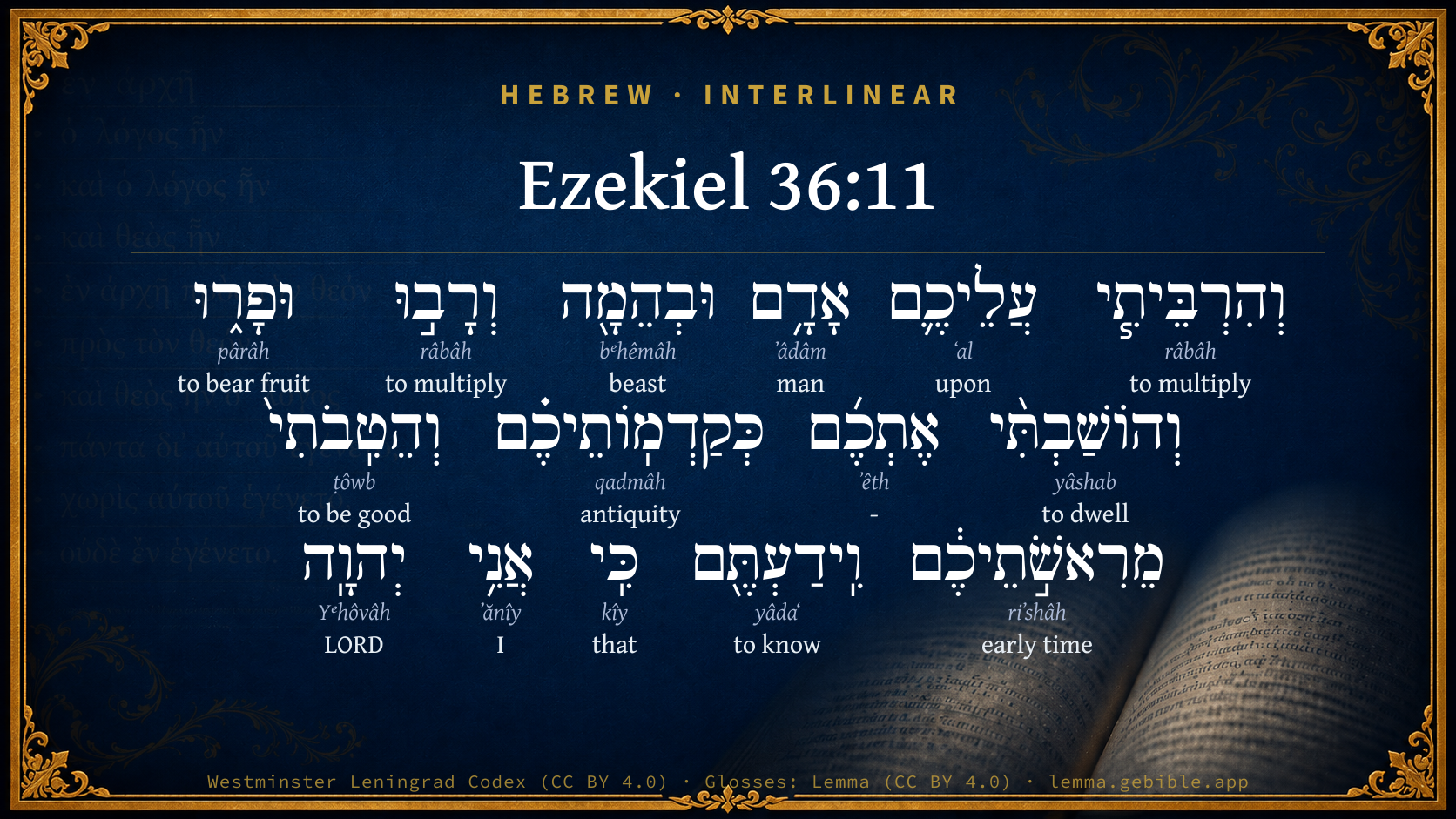
Ezekiel 36:11

Hebrew (Westminster Leningrad Codex) Ezekiel 36:11 appears in the Hebrew Old Testament. The text above is from the Westminster Leningrad Codex. Each word links to its Strong’s number, a concise gloss, and parsing drawn from the Open Scriptures Hebrew Bible morphology. Click any word for its full Brown-Driver-Briggs (BDB) entry.
Download image
Cite this verse

Ezekiel 36:11 (World English Bible). Public Domain. Lemma interlinear Bible study tool, https://lemma.gebible.app/v/ezekiel/36/11.

Show BibTeX & RIS
BibTeX
RIS
English Translation
and I will multiply on you man and animal; and they shall increase and be fruitful; and I will cause you to be inhabited after your former estate, and will do better [to you] than at your beginnings: and you shall know that I am Yahweh.
World English Bible · Public Domain
Highlights
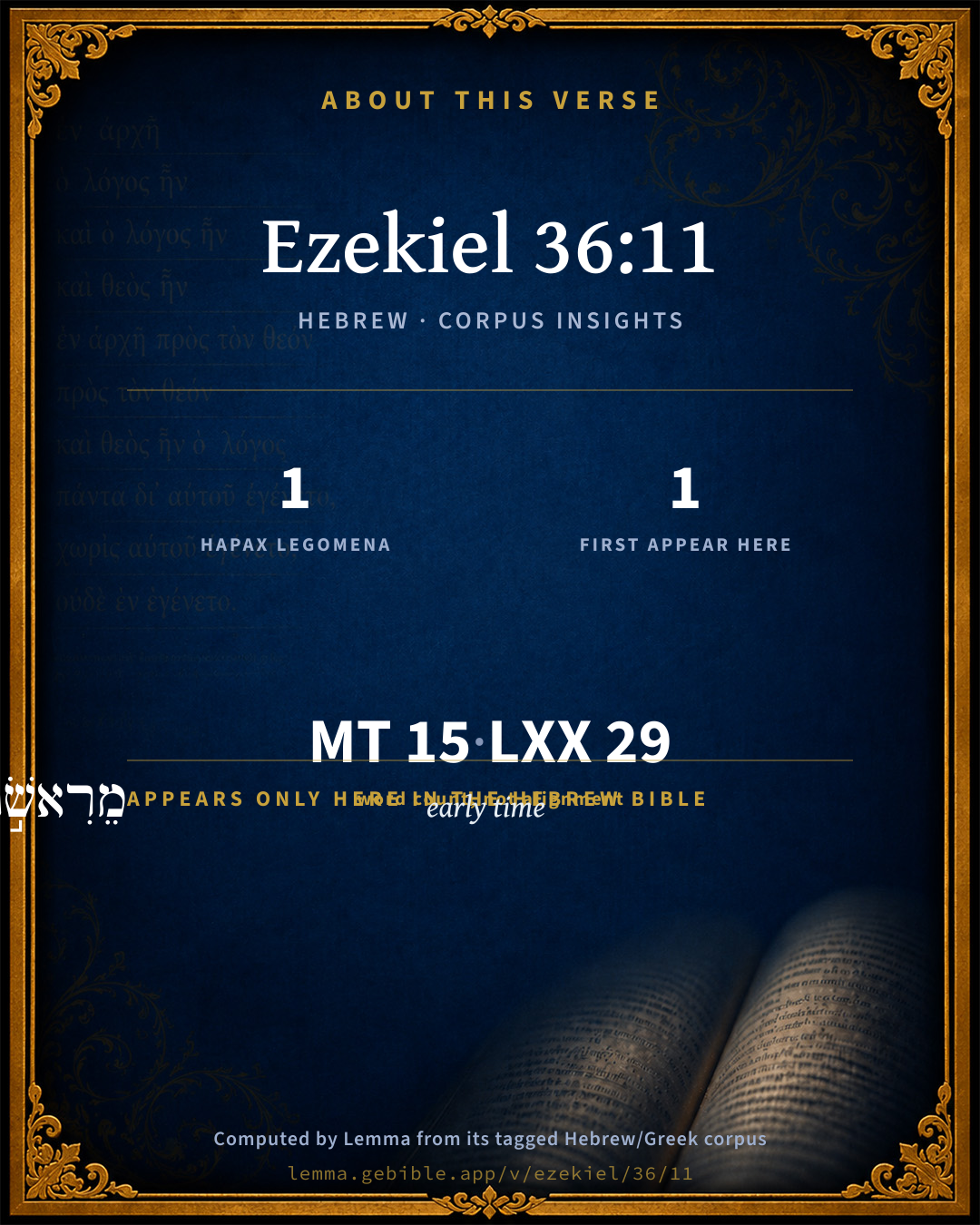
  • 1 hapax legomenon — only here in the Hebrew Bible
  • 1 first appearance in the Hebrew Bible
Full analysis ↓
Download a study sheet

One document with this verse’s original text, its word-by-word gloss line, the meaning frame, cross-references with their text, attributed commentary, and full source and license credits — printable, and it pastes into notes with its structure intact.

This verse Autodidact and up

Study sheet (.html) Plain text (.txt)

A passage Seminary Student

Up to 50 verses in one chapter. A passage sheet keeps up to 6 commentary sources and 12 cross-references per verse, in the order this page ranks them, and says so on the sheet whenever that leaves anything out. Ask for a single verse and you get the Autodidact verse sheet above.

Everything on this page stays free to read, with no account — the sheet is a download of what is already on screen, not access to it.

Want to remove ads? Support Godless Engineer
Compare translations 3

The same verse in 3 English versions, stacked beneath the original-language interlinear above. Click any original word for its lexicon entry.

Each is an independent rendering of the whole verse — the interlinear is not word-aligned to these translations.

Highlighted words mark where these versions differ — a whole-verse word diff, not a word-by-word alignment.

  • World English Bible Public Domain
    and I will multiply on you man and animal; and they shall increase and be fruitful; and I will cause you to be inhabited after your former estate, and will do better [to you] than at your beginnings: and you shall know that I am Yahweh.
  • King James Version Public Domain
    And I will multiply upon you man and beast; and they shall increase and bring fruit: and I will settle you after your old estates, and will do better unto you than at your beginnings: and ye shall know that I am the LORD.
  • unfoldingWord Literal Text CC BY-SA 4.0
    I will multiply man and beast on you mountains so that they will multiply and be fruitful. Then I will cause you to be inhabited as you previously were, and I will make you prosper more than you did in the past, for you will know that I am Yahweh.

unfoldingWord Literal Text — © unfoldingWord, licensed CC BY-SA 4.0. Word-aligned USFM3 via Door43 (git.door43.org/unfoldingWord/en_ult).

Versions to compare (up to 4)

3 of 4 selected

Show all 18 translations

Every available English version of this verse, each an independent rendering of the whole verse.

  • World English Bible Public Domain
    and I will multiply on you man and animal; and they shall increase and be fruitful; and I will cause you to be inhabited after your former estate, and will do better [to you] than at your beginnings: and you shall know that I am Yahweh.
  • Berean Standard Bible Public Domain
    I will fill you with people and animals, and they will multiply and be fruitful. I will make you as inhabited as you once were, and I will make you prosper more than before. Then you will know that I am the LORD.
  • Majority Standard Bible Public Domain
    I will fill you with people and animals, and they will multiply and be fruitful. I will make you as inhabited as you once were, and I will make you prosper more than before. Then you will know that I am the LORD.
  • King James Version Public Domain
    And I will multiply upon you man and beast; and they shall increase and bring fruit: and I will settle you after your old estates, and will do better unto you than at your beginnings: and ye shall know that I am the LORD.
  • American Standard Version (1901) Public Domain
    and I will multiply upon you man and beast; and they shall increase and be fruitful; and I will cause you to be inhabited after your former estate, and will do better `unto you' than at your beginnings: and ye shall know that I am Jehovah.
  • Revised Version (1885) Public Domain
    and I will multiply upon you man and beast; and they shall increase, and be fruitful: and I will cause you to be inhabited after your former estate, and will do better unto you than at your beginnings: and ye shall know that I am the LORD.
  • Geneva Bible (1599) Public Domain
    And I wil multiply vpon you man and beast, and they shall encrease, and bring fruite, and I will cause you to dwell after your olde estate, and I will bestowe benefites vpon you more then at the first, and ye shall know that I am the Lord.
  • Douay-Rheims (1899) Public Domain
    And I will make you abound with men and with beasts: and they shall be multiplied, and increased: and I will settle you as from the beginning, and will give you greater gifts, than you had from the beginning: and you shall know that I am the Lord.
  • Young's Literal Translation Public Domain
    And I have multiplied on you man and beast, And they have multiplied and been fruitful, And I have caused you to dwell according to your former states, And I have done better than at your beginnings, And ye have known that I `am' Jehovah.
  • Literal Standard Version CC BY-SA 4.0
    And I have multiplied man and beast on you, || And they have multiplied and been fruitful, || And I have caused you to dwell according to your former states, || And I have done better than at your beginnings, || And you have known that I [am] YHWH.
  • Unlocked Literal Bible CC BY-SA 4.0
    I will multiply man and beast on you mountains so that they will multiply and be fruitful. Then I will cause you to be inhabited as you previously were, and I will make you prosper more than you did in the past, for you will know that I am Yahweh.
  • unfoldingWord Literal Text CC BY-SA 4.0
    I will multiply man and beast on you mountains so that they will multiply and be fruitful. Then I will cause you to be inhabited as you previously were, and I will make you prosper more than you did in the past, for you will know that I am Yahweh.
  • Darby Bible Public Domain
    And I will multiply upon you man and beast, and they shall increase and bring forth fruit; and I will cause you to be inhabited as [in] your former times, yea, I will make it better than at your beginnings: and ye shall know that I [am] Jehovah.
  • World Messianic Bible Public Domain
    I will multiply man and animal on you. They will increase and be fruitful. I will cause you to be inhabited as you were before, and you will do better than at your beginnings. Then you will know that I am the LORD.
  • Webster's Bible Public Domain
    And I will multiply upon you man and beast; and they shall increase and bring fruit: and I will settle you after your old states, and will do better to you than at your beginnings: and ye shall know that I am the LORD.
  • Free Bible Version CC BY-SA 4.0
    The number of your people will grow— they will have many children. The animals too will have many young. You mountains, I will make sure that you are inhabited just as you used to be, and I will make you more prosperous than you were before. Then you will know that I am the Lord.
  • Bible in Basic English Public Domain
    Man and beast will be increased in you, and they will have offspring and be fertile: I will make you thickly peopled as you were before, and will do more for you than at the first: and you will be certain that I am the Lord.
  • JPS Tanakh (1917) Public Domain
    and I will multiply upon you man and beast, and they shall increase and be fruitful; and I will cause you to be inhabited after your former estate, and will do better unto you than at your beginnings; and ye shall know that I am the LORD.

Literal Standard Version (2020), Covenant Press — licensed CC BY-SA 4.0. Text via the HelloAO Bible API (eBible.org). Unlocked Literal Bible (unfoldingWord) — licensed CC BY-SA 4.0. Text via the HelloAO Bible API (eBible.org). unfoldingWord Literal Text — © unfoldingWord, licensed CC BY-SA 4.0. Word-aligned USFM3 via Door43 (git.door43.org/unfoldingWord/en_ult). Free Bible Version, Dr. Jonathan Gallagher — licensed CC BY-SA 4.0. Text via the HelloAO Bible API (eBible.org).

Word by word

More ways to search: Search by grammar → Find every occurrence → Compare this word →

Practice this passage: Drill this verse → Learn its vocabulary →

מֵרִאשֹׁ֣תֵיכֶ֔ם
riʼshâh
H7221
“from · early times · your”
Preposition + Noun, Common, Feminine, Plural, Construct + Suffix, Personal, 2nd Person, Masculine, Plural
Part of Speech
Preposition + Noun
Type
Common
Gender
Feminine
Number
Plural
State
Construct
Full BDB Definition

Origin: from the same as H7218

TWOT: 2097a

beginning time, early time
  1. וְהִרְבֵּיתִ֧י râbâh H7235 “and · to multiply” Conjunction + Verb, Hiphil, Sequential Perfect, 1st Person, Common, Singular
  2. עֲלֵיכֶ֛ם ʻal H5921 “upon · you” Preposition + Suffix, Personal, 2nd Person, Masculine, Plural
  3. אָדָ֥ם ʼâdâm H120 “man” Noun, Common, Masculine, Singular, Absolute
  4. וּבְהֵמָ֖ה bᵉhêmâh H929 “and · beast” Conjunction + Noun, Common, Feminine, Singular, Absolute
  5. וְרָב֣וּ râbâh H7235 “and · to multiply” Conjunction + Verb, Qal, Sequential Perfect, 3rd Person, Common, Plural
  6. וּפָר֑וּ pârâh H6509 “and · to bear fruit” Conjunction + Verb, Qal, Sequential Perfect, 3rd Person, Common, Plural
  7. וְהוֹשַׁבְתִּ֨י yâshab H3427 “and · to dwell” Conjunction + Verb, Hiphil, Sequential Perfect, 1st Person, Common, Singular
  8. אֶתְכֶ֜ם ʼêth H853 “- · you” Particle, Direct Object + Suffix, Personal, 2nd Person, Masculine, Plural
  9. כְּקַדְמֽוֹתֵיכֶ֗ם qadmâh H6927 “like/as · former estates · your” Preposition + Noun, Common, Feminine, Plural, Construct + Suffix, Personal, 2nd Person, Masculine, Plural
  10. וְהֵטִֽבֹתִי֙ ṭôwb H2895 “and · to be good” Conjunction + Verb, Hiphil, Sequential Perfect, 1st Person, Common, Singular
  11. וִֽידַעְתֶּ֖ם yâdaʻ H3045 “and · to know” Conjunction + Verb, Qal, Sequential Perfect, 2nd Person, Masculine, Plural
  12. כִּֽי kîy H3588 “that” Conjunction
  13. אֲנִ֥י ʼănîy H589 “I” Pronoun, Personal, 1st Person, Common, Singular
  14. יְהוָֽה Yᵉhôvâh H3068 “LORD” Noun, Proper

About this verse

These counts appear in no published source. They are computed here, from the morphology-tagged text and Lemma’s own curated glosses. What Lemma adds →

15
words
14
distinct lemmas
Prophets
section

Notable vocabulary

1 hapax legomenon — a word that appears only here in the entire Hebrew Bible:

  • מֵרִאשֹׁ֣תֵיכֶ֔ם early time H7221

First appearance in Scripture

This word makes its first canonical appearance in the Hebrew Bible here:

  • מֵרִאשֹׁ֣תֵיכֶ֔ם early time H7221

Shared distinctive vocabulary

כְּקַדְמֽוֹתֵיכֶ֗ם antiquity H6927 occurs in 4 verses of the Hebrew Bible. Also found in:

Grammatical profile

  • 6 verbs
  • 5 nouns
  • 1 pronoun
  • 1 preposition
  • 1 conjunction
  • 1 particle

Verb forms

  • וְהִרְבֵּיתִ֧י Hiphil · Sequential Perfect
  • וְרָב֣וּ Qal · Sequential Perfect
  • וּפָר֑וּ Qal · Sequential Perfect
  • וְהוֹשַׁבְתִּ֨י Hiphil · Sequential Perfect
  • וְהֵטִֽבֹתִי֙ Hiphil · Sequential Perfect
  • וִֽידַעְתֶּ֖ם Qal · Sequential Perfect

Repetition

A word recurs within this verse — often emphatic in Hebrew:

  • וְהִרְבֵּיתִ֧י to multiply H7235 ×2

Hebrew & Septuagint length

In English translation the verse runs 46 words from the Hebrew and 39 from the Septuagint (LXX English) — closely comparable.

A rough comparison of the two English renderings, which tokenize alike — not a word-level alignment.

Word counts can differ between the Hebrew and the Greek without any difference in meaning — e.g. the Hebrew direct-object marker אֵת has no separate Greek word, and Greek often adds the article ὁ.

In the original languages it is 15 Hebrew tokens and 29 Greek tokens — but the two are counted differently (Hebrew bundles its prefixes and suffixes into one token; the Greek is in lemma form), so that isn’t a like-for-like length.

Cross-references

24

Topical passages linked to Ezekiel 36:11 in the Treasury of Scripture Knowledge — connected by theme and wording, ordered by reader-vote popularity; previews shown in the World English Bible.

  • Jeremiah 33:12 Thus says Yahweh of Hosts: Yet again shall there be in this place, which is waste, without man and without animal, and in all the cities of it, a habitation of shepherds causing their flocks to lie down.
  • Jeremiah 23:5–8 Behold, the days come, says Yahweh, that I will raise to David a righteous Branch, and he shall reign as king and deal wisely, and shall execute justice and righteousness in the land.
  • Micah 7:14 Shepherd your people with your staff, The flock of your heritage, Who dwell by themselves in a forest, In the midst of fertile pasture land, let them feed; In Bashan and Gilead, as in the days of old.
  • Jeremiah 31:27 Behold, the days come, says Yahweh, that I will sow the house of Israel and the house of Judah with the seed of man, and with the seed of animal.
  • Ezekiel 37:13 You shall know that I am Yahweh, when I have opened your graves, and caused you to come up out of your graves, my people.
  • Job 42:12 So Yahweh blessed the latter end of Job more than his beginning. He had fourteen thousand sheep, six thousand camels, one thousand yoke of oxen, and a thousand female donkeys.
  • Jeremiah 30:18 Thus says Yahweh: Behold, I will turn again the captivity of Jacob's tents, and have compassion on his dwelling-places; and the city shall be built on its own hill, and the palace shall be inhabited after its own manner.
  • Ezekiel 16:55 Your sisters, Sodom and her daughters, shall return to their former estate; and Samaria and her daughters shall return to their former estate; and you and your daughters shall return to your former estate.
  • Hosea 2:20 I will even betroth you to me in faithfulness; And you shall know Yahweh.
  • Amos 9:15 I will plant them on their land, And they will no more be plucked up out of their land which I have given them," says Yahweh your God.
  • Isaiah 30:26 Moreover the light of the moon shall be as the light of the sun, and the light of the sun shall be sevenfold, as the light of seven days, in the day that Yahweh binds up the hurt of his people, and heals the stroke of their wound.
  • Isaiah 52:4–6 For thus says the Lord Yahweh, My people went down at the first into Egypt to sojourn there: and the Assyrian has oppressed them without cause.
  • Isaiah 54:7–10 For a small moment have I forsaken you; but with great mercies will I gather you.
  • Ezekiel 36:35 They shall say, This land that was desolate is become like the garden of Eden; and the waste and desolate and ruined cities are fortified and inhabited.
  • Joel 3:18–21 It will happen in that day, That the mountains will drop down sweet wine, The hills will flow with milk, All the brooks of Judah will flow with waters; And a fountain will come forth from the house of Yahweh, And will water the valley of Shittim.
  • Obadiah 1:19–21 Those of the South will possess the mountain of Esau, and those of the lowland, the Philistines. They will possess the field of Ephraim, and the field of Samaria. Benjamin will possess Gilead.
  • Zechariah 8:11–15 But now I will not be to the remnant of this people as in the former days," says Yahweh of Hosts.
  • Hebrews 8:8–13 For finding fault with them, he said, "Behold, the days come," says the Lord, "That I will make a new covenant with the house of Israel and with the house of Judah;
  • Hebrews 11:40 God having provided some better thing concerning us, so that apart from us they should not be made perfect.
  • Jeremiah 31:38–40 Behold, the days come, says Yahweh, that the city shall be built to Yahweh from the tower of Hananel to the gate of the corner.
  • Haggai 2:6–9 For this is what Yahweh of Hosts says: 'Yet once, it is a little while, and I will shake the heavens, the earth, the sea, and the dry land;
  • 1 John 5:20 We know that the Son of God has come, and has given us an understanding, that we know him who is true, and we are in him who is true, in his Son Jesus Christ. This is the true God, and eternal life.
  • Ezekiel 35:9 I will make you a perpetual desolation, and your cities shall not be inhabited; and you shall know that I am Yahweh.
  • Ezekiel 37:6 I will lay sinews on you, and will bring up flesh on you, and cover you with skin, and put breath in you, and you shall live; and you shall know that I am Yahweh.

Cross-references courtesy of OpenBible.info (CC BY 4.0).

Hebrew and Greek witnesses Masoretic Hebrew ↔ Greek Septuagint

The same verse in the two great witnesses to the Old Testament, shown verse-for-verse.

These are two independent witnesses, not word-aligned to each other, and the Septuagint is shown in lemma (dictionary) form.

Hebrew Ezekiel 36:11 Masoretic · Westminster Leningrad Codex

וְהִרְבֵּיתִ֧י עֲלֵיכֶ֛ם אָדָ֥ם וּבְהֵמָ֖ה וְרָב֣וּ וּפָר֑וּ וְהוֹשַׁבְתִּ֨י אֶתְכֶ֜ם כְּקַדְמֽוֹתֵיכֶ֗ם וְהֵטִֽבֹתִי֙ מֵרִאשֹׁ֣תֵיכֶ֔ם וִֽידַעְתֶּ֖ם כִּֽי אֲנִ֥י יְהוָֽה

and I will multiply on you man and animal; and they shall increase and be fruitful; and I will cause you to be inhabited after your former estate, and will do better [to you] than at your beginnings: and you shall know that I am Yahweh.

World English Bible · Public Domain

Greek LXX Ezekiel 36:11 Septuagint · lemma form

καί πληθύνω ἐπί σύ ἄνθρωπος καί κτῆνος καί καταοἰκίζω σύ ὡς ὁ ἐν ἀρχή σύ καί εὖ ποιέω σύ ὥσπερ ὁ ἔμπροσθεν σύ καί γιγνώσκω ὅτι ἐγώ εἰμί κύριος

And I will multiply men and cattle upon you; and I will cause you to dwell as at the beginning, and will treat you well, as in your former times: and you⌃ shall know that I am the Lord.

LXX2012 (modern English Septuagint) · Public Domain

On this verse, The Cambridge Bible for Schools and Colleges discusses the Septuagint’s reading. Read the note in Commentary ↓

Hebrew: Westminster Leningrad Codex (CC BY 4.0). Greek: Septuagint (public domain); English from LXX2012 (modern English Septuagint) (Public Domain). How the Septuagint differs from the Hebrew →

Targum (Aramaic paraphrase)

1

The Targum is the ancient Jewish Aramaic paraphrase of the Hebrew Scriptures — an interpretive translation, not the Hebrew text itself. Onkelos (literal) and Pseudo-Jonathan (expansive) render the Torah, and Jonathan the Prophets. Coverage is partial: where no permissively-licensed English translation exists for a verse, only the Aramaic is shown. This is verse-level text, not a word-by-word alignment to the Hebrew.

  1. Targum Jonathan Prophets (Joshua–Malachi)
    וְאַסְגֵי עֲלֵיכוֹן אֱנָשָׁא וּבְעִירָא וְיִסְגוּן וְיִפְשׁוּן וְאָתֵיב יַתְכוֹן כִּדְמִלְקָדְמִין וְאוֹטֵיב לְכוֹן כִּדְמִן אַוְלָא וְתִידְעוּן אֲרֵי אֲנָא יְיָ:

    (no public-domain English translation for this verse)

    Targum Jonathan — Aramaic: “Mikraot Gedolot” (public domain). English: “Sefaria Community Translation” (CC0 1.0 (public-domain dedication)); “London "Chaldee Paraphrase," 1871” (public domain). Text via Sefaria.

Commentary

Notes on Ezekiel 36:11 from classic Christian and Jewish commentators (each source and its license shown beneath its notes). The classic Christian expositions comment on the surrounding passage and are grouped to its opening verse, so a note may address several verses; the Jewish commentaries on the Tanakh (Rashi and others) are per-verse, so they appear only where the commentator wrote on this verse.

Lemma curates 59 commentaries, every one of them public domain or Creative Commons licensed, each selected and text-cleaned for this edition rather than reprinted as found. About our sources →

Trapp's Complete Commentary

John Trapp

Eze 36:11 And I will multiply upon you man and beast; and they shall increase and bring fruit: and I will settle you after your old estates, and will do better [unto you] than at your beginnings: and ye shall know that I [am] the LORD.

Ver. 11. And will do better unto you.] This must necessarily be understood of spiritual blessings by Christ; for temporals, they never had the like to those in the days of Joshua, David, Solomon, Hezekiah, &c.

John Trapp, A Commentary or Exposition upon All the Books of the Old and New Testament (1647–1656) — public domain. Text from a community e-Sword module.

The Biblical Illustrator

Joseph S. Exell

Eze_36:11

I will settle you after your old estates, and will do better unto you than at your beginnings.

Hope for your future

I. What is there, then, so good in our beginnings?

1. One choice enjoyment was our vivid sense of pardon. Taken out of the bonds of iniquity, our hearts danced at the very sound of the redeeming name.

2. You had then a delicious enjoyment of the good things of the covenant of grace. You did not know a tenth of what you know now, but you intensely enjoyed what you did know.

3. And, at that time, we were like the children of Israel in a third matter, namely, that we had repeated victories. You marvelled to see how the adversary was subdued beneath the, foot of your faith. Those were good times, were they not--those beginnings?

4. In those days you had great delight in prayer. When alone with Christ, it was heaven below; and in the prayer meetings, when Gods people were warm at heart, how you delighted to unite with them!

5. In those days we were full of living fruitfulness. What marvels we were going to do; ay, and we did many of them by Gods good grace!

6. Then, if we had but little strength, yet we kept the Lords Word. If we had but one talent, we made as much use of it, perhaps, as some do with ten.

7. Oh, how we loved the Saviour when first we discovered how He had loved us with an everlasting love!

II. Can anything be better than this? Well, it would be a very great pity if there could not be, because I am sure we, when we were young beginners, were not much to boast of; and all the joy we had was, artier all, but little compared with what is revealed in the Word of God. In what respects, then, can our future be better than that which is behind?

1. I answer very readily, faith may be stronger. At first it shoots up like the lily, very beautiful, but fragile; afterwards it is like the oak with great roots that grip the soil, and rugged branches that defy the winds.

2. God gives to His people, as they advance, much more knowledge. We learn the art of dissecting truth--taking it to pieces, and seeing the different veins of Divine thought that run through it; and then we see with delight blessing after blessing conveyed to us by the person and sacrifice of our exalted Lord.

3. Love to Christ gets to be more constant. It is a passion always, but with believers who grow in grace it comes to be a principle as well as a passion. If they are not always blazing with love, there is a good fire banked up within the soul.

4. As Christians grow in grace, prayer becomes more mighty. If the Lord builds you up into true spiritual manhood you will know how to wrestle.

5. So, I think, it is in usefulness. Growing Christians, and full-grown Christians, are more useful than beginners. Their fruit, if not quite so plentiful, is of better quality, and more mellow.

6. In fact, this one thing is clear of all believers who have grown in grace--that the work of grace in them is nearer completion. They are getting nearer heaven, and they are getting more fit for it.

III. How can we secure that it will be better with us by and by than it is now?

1. I answer, first, keep to the simplicity of your first faith. Never get an inch beyond the Cross; for, if you do, you will have to come back. That is your place till you die: you nothing, and Christ everything.

2. At the same time, practise great watchfulness. We ought to have the eyes of a lynx, and they ought never to be closed. We know not which way the next temptation will come.

3. The next advice is, grow in dependence upon God. You cannot keep yourself unless He keeps you. Remember that.

4. Determine, at the very beginning, to be thorough. Daily dread lest in anything you should omit to do your Lords will, or should trespass against Him. In this way your joy shall be maintained, and you shall be settled after your old estates; and God will do better unto you than at your beginnings.

5. Seek for more instruction. Try to grow in the knowledge of God, that your joy may be full. (C. H. Spurgeon.)

Better on before

In some parts of the Western Highlands of Scotland the travellers eye is delighted by the clear and sunlit waters of the lake, running far up into the hills. But as he climbs over the slopes and catches sight of the waters of the Atlantic, bathed in the glory of the setting sun, he almost forgets the beautiful vision which previously arrested him, for the latter scene is far superior. Thus do the growths of spiritual character unfold richer conceptions of Christs infinite love and character. (R. Venting.)

The Biblical Illustrator, edited by Joseph S. Exell (c. 1880s–1900s) — public domain. Text from a community e-Sword module.

Geneva Bible (1599)

Geneva Bible translators

Which was accomplished under Christ, to whom all these temporal deliverances did direct them.

Geneva Bible (1599) marginal notes — public domain. Text via Bolls.life.

Jamieson, Fausset & Brown

Robert Jamieson, A. R. Fausset & David Brown

do better . . . than at your beginnings--as in the case of Job (Job 42:12). Whereas the heathen nations fall irrevocably, Israel shall be more than restored; its last estate shall exceed even its first.

Jamieson, Fausset & Brown — Commentary Critical and Explanatory on the Whole Bible (1871) — public domain (CC PDM 1.0). Text via the HelloAO Bible API.

Adam Clarke's Commentary

Verse 11. I will multiply upon you man and beast] The agriculturalist and the beast of burden.

And will do better unto you than at your beginnings] I agree with Calmet, that it would be difficult to show the literal fulfilment of this prophecy from the days of Zerubbabel to the birth of Christ. The colouring is too high for that period; and the whole falls in better with Gospel than with Jewish times.

Adam Clarke's Commentary on the Bible (1810–1826) — public domain. Text from a community e-Sword/MySword module.

Ellicott's Commentary for English Readers

(11) Will multiply upon you.—The promises of abundant blessing of this, with the previous and following verses, certainly received a partial fulfilment at the time following the return from the exile, and in the subsequent Maccabean period; yet one cannot but feel that the language of promise, if taken only in a literal sense, goes far beyond the historic fulfilment, and hence that these earthly blessings are the shadow and type by which is set forth the higher spiritual blessing given to the Church without stint.

Settle you after your old estates.—This does not mean that particular families are to have again each their own former inheritance—though, doubtless, this was true, as far as circumstances allowed, of the comparatively small number of families who returned—but that they shall in general be settled and prosperous, as of old. And even this promise is eclipsed by the next clause: “I will do better unto you than at your beginnings,” which can only be considered as fulfilled in the spiritual blessings, far higher and better than anything of earth, of the Messianic kingdom.

A Bible Commentary for English Readers, edited by Charles John Ellicott (1878–1897) — public domain. Text from a community e-Sword module.

The Cambridge Bible for Schools and Colleges

gen. ed. J. J. S. Perowne

11. Jer_31:27; Jer_33:12-13; Hos_2:23; Zec_8:4-5. On “old estates,” i.e. former condition, cf. Eze_16:55.

your beginnings] i.e. early or former estate, Job_8:7; Job_42:12. The phrase “increase and bring fruit (multiply),” common in some parts of Pent. (Priests’ Code), is wanting in LXX.

The Cambridge Bible for Schools and Colleges (gen. ed. J. J. S. Perowne; Cambridge University Press, 1878–1918) — public domain. Text from a community e-Sword module.

John Gill's Exposition

And I will multiply upon you man and beast,.... Not only men, but beasts also, of which the mountains had been deprived, being killed by the enemy for present use, or drove off for future subsistence; but now there should be an increase of them, which should feed upon the herbage of the mountains, and the rich pastures on them, to the great advantage of the proprietors:

and they shall increase and bring forth; or, "multiply and increase" (h); both men and beasts:

and I will settle you after your old estates; that is, you mountains shall be inhabited by those that formerly dwelt in you, and you shall be enjoyed by your right owners; by those who had you in possession from the beginning, from the times of Joshua; by whom you were settled on them by lot, according to their several tribes:

and will do better unto you than at your beginnings; not that the land should be better or more fruitful than in the times of Joshua, who led the people into and found it a land flowing with milk and honey, and abounding with all kind of fruit; or that the people should be more flourishing in temporal things than in the times of David and Solomon; for no such fruitfulness and prosperity took place upon the return from the Babylonish captivity: but rather this is to be understood of spiritual blessings and privileges in the times of the Messiah; and particularly when the Jews will be converted in the latter day:

and ye shall know that I am the Lord; that is, the inhabitants of the mountains of Israel, the converted Jews, shall know and own the Messiah, and that he is Jehovah, the eternal God, and not a mere man.

(h) "multiplicabuntur et crescent", Pagninus, Montanus; "multiplicabunter et fructificabunt", Cocceius.

John Gill's Exposition of the Whole Bible (1746–1763) — public domain (CC PDM 1.0). Text via the HelloAO Bible API.

Haydock's Catholic Bible Commentary

Greater. Septuagint, "similar." (Haydock) --- It would be difficult to shew that the Jews arrived at greater eminence after the captivity than before, (Calmet) though they were less addicted to idolatry. Their kingdom was not independent: they had no prophets, &c. But the superior numbers and excellence of the Christian Church is manifest.

George Leo Haydock (1774–1849), Haydock's Catholic Family Bible and Commentary, 1859 edition — public domain. Excludes Psalms (Douay-Rheims chapter numbering differs from Protestant) and Deuterocanonical books (Catholic canon only).

Matthew Poole's English Annotations

These verses contain much the same promise of future good which God engageth to do for Israel after their return out of Babylon. He will multiply men upon the mountains of Israel, he will increase them; now, lest any should reply there had been too many men on the mountains, even all the heathen, God addeth, they shall be all of them of the house of Israel, Jews, and they should settle and build the wasted cities, not Jerusalem only, but other cities also; even wasted houses shall be built, you shall have large stocks of cattle, that your condition shall be as in days of old.

Will do better unto you; I will give spiritual blessings instead of temporal, and Messiah’s kingdom shall hasten to you instead of that which was abolished: in whatsoever this better consisted, it is certain God performed his word.

Matthew Poole's English Annotations on the Holy Bible (1683–1685) — public domain. Text from a community e-Sword/MySword module.

Lesson kit

Teaching starters — assembled from the data on this page, not authored interpretation. Every prompt links to the verse data it draws on. Edit before teaching.

Ezekiel, in the Prophets, opens this verse with 15 words (14 distinct Hebrew lemmas). Its most distinctive word is riʼshâh (“early time”). A historical commentator’s framing appears above. Read the whole chapter for the surrounding context.

Discussion questions

  1. What does “early time” (riʼshâh) contribute to the verse as a whole?
  2. This verse holds 1 word here found nowhere else in the Hebrew Bible. What might the rare word draw attention to?
  3. The word “early time” first appears here in Scripture. What is being introduced at this debut?
  4. Psalms 129:6 shares the word «antiquity» with this verse. How do the two illuminate each other?
  5. “to multiply” occurs 2× in this one verse. What is the effect of the repetition?
  6. The translations on this page render this verse differently — a whole-verse word diff, not a word-by-word alignment. What might account for the different wordings?
  7. The verb «וְהִרְבֵּיתִ֧י» is Hiphil Sequential Perfect. How does its form color the action?
  8. Reading how Trapp's Complete Commentary and The Biblical Illustrator read this verse, where do the two commentators agree and where do they part?

Things to notice

  • 1 word in this verse appears nowhere else in the Hebrew Bible.
  • 1 word makes its first canonical appearance in Scripture here.
  • This verse counts 15 Hebrew ↔ 29 Greek words.
  • These translations choose different wording for 28 words in this verse.
  • “to multiply” occurs 2× in this single verse.

Reading settings

Reading text

Shown beneath each verse's original-language words.

Old Testament
Old Testament edition

Read the OT as the Masoretic Hebrew (MT) or the Greek Septuagint (LXX).

English shown for the Greek Septuagint (in the Hebrew ↔ Greek comparison).

Comparing translations? Open the Compare panel on any verse page to stack up to four side by side.