
Ezekiel 11:6

Hebrew (Westminster Leningrad Codex) Ezekiel 11:6 appears in the Hebrew Old Testament. The text above is from the Westminster Leningrad Codex. Each word links to its Strong’s number, a concise gloss, and parsing drawn from the Open Scriptures Hebrew Bible morphology. Click any word for its full Brown-Driver-Briggs (BDB) entry.
Download image
Cite this verse

Ezekiel 11:6 (World English Bible). Public Domain. Lemma interlinear Bible study tool, https://lemma.gebible.app/v/ezekiel/11/6.

Show BibTeX & RIS
BibTeX
RIS
English Translation
You have multiplied your slain in this city, and you have filled the streets of it with the slain.
World English Bible · Public Domain
Download a study sheet

One document with this verse’s original text, its word-by-word gloss line, the meaning frame, cross-references with their text, attributed commentary, and full source and license credits — printable, and it pastes into notes with its structure intact.

This verse Autodidact and up

Study sheet (.html) Plain text (.txt)

A passage Seminary Student

Up to 50 verses in one chapter. A passage sheet keeps up to 6 commentary sources and 12 cross-references per verse, in the order this page ranks them, and says so on the sheet whenever that leaves anything out. Ask for a single verse and you get the Autodidact verse sheet above.

Everything on this page stays free to read, with no account — the sheet is a download of what is already on screen, not access to it.

Want to remove ads? Support Godless Engineer
Compare translations 3

The same verse in 3 English versions, stacked beneath the original-language interlinear above. Click any original word for its lexicon entry.

Each is an independent rendering of the whole verse — the interlinear is not word-aligned to these translations.

Highlighted words mark where these versions differ — a whole-verse word diff, not a word-by-word alignment.

  • World English Bible Public Domain
    You have multiplied your slain in this city, and you have filled the streets of it with the slain.
  • King James Version Public Domain
    Ye have multiplied your slain in this city, and ye have filled the streets thereof with the slain.
  • unfoldingWord Literal Text CC BY-SA 4.0
    You have multiplied the people you have killed in this city and filled its streets with them.

unfoldingWord Literal Text — © unfoldingWord, licensed CC BY-SA 4.0. Word-aligned USFM3 via Door43 (git.door43.org/unfoldingWord/en_ult).

Versions to compare (up to 4)

3 of 4 selected

Show all 18 translations

Every available English version of this verse, each an independent rendering of the whole verse.

  • World English Bible Public Domain
    You have multiplied your slain in this city, and you have filled the streets of it with the slain.
  • Berean Standard Bible Public Domain
    You have multiplied those you killed in this city and filled its streets with the dead.
  • Majority Standard Bible Public Domain
    You have multiplied those you killed in this city and filled its streets with the dead.
  • King James Version Public Domain
    Ye have multiplied your slain in this city, and ye have filled the streets thereof with the slain.
  • American Standard Version (1901) Public Domain
    Ye have multiplied your slain in this city, and ye have filled the streets thereof with the slain.
  • Revised Version (1885) Public Domain
    Ye have multiplied your slain in this city, and ye have filled the streets thereof with the slain.
  • Geneva Bible (1599) Public Domain
    Many haue ye murthered in this citie, and ye haue filled the streets thereof with the slaine.
  • Douay-Rheims (1899) Public Domain
    You have killed a great many in this city, and you have filled the streets thereof with the slain.
  • Young's Literal Translation Public Domain
    Ye multiplied your wounded in this city, And filled its out-places with the wounded.
  • Literal Standard Version CC BY-SA 4.0
    You multiplied your wounded in this city, || And filled its out-places with the wounded.
  • Unlocked Literal Bible CC BY-SA 4.0
    You have multiplied the people you have killed in this city and filled its streets with them.
  • unfoldingWord Literal Text CC BY-SA 4.0
    You have multiplied the people you have killed in this city and filled its streets with them.
  • Darby Bible Public Domain
    Ye have multiplied your slain in this city, and ye have filled the streets thereof with the slain.
  • World Messianic Bible Public Domain
    You have multiplied your slain in this city, and you have filled its streets with the slain.”
  • Webster's Bible Public Domain
    Ye have multiplied your slain in this city, and ye have filled its streets with the slain.
  • Free Bible Version CC BY-SA 4.0
    You murder more and more people in this city. You've filled its streets with the dead!
  • Bible in Basic English Public Domain
    You have made great the number of your dead in this town, you have made its streets full of dead men.
  • JPS Tanakh (1917) Public Domain
    Ye have multiplied your slain in this city, and ye have filled the streets thereof with the slain.

Literal Standard Version (2020), Covenant Press — licensed CC BY-SA 4.0. Text via the HelloAO Bible API (eBible.org). Unlocked Literal Bible (unfoldingWord) — licensed CC BY-SA 4.0. Text via the HelloAO Bible API (eBible.org). unfoldingWord Literal Text — © unfoldingWord, licensed CC BY-SA 4.0. Word-aligned USFM3 via Door43 (git.door43.org/unfoldingWord/en_ult). Free Bible Version, Dr. Jonathan Gallagher — licensed CC BY-SA 4.0. Text via the HelloAO Bible API (eBible.org).

Word by word

More ways to search: Search by grammar → Find every occurrence → Compare this word →

Practice this passage: Drill this verse → Learn its vocabulary →

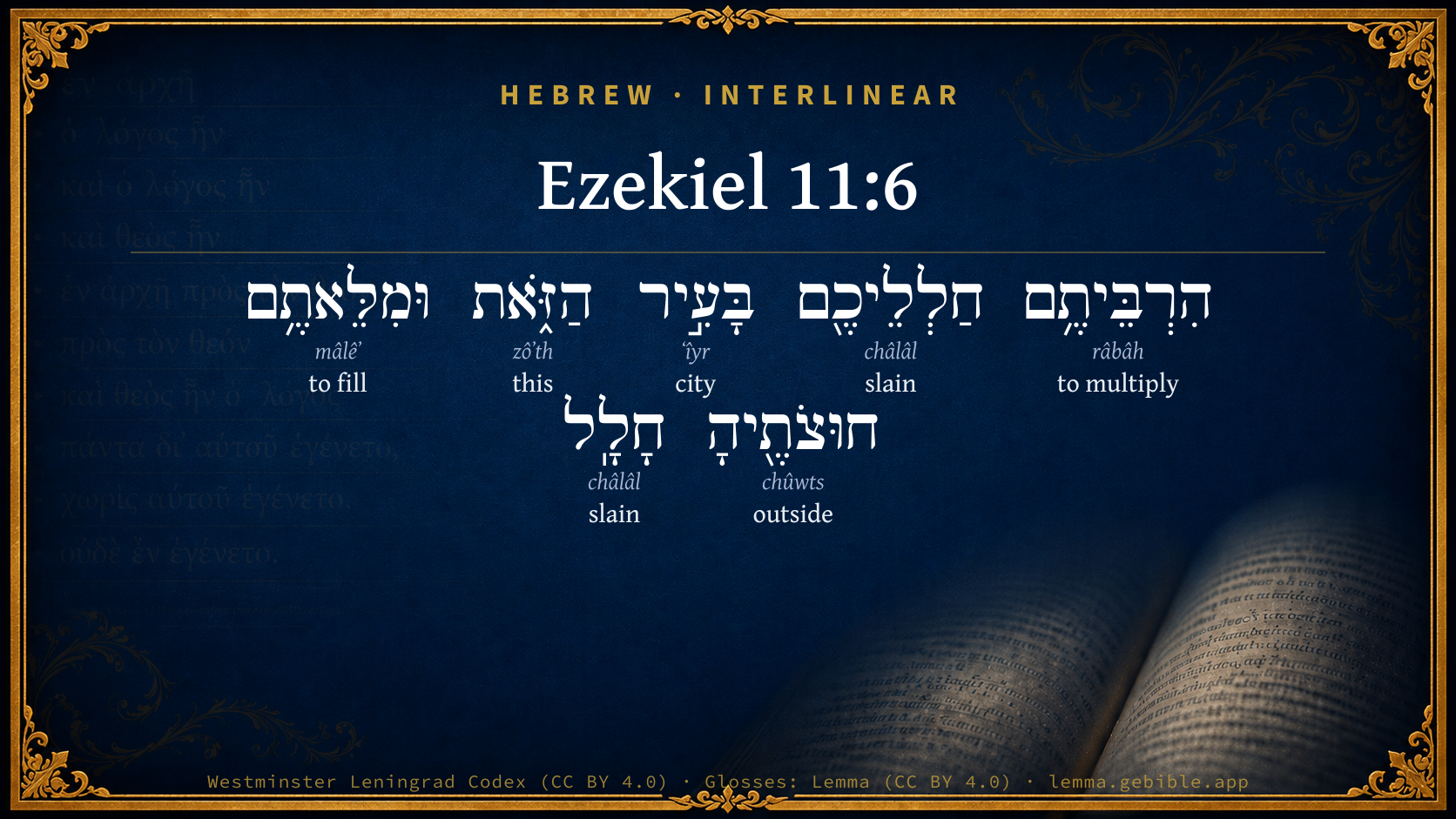
חַלְלֵיכֶ֖ם
châlâl
H2491
“slain · your”
Adjective, Adjective, Masculine, Plural, Construct + Suffix, Personal, 2nd Person, Masculine, Plural
Part of Speech
Adjective
Type
Adjective
Gender
Masculine
Number
Plural
State
Construct
Full BDB Definition

Origin: from H2490

TWOT: 660a

slain, fatally wounded, pierced (noun masculine) - pierced, fatally wounded - slain - (CLBL) profaned (adjective) - defiled, profaned (by divorce)
  1. הִרְבֵּיתֶ֥ם râbâh H7235 “to multiply” Verb, Hiphil, Perfect, 2nd Person, Masculine, Plural
  2. בָּעִ֣יר ʻîyr H5892 “in/at the · city” Preposition, Determined + Noun, Common, Feminine, Singular, Absolute
  3. הַזֹּ֑את zôʼth H2063 “the · this” Particle, Definite Article + Pronoun, Demonstrative, Feminine, Singular
  4. וּמִלֵּאתֶ֥ם mâlêʼ H4390 “and · to fill” Conjunction + Verb, Piel, Perfect, 2nd Person, Masculine, Plural
  5. חוּצֹתֶ֖יהָ chûwts H2351 “streets · her” Noun, Common, Masculine, Plural, Construct + Suffix, Personal, 3rd Person, Feminine, Singular
  6. חָלָֽל châlâl H2491 “slain” Adjective, Adjective, Masculine, Singular, Absolute

About this verse

These counts appear in no published source. They are computed here, from the morphology-tagged text and Lemma’s own curated glosses. What Lemma adds →

7
words
6
distinct lemmas
Prophets
section

Grammatical profile

  • 2 verbs
  • 2 nouns
  • 2 adjectives
  • 1 pronoun

Verb forms

  • הִרְבֵּיתֶ֥ם Hiphil · Perfect
  • וּמִלֵּאתֶ֥ם Piel · Perfect

Repetition

A word recurs within this verse — often emphatic in Hebrew:

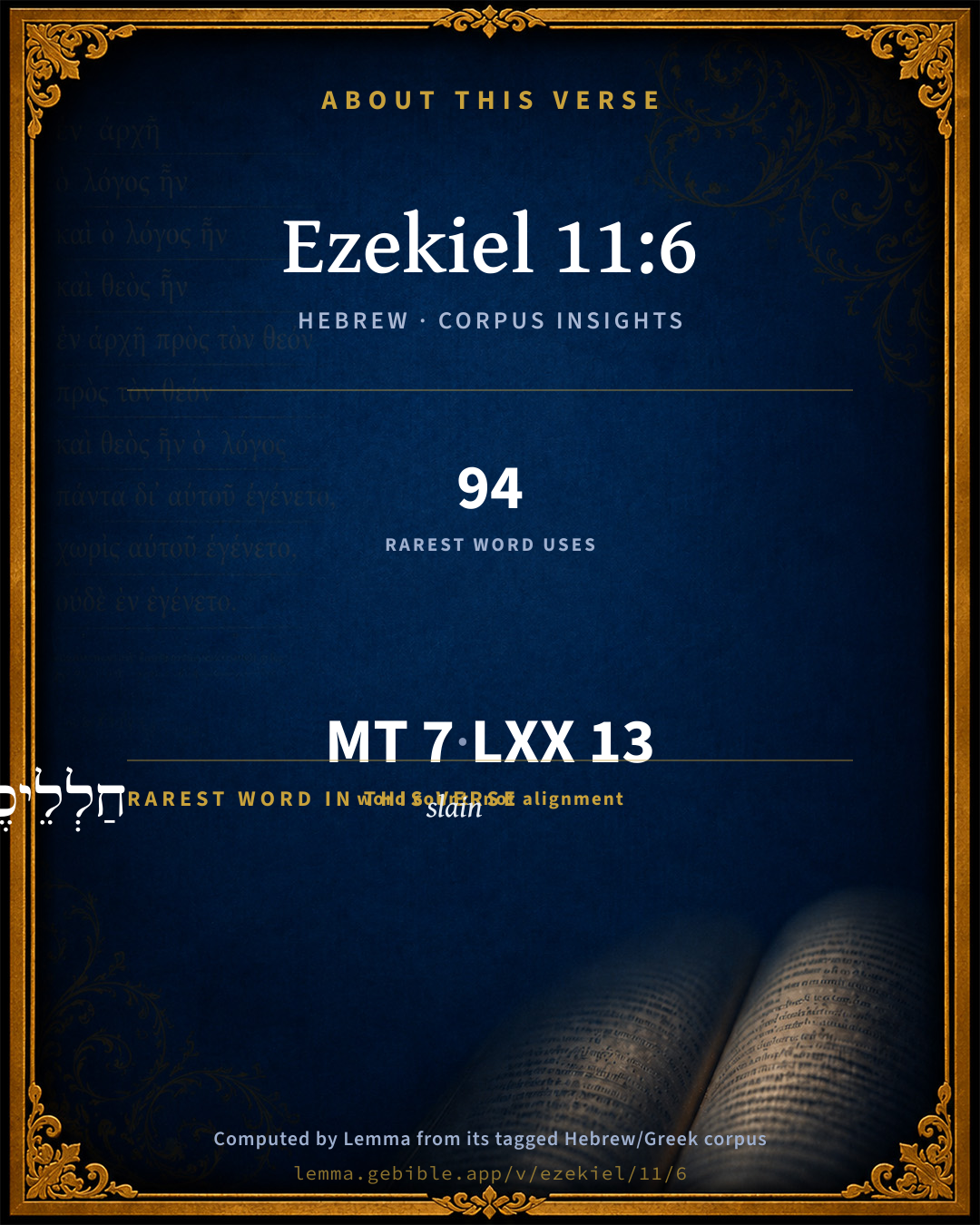
  • חַלְלֵיכֶ֖ם slain H2491 ×2

Hebrew & Septuagint length

In English translation the verse runs 19 words from the Hebrew and 17 from the Septuagint (LXX English) — closely comparable.

A rough comparison of the two English renderings, which tokenize alike — not a word-level alignment.

Word counts can differ between the Hebrew and the Greek without any difference in meaning — e.g. the Hebrew direct-object marker אֵת has no separate Greek word, and Greek often adds the article ὁ.

In the original languages it is 7 Hebrew tokens and 13 Greek tokens — but the two are counted differently (Hebrew bundles its prefixes and suffixes into one token; the Greek is in lemma form), so that isn’t a like-for-like length.

Cross-references

20

Topical passages linked to Ezekiel 11:6 in the Treasury of Scripture Knowledge — connected by theme and wording, ordered by reader-vote popularity; previews shown in the World English Bible.

  • Ezekiel 7:23 Make the chain; for the land is full of bloody crimes, and the city is full of violence.
  • Isaiah 1:15 When you spread forth your hands, I will hide my eyes from you; Yes, when you make many prayers, I will not hear. Your hands are full of blood.
  • Ezekiel 22:2–6 You, son of man, will you judge, will you judge the bloody city? then cause her to know all her abominations.
  • Ezekiel 22:12 In you have they taken bribes to shed blood; you have taken interest and increase, and you have greedily gained of your neighbors by oppression, and have forgotten me, says the Lord Yahweh.
  • Ezekiel 22:27 Her princes in the midst of it are like wolves ravening the prey, to shed blood, [and] to destroy souls, that they may get dishonest gain.
  • Hosea 4:2–3 There is cursing, lying, murder, stealing, and committing adultery; They break boundaries, and bloodshed causes bloodshed.
  • Micah 3:2–3 You who hate the good, And love the evil; Who tear off their skin, And their flesh from off their bones;
  • 2 Kings 21:16 Moreover Manasseh shed innocent blood very much, until he had filled Jerusalem from one end to another; besides his sin with which he made Judah to sin, in doing that which was evil in the sight of Yahweh.
  • Jeremiah 2:30 In vain have I struck your children; they received no correction: your own sword has devoured your prophets, like a destroying lion.
  • Jeremiah 2:34 Also in your skirts is found the blood of the souls of the innocent poor: you did not find them breaking in; but it is because of all these things.
  • Jeremiah 7:6 if you don't oppress the foreigner, the fatherless, and the widow, and don't shed innocent blood in this place, neither walk after other gods to your own hurt:
  • Jeremiah 7:9 Will you steal, murder, and commit adultery, and swear falsely, and burn incense to Baal, and walk after other gods that you have not known,
  • Lamentations 4:13 [It is] because of the sins of her prophets, [and] the iniquities of her priests, That have shed the blood of the just in the midst of her.
  • Ezekiel 9:9 Then said he to me, The iniquity of the house of Israel and Judah is exceeding great, and the land is full of blood, and the city full of wrestling [of judgment]: for they say, Yahweh has forsaken the land, and Yahweh doesn't see.
  • Ezekiel 22:9 Slanderous men have been in you to shed blood; and in you they have eaten on the mountains: in the midst of you they have committed lewdness.
  • Zephaniah 3:3 Her princes in the midst of her are roaring lions. Her judges are evening wolves. They leave nothing until the next day.
  • Matthew 23:35 that on you may come all the righteous blood shed on the earth, from the blood of righteous Abel to the blood of Zachariah son of Barachiah, whom you killed between the sanctuary and the altar.
  • Ezekiel 24:6–9 Therefore thus says the Lord Yahweh: Woe to the bloody city, to the caldron whose rust is therein, and whose rust is not gone out of it! take out of it piece after piece; No lot is fallen on it.
  • Micah 3:10 They build up Zion with blood, And Jerusalem with iniquity.
  • Micah 7:2 The godly man has perished out of the earth, And there is no one upright among men. They all lie in wait for blood; Every man hunts his brother with a net.

Cross-references courtesy of OpenBible.info (CC BY 4.0).

Hebrew and Greek witnesses Masoretic Hebrew ↔ Greek Septuagint

The same verse in the two great witnesses to the Old Testament, shown verse-for-verse.

These are two independent witnesses, not word-aligned to each other, and the Septuagint is shown in lemma (dictionary) form.

Hebrew Ezekiel 11:6 Masoretic · Westminster Leningrad Codex

הִרְבֵּיתֶ֥ם חַלְלֵיכֶ֖ם בָּעִ֣יר הַזֹּ֑את וּמִלֵּאתֶ֥ם חוּצֹתֶ֖יהָ חָלָֽל

You have multiplied your slain in this city, and you have filled the streets of it with the slain.

World English Bible · Public Domain

Greek LXX Ezekiel 11:6 Septuagint · lemma form

πληθύνω νεκρός σύ ἐν ὁ πόλις οὗτος καί ἐνπίμπλημι ὁ ὁδός αὐτός τραυματίας

You⌃ have multiplied your dead in this city, and you⌃ have filled your ways with slain men.

LXX2012 (modern English Septuagint) · Public Domain

Hebrew: Westminster Leningrad Codex (CC BY 4.0). Greek: Septuagint (public domain); English from LXX2012 (modern English Septuagint) (Public Domain). How the Septuagint differs from the Hebrew →

Targum (Aramaic paraphrase)

1

The Targum is the ancient Jewish Aramaic paraphrase of the Hebrew Scriptures — an interpretive translation, not the Hebrew text itself. Onkelos (literal) and Pseudo-Jonathan (expansive) render the Torah, and Jonathan the Prophets. Coverage is partial: where no permissively-licensed English translation exists for a verse, only the Aramaic is shown. This is verse-level text, not a word-by-word alignment to the Hebrew.

  1. Targum Jonathan Prophets (Joshua–Malachi)
    אַסְגֵיתוּן קְטִילֵכוֹן בְּקַרְתָּא הָדָא וּמְלֵיתוּן שׁוּקָהָא קְטִילִין:

    (no public-domain English translation for this verse)

    Targum Jonathan — Aramaic: “Mikraot Gedolot” (public domain). English: “Sefaria Community Translation” (CC0 1.0 (public-domain dedication)); “London "Chaldee Paraphrase," 1871” (public domain). Text via Sefaria.

Commentary

Notes on Ezekiel 11:6 from classic Christian and Jewish commentators (each source and its license shown beneath its notes). The classic Christian expositions comment on the surrounding passage and are grouped to its opening verse, so a note may address several verses; the Jewish commentaries on the Tanakh (Rashi and others) are per-verse, so they appear only where the commentator wrote on this verse.

Lemma curates 59 commentaries, every one of them public domain or Creative Commons licensed, each selected and text-cleaned for this edition rather than reprinted as found. About our sources →

Trapp's Complete Commentary

John Trapp

Eze 11:6 Ye have multiplied your slain in this city, and ye have filled the streets thereof with the slain.

Ver. 6. Ye have multiplied your slain in this city.] Called therefore a bloody city, {Eze 22:2; Eze 9:9; Eze 7:23} and it shall therefore despume you; Vos sicut spumae eieciemini. Evil counsellors are cruel and bloody-minded; their craft is never but accompanied with cruelty, and their cruelty seldom without craft. "None of them wanteth their mate," as the Scripture speaks of those birds of prey and desolation. {Isa 34:16}

John Trapp, A Commentary or Exposition upon All the Books of the Old and New Testament (1647–1656) — public domain. Text from a community e-Sword module.

Joseph Benson's Commentary

Eze 11:6-7. Ye have multiplied your slain in this city — Ye have, without law or justice, shed the blood of many in your streets. From this, and many other expressions in the Scripture, we may conclude that not only private murders were extremely frequent among them, but that they also frequently put to death, under colour of justice, those who were innocent of every crime deserving of death, but whom, for some wicked purposes, they wanted to be removed out of the way. And ye have filled the streets thereof with the slain — You have not only committed many murders yourselves, but you are accountable to God for all those whom the Chaldeans have slain, seeing you persuaded your people thus obstinately to stand out. Your slain, they are the flesh, &c. — You yourselves, therefore, have made your city, as it were, a caldron, by the murdered bodies with which you have filled the streets of it; many of them cut in pieces, so that they seem like flesh cut for the caldron. And this city may properly be called the caldron, into which their flesh has been thrown. But I will bring you forth out of the midst of it — Not in mercy, but in wrath, by the conquering hand of the king of Babylon. You shall not die there, but I will reserve you for another punishment: see Eze 11:9; Eze 11:11.

Joseph Benson's Commentary on the Old and New Testaments (1811–1818) — public domain. Text from a community e-Sword module.

Jamieson, Fausset & Brown

Robert Jamieson, A. R. Fausset & David Brown

your slain--those on whom you have brought ruin by your wicked counsels. Bloody crimes within the city brought on it a bloody foe from without (Eze 7:23-24). They had made it a caldron in which to boil the flesh of God's people (Mic 3:1-3), and eat it by unrighteous oppression; therefore God will make it a caldron in a different sense, one not wherein they may be safe in their guilt, but "out of the midst of" which they shall be "brought forth" (Jer 34:4-5).

Jamieson, Fausset & Brown — Commentary Critical and Explanatory on the Whole Bible (1871) — public domain (CC PDM 1.0). Text via the HelloAO Bible API.

John Calvin's Commentaries

Now Ezekiel attacks, as it were, in close combat, the buffoons who trifled with God by their jests, and brings forward that; sense which I have just before touched on, and of which the prophecy of Jeremiah was full, in a different manner to that. which they imagined. Ye, says he, have slain many; the city was full of many slaughters: therefore the pot was full of flesh; this flesh was cooked: there is no longer any room in the vessel. You must therefore of necessity be cast forth as froth, or as foul flesh, for which no vessel is found for cooking it. We see, then, that the Prophet here treats them wittily, and plays off jests in answer to them; meanwhile he strikes a deadly wound, when he shows that they joked so petulantly to their own destruction, and boasted that Jeremiah was their adversary. Hence he confirms the prophecy of Jeremiah, and yet he does not interpret it, because Jeremiah had spoken properly and clearly, when he said that they were flesh. The meaning was the same as if God were to pronounce that he would consume them in the midst of the city. It happened as we have formerly seen; for he scattered some of the people, and slew some with the sword, and some with hunger. Whatever it is, the prophecy of Jeremiah will always be found true, namely, that God had cooked the Jews with the fire of the Chaldees. (Jeremiah 1:13.) But since they had perverted that doctrine, the Prophet does not regard the meaning of Jeremiah, but shows that they never profited while they turned their backs on God. Ye shall not be flesh, says he, but your slain were flesh: ye have refilled the caldron, that is the city with the slain; now there is no room for you. What therefore remains, but that God should cast you out as foul flesh? Neither will he cook you, says he, nor will he consume you in a caldron, but where he has stretched you at full length on the earth, there will he consume you. Now, therefore, we see how great a destruction the Jews had brought upon themselves, when they took the liberty of joking and jesting at the Prophets. Hence he says, they had filled the city with the slain He does not mean that men had been openly put to death in Jerusalem, but this form of speech embraces all forms of injustice; for we know that God esteems those homicides who oppress miserable men, overturn their fortunes, and suck innocent blood. Since, then, God esteems all violence as slaughter, he properly says, that the city was filled with the slain The Jews might object that no one had brought violence upon them; they could not be convicted in the sight of men; but when their wickedness was so gross among themselves, that they did not spare the wretched, but cruelly afflicted them, he says that the city was filled with the slain He now adds, when the city was full of flesh there was no more place for them, and he now shows that although Jeremiah had predicted that they should be cooked with the fire of the Chaldeans, yet they had advanced so far in wickedness, that they were unworthy of being cooked within the city. Hence, says he, a greater vengeance from God awaits you, since ye proceed to provoke his anger more and more. It follows —

John Calvin's Commentaries (1540-1563) — public domain. Text from the Calvin Translation Society English edition (1840s-50s) via the Christian Classics Ethereal Library (ccel.org). Calvin's coverage is partial (roughly two-thirds of the Bible); uncommented books and verses are honest gaps, never fabricated. The 19th-century editor's footnotes and remarks are omitted so the notes are faithfully Calvin's own voice.

Ellicott's Commentary for English Readers

(6) Ye have multiplied your slain.—Crimes of violence, as well as of licentiousness, are always the fruit of defection from God. In this case the apostacy of the people had produced its natural result; and the abundant crimes against life formed a prominent feature of the terrible indictment against the city.

A Bible Commentary for English Readers, edited by Charles John Ellicott (1878–1897) — public domain. Text from a community e-Sword module.

The Cambridge Bible for Schools and Colleges

gen. ed. J. J. S. Perowne

6. Comp. ch. Eze_22:25, Eze_7:23. Those opposed to the schemes of the ruling party, or suspected of opposition, were openly or on various pretexts cut off.

The Cambridge Bible for Schools and Colleges (gen. ed. J. J. S. Perowne; Cambridge University Press, 1878–1918) — public domain. Text from a community e-Sword module.

John Gill's Exposition

Ye have multiplied your slain in this city,.... Had killed many of the prophets of the Lord that had been sent unto them, and had shed much innocent blood; and not only had unjustly condemned many to die, and had put them to death without a cause; but also the death of all those that were slain while the city was besieging, and when it was taken, were owing to their advice and counsel, in encouraging them to hold out, and not deliver up the city; fancying they should be able to defend it, contrary to the declarations of the Lord by the prophet; wherefore their death is laid to such advisers, and they are called their slain:

and ye have filled the streets thereof with the slain; such numbers of innocent persons being put to death, as in the times of Manasseh, Kg2 21:16; or so many dying of the famine, pestilence, and sword, during the siege, and at the taking of Jerusalem.

John Gill's Exposition of the Whole Bible (1746–1763) — public domain (CC PDM 1.0). Text via the HelloAO Bible API.

Haydock's Catholic Bible Commentary

Slain, under Manasses, &c. (Tirinus)

George Leo Haydock (1774–1849), Haydock's Catholic Family Bible and Commentary, 1859 edition — public domain. Excludes Psalms (Douay-Rheims chapter numbering differs from Protestant) and Deuterocanonical books (Catholic canon only).

Matthew Poole's English Annotations

Many murders, and great ones, (for the Hebrew includeth both,) have you committed, either with frauds or violence, and sometimes with colour and pretence of law.

Your slain; so called because they were such as God had not commanded to be cut off, but the Jews did it without warrant from God.

Filled the streets; either left them murdered in the streets; or rather, by an hyperbole, the streets are full, every where some or other in every street you have condemned and killed. It is an expression the Scripture much useth to set forth the bloody effects of the Jewish rage, and of others.

Matthew Poole's English Annotations on the Holy Bible (1683–1685) — public domain. Text from a community e-Sword/MySword module.

Whedon's Commentary on the Bible

Daniel D. Whedon

6. Ye have multiplied your slain — This shows how the captains and leaders of the war party had been accustomed to deal with those whose opinions differed from theirs (Eze_7:23; Eze_22:25).

Daniel D. Whedon (gen. ed.), Commentary on the Old and New Testaments (1874–1909) — public domain. Text from a community e-Sword module.

John Wesley's Explanatory Notes

Ye - Many murders have you committed yourselves, and you are accountable to God for all those whom the Chaldeans have slain, seeing you persuaded them, thus obstinately to stand out.

John Wesley, Explanatory Notes Upon the Whole Bible (1754–1765) — public domain. Text via the GEBible commentary corpus.

Lesson kit

Teaching starters — assembled from the data on this page, not authored interpretation. Every prompt links to the verse data it draws on. Edit before teaching.

Ezekiel, in the Prophets, opens this verse with 7 words (6 distinct Hebrew lemmas). Its most distinctive word is châlâl (“slain”). A historical commentator’s framing appears above. Read the whole chapter for the surrounding context.

Discussion questions

  1. The word châlâl carries the sense “slain.” How does it shape the verse?
  2. How does Ezekiel 7:23, which shares this passage’s theme, read alongside this verse?
  3. What does the repetition of “slain” (2× in this one verse) do in this verse?
  4. These translations render this verse differently. What is at stake in choosing one wording over another?
  5. «הִרְבֵּיתֶ֥ם» is a Hiphil Perfect verb. How does that grammatical form shape the action described?
  6. Compare how Trapp's Complete Commentary and Joseph Benson's Commentary read this verse. Where do they agree or differ?

Things to notice

Reading settings

Reading text

Shown beneath each verse's original-language words.

Old Testament
Old Testament edition

Read the OT as the Masoretic Hebrew (MT) or the Greek Septuagint (LXX).

English shown for the Greek Septuagint (in the Hebrew ↔ Greek comparison).

Comparing translations? Open the Compare panel on any verse page to stack up to four side by side.