
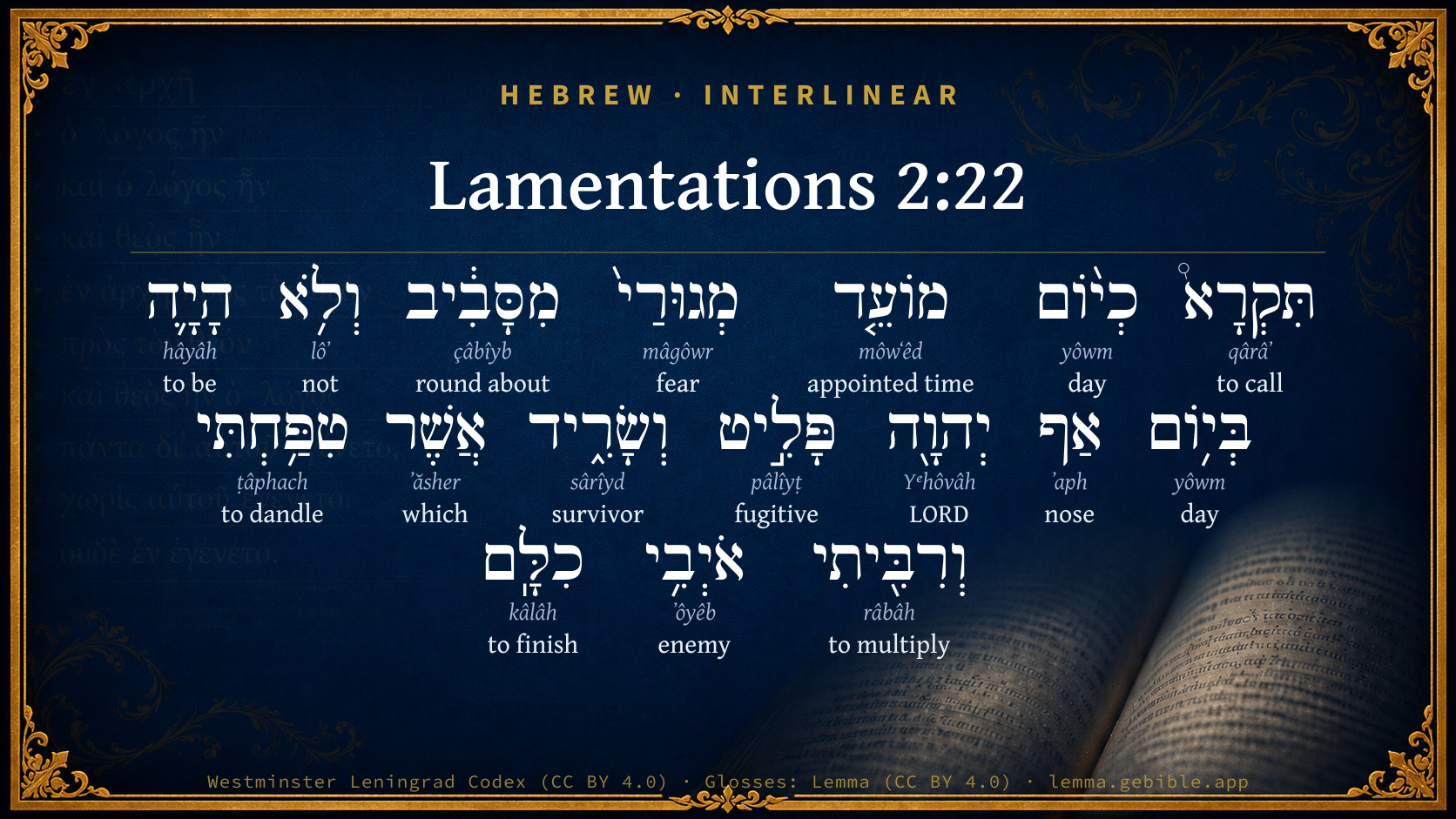
Lamentations 2:22

Hebrew (Westminster Leningrad Codex) Lamentations 2:22 appears in the Hebrew Old Testament. The text above is from the Westminster Leningrad Codex. Each word links to its Strong’s number, a concise gloss, and parsing drawn from the Open Scriptures Hebrew Bible morphology. Click any word for its full Brown-Driver-Briggs (BDB) entry.
Download image
Cite this verse

Lamentations 2:22 (World English Bible). Public Domain. Lemma interlinear Bible study tool, https://lemma.gebible.app/v/lamentations/2/22.

Show BibTeX & RIS
BibTeX
RIS
English Translation
You have called, as in the day of a solemn assembly, my terrors on every side; There was none that escaped or remained in the day of Yahweh's anger: Those that I have dandled and brought up has my enemy consumed.
World English Bible · Public Domain
Download a study sheet

One document with this verse’s original text, its word-by-word gloss line, the meaning frame, cross-references with their text, attributed commentary, and full source and license credits — printable, and it pastes into notes with its structure intact.

This verse Autodidact and up

Study sheet (.html) Plain text (.txt)

A passage Seminary Student

Up to 50 verses in one chapter. A passage sheet keeps up to 6 commentary sources and 12 cross-references per verse, in the order this page ranks them, and says so on the sheet whenever that leaves anything out. Ask for a single verse and you get the Autodidact verse sheet above.

Everything on this page stays free to read, with no account — the sheet is a download of what is already on screen, not access to it.

Want to remove ads? Support Godless Engineer
Compare translations 3

The same verse in 3 English versions, stacked beneath the original-language interlinear above. Click any original word for its lexicon entry.

Each is an independent rendering of the whole verse — the interlinear is not word-aligned to these translations.

Highlighted words mark where these versions differ — a whole-verse word diff, not a word-by-word alignment.

  • World English Bible Public Domain
    You have called, as in the day of a solemn assembly, my terrors on every side; There was none that escaped or remained in the day of Yahweh's anger: Those that I have dandled and brought up has my enemy consumed.
  • King James Version Public Domain
    Thou hast called as in a solemn day my terrors round about, so that in the day of the LORD's anger none escaped nor remained: those that I have swaddled and brought up hath mine enemy consumed.
  • unfoldingWord Literal Text CC BY-SA 4.0
    You have summoned, as on a day of an appointed festival, my terrors from all around, and there was not on the day of the anger of Yahweh an escapee or a survivor. Those whom I carried and multiplied, my enemy has consumed them.

unfoldingWord Literal Text — © unfoldingWord, licensed CC BY-SA 4.0. Word-aligned USFM3 via Door43 (git.door43.org/unfoldingWord/en_ult).

Versions to compare (up to 4)

3 of 4 selected

Show all 18 translations

Every available English version of this verse, each an independent rendering of the whole verse.

  • World English Bible Public Domain
    You have called, as in the day of a solemn assembly, my terrors on every side; There was none that escaped or remained in the day of Yahweh's anger: Those that I have dandled and brought up has my enemy consumed.
  • Berean Standard Bible Public Domain
    You summoned my attackers on every side, as for the day of an appointed feast. In the day of the LORD’s anger no one escaped or survived; my enemy has destroyed those I nurtured and reared.
  • Majority Standard Bible Public Domain
    You summoned my terrors on every side, as for the day of an appointed feast. In the day of the LORD’s anger no one escaped or survived; my enemy has destroyed those I nurtured and reared.
  • King James Version Public Domain
    Thou hast called as in a solemn day my terrors round about, so that in the day of the LORD's anger none escaped nor remained: those that I have swaddled and brought up hath mine enemy consumed.
  • American Standard Version (1901) Public Domain
    Thou hast called, as in the day of a solemn assembly, my terrors on every side; And there was none that escaped or remained in the day of Jehovah's anger: Those that I have dandled and brought up hath mine enemy consumed.
  • Revised Version (1885) Public Domain
    Thou hast called, as in the day of a solemn assembly, my terrors on every side, and there was none that escaped or remained in the day of the LORD’S anger: those that I have dandled and brought up hath mine enemy consumed.
  • Geneva Bible (1599) Public Domain
    Thou hast called as in a solemne daye my terrours rounde about, so that in the day of the Lordes wrath none escaped nor remained: those that I haue nourished and brought vp, hath mine enemie consumed.
  • Douay-Rheims (1899) Public Domain
    Thau. Thou hast called as to a festival, those that should terrify me round about, and there was none in the day of the wrath of the Lord that escaped and was left: those that I brought up, and nourished, my enemy hath consumed them.
  • Young's Literal Translation Public Domain
    Thou dost call as `at' a day of appointment, My fears from round about, And there hath not been in the day of the anger of Jehovah, An escaped and remaining one, They whom I stretched out and nourished, My enemy hath consumed!
  • Literal Standard Version CC BY-SA 4.0
    You call as [at] a day of appointment, || My fears from all around, || And there has not been in the day of the anger of YHWH, || An escaped and remaining one, || They whom I stretched out and nourished, || My enemy has consumed!
  • Unlocked Literal Bible CC BY-SA 4.0
    You have summoned, as you would call the people to a feast day, my terrors on every side, on the day of the anger of Yahweh no one escaped or survived; those I cared for and raised, my enemy has destroyed.
  • unfoldingWord Literal Text CC BY-SA 4.0
    You have summoned, as on a day of an appointed festival, my terrors from all around, and there was not on the day of the anger of Yahweh an escapee or a survivor. Those whom I carried and multiplied, my enemy has consumed them.
  • Darby Bible Public Domain
    Thou hast called up, as on the day of a set feast, my terrors on every side; and in the day of Jehovah's anger there was none that escaped or remained: those that I have nursed and brought up hath mine enemy consumed.
  • World Messianic Bible Public Domain
    “You have called, as in the day of a solemn assembly, my terrors on every side. There was no one that escaped or remained in the day of the LORD’s anger. My enemy has consumed those whom I have cared for and brought up.
  • Webster's Bible Public Domain
    Thou hast called as in a solemn day my terrors around, so that in the day of the LORD'S anger none escaped nor remained: those that I have swaddled and brought up, hath my enemy consumed.
  • Free Bible Version CC BY-SA 4.0
    You invited enemies to attack me from every direction like you were inviting them to a religious festival. At the time when the Lord was angry nobody escaped, nobody survived. My enemy has destroyed the children I looked after and loved.
  • Bible in Basic English Public Domain
    As in the day of a holy meeting you have made fears come round me on every side, and no one got away or was kept safe in the day of the Lord's wrath: those who were folded in my arms, whom I took care of, have been sent to their destruction by my hater.
  • JPS Tanakh (1917) Public Domain
    Thou hast called, as in the day of a solemn assembly, my terrors on every side, and there was none in the day of the LORD'S anger that escaped or remained; those that I have dandled and brought up hath mine enemy consumed.'

Literal Standard Version (2020), Covenant Press — licensed CC BY-SA 4.0. Text via the HelloAO Bible API (eBible.org). Unlocked Literal Bible (unfoldingWord) — licensed CC BY-SA 4.0. Text via the HelloAO Bible API (eBible.org). unfoldingWord Literal Text — © unfoldingWord, licensed CC BY-SA 4.0. Word-aligned USFM3 via Door43 (git.door43.org/unfoldingWord/en_ult). Free Bible Version, Dr. Jonathan Gallagher — licensed CC BY-SA 4.0. Text via the HelloAO Bible API (eBible.org).

Word by word

More ways to search: Search by grammar → Find every occurrence → Compare this word →

Practice this passage: Drill this verse → Learn its vocabulary →

טִפַּ֥חְתִּי
ṭâphach
H2946
“to dandle”
Verb, Piel, Perfect, 1st Person, Common, Singular
Part of Speech
Verb
Stem
Piel
Form
Perfect
Person
1st Person
Gender
Common
Number
Singular
Full BDB Definition

Origin: a primitive root

TWOT: 821

to extend, spread, trip, take quick little steps - (Piel) - to spread out - to carry on the palms, dandle - to rear children
  1. תִּקְרָא֩ qârâʼ H7121 “to call” Verb, Qal, Imperfect, 2nd Person, Masculine, Singular
  2. כְי֨וֹם yôwm H3117 “like/as · day of” Preposition + Noun, Common, Masculine, Singular, Construct
  3. מוֹעֵ֤ד môwʻêd H4150 “appointed time” Noun, Common, Masculine, Singular, Absolute
  4. מְגוּרַי֙ mâgôwr H4032 “fears · my” Noun, Common, Masculine, Plural, Construct + Suffix, Personal, 1st Person, Common, Singular
  5. מִסָּבִ֔יב çâbîyb H5439 “from · round about” Preposition + Noun, Common, Both, Singular, Absolute
  6. וְלֹ֥א lôʼ H3808 “and · not” Conjunction + Particle, Negative
  7. הָיָ֛ה hâyâh H1961 “to be” Verb, Qal, Perfect, 3rd Person, Masculine, Singular
  8. בְּי֥וֹם yôwm H3117 “in/at · day of” Preposition + Noun, Common, Masculine, Singular, Construct
  9. אַף ʼaph H639 “nose” Particle, Accusative
  10. יְהוָ֖ה Yᵉhôvâh H3068 “LORD” Noun, Proper
  11. פָּלִ֣יט pâlîyṭ H6412 “fugitive” Noun, Common, Masculine, Singular, Absolute
  12. וְשָׂרִ֑יד sârîyd H8300 “and · survivor” Conjunction + Noun, Common, Masculine, Singular, Absolute
  13. אֲשֶׁר ʼăsher H834 “which” Particle, Relative
  14. וְרִבִּ֖יתִי râbâh H7235 “and · to multiply” Conjunction + Verb, Piel, Perfect, 1st Person, Common, Singular
  15. אֹיְבִ֥י ʼôyêb H341 “enemy · me” Verb, Qal, Participle Active, Masculine, Singular, Construct + Suffix, Personal, 1st Person, Common, Singular
  16. כִלָּֽם kâlâh H3615 “to finish · them” Verb, Piel, Perfect, 3rd Person, Masculine, Singular + Suffix, Personal, 3rd Person, Masculine, Plural

About this verse

These counts appear in no published source. They are computed here, from the morphology-tagged text and Lemma’s own curated glosses. What Lemma adds →

17
words
16
distinct lemmas
Prophets
section

Notable vocabulary

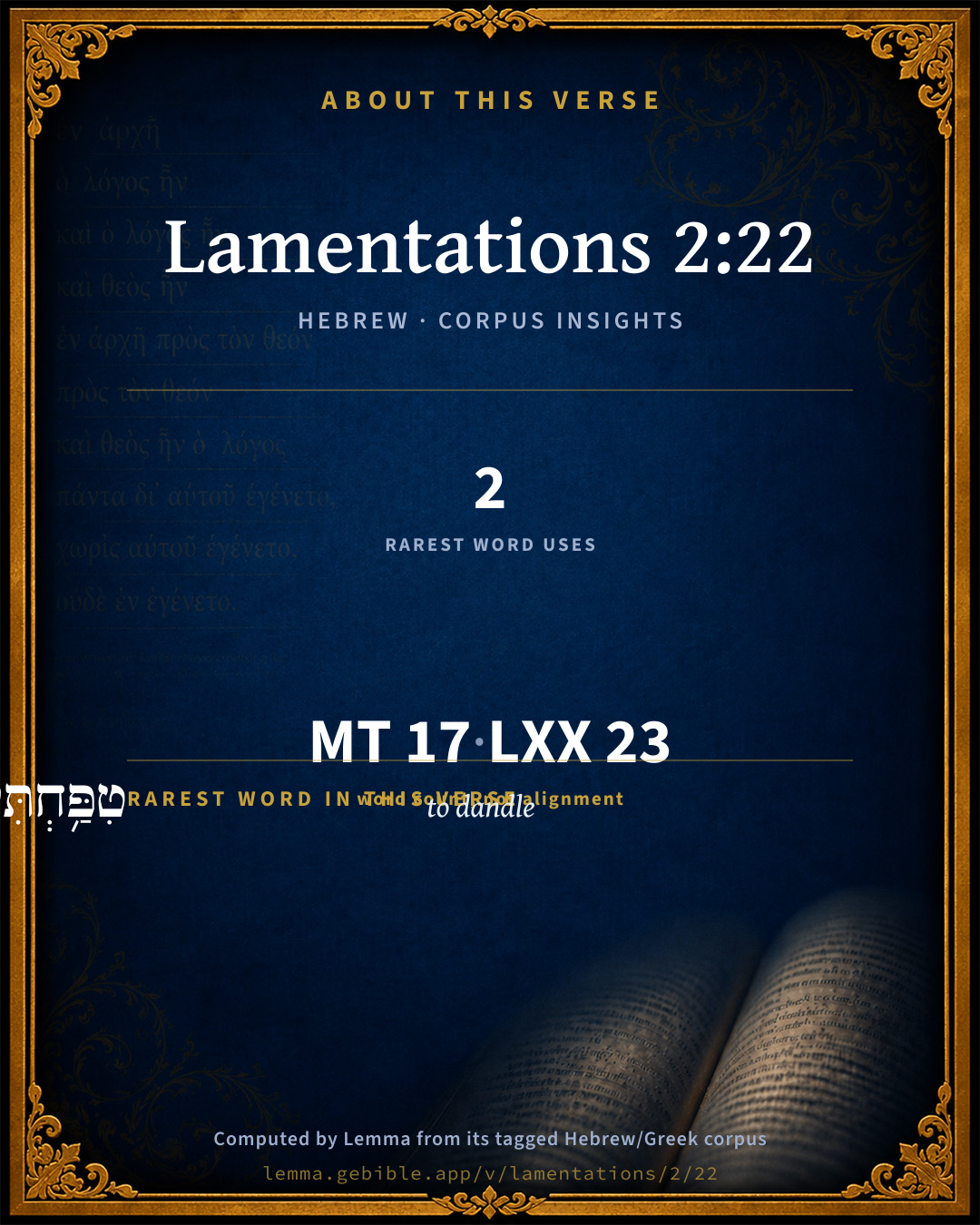
The rarest word here is טִפַּ֥חְתִּי to dandle H2946 — appearing just 2 times in the whole Hebrew Bible.

Shared distinctive vocabulary

טִפַּ֥חְתִּי to dandle H2946 occurs in 2 verses of the Hebrew Bible. Also found in:

Grammatical profile

  • 6 verbs
  • 8 nouns
  • 3 particles

Verb forms

  • תִּקְרָא֩ Qal · Imperfect
  • הָיָ֛ה Qal · Perfect
  • טִפַּ֥חְתִּי Piel · Perfect
  • וְרִבִּ֖יתִי Piel · Perfect
  • אֹיְבִ֥י Qal · Participle Active
  • כִלָּֽם Piel · Perfect

Repetition

A word recurs within this verse — often emphatic in Hebrew:

  • כְי֨וֹם day H3117 ×2

Hebrew & Septuagint length

In English translation the verse runs 41 words from the Hebrew and 41 from the Septuagint (LXX English) — the same length.

A rough comparison of the two English renderings, which tokenize alike — not a word-level alignment.

Word counts can differ between the Hebrew and the Greek without any difference in meaning — e.g. the Hebrew direct-object marker אֵת has no separate Greek word, and Greek often adds the article ὁ.

In the original languages it is 17 Hebrew tokens and 23 Greek tokens — but the two are counted differently (Hebrew bundles its prefixes and suffixes into one token; the Greek is in lemma form), so that isn’t a like-for-like length.

Cross-references

10

Topical passages linked to Lamentations 2:22 in the Treasury of Scripture Knowledge — connected by theme and wording, ordered by reader-vote popularity; previews shown in the World English Bible.

  • Psalms 31:13 For I have heard the slander of many, terror on every side, While they conspire together against me, They plot to take away my life.
  • Jeremiah 6:25 Don't go forth into the field, nor walk by the way; for the sword of the enemy, [and] terror, are on every side.
  • Isaiah 24:17–18 Fear, and the pit, and the snare, are on you, O inhabitant of the earth.
  • Jeremiah 16:2–4 You shall not take a wife, neither shall you have sons or daughters, in this place.
  • Jeremiah 20:3 It happened on the next day, that Pashhur brought forth Jeremiah out of the stocks. Then said Jeremiah to him, Yahweh has not called your name Pashhur, but Magormissabib.
  • Deuteronomy 28:18 Cursed shall be the fruit of your body, and the fruit of your ground, the increase of your cattle, and the young of your flock.
  • Jeremiah 46:5 Why have I seen it? they are dismayed and are turned backward; and their mighty ones are beaten down, and have fled apace, and don't look back: terror is on every side, says Yahweh.
  • Hosea 9:12–16 Though they bring up their children, Yet I will bereave them, so that not a man shall be left. Indeed, woe also to them when I depart from them!
  • Amos 9:1–4 I saw the Lord standing beside the altar, and he said, "Strike the tops of the pillars, that the thresholds may shake; and break them in pieces on the head of all of them; and I will kill the last of them with the sword: there shall not one of them flee away, and there shall not one of them escape.
  • Luke 23:29–30 For behold, the days are coming in which they will say, 'Blessed are the barren, the wombs that never bore, and the breasts that never nursed.'

Cross-references courtesy of OpenBible.info (CC BY 4.0).

Hebrew and Greek witnesses Masoretic Hebrew ↔ Greek Septuagint

The same verse in the two great witnesses to the Old Testament, shown verse-for-verse.

These are two independent witnesses, not word-aligned to each other, and the Septuagint is shown in lemma (dictionary) form.

Hebrew Lamentations 2:22 Masoretic · Westminster Leningrad Codex

תִּקְרָא֩ כְי֨וֹם מוֹעֵ֤ד מְגוּרַי֙ מִסָּבִ֔יב וְלֹ֥א הָיָ֛ה בְּי֥וֹם אַף יְהוָ֖ה פָּלִ֣יט וְשָׂרִ֑יד אֲשֶׁר טִפַּ֥חְתִּי וְרִבִּ֖יתִי אֹיְבִ֥י כִלָּֽם

You have called, as in the day of a solemn assembly, my terrors on every side; There was none that escaped or remained in the day of Yahweh's anger: Those that I have dandled and brought up has my enemy consumed.

World English Bible · Public Domain

Greek LXX Lamentations 2:22 Septuagint · lemma form

καλέω ἡμέρα ἑορτή παροικία ἐγώ κυκλόθεν καί οὐ γίγνομαι ἐν ἡμέρα ὀργή κύριος ἀνασώζω καί καταλείπω ὡς ἐπικρατέω καί πληθύνω ἐχθρός ἐγώ πᾶς

THAU. He has called my sojourners round about to a solemn day, and there was not in the day of the wrath of the Lord any one that escaped or was left; whereas I have strengthened and multiplied all my enemies.

LXX2012 (modern English Septuagint) · Public Domain

On this verse, Ellicott's Commentary for English Readers discusses the Septuagint’s reading. Read the note in Commentary ↓

Hebrew: Westminster Leningrad Codex (CC BY 4.0). Greek: Septuagint (public domain); English from LXX2012 (modern English Septuagint) (Public Domain). How the Septuagint differs from the Hebrew →

Commentary

Notes on Lamentations 2:22 from classic Christian and Jewish commentators (each source and its license shown beneath its notes). The classic Christian expositions comment on the surrounding passage and are grouped to its opening verse, so a note may address several verses; the Jewish commentaries on the Tanakh (Rashi and others) are per-verse, so they appear only where the commentator wrote on this verse.

Lemma curates 59 commentaries, every one of them public domain or Creative Commons licensed, each selected and text-cleaned for this edition rather than reprinted as found. About our sources →

Trapp's Complete Commentary

John Trapp

Lam 2:22 Thou hast called as in a solemn day my terrors round about, so that in the day of the LORD’S anger none escaped nor remained: those that I have swaddled and brought up hath mine enemy consumed.

Ver. 22. Thou hast called as in a solemn day my terrors,] i.e., My terrible enemies the Chaldees, being called in by thee their generalissimo, came on as cheerfully as if they had come to a solemn feast or some merry meeting, and not to a siege and to a bloody war, which they cannot but know to be utrinque triste, such as both sides usually suffer by.

Those that I have swaddled and brought up.] Singula haec verba ponderanda sunt; singula enim ingens habent pathos. Here every word is very ponderous and pathetic; indeed, this whole book is so, which is the reason that there is no great coherence in some places thereof to be discovered. For as he that is under some grievous affliction, without observing of order, now cries, now prays, now laments, now complains, &c.; so doth the prophet here, in the name of the Church, pour forth himself tumultuously in a flood such words as his grief ministered unto him; and grief is no methodical speaker.

John Trapp, A Commentary or Exposition upon All the Books of the Old and New Testament (1647–1656) — public domain. Text from a community e-Sword module.

The Biblical Illustrator

Joseph S. Exell

Lam_2:22

Thou hast called . . . my terrors round about.

The wicked instruments of punishment

1. God raiseth up the wickedest, and employeth them to punish His own servants when they sin (Isa_5:26; Isa_8:7).

2. None can escape Gods punishments, whom He meaneth to punish (Psa_139:7).

3. The children of impenitent sinners are often taken away, and prosper not to their comfort. In Gods displeasure all things are accursed unto us (Deu_28:15). (J. Udall.)

The ministry of terror

At Dunkeld there is a high rock, forming a conspicuous feature in the landscape, It is covered at the top with pine trees, which stand out like spears against the skyline, and only here and there can you see the grey face of the rock itself, showing how steep and dangerous it is. At one time the rock was perfectly bare; and one of the Dukes of Athole, who had a perfect passion for planting trees everywhere, wished to cover it like the other heights around with wood. But it was found impossible to climb up to the crevices and ledges of the huge rock, in order to plant the young trees. One day, Alexander Naismith, the father of the great engineer, paid a visit to the dukes grounds; and when told about his graces wish to adorn the rock with trees, he suggested a plan by which this might be accomplished. In front of the dukes castle he noticed an old cannon, which had been used for firing salutes on great occasions. He got this cannon removed to a convenient point near the rock; and then putting a large quantity of the seeds of pine and fir trees into a round tin canister, he rammed it into the mouth of the cannon with a charge of gunpowder, and fired it at the top of the rock. The canister, when it struck the rock, broke into bits and scattered the seeds in every direction. A great many of them fell into the nooks and crannies of the rock, where a little moss or soil had gathered; and with the first showers they began to sprout and send up their tiny shoots, which took firm hold of the rock. After years of slow and steadfast growth, for they had exceedingly little soil, they became trees which completely clothed the naked rock and made it one of the most picturesque parts of the landscape. Now, this was a very strange use to make of a cannon, and a very strange way of sowing seed. A cannon is usually employed to cause death and destruction. But on this occasion it was used to do good, to clothe a naked rock with beauty and fertility, to bring life out of death. It made a loud terrifying noise; it broke the rock in splinters, it burst the canister into fragments, but it scattered the seeds of life where they were wanted. Never was gunpowder employed in a more beneficent work! Now, God sometimes sows his seeds of eternal life by means of a cannon; He persuades men by terror. He says, indeed, of Himself, Fury is not in Me. It is contrary to His nature; for He is love. And yet He is sometimes obliged to do things that terrify for His peoples good. There are proud, lofty natures, full of conceit and self-sufficiency, that rise above their fellows in their own esteem, and lord it over them, and yet are bare and barren of any spiritual good thing, neither profitable to God nor man. If the seed of eternal life is to be sown at all in such lofty, inaccessible natures, it must be by means of a cannon. They must be persuaded by terror. God must thunder forth to them His warnings and invitations. (H. Macmillan, D. D.)

.

The Biblical Illustrator, edited by Joseph S. Exell (c. 1880s–1900s) — public domain. Text from a community e-Sword module.

Tyndale Open Study Notes

Tyndale Open Resources

2:22 calling them to a day of feasting: The poet compares Jerusalem’s destruction to an invitation to a banquet at which war, famine, wild animals, and sickness would feast on the wicked in Jerusalem (Deut 28:15-68; cp. Rev 19:17-21).

Tyndale Open Study Notes — © Tyndale Open Resources, licensed CC BY-SA 4.0. Text via the HelloAO Bible API.

Geneva Bible (1599)

Geneva Bible translators

Or, enemies, whom I feared.

Geneva Bible (1599) marginal notes — public domain. Text via Bolls.life.

Jamieson, Fausset & Brown

Robert Jamieson, A. R. Fausset & David Brown

Thou hast called as in . . . solemn day . . . terrors--Thou hast summoned my enemies against me from all quarters, just as multitudes used to be convened to Jerusalem, on the solemn feast days. The objects, for which the enemies and the festal multitude respectively met, formed a sad contrast. Compare Lam 1:15 : "called an assembly against me."

Jeremiah proposes his own experience under afflictions, as an example as to how the Jews should behave under theirs, so as to have hope of a restoration; hence the change from singular to plural (Lam 3:22, Lam 3:40-47). The stanzas consist of three lines, each of which begins with the same Hebrew letter.

Next: Lamentations Chapter 3

Jamieson, Fausset & Brown — Commentary Critical and Explanatory on the Whole Bible (1871) — public domain (CC PDM 1.0). Text via the HelloAO Bible API.

Adam Clarke's Commentary

Verse 22. Thou hast called as in a solemn day] It is by thy influence alone that so many enemies are called together at one time; and they have so hemmed us in that none could escape, and none remained unslain or uncaptivated, Perhaps the figure is the collecting of the people in Jerusalem on one of the solemn annual festivals. God has called terrors together to feast on Jerusalem, similar to the convocation of the people from all parts of the land to one of those annual festivals. The indiscriminate slaughter of young and old, priest and prophet, all ranks and conditions, may be illustrated by the following verses from Lucan, which appear as if a translation of the nineteenth, twentieth, and twenty-first verses of this chapter: -

Nobilitas cum plebe perit; lateque vagatur

Ensis, et a nullo revocatum est pectore ferrum.

Stat cruor in Templis; multaque rubentia caede

Lubrica saxa madent. Nulli sua profuit aetas.

Non senes extremum piguit vergentibus annis

Praecipitasse diem; nec primo in limine vitae,

Infanti miseri nascentia rumpere fata.

Pharsal. lib. ii., 101.

"With what a slide devouring slaughter passed,

And swept promiscuous orders in her haste;

O'er noble and plebeian ranged the sword,

Nor pity nor remorse one pause afford!

The sliding streets with blood were clotted o'er,

And sacred temples stood in pools of gore.

The ruthless steel, impatient of delay,

Forbade the sire to linger out his day:

It struck the bending father to the earth,

And cropped the wailing infant at its birth."

ROWE.

Adam Clarke's Commentary on the Bible (1810–1826) — public domain. Text from a community e-Sword/MySword module.

John Calvin's Commentaries

Here he uses a most appropriate metaphor, to show that the people had been brought to the narrowest straits; for he says that terrors had on every side surrounded them, as when a solemn assembly is called. They sounded the trumpets when a festival was at hand, that all might come up to the Temple. As, then, many companies were wont to come to Jerusalem on feast-days — for when the trumpets were sounded all were called — so the Prophet says that terrors had been sent by God from every part to straiten the miserable people: thou hast, then, called my terrors all around, — how? as to a feast-day, the day of the assembly; for מועד, muod, means the assembly as well as the place and the appointed time.

But we must ever bear in mind what I have already referred to, that though enemies terrified the Jews, yet this was to be ascribed to God, so that every one might acknowledge for himself, that the Chaldeans had not come by chance, but through the secret impulse of God. He afterwards adds, in the day of Jehovah’s wrath (he changes the person) there was none alive, or remaining; nay, he says the enemy has consumed those whom I had nursed and brought up. Here he transfers to enemies what he had before said was done by God, but in this sense, that he understood God as the chief author, and the Chaldeans as the ministers; of his vengeance. Now follows, —

John Calvin's Commentaries (1540-1563) — public domain. Text from the Calvin Translation Society English edition (1840s-50s) via the Christian Classics Ethereal Library (ccel.org). Calvin's coverage is partial (roughly two-thirds of the Bible); uncommented books and verses are honest gaps, never fabricated. The 19th-century editor's footnotes and remarks are omitted so the notes are faithfully Calvin's own voice.

Ellicott's Commentary for English Readers

(22) Thou hast called . . .—Better, Thou hast summoned, as for a solemn feast-day. (Comp. Lam_1:15.) In “terrors round about” we have a characteristic phrase of Jeremiah’s (Jer_6:25; Jer_20:3; Jer_20:10). The LXX., followed by some commentators, gives the rendering, “Thou hast summoned . . . my villages,” but on no sufficient grounds.

A Bible Commentary for English Readers, edited by Charles John Ellicott (1878–1897) — public domain. Text from a community e-Sword module.

The Cambridge Bible for Schools and Colleges

gen. ed. J. J. S. Perowne

22. Thou hast called, as in the day of a solemn assembly, my terrors on every side] i.e. Jehovah has summoned for my destruction the sword, famine, and pestilence. For the comparison with a solemn assembly cp. Lam_2:7, Lam_1:15. The LXX (and similarly Targ.) render instead of “terrors” (from a similar Heb. root) neighbouring villages (so Löhr), which, if this be the sense, are spoken of as sharing in Jerusalem’s calamities. The former view, however, is preferable, both as harmonizing better with the thought expressed in the last line, and as having probable reference to Jeremiah’s favourite expression (see on Jer_6:25).

The Cambridge Bible for Schools and Colleges (gen. ed. J. J. S. Perowne; Cambridge University Press, 1878–1918) — public domain. Text from a community e-Sword module.

John Gill's Exposition

Thou hast called, as in a solemn day, my terrors round about,.... Terrible enemies, as the Chaldeans; these came at the call of God, as soldiers at the command of their general; and in as great numbers as men from all parts of Judea flocked to Jerusalem on any of the three solemn feasts of passover, pentecost, and tabernacles. The Targum paraphrases it very foreign to the sense;

"thou shall proclaim liberty to thy people, the house of Israel, by the Messiah, as thou didst by Moses and Aaron on the day of the passover:''

so that in the day of the Lord's anger none escaped or remained; in the city of Jerusalem, and in the land of Judea; either they were put to death, or were carried captive; so that there was scarce an inhabitant to be found, especially after Gedaliah was slain, and the Jews left in the land were carried into Egypt:

those that I have swaddled and brought up hath mine enemy consumed; or "whom I could span", as Broughton; or "handled"; whose limbs she had stroked with her hands, whom she had swathed with bands, and had carried in her arms, and had most carefully and tenderly brought up: by those she had "swaddled" are meant the little ones; and by those she had "brought up" the greater ones, as Aben Ezra observes; but both the enemy, the Chaldeans, consumed and destroyed without mercy, without regard to their tender years, or the manner in which they were brought up; but as if they were nourished like lambs for the day of slaughter.

Next: Lamentations Chapter 3

John Gill's Exposition of the Whole Bible (1746–1763) — public domain (CC PDM 1.0). Text via the HelloAO Bible API.

Albert Barnes' Notes on the Bible

Thou hast called as in a solemn day - i. e. “Thou” callest “like a feast day,” i. e. like the proclaiming of a festival.

My terrors round about - The prophet’s watch-word (Jer 6:25 note). God now proclaims what Jeremiah had so often called out before, “Magor-missabib.” On every side were conquering Chaldaeans.

Albert Barnes' Notes on the Bible (1834–1885) — public domain. Text from a community e-Sword/MySword module.

Haydock's Catholic Bible Commentary

CHAPTER II.

About. The troops of the enemy resemble those multitudes, which come from all parts to Jerusalem. Many kings could not raise such an army. (Calmet)

George Leo Haydock (1774–1849), Haydock's Catholic Family Bible and Commentary, 1859 edition — public domain. Excludes Psalms (Douay-Rheims chapter numbering differs from Protestant) and Deuterocanonical books (Catholic canon only).

Matthew Poole's English Annotations

As my people were wont to be called together from all parts in a solemn day, when they were to meet at Jerusalem from all parts of Judea; so now by thy providence my terrible enemies, or terrible things, are by thee called together against that holy city, whither thy people were wont to be called to thy solemn worship. Thou hast made me as a great mother to bring Up many inhabitants that were my children, and now the enemy hath consumed the far greater number of them.

Matthew Poole's English Annotations on the Holy Bible (1683–1685) — public domain. Text from a community e-Sword/MySword module.

Whedon's Commentary on the Bible

Daniel D. Whedon

22. My terrors round about — These are the sword, famine, and plagues which had apparently combined for the destruction of the people.

Daniel D. Whedon (gen. ed.), Commentary on the Old and New Testaments (1874–1909) — public domain. Text from a community e-Sword module.

The Pulpit Commentary

Thou hast called as in a solemn day. The passage is illustrated by Lam_1:15, according to which the instruments of Jehovah"s vengeance are "summoned" by him to a festival when starting for the holy war. My terrors round about. Almost identical with one of the characteristic phrases of Jeremiah"s prophecies, "fear or rather, "terror on every side". (see on Jer_6:25) Have swaddled; rather, have borne upon the hands.

The completeness of Jehovah"s visitation.

I THE COMPARISON BY WHICH THIS IS SET FORTH. "Thou hast called as in a solemn day." At certain periods there were vast commanded gatherings of the people to Jerusalem. They came from far and wide and from all parts of the compass, and so, as they converged upon Jerusalem, they might be justly said to encircle it. And encircling it, they did so with a definite purpose. They were as far as possible from being a mere promiscuous crowd, in which each one could come and go at his own sweet will. At the centre of the circle stood Jehovah, giving the commandment to each which brought them all together. And we may infer from the use of the comparison here that the commandment must have been generally complied with. It was, indeed, a commandment not very hard to obey, requiring as it did mere outwardness of obedience. People living in quiet country places would be glad of the reason for occasional visits to Jerusalem. Well would it have been if the people had tried to carry their obedience a little further! if, when the solemn assemblies had gathered together, there had been in them the right spirit! A gathering of bodies is not so hard, but a gathering of hearts in complete union and sympathy, perfectly responsive to the will of God, who shall secure that?

II THE ASSEMBLY OF TERRORS AT GOD"S COMMAND. God called together the people, and they came; but when they came, instead of attending to God"s will, they pursued their own. But now God is represented as calling together all the agents that can inflict pain upon man and cause him terror; and they come with one consent, folding Israel round with an environment which cannot be escaped. There is no ultimate escape for the selfish, sinful man. He may get the evil day put off; he may find gate after gate opening, as he thinks, to let him away from trouble and pain; but in truth he is only going deeper and deeper into the corner where he will be completely shut up. God can surround us with providences and protections if we are willing to trust him. No other power can surround us with causes of terror. Our own hearts may imagine a menacing circle, but it only exists in imagination. If we seek the Lord he will bear us and deliver us from all our fears. (Psa_34:4) But no one can deliver us from God"s just wrath with all who are unrighteous. That God who breaks the circle with which his enemies seek to enclose his friends, also makes a circle in which those enemies must themselves be effectually enclosed. Y.

The Pulpit Commentary (1880–1919), ed. H.D.M. Spence-Jones & Joseph S. Exell — public domain. Text from a community e-Sword module.

John Wesley's Explanatory Notes

My terrors - As my people were wont to be called together from all parts in a solemn day, so now my terrible enemies, or terrible things are by thee called together.

John Wesley, Explanatory Notes Upon the Whole Bible (1754–1765) — public domain. Text via the GEBible commentary corpus.

Keil & Delitzsch

C. F. Keil & F. Delitzsch

The imperf. תּקרא has perhaps bee chosen merely for the sake of the alphabetic arrangement, because the description is still continued, and the idea of custom (wont) or repetition is not very suitable in the present instance. "Thou summonest, as for a feast-day (viz., for the enemy, cf. Lam 1:15), all my terrors round about." מגוּרי מסּביב is to be explained in conformity with the formula מגור מסּביב, so frequent in Jeremiah (Jer 6:25; Jer 20:4, Jer 20:10, etc.): מגוּרי is therefore to be derived from מגור, but not to be confined in its reference to the enemy (as in the Vulgate, qui terrent); it is rather to be understood as applying to all the terrible powers that had come upon Judah, - sword, famine, plagues (cf. Lam 1:20). On the ground that מגוּרים elsewhere means wandering, pilgrimage, and that, moreover, the sing. מגור in Psa 55:16 signifies a dwelling, Ewald translates the expression in the text, "my hamlets round about," understanding by that the inhabitants of the defenceless country towns and villages, which stand to the capital that gave them its protection in the relation of settlers in its neighbourhood (lxx πάροικοι). According to this view, the verse alludes to an important event which took place in those days of the siege, when all the inhabitants of the country towns fled to the capital, thinking that a great festival was going to be held there, as on former occasions; but this became at last for them the great festival of death, when the city was taken. But the translation of the lxx is of no authority, since they have given a false rendering of מגור מסּביב also; and the whole explanation is so artificial and unnatural, that it needs no further refutation. Raschi, indeed, had previously explained מגוּרי to mean שכיני, vicinos meos, but added improbos, ut sese congregarent adversus me ad perdendum. Notwithstanding this, מגוּרים, "wandering" and "place of sojourn," cannot denote the country towns as distinguished from the capital; nor can the flight of the inhabitants of the low-lying regions into the capital be fitly called a summoning together of them by the Lord. The combination פּליט ושׂריד is used as in Jer 42:17; Jer 44:14. For טפּח, see on Lam 2:20. With the complaint that no one could escape the judgment, - that the enemy dared to murder even the children whom she Jerusalem had carefully nourished and brought up, - the poem concludes, like the first, with deep sorrow, regarding which all attempts at comfort are quite unavailing (Gerlach).

Keil & Delitzsch — Biblical Commentary on the Old Testament (1861–1891) — public domain (CC PDM 1.0). Text via the HelloAO Bible API. (Old Testament only.)

Rashi

Rabbi Shlomo Yitzchaki (Rashi)

You have summoned...as though it were a feast day Heb. תִּקְרָא, like קָרָאתָ, and this is the present tense.

my neighbors my evil neighbors, to gather about me to destroy.

those whom I dandled and reared, my enemy exterminated The children whom I dandled and reared, the enemy came and exterminated.

Rashi on the Tanakh — English translations: “The Judaica Press complete Tanach with Rashi, translated by A. J. Rosenberg” (CC BY 4.0); “Pentateuch with Rashi's commentary by M. Rosenbaum and A.M. Silbermann, 1929-1934” (public domain); “The Metsudah Tanach series, Lakewood, N.J” (CC BY 4.0); and “The Book of Joshua, Metsudah Publications, 1997” (CC BY 4.0). Text via Sefaria.

Lesson kit

Teaching starters — assembled from the data on this page, not authored interpretation. Every prompt links to the verse data it draws on. Edit before teaching.

Lamentations, in the Prophets, opens this verse with 17 words (16 distinct Hebrew lemmas). Its most distinctive word is ṭâphach (“to dandle”). A historical commentator’s framing appears above. Read the whole chapter for the surrounding context.

Discussion questions

  1. How does “to dandle” (ṭâphach) shape what this verse is saying?
  2. How does Isaiah 48:13, which shares the word «to dandle», read alongside this verse?
  3. What does the repetition of “day” (2× in this one verse) do in this verse?
  4. These translations render this verse differently. What is at stake in choosing one wording over another?
  5. «תִּקְרָא֩» is a Qal Imperfect verb. How does that grammatical form shape the action described?
  6. Compare how Trapp's Complete Commentary and The Biblical Illustrator read this verse. Where do they agree or differ?

Things to notice

Reading settings

Reading text

Shown beneath each verse's original-language words.

Old Testament
Old Testament edition

Read the OT as the Masoretic Hebrew (MT) or the Greek Septuagint (LXX).

English shown for the Greek Septuagint (in the Hebrew ↔ Greek comparison).

Comparing translations? Open the Compare panel on any verse page to stack up to four side by side.