Ezekiel 36:10

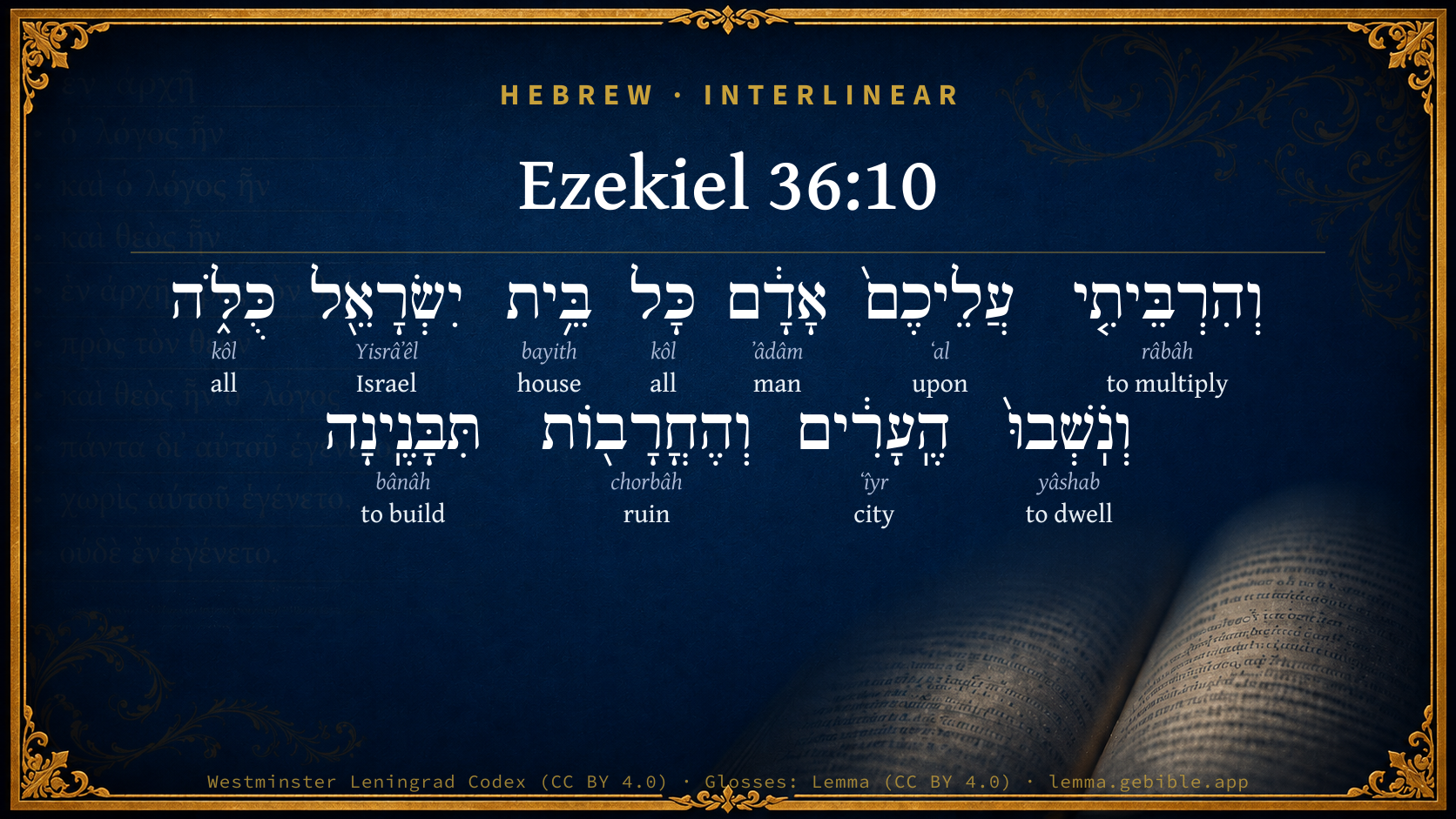
Hebrew (Westminster Leningrad Codex) Ezekiel 36:10 appears in the Hebrew Old Testament. The text above is from the Westminster Leningrad Codex. Each word links to its Strong’s number, a concise gloss, and parsing drawn from the Open Scriptures Hebrew Bible morphology. Click any word for its full Brown-Driver-Briggs (BDB) entry.
Download image
Cite this verse

Ezekiel 36:10 (World English Bible). Public Domain. Lemma interlinear Bible study tool, https://lemma.gebible.app/v/ezekiel/36/10.

Show BibTeX & RIS
BibTeX
RIS
English Translation
and I will multiply men on you, all the house of Israel, even all of it; and the cities shall be inhabited, and the waste places shall be built;
World English Bible · Public Domain
Download a study sheet

One document with this verse’s original text, its word-by-word gloss line, the meaning frame, cross-references with their text, attributed commentary, and full source and license credits — printable, and it pastes into notes with its structure intact.

This verse Autodidact and up

Study sheet (.html) Plain text (.txt)

A passage Seminary Student

Up to 50 verses in one chapter. A passage sheet keeps up to 6 commentary sources and 12 cross-references per verse, in the order this page ranks them, and says so on the sheet whenever that leaves anything out. Ask for a single verse and you get the Autodidact verse sheet above.

Everything on this page stays free to read, with no account — the sheet is a download of what is already on screen, not access to it.

Want to remove ads? Support Godless Engineer
Compare translations 3

The same verse in 3 English versions, stacked beneath the original-language interlinear above. Click any original word for its lexicon entry.

Each is an independent rendering of the whole verse — the interlinear is not word-aligned to these translations.

Highlighted words mark where these versions differ — a whole-verse word diff, not a word-by-word alignment.

  • World English Bible Public Domain
    and I will multiply men on you, all the house of Israel, even all of it; and the cities shall be inhabited, and the waste places shall be built;
  • King James Version Public Domain
    And I will multiply men upon you, all the house of Israel, even all of it: and the cities shall be inhabited, and the wastes shall be builded:
  • unfoldingWord Literal Text CC BY-SA 4.0
    So I will multiply upon you the number of your people, even the whole house of Israel. The cities will be inhabited and the ruins rebuilt.

unfoldingWord Literal Text — © unfoldingWord, licensed CC BY-SA 4.0. Word-aligned USFM3 via Door43 (git.door43.org/unfoldingWord/en_ult).

Versions to compare (up to 4)

3 of 4 selected

Show all 18 translations

Every available English version of this verse, each an independent rendering of the whole verse.

  • World English Bible Public Domain
    and I will multiply men on you, all the house of Israel, even all of it; and the cities shall be inhabited, and the waste places shall be built;
  • Berean Standard Bible Public Domain
    I will multiply the people upon you—the house of Israel in its entirety. The cities will be inhabited and the ruins rebuilt.
  • Majority Standard Bible Public Domain
    I will multiply the people upon you—the house of Israel in its entirety. The cities will be inhabited and the ruins rebuilt.
  • King James Version Public Domain
    And I will multiply men upon you, all the house of Israel, even all of it: and the cities shall be inhabited, and the wastes shall be builded:
  • American Standard Version (1901) Public Domain
    and I will multiply men upon you, all the house of Israel, even all of it; and the cities shall be inhabited, and the waste places shall be builded;
  • Revised Version (1885) Public Domain
    and I will multiply men upon you, all the house of Israel, even all of it: and the cities shall be inhabited, and the waste places shall be builded:
  • Geneva Bible (1599) Public Domain
    And I wil multiply the men vpon you, euen all the house of Israel wholly, and the cities shalbe inhabited, and the desolate places shalbe builded.
  • Douay-Rheims (1899) Public Domain
    And I will multiply men upon you, and all the house of Israel: and the cities shall be inhabited, and the ruinous places shall be repaired.
  • Young's Literal Translation Public Domain
    And I have multiplied on you men, All the house of Israel -- all of it, And the cities have been inhabited, And the wastes are built.
  • Literal Standard Version CC BY-SA 4.0
    And I have multiplied men on you, || All the house of Israel—all of it, || And the cities have been inhabited, || And the ruins are built.
  • Unlocked Literal Bible CC BY-SA 4.0
    So I will multiply upon you the number of your people, even the whole house of Israel. The cities will be inhabited and the ruins rebuilt.
  • unfoldingWord Literal Text CC BY-SA 4.0
    So I will multiply upon you the number of your people, even the whole house of Israel. The cities will be inhabited and the ruins rebuilt.
  • Darby Bible Public Domain
    And I will multiply men upon you, all the house of Israel, the whole of it; and the cities shall be inhabited, and the waste places shall be builded.
  • World Messianic Bible Public Domain
    I will multiply men on you, all the house of Israel, even all of it. The cities will be inhabited and the waste places will be built.
  • Webster's Bible Public Domain
    And I will multiply men upon you, all the house of Israel, even all of it: and the cities shall be inhabited, and the wastes shall be built.
  • Free Bible Version CC BY-SA 4.0
    You will support the people of Israel as they return and grow in number. People will live in the towns again and rebuild the ruins.
  • Bible in Basic English Public Domain
    And I will let your numbers be increased, all the children of Israel, even all of them: and the towns will be peopled and the waste places will have buildings;
  • JPS Tanakh (1917) Public Domain
    and I will multiply men upon you, all the house of Israel, even all of it; and the cities shall be inhabited, and the waste places shall be builded;

Literal Standard Version (2020), Covenant Press — licensed CC BY-SA 4.0. Text via the HelloAO Bible API (eBible.org). Unlocked Literal Bible (unfoldingWord) — licensed CC BY-SA 4.0. Text via the HelloAO Bible API (eBible.org). unfoldingWord Literal Text — © unfoldingWord, licensed CC BY-SA 4.0. Word-aligned USFM3 via Door43 (git.door43.org/unfoldingWord/en_ult). Free Bible Version, Dr. Jonathan Gallagher — licensed CC BY-SA 4.0. Text via the HelloAO Bible API (eBible.org).

Word by word

More ways to search: Search by grammar → Find every occurrence → Compare this word →

Practice this passage: Drill this verse → Learn its vocabulary →

וְהֶחֳרָב֖וֹת
chorbâh
H2723
“and · the · ruins”
Conjunction + Particle, Definite Article + Noun, Common, Feminine, Plural, Absolute
Part of Speech
Conjunction + Particle + Noun
Type
Common
Gender
Feminine
Number
Plural
State
Absolute
Full BDB Definition

Origin: from H2721

TWOT: 731d

a place laid waste, ruin, waste, desolation
  1. וְהִרְבֵּיתִ֤י râbâh H7235 “and · to multiply” Conjunction + Verb, Hiphil, Sequential Perfect, 1st Person, Common, Singular
  2. עֲלֵיכֶם֙ ʻal H5921 “upon · you” Preposition + Suffix, Personal, 2nd Person, Masculine, Plural
  3. אָדָ֔ם ʼâdâm H120 “man” Noun, Common, Masculine, Singular, Absolute
  4. כָּל kôl H3605 “all of” Noun, Common, Masculine, Singular, Construct
  5. בֵּ֥ית bayith H1004 “house of” Noun, Common, Masculine, Singular, Construct
  6. יִשְׂרָאֵ֖ל Yisrâʼêl H3478 “Israel” Noun, Proper
  7. כֻּלֹּ֑ה kôl H3605 “all · her” Noun, Common, Masculine, Singular, Construct + Suffix, Personal, 3rd Person, Feminine, Singular
  8. וְנֹֽשְׁבוּ֙ yâshab H3427 “and · to dwell” Conjunction + Verb, Niphal, Sequential Perfect, 3rd Person, Common, Plural
  9. הֶֽעָרִ֔ים ʻîyr H5892 “the · cities” Particle, Definite Article + Noun, Common, Feminine, Plural, Absolute
  10. תִּבָּנֶֽינָה bânâh H1129 “to build” Verb, Niphal, Imperfect, 3rd Person, Feminine, Plural

About this verse

These counts appear in no published source. They are computed here, from the morphology-tagged text and Lemma’s own curated glosses. What Lemma adds →

11
words
10
distinct lemmas
Prophets
section

Shared distinctive vocabulary

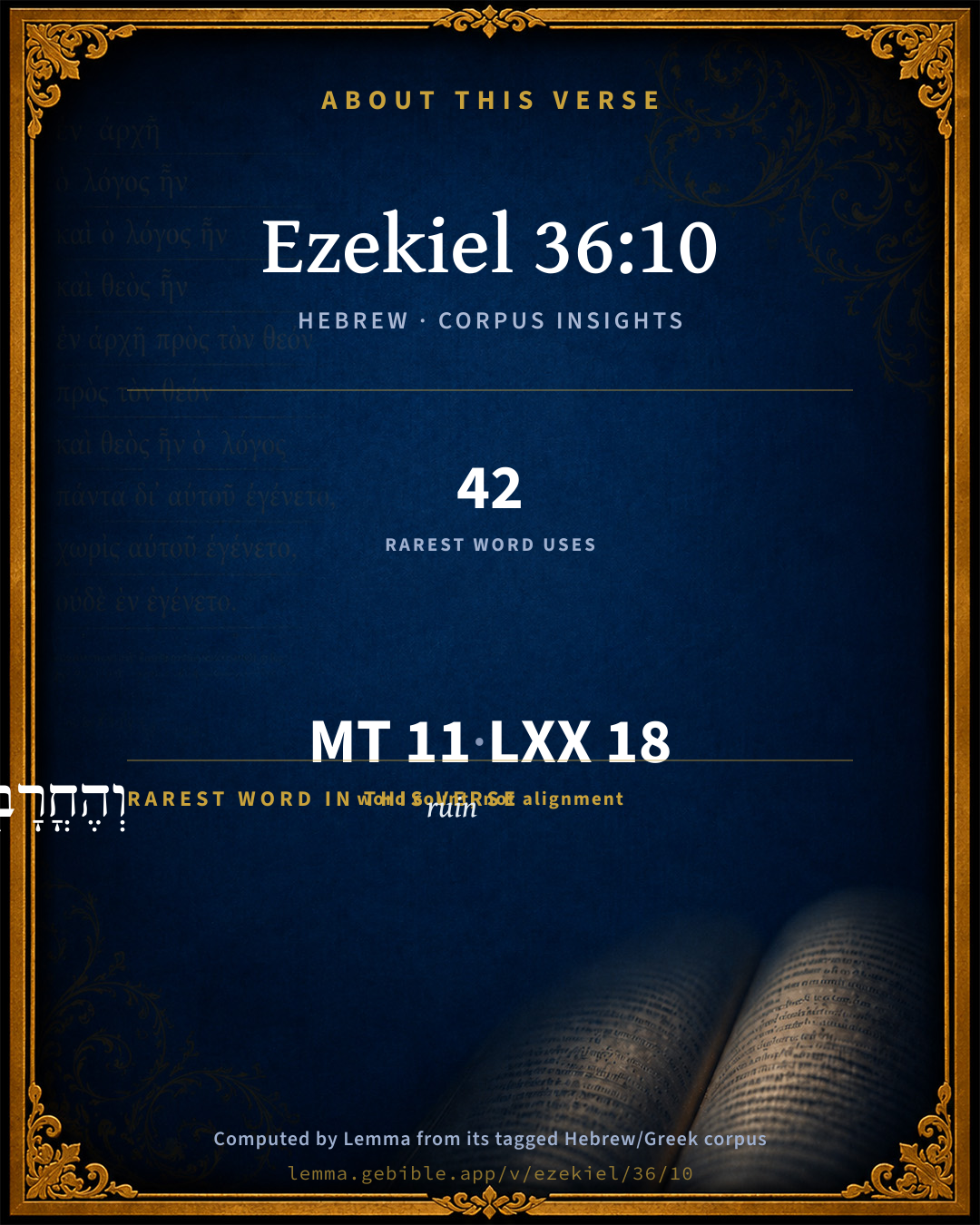
וְהֶחֳרָב֖וֹת ruin H2723 occurs in 42 verses of the Hebrew Bible. Also found in:

Grammatical profile

  • 3 verbs
  • 7 nouns
  • 1 preposition

Verb forms

  • וְהִרְבֵּיתִ֤י Hiphil · Sequential Perfect
  • וְנֹֽשְׁבוּ֙ Niphal · Sequential Perfect
  • תִּבָּנֶֽינָה Niphal · Imperfect

Repetition

A word recurs within this verse — often emphatic in Hebrew:

Hebrew & Septuagint length

In English translation the verse runs 29 words from the Hebrew and 30 from the Septuagint (LXX English) — closely comparable.

A rough comparison of the two English renderings, which tokenize alike — not a word-level alignment.

Word counts can differ between the Hebrew and the Greek without any difference in meaning — e.g. the Hebrew direct-object marker אֵת has no separate Greek word, and Greek often adds the article ὁ.

In the original languages it is 11 Hebrew tokens and 18 Greek tokens — but the two are counted differently (Hebrew bundles its prefixes and suffixes into one token; the Greek is in lemma form), so that isn’t a like-for-like length.

Cross-references

15

Topical passages linked to Ezekiel 36:10 in the Treasury of Scripture Knowledge — connected by theme and wording, ordered by reader-vote popularity; previews shown in the World English Bible.

  • Ezekiel 36:33 Thus says the Lord Yahweh: In the day that I cleanse you from all your iniquities, I will cause the cities to be inhabited, and the waste places shall be built.
  • Jeremiah 30:19 Out of them shall proceed thanksgiving and the voice of those who make merry: and I will multiply them, and they shall not be few; I will also glorify them, and they shall not be small.
  • Jeremiah 33:12 Thus says Yahweh of Hosts: Yet again shall there be in this place, which is waste, without man and without animal, and in all the cities of it, a habitation of shepherds causing their flocks to lie down.
  • Isaiah 27:6 In days to come shall Jacob take root; Israel shall blossom and bud; and they shall fill the surface of the world with fruit.
  • Jeremiah 31:27–28 Behold, the days come, says Yahweh, that I will sow the house of Israel and the house of Judah with the seed of man, and with the seed of animal.
  • Ezekiel 36:37 Thus says the Lord Yahweh: For this, moreover, will I be inquired of by the house of Israel, to do it for them: I will increase them with men like a flock.
  • Isaiah 41:17–23 The poor and needy seek water, and there is none, and their tongue fails for thirst; I, Yahweh, will answer them, I, the God of Israel, will not forsake them.
  • Isaiah 49:17–23 Your children make haste; your destroyers and those who made you waste shall go forth from you.
  • Isaiah 51:3 For Yahweh has comforted Zion; he has comforted all her waste places, and has made her wilderness like Eden, and her desert like the garden of Yahweh; joy and gladness shall be found therein, thanksgiving, and the voice of melody.
  • Isaiah 52:9 Break forth into joy, sing together, you waste places of Jerusalem; for Yahweh has comforted his people, he has redeemed Jerusalem.
  • Isaiah 58:12 Those who shall be of you shall build the old waste places; you shall raise up the foundations of many generations; and you shall be called The repairer of the breach, The restorer of paths to dwell in.
  • Isaiah 61:4 They shall build the old wastes, they shall raise up the former desolations, and they shall repair the waste cities, the desolations of many generations.
  • Jeremiah 31:10–14 Hear the word of Yahweh, you nations, and declare it in the isles afar off; and say, He who scattered Israel will gather him, and keep him, as shepherd does his flock.
  • Amos 9:14 I will bring back the captivity of my people Israel, And they will rebuild the ruined cities, and inhabit them; and they will plant vineyards, and drink wine from them. They shall also make gardens, And eat the fruit of them.
  • Zechariah 8:3–6 Thus says Yahweh: "I have returned to Zion, and will dwell in the midst of Jerusalem. Jerusalem shall be called 'The City of Truth;' and the mountain of Yahweh of Hosts, 'The Holy Mountain.'"

Cross-references courtesy of OpenBible.info (CC BY 4.0).

Hebrew and Greek witnesses Masoretic Hebrew ↔ Greek Septuagint

The same verse in the two great witnesses to the Old Testament, shown verse-for-verse.

These are two independent witnesses, not word-aligned to each other, and the Septuagint is shown in lemma (dictionary) form.

Hebrew Ezekiel 36:10 Masoretic · Westminster Leningrad Codex

וְהִרְבֵּיתִ֤י עֲלֵיכֶם֙ אָדָ֔ם כָּל בֵּ֥ית יִשְׂרָאֵ֖ל כֻּלֹּ֑ה וְנֹֽשְׁבוּ֙ הֶֽעָרִ֔ים וְהֶחֳרָב֖וֹת תִּבָּנֶֽינָה

and I will multiply men on you, all the house of Israel, even all of it; and the cities shall be inhabited, and the waste places shall be built;

World English Bible · Public Domain

Greek LXX Ezekiel 36:10 Septuagint · lemma form

καί πληθύνω ἐπί σύ ἄνθρωπος πᾶς οἶκος ἰσραήλ εἰς τέλος καί καταοἰκέω ὁ πόλις καί ὁ ἐρημόω οἰκοδομέω

and I will multiply men upon you, even all the house of Israel to the end: and the cities shall be inhabited, and the desolate land shall be built upon.

LXX2012 (modern English Septuagint) · Public Domain

Hebrew: Westminster Leningrad Codex (CC BY 4.0). Greek: Septuagint (public domain); English from LXX2012 (modern English Septuagint) (Public Domain). How the Septuagint differs from the Hebrew →

Targum (Aramaic paraphrase)

1

The Targum is the ancient Jewish Aramaic paraphrase of the Hebrew Scriptures — an interpretive translation, not the Hebrew text itself. Onkelos (literal) and Pseudo-Jonathan (expansive) render the Torah, and Jonathan the Prophets. Coverage is partial: where no permissively-licensed English translation exists for a verse, only the Aramaic is shown. This is verse-level text, not a word-by-word alignment to the Hebrew.

  1. Targum Jonathan Prophets (Joshua–Malachi)
    וְאַסְגֵי עֲלֵיכוֹן אֱנָשָׁא כָּל בֵּית יִשְׂרָאֵל כּוּלְהוֹן וְיִתְיַתְבָן קִרְוַיָא וְחֶרְבָתָא יִתְבַּנְיָן:

    (no public-domain English translation for this verse)

    Targum Jonathan — Aramaic: “Mikraot Gedolot” (public domain). English: “Sefaria Community Translation” (CC0 1.0 (public-domain dedication)); “London "Chaldee Paraphrase," 1871” (public domain). Text via Sefaria.

Commentary

Notes on Ezekiel 36:10 from classic Christian and Jewish commentators (each source and its license shown beneath its notes). The classic Christian expositions comment on the surrounding passage and are grouped to its opening verse, so a note may address several verses; the Jewish commentaries on the Tanakh (Rashi and others) are per-verse, so they appear only where the commentator wrote on this verse.

Lemma curates 59 commentaries, every one of them public domain or Creative Commons licensed, each selected and text-cleaned for this edition rather than reprinted as found. About our sources →

Trapp's Complete Commentary

John Trapp

Eze 36:10 And I will multiply men upon you, all the house of Israel, [even] all of it: and the cities shall be inhabited, and the wastes shall be builded:

Ver. 10. All the house of Israel, even all of it.] The Israel of God in the kingdom of the Messiah, totum totum, quantum quantum, not one of them shall be missing.

John Trapp, A Commentary or Exposition upon All the Books of the Old and New Testament (1647–1656) — public domain. Text from a community e-Sword module.

Jamieson, Fausset & Brown

Robert Jamieson, A. R. Fausset & David Brown

wastes builded-- Isa 58:12; Isa 61:4; Amo 9:11-12, Amo 9:14, where, as here (Eze 34:23-24), the names of David, Messiah's type, and Edom, Israel's foe, are introduced in connection with the coming restoration.

Jamieson, Fausset & Brown — Commentary Critical and Explanatory on the Whole Bible (1871) — public domain (CC PDM 1.0). Text via the HelloAO Bible API.

The Cambridge Bible for Schools and Colleges

gen. ed. J. J. S. Perowne

10. Cf. Eze_36:33; Isa_58:12; Isa_61:4; Zec_8:12.

The Cambridge Bible for Schools and Colleges (gen. ed. J. J. S. Perowne; Cambridge University Press, 1878–1918) — public domain. Text from a community e-Sword module.

John Gill's Exposition

And I will multiply men upon you,.... Who should inhabit the cities on the mountains, and increase very much:

all the house of Israel, even all of it: not the Heathens should be multiplied on them, but the Israelites, all of them, and them only; all the tribes of Israel, the ten tribes as well as the other; and which is repeated for the confirmation of it: by this it appears that the prophecy has a further view than to the return of the Jews from the Babylonish captivity; for all did not return, many remained in the provinces of Babylon; and those that returned were chiefly of the tribes of Judah and Benjamin; but few of the rest came with them. Kimchi thinks the words have respect to the ten tribes, which he says are hid to this day; so Ben Melech.

And the cities shall be inhabited, and the wastes shall be builded; in a literal sense; as well as the church of God, and inheritance of Christ, shall then be in a flourishing condition.

John Gill's Exposition of the Whole Bible (1746–1763) — public domain (CC PDM 1.0). Text via the HelloAO Bible API.

The Pulpit Commentary

Vers. 10, 11. I will multiply men upon you. Jehovah"s promise contemplated a return of both sections of the Golah, the whole house of Israel, Ephraim as well as Judah, (comp. Eze_20:40) to the land from which they had been deported, and a restoration of the united kingdom to a condition of prosperity in which its cities should again be inhabited, its ruined homesteads repaired, its fields cultivated, and its flocks and herds multiplied. (see Eze_16:55; Isa_44:26 Isa_54:3 Isa_61:4) a condition of prosperity so great that it should surpass any measure ordegree of good fortune previously enjoyed. (comp. Deu_30:5; Job_42:12)

Multiplying men.

I THE TRUE WEALTH OF A PEOPLE IS IN ITS POPULATION. God makes this promise to the house of Israel, that he "will multiply men." The land is desolate for want of inhabitants, the fields untilled for want of laborers, and the cities lying in ruins for lack of men to build up the waste places, The restoration shall be signalized by a return of the captives and a consequent increase of population. Now, the striking fact is that this multiplication of the population is noted as a great good for the land. Other things being equal, every country is strong in proportion to the number of its able-bodied citizens. In times of war this is obvious; the strong nation is one that can command a large army. But in industrial relations the same is equally true. The more producers there are the more wealth must be produced either in the form of food or in the form of commodities that may be exchanged for food purchased elsewhere. These plain facts are obscured by bad social habits.

1. Overcrowding in cities. The waste places should be built not the reeking fever-dens crammed with an overflowing population of sickly creatures, who have no energy for work, and whose surroundings do not permit decent living. One of the greatest evils of our day is the depletion of our rural districts and the pressing of the population into the cities. What is needed is not a reduction of the population, but a scattering of it over the face of the land at home and also throughout the colonies. The mistake that led to the building of the tower of Babel is still fatally prevalent.

2. Unworthy living. Too many men are not doing men"s work idle rich men who consume without producing, and idle poor men who are always near the border-land of crime, on the further side of which they would become positive destroyers. We cannot have too many true men, but they must be men indeed workers, not drones.

II THE STRENGTH OF THE CHURCH IS IN ITS MEMBERSHIP. The word "Church" stands for a community. The great Catholic Church of all nations and creeds is the whole body of Christians. This obvious fact is too often neglected. Thus the Church is sometimes regarded as an institution apart from the souls of which it consists; it is said to have its rights, its triumphs, while no thought is given to the people in it. This is a pure delusion the glorification of an empty abstraction. Again, for the Church some would substitute its officers. The Christian ministry is regarded as the Church. This was the case in the Middle Ages, when popes and great ecclesiastical dignitaries contended with emperors and kings for the privileges of the Church. In those contests little account was taken of the interest of the people the townsfolk and village folk who constituted the body of the Church. But in these democratic days the rights of the people are being better recognized, and now we are coming to see that the Church is just the men, women, and children that constitute it, viewed in their corporate relation as the body of Christ on earth. The Church is honored when men are multiplied in her midst. She cannot be in health if the missionary spirit dies out of her. But while she gathers in the heathen her first duty is to train her own children. She should thus grow her own members. Here, however, we need a caution. Mere numbers will count for nothing apart from character. Statistical Christianity is a poor production. We want true men living souls united to Christ and working for his glory. Still, the honor of the Church is not in remaining small and select, and keeping her privileges to herself and neglecting the world, but in multiplying men. She should he a great popular institution, true to the spirit of Christ, who called himself "the Son of man.

Ver. 11 ("And I will do better unto you than at your beginnings"). The better future.

I THE BETTER FUTURE OF THE WORLD. There is a natural tendency among men to say, "The former times were better." Nations cherish legends of an ancient golden age. People talk about "the good old times." But when we search history we cannot find these happy days. On the contrary, writers in the very ages to which some of our contemporary dreamers look back with sentimental regret deplore the degeneracy of their days. Our own age is bad enough, but it is not easy to lay our finger on any previous age that was not worse. This, however, is not the principal question. Waiving the point as to whether the past history of our race has been characterized by progress or by a process of degeneration, we have still to ask whether the future may not be better than anything that has been experienced in the past. Now, it is the distinct teaching of the Bible that it will be so. "The earth shall be full of the knowledge of the Lord, as the waters cover the sea." While men turn back wistfully to the lost Eden, God promises a better heaven. We do not need to discuss the idea of a Paradise regained, for we have the more glowing picture of the heavenly Jerusalem. Even if we grant the worst that has been said of man"s continuous decline, the New Testament points to an arrest of this dreadful movement, to a redemption and more than a restoration, to a perfection of humanity never attained in the past.

II THE BETTER FUTURE OF THE CHURCH. The Church, which has the seed of Divine life in her, should be continually growing in grace. While like the mustard tree she enlarges her size, she should also, like the rising temple, become ever more radiant with the beauty of holiness. Perhaps there is no sadder story than that of the history of the Church. No doubt there have been ages of glorious zeal and devotion; no doubt God has been continuously educating his people. But there have been awful times of relapse. We think we can see progress in our own day a wiser thought, a larger charity, a more practical activity in the service of man. But we are far indeed from realizing Christ"s great ideal. That ideal, however, is the picture of the future, and the pattern after which we are to toil with the utmost hopefulness. The New Testament promises a glorious future to the people of God. (Eph_2:21)

III THE BETTER FUTURE OF THE SOUL. In our melancholy moods we yearn after the old sweet days of childhood their innocence, their simplicity, their joyousness. We forget their limitations, their fears, their infantine distresses. But perhaps we have fallen far from those early days. Then we knew nothing of the world"s dreadful sin. Now we must confess that we have not kept ourselves unspotted. And with the soul"s fall has come the soul"s sorrow, and many disappointments and losses have made the day which dawned in golden sunshine overcast with gloomy clouds. Still, we have not reached the end. After bathing in the Jordan, Naaman"s leprous flesh became healthy as that of a little child. The leprous soul may he cleansed, the worn-out life renewed. "If any man be in Christ Jesus, he is a new creature". (2Co_5:17) Then the future is full of hope. The victorious Christian, with all his scars, and even with his memory of shameful unfaithfulness, stands higher than the unfallen because untried child. God has a blessed future in the heavenly inheritance reserved for the most weary souls. The secret of this happy prospect is in the power and grace of God. It is he who will do better for his people than at the beginning.

The Pulpit Commentary (1880–1919), ed. H.D.M. Spence-Jones & Joseph S. Exell — public domain. Text from a community e-Sword module.

unfoldingWord translationNotes

Door43 World Missions Community

General Information:

This continues Yahweh's message to the mountains of Israel. The message is intended for the people of Israel.

So I will multiply upon you

Yahweh is speaking to the mountains. This can be stated explicitly. AT: "So, mountains of Israel, I will multiply upon you" (See: Assumed Knowledge and Implicit Information)

even the whole house of Israel

Here "house" represents people. AT: "all of the people of Israel" (See: Metonymy)

The cities will be inhabited and the ruins rebuilt

This can be stated in active form. AT: "Then people will live in the cities and will rebuild the ruins" (See: Active or Passive)

they will multiply and be fruitful

Here "be fruitful" is an idiom that means to have many children and descendants. AT: "they will become very many people and have very many children" (See: Idiom)

you to be inhabited as you previously were

This can be stated in active form. AT: "people to live on you mountains as they did before" (See: Active or Passive)

know that I am Yahweh

When Yahweh says that people will know that he is Yahweh, he is implying that they will know that he is the one true God who has supreme authority and power. See how you translated this in Ezekiel 6:7. AT: "understand that I am Yahweh, the one true God" or "realize that I, Yahweh, have supreme power and authority" (See: Assumed Knowledge and Implicit Information)

They will possess you, and you will be their inheritance

The people living in the mountains and land of Israel permanently is spoke of as if the people would inherit them. AT: "They will possess you permanently" (See: Metaphor)

you will no longer cause their children to die

It is implied that in the past children died because there was not enough food in the land. Now the land would produce enough food. (See: Assumed Knowledge and Implicit Information)

translationWords

house

desolate

walk

possess

inherit

children

unfoldingWord translationNotes — © Distant Shores Media and the Door43 World Missions Community, licensed CC BY-SA 4.0. Source: git.door43.org/Door43/en_tn.

Lesson kit

Teaching starters — assembled from the data on this page, not authored interpretation. Every prompt links to the verse data it draws on. Edit before teaching.

Ezekiel, in the Prophets, opens this verse with 11 words (10 distinct Hebrew lemmas). Its most distinctive word is chorbâh (“ruin”). A historical commentator’s framing appears above. Read the whole chapter for the surrounding context.

Discussion questions

  1. What does “ruin” (chorbâh) contribute to the verse as a whole?
  2. How does Leviticus 26:31, which shares the word «ruin», read alongside this verse?
  3. What does the repetition of “all” (2× in this one verse) do in this verse?
  4. These translations render this verse differently; the difference is in the English rendering, not the original. What questions does that raise?
  5. «וְהִרְבֵּיתִ֤י» is a Hiphil Sequential Perfect verb. How does that grammatical form shape the action described?
  6. Compare how Trapp's Complete Commentary and Jamieson, Fausset & Brown read this verse. Where do they agree or differ?

Things to notice

Reading settings

Reading text

Shown beneath each verse's original-language words.

Old Testament
Old Testament edition

Read the OT as the Masoretic Hebrew (MT) or the Greek Septuagint (LXX).

English shown for the Greek Septuagint (in the Hebrew ↔ Greek comparison).

Comparing translations? Open the Compare panel on any verse page to stack up to four side by side.