
Jeremiah 46:16

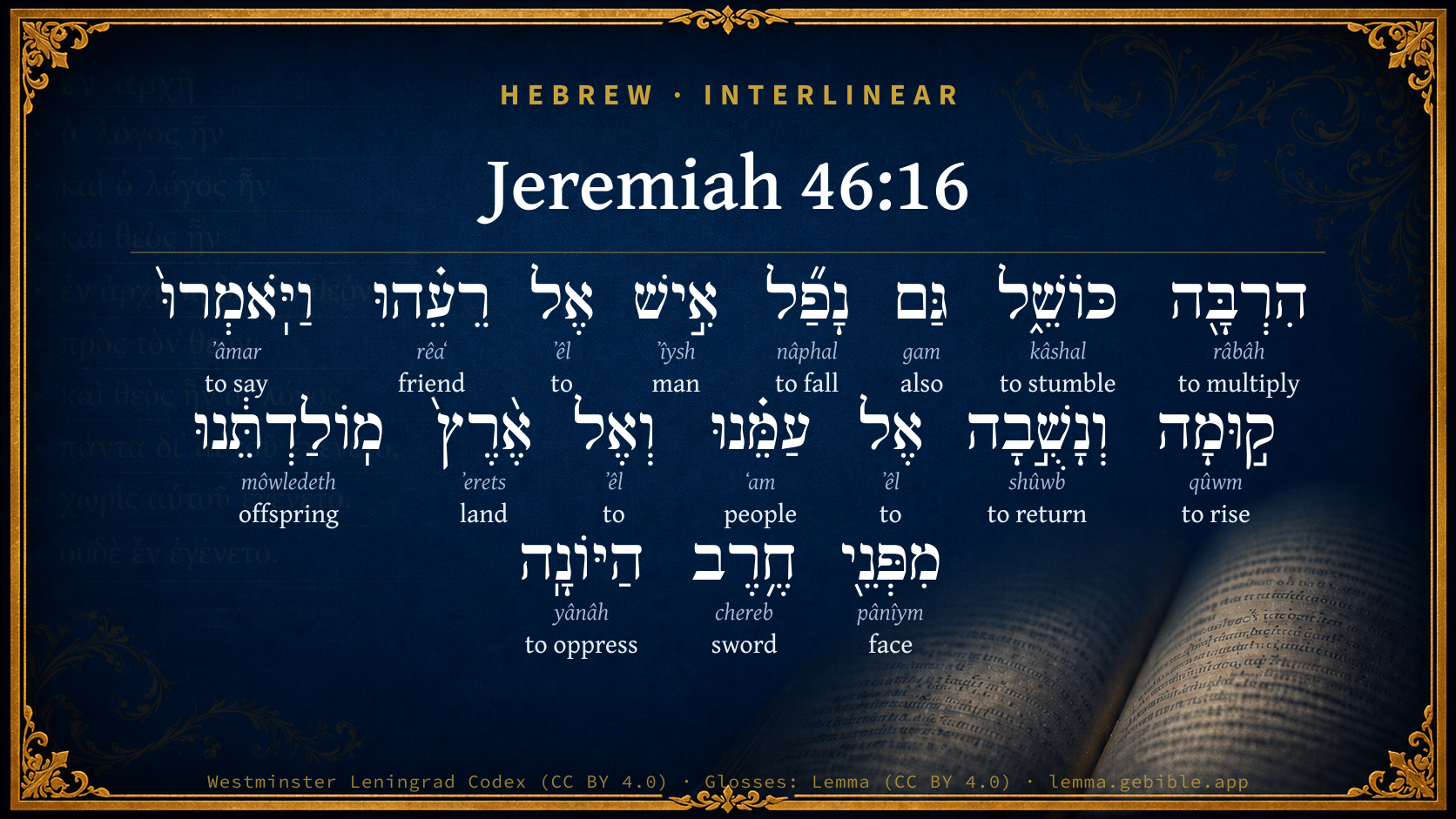
Hebrew (Westminster Leningrad Codex) Jeremiah 46:16 appears in the Hebrew Old Testament. The text above is from the Westminster Leningrad Codex. Each word links to its Strong’s number, a concise gloss, and parsing drawn from the Open Scriptures Hebrew Bible morphology. Click any word for its full Brown-Driver-Briggs (BDB) entry.
Download image
Cite this verse

Jeremiah 46:16 (World English Bible). Public Domain. Lemma interlinear Bible study tool, https://lemma.gebible.app/v/jeremiah/46/16.

Show BibTeX & RIS
BibTeX
RIS
English Translation
He made many to stumble, yes, they fell one on another: and they said, Arise, and let us go again to our own people, and to the land of our birth, from the oppressing sword.
World English Bible · Public Domain
Download a study sheet

One document with this verse’s original text, its word-by-word gloss line, the meaning frame, cross-references with their text, attributed commentary, and full source and license credits — printable, and it pastes into notes with its structure intact.

This verse Autodidact and up

Study sheet (.html) Plain text (.txt)

A passage Seminary Student

Up to 50 verses in one chapter. A passage sheet keeps up to 6 commentary sources and 12 cross-references per verse, in the order this page ranks them, and says so on the sheet whenever that leaves anything out. Ask for a single verse and you get the Autodidact verse sheet above.

Everything on this page stays free to read, with no account — the sheet is a download of what is already on screen, not access to it.

Want to remove ads? Support Godless Engineer
Compare translations 3

The same verse in 3 English versions, stacked beneath the original-language interlinear above. Click any original word for its lexicon entry.

Each is an independent rendering of the whole verse — the interlinear is not word-aligned to these translations.

Highlighted words mark where these versions differ — a whole-verse word diff, not a word-by-word alignment.

  • World English Bible Public Domain
    He made many to stumble, yes, they fell one on another: and they said, Arise, and let us go again to our own people, and to the land of our birth, from the oppressing sword.
  • King James Version Public Domain
    He made many to fall, yea, one fell upon another: and they said, Arise, and let us go again to our own people, and to the land of our nativity, from the oppressing sword.
  • unfoldingWord Literal Text CC BY-SA 4.0
    He increases the numbers of those who stumble. Each soldier falls against the next one. They are saying, ‘Get up. Let us go home. Let us go back to our own people, to our native land. Let us leave this sword that is beating us down.’

unfoldingWord Literal Text — © unfoldingWord, licensed CC BY-SA 4.0. Word-aligned USFM3 via Door43 (git.door43.org/unfoldingWord/en_ult).

Versions to compare (up to 4)

3 of 4 selected

Show all 18 translations

Every available English version of this verse, each an independent rendering of the whole verse.

  • World English Bible Public Domain
    He made many to stumble, yes, they fell one on another: and they said, Arise, and let us go again to our own people, and to the land of our birth, from the oppressing sword.
  • Berean Standard Bible Public Domain
    They continue to stumble; indeed, they have fallen over one another. They say, ‘Get up! Let us return to our people and to the land of our birth, away from the sword of the oppressor.’
  • Majority Standard Bible Public Domain
    They continue to stumble; indeed, they have fallen over one another. They say, ‘Get up! Let us return to our people and to the land of our birth, away from the sword of the oppressor.’
  • King James Version Public Domain
    He made many to fall, yea, one fell upon another: and they said, Arise, and let us go again to our own people, and to the land of our nativity, from the oppressing sword.
  • American Standard Version (1901) Public Domain
    He made many to stumble, yea, they fell one upon another: and they said, Arise, and let us go again to our own people, and to the land of our nativity, from the oppressing sword.
  • Revised Version (1885) Public Domain
    He made many to stumble, yea, they fell one upon another: and they said, Arise, and let us go again to our own people, and to the land of our nativity, from the oppressing sword.
  • Geneva Bible (1599) Public Domain
    Hee made many to fall, and one fell vpon another: and they saide, Arise, let vs goe againe to our owne people, and to the land of our natiuitie from the sworde of the violent.
  • Douay-Rheims (1899) Public Domain
    He hath multiplied them that fall, and one hath fallen upon another, and they shall say: Arise, and let us return to our own people, and to the land our nativity, from the sword of the dove.
  • Young's Literal Translation Public Domain
    He hath multiplied the stumbling, Yea one hath fallen upon his neighbour, And they say: Rise, and we turn back to our people, And unto the land of our birth, Because of the oppressing sword.
  • Literal Standard Version CC BY-SA 4.0
    He has multiplied the stumbling, || Indeed, one has fallen on his neighbor, || And they say: Rise, and we return to our people, || And to the land of our birth, || Because of the oppressing sword.
  • Unlocked Literal Bible CC BY-SA 4.0
    He increases the numbers of those who stumble. Each soldier falls against the next one. They are saying, 'Get up. Let us go home. Let us go back to our own people, to our native land. Let us leave this sword that is beating us down.'
  • unfoldingWord Literal Text CC BY-SA 4.0
    He increases the numbers of those who stumble. Each soldier falls against the next one. They are saying, ‘Get up. Let us go home. Let us go back to our own people, to our native land. Let us leave this sword that is beating us down.’
  • Darby Bible Public Domain
    He made many to stumble, yea, one fell upon another; and they said, Arise, and let us return to our own people and to the land of our nativity, from the oppressing sword.
  • World Messianic Bible Public Domain
    He made many to stumble. Yes, they fell on one another. They said, ‘Arise! Let’s go again to our own people, and to the land of our birth, from the oppressing sword.’
  • Webster's Bible Public Domain
    He made many to fall, yes, one fell upon another: and they said, Arise, and let us go again to our own people, and to the land of our nativity, from the oppressing sword.
  • Free Bible Version CC BY-SA 4.0
    Many soldiers trip and fall over one another and say, “Come on! Let's get back home to our people where we were born, otherwise we're going to be killed.”
  • Bible in Basic English Public Domain
    ... are stopped in their going, they are falling; and they say one to another, Let us get up and go back to our people, to the land of our birth, away from the cruel sword.
  • JPS Tanakh (1917) Public Domain
    He made many to stumble; yea, they fell one upon another, and said: 'Arise, and let us return to our own people, and to the land of our birth, from the oppressing sword.'

Literal Standard Version (2020), Covenant Press — licensed CC BY-SA 4.0. Text via the HelloAO Bible API (eBible.org). Unlocked Literal Bible (unfoldingWord) — licensed CC BY-SA 4.0. Text via the HelloAO Bible API (eBible.org). unfoldingWord Literal Text — © unfoldingWord, licensed CC BY-SA 4.0. Word-aligned USFM3 via Door43 (git.door43.org/unfoldingWord/en_ult). Free Bible Version, Dr. Jonathan Gallagher — licensed CC BY-SA 4.0. Text via the HelloAO Bible API (eBible.org).

Word by word

More ways to search: Search by grammar → Find every occurrence → Compare this word →

Practice this passage: Drill this verse → Learn its vocabulary →

הַיּוֹנָֽה
yânâh
H3238
“the · oppressing”
Particle, Definite Article + Verb, Qal, Participle Active, Feminine, Singular, Absolute
Part of Speech
Particle + Verb
Stem
Qal
Form
Participle Active
Gender
Feminine
Number
Singular
State
Absolute
Full BDB Definition

Origin: a primitive root

TWOT: 873

to oppress, suppress, treat violently, maltreat, vex, do wrong - (Qal) to oppress, suppress - (Hiphil) to treat violently, maltreat
  1. הִרְבָּ֖ה râbâh H7235 “to multiply” Verb, Hiphil, Perfect, 3rd Person, Masculine, Singular
  2. כּוֹשֵׁ֑ל kâshal H3782 “stumbling” Verb, Qal, Participle Active, Masculine, Singular, Absolute
  3. גַּם gam H1571 “also” Particle, Accusative
  4. נָפַ֞ל nâphal H5307 “to fall” Verb, Qal, Perfect, 3rd Person, Masculine, Singular
  5. אִ֣ישׁ ʼîysh H376 “man” Noun, Common, Masculine, Singular, Absolute
  6. אֶל ʼêl H413 “to” Preposition
  7. רֵעֵ֗הוּ rêaʻ H7453 “friend · his” Noun, Common, Masculine, Singular, Construct + Suffix, Personal, 3rd Person, Masculine, Singular
  8. וַיֹּֽאמְרוּ֙ ʼâmar H559 “and · to say” Conjunction + Verb, Qal, Sequential Imperfect, 3rd Person, Masculine, Plural
  9. ק֣וּמָה qûwm H6965 “rise” Verb, Qal, Imperative, 2nd Person, Masculine, Singular + Suffix, h
  10. וְנָשֻׁ֣בָה shûwb H7725 “and · to return” Conjunction + Verb, Qal, Cohortative, 1st Person, Common, Plural
  11. אֶל ʼêl H413 “to” Preposition
  12. עַמֵּ֗נוּ ʻam H5971 “people · our” Noun, Common, Masculine, Singular, Construct + Suffix, Personal, 1st Person, Common, Plural
  13. וְאֶל ʼêl H413 “and · to” Conjunction + Preposition
  14. אֶ֨רֶץ֙ ʼerets H776 “land of” Noun, Common, Both, Singular, Construct
  15. מֽוֹלַדְתֵּ֔נוּ môwledeth H4138 “offspring · our” Noun, Common, Feminine, Singular, Construct + Suffix, Personal, 1st Person, Common, Plural
  16. מִפְּנֵ֖י pânîym H6440 “from · face(s) of” Preposition + Noun, Common, Both, Plural, Construct
  17. חֶ֥רֶב chereb H2719 “sword of” Noun, Common, Feminine, Singular, Construct

About this verse

These counts appear in no published source. They are computed here, from the morphology-tagged text and Lemma’s own curated glosses. What Lemma adds →

18
words
16
distinct lemmas
Prophets
section

Notable vocabulary

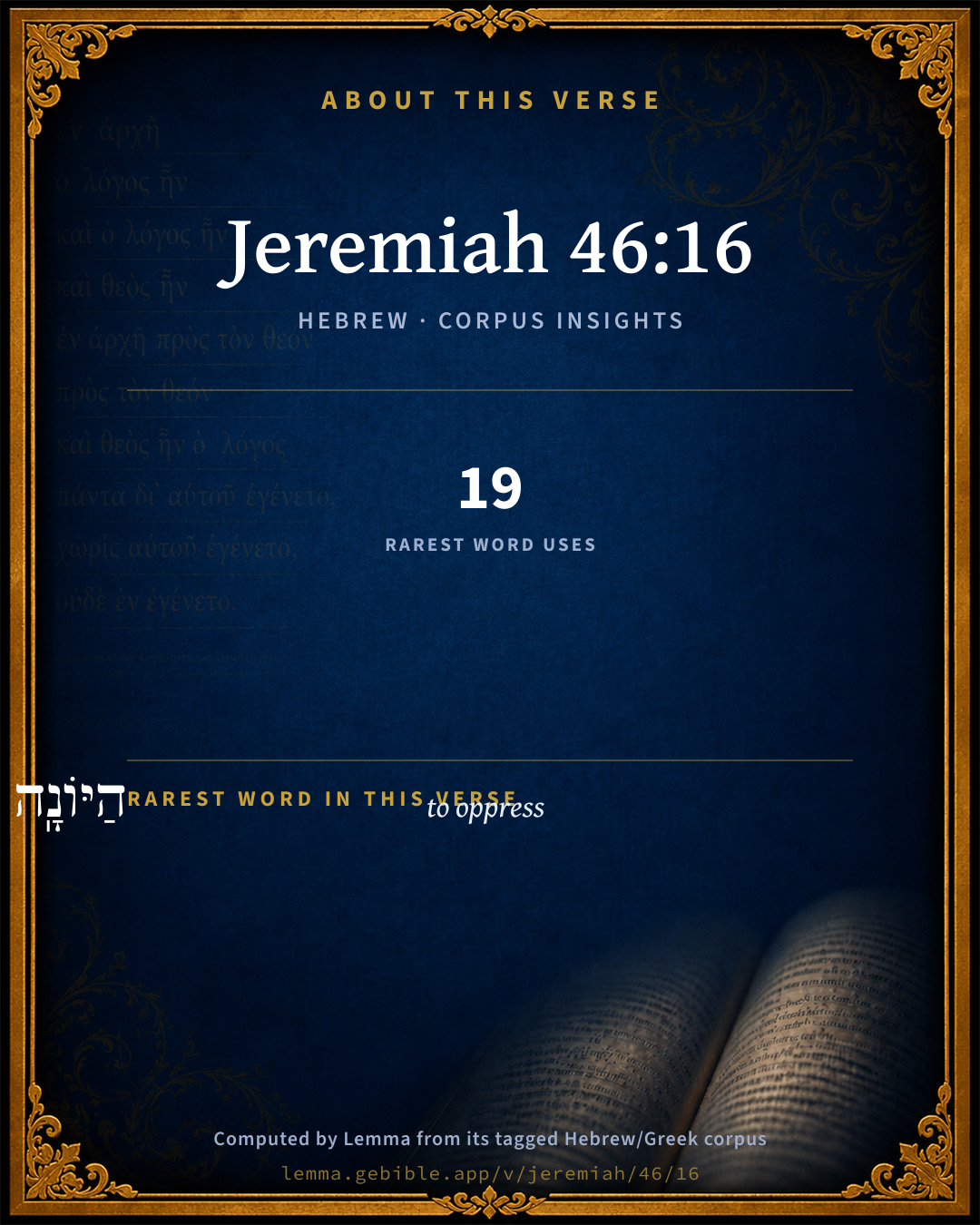
The rarest word here is הַיּוֹנָֽה to oppress H3238 — appearing just 19 times in the whole Hebrew Bible.

Shared distinctive vocabulary

הַיּוֹנָֽה to oppress H3238 occurs in 19 verses of the Hebrew Bible. Also found in:

Grammatical profile

  • 7 verbs
  • 7 nouns
  • 3 prepositions
  • 1 particle

Verb forms

  • הִרְבָּ֖ה Hiphil · Perfect
  • כּוֹשֵׁ֑ל Qal · Participle Active
  • נָפַ֞ל Qal · Perfect
  • וַיֹּֽאמְרוּ֙ Qal · Sequential Imperfect
  • ק֣וּמָה Qal · Imperative
  • וְנָשֻׁ֣בָה Qal · Cohortative
  • הַיּוֹנָֽה Qal · Participle Active

Repetition

A word recurs within this verse — often emphatic in Hebrew:

  • אֶל to H413 ×3

Cross-references

5

Topical passages linked to Jeremiah 46:16 in the Treasury of Scripture Knowledge — connected by theme and wording, ordered by reader-vote popularity; previews shown in the World English Bible.

  • Leviticus 26:36–37 "'As for those of you who are left, I will send a faintness into their hearts in the lands of their enemies: and the sound of a driven leaf will put them to flight; and they shall flee, as one flees from the sword; and they will fall when no one pursues.
  • Jeremiah 51:9 We would have healed Babylon, but she is not healed: forsake her, and let us go everyone into his own country; for her judgment reaches to heaven, and is lifted up even to the skies.
  • Jeremiah 46:6 Don't let the swift flee away, nor the mighty man escape; in the north by the river Euphrates have they stumbled and fallen.
  • Jeremiah 46:21 Also her hired men in the midst of her are like calves of the stall; for they also are turned back, they are fled away together, they didn't stand: for the day of their calamity is come on them, the time of their visitation.
  • Jeremiah 50:16 Cut off the sower from Babylon, and him who handles the sickle in the time of harvest: for fear of the oppressing sword they shall turn everyone to his people, and they shall flee everyone to his own land.

Cross-references courtesy of OpenBible.info (CC BY 4.0).

Hebrew and Greek witnesses Masoretic Hebrew ↔ Greek Septuagint

The same verse in the two great witnesses to the Old Testament, shown verse-for-verse.

These are two independent witnesses, not word-aligned to each other, and the Septuagint is shown in lemma (dictionary) form.

Hebrew Jeremiah 46:16 Masoretic · Westminster Leningrad Codex

הִרְבָּ֖ה כּוֹשֵׁ֑ל גַּם נָפַ֞ל אִ֣ישׁ אֶל רֵעֵ֗הוּ וַיֹּֽאמְרוּ֙ ק֣וּמָה וְנָשֻׁ֣בָה אֶל עַמֵּ֗נוּ וְאֶל אֶ֨רֶץ֙ מֽוֹלַדְתֵּ֔נוּ מִפְּנֵ֖י חֶ֥רֶב הַיּוֹנָֽה

He made many to stumble, yes, they fell one on another: and they said, Arise, and let us go again to our own people, and to the land of our birth, from the oppressing sword.

World English Bible · Public Domain

Greek LXX Structure differs

In the Septuagint, Jeremiah is about an eighth shorter than the Hebrew and arranges its material differently — the Oracles Against the Nations (Hebrew chapters 46–51) appear in the middle of the Greek book, after 25:13. Because the chapter and verse boundaries do not line up, a verse-for-verse comparison with the Hebrew is not shown.

A verse-for-verse comparison isn’t shown here because the chapters and verses don’t line up. Switch to the LXX edition with the MT / LXX toggle above to read the Greek directly.

On this verse, Joseph Benson's Commentary discusses the Septuagint’s reading. Read the note in Commentary ↓

Hebrew: Westminster Leningrad Codex (CC BY 4.0). Greek: Septuagint (public domain); English from a public-domain English Septuagint. How the Septuagint differs from the Hebrew →

Targum (Aramaic paraphrase)

1

The Targum is the ancient Jewish Aramaic paraphrase of the Hebrew Scriptures — an interpretive translation, not the Hebrew text itself. Onkelos (literal) and Pseudo-Jonathan (expansive) render the Torah, and Jonathan the Prophets. Coverage is partial: where no permissively-licensed English translation exists for a verse, only the Aramaic is shown. This is verse-level text, not a word-by-word alignment to the Hebrew.

  1. Targum Jonathan Prophets (Joshua–Malachi)
    אַסְגִיאוּ מַתְקְלֵיהוֹן אַף אִשְׁתְּמַעוּ גְבַר לְחַבְרֵיהּ וְיֵימְרוּן קוּמוּ וּנְתוּב לְעַמְנָא וּלְאַרְעָא יַלְדוּתָנָא מִן קֳדָם חַרְבָּא דְסָנְאָה דְהִיא כְחַמַר מְרַוְיָא:

    (no public-domain English translation for this verse)

    Targum Jonathan — Aramaic: “Mikraot Gedolot” (public domain). English: “Sefaria Community Translation” (CC0 1.0 (public-domain dedication)); “London "Chaldee Paraphrase," 1871” (public domain). Text via Sefaria.

Commentary

Notes on Jeremiah 46:16 from classic Christian and Jewish commentators (each source and its license shown beneath its notes). The classic Christian expositions comment on the surrounding passage and are grouped to its opening verse, so a note may address several verses; the Jewish commentaries on the Tanakh (Rashi and others) are per-verse, so they appear only where the commentator wrote on this verse.

Lemma curates 59 commentaries, every one of them public domain or Creative Commons licensed, each selected and text-cleaned for this edition rather than reprinted as found. About our sources →

Trapp's Complete Commentary

John Trapp

Jer 46:16 He made many to fall, yea, one fell upon another: and they said, Arise, and let us go again to our own people, and to the land of our nativity, from the oppressing sword.

Ver. 16. Yea, one fell upon another.] See Jer 46:12. In a confused flight it is wont so to be.

And they said.] The auxiliary and stipendiary soldiers said so, when once they saw that there was no good to be done for the Egyptians, Nebuchadnezzar having so wasted all.

John Trapp, A Commentary or Exposition upon All the Books of the Old and New Testament (1647–1656) — public domain. Text from a community e-Sword module.

Joseph Benson's Commentary

Jer 46:16-17. He made many to fall — Or, as the Vulgate renders הרבה כושׁל, multiplicavit ruentes, he multiplied those falling, or more literally, the faller, as in the margin, the word being singular. Blaney connects this with the next clause, as the LXX. do, and reads the verse thus: “He hath caused many to stumble, yea, to fall; they said therefore one to another, Arise, and let us return to our people, and to our native country, because of the oppressor’s sword.” These are either the words of the Egyptian allies, resolving to return to their own countries, and not concern themselves any further with the affairs of Egypt; or else they are the words of the remains of the Egyptians, resolving to retire within their own borders, as thinking the Babylonians would not follow them thither. They did cry, Pharaoh king of Egypt is but a noise — He is no more than an empty boaster: he has neglected the opportunities he ought to have laid hold on, and he is not prepared according to his appointment.

Joseph Benson's Commentary on the Old and New Testaments (1811–1818) — public domain. Text from a community e-Sword module.

Geneva Bible (1599)

Geneva Bible translators

As they that should repent that they helped the Egyptians.

Geneva Bible (1599) marginal notes — public domain. Text via Bolls.life.

Jamieson, Fausset & Brown

Robert Jamieson, A. R. Fausset & David Brown

He--Jehovah.

made many to fall--literally, "multiplied the faller," that is, fallers.

one fell upon another-- (Jer 46:6, Jer 46:12): even before the enemy strikes them (Lev 26:37).

let us go again to our own people--the language of the confederates and mercenaries, exhorting one another to desert the Egyptian standard, and return to their respective homes (Jer 46:9, Jer 46:21).

from the oppressing sword--from the cruel sword, namely, of the Chaldeans (compare Jer 25:38).

Jamieson, Fausset & Brown — Commentary Critical and Explanatory on the Whole Bible (1871) — public domain (CC PDM 1.0). Text via the HelloAO Bible API.

Adam Clarke's Commentary

Verse 16. One fell upon another] In their terror and confusion ranks fell on ranks, and overturned each other.

Let us go again to our own people] Let us flee to our own country with all possible speed. These were the auxiliaries.

Adam Clarke's Commentary on the Bible (1810–1826) — public domain. Text from a community e-Sword/MySword module.

John Calvin's Commentaries

Brevity of expression renders this sentence obscure or ambiguous. The verb הרבה, erebe, is put without a nominative case; but it is to be applied to God. God, then, has multiplied. And then there is a change of number, for the singular is to be taken as a plural when he says, he falls, כושל, cushil: the meaning is, that many would stumble, because God would drive them, as it was said in the last verse. Hence comes what immediately follows, Even fall shall every one on his friend, that is, before the enemy smote them; by crowding together they would of themselves dash one against another, so that each would fall by the pushing of his associate.

He afterwards adds, And they shall say, Rise Here he speaks not of natives. Some think that the reference is to foreigners, who had come into Egypt on account of the fruitfulness of the land; for a dwelling in Egypt, which we know was very fertile and full of all abundance, was especially advantageous to them. As, then, Egypt had in it many strangers and sojourners, some interpreters think that the Prophet here speaks of them, as though he had said, “They who came into Egypt, to live well there through the affluence of all good things, shall find nothing better for them than to flee away:” They shall then say, Rise; that is, every one will exhort one another, and say, Let us go into the land of our nativity, that is, “Let us be satisfied with our own native soil; for the very richness of Egypt will prove fatal to us if we remain in it.” But I rather think that the Prophet refers to the hired soldiers. We saw yesterday that when Pharaoh carried on war on the banks of Euphrates, he had with him Ethiopians, and Lydians, and many from Libya, and we shall see again presently that there were hired soldiers in Egypt when Nebuchadnezzar conquered it. It was then very suitable for the Prophet to mention these foreign soldiers whom Pharaoh had hired; for at the beginning of the verse he said, Every one shall stumble on his neighbor, and then it follows, And they shall say, Let us return to our own people and to the land of our nativity When he says, Every one shall stumble on his neighbor, he means, no doubt, those valiant men, called to defend Egypt; of the same also he speaks when he says, Rise, let us return to the land of our nativity.

He says, From the face of the devastating sword. The word היונה, eiune, is derived by some from יין, iin, wine; and they give this explanation, “from the inebriated sword.” Jerome renders the word “Dove,” but without reason. He then calls the sword wasting or destroying, which had already been inebriated with much blood, and which had done many slaughters. By the sword, he means that of the soldiers of Nebuchadnezzar. Some render the words, “saddening sword,” but this rendering appears to me unmeaning. They then say, “As we have been already broken down, and see our enemies committing slaughters with impunity, and kill all who meet them, nothing is better for us than to return to our own land.” It follows, —

John Calvin's Commentaries (1540-1563) — public domain. Text from the Calvin Translation Society English edition (1840s-50s) via the Christian Classics Ethereal Library (ccel.org). Calvin's coverage is partial (roughly two-thirds of the Bible); uncommented books and verses are honest gaps, never fabricated. The 19th-century editor's footnotes and remarks are omitted so the notes are faithfully Calvin's own voice.

Ellicott's Commentary for English Readers

(16) Arise, and let us go again to our own people.—The case contemplated is that of the settlers in Egypt, the Lydians, Ionians, and Carians (see Note on Jer_46:9) whom Psammetichus had encouraged, or the fugitives from Judæa of Jer_43:5-7. These should find that it was no longer a safe home for them. The “oppressing sword” is beyond question the right rendering, but it is curious that both the LXX. and Vulgate have taken the adjective in different senses: the former giving “from the Greek sword,” as if the word for oppressing (Ionah) meant Ionian; and the latter, the apparently strange version, a facie gladii columbœ (“from before the sword of the dove”). See, however, as giving a possible explanation of the words as referring to the dove as a symbol of the Chaldæan power, the Note on Jer_25:38.

A Bible Commentary for English Readers, edited by Charles John Ellicott (1878–1897) — public domain. Text from a community e-Sword module.

The Cambridge Bible for Schools and Colleges

gen. ed. J. J. S. Perowne

16. As the latter part of the v. implies that the speakers are foreigners, who, however, according to the present MT. have not been mentioned, Du. and others (with a certain amount of support from LXX) suggest that, with a slight emendation of the Hebrew, we should read, Thy mingled people (See on Jer_25:20) have stumbled and fallen; and they said one to another, Arise, etc. Co., however, prefers to omit a considerable part of the v., so as to continue Apis as the subject.

to our own people] The “mingled people,” i.e. foreigners in the country, mercenary troops and traders, as belonging to various nations, propose among themselves to return to their several countries (cp. Jer_46:21).

the oppressing sword] See on Jer_25:38.

The Cambridge Bible for Schools and Colleges (gen. ed. J. J. S. Perowne; Cambridge University Press, 1878–1918) — public domain. Text from a community e-Sword module.

John Gill's Exposition

He made many to fall,.... That is, the Lord, by the hand of the Chaldeans, by whose sword multitudes fell in battle:

yea, one fell upon another; they fell in heaps, denoting the multitude of the slain; or rather they fell in flight one upon another; one fell, and then another upon him, as usually they do, when men are frightened and flee precipitantly, as in Jer 46:12;

and they said, arise: not those that fell, which may seem at first sight; but either the strangers in the land of Egypt, as Kimchi, such as the Jews were; who, perceiving the destruction that was coming on Egypt, exhort one another to arise, and get out of it; or rather the auxiliaries of the Egyptians, as the Ethiopians, Lybians, and Lydians, Jer 46:9; who finding the enemy too strong for them, and they themselves deserted or unsupported by Pharaoh's army, advise one another to quit his service, and provide for their own safety:

and let us go again to our own people, and to the land of our nativity; their own country, where they were born, and their friends and relations lived; that so they might be safe

from the oppressing sword; the sword of the Chaldeans. The Septuagint version is a very bad one, followed by the Arabic, which renders it, "from the Grecian sword"; and so is the Vulgate Latin version, "from the face of the dove"; to countenance which it is said, that the Chaldeans and Assyrians had a dove in their ensigns; See Gill on Jer 25:38; and so a most ancient Saxon translation in the library of Christ's Church in Oxford, "from the face of the sword of the culver" (k), or "dove"; that is, from their sword, who display their banners in the field with the ensign of a dove; meaning the Chaldeans. The Targum is,

"from the sword of the enemy, which is as wine inebriating;''

which sense is followed by Jarchi.

(k) Apud Gregory's Posthuma, p. 236.

John Gill's Exposition of the Whole Bible (1746–1763) — public domain (CC PDM 1.0). Text via the HelloAO Bible API.

Albert Barnes' Notes on the Bible

Literally, as in the margin, i. e., Yahweh hath made many to stumble.

Arise ... - The Egyptian army being composed of mercenaries, has no patriotic feeling and immediately that the battle is lost, they propose to abandon the country which has hired them, and return each to his native land.

Albert Barnes' Notes on the Bible (1834–1885) — public domain. Text from a community e-Sword/MySword module.

Haydock's Catholic Bible Commentary

Dove. Hebrew also, "of the destroyer." Septuagint, "Greeks," or Ionians. (Calmet) --- See chap. xxv. 35. (Challoner) --- Nebuchodonosor came with expedition, or had a dove on his standards. (Menochius)

George Leo Haydock (1774–1849), Haydock's Catholic Family Bible and Commentary, 1859 edition — public domain. Excludes Psalms (Douay-Rheims chapter numbering differs from Protestant) and Deuterocanonical books (Catholic canon only).

Matthew Poole's English Annotations

The prophet had before spoken of Nebuchadnezzar, as an instrument in the hand of God, who being armed with his commission and power, made many to fall, yea, God caused such a fear to fall upon them, that in their flight they fell upon one another. And though they had many soldiers that came to help them from Cush, and Phut, and Libya, yet all was too little; the prophet foretells they should all be glad to go home again, and should speak to one another to that purpose, for the success of the king of Babylon’s sword should be such, as they should quickly see there would be no standing before it.

Matthew Poole's English Annotations on the Holy Bible (1683–1685) — public domain. Text from a community e-Sword/MySword module.

Whedon's Commentary on the Bible

Daniel D. Whedon

16. He (that is, Jehovah) made many to fall — The mighty one does not stand; so the individuals stumble and fall one over the other.

Daniel D. Whedon (gen. ed.), Commentary on the Old and New Testaments (1874–1909) — public domain. Text from a community e-Sword module.

The Pulpit Commentary

To fall; rather, to stumble. The fugitives are in such a wild confusion that they stumble over each other. The parallel passage in the earlier prophecy (ver. 12) suggests that the Egyptian warriors are here referred to, the most trustworthy portion of which, since the time of Psammetichus, was composed of mercenaries, the native troops having lost that military ardour for which they had been anciently renowned (see Herod., 2:152, and Sir Gardner Wilkinson"s note ap. Rawlinson). Being devoid of patriotic feeling, it was natural that these hired soldiers should hasten from the doomed country, exclaiming, as the prophet puts it, Arise, and let us go again to our own people. Greeks were probably among the speakers, at any rate, Ionians and Carians formed the mercenary troops of Psammetiehus, according to Herodotus (2:152).

The Pulpit Commentary (1880–1919), ed. H.D.M. Spence-Jones & Joseph S. Exell — public domain. Text from a community e-Sword module.

Rashi

Rabbi Shlomo Yitzchaki (Rashi)

He made many stumbling blocks The Holy One, blessed be He, Who pushed him down, made many stumbling blocks for him.

yea, they joined Heb. נפל [lit. fell]. They joined one another, saying, Arise and let us go back to our own people, whence we came to wage war.

the oppressing sword Heb. חרב. Jonathan renders: The sword of the enemy, which is like intoxicating wine. היונה. An expression of wine (יין). Another interpretation: It is an expression of oppression (אונאה).

Rashi on the Tanakh — English translations: “The Judaica Press complete Tanach with Rashi, translated by A. J. Rosenberg” (CC BY 4.0); “Pentateuch with Rashi's commentary by M. Rosenbaum and A.M. Silbermann, 1929-1934” (public domain); “The Metsudah Tanach series, Lakewood, N.J” (CC BY 4.0); and “The Book of Joshua, Metsudah Publications, 1997” (CC BY 4.0). Text via Sefaria.

Lesson kit

Teaching starters — assembled from the data on this page, not authored interpretation. Every prompt links to the verse data it draws on. Edit before teaching.

Jeremiah, in the Prophets, opens this verse with 18 words (16 distinct Hebrew lemmas). Its most distinctive word is yânâh (“to oppress”). A historical commentator’s framing appears above. Read the whole chapter for the surrounding context.

Discussion questions

  1. What does “to oppress” (yânâh) contribute to the verse as a whole?
  2. Exodus 22:21 shares the word «to oppress» with this verse. How do the two illuminate each other?
  3. “to” occurs 3× in this one verse. What is the effect of the repetition?
  4. These translations render this verse differently. What is at stake in choosing one wording over another?
  5. The verb «הִרְבָּ֖ה» is Hiphil Perfect. How does its form color the action?
  6. Reading how Trapp's Complete Commentary and Joseph Benson's Commentary read this verse, where do the two commentators agree and where do they part?

Things to notice

Reading settings

Reading text

Shown beneath each verse's original-language words.

Old Testament
Old Testament edition

Read the OT as the Masoretic Hebrew (MT) or the Greek Septuagint (LXX).

English shown for the Greek Septuagint (in the Hebrew ↔ Greek comparison).

Comparing translations? Open the Compare panel on any verse page to stack up to four side by side.