
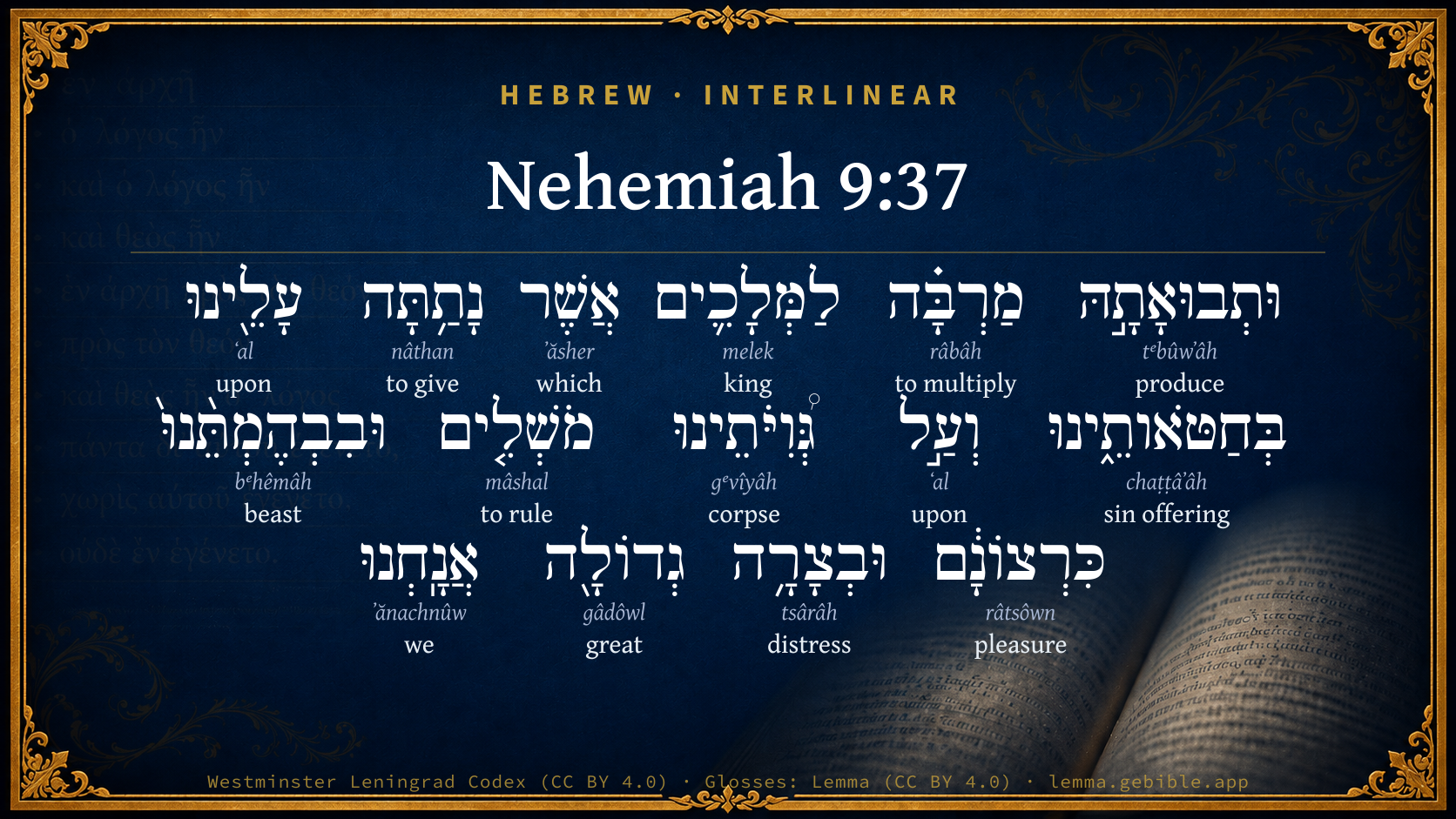
Nehemiah 9:37

Hebrew (Westminster Leningrad Codex) Nehemiah 9:37 appears in the Hebrew Old Testament. The text above is from the Westminster Leningrad Codex. Each word links to its Strong’s number, a concise gloss, and parsing drawn from the Open Scriptures Hebrew Bible morphology. Click any word for its full Brown-Driver-Briggs (BDB) entry.
Download image
Cite this verse

Nehemiah 9:37 (World English Bible). Public Domain. Lemma interlinear Bible study tool, https://lemma.gebible.app/v/nehemiah/9/37.

Show BibTeX & RIS
BibTeX
RIS
English Translation
It yields much increase to the kings whom you have set over us because of our sins: also they have power over our bodies, and over our cattle, at their pleasure, and we are in great distress.
World English Bible · Public Domain
Download a study sheet

One document with this verse’s original text, its word-by-word gloss line, the meaning frame, cross-references with their text, attributed commentary, and full source and license credits — printable, and it pastes into notes with its structure intact.

This verse Autodidact and up

Study sheet (.html) Plain text (.txt)

A passage Seminary Student

Up to 50 verses in one chapter. A passage sheet keeps up to 6 commentary sources and 12 cross-references per verse, in the order this page ranks them, and says so on the sheet whenever that leaves anything out. Ask for a single verse and you get the Autodidact verse sheet above.

Everything on this page stays free to read, with no account — the sheet is a download of what is already on screen, not access to it.

Want to remove ads? Support Godless Engineer
Compare translations 3

The same verse in 3 English versions, stacked beneath the original-language interlinear above. Click any original word for its lexicon entry.

Each is an independent rendering of the whole verse — the interlinear is not word-aligned to these translations.

Highlighted words mark where these versions differ — a whole-verse word diff, not a word-by-word alignment.

  • World English Bible Public Domain
    It yields much increase to the kings whom you have set over us because of our sins: also they have power over our bodies, and over our cattle, at their pleasure, and we are in great distress.
  • King James Version Public Domain
    And it yieldeth much increase unto the kings whom thou hast set over us because of our sins: also they have dominion over our bodies, and over our cattle, at their pleasure, and we are in great distress.
  • unfoldingWord Literal Text CC BY-SA 4.0
    And its great produce belongs to the kings whom you have given to be over us in our sins, and to be ruling over our bodies and over our livestock, according to their will. And we are in great distress.

unfoldingWord Literal Text — © unfoldingWord, licensed CC BY-SA 4.0. Word-aligned USFM3 via Door43 (git.door43.org/unfoldingWord/en_ult).

Versions to compare (up to 4)

3 of 4 selected

Show all 18 translations

Every available English version of this verse, each an independent rendering of the whole verse.

  • World English Bible Public Domain
    It yields much increase to the kings whom you have set over us because of our sins: also they have power over our bodies, and over our cattle, at their pleasure, and we are in great distress.
  • Berean Standard Bible Public Domain
    Its abundant harvest goes to the kings You have set over us because of our sins. And they rule over our bodies and our livestock as they please. We are in great distress.
  • Majority Standard Bible Public Domain
    Its abundant harvest goes to the kings You have set over us because of our sins. And they rule over our bodies and our livestock as they please. We are in great distress.
  • King James Version Public Domain
    And it yieldeth much increase unto the kings whom thou hast set over us because of our sins: also they have dominion over our bodies, and over our cattle, at their pleasure, and we are in great distress.
  • American Standard Version (1901) Public Domain
    And it yieldeth much increase unto the kings whom thou hast set over us because of our sins: also they have power over our bodies, and over our cattle, at their pleasure, and we are in great distress.
  • Revised Version (1885) Public Domain
    And it yieldeth much increase unto the kings whom thou hast set over us because of our sins: also they have power over our bodies, and over our cattle, at their pleasure, and we are in great distress.
  • Geneva Bible (1599) Public Domain
    And it yeeldeth much fruit vnto the kings whom thou hast set ouer vs, because of our sinnes: and they haue dominion ouer our bodyes and ouer our cattell at their pleasure, and we are in great affliction.
  • Douay-Rheims (1899) Public Domain
    And the fruits thereof grow up for the kings, whom thou hast set over us for our sins, and they have dominion over our bodies, and over our beasts, according to their will, and we are in great tribulation.
  • Young's Literal Translation Public Domain
    and its increase it is multiplying to the kings whom Thou hast set over us in our sins; and over our bodies they are ruling, and over our cattle, according to their pleasure, and we `are' in great distress.
  • Literal Standard Version CC BY-SA 4.0
    And its increase it is multiplying to the kings || Whom You have set over us || In our sins; And over our bodies they are ruling, || And over our livestock, || According to their pleasure, || And we [are] in great distress.
  • Unlocked Literal Bible CC BY-SA 4.0
    The rich yield from our land goes to the kings you have set over us because of our sins. They rule over our bodies and over our livestock as they please. We are in great distress.
  • unfoldingWord Literal Text CC BY-SA 4.0
    And its great produce belongs to the kings whom you have given to be over us in our sins, and to be ruling over our bodies and over our livestock, according to their will. And we are in great distress.
  • Darby Bible Public Domain
    And it yieldeth much increase unto the kings whom thou hast set over us because of our sins: and they have dominion over our bodies, and over our cattle, at their pleasure; and we are in great distress.
  • World Messianic Bible Public Domain
    It yields much increase to the kings whom you have set over us because of our sins. Also they have power over our bodies and over our livestock, at their pleasure, and we are in great distress.
  • Webster's Bible Public Domain
    And it yieldeth much increase to the kings whom thou hast set over us because of our sins: also they have dominion over our bodies, and over our cattle, at their pleasure, and we are in great distress.
  • Free Bible Version CC BY-SA 4.0
    The rich harvests of this land go to the kings you have placed over us because of our sins. They rule over our bodies and our cattle, doing whatever they want. We are suffering so much!”
  • Bible in Basic English Public Domain
    And it gives much increase to the kings whom you have put over us because of our sins: and they have power over our bodies and over our cattle at their pleasure, and we are in great trouble.
  • JPS Tanakh (1917) Public Domain
    And it yieldeth much increase unto the kings whom Thou hast set over us because of our sins; also they have power over our bodies, and over our cattle, at their pleasure, and we are in great distress.'

Literal Standard Version (2020), Covenant Press — licensed CC BY-SA 4.0. Text via the HelloAO Bible API (eBible.org). Unlocked Literal Bible (unfoldingWord) — licensed CC BY-SA 4.0. Text via the HelloAO Bible API (eBible.org). unfoldingWord Literal Text — © unfoldingWord, licensed CC BY-SA 4.0. Word-aligned USFM3 via Door43 (git.door43.org/unfoldingWord/en_ult). Free Bible Version, Dr. Jonathan Gallagher — licensed CC BY-SA 4.0. Text via the HelloAO Bible API (eBible.org).

Word by word

More ways to search: Search by grammar → Find every occurrence → Compare this word →

Practice this passage: Drill this verse → Learn its vocabulary →

גְּ֠וִיֹּתֵינוּ
gᵉvîyâh
H1472
“corpses · our”
Noun, Common, Feminine, Plural, Construct + Suffix, Personal, 1st Person, Common, Plural
Part of Speech
Noun
Type
Common
Gender
Feminine
Number
Plural
State
Construct
Full BDB Definition

Origin: prolonged for H1465

TWOT: 326d

a body (of living creatures) - a corpse, carcass, dead body
  1. וּתְבוּאָתָ֣הּ tᵉbûwʼâh H8393 “and · produce · her” Conjunction + Noun, Common, Feminine, Singular, Construct + Suffix, Personal, 3rd Person, Feminine, Singular
  2. מַרְבָּ֗ה râbâh H7235 “multiplying” Verb, Hiphil, Participle Active, Feminine, Singular, Absolute
  3. לַמְּלָכִ֛ים melek H4428 “to/for the · kings” Preposition, Determined + Noun, Common, Masculine, Plural, Absolute
  4. אֲשֶׁר ʼăsher H834 “which” Particle, Relative
  5. נָתַ֥תָּה nâthan H5414 “to give” Verb, Qal, Perfect, 2nd Person, Masculine, Singular
  6. עָלֵ֖ינוּ ʻal H5921 “upon · us” Preposition + Suffix, Personal, 1st Person, Common, Plural
  7. בְּחַטֹּאותֵ֑ינוּ chaṭṭâʼâh H2403 “in/at · sin offerings · our” Preposition + Noun, Common, Feminine, Plural, Construct + Suffix, Personal, 1st Person, Common, Plural
  8. וְעַ֣ל ʻal H5921 “and · upon” Conjunction + Preposition
  9. מֹשְׁלִ֤ים mâshal H4910 “ruling” Verb, Qal, Participle Active, Masculine, Plural, Absolute
  10. וּבִבְהֶמְתֵּ֨נוּ֙ bᵉhêmâh H929 “and · in/at · beast · our” Conjunction + Preposition + Noun, Common, Feminine, Singular, Construct + Suffix, Personal, 1st Person, Common, Plural
  11. כִּרְצוֹנָ֔ם râtsôwn H7522 “like/as · pleasure · their” Preposition + Noun, Common, Masculine, Singular, Construct + Suffix, Personal, 3rd Person, Masculine, Plural
  12. וּבְצָרָ֥ה tsârâh H6869 “and · in/at · distress” Conjunction + Preposition + Noun, Common, Feminine, Singular, Absolute
  13. גְדוֹלָ֖ה gâdôwl H1419 “great” Adjective, Adjective, Feminine, Singular, Absolute
  14. אֲנָֽחְנוּ ʼănachnûw H587 “we” Pronoun, Personal, 1st Person, Common, Plural

About this verse

These counts appear in no published source. They are computed here, from the morphology-tagged text and Lemma’s own curated glosses. What Lemma adds →

15
words
14
distinct lemmas
Historical
section

Notable vocabulary

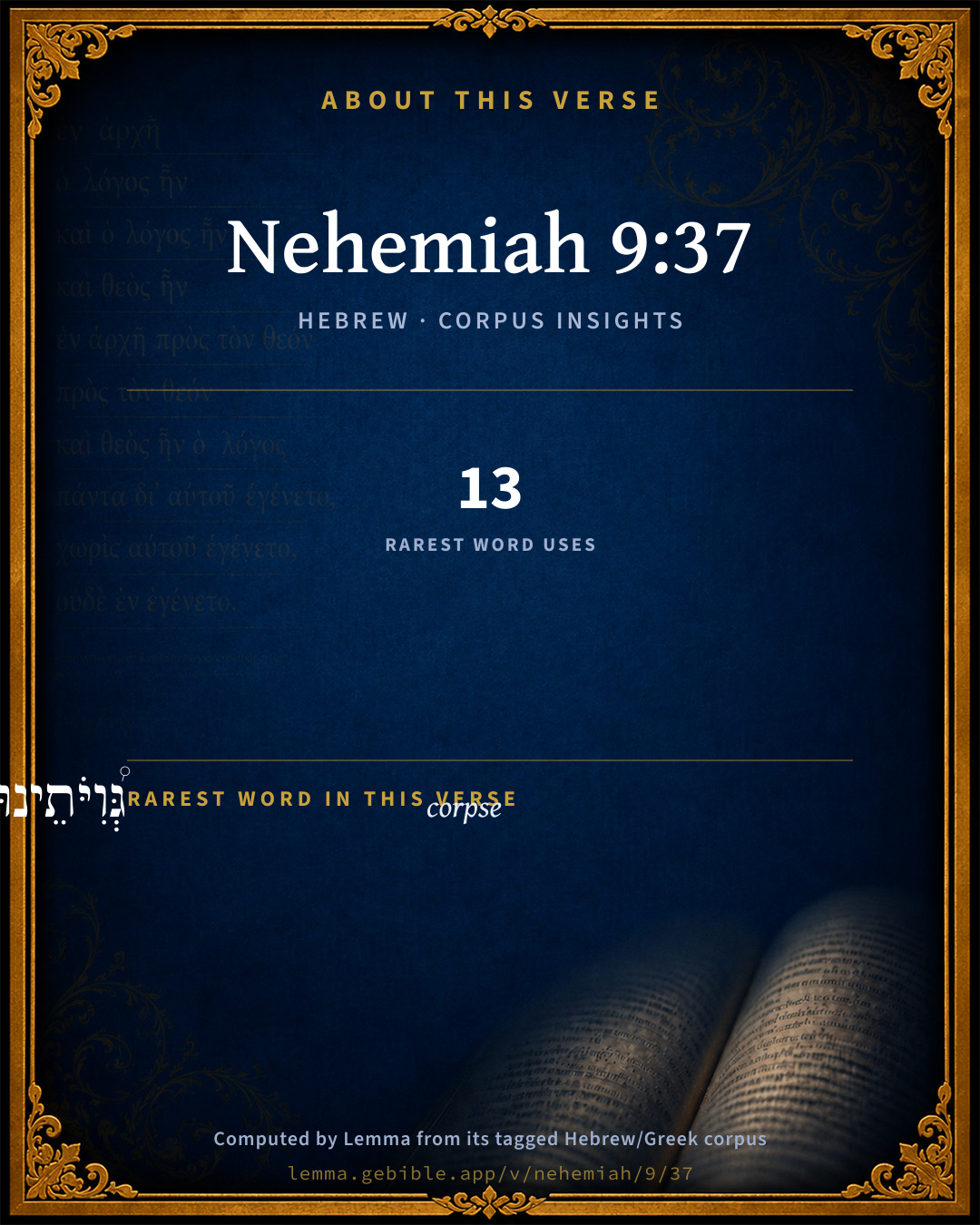
The rarest word here is גְּ֠וִיֹּתֵינוּ corpse H1472 — appearing just 13 times in the whole Hebrew Bible.

Shared distinctive vocabulary

גְּ֠וִיֹּתֵינוּ corpse H1472 occurs in 11 verses of the Hebrew Bible. Also found in:

Grammatical profile

  • 3 verbs
  • 7 nouns
  • 1 adjective
  • 1 pronoun
  • 2 prepositions
  • 1 particle

Verb forms

  • מַרְבָּ֗ה Hiphil · Participle Active
  • נָתַ֥תָּה Qal · Perfect
  • מֹשְׁלִ֤ים Qal · Participle Active

Repetition

A word recurs within this verse — often emphatic in Hebrew:

  • עָלֵ֖ינוּ upon H5921 ×2

Cross-references

10

Topical passages linked to Nehemiah 9:37 in the Treasury of Scripture Knowledge — connected by theme and wording, ordered by reader-vote popularity; previews shown in the World English Bible.

  • Deuteronomy 28:33 The fruit of your ground, and all your labors, shall a nation which you don't know eat up; and you shall be only oppressed and crushed always;
  • Deuteronomy 28:48 therefore shall you serve your enemies whom Yahweh shall send against you, in hunger, and in thirst, and in nakedness, and in want of all things: and he shall put a yoke of iron on your neck, until he have destroyed you.
  • Ezra 7:24 Also we inform you, that touching any of the priests and Levites, the singers, porters, Nethinim, or servants of this house of God, it shall not be lawful to impose tribute, custom, or toll, on them.
  • Leviticus 26:17 I will set my face against you, and you will be struck before your enemies. Those who hate you will rule over you; and you will flee when no one pursues you.
  • Deuteronomy 28:39 You shall plant vineyards and dress them, but you shall neither drink of the wine, nor gather [the grapes]; for the worm shall eat them.
  • Deuteronomy 28:51 and shall eat the fruit of your cattle, and the fruit of your ground, until you are destroyed; that also shall not leave you grain, new wine, or oil, the increase of your cattle, or the young of your flock, until they have caused you to perish.
  • Ezra 4:13 Be it known now to the king that if this city is built, and the walls finished, they will not pay tribute, custom, or toll, and in the end it will be hurtful to the kings.
  • Ezra 6:8 Moreover I make a decree what you shall do to these elders of the Jews for the building of this house of God: that of the king's goods, even of the tribute beyond the River, expenses be given with all diligence to these men, that they be not hindered.
  • Nehemiah 5:8 I said to them, We after our ability have redeemed our brothers the Jews, that were sold to the nations; and would you even sell your brothers, and should they be sold to us? Then held they their peace, and found never a word.
  • John 8:33 They answered him, "We are Abraham's seed, and have never been in bondage to anyone. How do you say, 'You will be made free?'"

Cross-references courtesy of OpenBible.info (CC BY 4.0).

Hebrew and Greek witnesses Masoretic Hebrew ↔ Greek Septuagint

The same verse in the two great witnesses to the Old Testament, shown verse-for-verse.

These are two independent witnesses, not word-aligned to each other, and the Septuagint is shown in lemma (dictionary) form.

Hebrew Nehemiah 9:37 Masoretic · Westminster Leningrad Codex

וּתְבוּאָתָ֣הּ מַרְבָּ֗ה לַמְּלָכִ֛ים אֲשֶׁר נָתַ֥תָּה עָלֵ֖ינוּ בְּחַטֹּאותֵ֑ינוּ וְעַ֣ל גְּ֠וִיֹּתֵינוּ מֹשְׁלִ֤ים וּבִבְהֶמְתֵּ֨נוּ֙ כִּרְצוֹנָ֔ם וּבְצָרָ֥ה גְדוֹלָ֖ה אֲנָֽחְנוּ

It yields much increase to the kings whom you have set over us because of our sins: also they have power over our bodies, and over our cattle, at their pleasure, and we are in great distress.

World English Bible · Public Domain

Greek LXX Structure differs

The Septuagint has no separate book of Nehemiah. Its Greek text is the second half of Esdras B (2 Esdras), chapters 11–23; Ezra is the first half (1–10).

A verse-for-verse comparison isn’t shown here because the chapters and verses don’t line up. Switch to the LXX edition with the MT / LXX toggle above to read the Greek directly.

Hebrew: Westminster Leningrad Codex (CC BY 4.0). Greek: Septuagint (public domain); English from a public-domain English Septuagint. How the Septuagint differs from the Hebrew →

Commentary

Notes on Nehemiah 9:37 from classic Christian and Jewish commentators (each source and its license shown beneath its notes). The classic Christian expositions comment on the surrounding passage and are grouped to its opening verse, so a note may address several verses; the Jewish commentaries on the Tanakh (Rashi and others) are per-verse, so they appear only where the commentator wrote on this verse.

Lemma curates 59 commentaries, every one of them public domain or Creative Commons licensed, each selected and text-cleaned for this edition rather than reprinted as found. About our sources →

Trapp's Complete Commentary

John Trapp

Neh 9:37 And it yieldeth much increase unto the kings whom thou hast set over us because of our sins: also they have dominion over our bodies, and over our cattle, at their pleasure, and we [are] in great distress.

Ver. 37. And it yieldeth much increase unto the kings] As this land once did unto the king of locusts; when it was styled the pope’s hortus deliciarum, garden of delights, out of which he could fetch what money or anything else he pleased, so long as he could hold a pen in his hand. In the year 720, John, king of West Saxons, caused in all his dominion, in every house having a chimney, a penny to be collected and paid to the bishop of Rome, in the name of St Peter; and thereof were they called Peter pence. These continued till Henry VIII’s time; who, in his protestation against the pope, speaketh thus: England is no more a babe; there is no man here but now he knows that they do foolishly that give gold for lead, more weight of that than they receive of this, &c.

Also they have dominion] {See Trapp on "Neh 9:30"}

At their pleasure] Their will was a law; which to argue or debate was high misdemeanour; to detract or disobey, present death.

John Trapp, A Commentary or Exposition upon All the Books of the Old and New Testament (1647–1656) — public domain. Text from a community e-Sword module.

Joseph Benson's Commentary

Neh 9:37. And it yieldeth much increase unto the kings, &c. — We plough, and sow, and labour, and thou givest thy blessing to our endeavours; and yet in a great measure this is not for ourselves, as formerly it was, but for our kings, to whom we pay heavy tributes. Also they have dominion over our bodies — Which are liable to be pressed, to serve in the king’s wars, or in his works. And over our cattle at their pleasure — Our cattle are liable to be made use of, when there is occasion to employ them about the king’s business. And we are in great distress — Though we are permitted to live by our own laws, which we account a great privilege, yet we lie under these public burdens, and are compelled to bear them. Thus, as Mr. Peters observes, this prayer contains a beautiful epitome of the history of the Jews, raised and animated by a spirit of devotion, which appears in all that moving eloquence so well suited to the great occasion; and, at the same time, with all that chasteness and correctness of thought and expression, which so eminently distinguish the sacred writings of this sort from all merely human compositions.

Joseph Benson's Commentary on the Old and New Testaments (1811–1818) — public domain. Text from a community e-Sword module.

Jamieson, Fausset & Brown

Robert Jamieson, A. R. Fausset & David Brown

it yieldeth much increase unto the kings whom thou hast set over us because of our sins--Our agricultural labors have been resumed in the land--we plough, and sow, and till, and Thou blessest the work of our hands with a plentiful return; but this increase is not for ourselves, as once it was, but for our foreign masters, to whom we have to pay large and oppressive tribute.

they have dominion over our bodies--Their persons were liable to be pressed, at the mandate of their Assyrian conqueror, into the service of his empire, either in war or in public works. And our beasts are taken to do their pleasure.

Jamieson, Fausset & Brown — Commentary Critical and Explanatory on the Whole Bible (1871) — public domain (CC PDM 1.0). Text via the HelloAO Bible API.

Adam Clarke's Commentary

Verse 37. It yieldeth much increase unto the kings] Good and fruitful as the land is, yet it profits us little; as the chief profits on all things go to the kings of Persia.

Over our bodies] Exacting personal and feudal services from us, and from our cattle; and this not by any fixed rate, or rule, of so much rent, so much labour, or boons; but at their pleasure; so that we can neither call our persons, our time, our land, nor our cattle, our own: therefore we are in great distress. Miserable are the people that live under such a government. Think of this, ye Britons! think of your liberties and rights. Compare them with any other nation under heaven, and see what a balance is in your favour. Almost all the nations of the earth acknowledge Britons the most happy of all men. May I not say,

O fortunatos nimium, sua si bona norint!

"How exceedingly happy would you be, could

you but consider your many advantages!"

Adam Clarke's Commentary on the Bible (1810–1826) — public domain. Text from a community e-Sword/MySword module.

Ellicott's Commentary for English Readers

(37) Yieldeth much increase.—In money and kind a very large amount was sent by Syria to the Persian treasury.

Over our bodies, and over our cattle.—For military service; but the priests do not omit themselves.

In great distress.—Not so much under the Persian yoke as in the remembrance of God’s judgments. The pathetic comparison between the Divine purpose in giving the land originally and their present bondage in it extends almost to every word.

A Bible Commentary for English Readers, edited by Charles John Ellicott (1878–1897) — public domain. Text from a community e-Sword module.

The Cambridge Bible for Schools and Colleges

gen. ed. J. J. S. Perowne

37. yieldeth much increase] Literally ‘its produce it maketh in abundance.’ The allusion is to the pressure of the tribute exacted for the Persian revenue. Cf. Neh_5:4. See Rawlinson’s Ancient Monarchies, vol. III., pp. 421–423.

‘Besides money payments ‘a payment … had to be made in kind, each province being required to furnish that commodity, or those commodities, for which it was most celebrated.… While the claims of the crown upon its subjects were definite and could not be exceeded, the satrap was at liberty to make any exactions that he pleased beyond them.… Like a Roman proconsul, he was to pay himself out of the pockets of his subjects; and, like that class of persons, he took care to pay himself highly.’

dominion] R.V. authority. Cf. Deu_28:33, ‘The fruit of thy ground, and all thy labours shall a nation which thou knowest not eat up.’ Isa_26:13, ‘O Lord our God, other lords beside thee have had dominion over us.’

we are in great distress] We must remember that this language of complaint at the severity of the foreign rule and exactions is not the utterance of Nehemiah the king’s minister. This portion of the book is not Nehemiah’s writing. The words are spoken not by Nehemiah but by Ezra, or by the Levites. The contents of chap. 5 show that the effects of the foreign taxation upon the condition of the middle and lower classes were felt very acutely.

The Cambridge Bible for Schools and Colleges (gen. ed. J. J. S. Perowne; Cambridge University Press, 1878–1918) — public domain. Text from a community e-Sword module.

John Gill's Exposition

And it yieldeth much increase unto the kings whom thou hast set over us, because of our sins,.... Though a very fruitful land, and brought forth much, yet not for them, but for foreign kings, that had the sovereignty over them, and enacted much toll, tribute, and custom from them, which greatly lessened the profit of the earth to them:

also they have dominion over our bodies; and could oblige them to work for them, and do any service they should command:

and over our cattle, at their pleasure; to carry burdens for them, or ride post with them:

and we are in great distress; being servants and tributaries to a foreign power.

John Gill's Exposition of the Whole Bible (1746–1763) — public domain (CC PDM 1.0). Text via the HelloAO Bible API.

Haydock's Catholic Bible Commentary

Tribulation. As we cannot enjoy the fruits, being so heavily taxed, and obliged to work in person for the king of a foreign country. (Calmet)

George Leo Haydock (1774–1849), Haydock's Catholic Family Bible and Commentary, 1859 edition — public domain. Excludes Psalms (Douay-Rheims chapter numbering differs from Protestant) and Deuterocanonical books (Catholic canon only).

Matthew Poole's English Annotations

We plough, and sow, and labour, and thou givest thy blessing to our endeavours; and yet in a great measure this is not for ourselves, as formerly it was, but for our kings, to whom we pay great and heavy tributes for these things; of which see Ezr 6:8; 7:24. They have dominion over our bodies, and over our cattle; pressing or forcing both us and our beasts to go and do what they please.

Matthew Poole's English Annotations on the Holy Bible (1683–1685) — public domain. Text from a community e-Sword/MySword module.

The Pulpit Commentary

It yieldeth much increase unto the kings. "The Persian monarchs derive a large revenue from our territory." The amount paid by Judaea is not known; but Syria, in which Judaea was included, paid annually in money 350 talents of silver (Heb 3:91), or about There was also a further contribution in kind. They have dominion over our bodies. They can impress us either as soldiers or sailors, and make us fight their battles for them. Jews probably took part in the expedition of Xerxes against Greece. And over our cattle. They can impress our cattle for their baggage-train.

The Pulpit Commentary (1880–1919), ed. H.D.M. Spence-Jones & Joseph S. Exell — public domain. Text from a community e-Sword module.

John Wesley's Explanatory Notes

Yieldeth much, &c. - We plow, and sow, and labour, and thou givest thy blessing to our endeavours; and yet in a great measure this is not for ourselves, as formerly it was, but for our kings, to whom we pay heavy tributes. Dominion - Pressing or forcing both us and our beasts to go and to do what they please.

John Wesley, Explanatory Notes Upon the Whole Bible (1754–1765) — public domain. Text via the GEBible commentary corpus.

Rashi

Rabbi Shlomo Yitzchaki (Rashi)

And its produce [the produce] of the land of Israel.

it lavishes delicacies to the kings of the nations...

whom You have appointed over us who rule over us.

Rashi on the Tanakh — English translations: “The Judaica Press complete Tanach with Rashi, translated by A. J. Rosenberg” (CC BY 4.0); “Pentateuch with Rashi's commentary by M. Rosenbaum and A.M. Silbermann, 1929-1934” (public domain); “The Metsudah Tanach series, Lakewood, N.J” (CC BY 4.0); and “The Book of Joshua, Metsudah Publications, 1997” (CC BY 4.0). Text via Sefaria.

Lesson kit

Teaching starters — assembled from the data on this page, not authored interpretation. Every prompt links to the verse data it draws on. Edit before teaching.

Nehemiah, in the Historical, opens this verse with 15 words (14 distinct Hebrew lemmas). Its most distinctive word is gᵉvîyâh (“corpse”). A historical commentator’s framing appears above. Read the whole chapter for the surrounding context.

Discussion questions

  1. How does “corpse” (gᵉvîyâh) shape what this verse is saying?
  2. Genesis 47:18 shares the word «corpse» with this verse. How do the two illuminate each other?
  3. “upon” occurs 2× in this one verse. What is the effect of the repetition?
  4. These translations render this verse differently. What is at stake in choosing one wording over another?
  5. The verb «מַרְבָּ֗ה» is Hiphil Participle Active. How does its form color the action?
  6. Reading how Trapp's Complete Commentary and Joseph Benson's Commentary read this verse, where do the two commentators agree and where do they part?

Things to notice

Reading settings

Reading text

Shown beneath each verse's original-language words.

Old Testament
Old Testament edition

Read the OT as the Masoretic Hebrew (MT) or the Greek Septuagint (LXX).

English shown for the Greek Septuagint (in the Hebrew ↔ Greek comparison).

Comparing translations? Open the Compare panel on any verse page to stack up to four side by side.