
Deuteronomy 6:3

Hebrew (Westminster Leningrad Codex) Deuteronomy 6:3 appears in the Hebrew Old Testament. The text above is from the Westminster Leningrad Codex. Each word links to its Strong’s number, a concise gloss, and parsing drawn from the Open Scriptures Hebrew Bible morphology. Click any word for its full Brown-Driver-Briggs (BDB) entry.
Download image
Cite this verse

Deuteronomy 6:3 (World English Bible). Public Domain. Lemma interlinear Bible study tool, https://lemma.gebible.app/v/deuteronomy/6/3.

Show BibTeX & RIS
BibTeX
RIS
English Translation
Hear therefore, Israel, and observe to do it; that it may be well with you, and that you may increase mightily, as Yahweh, the God of your fathers, has promised to you, in a land flowing with milk and honey.
World English Bible · Public Domain
Download a study sheet

One document with this verse’s original text, its word-by-word gloss line, the meaning frame, cross-references with their text, attributed commentary, and full source and license credits — printable, and it pastes into notes with its structure intact.

This verse Autodidact and up

Study sheet (.html) Plain text (.txt)

A passage Seminary Student

Up to 50 verses in one chapter. A passage sheet keeps up to 6 commentary sources and 12 cross-references per verse, in the order this page ranks them, and says so on the sheet whenever that leaves anything out. Ask for a single verse and you get the Autodidact verse sheet above.

Everything on this page stays free to read, with no account — the sheet is a download of what is already on screen, not access to it.

Want to remove ads? Support Godless Engineer
Compare translations 3

The same verse in 3 English versions, stacked beneath the original-language interlinear above. Click any original word for its lexicon entry.

Each is an independent rendering of the whole verse — the interlinear is not word-aligned to these translations.

Highlighted words mark where these versions differ — a whole-verse word diff, not a word-by-word alignment.

  • World English Bible Public Domain
    Hear therefore, Israel, and observe to do it; that it may be well with you, and that you may increase mightily, as Yahweh, the God of your fathers, has promised to you, in a land flowing with milk and honey.
  • King James Version Public Domain
    Hear therefore, O Israel, and observe to do it; that it may be well with thee, and that ye may increase mightily, as the LORD God of thy fathers hath promised thee, in the land that floweth with milk and honey.
  • unfoldingWord Literal Text CC BY-SA 4.0
    And you shall listen, Israel, and carefully do, that it will go well for you, and that you will greatly multiply, as Yahweh, the God of your fathers spoke to you, a land flowing with milk and honey.

unfoldingWord Literal Text — © unfoldingWord, licensed CC BY-SA 4.0. Word-aligned USFM3 via Door43 (git.door43.org/unfoldingWord/en_ult).

Versions to compare (up to 4)

3 of 4 selected

Show all 18 translations

Every available English version of this verse, each an independent rendering of the whole verse.

  • World English Bible Public Domain
    Hear therefore, Israel, and observe to do it; that it may be well with you, and that you may increase mightily, as Yahweh, the God of your fathers, has promised to you, in a land flowing with milk and honey.
  • Berean Standard Bible Public Domain
    Hear, O Israel, and be careful to observe them, so that you may prosper and multiply greatly in a land flowing with milk and honey, just as the LORD, the God of your fathers, has promised you.
  • Majority Standard Bible Public Domain
    Hear, O Israel, and be careful to observe them, so that you may prosper and multiply greatly in a land flowing with milk and honey, just as the LORD, the God of your fathers, has promised you.
  • King James Version Public Domain
    Hear therefore, O Israel, and observe to do it; that it may be well with thee, and that ye may increase mightily, as the LORD God of thy fathers hath promised thee, in the land that floweth with milk and honey.
  • American Standard Version (1901) Public Domain
    Hear therefore, O Israel, and observe to do it; that it may be well with thee, and that ye may increase mightily, as Jehovah, the God of thy fathers, hath promised unto thee, in a land flowing with milk and honey.
  • Revised Version (1885) Public Domain
    Hear therefore, O Israel, and observe to do it; that it may be well with thee, and that ye may increase mightily, as the LORD, the God of thy fathers, hath promised unto thee, in a land flowing with milk and honey.
  • Geneva Bible (1599) Public Domain
    Heare therefore, O Israel, and take heede to doe it, that it may go well with thee, and that ye may increase mightily in the land that floweth with milke and hony, as the Lord God of thy fathers hath promised thee.
  • Douay-Rheims (1899) Public Domain
    Hear, O Israel, and observe to do the things which the Lord hath commanded thee, that it may be well with thee, and thou mayst be greatly multiplied, as the Lord the God of thy fathers hath promised thee a land flowing with milk and honey.
  • Young's Literal Translation Public Domain
    `And thou hast heard, O Israel, and observed to do, that it may be well with thee, and that thou mayest multiply exceedingly, as Jehovah, God of thy fathers, hath spoken to thee, `in' the land flowing with milk and honey.
  • Literal Standard Version CC BY-SA 4.0
    And you have heard, O Israel, and observed to do [them], that it may be well with you, and that you may multiply exceedingly, as YHWH, God of your fathers, has spoken to you, [in] the land flowing with milk and honey.
  • Unlocked Literal Bible CC BY-SA 4.0
    Therefore listen to them, Israel, and keep them, so that it may go well with you, so that you may greatly multiply, in a land flowing with milk and honey, as Yahweh, the God of your fathers, has promised you would do.
  • unfoldingWord Literal Text CC BY-SA 4.0
    And you shall listen, Israel, and carefully do, that it will go well for you, and that you will greatly multiply, as Yahweh, the God of your fathers spoke to you, a land flowing with milk and honey.
  • Darby Bible Public Domain
    And thou shalt hear, Israel, and take heed to do [them]; that it may be well with thee, and that ye may increase greatly, as Jehovah the God of thy fathers hath said unto thee, in a land flowing with milk and honey.
  • World Messianic Bible Public Domain
    Hear therefore, Israel, and observe to do it, that it may be well with you, and that you may increase mightily, as the LORD, the God of your fathers, has promised to you, in a land flowing with milk and honey.
  • Webster's Bible Public Domain
    Hear therefore, O Israel, and observe to do it; that it may be well with thee, and that ye may increase mightily, as the LORD God of thy fathers hath promised thee, in the land that floweth with milk and honey.
  • Free Bible Version CC BY-SA 4.0
    Listen, people of Israel, and be careful to observe them, so that you may do well and have many descendants in a land flowing with milk and honey, just as the Lord, the God of your forefathers, promised you.
  • Bible in Basic English Public Domain
    So give ear, O Israel, and take care to do this; so that it may be well for you, and you may be greatly increased, as the Lord the God of your fathers has given you his word, in a land flowing with milk and honey.
  • JPS Tanakh (1917) Public Domain
    Hear therefore, O Israel, and observe to do it; that it may be well with thee, and that ye may increase mightily, as the LORD, the God of thy fathers, hath promised unto thee — a land flowing with milk and honey.

Literal Standard Version (2020), Covenant Press — licensed CC BY-SA 4.0. Text via the HelloAO Bible API (eBible.org). Unlocked Literal Bible (unfoldingWord) — licensed CC BY-SA 4.0. Text via the HelloAO Bible API (eBible.org). unfoldingWord Literal Text — © unfoldingWord, licensed CC BY-SA 4.0. Word-aligned USFM3 via Door43 (git.door43.org/unfoldingWord/en_ult). Free Bible Version, Dr. Jonathan Gallagher — licensed CC BY-SA 4.0. Text via the HelloAO Bible API (eBible.org).

Word by word

More ways to search: Search by grammar → Find every occurrence → Compare this word →

Practice this passage: Drill this verse → Learn its vocabulary →

זָבַ֥ת
zûwb
H2100
“flowing”
Verb, Qal, Participle Active, Feminine, Singular, Construct
Part of Speech
Verb
Stem
Qal
Form
Participle Active
Gender
Feminine
Number
Singular
State
Construct
Full BDB Definition

Origin: a primitive root

TWOT: 534

to flow, gush, issue, discharge - (Qal) - to flow, gush - to die, pine away (figuratively) - to flow (of issue from woman), have an issue, flux - flowing (participle)
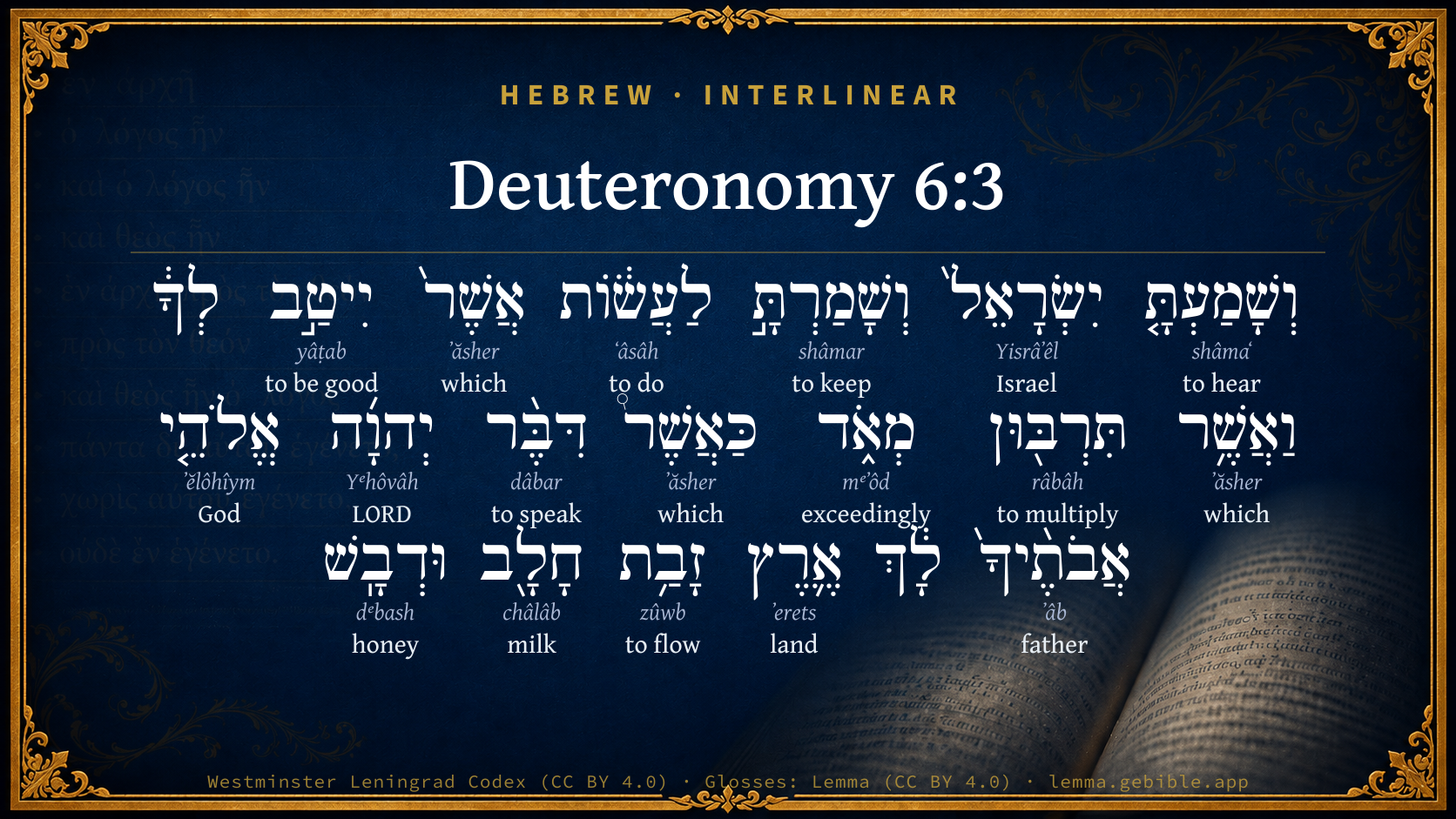
  1. וְשָׁמַעְתָּ֤ shâmaʻ H8085 “and · to hear” Conjunction + Verb, Qal, Sequential Perfect, 2nd Person, Masculine, Singular
  2. יִשְׂרָאֵל֙ Yisrâʼêl H3478 “Israel” Noun, Proper
  3. וְשָׁמַרְתָּ֣ shâmar H8104 “and · to keep” Conjunction + Verb, Qal, Sequential Perfect, 2nd Person, Masculine, Singular
  4. לַעֲשׂ֔וֹת ʻâsâh H6213 “to do” Preposition + Verb, Qal, Infinitive Construct
  5. אֲשֶׁר֙ ʼăsher H834 “which” Particle, Relative
  6. יִיטַ֣ב yâṭab H3190 “to be good” Verb, Qal, Imperfect, 3rd Person, Masculine, Singular
  7. וַאֲשֶׁ֥ר ʼăsher H834 “and · which” Conjunction + Particle, Relative
  8. תִּרְבּ֖וּן râbâh H7235 “to multiply” Verb, Qal, Imperfect, 2nd Person, Masculine, Plural + Suffix, n
  9. מְאֹ֑ד mᵉʼôd H3966 “exceedingly” Adverb
  10. כַּאֲשֶׁר֩ ʼăsher H834 “like/as · which” Preposition + Particle, Relative
  11. דִּבֶּ֨ר dâbar H1696 “to speak” Verb, Piel, Perfect, 3rd Person, Masculine, Singular
  12. יְהוָ֜ה Yᵉhôvâh H3068 “LORD” Noun, Proper
  13. אֱלֹהֵ֤י ʼĕlôhîym H430 “God(s) of” Noun, Common, Masculine, Plural, Construct
  14. אֲבֹתֶ֨יךָ֙ ʼâb H1 “fathers · your” Noun, Common, Masculine, Plural, Construct + Suffix, Personal, 2nd Person, Masculine, Singular
  15. אֶ֛רֶץ ʼerets H776 “land” Noun, Common, Both, Singular, Absolute
  16. חָלָ֖ב châlâb H2461 “milk” Noun, Common, Masculine, Singular, Absolute
  17. וּדְבָֽשׁ dᵉbash H1706 “and · honey” Conjunction + Noun, Common, Masculine, Singular, Absolute

About this verse

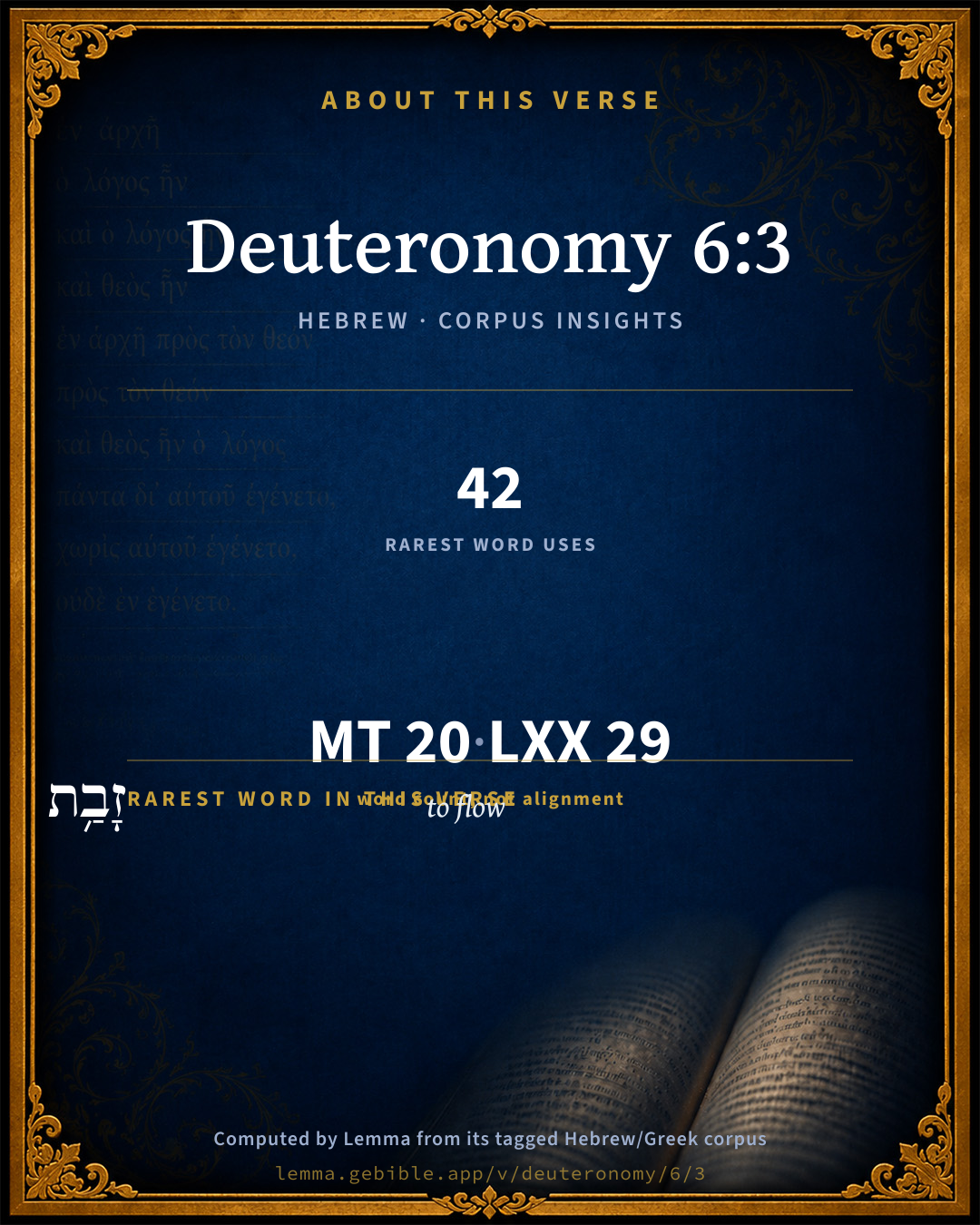
These counts appear in no published source. They are computed here, from the morphology-tagged text and Lemma’s own curated glosses. What Lemma adds →

20
words
16
distinct lemmas
Pentateuch
section

Shared distinctive vocabulary

זָבַ֥ת to flow H2100 occurs in 41 verses of the Hebrew Bible. Also found in:

Grammatical profile

  • 7 verbs
  • 7 nouns
  • 2 prepositions
  • 1 adverb
  • 3 particles

Verb forms

  • וְשָׁמַעְתָּ֤ Qal · Sequential Perfect
  • וְשָׁמַרְתָּ֣ Qal · Sequential Perfect
  • לַעֲשׂ֔וֹת Qal · Infinitive Construct
  • יִיטַ֣ב Qal · Imperfect
  • תִּרְבּ֖וּן Qal · Imperfect
  • דִּבֶּ֨ר Piel · Perfect
  • זָבַ֥ת Qal · Participle Active

Repetition

A word recurs within this verse — often emphatic in Hebrew:

  • אֲשֶׁר֙ which H834 ×3

Hebrew & Septuagint length

In English translation the verse runs 40 words from the Hebrew and 72 from the Septuagint (LXX English) — the Septuagint runs noticeably longer here. See the side-by-side →

A rough comparison of the two English renderings, which tokenize alike — not a word-level alignment.

Word counts can differ between the Hebrew and the Greek without any difference in meaning — e.g. the Hebrew direct-object marker אֵת has no separate Greek word, and Greek often adds the article ὁ.

In the original languages it is 20 Hebrew tokens and 29 Greek tokens — but the two are counted differently (Hebrew bundles its prefixes and suffixes into one token; the Greek is in lemma form), so that isn’t a like-for-like length.

Cross-references

13

Topical passages linked to Deuteronomy 6:3 in the Treasury of Scripture Knowledge — connected by theme and wording, ordered by reader-vote popularity; previews shown in the World English Bible.

  • Genesis 22:17 that in blessing I will bless you, and in multiplying I will multiply your seed as the stars of the heavens, and as the sand which is on the seashore. Your seed will possess the gate of his enemies.
  • Genesis 15:5 Yahweh brought him outside, and said, "Look now toward the sky, and count the stars, if you are able to count them." He said to Abram, "So shall your seed be."
  • Genesis 26:4 I will multiply your seed as the stars of the sky, and will give to your seed all these lands. In your seed will all the nations of the earth be blessed,
  • Genesis 28:14 Your seed will be as the dust of the earth, and you will spread abroad to the west, and to the east, and to the north, and to the south. In you and in your seed will all the families of the earth be blessed.
  • Exodus 3:8 I have come down to deliver them out of the hand of the Egyptians, and to bring them up out of that land to a good and large land, to a land flowing with milk and honey; to the place of the Canaanite, the Hittite, the Amorite, the Perizzite, the Hivite, and the Jebusite.
  • Isaiah 3:10 Tell the righteous "Good!" For they shall eat the fruit of their deeds.
  • Genesis 12:2 I will make of you a great nation. I will bless you, and make your name great. You will be a blessing.
  • Genesis 13:16 I will make your offspring as the dust of the earth, so that if a man can number the dust of the earth, then your seed may also be numbered.
  • Exodus 1:7 The children of Israel were fruitful, and increased abundantly, and multiplied, and grew exceedingly mighty; and the land was filled with them.
  • Deuteronomy 4:6 Keep therefore and do them; for this is your wisdom and your understanding in the sight of the peoples, who shall hear all these statutes, and say, Surely this great nation is a wise and understanding people.
  • Deuteronomy 5:32–33 You shall observe to do therefore as Yahweh your God has commanded you: you shall not turn aside to the right hand or to the left.
  • Ecclesiastes 8:12 Though a sinner commits crimes a hundred times, and lives long, yet surely I know that it will be better with those who fear God, who are reverent before him.
  • Acts 7:17 "But as the time of the promise came close which God had sworn to Abraham, the people grew and multiplied in Egypt,

Cross-references courtesy of OpenBible.info (CC BY 4.0).

Hebrew and Greek witnesses Masoretic Hebrew ↔ Greek Septuagint

The same verse in the two great witnesses to the Old Testament, shown verse-for-verse.

Here the Septuagint runs noticeably longer than the Hebrew — LXX2012 (modern English Septuagint) 72 words vs World English Bible 40. A rough length comparison of the two English translations, not a word-level alignment — read both below.

These are two independent witnesses, not word-aligned to each other, and the Septuagint is shown in lemma (dictionary) form.

Hebrew Deuteronomy 6:3 Masoretic · Westminster Leningrad Codex

וְשָׁמַעְתָּ֤ יִשְׂרָאֵל֙ וְשָׁמַרְתָּ֣ לַעֲשׂ֔וֹת אֲשֶׁר֙ יִיטַ֣ב לְךָ֔ וַאֲשֶׁ֥ר תִּרְבּ֖וּן מְאֹ֑ד כַּאֲשֶׁר֩ דִּבֶּ֨ר יְהוָ֜ה אֱלֹהֵ֤י אֲבֹתֶ֨יךָ֙ לָ֔ךְ אֶ֛רֶץ זָבַ֥ת חָלָ֖ב וּדְבָֽשׁ

Hear therefore, Israel, and observe to do it; that it may be well with you, and that you may increase mightily, as Yahweh, the God of your fathers, has promised to you, in a land flowing with milk and honey.

World English Bible · Public Domain

Greek LXX Deuteronomy 6:3 Septuagint · lemma form

καί ἀκούω ἰσραήλ καί φυλάσσω ποιέω ὅπως εὖ σύ εἰμί καί ἵνα πληθύνω σφόδρα καθάπερ λαλέω κύριος ὁ θεός ὁ πατήρ σύ δίδωμι σύ γῆ ῥέω γάλα καί μέλι

Hear, therefore, O Israel, and observe to do them, that it may be well with you, and that you⌃ may be greatly multiplied, as the Lord God of your fathers said that he would give you a land flowing with milk and honey: and these are the ordinances, and the judgments, which the Lord commanded the children of Israel in the wilderness, when they had gone forth from the land of Egypt.

LXX2012 (modern English Septuagint) · Public Domain

On this verse, The Cambridge Bible for Schools and Colleges discusses the Septuagint’s reading. Read the note in Commentary ↓

Hebrew: Westminster Leningrad Codex (CC BY 4.0). Greek: Septuagint (public domain); English from LXX2012 (modern English Septuagint) (Public Domain). How the Septuagint differs from the Hebrew →

Targum (Aramaic paraphrase)

2

The Targum is the ancient Jewish Aramaic paraphrase of the Hebrew Scriptures — an interpretive translation, not the Hebrew text itself. Onkelos (literal) and Pseudo-Jonathan (expansive) render the Torah, and Jonathan the Prophets. Coverage is partial: where no permissively-licensed English translation exists for a verse, only the Aramaic is shown. This is verse-level text, not a word-by-word alignment to the Hebrew.

  1. Targum Onkelos Torah (Genesis–Deuteronomy)
    וּתְקַבֵּל יִשְׂרָאֵל וְתִטַר לְמֶעְבַּד דִי יֵיטַב לָךְ וְדִי תִסְגוּן לַחֲדָא כְּמָא דִי מַלִיל יְיָ אֱלָהָא דַאֲבָהָתָךְ לָךְ אַרְעָא עָבְדָא חֲלַב וּדְבָשׁ

    (no public-domain English translation for this verse)

    Targum Onkelos — Aramaic: “Onkelos Genesis” (public domain); “Onkelos Exodus” (public domain); “Onkelos Leviticus” (public domain); “Onkelos Numbers” (public domain); “Onkelos Deuteronomy” (public domain). English: “Sefaria Community Translation” (CC0 1.0 (public-domain dedication)); “J.W. Etheridge. The Targums of Onkelos and Jonathan Ben Uzziel on the Pentateuch. London: Longmans, Green, 1862” (public domain). Text via Sefaria.

  2. Targum Pseudo-Jonathan Torah (Genesis–Deuteronomy)
    וּתְקַבֵּיל יִשְרָאֵל וְתִנְטוֹר לְמֶעֱבַד מְטוּל דְּיוֹטֵב לָךְ וְתִסְגוּן לַחֲדָא הֵיכְמָא דְמַלֵיל יְיָ אֱלָהָא דְאַבְהָתָךְ לָךְ אֲרַע דְּפֵירָהָא שְׁמֵינִין כַּחֲלָב וְחַלְיָין כִּדְבָשׁ

    Hearken then, Israel, to keep and to do, that it may be well with thee, and you may increase greatly, as the Lord God of thy fathers hath spoken to thee, (that) He will give thee a land whose fruits are rich as milk, and sweet as honey.

    Targum Pseudo-Jonathan — Aramaic: “Targum Jonathan on Genesis” (public domain); “Targum Jonathan on Exodus” (public domain); “Targum Jonathan on Leviticus” (public domain); “Targum Jonathan on Numbers” (public domain); “Targum Jonathan on Deuteronomy” (public domain). English: “The Targum of Jonathan ben Uzziel, trans. J. W. Etheridge, London, 1862” (public domain). Text via Sefaria.

Commentary

Notes on Deuteronomy 6:3 from classic Christian and Jewish commentators (each source and its license shown beneath its notes). The classic Christian expositions comment on the surrounding passage and are grouped to its opening verse, so a note may address several verses; the Jewish commentaries on the Tanakh (Rashi and others) are per-verse, so they appear only where the commentator wrote on this verse.

Lemma curates 59 commentaries, every one of them public domain or Creative Commons licensed, each selected and text-cleaned for this edition rather than reprinted as found. About our sources →

Trapp's Complete Commentary

John Trapp

Deu 6:3 Hear therefore, O Israel, and observe to do [it]; that it may be well with thee, and that ye may increase mightily, as the LORD God of thy fathers hath promised thee, in the land that floweth with milk and honey.

Ver. 3. That it may be well with thee.] Respect may be had to the recompense of reward. We may make it our scope, our aim, {σκοπουντων, 2Co 4:18} though not our highest aim; Moses cast an eye when he was on his journey, {απεβλεπε, Heb 11:26} he stole a look from glory, and got fresh encouragement.

John Trapp, A Commentary or Exposition upon All the Books of the Old and New Testament (1647–1656) — public domain. Text from a community e-Sword module.

Tyndale Open Study Notes

Tyndale Open Resources

6:3 The milk and honey abundant in Canaan represented both agriculture and forage. Compared to the desert fare, Canaan’s food was sumptuous indeed (see Exod 3:8, 17).

Tyndale Open Study Notes — © Tyndale Open Resources, licensed CC BY-SA 4.0. Text via the HelloAO Bible API.

Geneva Bible (1599)

Geneva Bible translators

Which hath abundance of all things appertaining to man’s life.

Geneva Bible (1599) marginal notes — public domain. Text via Bolls.life.

Adam Clarke's Commentary

Verse 3. Hear therefore, O Israel, and observe to do it] Literally, Ye shall hear, O Israel, and thou shalt keep to do them.

1. God is to be heard; no obligation without law to found it on, and no law in religion but from God.

2. The commandment must be understood in order to be obeyed.

3. It must be observed - attentively considered, in order to be understood. And,

4. It must be performed, that the end for which it was given may be accomplished, viz., that GOD may be glorified, and that it may be well with the people.

What is here spoken applies powerfully to every part of the moral law; God has given IT as a rule of life, therefore obedience to it is indispensably necessary, not to the purchase of salvation, for no human merit can ever extend to that, but it is the way by which both the justice and mercy of God choose to conduct men to heaven. But let it be fully understood that no man can walk in the way of obedience but by and under the influence of the grace of God.

Adam Clarke's Commentary on the Bible (1810–1826) — public domain. Text from a community e-Sword/MySword module.

Ellicott's Commentary for English Readers

(3) That ye may increase mightily . . . in the land.—The position of Israel in the land, and their continuance therein, depended entirely on their fulfilment of the purpose for which they were brought there—the observance of the Law of Jehovah, as it applied to their peculiar situation.

A Bible Commentary for English Readers, edited by Charles John Ellicott (1878–1897) — public domain. Text from a community e-Sword module.

The Cambridge Bible for Schools and Colleges

gen. ed. J. J. S. Perowne

3. observe to do] See on Deu_5:1.

that ye may increase mightily] A partial return to the Pl., and, with such a verb, logical and natural. The phrase is not found elsewhere. This therefore may not be a mere editorial echo. But the idea of the multiplication of the people as a Divine blessing is constant in Deut. as in other O.T. writings. In their world of war all Semitic tribes naturally prayed for large numbers. Cf. Doughty on the Arabs: ‘the soul of them is greedy first of their proper subsistence and then of their proper increase.’

the God of thy fathers] Deu_1:21, Deu_12:1, Deu_27:3; of your f., Deu_1:11, Deu_4:1, cp. Deu_29:25. So E, Exo_3:15 and J, Exo_3:16.

unto thee … a land, etc.] The construction is defective: in supplied by R.V. is not in the Heb. LXX adds to give thee, which affords a good connection and is probably original; as the eye of a Heb. scribe may easily have confused the first and second thee’s.

a land flowing with milk and honey] found in J and E and in both the Sg. and Pl. passages of Deut. For a list of the instances, and the meaning of the phrase, see on Exo_3:8. ‘Only where rich wells or running water produce sufficient pasture for the whole year, is it possible always to get fresh milk; and therefore the desert-dweller dreams of such regions in which water and in consequence milk always flows.’ ‘On long marches mothers comfort their weeping children thus: I will give you milk and honey’ (Musil, Ethn. Ber. 154, 158).

The Cambridge Bible for Schools and Colleges (gen. ed. J. J. S. Perowne; Cambridge University Press, 1878–1918) — public domain. Text from a community e-Sword module.

John Gill's Exposition

Hear therefore, O Israel, and observe to do it,.... Or them, the commandments given them:

that it may be well with thee; in body and estate:

and that ye may increase mightily; not only in wealth and riches, but chiefly in numbers:

as the Lord God of thy fathers hath promised thee; a promise of increase of numbers was frequently made to Abraham, Isaac, and Jacob; as that their seed should be as the stars of heaven, and as the dust of the earth, and the sand on the sea shore, innumerable; see Gen 15:5 and this especially

in the land that floweth with milk and honey; a very common periphrasis of the land of Canaan, because of the plenty of good things in it; see Exo 3:8.

John Gill's Exposition of the Whole Bible (1746–1763) — public domain (CC PDM 1.0). Text via the HelloAO Bible API.

Albert Barnes' Notes on the Bible

In the land - Better: According as the Lord the God of thy fathers promised thee a land flowing with milk and honey.

Albert Barnes' Notes on the Bible (1834–1885) — public domain. Text from a community e-Sword/MySword module.

Haydock's Catholic Bible Commentary

Hear. The Jews have a particular respect for the seven following verses, which they write on vellum, and recite every day, as a preservative against the devil. (Clarius.) --- To do. It will not suffice to hear nor to learn the law, we must also put it in execution, chap. v. 1. (Worthington)

George Leo Haydock (1774–1849), Haydock's Catholic Family Bible and Commentary, 1859 edition — public domain. Excludes Psalms (Douay-Rheims chapter numbering differs from Protestant) and Deuterocanonical books (Catholic canon only).

Whedon's Commentary on the Bible

Daniel D. Whedon

3. Promised thee, in the land — As there is no preposition before the word translated land the passage is better read: “For Jehovah, God of thy fathers, promised thee a land flowing with milk and honey.”

Daniel D. Whedon (gen. ed.), Commentary on the Old and New Testaments (1874–1909) — public domain. Text from a community e-Sword module.

The Pulpit Commentary

God had promised from the first to the patriarchs that he would make of their posterity a great nation. (Gen_12:1 Gen_17:6 Gen_18:18) But the fulfillment of this promise was conditioned by their continuing as a people in the fear of God, and in obedience to his Law. Everything, then, depended on their hearing what Moses had been commanded to teach them, and observing to do it (cf. Lev_26:9, etc.) In the land, etc. This is to be connected with the clause, "that it may be well with thee, and that ye may increase mightily;" the land was to be the scene and sphere of their prosperity and increase. Some would render thus: "As the Lord God of thy fathers hath promised thee a laud," etc., i.e. a place in which thou mayest prosper and increase; the other, however, is the more natural construction and rendering. There is, indeed, no preposition before "the land" in the Hebrew; but nothing is more common in that language than for the accusative of a noun to be used adverbially to describe the place where anything is done. Milk and honey; emblem of fruitfulness and sweetness; (Son_4:11) proverbially descriptive of Canaan, as rich in pasturage for flocks, and abounding in flowers whence the bees could extract honey (cf. Exo_3:8, Exo_3:17)

The Pulpit Commentary (1880–1919), ed. H.D.M. Spence-Jones & Joseph S. Exell — public domain. Text from a community e-Sword module.

unfoldingWord translationNotes

Door43 World Missions Community

General Information:

Moses continues to tell the people of Israel Yahweh's words as if the Israelites are one person. (See: Forms of You)

listen to them

Here "listen" means to obey, and "them" refers to Yahweh's commandments. The full meaning of this statement can be made explicit. AT: "listen to Yahweh's commandments, statutes, and decrees" (See: Assumed Knowledge and Implicit Information)

keep them

"obey them"

a land flowing with milk and honey

This is an idiom. AT: "a land where plenty of milk and honey flow" or "a land that is excellent for cattle and farming" (See: Idiom)

translationWords

Israel

honey

Yahweh

God

ancestor

promise

unfoldingWord translationNotes — © Distant Shores Media and the Door43 World Missions Community, licensed CC BY-SA 4.0. Source: git.door43.org/Door43/en_tn.

Ramban (Nachmanides)

Rabbi Moshe ben Nachman (Ramban / Nachmanides)

AND THOU SHALT OBSERVE TO DO IT ‘ASHER YITAV LECHA’ (WHICH WILL BE WELL WITH THEE). He is thus commanding you that you should take care to do what will benefit you. “A LAND FLOWING WITH MILK AND HONEY. Although removed from it, this phrase is connected with the expression to possess it [at the end of Verse 1]. Or it may be that the expression [a Land flowing …] lacks the letter beth, [making it equivalent to ba’aretz — ‘in the Land’ flowing with milk and honey, and thus it is not necessary to say that the phrase a Land flowing … refers to Verse 1; instead, the verse before us enjoins Israel to observe the commandments in the Land] just as in the verse, that was found ‘beith’ (House of) the Eternal [which lacks a beth, making it b’veith — ‘in the House of’ the Eternal].” This is the language of Rabbi Abraham ibn Ezra. And if so, there is also lacking in the phrase and that ye might increase mightily the word bo (“in it”) [so that its meaning would be “and that ye might increase mightily ‘in it,’” that is, in the Land flowing with milk and honey]; or [the missing part may be the word] ba’avuro (“because of it”). But there is no need [to interpret the verse as if letters and words were missing]. For [the word l’ma’an (so that) from the phrase in the preceding Verse 2] and ‘so that’ thy days be prolonged, should be drawn here [to Verse 3], and its meaning is as follows: “‘so that’ it may be well with thee.” Or it may be that the word asher (which) [‘asher’ yitav lecha] itself serves the same purpose [meaning “so that” or “because of”], as in the verse, And he removed her from being queen ‘asher’ she had made an abominable image which means “‘because of’ her having made an abominable image.” Similarly, ‘ba’asher’ thou art his wife means “‘because of’ your being his wife.” And so also Scripture states, which I command thee this day ‘asher’ (so that) it may go well with thee etc., and so that thou mayest prolong thy days upon the Land. And the purport of the verse [here] is as follows: “Hear, therefore, O Israel, and take care to do it so that it may be well with thee, and that ye may increase mightily, as the Eternal the G-d of thy fathers hath promised to give unto thee a Land flowing with milk and honey etc.;” that is to say, in order that He may do good to you when He gives you a good and large Land, as he said further [in Verse 18], so that it may be well with thee, and that thou mayest go in and possess the good Land. Similarly, and he gave him a house, and said to him victuals, means “promised to give thee.” [means: “and he said to ‘give’ him victuals”].

Ramban (Nachmanides) on the Tanakh — English translation: “Commentary on the Torah by Ramban (Nachmanides). Translated and annotated by Charles B. Chavel. New York, Shilo Pub. House, 1971-1976” (CC BY 4.0). Text via Sefaria.

Lesson kit

Teaching starters — assembled from the data on this page, not authored interpretation. Every prompt links to the verse data it draws on. Edit before teaching.

Deuteronomy, in the Pentateuch, opens this verse with 20 words (16 distinct Hebrew lemmas). Its most distinctive word is zûwb (“to flow”). The Greek Septuagint runs longer here. A historical commentator’s framing appears above. Read the whole chapter for the surrounding context.

Discussion questions

  1. How does “to flow” (zûwb) shape what this verse is saying?
  2. Exodus 3:8 shares the word «to flow» with this verse. How do the two illuminate each other?
  3. “which” occurs 3× in this one verse. What is the effect of the repetition?
  4. Compared with the Hebrew, the Septuagint runs longer here. What questions does that raise?
  5. These translations render this verse differently. What is at stake in choosing one wording over another?
  6. The verb «וְשָׁמַעְתָּ֤» is Qal Sequential Perfect. How does its form color the action?
  7. Reading how Trapp's Complete Commentary and Tyndale Open Study Notes read this verse, where do the two commentators agree and where do they part?

Things to notice

Reading settings

Reading text

Shown beneath each verse's original-language words.

Old Testament
Old Testament edition

Read the OT as the Masoretic Hebrew (MT) or the Greek Septuagint (LXX).

English shown for the Greek Septuagint (in the Hebrew ↔ Greek comparison).

Comparing translations? Open the Compare panel on any verse page to stack up to four side by side.