Ecclesiastes 5:20

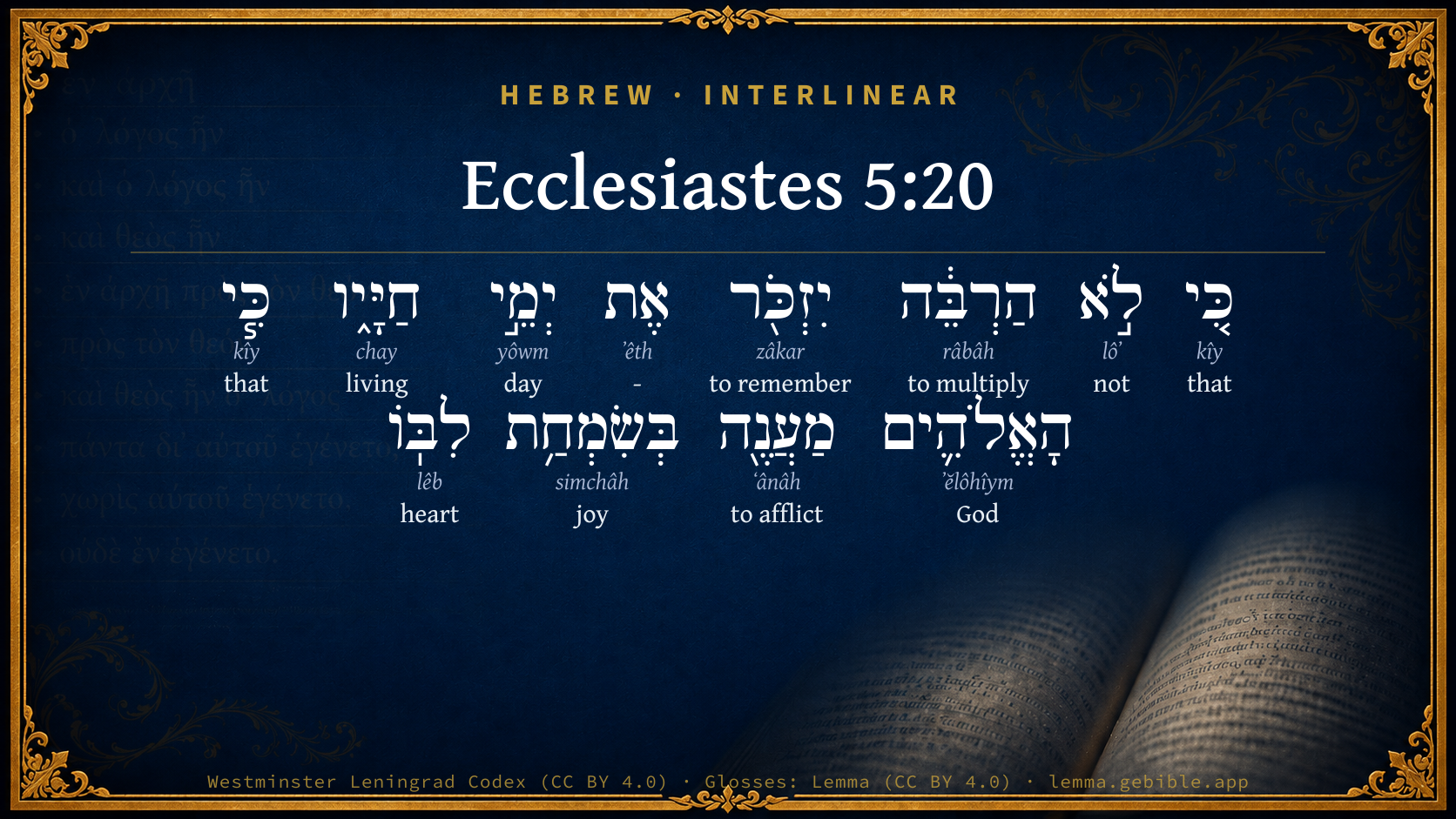
Hebrew (Westminster Leningrad Codex) Ecclesiastes 5:20 appears in the Hebrew Old Testament. The text above is from the Westminster Leningrad Codex. Each word links to its Strong’s number, a concise gloss, and parsing drawn from the Open Scriptures Hebrew Bible morphology. Click any word for its full Brown-Driver-Briggs (BDB) entry.
Download image
Cite this verse

Ecclesiastes 5:20 (World English Bible). Public Domain. Lemma interlinear Bible study tool, https://lemma.gebible.app/v/ecclesiastes/5/20.

Show BibTeX & RIS
BibTeX
RIS
English Translation
For he shall not often reflect on the days of his life; because God occupies him with the joy of his heart.
World English Bible · Public Domain
Download a study sheet

One document with this verse’s original text, its word-by-word gloss line, the meaning frame, cross-references with their text, attributed commentary, and full source and license credits — printable, and it pastes into notes with its structure intact.

This verse Autodidact and up

Study sheet (.html) Plain text (.txt)

A passage Seminary Student

Up to 50 verses in one chapter. A passage sheet keeps up to 6 commentary sources and 12 cross-references per verse, in the order this page ranks them, and says so on the sheet whenever that leaves anything out. Ask for a single verse and you get the Autodidact verse sheet above.

Everything on this page stays free to read, with no account — the sheet is a download of what is already on screen, not access to it.

Want to remove ads? Support Godless Engineer
Compare translations 3

The same verse in 3 English versions, stacked beneath the original-language interlinear above. Click any original word for its lexicon entry.

Each is an independent rendering of the whole verse — the interlinear is not word-aligned to these translations.

Highlighted words mark where these versions differ — a whole-verse word diff, not a word-by-word alignment.

  • World English Bible Public Domain
    For he shall not often reflect on the days of his life; because God occupies him with the joy of his heart.
  • King James Version Public Domain
    For he shall not much remember the days of his life; because God answereth him in the joy of his heart.
  • unfoldingWord Literal Text CC BY-SA 4.0
    For not much does he remember the days of his life, because the God occupies with the joys of his heart.

unfoldingWord Literal Text — © unfoldingWord, licensed CC BY-SA 4.0. Word-aligned USFM3 via Door43 (git.door43.org/unfoldingWord/en_ult).

Versions to compare (up to 4)

3 of 4 selected

Show all 14 translations

Every available English version of this verse, each an independent rendering of the whole verse.

  • World English Bible Public Domain
    For he shall not often reflect on the days of his life; because God occupies him with the joy of his heart.
  • Berean Standard Bible Public Domain
    For a man seldom considers the days of his life, because God keeps him occupied with the joy of his heart.
  • Majority Standard Bible Public Domain
    For a man seldom considers the days of his life, because God keeps him occupied with the joy of his heart.
  • King James Version Public Domain
    For he shall not much remember the days of his life; because God answereth him in the joy of his heart.
  • American Standard Version (1901) Public Domain
    For he shall not much remember the days of his life; because God answereth `him' in the joy of his heart.
  • Revised Version (1885) Public Domain
    For he shall not much remember the days of his life; because God answereth him in the joy of his heart.
  • Young's Literal Translation Public Domain
    For he doth not much remember the days of his life, for God is answering through the joy of his heart.
  • Literal Standard Version CC BY-SA 4.0
    For he does not much remember the days of his life, for God is answering through the joy of his heart.
  • Unlocked Literal Bible CC BY-SA 4.0
    For he does not call to mind very often the days of his life, because God makes him keep busy with the things that he enjoys doing.
  • unfoldingWord Literal Text CC BY-SA 4.0
    For not much does he remember the days of his life, because the God occupies with the joys of his heart.
  • Darby Bible Public Domain
    For he will not much remember the days of his life, because God answereth [him] with the joy of his heart.
  • World Messianic Bible Public Domain
    For he shall not often reflect on the days of his life, because God occupies him with the joy of his heart.
  • Free Bible Version CC BY-SA 4.0
    In fact such people have little time to think about life because God keeps them busy with all that makes them happy.
  • JPS Tanakh (1917) Public Domain
    (5-19) For let him remember the days of his life that they are not many; for God answereth him in the joy of his heart.

Literal Standard Version (2020), Covenant Press — licensed CC BY-SA 4.0. Text via the HelloAO Bible API (eBible.org). Unlocked Literal Bible (unfoldingWord) — licensed CC BY-SA 4.0. Text via the HelloAO Bible API (eBible.org). unfoldingWord Literal Text — © unfoldingWord, licensed CC BY-SA 4.0. Word-aligned USFM3 via Door43 (git.door43.org/unfoldingWord/en_ult). Free Bible Version, Dr. Jonathan Gallagher — licensed CC BY-SA 4.0. Text via the HelloAO Bible API (eBible.org).

Word by word

More ways to search: Search by grammar → Find every occurrence → Compare this word →

Practice this passage: Drill this verse → Learn its vocabulary →

מַעֲנֶ֖ה
ʻânâh
H6031
“afflicting”
Verb, Hiphil, Participle Active, Masculine, Singular, Absolute
Part of Speech
Verb
Stem
Hiphil
Form
Participle Active
Gender
Masculine
Number
Singular
State
Absolute
Full BDB Definition

Origin: a primitive root [possibly rather ident. with H6030 through the idea of looking down or browbeating]

TWOT: 1651 , 1652

(Qal) to be occupied, be busied with - to afflict, oppress, humble, be afflicted, be bowed down - (Qal) - to be put down, become low - to be depressed, be downcast - to be afflicted - to stoop - (Niphal) - to humble oneself, bow down - to be afflicted, be humbled - (Piel) - to humble, mishandle, afflict - to humble, be humiliated - to afflict - to humble, weaken oneself - (Pual) - to be afflicted - to be humbled - (Hiphil) to afflict - (Hithpael) - to humble oneself - to be afflicted

  1. כִּ֚י kîy H3588 “that” Conjunction
  2. לֹ֣א lôʼ H3808 “not” Particle, Negative
  3. הַרְבֵּ֔ה râbâh H7235 “to multiply” Verb, Hiphil, Infinitive Absolute
  4. יִזְכֹּ֖ר zâkar H2142 “to remember” Verb, Qal, Imperfect, 3rd Person, Masculine, Singular
  5. אֶת ʼêth H853 “-” Particle, Direct Object
  6. יְמֵ֣י yôwm H3117 “days of” Noun, Common, Masculine, Plural, Construct
  7. חַיָּ֑יו chay H2416 “living things · his” Noun, Common, Masculine, Plural, Construct + Suffix, Personal, 3rd Person, Masculine, Singular
  8. כִּ֧י kîy H3588 “that” Conjunction
  9. הָאֱלֹהִ֛ים ʼĕlôhîym H430 “the · God(s)” Particle, Definite Article + Noun, Common, Masculine, Plural, Absolute
  10. בְּשִׂמְחַ֥ת simchâh H8057 “in/at · joy of” Preposition + Noun, Common, Feminine, Singular, Construct
  11. לִבּֽוֹ lêb H3820 “heart · his” Noun, Common, Masculine, Singular, Construct + Suffix, Personal, 3rd Person, Masculine, Singular

About this verse

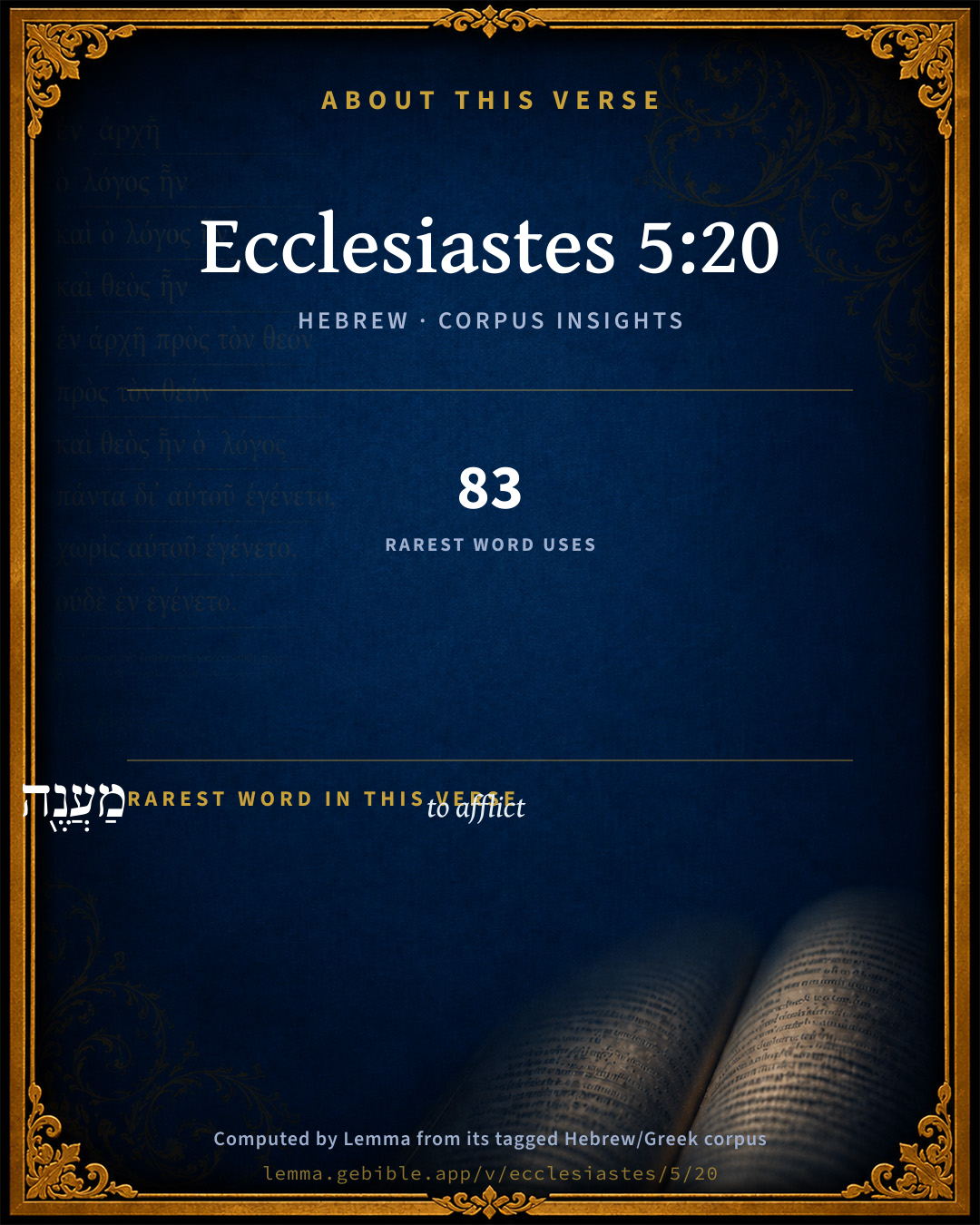
These counts appear in no published source. They are computed here, from the morphology-tagged text and Lemma’s own curated glosses. What Lemma adds →

12
words
11
distinct lemmas
Wisdom
section

Grammatical profile

  • 3 verbs
  • 5 nouns
  • 2 conjunctions
  • 2 particles

Verb forms

  • הַרְבֵּ֔ה Hiphil · Infinitive Absolute
  • יִזְכֹּ֖ר Qal · Imperfect
  • מַעֲנֶ֖ה Hiphil · Participle Active

Repetition

A word recurs within this verse — often emphatic in Hebrew:

  • כִּ֚י that H3588 ×2

Cross-references

9

Topical passages linked to Ecclesiastes 5:20 in the Treasury of Scripture Knowledge — connected by theme and wording, ordered by reader-vote popularity; previews shown in the World English Bible.

  • Psalms 37:16 Better is a little that the righteous has, Than the abundance of many wicked.
  • Isaiah 65:13–14 Therefore thus says the Lord Yahweh, Behold, my servants shall eat, but you shall be hungry; behold, my servants shall drink, but you shall be thirsty; behold, my servants shall rejoice, but you shall be disappointed;
  • Isaiah 65:21–24 They shall build houses, and inhabit them; and they shall plant vineyards, and eat the fruit of them.
  • Psalms 4:6–7 Many say, "Who will show us any good?" Yahweh, let the light of your face shine on us.
  • Romans 5:1 Being therefore justified by faith, we have peace with God through our Lord Jesus Christ;
  • Deuteronomy 28:8–12 Yahweh will command the blessing on you in your barns, and in all that you put your hand to; and he will bless you in the land which Yahweh your God gives you.
  • Deuteronomy 28:47 Because you didn't serve Yahweh your God with joyfulness, and with gladness of heart, by reason of the abundance of all things;
  • Isaiah 64:5 You meet him who rejoices and works righteousness, those who remember you in your ways: behold, you were angry, and we sinned: in them [have we been] of long time; and shall we be saved?
  • Romans 5:5–11 and hope doesn't disappoint us, because God's love has been poured out into our hearts through the Holy Spirit who was given to us.

Cross-references courtesy of OpenBible.info (CC BY 4.0).

Hebrew and Greek witnesses Masoretic Hebrew ↔ Greek Septuagint

The same verse in the two great witnesses to the Old Testament, shown verse-for-verse.

These are two independent witnesses, not word-aligned to each other, and the Septuagint is shown in lemma (dictionary) form.

Hebrew Ecclesiastes 5:20 Masoretic · Westminster Leningrad Codex

כִּ֚י לֹ֣א הַרְבֵּ֔ה יִזְכֹּ֖ר אֶת יְמֵ֣י חַיָּ֑יו כִּ֧י הָאֱלֹהִ֛ים מַעֲנֶ֖ה בְּשִׂמְחַ֥ת לִבּֽוֹ

For he shall not often reflect on the days of his life; because God occupies him with the joy of his heart.

World English Bible · Public Domain

On this verse, The Pulpit Commentary discusses the Septuagint’s reading. Read the note in Commentary ↓

Hebrew: Westminster Leningrad Codex (CC BY 4.0). Greek: Septuagint (public domain); English from a public-domain English Septuagint. How the Septuagint differs from the Hebrew →

Commentary

Notes on Ecclesiastes 5:20 from classic Christian and Jewish commentators (each source and its license shown beneath its notes). The classic Christian expositions comment on the surrounding passage and are grouped to its opening verse, so a note may address several verses; the Jewish commentaries on the Tanakh (Rashi and others) are per-verse, so they appear only where the commentator wrote on this verse.

Lemma curates 59 commentaries, every one of them public domain or Creative Commons licensed, each selected and text-cleaned for this edition rather than reprinted as found. About our sources →

Trapp's Complete Commentary

John Trapp

Ecc 5:20 For he shall not much remember the days of his life; because God answereth [him] in the joy of his heart.

Ver. 20. For he shall not much remember, &c.] He vexeth not at the brevity or misery of his life, but looketh upon himself as a stranger here, and therefore if he can have a better condition, he "useth it rather," {1Co 7:21} as if a traveller can get a better room in an inn, he will; if not, he can be content, for, saith he, it is but for a night.

John Trapp, A Commentary or Exposition upon All the Books of the Old and New Testament (1647–1656) — public domain. Text from a community e-Sword module.

Jamieson, Fausset & Brown

Robert Jamieson, A. R. Fausset & David Brown

He will not remember much, looking back with disappointment, as the ungodly do (Ecc 2:11), on the days of his life.

answereth . . . in the joy--God answers his prayers in giving him "power" to enjoy his blessings. GESENIUS and Vulgate translate, "For God (so) occupies him with joy," &c., that he thinks not much of the shortness and sorrows of life. HOLDEN, "Though God gives not much (as to real enjoyment), yet he remembers (with thankfulness) the days; for (he knows) God exercises him by the joy," &c. (tries him by prosperity), so Margin, but English Version is simplest.

Next: Ecclesiastes Chapter 6

Jamieson, Fausset & Brown — Commentary Critical and Explanatory on the Whole Bible (1871) — public domain (CC PDM 1.0). Text via the HelloAO Bible API.

Adam Clarke's Commentary

Verse 20. For he shall not much remember] The person who acts in this way, extracts all the good requisite from life. He passes through things temporal so as not to lose those that are eternal: -

"Calm and serene, the road of life to him,

Or long or short, rugged or smooth, with thorns

O'erspread, or gay with flowers, is but a road.

Such fare as offers grateful he accepts,

And smiling to his native home proceeds."

C.

Adam Clarke's Commentary on the Bible (1810–1826) — public domain. Text from a community e-Sword/MySword module.

Ellicott's Commentary for English Readers

(20) “In the enjoyment of God’s gifts he does not think much of the sorrows or brevity of life.” This is the usual explanation; and though not satisfied with it, we cannot suggest a better.

A Bible Commentary for English Readers, edited by Charles John Ellicott (1878–1897) — public domain. Text from a community e-Sword module.

The Cambridge Bible for Schools and Colleges

gen. ed. J. J. S. Perowne

20. he shall not much remember the days of his life] This follows the order of the Hebrew and gives a satisfying meaning: The man who has learnt the secret of enjoyment is not anxious about the days of his life, does not brood even over its transitoriness, but takes each day tranquilly, as it comes, as God’s gift to him. By some commentators, however, the sentence is construed so as to give just the opposite sense, “He remembereth (or should remember) that the days of his life are not many,” i.e. never loses sight of the shortness of human life. It is difficult to see how the translators of the A. V. could have been led to their marginal reading “Though he give not much, yet he remembereth the days of his life.”

because God answereth him in the joy of his heart] The verb has been very variously rendered, (1) “God occupies him with the joy …,” or (2) “God makes him sing with the joy …,” or (3) “God causeth him to work for the enjoyment …,” or (4) “God makes all answer (i.e. correspond with) his wishes,” or (5) “God himself corresponds to his joy,” i.e. is felt to approve it as harmonizing, in its calm evenness, with His own blessedness. The last is, perhaps, that which has most to commend it. So taken, the words find a parallel in the teaching of Epicurus, “The Blessed and the Immortal neither knows trouble of its own nor causeth it to others. Wherefore it is not influenced either by wrath or favour,” (Diog. Laert. x. 1. 139). The tranquillity of the wise man mirrors, the Teacher implies, the tranquillity of God. So Lucretius;

“Omnis enim per se divum natura necessest,

Immortali ævo summâ cum pace fruatur,

Semota ab nostris rebus sejunctaque longe;

Nam privata dolore omni, privata periclis,

Ipsa suis pollens opibus, nil indiga nostri,

Nec bene promeritis capitur neque tangitur ira.”

“The nature of the Gods must need enjoy

Life everlasting in supreme repose,

Far from our poor concerns and separate:

For from all pain exempt, exempt from risks,

Rich in its own wealth, needing nought of ours,

’Tis neither soothed by gifts nor stirred by wrath.”

De Rer. Nat. ii. 646–651.

The Cambridge Bible for Schools and Colleges (gen. ed. J. J. S. Perowne; Cambridge University Press, 1878–1918) — public domain. Text from a community e-Sword module.

John Gill's Exposition

For he shall not much remember the days of his life,.... Be they more or fewer, as Jarchi: he will not think life long and tedious; nor dwell upon, and distress himself with, the troubles he has met with, or is likely to meet with; but, being content with the good things God has given him, and freely and cheerfully enjoying them, he passes away his time delightfully and pleasantly. Some, as Aben Ezra observes, and which he approves of, and is agreeably to the accents, render the words, "if he has not much, he remembers the days of his life" (t); if he has but little of the good things of this life, he remembers how few his days are he has to live; and doubts not he shall have enough to carry him to the end of his days, and therefore is quite easy and content; he calls to mind how he has been supplied all his days hitherto, and is persuaded that that God, who has provided for him, will continue his goodness to him, and that he shall not want any good thing; and therefore does not distress himself with what is to come;

because God answereth him in the joy of his heart; he calls upon God for a blessing on his labours, asks of him his daily food, and desires what may be proper and sufficient for him, or what he judges is necessary and convenient; and God answers his prayers and petitions, and good wishes, by filling his heart with food and gladness; and giving him that cheerfulness of spirit, and thankfulness of heart, in the enjoyment of every blessing; and especially if along with it he lifts up the light of his countenance, and grants him joy in the Holy Ghost; he will go on so pleasantly and comfortably as to forget all his former troubles; and it will dissipate his doubts and fears about how he shall live for the future.

(t) "quod si non multum recordabitur dierum vitae suae", Junius & Tremellius.

Next: Ecclesiastes Chapter 6

John Gill's Exposition of the Whole Bible (1746–1763) — public domain (CC PDM 1.0). Text via the HelloAO Bible API.

Albert Barnes' Notes on the Bible

The days will pass smoothly and pleasantly, while he lives in the consciousness of God’s favor.

Answereth him - i. e., grants his prayers.

Albert Barnes' Notes on the Bible (1834–1885) — public domain. Text from a community e-Sword/MySword module.

Matthew Poole's English Annotations

He shall not much remember; so as to disquiet or vex himself therewith.

The days; either,

1. The troubles; days being here put for evil or sad days, by a usual synecdoche, as Job 18:20; Psa 137:7; Ob 12; Mic 7:4. Or,

2. The time in general; which is irksome and tedious to men oppressed with discontent or misery, who usually reckon every hour or minute that passeth, and have their minds and thoughts constantly fixed upon the vanity and uncertainty of this life, upon the afflictions which they have already endured and may further expect; whereas to men of contented and cheerful minds the time is short and sweet, and passeth over them before they are aware of it, and they enjoy their present comforts without perplexing themselves about former or future events.

Answereth him; answereth, either,

1. His labours with success, as money is said to answer all things, Ecc 10:19, because it is equivalent to all, and able to purchase all things. Or,

2. His desires. In the joy of his heart; in giving him that solid joy and comfort of his labours which his heart expected and desired.

Matthew Poole's English Annotations on the Holy Bible (1683–1685) — public domain. Text from a community e-Sword/MySword module.

Whedon's Commentary on the Bible

Daniel D. Whedon

20. In this verse much agrees with the days of his life. A better placing would be, For he must remember the days of his life are not many in which God gives him power to work for the joy of his heart. The grammar clears up the sense.

Daniel D. Whedon (gen. ed.), Commentary on the Old and New Testaments (1874–1909) — public domain. Text from a community e-Sword module.

The Pulpit Commentary

For he shall not much remember the days of his life. The man who has learned the lesson of calm enjoyment does not much concern himself with the shortness, uncertainty, or possible trouble of life. He carries out the counsel of Christ, Be not anxious for the morrow, for the morrow will be anxious for itself. Sufficient unto the day is the evil thereof". (Mat_6:34) Ginsburg gives an entirely opposite rendering to the clause, He should remember that the days of his life are not many;" i.e. the thought of the shortness of life should urge us to enjoy it while it lasts. But the Authorized Version is supported by the Septuagint and Vulgate and most modern commentators, and seems most appropriate to the context. The marginal rendering, Though he give not much, yet he remembereth," etc., which Ginsburg calls a literary curiosity, must have been derived from the version of Junius, which gives, "Quod si non multum (supple, est illud quod dederit Deus, ex versu praec.)," etc. Because God answereth him in the joy of his heart. The man passes a calm and contented life, because God shows that he is pleased with him by the tranquil joy shed over his heart. The verb hn, (the hiph. participle of hn) is variously rendered. The Septuagint gives, JO Qeov perispa aujtonh kardiav aujtou, "God distracts him in the mirth of his heart;" Vulgate, Eo quod Deus occupet deliciis cot ejus; Ginsburg, "God causeth him to work for the enjoyment of his heart," i.e. God assigns him work that he may thence derive enjoyment; Koster," God makes him sing in the joy of his heart;" Delitzsch, Wright, and Plumptre, "God answers (corresponds with) the joy of his heart," which the latter explains to mean "is felt to approve it as harmonizing, in its calm evenness, with his own blessedness, the tranquility of the wise man mirroring the tranquility of God." But this modified Epicureanism is alien from the teaching of Koheleth. Rather the idea is that God answers him with, imparts to him, joy of heart, makes him sensible of his favorable regard by this inward feeling of satisfaction and content.

The Pulpit Commentary (1880–1919), ed. H.D.M. Spence-Jones & Joseph S. Exell — public domain. Text from a community e-Sword module.

John Wesley's Explanatory Notes

Remember - So as to disquiet himself. The days - The troubles; days being put here for evil, or, sad days. Answereth - His desires, in giving him solid joy and comfort.

John Wesley, Explanatory Notes Upon the Whole Bible (1754–1765) — public domain. Text via the GEBible commentary corpus.

Keil & Delitzsch

C. F. Keil & F. Delitzsch

Over this enjoyment he forgets the frailty and the darkened side of this life. It proves itself to be a gift of God, a gift from above: "For he doth not (then) think much of the days of his life; because God answereth the joy of his heart." Such an one, permitted by God to enjoy this happiness of life, is thereby prevented from tormenting himself by reflections regarding its transitoriness. Incorrectly, Hengst.: Remembrance and enjoyment of this life do not indeed last long, according to Ewald, who now, however, rightly explains: He will not, by constant reflection on the brevity of his life, too much embitter this enjoyment; because God, indeed, grants to him true heart-joy as the fairest gift. The meaning of Ecc 5:19 is also, in general, hit upon. The lxx translates: "because God occupies him with the joy of his heart;" but for that we ought to have had the word מענהוּ; Jerome helps it, for he reads בשמהה instead of בשמחת: eo quod Deus occupet deliciis cor ejus. But also, in this form, this explanation of מענה is untenable; for ב ענה, the causat. of which would be מענה, signifies, in the style of Koheleth, not in general to busy oneself with something, but to weary oneself with something; hence ענה בשׂ cannot mean: to be occupied with joy, and thereby to be drawn away from some other thing. And since the explanation: "he makes him sing," needs to argument to dispose of it, מענה thus remains only as the Hiph. of אנה, to meet, to respond to, grant a request. Accordingly, Hitz., like Aben Ezra and Kimchi, comparing Hos 2:23.: God makes to answer, i.e., so works that all things which have in or of themselves that which can make him glad, must respond to his wish. But the omission of the obj. - of which Hitz. remarks, that because indefinite it is left indefinite - is insufferably hard, and the explanation thus ambiguous. Most interpreters translate: for God answers (Gesen. He. Wrt. B., incorrectly: answered) him with joy of his heart, i.e., grants this to him in the way of answer. Ewald compares Psa 65:6; but that affords no voucher for the expression: to answer one with something = to grant it to him; for ענה is there connected with a double accus., and בּצדק is the adv. statement of the way and manner. But above all, against this interpretation is the fact of the want of the personal obj. The author behoved to have written מענהוּ or אתו מענה. We take the Hiph. as in the sense of the Kal, but give it its nearest signification: to answer, and explain, as in a similar manner Seb. Schmid, Rambam, and others have already done: God answers to the joy of his heart, i.e., He assents to it, or (using an expression which is an exact equivalent), He corresponds to it. This makes the joy a heart-joy, i.e., a joy which a man feels not merely externally, but in the deepest recess of his heart, for the joy penetrates his heart and satisfies it (Sol 3:11; Isa 30:29; Jer 15:16). A similar expression, elsewhere not found, we had at Ecc 5:9 in אהב בּ. Why should not ענה ב (הענה) be possible with ענהוּ, just as ἀμείβεσθαι πρός τι is with ἀμείβεσθαί τινα? For the rest, בש לב is not needed as obj.; we can take it also as an expression of the state or condition: God gives answer in the heart-joy of such an one. In ענה, to answer, to hear the answer, is thought of as granting a request; here, as giving assent to. Job 35:9 affords a twofold suitable example, that the Hiph. can have an enlarged Kal signification.

After the author has taken the opportunity of once more expressing his ultimatum, he continues to register the sad evils that cling to wealth.

Keil & Delitzsch — Biblical Commentary on the Old Testament (1861–1891) — public domain (CC PDM 1.0). Text via the HelloAO Bible API. (Old Testament only.)

Lesson kit

Teaching starters — assembled from the data on this page, not authored interpretation. Every prompt links to the verse data it draws on. Edit before teaching.

Ecclesiastes, in the Wisdom, opens this verse with 12 words (11 distinct Hebrew lemmas). Its most distinctive word is ʻânâh (“to afflict”). A historical commentator’s framing appears above. Read the whole chapter for the surrounding context.

Discussion questions

  1. What does “to afflict” (ʻânâh) contribute to the verse as a whole?
  2. How does Psalms 37:16, which shares this passage’s theme, read alongside this verse?
  3. What does the repetition of “that” (2× in this one verse) do in this verse?
  4. These translations render this verse differently; the difference is in the English rendering, not the original. What questions does that raise?
  5. «הַרְבֵּ֔ה» is a Hiphil Infinitive Absolute verb. How does that grammatical form shape the action described?
  6. Compare how Trapp's Complete Commentary and Jamieson, Fausset & Brown read this verse. Where do they agree or differ?

Things to notice

Reading settings

Reading text

Shown beneath each verse's original-language words.

Old Testament
Old Testament edition

Read the OT as the Masoretic Hebrew (MT) or the Greek Septuagint (LXX).

English shown for the Greek Septuagint (in the Hebrew ↔ Greek comparison).

Comparing translations? Open the Compare panel on any verse page to stack up to four side by side.