
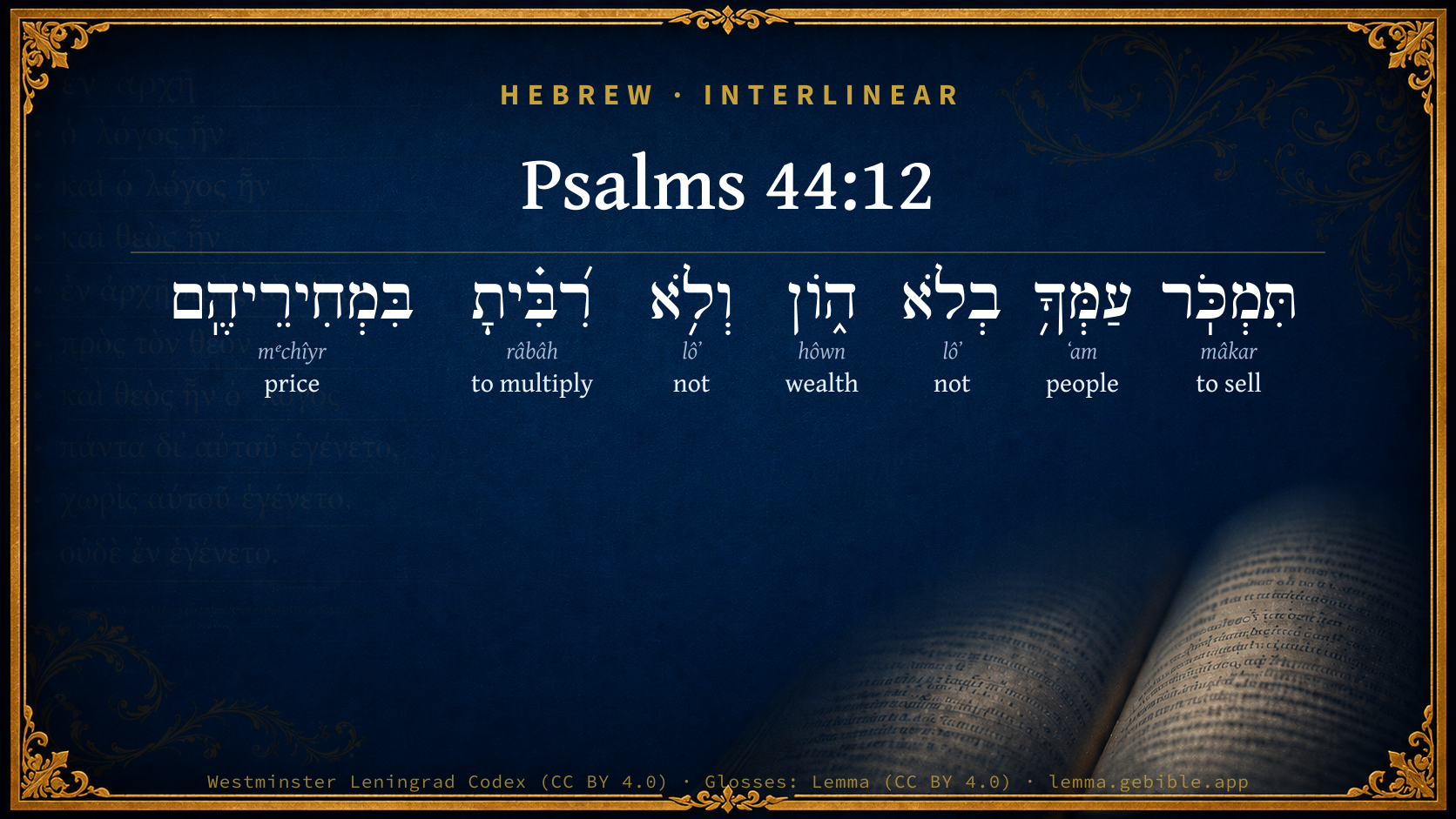
Psalms 44:12

Hebrew (Westminster Leningrad Codex) Psalms 44:12 appears in the Hebrew Old Testament. The text above is from the Westminster Leningrad Codex. Each word links to its Strong’s number, a concise gloss, and parsing drawn from the Open Scriptures Hebrew Bible morphology. Click any word for its full Brown-Driver-Briggs (BDB) entry.
Download image
Cite this verse

Psalms 44:12 (World English Bible). Public Domain. Lemma interlinear Bible study tool, https://lemma.gebible.app/v/psalms/44/12.

Show BibTeX & RIS
BibTeX
RIS
English Translation
You sell your people for nothing, And have gained nothing from their sale.
World English Bible · Public Domain
Highlights
  • 1 first appearance in the Hebrew Bible
Full analysis ↓
Download a study sheet

One document with this verse’s original text, its word-by-word gloss line, the meaning frame, cross-references with their text, attributed commentary, and full source and license credits — printable, and it pastes into notes with its structure intact.

This verse Autodidact and up

Study sheet (.html) Plain text (.txt)

A passage Seminary Student

Up to 50 verses in one chapter. A passage sheet keeps up to 6 commentary sources and 12 cross-references per verse, in the order this page ranks them, and says so on the sheet whenever that leaves anything out. Ask for a single verse and you get the Autodidact verse sheet above.

Everything on this page stays free to read, with no account — the sheet is a download of what is already on screen, not access to it.

Want to remove ads? Support Godless Engineer
Compare translations 3

The same verse in 3 English versions, stacked beneath the original-language interlinear above. Click any original word for its lexicon entry.

Each is an independent rendering of the whole verse — the interlinear is not word-aligned to these translations.

Highlighted words mark where these versions differ — a whole-verse word diff, not a word-by-word alignment.

  • World English Bible Public Domain
    You sell your people for nothing, And have gained nothing from their sale.
  • King James Version Public Domain
    Thou sellest thy people for nought, and dost not increase thy wealth by their price.
  • unfoldingWord Literal Text CC BY-SA 4.0
    You have sold your people for not-wealth, and you have not increased by their price.

unfoldingWord Literal Text — © unfoldingWord, licensed CC BY-SA 4.0. Word-aligned USFM3 via Door43 (git.door43.org/unfoldingWord/en_ult).

Versions to compare (up to 4)

3 of 4 selected

Show all 18 translations

Every available English version of this verse, each an independent rendering of the whole verse.

  • World English Bible Public Domain
    You sell your people for nothing, And have gained nothing from their sale.
  • Berean Standard Bible Public Domain
    You sell Your people for nothing; no profit do You gain from their sale.
  • Majority Standard Bible Public Domain
    You sell Your people for nothing; no profit do You gain from their sale.
  • King James Version Public Domain
    Thou sellest thy people for nought, and dost not increase thy wealth by their price.
  • American Standard Version (1901) Public Domain
    Thou sellest thy people for nought, And hast not increased `thy wealth' by their price.
  • Revised Version (1885) Public Domain
    Thou sellest thy people for nought, and hast not increased thy wealth by their price.
  • Geneva Bible (1599) Public Domain
    Thou sellest thy people without gaine, and doest not increase their price.
  • Douay-Rheims (1899) Public Domain
    Thou hast given us up like sheep to be eaten: thou hast scattered us among the nations.
  • Young's Literal Translation Public Domain
    Thou sellest Thy people -- without wealth, And hast not become great by their price.
  • Literal Standard Version CC BY-SA 4.0
    You sell Your people—without wealth, || And have not become great by their price.
  • Unlocked Literal Bible CC BY-SA 4.0
    You sell your people for nothing; you have not increased your wealth by doing so.
  • unfoldingWord Literal Text CC BY-SA 4.0
    You have sold your people for not-wealth, and you have not increased by their price.
  • Darby Bible Public Domain
    Thou hast sold thy people for nought, and hast not increased [thy wealth] by their price;
  • World Messianic Bible Public Domain
    You sell your people for nothing, and have gained nothing from their sale.
  • Webster's Bible Public Domain
    \\44:11\\Thou hast given us like sheep appointed for food; and hast scattered us among the heathen.
  • Free Bible Version CC BY-SA 4.0
    You have sold your own people for next to nothing, making no profit on the sale.
  • Bible in Basic English Public Domain
    You let your people go for nothing; your wealth is not increased by their price.
  • JPS Tanakh (1917) Public Domain
    (44-13) Thou sellest Thy people for small gain, and hast not set their prices high.

Literal Standard Version (2020), Covenant Press — licensed CC BY-SA 4.0. Text via the HelloAO Bible API (eBible.org). Unlocked Literal Bible (unfoldingWord) — licensed CC BY-SA 4.0. Text via the HelloAO Bible API (eBible.org). unfoldingWord Literal Text — © unfoldingWord, licensed CC BY-SA 4.0. Word-aligned USFM3 via Door43 (git.door43.org/unfoldingWord/en_ult). Free Bible Version, Dr. Jonathan Gallagher — licensed CC BY-SA 4.0. Text via the HelloAO Bible API (eBible.org).

Word by word

More ways to search: Search by grammar → Find every occurrence → Compare this word →

Practice this passage: Drill this verse → Learn its vocabulary →

About this verse

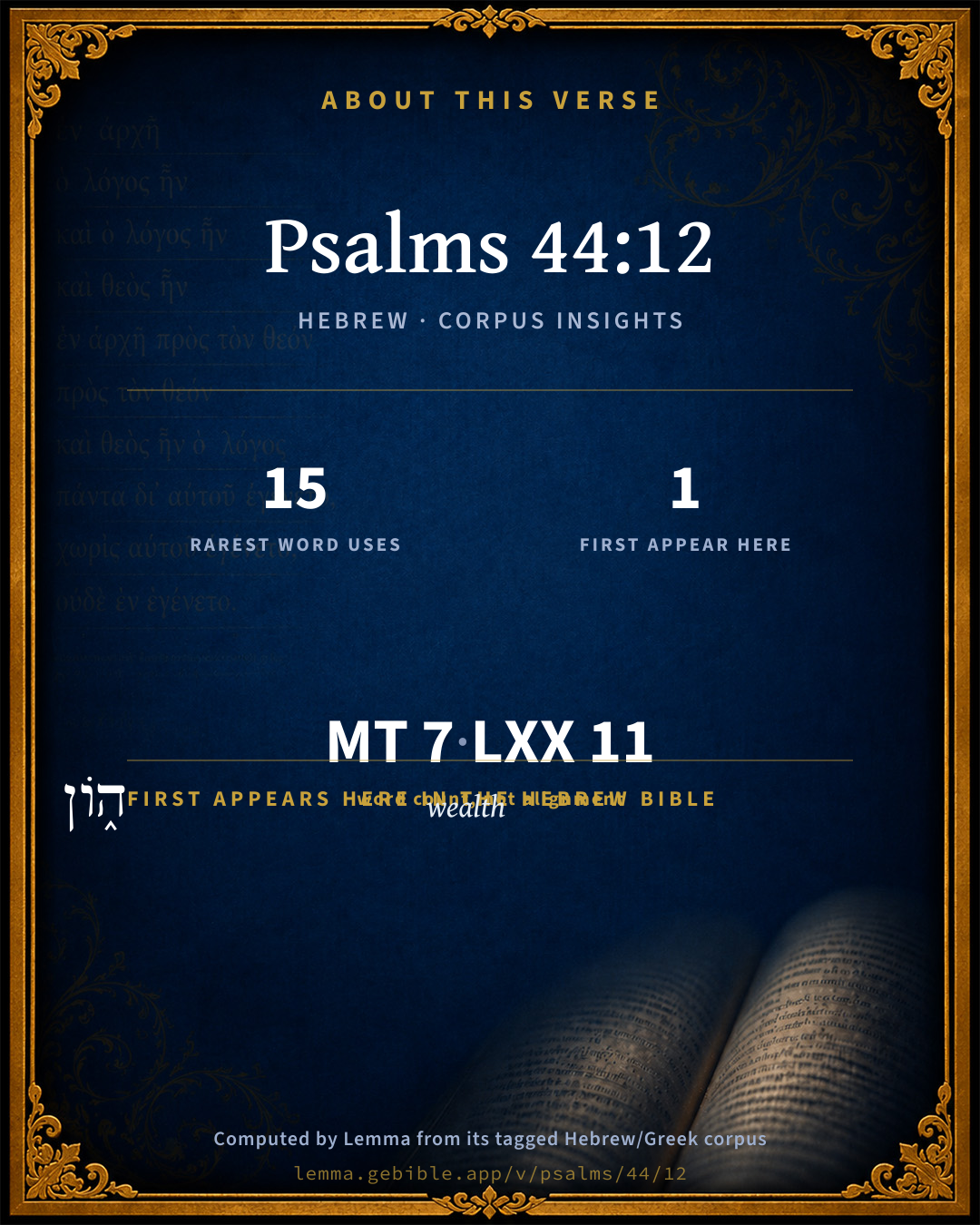
These counts appear in no published source. They are computed here, from the morphology-tagged text and Lemma’s own curated glosses. What Lemma adds →

7
words
6
distinct lemmas
Wisdom
section

Notable vocabulary

The rarest word here is בִּמְחִירֵיהֶֽם price H4242 — appearing just 15 times in the whole Hebrew Bible.

First appearance in Scripture

This word makes its first canonical appearance in the Hebrew Bible here:

  • ה֑וֹן wealth H1952

Shared distinctive vocabulary

בִּמְחִירֵיהֶֽם price H4242 occurs in 15 verses of the Hebrew Bible. Also found in:

Grammatical profile

  • 2 verbs
  • 3 nouns
  • 2 particles

Verb forms

  • תִּמְכֹּֽר Qal · Imperfect
  • רִ֝בִּ֗יתָ Piel · Perfect

Repetition

A word recurs within this verse — often emphatic in Hebrew:

  • בְלֹא not H3808 ×2

Hebrew & Septuagint length

In English translation the verse runs 13 words from the Hebrew and 15 from the Septuagint (LXX English) — closely comparable.

A rough comparison of the two English renderings, which tokenize alike — not a word-level alignment.

Word counts can differ between the Hebrew and the Greek without any difference in meaning — e.g. the Hebrew direct-object marker אֵת has no separate Greek word, and Greek often adds the article ὁ.

In the original languages it is 7 Hebrew tokens and 11 Greek tokens — but the two are counted differently (Hebrew bundles its prefixes and suffixes into one token; the Greek is in lemma form), so that isn’t a like-for-like length.

Cross-references

8

Topical passages linked to Psalms 44:12 in the Treasury of Scripture Knowledge — connected by theme and wording, ordered by reader-vote popularity; previews shown in the World English Bible.

  • Jeremiah 15:13 Your substance and your treasures will I give for a spoil without price, and that for all your sins, even in all your borders.
  • Deuteronomy 32:30 How should one chase a thousand, Two put ten thousand to flight, Except their Rock had sold them, Yahweh had delivered them up?
  • Isaiah 52:3–4 For thus says Yahweh, You were sold for nothing; and you shall be redeemed without money.
  • Judges 2:14 The anger of Yahweh was kindled against Israel, and he delivered them into the hands of spoilers who despoiled them; and he sold them into the hands of their enemies round about, so that they could not any longer stand before their enemies.
  • Judges 3:8 Therefore the anger of Yahweh was kindled against Israel, and he sold them into the hand of Cushan Rishathaim king of Mesopotamia: and the children of Israel served Cushan Rishathaim eight years.
  • Isaiah 50:1 Thus says Yahweh, Where is the bill of your mother's divorce, with which I have put her away? or which of my creditors is it to whom I have sold you? Behold, for your iniquities were you sold, and for your transgressions was your mother put away.
  • Nehemiah 5:8–12 I said to them, We after our ability have redeemed our brothers the Jews, that were sold to the nations; and would you even sell your brothers, and should they be sold to us? Then held they their peace, and found never a word.
  • Revelation 18:13 and cinnamon, incense, perfume, frankincense, wine, olive oil, fine flour, wheat, sheep, horses, chariots, bodies, and people's souls.

Cross-references courtesy of OpenBible.info (CC BY 4.0).

Hebrew and Greek witnesses Masoretic Hebrew ↔ Greek Septuagint

The same verse in the two great witnesses to the Old Testament, shown verse-for-verse.

You’re reading Greek Psalm 43 (Hebrew Psalm 44). The Septuagint counts the superscription, so verse numbers can differ from the Hebrew — chapter-level alignment, not verse-by-verse. Numbering follows Rahlfs.

These are two independent witnesses, not word-aligned to each other, and the Septuagint is shown in lemma (dictionary) form.

Hebrew Psalms 44:12 Masoretic · Westminster Leningrad Codex

תִּמְכֹּֽר עַמְּךָ֥ בְלֹא ה֑וֹן וְלֹ֥א רִ֝בִּ֗יתָ בִּמְחִירֵיהֶֽם

You sell your people for nothing, And have gained nothing from their sale.

World English Bible · Public Domain

Greek LXX Greek Psalm 43:12 Septuagint · lemma form

δίδωμι ἐγώ ὡς πρόβατον βρῶσις καί ἐν ὁ ἔθνος διασπείρω ἐγώ

You have sold your people without price, and there was no profit by their exchange.

LXX2012 (modern English Septuagint) · Public Domain

Hebrew: Westminster Leningrad Codex (CC BY 4.0). Greek: Septuagint (public domain); English from LXX2012 (modern English Septuagint) (Public Domain). How the Septuagint differs from the Hebrew →

Commentary

Notes on Psalms 44:12 from classic Christian and Jewish commentators (each source and its license shown beneath its notes). The classic Christian expositions comment on the surrounding passage and are grouped to its opening verse, so a note may address several verses; the Jewish commentaries on the Tanakh (Rashi and others) are per-verse, so they appear only where the commentator wrote on this verse.

Lemma curates 59 commentaries, every one of them public domain or Creative Commons licensed, each selected and text-cleaned for this edition rather than reprinted as found. About our sources →

Trapp's Complete Commentary

John Trapp

Psa 44:12 Thou sellest thy people for nought, and dost not increase [thy wealth] by their price.

Ver. 12. Thou sellest thy people for nought] Thirty for a penny the Jews were sold by the Romans, saith Josephus, at the last devastation.

And dost not increase thy wealth by their price] Thou takest thy first chapman (as the pope gave England, in Henry VIIl’s time, Primo occupaluro, to him that could first seize it), and hast not made thy best of them; but given them away, for whom thou wast wont to give great nations, Isa 43:3. All the comfort in this case was, that yet they were dear to God as his sons, though sold for slaves to the enemies, as may be seen, Isa 50:1; Isa 52:3.

John Trapp, A Commentary or Exposition upon All the Books of the Old and New Testament (1647–1656) — public domain. Text from a community e-Sword module.

J. A. Alexander on Psalms

Joseph Addison Alexander

13. (Psa 44:12). Thou wilt sell thy people without gain, and hast not increased by their price. They seemed to be gratuitously given up, i.e. without necessity or profit. Without gain, literally wealth or riches, as a product or equivalent. The same noun may be repeated in the next clause, thou hast not increased (thy wealth), just as the verb gain is absolutely used in English. Their price, literally their prices, perhaps with reference to the individual captives, or to repeated sales of the kind here mentioned. Another possible but far less natural construction, treats the preposition as a mere connective, and reads, thou hast not enhanced their price, i. e. set a high price upon them, implying that he had, on the contrary, sold them for too little, or rather given them away for nothing. Compare Jer 15:13.

Joseph Addison Alexander, The Psalms Translated and Explained (1850) — public domain. Text from a community e-Sword module.

Geneva Bible (1599)

Geneva Bible translators

As slaves which are sold for a low price, neither lookest thou for him that offereth most, but takest the first chapman.

Geneva Bible (1599) marginal notes — public domain. Text via Bolls.life.

Adam Clarke's Commentary

Verse 12. Thou sellest thy people for nought] An allusion to the mode of disposing of slaves by their proprietors or sovereigns. Instead of seeking profit, thou hast made us a present to our enemies.

Adam Clarke's Commentary on the Bible (1810–1826) — public domain. Text from a community e-Sword/MySword module.

John Calvin's Commentaries

12 Thou hast sold thy people, and not become rich. In saying that they were sold without any gain, it is meant that they were exposed to sale as slaves that are contemptible, and of no value. In the second clause, too, And hast not increased the price of them, there seems to be an allusion to the custom of exposing things to auction, and selling them to the highest bidder. We know that those slaves who were sold were not delivered to the buyers till the price of them had been increased by bidding. Thus the faithful mean, that they were cast out as being altogether worthless, so that their condition had been worse than that of any bond-slave. And as they rather appeal to God than turn to their enemies, of whose pride and cruelty they had just cause to complain, let us learn from this, that there is nothing better, or more advantageous for us in our adversity, than to give ourselves to meditation upon the providence and judgment of God. When men trouble us, it is no doubt the devil who drives them to it, and it is with him we have to do; but we must, notwithstanding, raise our thoughts to God himself, that we may know that we are proved and tried by him, either to chastise us, or to exercise our patience, or to subdue the sinful desires of our flesh, or to humble us and train us to the practice of self-denial. And when we hear that the Fathers who lived under the Law were treated so ignominiously, there is no reason why we should lose courage by any outrage or ill treatment, if God should at any time see meet to subject us to it. It is not here said simply that God sold some people, but that he sold his own people, as if his own inheritance were of no estimation in his sight. Even at this day, we may in our prayers still make the same complaint, provided we, at the same time, make use of this example, for the purpose of supporting and establishing our faith, so that, however much afflicted we may be, our hearts may not fail us. In Isaiah 52:3, God, using the same form of speech, says that he sold his people without price; but there it is to be understood in a different sense, namely, to show that he will have no difficulty in redeeming them, because he is under no obligation to those that bought them, and had received nothing from them in return.

John Calvin's Commentaries (1540-1563) — public domain. Text from the Calvin Translation Society English edition (1840s-50s) via the Christian Classics Ethereal Library (ccel.org). Calvin's coverage is partial (roughly two-thirds of the Bible); uncommented books and verses are honest gaps, never fabricated. The 19th-century editor's footnotes and remarks are omitted so the notes are faithfully Calvin's own voice.

Ellicott's Commentary for English Readers

(12) For nought.—Literally, for not riches (comp. Jer_15:13); notice the contrast to Psa_72:14.

And dost not increase thy wealth by their price.—This rendering takes the verb as in Pro_22:16; but to make the two places exactly parallel, we should have “dost not increase for thee.” It is better, therefore, to make the clause synonymous with the last, and render thou didst not increase in (the matter of) their price, i.e., thou didst not set a high price on them.

A Bible Commentary for English Readers, edited by Charles John Ellicott (1878–1897) — public domain. Text from a community e-Sword module.

The Cambridge Bible for Schools and Colleges

gen. ed. J. J. S. Perowne

12. Thou sellest thy people] Handing them over to their enemies (Deu_32:30; Jdg_2:14; Isa_50:1); and that for nought, as though they were worthless in Thy estimation (Jer_15:13): and hast made no gain by their price; a bold ‘anthropopathy,’ or ascription to God of human motives and feelings, as though the surrender of His people might have seemed more justifiable if He had received some equivalent for them. Comp. the plea in Psa_30:9.

The Cambridge Bible for Schools and Colleges (gen. ed. J. J. S. Perowne; Cambridge University Press, 1878–1918) — public domain. Text from a community e-Sword module.

John Gill's Exposition

Thou sellest thy people for nought,.... So God, when he is said to deliver up his people into the hands of their enemies, is said to sell them to them; see Jdg 2:14; and selling them for nought suggests, that in their apprehensions he had no esteem of them and value for them; just as men, when they have any person or thing to dispose of they have no regard unto, but choose to be rid of, will part with it for nothing: and as it follows,

and dost not increase thy wealth by their price; get nothing by the bargain. This must be understood after the manner of men, and in the opinion of the church, and not as in reality; no otherwise than as it has been true, that God has suffered some of his people to be in the bondage and slavery of mystical Babylon, called Egypt, one part of whose wares and merchandises are slaves and souls of men, Rev 11:8.

John Gill's Exposition of the Whole Bible (1746–1763) — public domain (CC PDM 1.0). Text via the HelloAO Bible API.

Albert Barnes' Notes on the Bible

Thou sellest thy people for nought - Margin, without riches. Without gain, or advantage; that is, for no price that would be an equivalent. The people were given up to their enemies, but there was nothing in return that would be of equal value. The loss was in no way made up. They were taken away from their country and their homes. They were withdrawn from useful labor in the land; there was a great diminution of the national strength and of the national wealth; but there was no return to the land, no advantage, no valuable result, that would be an equivalent for thus withdrawing them from their country and their homes. It was as though they had been given away. A case may be supposed where the exile of a part of a people might be an advantage to a land, or where there would be a full equivalent for the loss sustained, as when soldiers go forth to defend their country, and to repel a foe, rendering a higher service than they could by remaining at home; or as when colonists go forth and settle in a new region, producing valuable returns in commerce; or as when missionaries go forth among the pagan, often producing, by a reflex influence, effects on the piety and prosperity of the churches at home, more important, and more widely diffused, than would have been produced by their remaining to labor in their own country.

But no such valuable results occurred here. The idea is that they were lost to their homes; to their country; to the cause of religion. It is not necessary to suppose that the psalmist here means to say that the people had been literally sold into slavery, although it is not in itself improbable that this had occurred. All that the words necessarily imply would be that the effect was as if they were sold into bondage. In Deu 32:30; Jdg 2:14; Jdg 3:8; Jdg 4:2, Jdg 4:9; Jdg 10:7, the word used here is employed to express the fact that God delivered his people into the hand of their enemies. Any removal into the territories of the pagan would be a fact corresponding with all that is conveyed by the language used. There call be little doubt, however, that (at the time referred to) those who were made captives in war were literally sold as slaves. This was a common custom. Compare the notes at Isa 52:3.

And dost not increase thy wealth by their price - The words “thy wealth” are supplied by the translators; but the idea of the psalmist is undoubtedly expressed with accuracy. The meaning is, that no good result to the cause of religion, no corresponding returns had been the consequence of thus giving up the people into the hand of their enemies. This may however, be rendered, as DeWette translates it, “thou hast not enhanced their price;” that is, God had not set a high price on them, but had sold them for too little, or had given them away for nothing. But the former idea seems better to suit the connection and to convey more exactly the meaning of the original. So it is rendered in the Chaldee, and by Luther.

Albert Barnes' Notes on the Bible (1834–1885) — public domain. Text from a community e-Sword/MySword module.

Matthew Poole's English Annotations

For nought; for a thing of nought. Or, without money, and without price, as it is said, Isa 55:1; for a very small, or for no price; for a pair of shoes, as we read, Amo 2:6.

Dost not increase thy wealth by their price; thou hast not advanced thy honour and service thereby; for thy enemies do not serve thee more and better than thy people, nor yet so much.

Matthew Poole's English Annotations on the Holy Bible (1683–1685) — public domain. Text from a community e-Sword/MySword module.

The Treasury of David

Charles H. Spurgeon

Ver. 12. Thou sellest thy people for nought. As men sell merchandise to any one who cares to have it, so the Lord seemed to hand over his people to any nation who might choose to make war upon them. Meanwhile no good result was perceptible from all the miseries of Israel; so far as the psalmist could discover, the Lord's name received no honour from the sorrows of his people; they were given away to their foes as if they were so little valued as not to be worth the ordinary price of slaves, and the Lord did not care to gain by them so long as they did but suffer. The woe expressed in this line is as vinegar mingled with gall: the expression is worthy of the weeping prophet. And dost not increase thy wealth by their price. If Jehovah had been glorified by all this wretchedness it could have been borne patiently, but it was the reverse; the Lord's name had, through the nation's calamities, been despised by the insulting heathen, who counted the overthrow of Israel to be the defeat of Jehovah himself. It always lightens a believer's trouble when he can see that God's great name will be honoured thereby, but it is a grievous aggravation of misery when we appear to be tortured in vain. For our comfort let us rest satisfied that in reality the Lord is glorified, and when no revenue of glory is manifestly rendered to him, he none the less accomplishes his own secret purposes, of which the grand result will be revealed in due time. We do not suffer for nought, nor are our griefs without result.

Ver. 12. Thou sellest thy people for nought, and dost not increase thy wealth by their price. The sense is: Thou hast given thy people unto the power of their enemies without trouble, without causing the victory even to be clearly bought, as one who parts with a good for any price, which he despises and hates, desiring merely to get rid of it. E. W. Hengstenberg.

Ver. 12. Thou sellest thy people for nought, etc. Referring to the siege of Jerusalem by Titus, Eusebius says: "Many were sold for a small price; there were many to be sold, but few to buy."

Ver. 12. And dost not increase thy wealth by their price. Thou hast not advanced thy honour and service thereby; for thy enemies do not serve thee more and better than thy people, nor yet so much. Matthew Pool.

Ver. 12. (last clause). Takest no money for them; literally, enhances not the price of them, as a seller usually does to the buyer. Daniel Creswell.

Ver. 12. The human and divine estimate of the results of persecution.

Ver. 12. In answer to this complaint.

1. God's people lose nothing eventually by their privations.

2. The wicked gain nothing by their triumphs.

3. God loses none of his glory in his dealings with either.

George Rogers.

Psalms 44:13*

Charles H. Spurgeon's The Treasury of David (1869–1885) — public domain. Psalms only. Text from a community e-Sword/MySword module.

The Pulpit Commentary

Thou sellest thy people for nought; literally, for not-wealth. (comp. Jer_15:13) The whole people is regarded, not as sold for slaves, but as delivered over to the will of their enemies; and all "for nought," God gaining nothing in exchange. Thou dost not increase thy wealth by their price. A repetition for the sake of emphasis, but adding no new idea.

The Pulpit Commentary (1880–1919), ed. H.D.M. Spence-Jones & Joseph S. Exell — public domain. Text from a community e-Sword module.

unfoldingWord translationNotes

Door43 World Missions Community

sell your people for nothing

The writer speaks of Yahweh allowing Israel's enemies to conquer them as if he were selling the people of Israel to their enemies but does not require any payment from their enemies. (See: Metaphor)

You make us a rebuke to our neighbors, scoffed and mocked by those around us

These two phrases are parallel emphasizing how the people among whom they live mock them. (See: Parallelism)

You make us a rebuke to our neighbors

The word "rebuke" can be translated as a verb. AT: "You make us something that our neighbors rebuke" (See: Abstract Nouns)

scoffed and mocked by those around us

This can be stated in active form. AT: "those around us scoff at us and mock us" (See: Active or Passive)

an insult among ... a shaking of the head

These phrases are parallel emphasizing how intensely the nations around them mock them. (See: Parallelism)

You make us an insult among the nations

The word "insult" can be translated as a verb. AT: "You make the nations around us insult us" (See: Abstract Nouns)

a shaking of the head among the peoples

The phrase "a shaking of the head" can be translated in verbal form. AT: "something at which the peoples shake their heads" (See: Abstract Nouns)

a shaking of the head

This was a gesture that people used to show scorn to others.

translationWords

rebuke

neighbor

nation

people group

unfoldingWord translationNotes — © Distant Shores Media and the Door43 World Missions Community, licensed CC BY-SA 4.0. Source: git.door43.org/Door43/en_tn.

Rashi

Rabbi Shlomo Yitzchaki (Rashi)

You scatter us Epondis nous in Old French, tu nous repandis in modern French.

Rashi on the Tanakh — English translations: “The Judaica Press complete Tanach with Rashi, translated by A. J. Rosenberg” (CC BY 4.0); “Pentateuch with Rashi's commentary by M. Rosenbaum and A.M. Silbermann, 1929-1934” (public domain); “The Metsudah Tanach series, Lakewood, N.J” (CC BY 4.0); and “The Book of Joshua, Metsudah Publications, 1997” (CC BY 4.0). Text via Sefaria.

Lesson kit

Teaching starters — assembled from the data on this page, not authored interpretation. Every prompt links to the verse data it draws on. Edit before teaching.

Psalms, in the Wisdom, opens this verse with 7 words (6 distinct Hebrew lemmas). Its most distinctive word is mᵉchîyr (“price”). A historical commentator’s framing appears above. Read the whole chapter for the surrounding context.

Discussion questions

  1. The word mᵉchîyr carries the sense “price.” How does it shape the verse?
  2. This is the first place “wealth” appears in Scripture (first appears here). What does its debut here establish?
  3. How does Deuteronomy 23:18, which shares the word «price», read alongside this verse?
  4. What does the repetition of “not” (2× in this one verse) do in this verse?
  5. These translations render this verse differently. What is at stake in choosing one wording over another?
  6. «תִּמְכֹּֽר» is a Qal Imperfect verb. How does that grammatical form shape the action described?
  7. Compare how Trapp's Complete Commentary and J. A. Alexander on Psalms read this verse. Where do they agree or differ?

Things to notice

Reading settings

Reading text

Shown beneath each verse's original-language words.

Old Testament
Old Testament edition

Read the OT as the Masoretic Hebrew (MT) or the Greek Septuagint (LXX).

English shown for the Greek Septuagint (in the Hebrew ↔ Greek comparison).

Comparing translations? Open the Compare panel on any verse page to stack up to four side by side.