
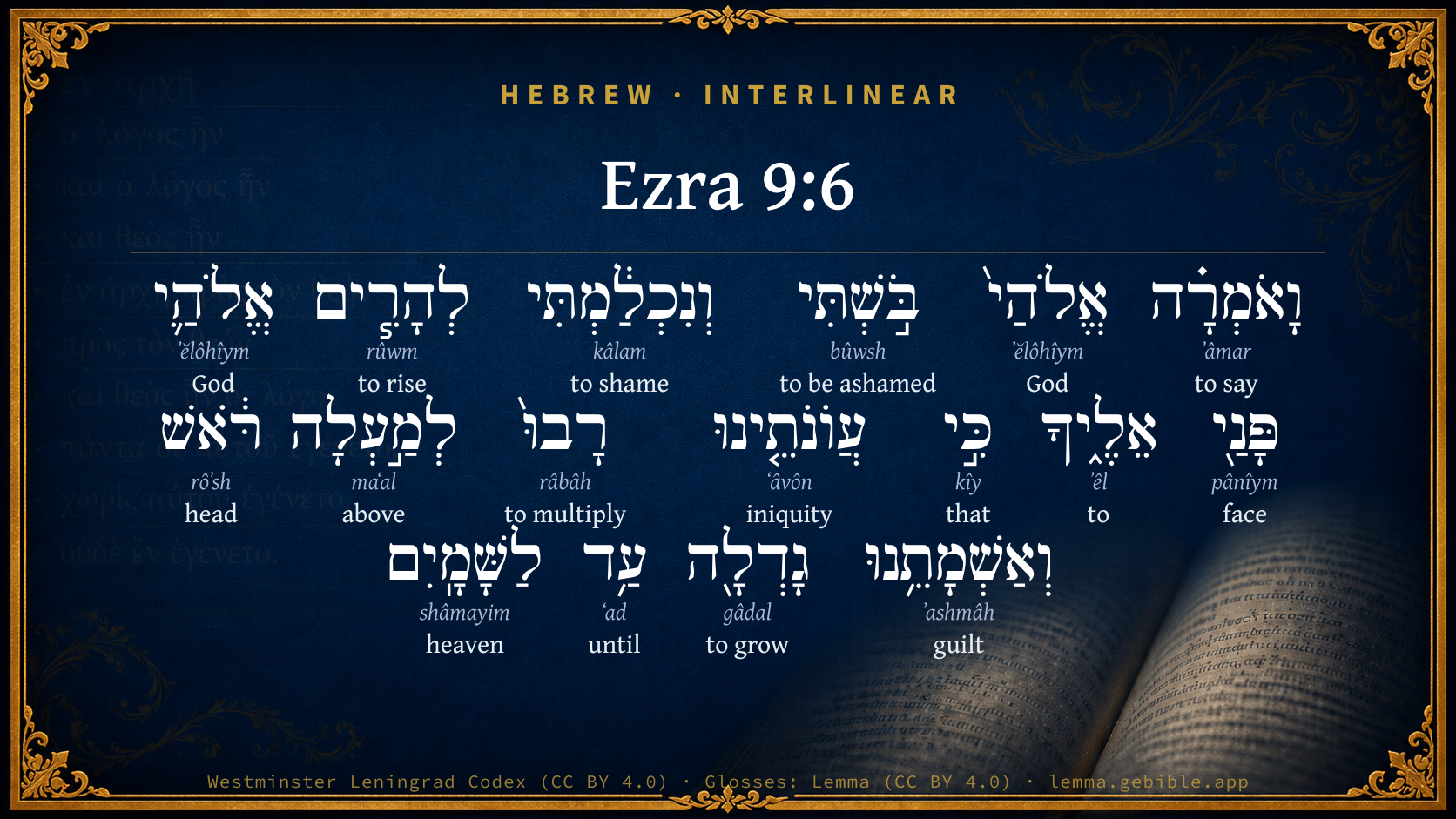
Ezra 9:6

Hebrew (Westminster Leningrad Codex) Ezra 9:6 appears in the Hebrew Old Testament. The text above is from the Westminster Leningrad Codex. Each word links to its Strong’s number, a concise gloss, and parsing drawn from the Open Scriptures Hebrew Bible morphology. Click any word for its full Brown-Driver-Briggs (BDB) entry.
Download image
Cite this verse

Ezra 9:6 (World English Bible). Public Domain. Lemma interlinear Bible study tool, https://lemma.gebible.app/v/ezra/9/6.

Show BibTeX & RIS
BibTeX
RIS
English Translation
and I said, my God, I am ashamed and blush to lift up my face to you, my God; for our iniquities are increased over our head, and our guiltiness is grown up to the heavens.
World English Bible · Public Domain
Download a study sheet

One document with this verse’s original text, its word-by-word gloss line, the meaning frame, cross-references with their text, attributed commentary, and full source and license credits — printable, and it pastes into notes with its structure intact.

This verse Autodidact and up

Study sheet (.html) Plain text (.txt)

A passage Seminary Student

Up to 50 verses in one chapter. A passage sheet keeps up to 6 commentary sources and 12 cross-references per verse, in the order this page ranks them, and says so on the sheet whenever that leaves anything out. Ask for a single verse and you get the Autodidact verse sheet above.

Everything on this page stays free to read, with no account — the sheet is a download of what is already on screen, not access to it.

Want to remove ads? Support Godless Engineer
Compare translations 3

The same verse in 3 English versions, stacked beneath the original-language interlinear above. Click any original word for its lexicon entry.

Each is an independent rendering of the whole verse — the interlinear is not word-aligned to these translations.

Highlighted words mark where these versions differ — a whole-verse word diff, not a word-by-word alignment.

  • World English Bible Public Domain
    and I said, my God, I am ashamed and blush to lift up my face to you, my God; for our iniquities are increased over our head, and our guiltiness is grown up to the heavens.
  • King James Version Public Domain
    And said, O my God, I am ashamed and blush to lift up my face to thee, my God: for our iniquities are increased over our head, and our trespass is grown up unto the heavens.
  • unfoldingWord Literal Text CC BY-SA 4.0
    And I said, “My God, I am ashamed and humiliated to raise my face to you, my God. For our iniquities have multiplied to above the head, and our guilt has grown up as far as to the heavens.

unfoldingWord Literal Text — © unfoldingWord, licensed CC BY-SA 4.0. Word-aligned USFM3 via Door43 (git.door43.org/unfoldingWord/en_ult).

Versions to compare (up to 4)

3 of 4 selected

Show all 18 translations

Every available English version of this verse, each an independent rendering of the whole verse.

  • World English Bible Public Domain
    and I said, my God, I am ashamed and blush to lift up my face to you, my God; for our iniquities are increased over our head, and our guiltiness is grown up to the heavens.
  • Berean Standard Bible Public Domain
    and said: “O my God, I am ashamed and embarrassed to lift up my face to You, my God, because our iniquities are higher than our heads, and our guilt has reached the heavens.
  • Majority Standard Bible Public Domain
    and said: “O my God, I am ashamed and embarrassed to lift up my face to You, my God, because our iniquities are higher than our heads, and our guilt has reached the heavens.
  • King James Version Public Domain
    And said, O my God, I am ashamed and blush to lift up my face to thee, my God: for our iniquities are increased over our head, and our trespass is grown up unto the heavens.
  • American Standard Version (1901) Public Domain
    and I said, O my God, I am ashamed and blush to lift up my face to thee, my God; for our iniquities are increased over our head, and our guiltiness is grown up unto the heavens.
  • Revised Version (1885) Public Domain
    and I said, O my God, I am ashamed and blush to lift up my face to thee, my God: for our iniquities are increased over our head, and our guiltiness is grown up unto the heavens.
  • Geneva Bible (1599) Public Domain
    And said, O my God, I am confounded and ashamed, to lift vp mine eyes vnto thee my God: for our iniquities are increased ouer our head, and our trespasse is growen vp vnto the heauen.
  • Douay-Rheims (1899) Public Domain
    And said: My God I am confounded and ashamed to lift up my face to thee: for our iniquities are multiplied over our heads, and our sins are grown up even unto heaven,
  • Young's Literal Translation Public Domain
    and say, `O my God, I have been ashamed, and have blushed to lift up, O my God, my face unto Thee, for our iniquities have increased over the head, and our guilt hath become great unto the heavens.
  • Literal Standard Version CC BY-SA 4.0
    and say, “O my God, I have been ashamed, and have blushed to lift up, O my God, my face to You, for our iniquities have increased over the head, and our guilt has become great to the heavens.
  • Unlocked Literal Bible CC BY-SA 4.0
    I said, “My God, I am ashamed and disgraced to raise my face to you, for our iniquities increase over our head, and our guilt grows to the heavens.
  • unfoldingWord Literal Text CC BY-SA 4.0
    And I said, “My God, I am ashamed and humiliated to raise my face to you, my God. For our iniquities have multiplied to above the head, and our guilt has grown up as far as to the heavens.
  • Darby Bible Public Domain
    and said: O my God, I am ashamed and blush to lift up my face to thee, my God; for our iniquities are increased over [our] head, and our trespass is grown up to the heavens.
  • World Messianic Bible Public Domain
    and I said, “My God, I am ashamed and blush to lift up my face to you, my God, for our iniquities have increased over our head, and our guiltiness has grown up to the heavens.
  • Webster's Bible Public Domain
    And said, O my God, I am ashamed and blush to lift up my face to thee, my God: for our iniquities are increased over our head, and our trespass is grown up to the heavens.
  • Free Bible Version CC BY-SA 4.0
    I prayed, “My God, I am so ashamed and embarrassed to come and pray to you, my God, because we are in over our heads in sin, and our guilt has risen to the heavens.
  • Bible in Basic English Public Domain
    I said, O my God, shame keeps me from lifting up my face to you, my God: for our sins are increased higher than our heads and our evil-doing has come up to heaven.
  • JPS Tanakh (1917) Public Domain
    and I said: 'O my God, I am ashamed and blush to lift up my face to Thee, my God; for our iniquities are increased over our head, and our guiltiness is grown up unto the heavens.

Literal Standard Version (2020), Covenant Press — licensed CC BY-SA 4.0. Text via the HelloAO Bible API (eBible.org). Unlocked Literal Bible (unfoldingWord) — licensed CC BY-SA 4.0. Text via the HelloAO Bible API (eBible.org). unfoldingWord Literal Text — © unfoldingWord, licensed CC BY-SA 4.0. Word-aligned USFM3 via Door43 (git.door43.org/unfoldingWord/en_ult). Free Bible Version, Dr. Jonathan Gallagher — licensed CC BY-SA 4.0. Text via the HelloAO Bible API (eBible.org).

Word by word

More ways to search: Search by grammar → Find every occurrence → Compare this word →

Practice this passage: Drill this verse → Learn its vocabulary →

וְאַשְׁמָתֵ֥נוּ
ʼashmâh
H819
“and · guilt · our”
Conjunction + Noun, Common, Feminine, Singular, Construct + Suffix, Personal, 1st Person, Common, Plural
Part of Speech
Conjunction + Noun
Type
Common
Gender
Feminine
Number
Singular
State
Construct
Full BDB Definition

Origin: from H817

TWOT: 180c

guiltiness, guilt, offense, sin, wrong-doing - doing wrong, committing a trespass or offense - becoming guilty, guilt - bringing a guilt-offering
  1. וָאֹמְרָ֗ה ʼâmar H559 “and · to say” Conjunction + Verb, Qal, Sequential Imperfect, 1st Person, Common, Singular + Suffix, h
  2. אֱלֹהַי֙ ʼĕlôhîym H430 “God(s) · my” Noun, Common, Masculine, Plural, Construct + Suffix, Personal, 1st Person, Common, Singular
  3. בֹּ֣שְׁתִּי bûwsh H954 “to be ashamed” Verb, Qal, Perfect, 1st Person, Common, Singular
  4. וְנִכְלַ֔מְתִּי kâlam H3637 “and · to shame” Conjunction + Verb, Niphal, Perfect, 1st Person, Common, Singular
  5. לְהָרִ֧ים rûwm H7311 “to rise” Preposition + Verb, Hiphil, Infinitive Construct
  6. אֱלֹהַ֛י ʼĕlôhîym H430 “God(s) · my” Noun, Common, Masculine, Plural, Construct + Suffix, Personal, 1st Person, Common, Singular
  7. פָּנַ֖י pânîym H6440 “face(s) · my” Noun, Common, Both, Plural, Construct + Suffix, Personal, 1st Person, Common, Singular
  8. אֵלֶ֑יךָ ʼêl H413 “to · you” Preposition + Suffix, Personal, 2nd Person, Masculine, Singular
  9. כִּ֣י kîy H3588 “that” Conjunction
  10. עֲוֺנֹתֵ֤ינוּ ʻâvôn H5771 “iniquities · our” Noun, Common, Both, Plural, Construct + Suffix, Personal, 1st Person, Common, Plural
  11. רָבוּ֙ râbâh H7235 “to multiply” Verb, Qal, Perfect, 3rd Person, Common, Plural
  12. לְמַ֣עְלָה maʻal H4605 “to/for · above · toward” Preposition + Adverb + Suffix, Demonstrative
  13. רֹּ֔אשׁ rôʼsh H7218 “head” Noun, Common, Masculine, Singular, Absolute
  14. גָדְלָ֖ה gâdal H1431 “to grow” Verb, Qal, Perfect, 3rd Person, Feminine, Singular
  15. עַ֥ד ʻad H5704 “until” Preposition
  16. לַשָּׁמָֽיִם shâmayim H8064 “to/for the · heaven(s)” Preposition, Determined + Noun, Common, Masculine, Plural, Absolute

About this verse

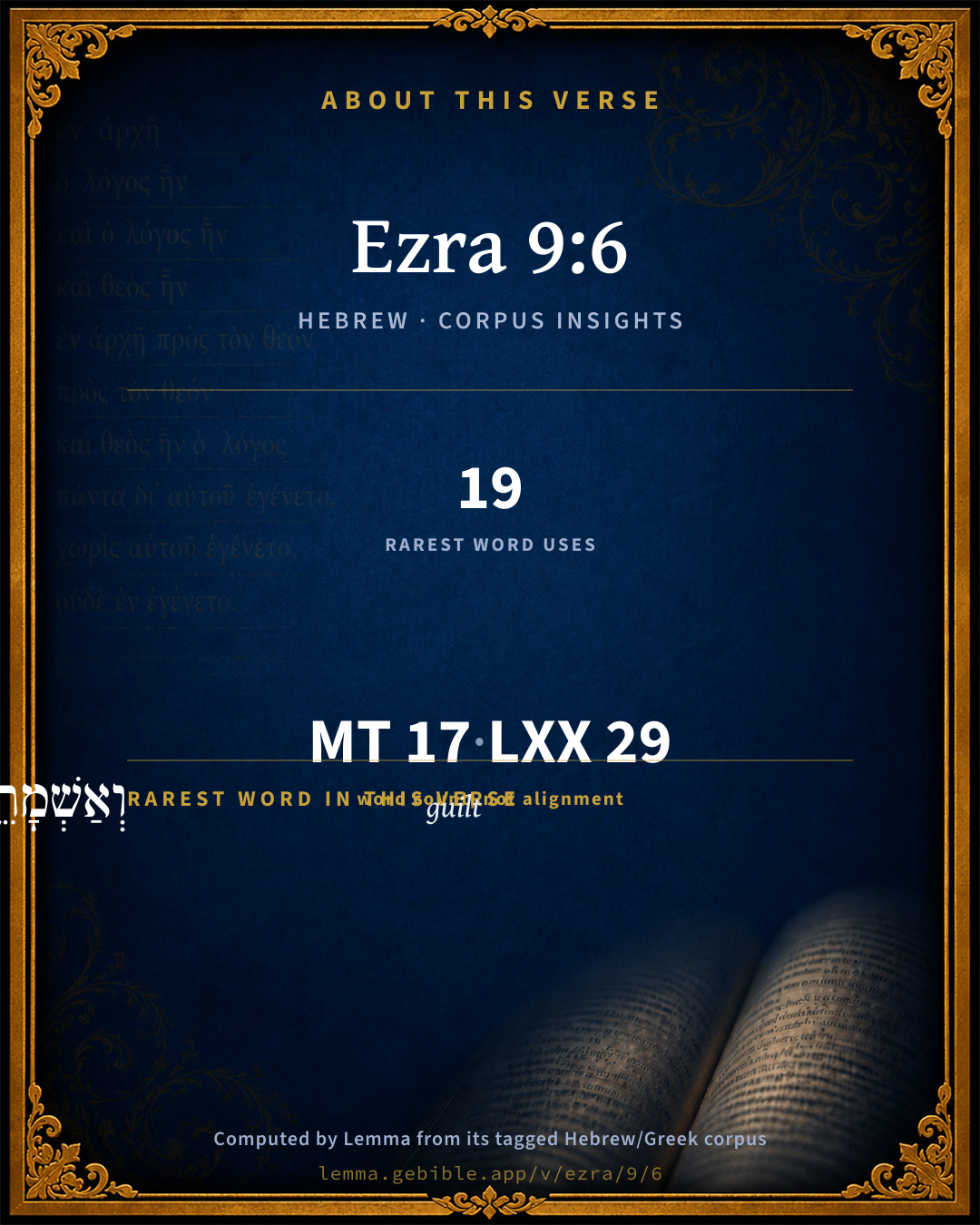
These counts appear in no published source. They are computed here, from the morphology-tagged text and Lemma’s own curated glosses. What Lemma adds →

17
words
16
distinct lemmas
Historical
section

Notable vocabulary

The rarest word here is וְאַשְׁמָתֵ֥נוּ guilt H819 — appearing just 19 times in the whole Hebrew Bible.

Shared distinctive vocabulary

וְאַשְׁמָתֵ֥נוּ guilt H819 occurs in 17 verses of the Hebrew Bible. Also found in:

Grammatical profile

  • 6 verbs
  • 7 nouns
  • 2 prepositions
  • 1 conjunction
  • 1 adverb

Verb forms

  • וָאֹמְרָ֗ה Qal · Sequential Imperfect
  • בֹּ֣שְׁתִּי Qal · Perfect
  • וְנִכְלַ֔מְתִּי Niphal · Perfect
  • לְהָרִ֧ים Hiphil · Infinitive Construct
  • רָבוּ֙ Qal · Perfect
  • גָדְלָ֖ה Qal · Perfect

Repetition

A word recurs within this verse — often emphatic in Hebrew:

  • אֱלֹהַי֙ God H430 ×2

Hebrew & Septuagint length

In English translation the verse runs 36 words from the Hebrew and 36 from the Septuagint (LXX English) — the same length.

A rough comparison of the two English renderings, which tokenize alike — not a word-level alignment.

Word counts can differ between the Hebrew and the Greek without any difference in meaning — e.g. the Hebrew direct-object marker אֵת has no separate Greek word, and Greek often adds the article ὁ.

In the original languages it is 17 Hebrew tokens and 29 Greek tokens — but the two are counted differently (Hebrew bundles its prefixes and suffixes into one token; the Greek is in lemma form), so that isn’t a like-for-like length.

Cross-references

19

Topical passages linked to Ezra 9:6 in the Treasury of Scripture Knowledge — connected by theme and wording, ordered by reader-vote popularity; previews shown in the World English Bible.

  • Revelation 18:5 for her sins have reached to the sky, and God has remembered her iniquities.
  • Psalms 38:4 For my iniquities have gone over my head. As a heavy burden, they are too heavy for me.
  • 2 Chronicles 28:9 But a prophet of Yahweh was there, whose name was Oded: and he went out to meet the host that came to Samaria, and said to them, Behold, because Yahweh, the God of your fathers, was angry with Judah, he has delivered them into your hand, and you have slain them in a rage which has reached up to heaven.
  • Ezra 9:15 Yahweh, the God of Israel, you are righteous; for we are left a remnant that is escaped, as it is this day: behold, we are before you in our guiltiness; for none can stand before you because of this.
  • Job 42:6 Therefore I abhor myself, And repent in dust and ashes."
  • Luke 15:21 The son said to him, 'Father, I have sinned against heaven, and in your sight. I am no longer worthy to be called your son.'
  • Jeremiah 3:24–25 But the shameful thing has devoured the labor of our fathers from our youth, their flocks and their herds, their sons and their daughters.
  • Genesis 13:13 Now the men of Sodom were exceedingly wicked and sinners against Yahweh.
  • Ezra 9:13 After all that is come on us for our evil deeds, and for our great guilt, seeing that you our God have punished us less than our iniquities deserve, and have given us such a remnant,
  • Job 40:4 "Behold, I am of small account. What shall I answer you? I lay my hand on my mouth.
  • Isaiah 1:18 "Come now, and let us reason together," says Yahweh: "Though your sins be as scarlet, they shall be as white as snow. Though they be red like crimson, they shall be as wool.
  • Isaiah 59:12 For our transgressions are multiplied before you, and our sins testify against us; for our transgressions are with us, and as for our iniquities, we know them:
  • Jeremiah 3:3 Therefore the showers have been withheld, and there has been no latter rain; yet you have a prostitute's forehead, you refused to be ashamed.
  • Jeremiah 6:15 Were they ashamed when they had committed abomination? nay, they were not at all ashamed, neither could they blush: therefore they shall fall among those who fall; at the time that I visit them they shall be cast down, says Yahweh.
  • Jeremiah 8:12 Were they ashamed when they had committed abomination? nay, they were not at all ashamed, neither could they blush: therefore shall they fall among those who fall; in the time of their visitation they shall be cast down, says Yahweh.
  • Jeremiah 31:19 Surely after that I was turned, I repented; and after that I was instructed, I struck on my thigh: I was ashamed, yes, even confounded, because I did bear the reproach of my youth.
  • Ezekiel 16:63 that you may remember, and be confounded, and never open your mouth any more, because of your shame, when I have forgiven you all that you have done, says the Lord Yahweh.
  • Daniel 9:7–8 Lord, righteousness belongs to you, but to us confusion of face, as at this day; to the men of Judah, and to the inhabitants of Jerusalem, and to all Israel, who are near, and who are far off, through all the countries where you have driven them, because of their trespass that they have trespassed against you.
  • Romans 6:21 What fruit then did you have at that time in the things of which you are now ashamed? For the end of those things is death.

Cross-references courtesy of OpenBible.info (CC BY 4.0).

Hebrew and Greek witnesses Masoretic Hebrew ↔ Greek Septuagint

The same verse in the two great witnesses to the Old Testament, shown verse-for-verse.

These are two independent witnesses, not word-aligned to each other, and the Septuagint is shown in lemma (dictionary) form.

Hebrew Ezra 9:6 Masoretic · Westminster Leningrad Codex

וָאֹמְרָ֗ה אֱלֹהַי֙ בֹּ֣שְׁתִּי וְנִכְלַ֔מְתִּי לְהָרִ֧ים אֱלֹהַ֛י פָּנַ֖י אֵלֶ֑יךָ כִּ֣י עֲוֺנֹתֵ֤ינוּ רָבוּ֙ לְמַ֣עְלָה רֹּ֔אשׁ וְאַשְׁמָתֵ֥נוּ גָדְלָ֖ה עַ֥ד לַשָּׁמָֽיִם

and I said, my God, I am ashamed and blush to lift up my face to you, my God; for our iniquities are increased over our head, and our guiltiness is grown up to the heavens.

World English Bible · Public Domain

Greek LXX Ezra 9:6 Septuagint · lemma form

καί εἶπον κύριος αἰσχύνω καί ἐντρέπω ὁ ὑψόω ὁ πρόσωπον ἐγώ πρός σύ ὅτι ὁ ἀνομία ἐγώ πληθύνω ὑπέρ κεφαλή ἐγώ καί ὁ πλημμέλεια ἐγώ μεγαλύνω ἕως εἰς οὐρανός

and I said, O Lord, I am ashamed and confounded, O my God, to lift up my face to you: for our transgressions have abounded over our head, and our trespasses have increased even to heaven.

LXX2012 (modern English Septuagint) · Public Domain

In the Septuagint this is one book — Esdras B (2 Esdras): Ezra is chapters 1–10, Nehemiah 11–23.

Hebrew: Westminster Leningrad Codex (CC BY 4.0). Greek: Septuagint (public domain); English from LXX2012 (modern English Septuagint) (Public Domain). How the Septuagint differs from the Hebrew →

Commentary

Notes on Ezra 9:6 from classic Christian and Jewish commentators (each source and its license shown beneath its notes). The classic Christian expositions comment on the surrounding passage and are grouped to its opening verse, so a note may address several verses; the Jewish commentaries on the Tanakh (Rashi and others) are per-verse, so they appear only where the commentator wrote on this verse.

Lemma curates 59 commentaries, every one of them public domain or Creative Commons licensed, each selected and text-cleaned for this edition rather than reprinted as found. About our sources →

The Cambridge Bible for Schools and Colleges

gen. ed. J. J. S. Perowne

6. A brief exordium: expression of personal shame and national guilt.

I am ashamed and blush] These words occur together frequently as in Jer_31:19 ‘I was ashamed, yea, even confounded, because I did bear the reproach of my youth’. Isa_45:16; Psa_35:4. Ezra’s expression of shame and confusion is the echo of the prophet’s words, ‘Beashamed and confounded for your ways, O house of Israel’ (Eze_36:32), the very opposite of their spirit, who ‘were not at all ashamed, neither could they blush’ (Jer_6:15; Jer_8:12).

to lift up my face to thee] The consciousness of sin will not permit the humble supplicant to ‘lift up so much as his eyes to heaven’ (Luk_18:13). The first person singular is here dropped.

for our iniquities are increased over our head] The metaphor is drawn from the waters of a flood (cf. Gen_7:17-18). Compare Psa_38:4 ‘For mine iniquities are gone over mine head’.

and our trespass] R.V. our guiltiness. The word ‘guiltiness’ (‘ashmah’, not ‘ma-al’ ‘trespass’ of Ezr_9:1) is used here and in Ezr_9:7; Ezr_9:13; Ezr_9:15, Ezr_10:10; Ezr_10:19. It is the state of guilt resulting from sin, e.g. Lev_4:3, ‘if the anointed priest shall sin so as to bring guilt (ashmah) on the people’; Ezr_6:5; Ezr_6:7, 2Ch_28:13 ‘For ye purpose that which will bring upon us a trespass (marg. ‘guilt’, Hebr. ‘ashmah’) against the Lord, to add unto our sins and to our trespass; for our trespass is great’, 2Ch_24:18, 2Ch_28:10, 2Ch_33:23, Amo_8:14 ‘Swear by the sin (ashmah) of Samaria’. Psa_69:5 ‘My sins (marg. Heb. guiltinesses) are not hid from thee’.

is grown up unto the heavens] Compare the same metaphor applied to ‘rage’, 2Ch_28:9 ‘In a rage which hath reached up unto heaven’. Either, which is most probable, hyperbolically of magnitude, as of the tower of Babel, ‘whose top may reach unto heaven’ (Gen_11:4), cities walled up to heaven (Deu_1:28), the judgement of Babylon (Jer_51:9), or metaphorically, as if the magnitude of the guilt had forced itself upon the notice of God like the cry of Sodom and Gomorrah (Gen_18:20-21).

6–15. Ezra’s Prayer

Ezra’s prayer, as a confession of national sin, should be compared with the prayer of the Levites (Neh_9:6-38), and more especially with the prayer of Daniel (Dan_9:4-19). As in the confession of Daniel, the personality of the speaker is merged in that of the nation, The sin of the race no less than its shame and its punishment is acknowledged in the ‘we’, ‘our’, and ‘us’. The self-abnegation and love of Ezra as of Moses (Exo_32:32), and of Paul (Rom_9:3), accept the obligations of nationality as the source of guilt as well as on privilege to the individual.

The general plan of the confession resembles that of Daniel. It consists of (1) general confession, Ezr_9:6 (cf. Dan_9:4-6), (2) the sins of former time, Ezr_9:7 (Dan_9:7-8); (3) God’s mercy and goodness, Ezr_9:7-8 (Dan_9:9); (4) Israel’s sin in the face of the Divine warning, Ezr_9:10-12 (Dan_9:10-14); (5) the fresh guilt and final appeal, Ezr_9:13-15 (Dan_9:15-19).

The Cambridge Bible for Schools and Colleges (gen. ed. J. J. S. Perowne; Cambridge University Press, 1878–1918) — public domain. Text from a community e-Sword module.

Trapp's Complete Commentary

John Trapp

Ezr 9:6 And said, O my God, I am ashamed and blush to lift up my face to thee, my God: for our iniquities are increased over [our] head, and our trespass is grown up unto the heavens.

Ver. 6. And said, O my God] This was a prayer of faith, and founded upon the covenant, that beehive of heavenly honey, as one well calleth it.

I am ashamed and blush] Sin is a blushful thing, and hales shame at the heels of it, Rev 3:17. Therefore when a man hath committed a sin, he blusheth; the blood, as it were, would cover the sin. But he is past grace that is past shame, and can blush no more than a sackbut, Illum ego periisse dico cui periit pudor (Sallust).

For our iniquities] He maketh himself a party, because he was one of the same community with them that had done that evil. He also knew himself to have a hand, if not upon the great cart ropes, set upon the lesser cords that might draw down divine vengeance upon the land. Hence he includeth himself after the example of Daniel, Dan 9:5.

Are increased over our head] As an overwhelming flood, Psa 38:4. That threateneth to go over our souls too, Psa 124:4, and to sink them in the bottomless lake, that lower most part of hell imported by that ä locale (as Hebricians note), Psa 9:17. {Hebrew Text Note}

And our trespass is grown up unto the heavens] So great is our guilt, that it is gotten as high as heaven, that is, as high as may be. For beyond the moveable heavens, Aristotle (nature’s best secretary) saith there is neither body, nor time, nor place, nor vacuum. See Rev 18:5. {See Trapp on "Rev 18:5"} Man’s sin defileth even the very visible heavens; which must therefore be purged with the fire of the last day. Yea, it pierceth into the heaven of heavens, and maketh a loud outcry in God’s ears for vengeance, Gen 4:10; Gen 18:20.

John Trapp, A Commentary or Exposition upon All the Books of the Old and New Testament (1647–1656) — public domain. Text from a community e-Sword module.

Joseph Benson's Commentary

Ezr 9:6. O my God, I am ashamed and blush — “Nothing can be more humble, devout, and pathetic, than this address, in which Ezra acknowledges that he was confounded when he thought of the greatness of their sins, which were ready to overwhelm them, and of the boldness and insolence of them beyond measure, even though they had seen the divine vengeance upon their forefathers in so terrible a manner, that they had not yet worn off the marks of his displeasure. He had, indeed, begun to show favour to some of them; but this so much the more aggravated their wickedness, in that, so soon after their restoration and settlement in their native country, they had returned to their old provocations, notwithstanding the many admonitions, in the law and the prophets, to have nothing to do with the people of Canaan, except it were to expel and drive them out. What then can we expect, says he, but the utter destruction of the small remnant that is left of us, if after all the punishment which God hath inflicted upon us, and now that he is beginning to be gracious unto us, we relapse into the same offences for which we have so severely suffered? For while we remain monuments of his mercy, and yet appear before him in our abominations, we must be dumb, and have nothing to plead in excuse of our detestable ingratitude.” — Dodd. For our iniquities — He includes himself in the number of the transgressors, because he himself was guilty of many sins; and because the princes and priests, and so many of the people, having done this, the guilt was now become national. Are increased over our head — Like deep waters, in which we are, as it were, drowned, and ready to perish.

Joseph Benson's Commentary on the Old and New Testaments (1811–1818) — public domain. Text from a community e-Sword module.

Tyndale Open Study Notes

Tyndale Open Resources

9:6-15 Ezra’s prayer provides a model for intercessory prayer (cp. Neh 1:5-11; Dan 9:4-19). It includes confessing sin (Ezra 9:6-7), remembering God’s past grace (9:8-9), admitting that the people have ignored God (9:10-12), and recognizing their unworthiness (9:13-15).

9:6 I am utterly ashamed . . . our sins are piled higher than our heads: Although he was not one of the offending parties, Ezra personally identified with his people (see “Community Identity” Theme Note).

Tyndale Open Study Notes — © Tyndale Open Resources, licensed CC BY-SA 4.0. Text via the HelloAO Bible API.

Geneva Bible (1599)

Geneva Bible translators

They so exceed that they cannot grow greater.

That is, we are drowned in sin.

Geneva Bible (1599) marginal notes — public domain. Text via Bolls.life.

Adam Clarke's Commentary

Verse 6. I am ashamed and blush] God had been so often provoked, and had so often pardoned them, and they had continued to transgress, that he was ashamed to go back again to the throne of grace to ask for mercy in their behalf. This is the genuine feeling of every reawakened backslider.

Adam Clarke's Commentary on the Bible (1810–1826) — public domain. Text from a community e-Sword/MySword module.

John Gill's Exposition

And said, O my God,.... Here begins the prayer of Ezra, and that with faith in God as covenant God, even when he was about to make confession of sin, and repentance for it; that prayer is right which is put up in faith, and that repentance genuine which is accompanied with faith, and flows from it:

I am ashamed, and blush to lift up my face to thee, my God; a true sight and sense of sin causes shame and blushing, and never more than when a man is sensible of his covenant interest in God, and of his grace and favour to him, particularly in the forgiveness of his sin, see Eze 16:61

for our iniquities are increased over our head; arisen and swelled like mighty waters, which seemed to threaten an overwhelming of them:

and our trespass is grown up unto the heavens; being done in an open, public, and insolent manner, and in such numbers, that they were, as it were, piled up in heaps, reaching to heaven, and calling down vengeance from thence. Ezra includes himself as being one of the same nation; and these sins being so common were become national ones, which involved all the individuals, and exposed them to the divine resentment.

John Gill's Exposition of the Whole Bible (1746–1763) — public domain (CC PDM 1.0). Text via the HelloAO Bible API.

Matthew Poole's English Annotations

He includes himself in the number of the transgressors, not only by a rhetorical figure called communication, but partly because he himself was guilty of many sins; and partly because the princes and priests, and so many of the people, having done this, the guilt was now become national.

Increased over our head; like deep waters, in which we are as it were drowned, and ready to perish. Compare Psa 38:4.

Matthew Poole's English Annotations on the Holy Bible (1683–1685) — public domain. Text from a community e-Sword/MySword module.

Whedon's Commentary on the Bible

Daniel D. Whedon

6. O my God — The following prayer of Ezra is, for its occasion, a most perfect model of intercessory supplication. Or rather, perhaps, we should say, it is a most perfect utterance of humiliation and confession before God, for there is no word of direct supplication here. Much is suggested and implied, but every utterance is that of confession of past and present sin, and personal humiliation before God. Ezra enumerates the manifold sins of his nation in connexion with the manifold mercies of God, and confesses that all the woes and punishments of Israel have been less than their sins. He ventures not to pray for mercy and pardon, but presents the people in their trespasses before Jehovah, confessing that they are not able to stand. Compare Daniel’s prayer, (Dan_9:4-19,) where is found much of direct supplication.

Our iniquities… over our head — Like a flood they have been rising higher and higher, until we are quite submerged and overwhelmed.

Grown up unto the heavens — Like a tower of Babel, which has been built higher and higher, as if to defy the very God of heaven.

Daniel D. Whedon (gen. ed.), Commentary on the Old and New Testaments (1874–1909) — public domain. Text from a community e-Sword module.

The Pulpit Commentary

I am ashamed and blush. Jeremiah had complained that in his day those who "committed abominations were not at all ashamed, neither could they blush". (Jer_6:15 Jer_8:12) Ezra, with these words in his thoughts possibly, begins his confession with a protestation that he at any rate is not open to this reproach he blushes and burns with shame for the sins of his people. Our iniquities are increased over our head. i.e. have kept on rising like a flood; "gone over our head", (Psa_38:4) and overwhelmed us. And our trespass is grown up unto the heavens. Has grown to such a height that it has attracted the notice of God, and made him angry with us.

HOMILIES BY J.A. MACDONALD Vers. 6-15.

Ezra"s prayer.

While the smoke of the altar rises to heaven from the evening sacrifice, lo! there is Ezra before the temple of the Lord with rent garments and disordered hair, bowed upon his knees, and with lifted hands, pouring out confession of sin in tones of plaintive grief and shame and terror. "O my God,! am ashamed," etc. In this prayer we mark

I THE CRIME CONFESSED (vers. 11, 12).

1. Here were open violations of the law of God.

(1) The patriarchal law was pronounced against the intermarriages of the holy race of Seth, with whom was the promise of the Holy Seed, with the profane race of Cain the excommunicate. The infraction of this law provoked the Deluge. (Gen_6:2, Gen_6:3) Abraham, who, like Seth, was the depositary of the Promise, was averse to the intermarriage of his issue with the daughters of the accursed Cainan. (Gen_24:3, Gen_24:4; see also Gen_28:1, Gen_28:2)

(2) This patriarchal law became incorporated in the Mosaic system. (Deu_7:3)

(3) The prophets also declared against these mixed alliances. In particular, it would seem, Haggai and Zechariah (ver. 11 with 6:21).

(4) This law, in the spirit of it, is still binding upon Christians. (1Co_7:39; 2Co_6:14)

2. The reasons given for this law are most weighty.

(1) The holiness of God"s people. This reason holds in all ages.

(2) The tendency to be swayed from true worship to idolatry. (Exo_23:32 Exo_34:16)

(3) These reasons were vividly before the mind of Ezra. So should they be ever present with Christians.

3. Nothing should induce men to commit this sin.

(1) The wealth of idolaters is dearly purchased by the imperilling of the inheritance of the saints.

(2) Peace with idolaters is costly at the sacrificing of the peace of God.

II THE AGGRAVATIONS ACKNOWLEDGED. Ezra confessed for his people

1. That their experiences in the captivity should have taught them differently (ver. 7).

(1) Their humiliation was deep. They suffered from the "sword," viz., of the Babylonians who in the days of Nebuchadnezzar invaded their land. From "captivity," for their Babylonish victor carried them away. Who can estimate the sufferings entailed by that deportation? From the "spoil" which they suffered from the invaders, and from those who removed them. And from "confusion of face," viz., in the remembrance that all their sufferings were on account of their sins. This shame they felt in the presence of their Babylonish lords. (see Dan_9:7, Dan_9:8) Also before their Persian masters.

(2) Their calamities were sweeping. The people were involved in them. So were their "kings." What a contrast between the condition of David and Solomon and that of Jehoiachin and Zedekiah! (2Ki_25:7) So were their "priests;" and in the ruin of the priests the ruin of the temple also was involved.

(3) They were also of long continuance. There were the initial sufferings from the time of the first invasion of the Babylonians. Then the interval of seventy years from the date of the captivity to the first year of Cyrus, when Zerubbabel led back the larger body of the restoration. Another period of seventy or eighty years had elapsed before this second contingent was led back by Ezra. What excuse then, after all these sufferings, could be pleaded for their sin?

2. The mercy of God should have been better requited (vers. 8, 9). That mercy was shown

(1) In his "leaving a remnant to escape." That was mercy not only to the individuals spared, but also to the world, for the holy Seed was among them, through whom the blessings of an everlasting salvation were to come.

(2) In "giving them a nail in his holy place." The margin explains this to be "a constant and sure abode," and refers to Isa_22:23 in support of this interpretation. The passage in Isaiah points to Christ; so may this point to him.

(3) In this view there is the greater force in what follows, "that our God may lighten our eyes, and give us a little reviving in our bondage." And how the mercy of God in all this becomes increased when the spiritual blessings of the gospel are seen in it.

(4) Even in their bondage God had not forsaken them. For he gave them favour in the sight of the kings of Persia. This favour enabled them to return, "gave them a reviving," and to repair the desolations of the temple, of the holy city, and the wall. Such mercy claimed gratitude, but was requited with rebellion. Ezra is without apology (ver. 10).

III THE SUBMISSION TO THE JUDGMENT OF MERCY (vers. 6 and 15).

1. Here he awaits the judgment of the Lord.

(1) He is ashamed to look up. Who can bear to look into the face of an injured friend when we have nothing to plead in apology? That will be the position of the sinner in the great day of judgment.

(2) He is oppressed by the growing weight of accumulating rebellion and ingratitude. He is terrified by the cloud upon the face of God.

(3) He confesses that wrath to the uttermost is deserved.

2. Here is no formal plea for mercy.

(1) There is the silent cry of misery and distress and blushing shame. But who can trust in this? It is only the consciousness of sin.

(2) There is eloquence in the evening sacrifice. The victim slain is a vicarious sufferer. It is the shadow of a better sacrifice. J.A.M.

The Pulpit Commentary (1880–1919), ed. H.D.M. Spence-Jones & Joseph S. Exell — public domain. Text from a community e-Sword module.

John Wesley's Explanatory Notes

Our - He includes himself in the number of the transgressors, because he himself was guilty of many sins; and because the princes and priests, and so many of the people having done this, the guilt was now become national.

John Wesley, Explanatory Notes Upon the Whole Bible (1754–1765) — public domain. Text via the GEBible commentary corpus.

Lesson kit

Teaching starters — assembled from the data on this page, not authored interpretation. Every prompt links to the verse data it draws on. Edit before teaching.

Ezra, in the Historical, opens this verse with 17 words (16 distinct Hebrew lemmas). Its most distinctive word is ʼashmâh (“guilt”). A historical commentator’s framing appears above. Read the whole chapter for the surrounding context.

Discussion questions

  1. The word ʼashmâh carries the sense “guilt.” How does it shape the verse?
  2. How does Leviticus 4:3, which shares the word «guilt», read alongside this verse?
  3. What does the repetition of “God” (2× in this one verse) do in this verse?
  4. These translations render this verse differently. What is at stake in choosing one wording over another?
  5. «וָאֹמְרָ֗ה» is a Qal Sequential Imperfect verb. How does that grammatical form shape the action described?
  6. Compare how The Cambridge Bible for Schools and Colleges and Trapp's Complete Commentary read this verse. Where do they agree or differ?

Things to notice

Reading settings

Reading text

Shown beneath each verse's original-language words.

Old Testament
Old Testament edition

Read the OT as the Masoretic Hebrew (MT) or the Greek Septuagint (LXX).

English shown for the Greek Septuagint (in the Hebrew ↔ Greek comparison).

Comparing translations? Open the Compare panel on any verse page to stack up to four side by side.