
Jeremiah 29:6

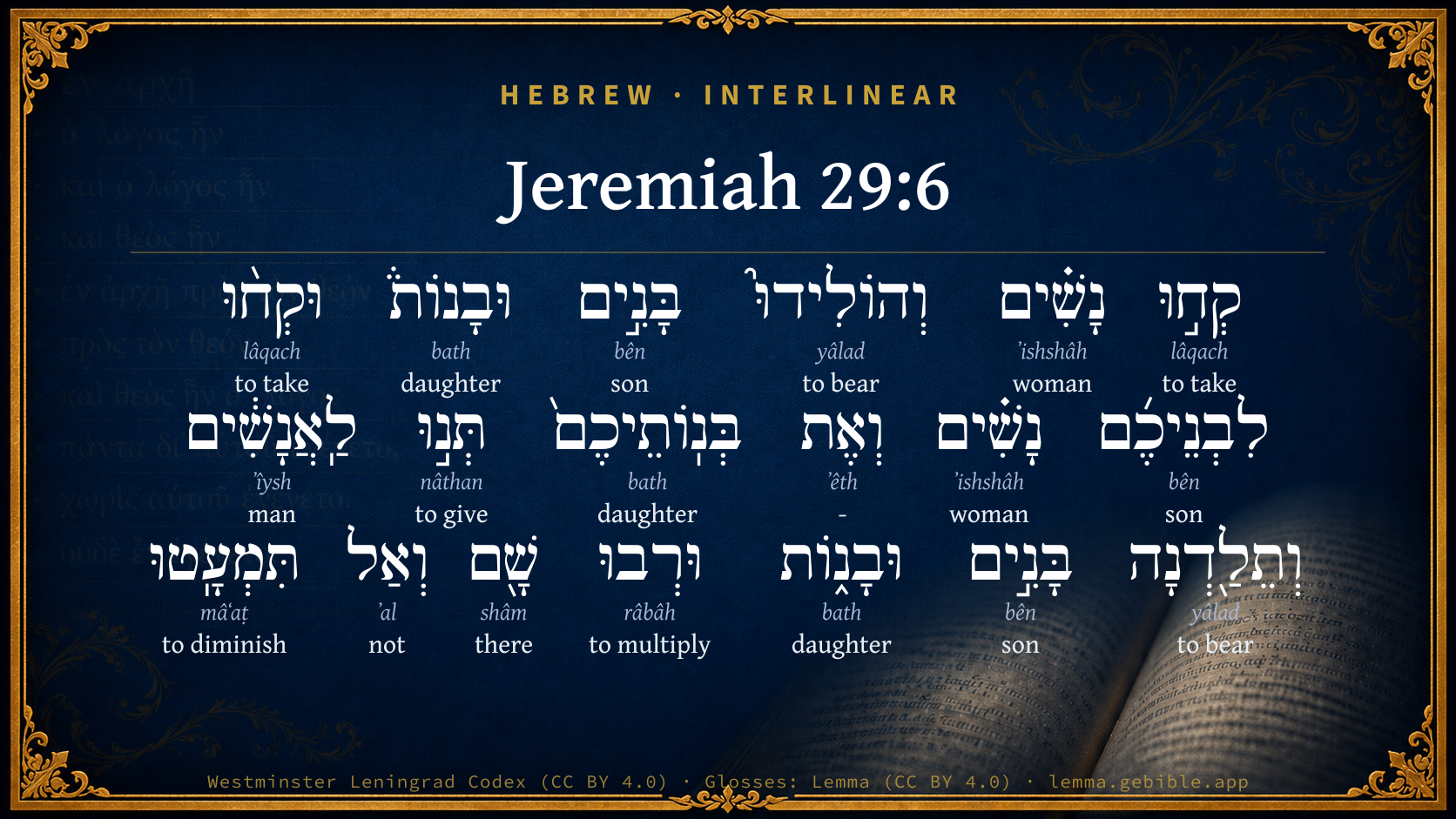
Hebrew (Westminster Leningrad Codex) Jeremiah 29:6 appears in the Hebrew Old Testament. The text above is from the Westminster Leningrad Codex. Each word links to its Strong’s number, a concise gloss, and parsing drawn from the Open Scriptures Hebrew Bible morphology. Click any word for its full Brown-Driver-Briggs (BDB) entry.
Download image
Cite this verse

Jeremiah 29:6 (World English Bible). Public Domain. Lemma interlinear Bible study tool, https://lemma.gebible.app/v/jeremiah/29/6.

Show BibTeX & RIS
BibTeX
RIS
English Translation
Take wives, and father sons and daughters; and take wives for your sons, and give your daughters to husbands, that they may bear sons and daughters; and multiply you there, and don't be diminished.
World English Bible · Public Domain
Download a study sheet

One document with this verse’s original text, its word-by-word gloss line, the meaning frame, cross-references with their text, attributed commentary, and full source and license credits — printable, and it pastes into notes with its structure intact.

This verse Autodidact and up

Study sheet (.html) Plain text (.txt)

A passage Seminary Student

Up to 50 verses in one chapter. A passage sheet keeps up to 6 commentary sources and 12 cross-references per verse, in the order this page ranks them, and says so on the sheet whenever that leaves anything out. Ask for a single verse and you get the Autodidact verse sheet above.

Everything on this page stays free to read, with no account — the sheet is a download of what is already on screen, not access to it.

Want to remove ads? Support Godless Engineer
Compare translations 3

The same verse in 3 English versions, stacked beneath the original-language interlinear above. Click any original word for its lexicon entry.

Each is an independent rendering of the whole verse — the interlinear is not word-aligned to these translations.

Highlighted words mark where these versions differ — a whole-verse word diff, not a word-by-word alignment.

  • World English Bible Public Domain
    Take wives, and father sons and daughters; and take wives for your sons, and give your daughters to husbands, that they may bear sons and daughters; and multiply you there, and don't be diminished.
  • King James Version Public Domain
    Take ye wives, and beget sons and daughters; and take wives for your sons, and give your daughters to husbands, that they may bear sons and daughters; that ye may be increased there, and not diminished.
  • unfoldingWord Literal Text CC BY-SA 4.0
    Take wives and give birth to sons and daughters. Then take wives for your sons, and give your daughters to husbands. Let them give birth to sons and daughters and increase there so you do not become too few.

unfoldingWord Literal Text — © unfoldingWord, licensed CC BY-SA 4.0. Word-aligned USFM3 via Door43 (git.door43.org/unfoldingWord/en_ult).

Versions to compare (up to 4)

3 of 4 selected

Show all 18 translations

Every available English version of this verse, each an independent rendering of the whole verse.

  • World English Bible Public Domain
    Take wives, and father sons and daughters; and take wives for your sons, and give your daughters to husbands, that they may bear sons and daughters; and multiply you there, and don't be diminished.
  • Berean Standard Bible Public Domain
    Take wives and have sons and daughters. Take wives for your sons and give your daughters in marriage, so that they too may have sons and daughters. Multiply there; do not decrease.
  • Majority Standard Bible Public Domain
    Take wives and have sons and daughters. Take wives for your sons and give your daughters in marriage, so that they too may have sons and daughters. Multiply there; do not decrease.
  • King James Version Public Domain
    Take ye wives, and beget sons and daughters; and take wives for your sons, and give your daughters to husbands, that they may bear sons and daughters; that ye may be increased there, and not diminished.
  • American Standard Version (1901) Public Domain
    Take ye wives, and beget sons and daughters; and take wives for your sons, and give your daughters to husbands, that they may bear sons and daughters; and multiply ye there, and be not diminished.
  • Revised Version (1885) Public Domain
    Take ye wives, and beget sons and daughters; and take wives for your sons, and give your daughters to husbands, that they may bear sons and daughters; and multiply ye there, and be not diminished.
  • Geneva Bible (1599) Public Domain
    Take you wiues, and beget sonnes and daughters, and take wiues for your sonnes, and giue your daughters to husbands, that they may beare sonnes and daughters, that ye may bee increased there, and not diminished.
  • Douay-Rheims (1899) Public Domain
    Take ye wives, and beget sons and daughters: and take wives for your sons, and give your daughters to husbands, and let them bear sons and daughters: and be ye multiplied there, and be not few in number.
  • Young's Literal Translation Public Domain
    Take ye wives, and beget sons and daughters; and take for your sons wives, and your daughters give to husbands, and they bear sons and daughters; and multiply there, and ye are not few;
  • Literal Standard Version CC BY-SA 4.0
    take wives and beget sons and daughters; and take wives for your sons, and give your daughters to husbands, and they bear sons and daughters; and multiply there, and you are not few;
  • Unlocked Literal Bible CC BY-SA 4.0
    Take wives and give birth to sons and daughters. Then take wives for your sons, and give your daughters to husbands. Let them give birth to sons and daughters and increase there so you do not become too few.
  • unfoldingWord Literal Text CC BY-SA 4.0
    Take wives and give birth to sons and daughters. Then take wives for your sons, and give your daughters to husbands. Let them give birth to sons and daughters and increase there so you do not become too few.
  • Darby Bible Public Domain
    Take wives, and beget sons and daughters; and take wives for your sons, and give your daughters to husbands, that they may bear sons and daughters; and multiply there, and be not diminished.
  • World Messianic Bible Public Domain
    Take wives and father sons and daughters. Take wives for your sons, and give your daughters to husbands, that they may bear sons and daughters. Multiply there, and don’t be diminished.
  • Webster's Bible Public Domain
    Take ye wives, and beget sons and daughters; and take wives for your sons, and give your daughters to husbands, that they may bear sons and daughters; that ye may be increased there, and not diminished.
  • Free Bible Version CC BY-SA 4.0
    Get married and have children. Arrange for your children to get married so they can have children too. Increase in number, don't decrease.
  • Bible in Basic English Public Domain
    Take wives and have sons and daughters, and take wives for your sons, and give your daughters to husbands, so that they may have sons and daughters; and be increased in number there and do not become less.
  • JPS Tanakh (1917) Public Domain
    take ye wives, and beget sons and daughters; and take wives for your sons, and give your daughters to husbands, that they may bear sons and daughters; and multiply ye there, and be not diminished.

Literal Standard Version (2020), Covenant Press — licensed CC BY-SA 4.0. Text via the HelloAO Bible API (eBible.org). Unlocked Literal Bible (unfoldingWord) — licensed CC BY-SA 4.0. Text via the HelloAO Bible API (eBible.org). unfoldingWord Literal Text — © unfoldingWord, licensed CC BY-SA 4.0. Word-aligned USFM3 via Door43 (git.door43.org/unfoldingWord/en_ult). Free Bible Version, Dr. Jonathan Gallagher — licensed CC BY-SA 4.0. Text via the HelloAO Bible API (eBible.org).

Word by word

More ways to search: Search by grammar → Find every occurrence → Compare this word →

Practice this passage: Drill this verse → Learn its vocabulary →

תִּמְעָֽטוּ
mâʻaṭ
H4591
“to diminish”
Verb, Qal, Jussive, 2nd Person, Masculine, Plural
Part of Speech
Verb
Stem
Qal
Form
Jussive
Person
2nd Person
Gender
Masculine
Number
Plural
Full BDB Definition

Origin: a primitive root

TWOT: 1228

to be or become small, be few, be diminished - (Qal) - to diminish - to be too small - (Piel) to become few - (Hiphil) - to make small, make few, diminish - to give less
  1. קְח֣וּ lâqach H3947 “take” Verb, Qal, Imperative, 2nd Person, Masculine, Plural
  2. נָשִׁ֗ים ʼishshâh H802 “women” Noun, Common, Feminine, Plural, Absolute
  3. וְהוֹלִידוּ֮ yâlad H3205 “and · bear” Conjunction + Verb, Hiphil, Imperative, 2nd Person, Masculine, Plural
  4. בָּנִ֣ים bên H1121 “sons” Noun, Common, Masculine, Plural, Absolute
  5. וּבָנוֹת֒ bath H1323 “and · daughters” Conjunction + Noun, Common, Feminine, Plural, Absolute
  6. וּקְח֨וּ lâqach H3947 “and · take” Conjunction + Verb, Qal, Imperative, 2nd Person, Masculine, Plural
  7. לִבְנֵיכֶ֜ם bên H1121 “to/for · sons · your” Preposition + Noun, Common, Masculine, Plural, Construct + Suffix, Personal, 2nd Person, Masculine, Plural
  8. נָשִׁ֗ים ʼishshâh H802 “women” Noun, Common, Feminine, Plural, Absolute
  9. וְאֶת ʼêth H853 “and · -” Conjunction + Particle, Direct Object
  10. בְּנֽוֹתֵיכֶם֙ bath H1323 “daughters · your” Noun, Common, Feminine, Plural, Construct + Suffix, Personal, 2nd Person, Masculine, Plural
  11. תְּנ֣וּ nâthan H5414 “give” Verb, Qal, Imperative, 2nd Person, Masculine, Plural
  12. לַֽאֲנָשִׁ֔ים ʼîysh H376 “to/for · men” Preposition + Noun, Common, Masculine, Plural, Absolute
  13. וְתֵלַ֖דְנָה yâlad H3205 “and · to bear” Conjunction + Verb, Qal, Imperfect, 3rd Person, Feminine, Plural
  14. בָּנִ֣ים bên H1121 “sons” Noun, Common, Masculine, Plural, Absolute
  15. וּבָנ֑וֹת bath H1323 “and · daughters” Conjunction + Noun, Common, Feminine, Plural, Absolute
  16. וּרְבוּ râbâh H7235 “and · multiply” Conjunction + Verb, Qal, Imperative, 2nd Person, Masculine, Plural
  17. שָׁ֖ם shâm H8033 “there” Adverb
  18. וְאַל ʼal H408 “and · not” Conjunction + Particle, Negative

About this verse

These counts appear in no published source. They are computed here, from the morphology-tagged text and Lemma’s own curated glosses. What Lemma adds →

19
words
12
distinct lemmas
Prophets
section

Notable vocabulary

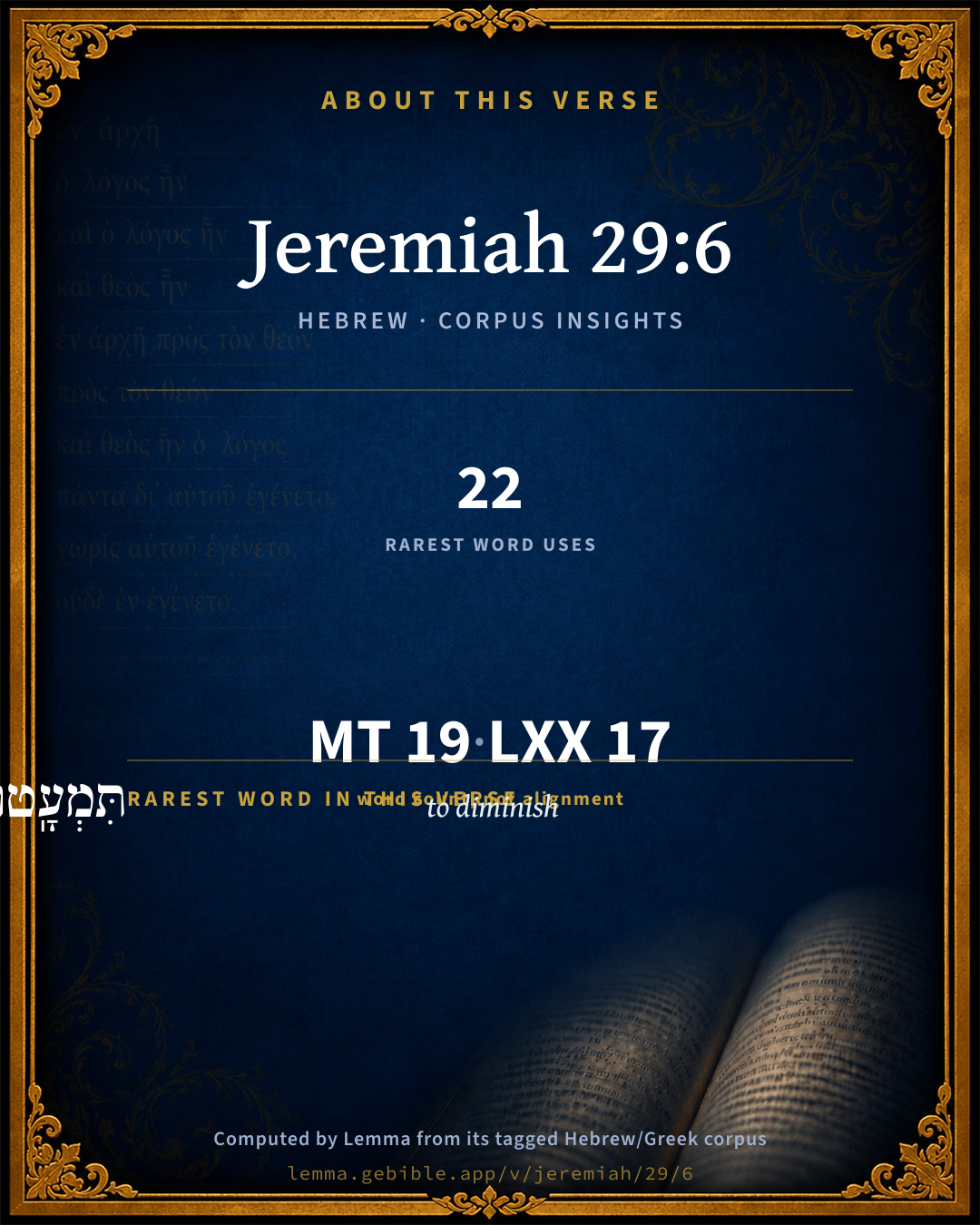
The rarest word here is תִּמְעָֽטוּ to diminish H4591 — appearing just 22 times in the whole Hebrew Bible.

Shared distinctive vocabulary

תִּמְעָֽטוּ to diminish H4591 occurs in 21 verses of the Hebrew Bible. Also found in:

Grammatical profile

  • 7 verbs
  • 9 nouns
  • 1 adverb
  • 2 particles

Verb forms

  • קְח֣וּ Qal · Imperative
  • וְהוֹלִידוּ֮ Hiphil · Imperative
  • וּקְח֨וּ Qal · Imperative
  • תְּנ֣וּ Qal · Imperative
  • וְתֵלַ֖דְנָה Qal · Imperfect
  • וּרְבוּ Qal · Imperative
  • תִּמְעָֽטוּ Qal · Jussive

Repetition

Words recur within this verse — often emphatic in Hebrew:

  • בָּנִ֣ים son H1121 ×3
  • וּבָנוֹת֒ daughter H1323 ×3
  • קְח֣וּ to take H3947 ×2
  • נָשִׁ֗ים woman H802 ×2
  • וְהוֹלִידוּ֮ to bear H3205 ×2

Hebrew & Septuagint length

In the original languages it is 19 Hebrew tokens and 17 Greek tokens — but the two are counted differently (Hebrew bundles its prefixes and suffixes into one token; the Greek is in lemma form), so that isn’t a like-for-like length.

Cross-references

15

Topical passages linked to Jeremiah 29:6 in the Treasury of Scripture Knowledge — connected by theme and wording, ordered by reader-vote popularity; previews shown in the World English Bible.

  • Genesis 21:21 He lived in the wilderness of Paran. His mother took a wife for him out of the land of Egypt.
  • Genesis 24:3–4 I will make you swear by Yahweh, the God of heaven and the God of the earth, that you shall not take a wife for my son of the daughters of the Canaanites, among whom I live.
  • Genesis 24:51 Behold, Rebekah is before you, take her, and go, and let her be your master's son's wife, as Yahweh has spoken."
  • Genesis 28:1–4 Isaac called Jacob, blessed him, and commanded him, "You shall not take a wife of the daughters of Canaan.
  • Genesis 29:19 Laban said, "It is better that I give her to you, than that I should give her to another man. Stay with me."
  • Judges 12:9 He had thirty sons; and thirty daughters he sent abroad, and thirty daughters he brought in from abroad for his sons. He judged Israel seven years.
  • Genesis 1:27–28 God created man in his own image. In God's image he created him; male and female he created them.
  • Genesis 9:7 Be fruitful, and multiply. Bring forth abundantly in the earth, and multiply in it."
  • Genesis 34:4 Shechem spoke to his father, Hamor, saying, "Get me this young lady as a wife."
  • Judges 1:12–14 Caleb said, He who strikes Kiriath Sepher, and takes it, to him will I give Achsah my daughter as wife.
  • Judges 14:2 He came up, and told his father and his mother, and said, I have seen a woman in Timnah of the daughters of the Philistines: now therefore get her for me as wife.
  • Jeremiah 16:2–4 You shall not take a wife, neither shall you have sons or daughters, in this place.
  • 1 Corinthians 7:36–38 But if any man thinks that he is behaving inappropriately toward his virgin, if she is past the flower of her age, and if need so requires, let him do what he desires. He doesn't sin. Let them marry.
  • 1 Timothy 5:14 I desire therefore that the younger widows marry, bear children, rule the household, and give no occasion to the adversary for reviling.
  • Genesis 24:60 They blessed Rebekah, and said to her, "Our sister, may you be the mother of thousands of ten thousands, and let your seed possess the gate of those who hate them."

Cross-references courtesy of OpenBible.info (CC BY 4.0).

Hebrew and Greek witnesses Masoretic Hebrew ↔ Greek Septuagint

The same verse in the two great witnesses to the Old Testament, shown verse-for-verse.

These are two independent witnesses, not word-aligned to each other, and the Septuagint is shown in lemma (dictionary) form.

Hebrew Jeremiah 29:6 Masoretic · Westminster Leningrad Codex

קְח֣וּ נָשִׁ֗ים וְהוֹלִידוּ֮ בָּנִ֣ים וּבָנוֹת֒ וּקְח֨וּ לִבְנֵיכֶ֜ם נָשִׁ֗ים וְאֶת בְּנֽוֹתֵיכֶם֙ תְּנ֣וּ לַֽאֲנָשִׁ֔ים וְתֵלַ֖דְנָה בָּנִ֣ים וּבָנ֑וֹת וּרְבוּ שָׁ֖ם וְאַל תִּמְעָֽטוּ

Take wives, and father sons and daughters; and take wives for your sons, and give your daughters to husbands, that they may bear sons and daughters; and multiply you there, and don't be diminished.

World English Bible · Public Domain

Greek LXX Structure differs

In the Septuagint, Jeremiah is about an eighth shorter than the Hebrew and arranges its material differently — the Oracles Against the Nations (Hebrew chapters 46–51) appear in the middle of the Greek book, after 25:13. Because the chapter and verse boundaries do not line up, a verse-for-verse comparison with the Hebrew is not shown.

A verse-for-verse comparison isn’t shown here because the chapters and verses don’t line up. Switch to the LXX edition with the MT / LXX toggle above to read the Greek directly.

Hebrew: Westminster Leningrad Codex (CC BY 4.0). Greek: Septuagint (public domain); English from a public-domain English Septuagint. How the Septuagint differs from the Hebrew →

Targum (Aramaic paraphrase)

1

The Targum is the ancient Jewish Aramaic paraphrase of the Hebrew Scriptures — an interpretive translation, not the Hebrew text itself. Onkelos (literal) and Pseudo-Jonathan (expansive) render the Torah, and Jonathan the Prophets. Coverage is partial: where no permissively-licensed English translation exists for a verse, only the Aramaic is shown. This is verse-level text, not a word-by-word alignment to the Hebrew.

  1. Targum Jonathan Prophets (Joshua–Malachi)
    סָבוּ נְשִׁין וְאוֹלִידוּ בְנִין וּבְנָן וּסְבוּ לִבְנֵיכוֹן נְשִׁין וְיַת בְּנָתֵיכוֹן הָבוּ לְגַבְרַיָא וִילֵידַת בְּנִין וּבְנָן וּסְגוּ תַמָן וְלָא תִזְעֲרוּן:

    (no public-domain English translation for this verse)

    Targum Jonathan — Aramaic: “Mikraot Gedolot” (public domain). English: “Sefaria Community Translation” (CC0 1.0 (public-domain dedication)); “London "Chaldee Paraphrase," 1871” (public domain). Text via Sefaria.

Commentary

Notes on Jeremiah 29:6 from classic Christian and Jewish commentators (each source and its license shown beneath its notes). The classic Christian expositions comment on the surrounding passage and are grouped to its opening verse, so a note may address several verses; the Jewish commentaries on the Tanakh (Rashi and others) are per-verse, so they appear only where the commentator wrote on this verse.

Lemma curates 59 commentaries, every one of them public domain or Creative Commons licensed, each selected and text-cleaned for this edition rather than reprinted as found. About our sources →

Trapp's Complete Commentary

John Trapp

Jer 29:6 Take ye wives, and beget sons and daughters; and take wives for your sons, and give your daughters to husbands, that they may bear sons and daughters; that ye may be increased there, and not diminished.

Ver. 6. Take ye wives, and beget sons.] First get ye houses and gardens, and then take wives. So in the last commandment house is set before wife; and nature teacheth the birds to build their nests before they come together for copulation.

John Trapp, A Commentary or Exposition upon All the Books of the Old and New Testament (1647–1656) — public domain. Text from a community e-Sword module.

Jamieson, Fausset & Brown

Robert Jamieson, A. R. Fausset & David Brown

that ye . . . be . . . not diminished--It was God's will that the seed of Abraham should not fail; thus consolation is given them, and the hope, though not of an immediate, yet of an ultimate, return.

Jamieson, Fausset & Brown — Commentary Critical and Explanatory on the Whole Bible (1871) — public domain (CC PDM 1.0). Text via the HelloAO Bible API.

John Calvin's Commentaries

In bidding them to take wives for their sons, and to give their daughters in marriage, he speaks according to the usual order of nature; for it would be altogether unreasonable for young men and young women to seek partners for themselves, according to their own humor and fancy. God then speaks here according to the common order of things, when he bids young men not to be otherwise joined in marriage than by the consent of parents, and that young women are not to marry but those to whom they are given.

He then adds, Be ye multiplied there and not diminished; as though he had said, that the time of exile would be so long, that except they propagated, they would soon come to nothing: and God expressed this, because it was not his will that Abraham’s seed should fail. It was indeed a kind of death, when he had driven them so far, as though he had deprived them of the inheritance which he had promised to be perpetual: he, however, administers comfort here by commanding them to propagate their kind: for they could not have been encouraged to do so, except they had their eyes directed to the hope of a return. He then afforded them some taste of his mercy when he bade them not to be diminished in Chaldea. He then adds, —

John Calvin's Commentaries (1540-1563) — public domain. Text from the Calvin Translation Society English edition (1840s-50s) via the Christian Classics Ethereal Library (ccel.org). Calvin's coverage is partial (roughly two-thirds of the Bible); uncommented books and verses are honest gaps, never fabricated. The 19th-century editor's footnotes and remarks are omitted so the notes are faithfully Calvin's own voice.

John Gill's Exposition

Take ye wives, and beget sons and daughters,.... That is, such as had no wives, who were either bachelors or widowers; not that they were to take wives of the Chaldeans, but of those of their own nation; for intermarriages with Heathens were forbidden them; and this they were to do, in order to propagate their posterity, and keep up a succession:

and take wives for your sons, and give your daughters to husbands; or "men" (s); preserving and establishing the right of parents to give their children in marriage, and pointing to them their duty to provide suitable yoke fellows for them; and hereby is signified, that not only they, but their children after them, should continue in this state of captivity:

that they may bear sons and daughters, that ye may be increased there;

and not diminished; like their ancestors in Egypt, who grew very numerous amidst all their afflictions and bondage.

(s) "viris", Junius & Tremellius, Piscator, Schmidt.

John Gill's Exposition of the Whole Bible (1746–1763) — public domain (CC PDM 1.0). Text via the HelloAO Bible API.

Matthew Poole's English Annotations

That is, Be not uneasy in your minds, not resolving what to do, through the prophecies of the false prophets, that tell you the captivity shall be but two years, or at least very short; but do all things which you would do if Babylon were to be your fixed habitation (as it is like to be for seventy years, say the prophets what they please); marry, and give and take in marriage, do whatsoever it becometh prudent men to do, who would accommodate themselves in a place where they are like to abide, and preserve their families, that they might not be utterly extinguished. The words must not be understood as a precept, obliging all in the captivity to do every of these things, which it may be they were not able all to do, but as a counsel and advice not to forbear any thing of this nature, which they would do, if they did fully believe they were to abide in a place seventy years.

Matthew Poole's English Annotations on the Holy Bible (1683–1685) — public domain. Text from a community e-Sword/MySword module.

unfoldingWord translationNotes

Door43 World Missions Community

take wives for your sons, and give your daughters to husbands

Parents commonly arranged their children's marriages.

Seek the peace of the city

The peace of the city is a metonym for the people living in peace. AT: "Do everything you can so the people of the city live in peace" (See: Metonymy)

the city ... its behalf ... it is at peace

These words refer to the city of Babylon.

translationWords

peace

intercede

unfoldingWord translationNotes — © Distant Shores Media and the Door43 World Missions Community, licensed CC BY-SA 4.0. Source: git.door43.org/Door43/en_tn.

Lesson kit

Teaching starters — assembled from the data on this page, not authored interpretation. Every prompt links to the verse data it draws on. Edit before teaching.

Jeremiah, in the Prophets, opens this verse with 19 words (12 distinct Hebrew lemmas). Its most distinctive word is mâʻaṭ (“to diminish”). A historical commentator’s framing appears above. Read the whole chapter for the surrounding context.

Discussion questions

  1. The word mâʻaṭ carries the sense “to diminish.” How does it shape the verse?
  2. Exodus 12:4 shares the word «to diminish» with this verse. How do the two illuminate each other?
  3. “son” occurs 3× in this one verse. What is the effect of the repetition?
  4. These translations render this verse differently; the difference is in the English rendering, not the original. What questions does that raise?
  5. The verb «קְח֣וּ» is Qal Imperative. How does its form color the action?
  6. Reading how Trapp's Complete Commentary and Jamieson, Fausset & Brown read this verse, where do the two commentators agree and where do they part?

Things to notice

Reading settings

Reading text

Shown beneath each verse's original-language words.

Old Testament
Old Testament edition

Read the OT as the Masoretic Hebrew (MT) or the Greek Septuagint (LXX).

English shown for the Greek Septuagint (in the Hebrew ↔ Greek comparison).

Comparing translations? Open the Compare panel on any verse page to stack up to four side by side.