Isaiah 23:16

Hebrew (Westminster Leningrad Codex) Isaiah 23:16 appears in the Hebrew Old Testament. The text above is from the Westminster Leningrad Codex. Each word links to its Strong’s number, a concise gloss, and parsing drawn from the Open Scriptures Hebrew Bible morphology. Click any word for its full Brown-Driver-Briggs (BDB) entry.
Download image
Cite this verse

Isaiah 23:16 (World English Bible). Public Domain. Lemma interlinear Bible study tool, https://lemma.gebible.app/v/isaiah/23/16.

Show BibTeX & RIS
BibTeX
RIS
English Translation
Take a harp, go about the city, you prostitute that has been forgotten; make sweet melody, sing many songs, that you may be remembered.
World English Bible · Public Domain
Download a study sheet

One document with this verse’s original text, its word-by-word gloss line, the meaning frame, cross-references with their text, attributed commentary, and full source and license credits — printable, and it pastes into notes with its structure intact.

This verse Autodidact and up

Study sheet (.html) Plain text (.txt)

A passage Seminary Student

Up to 50 verses in one chapter. A passage sheet keeps up to 6 commentary sources and 12 cross-references per verse, in the order this page ranks them, and says so on the sheet whenever that leaves anything out. Ask for a single verse and you get the Autodidact verse sheet above.

Everything on this page stays free to read, with no account — the sheet is a download of what is already on screen, not access to it.

Want to remove ads? Support Godless Engineer
Compare translations 3

The same verse in 3 English versions, stacked beneath the original-language interlinear above. Click any original word for its lexicon entry.

Each is an independent rendering of the whole verse — the interlinear is not word-aligned to these translations.

Highlighted words mark where these versions differ — a whole-verse word diff, not a word-by-word alignment.

  • World English Bible Public Domain
    Take a harp, go about the city, you prostitute that has been forgotten; make sweet melody, sing many songs, that you may be remembered.
  • King James Version Public Domain
    Take an harp, go about the city, thou harlot that hast been forgotten; make sweet melody, sing many songs, that thou mayest be remembered.
  • unfoldingWord Literal Text CC BY-SA 4.0
    “Take a harp, go around the city, forgotten prostitute; make well to play, multiply song, that you may be remembered.”

unfoldingWord Literal Text — © unfoldingWord, licensed CC BY-SA 4.0. Word-aligned USFM3 via Door43 (git.door43.org/unfoldingWord/en_ult).

Versions to compare (up to 4)

3 of 4 selected

Show all 18 translations

Every available English version of this verse, each an independent rendering of the whole verse.

  • World English Bible Public Domain
    Take a harp, go about the city, you prostitute that has been forgotten; make sweet melody, sing many songs, that you may be remembered.
  • Berean Standard Bible Public Domain
    “Take up your harp, stroll through the city, O forgotten harlot. Make sweet melody, sing many a song, so you will be remembered.”
  • Majority Standard Bible Public Domain
    “Take up your harp, stroll through the city, O forgotten harlot. Make sweet melody, sing many a song, so you will be remembered.”
  • King James Version Public Domain
    Take an harp, go about the city, thou harlot that hast been forgotten; make sweet melody, sing many songs, that thou mayest be remembered.
  • American Standard Version (1901) Public Domain
    Take a harp, go about the city, thou harlot that hast been forgotten; make sweet melody, sing many songs, that thou mayest be remembered.
  • Revised Version (1885) Public Domain
    Take an harp, go about the city, thou harlot that hast been forgotten; make sweet melody, sing many songs, that thou mayest be remembered.
  • Geneva Bible (1599) Public Domain
    Take an harpe and go about the citie: (thou harlot thou hast beene forgotten) make sweete melodie, sing moe songes that thou maiest be remembred.
  • Douay-Rheims (1899) Public Domain
    Take a harp, go about the city, thou harlot that hast been forgotten: sing well, sing many a song, that thou mayst be remembered.
  • Young's Literal Translation Public Domain
    Take a harp, go round the city, O forgotten harlot, play well, Multiply song that thou mayest be remembered.
  • Literal Standard Version CC BY-SA 4.0
    Take a harp, go around the city, O forgotten harlot, play well, || Multiply song that you may be remembered.
  • Unlocked Literal Bible CC BY-SA 4.0
    Take a harp, go about the city, you forgotten prostitute; play it well, sing many songs, so that you may be remembered.
  • unfoldingWord Literal Text CC BY-SA 4.0
    “Take a harp, go around the city, forgotten prostitute; make well to play, multiply song, that you may be remembered.”
  • Darby Bible Public Domain
    Take a harp, go about the city, thou forgotten harlot! Make sweet melody, sing many songs, that thou mayest be remembered.
  • World Messianic Bible Public Domain
    Take a harp; go about the city, you prostitute that has been forgotten. Make sweet melody. Sing many songs, that you may be remembered.
  • Webster's Bible Public Domain
    Take a harp, go about the city, thou harlot that hast been forgotten; make sweet melody, sing many songs, that thou mayest be remembered.
  • Free Bible Version CC BY-SA 4.0
    “Take a lyre and walk around the city, forgotten prostitute! Play and sing so people will remember you!”
  • Bible in Basic English Public Domain
    Take an instrument of music, go about the town, O loose woman who has gone out from the memory of man; make sweet melody with songs, so that you may come back to men's minds.
  • JPS Tanakh (1917) Public Domain
    Take a harp, go about the city, thou harlot long forgotten; make sweet melody, sing many songs, that thou mayest be remembered.

Literal Standard Version (2020), Covenant Press — licensed CC BY-SA 4.0. Text via the HelloAO Bible API (eBible.org). Unlocked Literal Bible (unfoldingWord) — licensed CC BY-SA 4.0. Text via the HelloAO Bible API (eBible.org). unfoldingWord Literal Text — © unfoldingWord, licensed CC BY-SA 4.0. Word-aligned USFM3 via Door43 (git.door43.org/unfoldingWord/en_ult). Free Bible Version, Dr. Jonathan Gallagher — licensed CC BY-SA 4.0. Text via the HelloAO Bible API (eBible.org).

Word by word

More ways to search: Search by grammar → Find every occurrence → Compare this word →

Practice this passage: Drill this verse → Learn its vocabulary →

נַגֵּן֙
nâgan
H5059
“to play stringed instrument”
Verb, Piel, Infinitive Construct
Part of Speech
Verb
Stem
Piel
Form
Infinitive Construct
Full BDB Definition

Origin: a primitive root

TWOT: 1292 . 1

to play or strike strings, play a stringed instrument - (Qal) - player (participle) - (Piel) - to play - player, minstrel (participle)
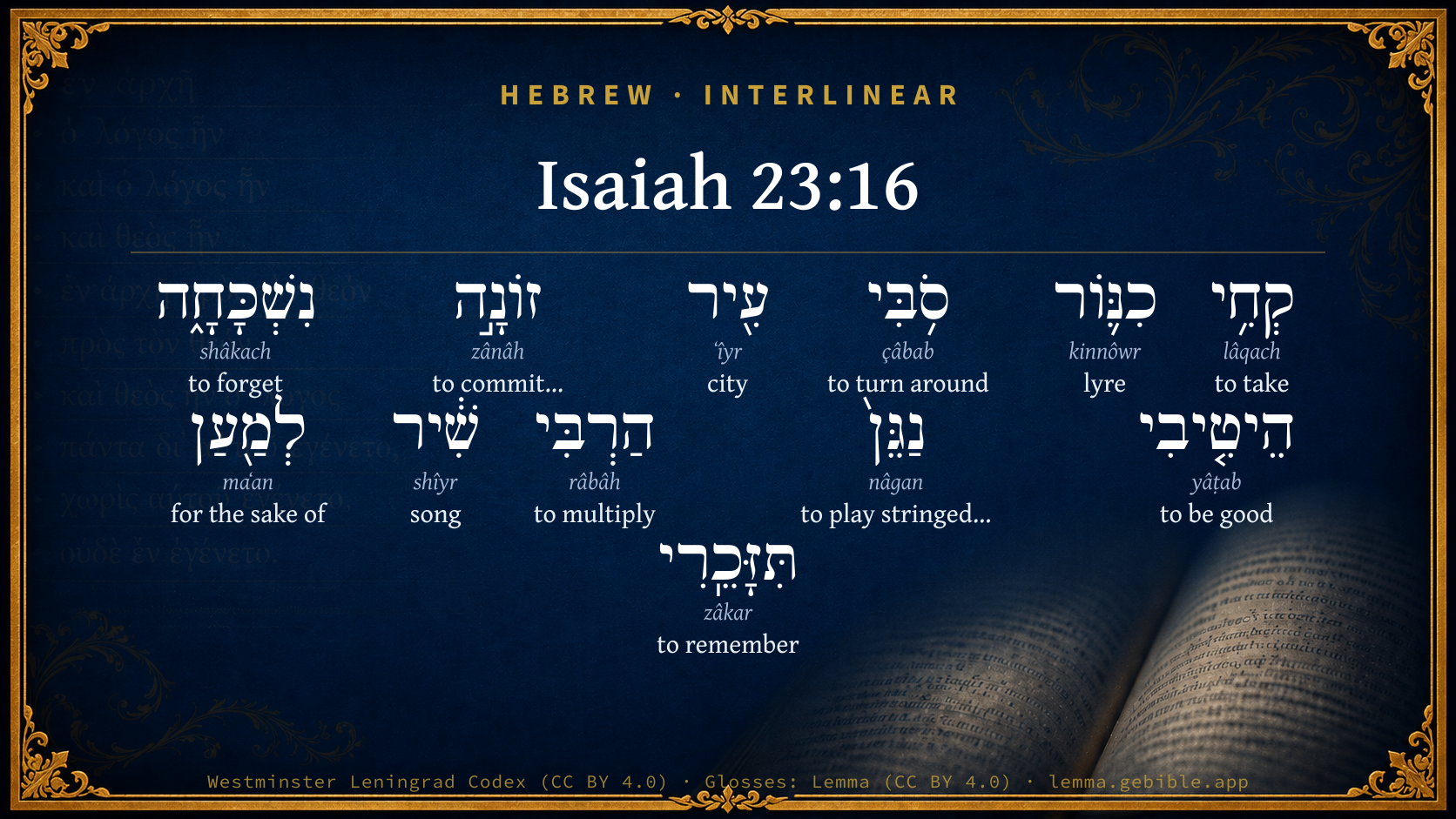
  1. קְחִ֥י lâqach H3947 “take” Verb, Qal, Imperative, 2nd Person, Feminine, Singular
  2. כִנּ֛וֹר kinnôwr H3658 “lyre” Noun, Common, Masculine, Singular, Absolute
  3. סֹ֥בִּי çâbab H5437 “turn around” Verb, Qal, Imperative, 2nd Person, Feminine, Singular
  4. עִ֖יר ʻîyr H5892 “city” Noun, Common, Feminine, Singular, Absolute
  5. זוֹנָ֣ה zânâh H2181 “committing fornication” Verb, Qal, Participle Active, Feminine, Singular, Absolute
  6. נִשְׁכָּחָ֑ה shâkach H7911 “forgeting” Verb, Niphal, Participle Active, Feminine, Singular, Absolute
  7. הֵיטִ֤יבִי yâṭab H3190 “be good” Verb, Hiphil, Imperative, 2nd Person, Feminine, Singular
  8. הַרְבִּי râbâh H7235 “multiply” Verb, Hiphil, Imperative, 2nd Person, Feminine, Singular
  9. שִׁ֔יר shîyr H7892 “song” Noun, Common, Both, Singular, Absolute
  10. לְמַ֖עַן maʻan H4616 “for the sake of” Preposition
  11. תִּזָּכֵֽרִי zâkar H2142 “to remember” Verb, Niphal, Imperfect, 2nd Person, Feminine, Singular

About this verse

These counts appear in no published source. They are computed here, from the morphology-tagged text and Lemma’s own curated glosses. What Lemma adds →

12
words
12
distinct lemmas
Prophets
section

Notable vocabulary

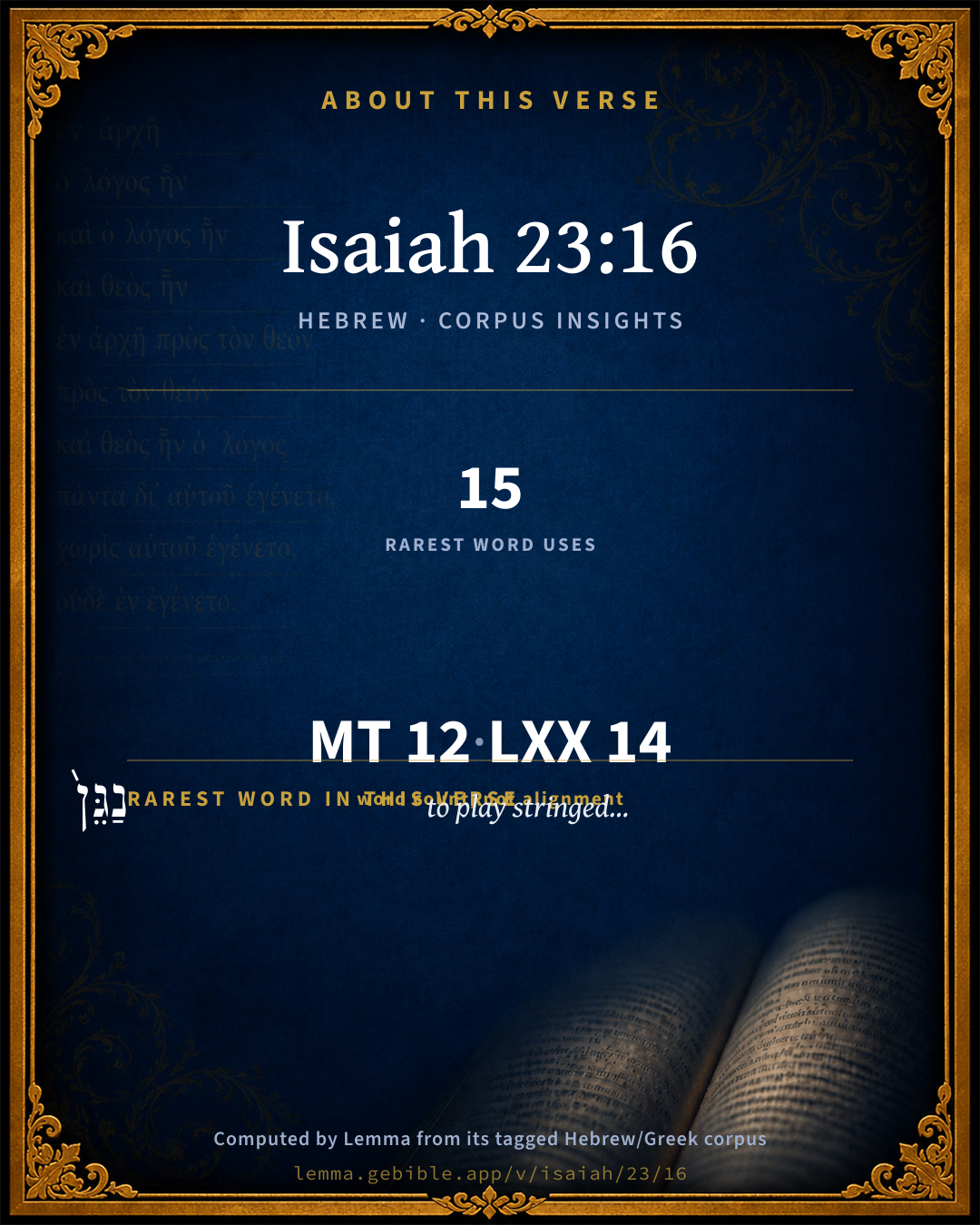
The rarest word here is נַגֵּן֙ to play stringed instrument H5059 — appearing just 15 times in the whole Hebrew Bible.

Shared distinctive vocabulary

נַגֵּן֙ to play stringed instrument H5059 occurs in 12 verses of the Hebrew Bible. Also found in:

Grammatical profile

  • 8 verbs
  • 3 nouns
  • 1 preposition

Verb forms

  • קְחִ֥י Qal · Imperative
  • סֹ֥בִּי Qal · Imperative
  • זוֹנָ֣ה Qal · Participle Active
  • נִשְׁכָּחָ֑ה Niphal · Participle Active
  • הֵיטִ֤יבִי Hiphil · Imperative
  • נַגֵּן֙ Piel · Infinitive Construct
  • הַרְבִּי Hiphil · Imperative
  • תִּזָּכֵֽרִי Niphal · Imperfect

Hebrew & Septuagint length

In English translation the verse runs 24 words from the Hebrew and 26 from the Septuagint (LXX English) — closely comparable.

A rough comparison of the two English renderings, which tokenize alike — not a word-level alignment.

Word counts can differ between the Hebrew and the Greek without any difference in meaning — e.g. the Hebrew direct-object marker אֵת has no separate Greek word, and Greek often adds the article ὁ.

In the original languages it is 12 Hebrew tokens and 14 Greek tokens — but the two are counted differently (Hebrew bundles its prefixes and suffixes into one token; the Greek is in lemma form), so that isn’t a like-for-like length.

Cross-references

2

Topical passages linked to Isaiah 23:16 in the Treasury of Scripture Knowledge — connected by theme and wording, ordered by reader-vote popularity; previews shown in the World English Bible.

  • Proverbs 7:10–12 Behold, there a woman met him with the attire of a prostitute, And with crafty intent.
  • Jeremiah 30:14 All your lovers have forgotten you; they don't seek you: for I have wounded you with the wound of an enemy, with the chastisement of a cruel one, for the greatness of your iniquity, because your sins were increased.

Cross-references courtesy of OpenBible.info (CC BY 4.0).

Hebrew and Greek witnesses Masoretic Hebrew ↔ Greek Septuagint

The same verse in the two great witnesses to the Old Testament, shown verse-for-verse.

These are two independent witnesses, not word-aligned to each other, and the Septuagint is shown in lemma (dictionary) form.

Hebrew Isaiah 23:16 Masoretic · Westminster Leningrad Codex

קְחִ֥י כִנּ֛וֹר סֹ֥בִּי עִ֖יר זוֹנָ֣ה נִשְׁכָּחָ֑ה הֵיטִ֤יבִי נַגֵּן֙ הַרְבִּי שִׁ֔יר לְמַ֖עַן תִּזָּכֵֽרִי

Take a harp, go about the city, you prostitute that has been forgotten; make sweet melody, sing many songs, that you may be remembered.

World English Bible · Public Domain

Greek LXX Isaiah 23:16 Septuagint · lemma form

λαμβάνω κιθάρα ῥεμβεύω πόλις πόρνη ἐπιλανθάνω καλῶς κιθαρίζω πολύς ᾄδω ἵνα σύ μνεία γίγνομαι

Take a harp, go about, O city, you harlot that have been forgotten; play well on the harp, sing many songs, that you may be remembered.

LXX2012 (modern English Septuagint) · Public Domain

Hebrew: Westminster Leningrad Codex (CC BY 4.0). Greek: Septuagint (public domain); English from LXX2012 (modern English Septuagint) (Public Domain). How the Septuagint differs from the Hebrew →

Targum (Aramaic paraphrase)

1

The Targum is the ancient Jewish Aramaic paraphrase of the Hebrew Scriptures — an interpretive translation, not the Hebrew text itself. Onkelos (literal) and Pseudo-Jonathan (expansive) render the Torah, and Jonathan the Prophets. Coverage is partial: where no permissively-licensed English translation exists for a verse, only the Aramaic is shown. This is verse-level text, not a word-by-word alignment to the Hebrew.

  1. Targum Jonathan Prophets (Joshua–Malachi)
    אִתְחַלֵיף יְקָרִיךְ אִטַלְטֵל לִמְדִינָא קַרְתָּא דִי הֲוֵת כְנַפְקַת בְּרָא אִתְרַחֲקַת הֲפוּכִי כִנָרַיִךְ לְאֶבְלָא וּזְמָרַיִךְ לְאִלְיָא מָאִים יֵעוּל דָכְרָנֵיךְ:

    Thy glory is changed: wander to another country, O city, who hast been as an harlot, thou art doomed to oblivion: thy harp is turned into mourning, and thy song to lamentation; perhaps, thou mayest be remembered.

    Targum Jonathan — Aramaic: “Mikraot Gedolot” (public domain). English: “Sefaria Community Translation” (CC0 1.0 (public-domain dedication)); “London "Chaldee Paraphrase," 1871” (public domain). Text via Sefaria.

Commentary

Notes on Isaiah 23:16 from classic Christian and Jewish commentators (each source and its license shown beneath its notes). The classic Christian expositions comment on the surrounding passage and are grouped to its opening verse, so a note may address several verses; the Jewish commentaries on the Tanakh (Rashi and others) are per-verse, so they appear only where the commentator wrote on this verse.

Lemma curates 59 commentaries, every one of them public domain or Creative Commons licensed, each selected and text-cleaned for this edition rather than reprinted as found. About our sources →

Trapp's Complete Commentary

John Trapp

Isa 23:16 Take an harp, go about the city, thou harlot that hast been forgotten; make sweet melody, sing many songs, that thou mayest be remembered.

Ver. 16. Take an harp.] In bidding her do so, he foretelleth that she shall do so - sc., ad ingenium suum redire, fall to her former practices.

Make sweet melody, &c.] The Tyrians were much addicted to music. {Eze 26:13; Eze 28:13}

John Trapp, A Commentary or Exposition upon All the Books of the Old and New Testament (1647–1656) — public domain. Text from a community e-Sword module.

Geneva Bible (1599)

Geneva Bible translators

She shall labor by all means to recover her first credit: as an harlot when she is long forgotten, seeketh by all means to entertain her lovers.

Geneva Bible (1599) marginal notes — public domain. Text via Bolls.life.

Jamieson, Fausset & Brown

Robert Jamieson, A. R. Fausset & David Brown

Same figure [Isa 23:15] to express that Tyre would again prosper and attract commercial intercourse of nations to her, and be the same joyous, self-indulging city as before.

Jamieson, Fausset & Brown — Commentary Critical and Explanatory on the Whole Bible (1871) — public domain (CC PDM 1.0). Text via the HelloAO Bible API.

Ellicott's Commentary for English Readers

(16) Take an harp, go about the city . . .—In a tone half of irony and half of pity, the prophet tells the “harlot that had been forgotten” to return to her old arts of song (the singing women of the East were commonly of this class), and to go about once more with song and lyre, recalling her old lovers (i.e., her old allies) to the memory of their past love.

A Bible Commentary for English Readers, edited by Charles John Ellicott (1878–1897) — public domain. Text from a community e-Sword module.

The Cambridge Bible for Schools and Colleges

gen. ed. J. J. S. Perowne

16. The song of the harlot, celebrating the wiles by which a forgotten prostitute seeks to regain her influence. The song has a light, dancing rhythm, and consists of six lines of two words each.

make sweet melody] Better: play skilfully.

The Cambridge Bible for Schools and Colleges (gen. ed. J. J. S. Perowne; Cambridge University Press, 1878–1918) — public domain. Text from a community e-Sword module.

John Gill's Exposition

Take a harp, go about the city,.... As harlots used to do, that by their music, both vocal and instrumental, they might allure men into their company to commit fornication with them; so Tyre is directed to, or rather this is a prophecy that she should take very artful and ensnaring methods to restore her commerce and merchandise:

thou harlot that hast been forgotten; See Gill on Isa 23:15,

make sweet melody; or, "do well by striking" (k); that is, the harp in her hand; strike it well with art and skill, so as to make melody, and give pleasure:

sing many songs; or, "multiply a song" (l); sing one after another, till the point is carried aimed at:

that thou mayest be remembered; men may took at thee again, and trade with thee as formerly, who had been so long forgotten and neglected.

(k) "benefac pulsando", Junius; "belle pulsa", Piscator. (l) "multiplica cantum", Piscator.

John Gill's Exposition of the Whole Bible (1746–1763) — public domain (CC PDM 1.0). Text via the HelloAO Bible API.

Albert Barnes' Notes on the Bible

Take an harp - This is a continuation of the figure commenced in the previous verse, a direct command to Tyre as an harlot, to go about the city with the usual expressions of rejoicing. Thus Donatus, in Terent. Eunuch., iii. 2, 4, says:

‘Fidicinam esse meretricum est;’

And thus Horace:

‘Nec meretrix tibicina, cujus

Ad strepitum salias.’

1 Epis. xiv. 25.

Thou harlot that hast been forgotten - For seventy years thou hast lain unknown, desolate, ruined.

Make sweet melody ... - Still the prophet keeps up the idea of the harlot that had been forgotten, and that would now call her lovers again to her dwelling. The sense is, that Tyre would rise to her former splendor, and that the nations would be attracted by the proofs of returning prosperity to renew their commercial contact with her.

Albert Barnes' Notes on the Bible (1834–1885) — public domain. Text from a community e-Sword/MySword module.

Matthew Poole's English Annotations

Take an harp, go about the city; as harlots use to do, to allure customers.

Thou harlot; so he calleth Tyre, partly because she enticed merchants to deal with her by various artifices, and even by dishonest practices, as harlots use; and partly because of the great and general uncleanness which was both committed and tolerated in it. That thou mayest be remembered by those who had forgotten thee, Isa 23:15.

Matthew Poole's English Annotations on the Holy Bible (1683–1685) — public domain. Text from a community e-Sword/MySword module.

Whedon's Commentary on the Bible

Daniel D. Whedon

16. Take a harp — This verse indicates the continuance of the city, but so humbled, that, to make herself believe that she is something like her former self, she is told to put on extra simulations — to sing, play the harp, and make a big show of happiness and prosperity.

Daniel D. Whedon (gen. ed.), Commentary on the Old and New Testaments (1874–1909) — public domain. Text from a community e-Sword module.

The Pulpit Commentary

Take a harp. Harlots in the East, and indeed in the West also in ancient times (Her., "Epist.," 1:14, 1. 25), were expected to be musicians. The harp and the guitar were their usual instruments. Forgotten harlot. In addressing. Tyro as a "harlot," the prophet does not seem to mean more than that her aims were, or at any rate had been, selfish and worldly, such as sever between man and God. She had pursued wealth for the enjoyments that it brought her, not in order to make a good use of it. Hers had been the covetousness which is "idolatry". (Col_3:5)

The Pulpit Commentary (1880–1919), ed. H.D.M. Spence-Jones & Joseph S. Exell — public domain. Text from a community e-Sword module.

John Wesley's Explanatory Notes

Go about - As harlots use to do. Thou harlot - So he calls Tyre, because she enticed the merchants to deal with her by various artifices, and even by dishonest practices, and because of the great and general uncleanness which was committed in it.

John Wesley, Explanatory Notes Upon the Whole Bible (1754–1765) — public domain. Text via the GEBible commentary corpus.

J. A. Alexander on Isaiah

Joseph Addison Alexander

“Take a harp, go about the city, oh forgotten harlot, play well, sing much, that thou mayest be remembered.” These are now commonly explained as the words of the song itself, describing the only way in which the harlot could recover her lost place in the memory of men, viz. by soliciting their notice and their favor. The application of the song to Tyre implies not only that she had lost her former position in the sight of the nations, but that exertion would be needed to recover it. Play well, sing much, literally, make good playing, multiply song.

Joseph Addison Alexander, The Prophecies of Isaiah (1846–1847; New York: Scribner, 1870–1878) — public domain. Text from a community e-Sword module.

Rashi

Rabbi Shlomo Yitzchaki (Rashi)

sing many songs That is to say, also make many supplications and humble your haughtiness.

Rashi on the Tanakh — English translations: “The Judaica Press complete Tanach with Rashi, translated by A. J. Rosenberg” (CC BY 4.0); “Pentateuch with Rashi's commentary by M. Rosenbaum and A.M. Silbermann, 1929-1934” (public domain); “The Metsudah Tanach series, Lakewood, N.J” (CC BY 4.0); and “The Book of Joshua, Metsudah Publications, 1997” (CC BY 4.0). Text via Sefaria.

Ibn Ezra

Rabbi Abraham ibn Ezra

Take up an harp, etc. The forgotten harlot walks about the city playing, that she may be remembered again; thus Tyre will send letters to all her neighbours, that the merchants may again come to her as before.

Ibn Ezra on the Tanakh — English translations: “Sefaria Community Translation” (CC0 1.0 (public-domain dedication)); “Yalkut, Sifsei Chachomim Chumash, Metsudah Publications, 2009” (CC BY 4.0); and “Commentary of Ibn Ezra on Isaiah - trans. by M. Friedlander, 1873” (public domain). Text via Sefaria.

Lesson kit

Teaching starters — assembled from the data on this page, not authored interpretation. Every prompt links to the verse data it draws on. Edit before teaching.

Isaiah, in the Prophets, opens this verse with 12 words (12 distinct Hebrew lemmas). Its most distinctive word is nâgan (“to play stringed instrument”). A historical commentator’s framing appears above. Read the whole chapter for the surrounding context.

Discussion questions

  1. The word nâgan carries the sense “to play stringed instrument.” How does it shape the verse?
  2. How does 1 Samuel 16:16, which shares the word «to play stringed instrument», read alongside this verse?
  3. These translations render this verse differently; the difference is in the English rendering, not the original. What questions does that raise?
  4. «קְחִ֥י» is a Qal Imperative verb. How does that grammatical form shape the action described?
  5. Compare how Trapp's Complete Commentary and Geneva Bible (1599) read this verse. Where do they agree or differ?

Things to notice

Reading settings

Reading text

Shown beneath each verse's original-language words.

Old Testament
Old Testament edition

Read the OT as the Masoretic Hebrew (MT) or the Greek Septuagint (LXX).

English shown for the Greek Septuagint (in the Hebrew ↔ Greek comparison).

Comparing translations? Open the Compare panel on any verse page to stack up to four side by side.