
Ezekiel 37:26

Hebrew (Westminster Leningrad Codex) Ezekiel 37:26 appears in the Hebrew Old Testament. The text above is from the Westminster Leningrad Codex. Each word links to its Strong’s number, a concise gloss, and parsing drawn from the Open Scriptures Hebrew Bible morphology. Click any word for its full Brown-Driver-Briggs (BDB) entry.
Download image
Cite this verse

Ezekiel 37:26 (World English Bible). Public Domain. Lemma interlinear Bible study tool, https://lemma.gebible.app/v/ezekiel/37/26.

Show BibTeX & RIS
BibTeX
RIS
English Translation
Moreover I will make a covenant of peace with them; it shall be an everlasting covenant with them; and I will place them, and multiply them, and will set my sanctuary in the midst of them forevermore.
World English Bible · Public Domain
Download a study sheet

One document with this verse’s original text, its word-by-word gloss line, the meaning frame, cross-references with their text, attributed commentary, and full source and license credits — printable, and it pastes into notes with its structure intact.

This verse Autodidact and up

Study sheet (.html) Plain text (.txt)

A passage Seminary Student

Up to 50 verses in one chapter. A passage sheet keeps up to 6 commentary sources and 12 cross-references per verse, in the order this page ranks them, and says so on the sheet whenever that leaves anything out. Ask for a single verse and you get the Autodidact verse sheet above.

Everything on this page stays free to read, with no account — the sheet is a download of what is already on screen, not access to it.

Want to remove ads? Support Godless Engineer
Compare translations 3

The same verse in 3 English versions, stacked beneath the original-language interlinear above. Click any original word for its lexicon entry.

Each is an independent rendering of the whole verse — the interlinear is not word-aligned to these translations.

Highlighted words mark where these versions differ — a whole-verse word diff, not a word-by-word alignment.

  • World English Bible Public Domain
    Moreover I will make a covenant of peace with them; it shall be an everlasting covenant with them; and I will place them, and multiply them, and will set my sanctuary in the midst of them forevermore.
  • King James Version Public Domain
    Moreover I will make a covenant of peace with them; it shall be an everlasting covenant with them: and I will place them, and multiply them, and will set my sanctuary in the midst of them for evermore.
  • unfoldingWord Literal Text CC BY-SA 4.0
    I will establish a covenant of peace with them. It will be an everlasting covenant with them. I will establish them and multiply them and set my holy place in their midst forever.

unfoldingWord Literal Text — © unfoldingWord, licensed CC BY-SA 4.0. Word-aligned USFM3 via Door43 (git.door43.org/unfoldingWord/en_ult).

Versions to compare (up to 4)

3 of 4 selected

Show all 18 translations

Every available English version of this verse, each an independent rendering of the whole verse.

  • World English Bible Public Domain
    Moreover I will make a covenant of peace with them; it shall be an everlasting covenant with them; and I will place them, and multiply them, and will set my sanctuary in the midst of them forevermore.
  • Berean Standard Bible Public Domain
    And I will make a covenant of peace with them; it will be an everlasting covenant. I will establish them and multiply them, and I will set My sanctuary among them forever.
  • Majority Standard Bible Public Domain
    And I will make a covenant of peace with them; it will be an everlasting covenant. I will establish them and multiply them, and I will set My sanctuary among them forever.
  • King James Version Public Domain
    Moreover I will make a covenant of peace with them; it shall be an everlasting covenant with them: and I will place them, and multiply them, and will set my sanctuary in the midst of them for evermore.
  • American Standard Version (1901) Public Domain
    Moreover I will make a covenant of peace with them; it shall be an everlasting covenant with them; and I will place them, and multiply them, and will set my sanctuary in the midst of them for evermore.
  • Revised Version (1885) Public Domain
    Moreover I will make a covenant of peace with them: it shall be an everlasting covenant with them: and I will place them, and multiply them, and will set my sanctuary in the midst of them for evermore.
  • Geneva Bible (1599) Public Domain
    Moreouer, I will make a couenant of peace with them: it shall be an euerlasting couenant with them, and I wil place them, and multiply them, and wil set my Sanctuarie among them for euermore.
  • Douay-Rheims (1899) Public Domain
    And I will make a covenant of peace with them, it shall be an everlasting covenant with them: and I will establish them, and will multiply them, and will set my sanctuary in the midst of them for ever.
  • Young's Literal Translation Public Domain
    And I have made to them a covenant of peace, A covenant age-during it is with them, And I have placed them, and multiplied them, And placed My sanctuary in their midst -- to the age.
  • Literal Standard Version CC BY-SA 4.0
    And I have made a covenant of peace with them, || It is a perpetual covenant with them, || And I have placed them, and multiplied them, || And placed My sanctuary in their midst for all time.
  • Unlocked Literal Bible CC BY-SA 4.0
    I will establish a covenant of peace with them. It will be an everlasting covenant with them. I will establish them and multiply them and set my holy place in their midst forever.
  • unfoldingWord Literal Text CC BY-SA 4.0
    I will establish a covenant of peace with them. It will be an everlasting covenant with them. I will establish them and multiply them and set my holy place in their midst forever.
  • Darby Bible Public Domain
    And I will make a covenant of peace with them: it shall be an everlasting covenant with them; and I will place them, and multiply them, and will set my sanctuary in the midst of them for ever.
  • World Messianic Bible Public Domain
    Moreover I will make a covenant of peace with them. It will be an everlasting covenant with them. I will place them, multiply them, and will set my sanctuary among them forever more.
  • Webster's Bible Public Domain
    Moreover I will make a covenant of peace with them; it shall be an everlasting covenant with them: and I will place them, and multiply them, and will set my sanctuary in the midst of them for evermore.
  • Free Bible Version CC BY-SA 4.0
    I will make an agreement of peace with them. This will be an everlasting agreement. I will make them secure and increase their numbers, and I will keep my sanctuary there with them forever.
  • Bible in Basic English Public Domain
    And I will make an agreement of peace with them: it will be an eternal agreement with them: and I will have mercy on them and make their numbers great, and will put my holy place among them for ever.
  • JPS Tanakh (1917) Public Domain
    Moreover I will make a covenant of peace with them — it shall be an everlasting covenant with them; and I will establish them, and multiply them, and will set My sanctuary in the midst of them for ever.

Literal Standard Version (2020), Covenant Press — licensed CC BY-SA 4.0. Text via the HelloAO Bible API (eBible.org). Unlocked Literal Bible (unfoldingWord) — licensed CC BY-SA 4.0. Text via the HelloAO Bible API (eBible.org). unfoldingWord Literal Text — © unfoldingWord, licensed CC BY-SA 4.0. Word-aligned USFM3 via Door43 (git.door43.org/unfoldingWord/en_ult). Free Bible Version, Dr. Jonathan Gallagher — licensed CC BY-SA 4.0. Text via the HelloAO Bible API (eBible.org).

Word by word

More ways to search: Search by grammar → Find every occurrence → Compare this word →

Practice this passage: Drill this verse → Learn its vocabulary →

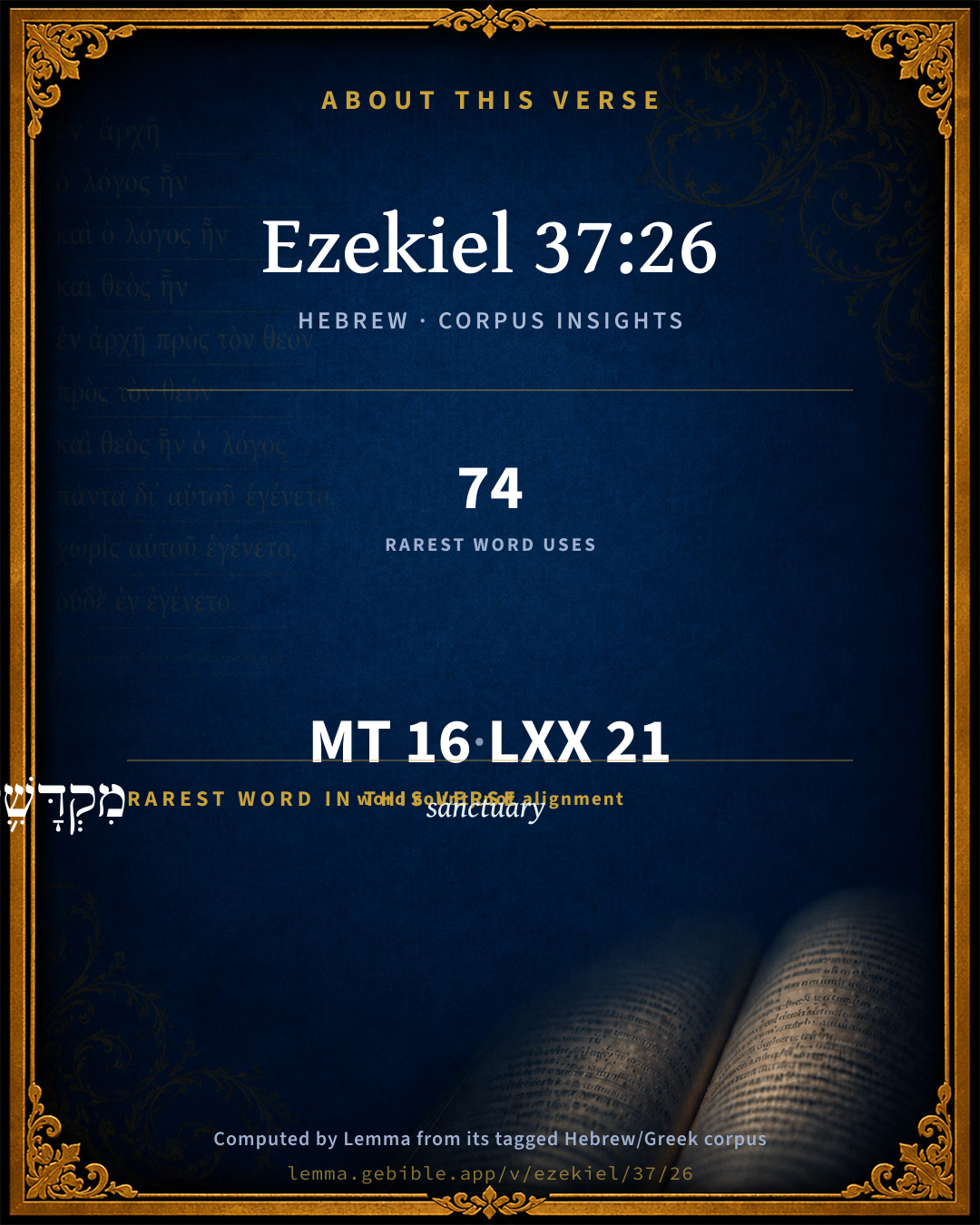
מִקְדָּשִׁ֛י
miqdâsh
H4720
“sanctuary · my”
Noun, Common, Masculine, Singular, Construct + Suffix, Personal, 1st Person, Common, Singular
Part of Speech
Noun
Type
Common
Gender
Masculine
Number
Singular
State
Construct
Full BDB Definition

Origin: from H6942

TWOT: 1990f

sacred place, sanctuary, holy place - sanctuary - of the temple - of the tabernacle - of Ezekiel's temple - of Jehovah
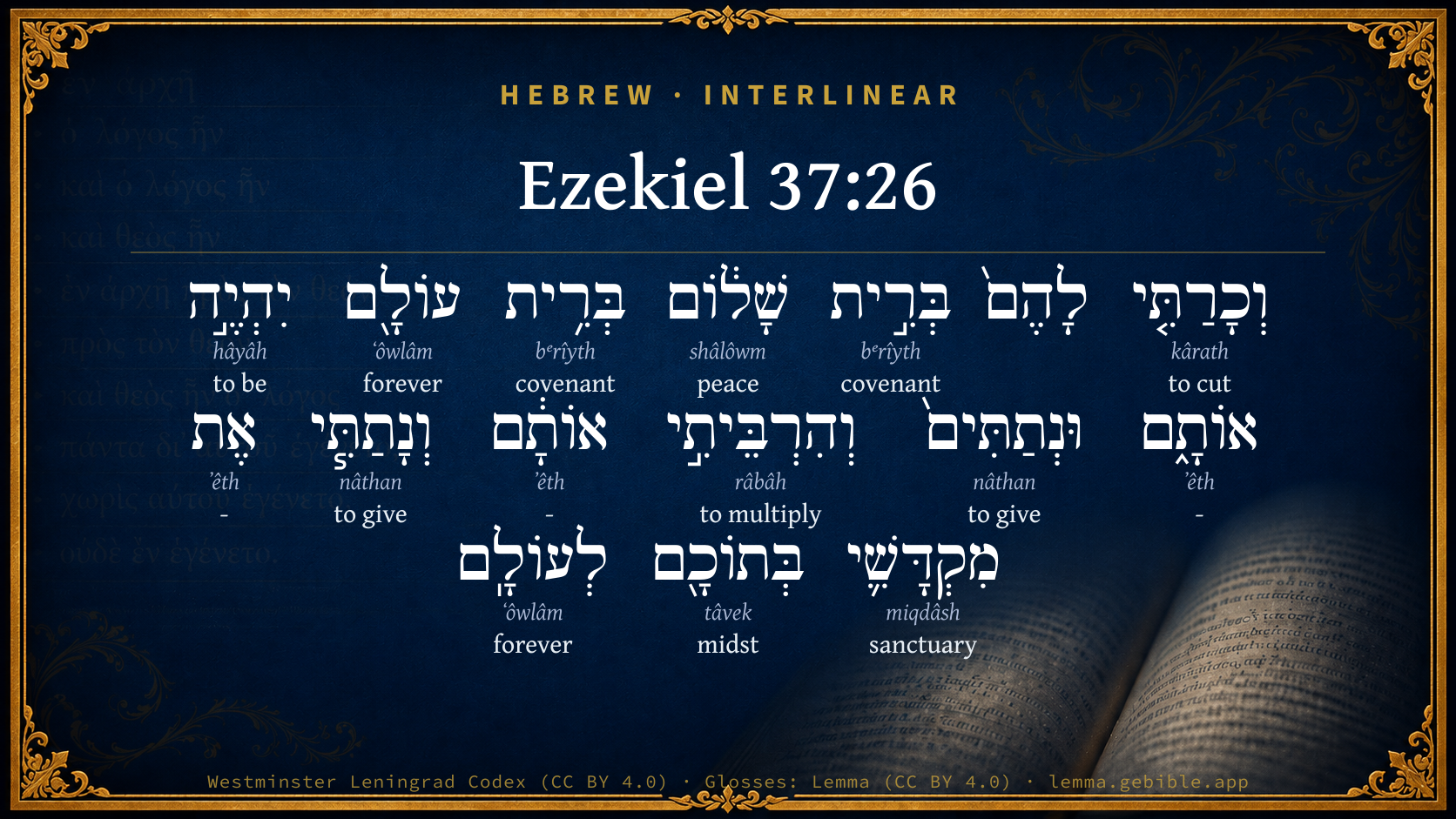
  1. וְכָרַתִּ֤י kârath H3772 “and · to cut” Conjunction + Verb, Qal, Sequential Perfect, 1st Person, Common, Singular
  2. בְּרִ֣ית bᵉrîyth H1285 “covenant of” Noun, Common, Feminine, Singular, Construct
  3. שָׁל֔וֹם shâlôwm H7965 “peace” Noun, Common, Masculine, Singular, Absolute
  4. בְּרִ֥ית bᵉrîyth H1285 “covenant of” Noun, Common, Feminine, Singular, Construct
  5. עוֹלָ֖ם ʻôwlâm H5769 “forever” Noun, Common, Masculine, Singular, Absolute
  6. יִהְיֶ֣ה hâyâh H1961 “to be” Verb, Qal, Imperfect, 3rd Person, Masculine, Singular
  7. אוֹתָ֑ם ʼêth H853 “- · them” Particle, Direct Object + Suffix, Personal, 3rd Person, Masculine, Plural
  8. וּנְתַתִּים֙ nâthan H5414 “and · to give · them” Conjunction + Verb, Qal, Sequential Perfect, 1st Person, Common, Singular + Suffix, Personal, 3rd Person, Masculine, Plural
  9. וְהִרְבֵּיתִ֣י râbâh H7235 “and · to multiply” Conjunction + Verb, Hiphil, Sequential Perfect, 1st Person, Common, Singular
  10. אוֹתָ֔ם ʼêth H853 “- · them” Particle, Direct Object + Suffix, Personal, 3rd Person, Masculine, Plural
  11. וְנָתַתִּ֧י nâthan H5414 “and · to give” Conjunction + Verb, Qal, Sequential Perfect, 1st Person, Common, Singular
  12. אֶת ʼêth H853 “-” Particle, Direct Object
  13. בְּתוֹכָ֖ם tâvek H8432 “in/at · midst · their” Preposition + Noun, Common, Masculine, Singular, Construct + Suffix, Personal, 3rd Person, Masculine, Plural
  14. לְעוֹלָֽם ʻôwlâm H5769 “to/for · forever” Preposition + Noun, Common, Masculine, Singular, Absolute

About this verse

These counts appear in no published source. They are computed here, from the morphology-tagged text and Lemma’s own curated glosses. What Lemma adds →

16
words
10
distinct lemmas
Prophets
section

Grammatical profile

  • 5 verbs
  • 7 nouns
  • 1 preposition
  • 3 particles

Verb forms

  • וְכָרַתִּ֤י Qal · Sequential Perfect
  • יִהְיֶ֣ה Qal · Imperfect
  • וּנְתַתִּים֙ Qal · Sequential Perfect
  • וְהִרְבֵּיתִ֣י Hiphil · Sequential Perfect
  • וְנָתַתִּ֧י Qal · Sequential Perfect

Repetition

Words recur within this verse — often emphatic in Hebrew:

  • בְּרִ֣ית covenant H1285 ×2
  • עוֹלָ֖ם forever H5769 ×2
  • וּנְתַתִּים֙ to give H5414 ×2

Hebrew & Septuagint length

In English translation the verse runs 37 words from the Hebrew and 31 from the Septuagint (LXX English) — closely comparable.

A rough comparison of the two English renderings, which tokenize alike — not a word-level alignment.

Word counts can differ between the Hebrew and the Greek without any difference in meaning — e.g. the Hebrew direct-object marker אֵת has no separate Greek word, and Greek often adds the article ὁ.

In the original languages it is 16 Hebrew tokens and 21 Greek tokens — but the two are counted differently (Hebrew bundles its prefixes and suffixes into one token; the Greek is in lemma form), so that isn’t a like-for-like length.

Cross-references

27

Topical passages linked to Ezekiel 37:26 in the Treasury of Scripture Knowledge — connected by theme and wording, ordered by reader-vote popularity; previews shown in the World English Bible.

  • Isaiah 55:3 Turn your ear, and come to me; hear, and your soul shall live: and I will make an everlasting covenant with you, even the sure mercies of David.
  • Jeremiah 30:19 Out of them shall proceed thanksgiving and the voice of those who make merry: and I will multiply them, and they shall not be few; I will also glorify them, and they shall not be small.
  • Ezekiel 34:25 I will make with them a covenant of peace, and will cause evil animals to cease out of the land; and they shall dwell securely in the wilderness, and sleep in the woods.
  • Leviticus 26:11–12 I will set my tent among you: and my soul won't abhor you.
  • Ezekiel 43:7 He said to me, Son of man, [this is] the place of my throne, and the place of the soles of my feet, where I will dwell in the midst of the children of Israel forever. The house of Israel shall no more defile my holy name, neither they, nor their kings, by their prostitution, and by the dead bodies of their kings [in] their high places;
  • 2 Corinthians 6:16 What agreement has a temple of God with idols? For you are a temple of the living God. Even as God said, "I will dwell in them, and walk in them; and I will be their God, and they will be my people."
  • Hebrews 13:20–21 Now may the God of peace, who brought again from the dead the great shepherd of the sheep with the blood of an eternal covenant, our Lord Jesus,
  • Ezekiel 16:62 I will establish my covenant with you; and you shall know that I am Yahweh;
  • Ezekiel 36:37 Thus says the Lord Yahweh: For this, moreover, will I be inquired of by the house of Israel, to do it for them: I will increase them with men like a flock.
  • John 14:27 Peace I leave with you. My peace I give to you; not as the world gives, give I to you. Don't let your heart be troubled, neither let it be fearful.
  • Hebrews 6:14 saying, "Most surely I will bless you, and I will surely multiply you."
  • Genesis 17:7 I will establish my covenant between me and you and your seed after you throughout their generations for an everlasting covenant, to be a God to you and to your seed after you.
  • 2 Samuel 23:5 Most assuredly my house is not so with God; Yet he has made with me an everlasting covenant, Ordered in all things, and sure: For it is all my salvation, and all [my] desire, Although he doesn't make it grow.
  • Psalms 68:18 You have ascended on high. You have led away captives. You have received gifts among men, Yes, among the rebellious also, that Yah God might dwell there.
  • Psalms 89:3–4 "I have made a covenant with my chosen one, I have sworn to David, my servant,
  • Jeremiah 32:40 and I will make an everlasting covenant with them, that I will not turn away from following them, to do them good; and I will put my fear in their hearts, that they may not depart from me.
  • Isaiah 59:20–21 A Redeemer will come to Zion, and to those who turn from disobedience in Jacob, says Yahweh.
  • Ezekiel 11:16 Therefore say, Thus says the Lord Yahweh: Whereas I have removed them far off among the nations, and whereas I have scattered them among the countries, yet will I be to them a sanctuary for a little while in the countries where they are come.
  • Ezekiel 36:10 and I will multiply men on you, all the house of Israel, even all of it; and the cities shall be inhabited, and the waste places shall be built;
  • Hosea 2:18–23 In that day I will make a covenant for them with the animals of the field, And with the birds of the sky, And with the creeping things of the ground. I will break the bow, the sword, and the battle out of the land, And will make them lie down safely.
  • Zechariah 2:5 For I,' says Yahweh, 'will be to her a wall of fire around it, and I will be the glory in the midst of her.
  • 1 Kings 8:20–21 Yahweh has established his word that he spoke; for I am risen up in the room of David my father, and sit on the throne of Israel, as Yahweh promised, and have built the house for the name of Yahweh, the God of Israel.
  • Isaiah 27:6 In days to come shall Jacob take root; Israel shall blossom and bud; and they shall fill the surface of the world with fruit.
  • Isaiah 49:21 Then shall you say in your heart, Who has conceived these for me, seeing I have been bereaved of my children, and am solitary, an exile, and wandering back and forth? and who has brought up these? Behold, I was left alone; these, where were they?
  • Jeremiah 31:27 Behold, the days come, says Yahweh, that I will sow the house of Israel and the house of Judah with the seed of man, and with the seed of animal.
  • Ezekiel 45:1–6 Moreover, when you shall divide by lot the land for inheritance, you shall offer an offering to Yahweh, a holy portion of the land; the length shall be the length of twenty-five thousand [reeds], and the breadth shall be ten thousand: it shall be holy in all the border of it round about.
  • Zechariah 8:4–5 Thus says Yahweh of Hosts: "Old men and old women will again dwell in the streets of Jerusalem, every man with his staff in his hand for very age.

Cross-references courtesy of OpenBible.info (CC BY 4.0).

Hebrew and Greek witnesses Masoretic Hebrew ↔ Greek Septuagint

The same verse in the two great witnesses to the Old Testament, shown verse-for-verse.

These are two independent witnesses, not word-aligned to each other, and the Septuagint is shown in lemma (dictionary) form.

Hebrew Ezekiel 37:26 Masoretic · Westminster Leningrad Codex

וְכָרַתִּ֤י לָהֶם֙ בְּרִ֣ית שָׁל֔וֹם בְּרִ֥ית עוֹלָ֖ם יִהְיֶ֣ה אוֹתָ֑ם וּנְתַתִּים֙ וְהִרְבֵּיתִ֣י אוֹתָ֔ם וְנָתַתִּ֧י אֶת מִקְדָּשִׁ֛י בְּתוֹכָ֖ם לְעוֹלָֽם

Moreover I will make a covenant of peace with them; it shall be an everlasting covenant with them; and I will place them, and multiply them, and will set my sanctuary in the midst of them forevermore.

World English Bible · Public Domain

Greek LXX Ezekiel 37:26 Septuagint · lemma form

καί διατίθημι αὐτός διαθήκη εἰρήνη διαθήκη αἰώνιος εἰμί μετά αὐτός καί τίθημι ὁ ἅγιος ἐγώ ἐν μέσος αὐτός εἰς ὁ αἰών

And I will make with them a covenant of peace; it shall be an everlasting covenant with them; and I will establish my sanctuary in the midst of them for ever.

LXX2012 (modern English Septuagint) · Public Domain

Hebrew: Westminster Leningrad Codex (CC BY 4.0). Greek: Septuagint (public domain); English from LXX2012 (modern English Septuagint) (Public Domain). How the Septuagint differs from the Hebrew →

Targum (Aramaic paraphrase)

1

The Targum is the ancient Jewish Aramaic paraphrase of the Hebrew Scriptures — an interpretive translation, not the Hebrew text itself. Onkelos (literal) and Pseudo-Jonathan (expansive) render the Torah, and Jonathan the Prophets. Coverage is partial: where no permissively-licensed English translation exists for a verse, only the Aramaic is shown. This is verse-level text, not a word-by-word alignment to the Hebrew.

  1. Targum Jonathan Prophets (Joshua–Malachi)
    וְאֶגְזַר לְהוֹן קְיַם שְׁלָם קְיַם עֲלַם יְהֵי עִמְהוֹן וֶאֱבָרְכִינוּן וְאַסְגֵי יַתְהוֹן וְאֶתֵּן יַת מַקְדְשִׁי בֵּינֵיהוֹן לַעֲלָם:

    (no public-domain English translation for this verse)

    Targum Jonathan — Aramaic: “Mikraot Gedolot” (public domain). English: “Sefaria Community Translation” (CC0 1.0 (public-domain dedication)); “London "Chaldee Paraphrase," 1871” (public domain). Text via Sefaria.

Commentary

Notes on Ezekiel 37:26 from classic Christian and Jewish commentators (each source and its license shown beneath its notes). The classic Christian expositions comment on the surrounding passage and are grouped to its opening verse, so a note may address several verses; the Jewish commentaries on the Tanakh (Rashi and others) are per-verse, so they appear only where the commentator wrote on this verse.

Lemma curates 59 commentaries, every one of them public domain or Creative Commons licensed, each selected and text-cleaned for this edition rather than reprinted as found. About our sources →

Trapp's Complete Commentary

John Trapp

Eze 37:26 Moreover I will make a covenant of peace with them; it shall be an everlasting covenant with them: and I will place them, and multiply them, and will set my sanctuary in the midst of them for evermore.

Ver. 26. Moreover, &c.] See Eze 34:25.

And it shall be an everlasting covenant with them.] With all the Israel of God.

And I will place them,] sc., In the Holy Land, saith Piscator; or else I understand not what this word "place them," or give them, meaneth.

And will set my sanctuary in the midst of them,] i.e., I will indwell in them, and walk in them, &c. {as 2Co 6:16} The Jews pray earnestly for the rebuilding of their material temple. Pray we as hard for the building up of the mystical temple.

John Trapp, A Commentary or Exposition upon All the Books of the Old and New Testament (1647–1656) — public domain. Text from a community e-Sword module.

Joseph Benson's Commentary

Eze 37:26-28. I will make a covenant of peace with them — I will grant them the blessing of peace and prosperity. Or rather, the words are to be understood in a spiritual sense, that God will be reconciled to them through Christ, and admit them into that covenant of peace of which Christ is the Mediator, and therefore is called our peace, Eph 2:14; and then the following words, It shall be an everlasting covenant with them, may fitly be explained of the gospel, being such a covenant as shall never be abolished, or give way to any new dispensation. It is certain that the expression, a covenant of peace, could not at all agree with the ancient covenant, for when was there an age, half an age, twenty years peace in Israel? The whole history of the Jewish nation is nothing more than a recital of wars and continual divisions. And if we understand it of peace between God and his people, where shall we find this people faithfully attached to the Lord during one century only? We have only to open the books of the prophets, and the other sacred records, to remark their infidelities and perpetual rebellions against God. This expression, therefore, can only respect the new covenant, whereof Jesus Christ, the Prince of peace, is the mediator, and who gives us that true peace which surpasses all conceptions: see Calmet. And I will set my sanctuary in the midst of them — I will set up a spiritual, glorious temple and worship among them; for evermore — Never to be altered or abolished on earth, but to be consummated in heaven. My tabernacle also shall be with them — The tabernacle wherein I will show my presence among them, and my protection over them. God’s placing first his tabernacle, and then his temple among the Jews, was a pledge and token both of his presence and protection. And we may understand him as promising here new and more valuable tokens of his presence among them, by the graces of his Holy Spirit, and the efficacy of his word and ordinances, if not also some extraordinary appearances of the divine majesty. I will be their God, and they shall be my people — By my grace I will make them holy, as the people of a holy God; and I will make them happy, as the people of the ever-blessed God. And the heathen shall know that I do sanctify Israel — The conversion of the Jewish nation, and their being restored to a state of favour and acceptance with God, will be a work of providence, taken notice of by the heathen themselves, who shall join themselves to the Jews, as the church of God and temple of truth: see note on Eze 36:23.

Joseph Benson's Commentary on the Old and New Testaments (1811–1818) — public domain. Text from a community e-Sword module.

Jamieson, Fausset & Brown

Robert Jamieson, A. R. Fausset & David Brown

covenant of peace--better than the old legal covenant, because an unchangeable covenant of grace (Eze 34:25; Isa 55:3; Jer 32:40).

I will place them--set them in an established position; no longer unsettled as heretofore.

my sanctuary--the temple of God; spiritual in the heart of all true followers of Messiah (Co2 6:16); and, in some "literal" sense, in the restored Israel (Eze. 40:1-44:31).

Jamieson, Fausset & Brown — Commentary Critical and Explanatory on the Whole Bible (1871) — public domain (CC PDM 1.0). Text via the HelloAO Bible API.

Adam Clarke's Commentary

Verse 26. Covenant of peace] See this explained Eze 34:25.

Adam Clarke's Commentary on the Bible (1810–1826) — public domain. Text from a community e-Sword/MySword module.

Ellicott's Commentary for English Readers

(26) Multiply them.—In accordance with what has gone before, comes this promise of the great increase of the spiritual Israel. Even John the Baptist had said, “God is able of these stones to raise up children unto Abraham”; but our Lord more emphatically taught that the true children of Abraham were those who followed Him (Joh_8:39, &c.); while His Apostle St. Paul explains repeatedly, and at length, that Abraham was the father of all those who walk in his faith, whether they be of the circumcision or the uncircumcision (Rom_4:12, &c.); and again, “that they which are of faith, the same are the children of Abraham” (Gal_3:7). Thus was fulfilled the promise that he should be “the father of many nations” (Gen_17:5, interpreted in Rom_4:17), and in the same way also was to be fulfilled the present promise of the multiplication of the seed of Israel.

A Bible Commentary for English Readers, edited by Charles John Ellicott (1878–1897) — public domain. Text from a community e-Sword module.

The Cambridge Bible for Schools and Colleges

gen. ed. J. J. S. Perowne

26. a covenant of peace] Cf. Eze_36:25; Isa_55:3; Jer_32:40.

my sanctuary] The name given by the prophet to the temple as the dwelling place of Jehovah (Eze_37:27) and specially sanctified or made holy by his presence.

The Cambridge Bible for Schools and Colleges (gen. ed. J. J. S. Perowne; Cambridge University Press, 1878–1918) — public domain. Text from a community e-Sword module.

John Gill's Exposition

Moreover I will make a covenant of peace with them,.... So the covenant of grace is called, Isa 54:10, one principal article of which is peace and reconciliation made between God and his people by the blood of Christ, agreed on in that covenant, from whence it has its name: now here it signifies that this covenant should be made known to the converted Jews, and their interest in it; in virtue of which they shall see that peace is made for them by the blood of Christ; and shall have a true conscience peace in themselves, through that blood of the covenant being sprinkled on them; and be at peace with converted Gentiles, and even with their worst enemies, enjoying all kind of prosperity, temporal and spiritual:

it shall be an everlasting covenant with them; it shall not wax old, and vanish away, as the former covenant did; under which they were before the coming of Christ, which was exhibited in types and shadows, legal sacrifices and carnal ordinances; and besides, God will always have a covenant people among them from this time to the end of the world; so that a "loammi" shall no more be written upon them:

and I will place them, and multiply them; that is, place them in their own land, and increase their number there: or, "I will give them" (l); a place in their land, and every blessing temporal and spiritual: so the Targum,

"I will bless them, and multiply them:''

and will set my sanctuary in the midst of them for evermore; not any material temple, but his word and ordinances; in which he will grant his spiritual presence with them, and which shall continue to the end of the world.

(l) "dabo eos", Montanus, Piscator; "dabo ipsos", Cocceius, Starckius.

John Gill's Exposition of the Whole Bible (1746–1763) — public domain (CC PDM 1.0). Text via the HelloAO Bible API.

Haydock's Catholic Bible Commentary

Peace. Can this regard the synagogue? Not a century passed without some flagrant misconduct, or chastisement. But our Saviour is the mediator of peace, Philippians iv. 7. (Calmet)

George Leo Haydock (1774–1849), Haydock's Catholic Family Bible and Commentary, 1859 edition — public domain. Excludes Psalms (Douay-Rheims chapter numbering differs from Protestant) and Deuterocanonical books (Catholic canon only).

Matthew Poole's English Annotations

I will make; as it was my kindness to your fathers to give them, so shall it be to you to give you, my blessings on the sure and inviolable security of a covenant.

A covenant of peace; comprehending all blessings that may give a people content, and render them happy; peace with God in heaven? peace in your conscience with yourselves, with your brethren in the church, with the beasts of the field, and with your enemies, who shall for fear, though not of love, keep peace with you, while your ways please your God.

An everlasting covenant; the spiritual part is absolutely endless, the external part shall be for a long time, as it is always to be interpreted where temporals seem promised for ever.

My sanctuary; both temple and worship; not such as is typical of the Messiah to come, but such as may assert he is come, such as bring to the knowledge, love, and obedience of him. I will set up a spiritually glorious temple and worship amidst you. For evermore; never to be altered or abolished on earth, but to be consummated in heaven.

Matthew Poole's English Annotations on the Holy Bible (1683–1685) — public domain. Text from a community e-Sword/MySword module.

The Pulpit Commentary

Vers. 26, 27. With the people thus gathered (ver. 21), united (ver. 22), purified (ver. 23), and established under the rule of Messiah (ver. 25), Jehovah makes a covenant of peace, (see on Eze_34:25; and comp. Psa_89:3) further characterized as an everlasting covenant; or, covenant of eternity (see on Eze_16:60; and comp. Isa_55:3; Jer_32:40) which guarantees the continuance between him and them of undying friendship, conjoined with the bestowment on his part and the enjoyment on theirs of the highest social and religious blessings. First, national existence and secure possession of the soil. I will place (literally, give) them, either to their land, as in Eze_17:22 (Smend) or to be a nation (Keil), or perhaps both (Kliefoth). Next, steady increase of populationI will multiply them. (comp. Eze_36:37; Lev_26:9) Thirdly, perpetual residence of Jehovah amongst them, I will set (or, give) my sanctuary (mikdashi, conveying the idea of sanctity) in the midst of them for evermore; (Lev_26:11) my tabernacle (mishkani, the idea being that of residence or dwelling) also shall be with them; or, over them the figure being derived from the elevated site of the temple, whichoverhung the city, (Psa_69:29) and intended to suggest the idea of Jehovah"s protecting grace. That this promise was in part implemented by the erection of the second temple in the days of Zerubbabel may be conceded, and also that Ezekiel himself may have looked forward to a literal restoration of the sanctuary; but its highest realization must be sought for, first in the Incarnation, (Joh_1:14) next in God"s inhabitation of the Church through the Spirit, (2Co_6:16) and finally in his tabernacling with redeemed men in the heavenly Jerusalem. (Rev_21:3, Rev_21:22) The last blessing specified is the intimate communion of God with his people, and of them with him Yea, I will be their God, and they shall be my people. This, which formed the kernel of the old covenant with Israel, (Lev_26:12) became the essence of the new covenant with the Israel of the restoration (Eze_11:20 Eze_36:28; Jer_30:22 Jer_31:33 Jer_32:38; Zec_8:8 Zec_13:9) but only attained to complete realization in the relation of Christian believers to the Father of our Lord Jesus Christ. (2Co_6:16)

The Pulpit Commentary (1880–1919), ed. H.D.M. Spence-Jones & Joseph S. Exell — public domain. Text from a community e-Sword module.

John Wesley's Explanatory Notes

My sanctuary - I will set up a spiritual glorious temple, and worship among you. For evermore - Never to be altered or abolished on earth, but to be consummated in heaven.

John Wesley, Explanatory Notes Upon the Whole Bible (1754–1765) — public domain. Text via the GEBible commentary corpus.

unfoldingWord translationNotes

Door43 World Missions Community

General Information:

Yahweh is speaking about the people of Israel.

I will establish

"I will set up" or "I will create"

a covenant of peace

"a covenant that brings peace." See how you translated this in Ezekiel 34:25.

I will establish them

It was implied that Yahweh would establish them in the land of Israel. AT: "I will set them in the land of Israel" or "I will cause them to live securely in the land of Israel" (See: Assumed Knowledge and Implicit Information)

multiply them

"cause their people to increase in number"

my holy place

"my holy sanctuary" or "my holy temple"

in their midst

"among them"

My dwelling place

"The place where I live"

I will be their God, and they will be my people

See how you translated a similar phrase in Ezekiel 11:20.

translationWords

covenant

peace

eternity

holy place

people of God

set apart

unfoldingWord translationNotes — © Distant Shores Media and the Door43 World Missions Community, licensed CC BY-SA 4.0. Source: git.door43.org/Door43/en_tn.

Lesson kit

Teaching starters — assembled from the data on this page, not authored interpretation. Every prompt links to the verse data it draws on. Edit before teaching.

Ezekiel, in the Prophets, opens this verse with 16 words (10 distinct Hebrew lemmas). Its most distinctive word is miqdâsh (“sanctuary”). A historical commentator’s framing appears above. Read the whole chapter for the surrounding context.

Discussion questions

  1. The word miqdâsh carries the sense “sanctuary.” How does it shape the verse?
  2. How does Isaiah 55:3, which shares this passage’s theme, read alongside this verse?
  3. What does the repetition of “covenant” (2× in this one verse) do in this verse?
  4. These translations render this verse differently. What is at stake in choosing one wording over another?
  5. «וְכָרַתִּ֤י» is a Qal Sequential Perfect verb. How does that grammatical form shape the action described?
  6. Compare how Trapp's Complete Commentary and Joseph Benson's Commentary read this verse. Where do they agree or differ?

Things to notice

Reading settings

Reading text

Shown beneath each verse's original-language words.

Old Testament
Old Testament edition

Read the OT as the Masoretic Hebrew (MT) or the Greek Septuagint (LXX).

English shown for the Greek Septuagint (in the Hebrew ↔ Greek comparison).

Comparing translations? Open the Compare panel on any verse page to stack up to four side by side.