
Deuteronomy 30:5

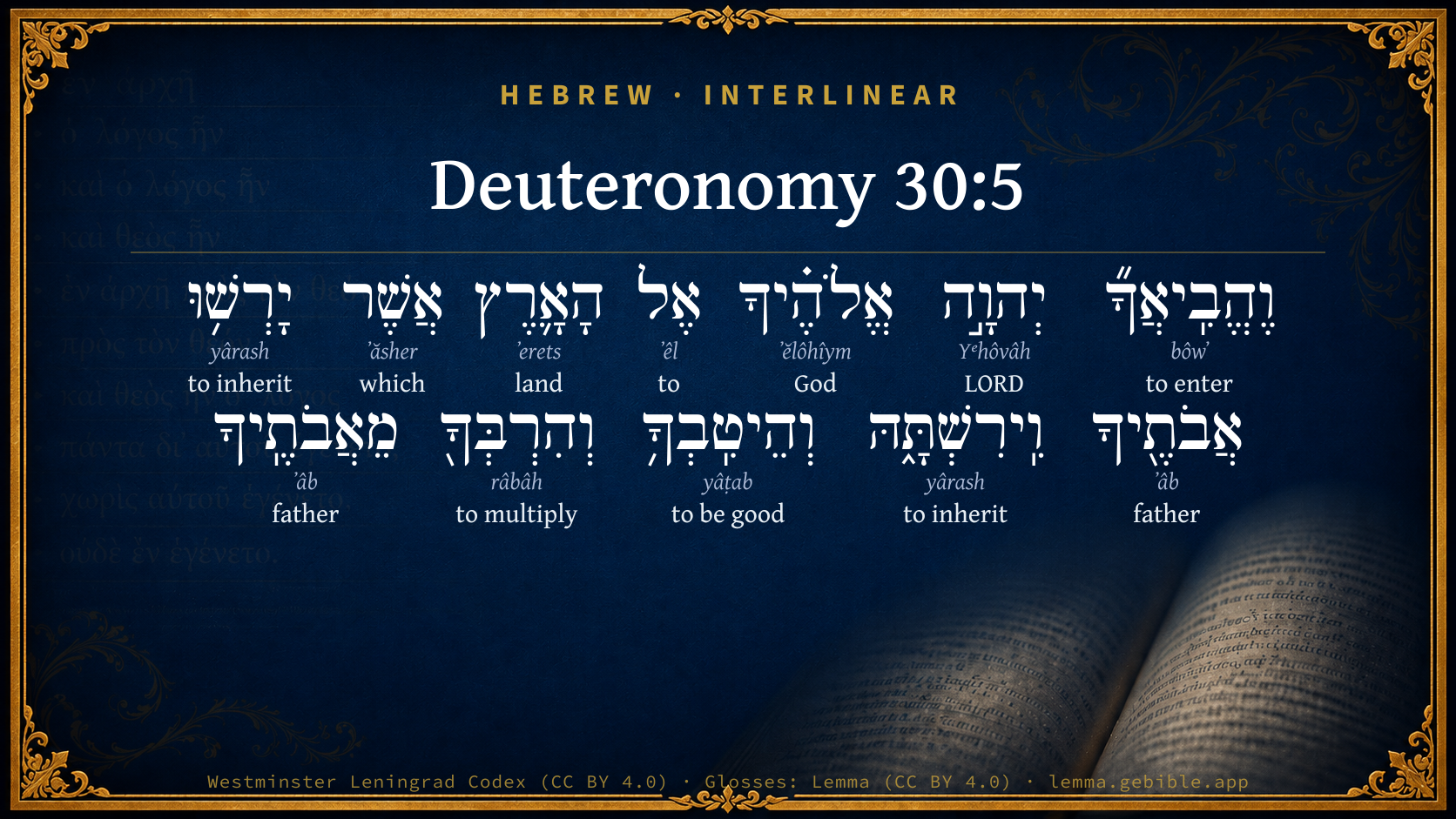
Hebrew (Westminster Leningrad Codex) Deuteronomy 30:5 appears in the Hebrew Old Testament. The text above is from the Westminster Leningrad Codex. Each word links to its Strong’s number, a concise gloss, and parsing drawn from the Open Scriptures Hebrew Bible morphology. Click any word for its full Brown-Driver-Briggs (BDB) entry.
Download image
Cite this verse

Deuteronomy 30:5 (World English Bible). Public Domain. Lemma interlinear Bible study tool, https://lemma.gebible.app/v/deuteronomy/30/5.

Show BibTeX & RIS
BibTeX
RIS
English Translation
and Yahweh your God will bring you into the land which your fathers possessed, and you shall possess it; and he will do you good, and multiply you above your fathers.
World English Bible · Public Domain
Download a study sheet

One document with this verse’s original text, its word-by-word gloss line, the meaning frame, cross-references with their text, attributed commentary, and full source and license credits — printable, and it pastes into notes with its structure intact.

This verse Autodidact and up

Study sheet (.html) Plain text (.txt)

A passage Seminary Student

Up to 50 verses in one chapter. A passage sheet keeps up to 6 commentary sources and 12 cross-references per verse, in the order this page ranks them, and says so on the sheet whenever that leaves anything out. Ask for a single verse and you get the Autodidact verse sheet above.

Everything on this page stays free to read, with no account — the sheet is a download of what is already on screen, not access to it.

Want to remove ads? Support Godless Engineer
Compare translations 3

The same verse in 3 English versions, stacked beneath the original-language interlinear above. Click any original word for its lexicon entry.

Each is an independent rendering of the whole verse — the interlinear is not word-aligned to these translations.

Highlighted words mark where these versions differ — a whole-verse word diff, not a word-by-word alignment.

  • World English Bible Public Domain
    and Yahweh your God will bring you into the land which your fathers possessed, and you shall possess it; and he will do you good, and multiply you above your fathers.
  • King James Version Public Domain
    And the LORD thy God will bring thee into the land which thy fathers possessed, and thou shalt possess it; and he will do thee good, and multiply thee above thy fathers.
  • unfoldingWord Literal Text CC BY-SA 4.0
    And Yahweh your God will bring you into the land that your fathers possessed, and you will possess it, and he will do you good and will multiply you more than your fathers.

unfoldingWord Literal Text — © unfoldingWord, licensed CC BY-SA 4.0. Word-aligned USFM3 via Door43 (git.door43.org/unfoldingWord/en_ult).

Versions to compare (up to 4)

3 of 4 selected

Show all 18 translations

Every available English version of this verse, each an independent rendering of the whole verse.

  • World English Bible Public Domain
    and Yahweh your God will bring you into the land which your fathers possessed, and you shall possess it; and he will do you good, and multiply you above your fathers.
  • Berean Standard Bible Public Domain
    And the LORD your God will bring you into the land your fathers possessed, and you will take possession of it. He will cause you to prosper and multiply more than your fathers.
  • Majority Standard Bible Public Domain
    And the LORD your God will bring you into the land your fathers possessed, and you will take possession of it. He will cause you to prosper and multiply more than your fathers.
  • King James Version Public Domain
    And the LORD thy God will bring thee into the land which thy fathers possessed, and thou shalt possess it; and he will do thee good, and multiply thee above thy fathers.
  • American Standard Version (1901) Public Domain
    and Jehovah thy God will bring thee into the land which thy fathers possessed, and thou shalt possess it; and he will do thee good, and multiply thee above thy fathers.
  • Revised Version (1885) Public Domain
    and the LORD thy God will bring thee into the land which thy fathers possessed, and thou shalt possess it; and he will do thee good, and multiply thee above thy fathers.
  • Geneva Bible (1599) Public Domain
    And the Lord thy God will bring thee into the land which thy fathers possessed, and thou shalt possesse it, and he will shewe thee fauour, and will multiplie thee aboue thy fathers.
  • Douay-Rheims (1899) Public Domain
    And will take thee to himself, and bring thee into the land which thy fathers possessed, and thou shalt possess it: and blessing thee, he will make thee more numerous than were thy fathers.
  • Young's Literal Translation Public Domain
    and Jehovah thy God hath brought thee in unto the land which thy fathers have possessed, and thou hast inherited it, and He hath done thee good, and multiplied thee above thy fathers.
  • Literal Standard Version CC BY-SA 4.0
    and your God YHWH has brought you into the land which your fathers have possessed, and you have inherited it, and He has done you good, and multiplied you above your fathers.
  • Unlocked Literal Bible CC BY-SA 4.0
    Yahweh your God will bring you into the land that your forefathers possessed, and you will possess it again; he will do you good and will multiply you more than he did your forefathers.
  • unfoldingWord Literal Text CC BY-SA 4.0
    And Yahweh your God will bring you into the land that your fathers possessed, and you will possess it, and he will do you good and will multiply you more than your fathers.
  • Darby Bible Public Domain
    and Jehovah thy God will bring thee into the land that thy fathers possessed, and thou shalt possess it; and he will do thee good, and multiply thee above thy fathers.
  • World Messianic Bible Public Domain
    The LORD your God will bring you into the land which your fathers possessed, and you will possess it. He will do you good, and increase your numbers more than your fathers.
  • Webster's Bible Public Domain
    And the LORD thy God will bring thee into the land which thy fathers possessed, and thou shalt possess it: and he will do thee good, and multiply thee above thy fathers.
  • Free Bible Version CC BY-SA 4.0
    The Lord your God will bring you home to the country that belonged to your forefathers and you will own it again. He will make you successful, and you will have even more descendants than your forefathers.
  • Bible in Basic English Public Domain
    Placing you again in the land of your fathers as your heritage; and he will do you good, increasing you till you are more in number than your fathers were.
  • JPS Tanakh (1917) Public Domain
    And the LORD thy God will bring thee into the land which thy fathers possessed, and thou shalt possess it; and He will do thee good, and multiply thee above thy fathers.

Literal Standard Version (2020), Covenant Press — licensed CC BY-SA 4.0. Text via the HelloAO Bible API (eBible.org). Unlocked Literal Bible (unfoldingWord) — licensed CC BY-SA 4.0. Text via the HelloAO Bible API (eBible.org). unfoldingWord Literal Text — © unfoldingWord, licensed CC BY-SA 4.0. Word-aligned USFM3 via Door43 (git.door43.org/unfoldingWord/en_ult). Free Bible Version, Dr. Jonathan Gallagher — licensed CC BY-SA 4.0. Text via the HelloAO Bible API (eBible.org).

Word by word

More ways to search: Search by grammar → Find every occurrence → Compare this word →

Practice this passage: Drill this verse → Learn its vocabulary →

וְהֵיטִֽבְךָ֥
yâṭab
H3190
“and · to be good · you”
Conjunction + Verb, Hiphil, Sequential Perfect, 3rd Person, Masculine, Singular + Suffix, Personal, 2nd Person, Masculine, Singular
Part of Speech
Conjunction + Verb
Stem
Hiphil
Form
Sequential Perfect
Person
3rd Person
Gender
Masculine
Number
Singular
Full BDB Definition

Origin: a primitive root

TWOT: 863

to be good, be pleasing, be well, be glad - (Qal) - to be glad, be joyful - to be well placed - to be well for, be well with, go well with - to be pleasing, be pleasing to - (Hiphil) - to make glad, rejoice - to do good to, deal well with - to do well, do thoroughly - to make a thing good or right or beautiful - to do well, do right
  1. וֶהֱבִֽיאֲךָ֞ bôwʼ H935 “and · to enter · you” Conjunction + Verb, Hiphil, Sequential Perfect, 3rd Person, Masculine, Singular + Suffix, Personal, 2nd Person, Masculine, Singular
  2. יְהוָ֣ה Yᵉhôvâh H3068 “LORD” Noun, Proper
  3. אֱלֹהֶ֗יךָ ʼĕlôhîym H430 “God(s) · your” Noun, Common, Masculine, Plural, Construct + Suffix, Personal, 2nd Person, Masculine, Singular
  4. אֶל ʼêl H413 “to” Preposition
  5. הָאָ֛רֶץ ʼerets H776 “the · land” Particle, Definite Article + Noun, Common, Both, Singular, Absolute
  6. אֲשֶׁר ʼăsher H834 “which” Particle, Relative
  7. יָרְשׁ֥וּ yârash H3423 “to inherit” Verb, Qal, Perfect, 3rd Person, Common, Plural
  8. אֲבֹתֶ֖יךָ ʼâb H1 “fathers · your” Noun, Common, Masculine, Plural, Construct + Suffix, Personal, 2nd Person, Masculine, Singular
  9. וִֽירִשְׁתָּ֑הּ yârash H3423 “and · to inherit · her” Conjunction + Verb, Qal, Sequential Perfect, 2nd Person, Masculine, Singular + Suffix, Personal, 3rd Person, Feminine, Singular
  10. וְהִרְבְּךָ֖ râbâh H7235 “and · to multiply · you” Conjunction + Verb, Hiphil, Sequential Perfect, 3rd Person, Masculine, Singular + Suffix, Personal, 2nd Person, Masculine, Singular
  11. מֵאֲבֹתֶֽיךָ ʼâb H1 “from · fathers · your” Preposition + Noun, Common, Masculine, Plural, Construct + Suffix, Personal, 2nd Person, Masculine, Singular

About this verse

These counts appear in no published source. They are computed here, from the morphology-tagged text and Lemma’s own curated glosses. What Lemma adds →

12
words
10
distinct lemmas
Pentateuch
section

Grammatical profile

  • 5 verbs
  • 5 nouns
  • 1 preposition
  • 1 particle

Verb forms

  • וֶהֱבִֽיאֲךָ֞ Hiphil · Sequential Perfect
  • יָרְשׁ֥וּ Qal · Perfect
  • וִֽירִשְׁתָּ֑הּ Qal · Sequential Perfect
  • וְהֵיטִֽבְךָ֥ Hiphil · Sequential Perfect
  • וְהִרְבְּךָ֖ Hiphil · Sequential Perfect

Repetition

Words recur within this verse — often emphatic in Hebrew:

  • יָרְשׁ֥וּ to inherit H3423 ×2
  • אֲבֹתֶ֖יךָ father H1 ×2

Hebrew & Septuagint length

In English translation the verse runs 31 words from the Hebrew and 36 from the Septuagint (LXX English) — closely comparable.

A rough comparison of the two English renderings, which tokenize alike — not a word-level alignment.

Word counts can differ between the Hebrew and the Greek without any difference in meaning — e.g. the Hebrew direct-object marker אֵת has no separate Greek word, and Greek often adds the article ὁ.

Cross-references

1

Topical passages linked to Deuteronomy 30:5 in the Treasury of Scripture Knowledge — connected by theme and wording, ordered by reader-vote popularity; previews shown in the World English Bible.

  • Jeremiah 29:14 I will be found by you, says Yahweh, and I will turn again your captivity, and I will gather you from all the nations, and from all the places where I have driven you, says Yahweh; and I will bring you again to the place from where I caused you to be carried away captive.

Cross-references courtesy of OpenBible.info (CC BY 4.0).

Hebrew and Greek witnesses Masoretic Hebrew ↔ Greek Septuagint

The same verse in the two great witnesses to the Old Testament, shown verse-for-verse.

These are two independent witnesses, not word-aligned to each other, and the Septuagint is shown in lemma (dictionary) form.

Hebrew Deuteronomy 30:5 Masoretic · Westminster Leningrad Codex

וֶהֱבִֽיאֲךָ֞ יְהוָ֣ה אֱלֹהֶ֗יךָ אֶל הָאָ֛רֶץ אֲשֶׁר יָרְשׁ֥וּ אֲבֹתֶ֖יךָ וִֽירִשְׁתָּ֑הּ וְהֵיטִֽבְךָ֥ וְהִרְבְּךָ֖ מֵאֲבֹתֶֽיךָ

and Yahweh your God will bring you into the land which your fathers possessed, and you shall possess it; and he will do you good, and multiply you above your fathers.

World English Bible · Public Domain

Greek LXX Deuteronomy 30:5 Septuagint · lemma form

καί εἰςἄγω σύ κύριος ὁ θεός σύ εἰς ὁ γῆ ὅς κληρονομέω ὁ πατήρ σύ καί κληρονομέω αὐτός καί εὖ σύ ποιέω καί πλεοναστός σύ ποιέω ὑπέρ ὁ πατήρ σύ

And the Lord your God shall bring you in from thence into the land which your fathers have inherited, and you shall inherit it; and he will do you good, and multiply you above your fathers.

LXX2012 (modern English Septuagint) · Public Domain

Hebrew: Westminster Leningrad Codex (CC BY 4.0). Greek: Septuagint (public domain); English from LXX2012 (modern English Septuagint) (Public Domain). How the Septuagint differs from the Hebrew →

Targum (Aramaic paraphrase)

2

The Targum is the ancient Jewish Aramaic paraphrase of the Hebrew Scriptures — an interpretive translation, not the Hebrew text itself. Onkelos (literal) and Pseudo-Jonathan (expansive) render the Torah, and Jonathan the Prophets. Coverage is partial: where no permissively-licensed English translation exists for a verse, only the Aramaic is shown. This is verse-level text, not a word-by-word alignment to the Hebrew.

  1. Targum Onkelos Torah (Genesis–Deuteronomy)
    וְיָעֵלִנָךְ יְיָ אֱלָהָךְ לְאַרְעָא דִירִיתוּ אֲבָהָתָךְ וְתֵרְתַהּ וְיוֹטֶב לָךְ וְיַסְגִנָךְ מֵאֲבְהָתָךְ

    (no public-domain English translation for this verse)

    Targum Onkelos — Aramaic: “Onkelos Genesis” (public domain); “Onkelos Exodus” (public domain); “Onkelos Leviticus” (public domain); “Onkelos Numbers” (public domain); “Onkelos Deuteronomy” (public domain). English: “Sefaria Community Translation” (CC0 1.0 (public-domain dedication)); “J.W. Etheridge. The Targums of Onkelos and Jonathan Ben Uzziel on the Pentateuch. London: Longmans, Green, 1862” (public domain). Text via Sefaria.

  2. Targum Pseudo-Jonathan Torah (Genesis–Deuteronomy)
    וְיָעֵלִינְכוֹן מֵימְרָא דַיְיָ אֱלָהָכוֹן לְאַרְעָא דְיָרִיתוּ אַבְהַתְכוֹן וְתֵרְתָהּ וְיוֹטֵב לְכוֹן וְיַסְגִינְכוֹן יַתִּיר מִן אַבְהַתְכוֹן

    And the Word of the Lord your God will bring you into the land which your fathers possessed by inheritance, and you shall possess it, and He will bless you and increase you more than your fathers.

    Targum Pseudo-Jonathan — Aramaic: “Targum Jonathan on Genesis” (public domain); “Targum Jonathan on Exodus” (public domain); “Targum Jonathan on Leviticus” (public domain); “Targum Jonathan on Numbers” (public domain); “Targum Jonathan on Deuteronomy” (public domain). English: “The Targum of Jonathan ben Uzziel, trans. J. W. Etheridge, London, 1862” (public domain). Text via Sefaria.

Commentary

Notes on Deuteronomy 30:5 from classic Christian and Jewish commentators (each source and its license shown beneath its notes). The classic Christian expositions comment on the surrounding passage and are grouped to its opening verse, so a note may address several verses; the Jewish commentaries on the Tanakh (Rashi and others) are per-verse, so they appear only where the commentator wrote on this verse.

Lemma curates 59 commentaries, every one of them public domain or Creative Commons licensed, each selected and text-cleaned for this edition rather than reprinted as found. About our sources →

Joseph Benson's Commentary

Deu 30:5. He will do thee good, and multiply thee above thy fathers — There are in this and several other prophecies concerning the restoration of the Jews, such magnificent descriptions of it as do by no means appear to have been sufficiently fulfilled in any restoration yet past; and therefore are to be accomplished in a more complete one yet to come, after their conversion, in principle and practice, to true Christianity.

Joseph Benson's Commentary on the Old and New Testaments (1811–1818) — public domain. Text from a community e-Sword module.

Adam Clarke's Commentary

Verse 5. Will bring thee into the land] As this promise refers to a return from a captivity in which they had been scattered among all nations, consequently it is not the Babylonish captivity which is intended; and the repossession of their land must be different from that which was consequent on their return from Chaldea.

Adam Clarke's Commentary on the Bible (1810–1826) — public domain. Text from a community e-Sword/MySword module.

Ellicott's Commentary for English Readers

(5) Into the land which thy fathers possessed.—It is very difficult to interpret these words of any land except Palestine. Comp. Jer_29:13-14, for their fulfilment in the first restoration, from Babylon.

A Bible Commentary for English Readers, edited by Charles John Ellicott (1878–1897) — public domain. Text from a community e-Sword module.

The Cambridge Bible for Schools and Colleges

gen. ed. J. J. S. Perowne

5. will bring thee into the land] See on Deu_6:10.

do thee good] Deu_8:16, Deu_28:63.

multiply] See on Deu_6:3 and Deu_13:17 (18).

The Cambridge Bible for Schools and Colleges (gen. ed. J. J. S. Perowne; Cambridge University Press, 1878–1918) — public domain. Text from a community e-Sword module.

John Gill's Exposition

And the Lord thy God will bring thee into the land which thy fathers possessed, and thou shalt possess it,.... That the Jews upon their conversion in the latter day will return to the land of Judea again, and possess it, is the sense of many passages of Scripture; among others, see Jer 30:18; the above Targum is;"the Word of the Lord will bring thee, &c."

and he will do thee good; both in things temporal and spiritual; see Eze 34:24,

and multiply thee above thy fathers; increase their number more than ever they were in any age; for they shall be as the sand of the sea, which cannot be numbered, Hos 1:10.

John Gill's Exposition of the Whole Bible (1746–1763) — public domain (CC PDM 1.0). Text via the HelloAO Bible API.

Haydock's Catholic Bible Commentary

Fathers. Some sinners have risen to greater eminence by sincere repentance, than others who have offended less. (Worthington) See Luke vii. 47.

George Leo Haydock (1774–1849), Haydock's Catholic Family Bible and Commentary, 1859 edition — public domain. Excludes Psalms (Douay-Rheims chapter numbering differs from Protestant) and Deuterocanonical books (Catholic canon only).

Lesson kit

Teaching starters — assembled from the data on this page, not authored interpretation. Every prompt links to the verse data it draws on. Edit before teaching.

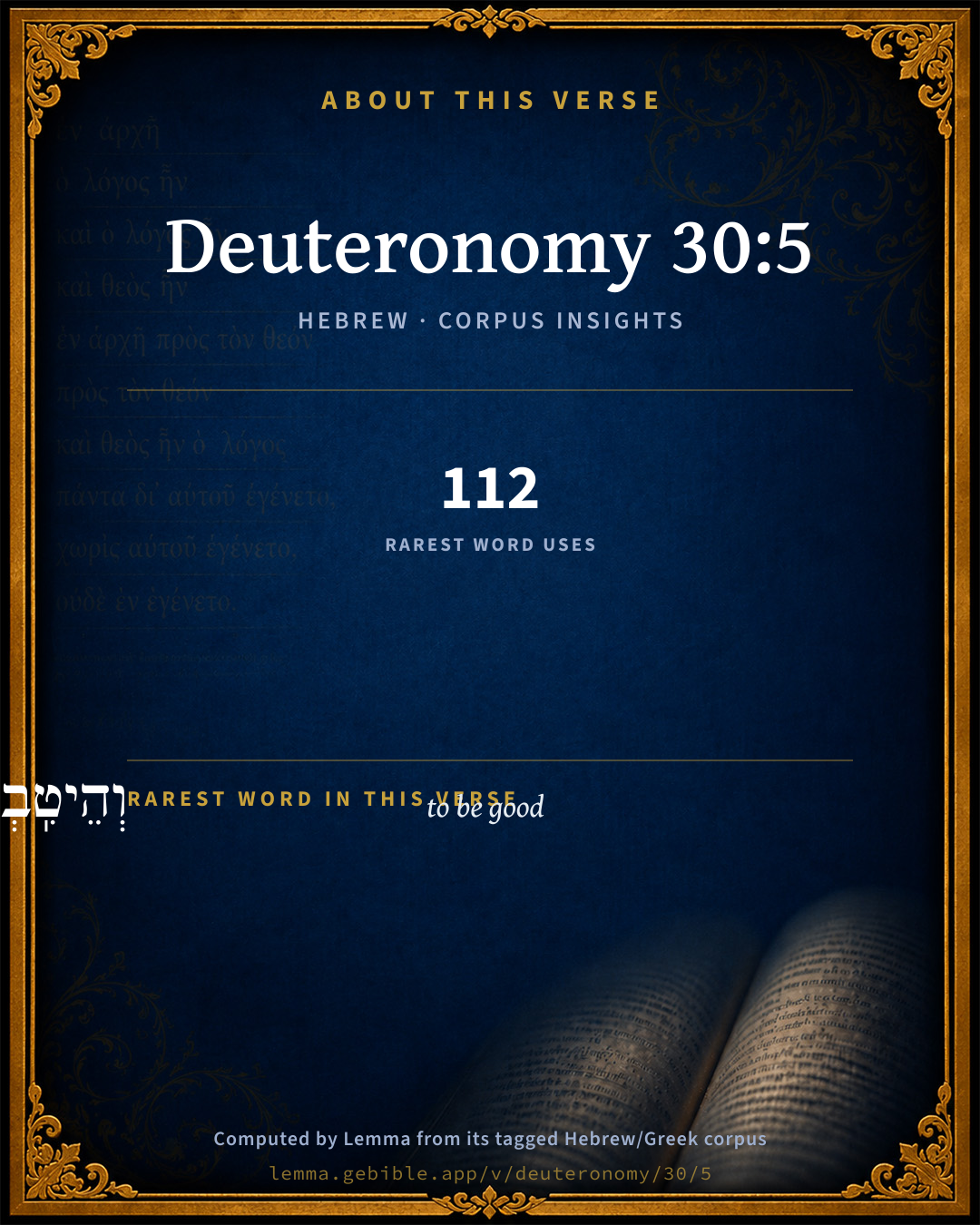
Deuteronomy, in the Pentateuch, opens this verse with 12 words (10 distinct Hebrew lemmas). Its most distinctive word is yâṭab (“to be good”). A historical commentator’s framing appears above. Read the whole chapter for the surrounding context.

Discussion questions

  1. What does “to be good” (yâṭab) contribute to the verse as a whole?
  2. How does Jeremiah 29:14, which shares this passage’s theme, read alongside this verse?
  3. What does the repetition of “to inherit” (2× in this one verse) do in this verse?
  4. These translations render this verse differently; the difference is in the English rendering, not the original. What questions does that raise?
  5. «וֶהֱבִֽיאֲךָ֞» is a Hiphil Sequential Perfect verb. How does that grammatical form shape the action described?
  6. Compare how Joseph Benson's Commentary and Adam Clarke's Commentary read this verse. Where do they agree or differ?

Things to notice

  • These translations choose different wording for 7 words in this verse.
  • “to inherit” occurs 2× in this single verse.
  • 10 distinct Hebrew lemmas span 12 words in this verse.

Reading settings

Reading text

Shown beneath each verse's original-language words.

Old Testament
Old Testament edition

Read the OT as the Masoretic Hebrew (MT) or the Greek Septuagint (LXX).

English shown for the Greek Septuagint (in the Hebrew ↔ Greek comparison).

Comparing translations? Open the Compare panel on any verse page to stack up to four side by side.