
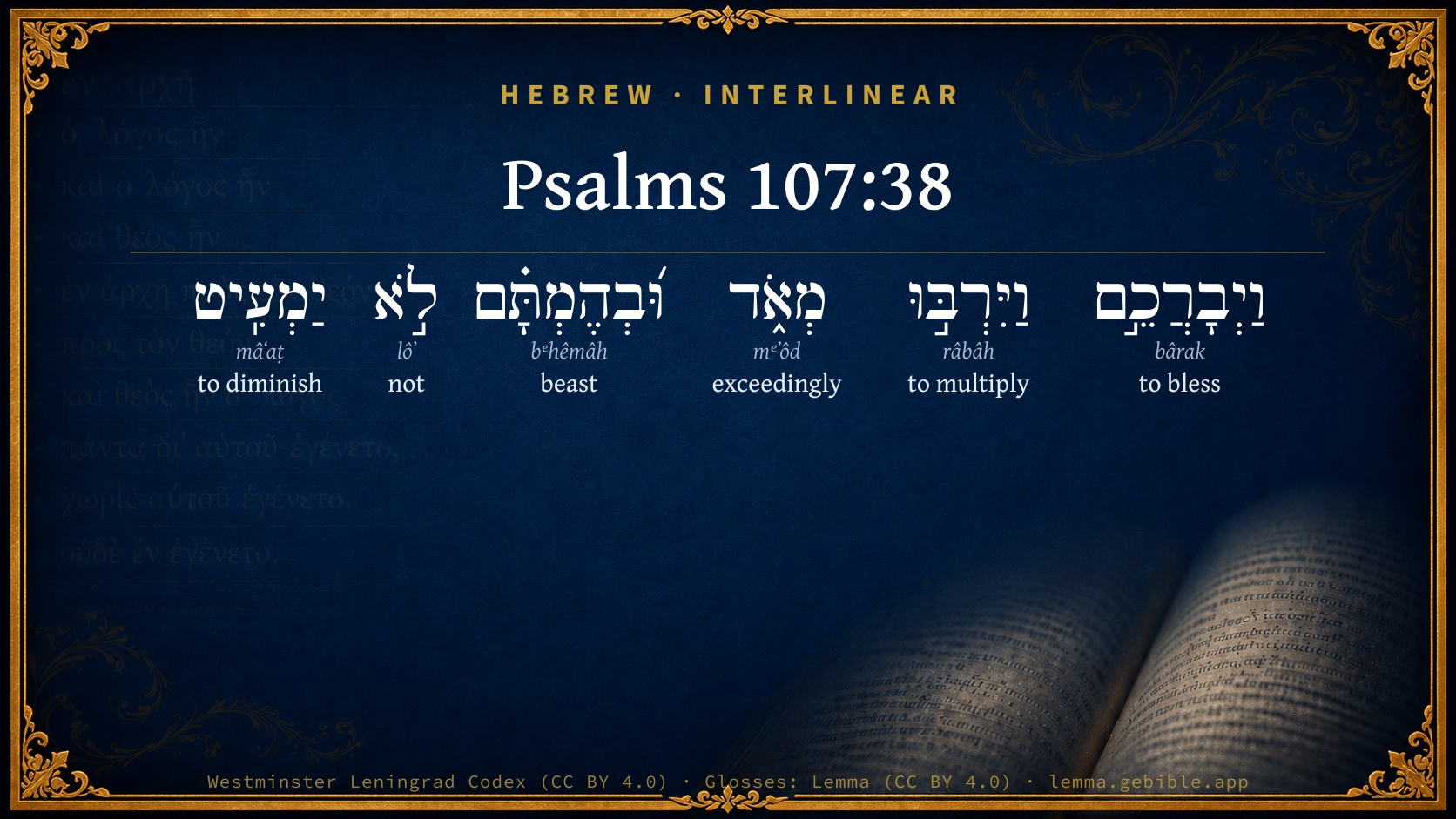
Psalms 107:38

Hebrew (Westminster Leningrad Codex) Psalms 107:38 appears in the Hebrew Old Testament. The text above is from the Westminster Leningrad Codex. Each word links to its Strong’s number, a concise gloss, and parsing drawn from the Open Scriptures Hebrew Bible morphology. Click any word for its full Brown-Driver-Briggs (BDB) entry.
Download image
Cite this verse

Psalms 107:38 (World English Bible). Public Domain. Lemma interlinear Bible study tool, https://lemma.gebible.app/v/psalms/107/38.

Show BibTeX & RIS
BibTeX
RIS
English Translation
He blesses them also, so that they are multiplied greatly. He doesn't allow their cattle to decrease.
World English Bible · Public Domain
Download a study sheet

One document with this verse’s original text, its word-by-word gloss line, the meaning frame, cross-references with their text, attributed commentary, and full source and license credits — printable, and it pastes into notes with its structure intact.

This verse Autodidact and up

Study sheet (.html) Plain text (.txt)

A passage Seminary Student

Up to 50 verses in one chapter. A passage sheet keeps up to 6 commentary sources and 12 cross-references per verse, in the order this page ranks them, and says so on the sheet whenever that leaves anything out. Ask for a single verse and you get the Autodidact verse sheet above.

Everything on this page stays free to read, with no account — the sheet is a download of what is already on screen, not access to it.

Want to remove ads? Support Godless Engineer
Compare translations 3

The same verse in 3 English versions, stacked beneath the original-language interlinear above. Click any original word for its lexicon entry.

Each is an independent rendering of the whole verse — the interlinear is not word-aligned to these translations.

Highlighted words mark where these versions differ — a whole-verse word diff, not a word-by-word alignment.

  • World English Bible Public Domain
    He blesses them also, so that they are multiplied greatly. He doesn't allow their cattle to decrease.
  • King James Version Public Domain
    He blesseth them also, so that they are multiplied greatly; and suffereth not their cattle to decrease.
  • unfoldingWord Literal Text CC BY-SA 4.0
    He blesses them and they become very many and their cattle do not become few.

unfoldingWord Literal Text — © unfoldingWord, licensed CC BY-SA 4.0. Word-aligned USFM3 via Door43 (git.door43.org/unfoldingWord/en_ult).

Versions to compare (up to 4)

3 of 4 selected

Show all 18 translations

Every available English version of this verse, each an independent rendering of the whole verse.

  • World English Bible Public Domain
    He blesses them also, so that they are multiplied greatly. He doesn't allow their cattle to decrease.
  • Berean Standard Bible Public Domain
    He blesses them, and they multiply greatly; He does not let their herds diminish.
  • Majority Standard Bible Public Domain
    He blesses them, and they multiply greatly; He does not let their herds diminish.
  • King James Version Public Domain
    He blesseth them also, so that they are multiplied greatly; and suffereth not their cattle to decrease.
  • American Standard Version (1901) Public Domain
    He blesseth them also, so that they are multiplied greatly; And he suffereth not their cattle to decrease.
  • Revised Version (1885) Public Domain
    He blesseth them also, so that they are multiplied greatly; and he suffereth not their cattle to decrease.
  • Geneva Bible (1599) Public Domain
    For he blesseth them, and they multiplie exceedingly, and he diminisheth not their cattell.
  • Douay-Rheims (1899) Public Domain
    And he blessed them, and they were multiplied exceedingly: and their cattle he suffered not to decrease.
  • Young's Literal Translation Public Domain
    And He blesseth them, and they multiply exceedingly, And their cattle He doth not diminish.
  • Literal Standard Version CC BY-SA 4.0
    And He blesses them, and they multiply exceedingly, || And He does not diminish their livestock.
  • Unlocked Literal Bible CC BY-SA 4.0
    He blesses them so they are very numerous. He does not let their cattle decrease in number.
  • unfoldingWord Literal Text CC BY-SA 4.0
    He blesses them and they become very many and their cattle do not become few.
  • Darby Bible Public Domain
    And he blesseth them, so that they are multiplied greatly; and he suffereth not their cattle to decrease.
  • World Messianic Bible Public Domain
    He blesses them also, so that they are multiplied greatly. He doesn’t allow their livestock to decrease.
  • Webster's Bible Public Domain
    He blesseth them also, so that they are multiplied greatly; and suffereth not their cattle to decrease.
  • Free Bible Version CC BY-SA 4.0
    He takes care of them, and their numbers increase dramatically—their cattle too!
  • Bible in Basic English Public Domain
    He gives them his blessing so that they are increased greatly, and their cattle do not become less.
  • JPS Tanakh (1917) Public Domain
    He blesseth them also, so that they are multiplied greatly, and suffereth not their cattle to decrease.

Literal Standard Version (2020), Covenant Press — licensed CC BY-SA 4.0. Text via the HelloAO Bible API (eBible.org). Unlocked Literal Bible (unfoldingWord) — licensed CC BY-SA 4.0. Text via the HelloAO Bible API (eBible.org). unfoldingWord Literal Text — © unfoldingWord, licensed CC BY-SA 4.0. Word-aligned USFM3 via Door43 (git.door43.org/unfoldingWord/en_ult). Free Bible Version, Dr. Jonathan Gallagher — licensed CC BY-SA 4.0. Text via the HelloAO Bible API (eBible.org).

Word by word

More ways to search: Search by grammar → Find every occurrence → Compare this word →

Practice this passage: Drill this verse → Learn its vocabulary →

About this verse

These counts appear in no published source. They are computed here, from the morphology-tagged text and Lemma’s own curated glosses. What Lemma adds →

6
words
6
distinct lemmas
Wisdom
section

Notable vocabulary

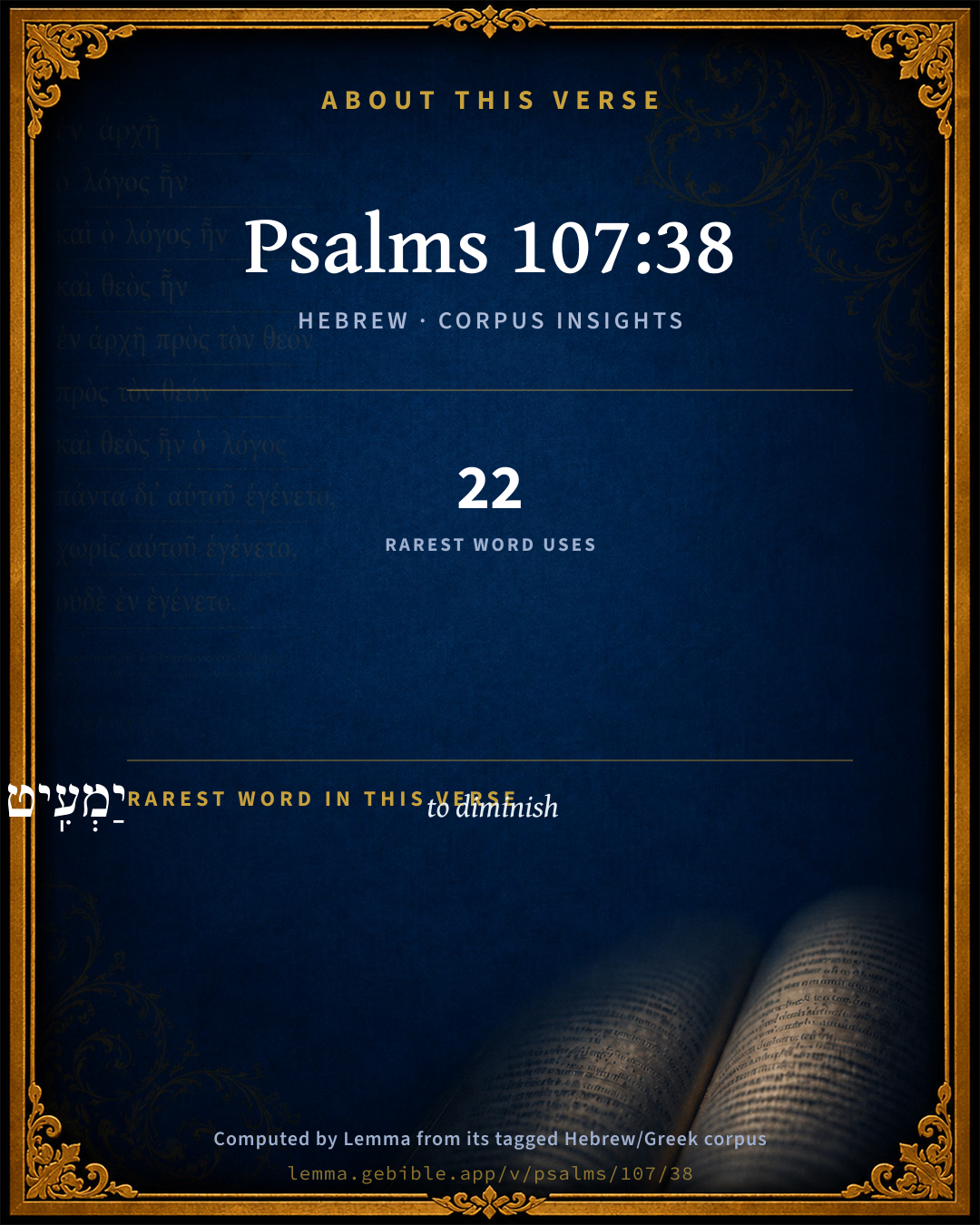
The rarest word here is יַמְעִֽיט to diminish H4591 — appearing just 22 times in the whole Hebrew Bible.

Shared distinctive vocabulary

יַמְעִֽיט to diminish H4591 occurs in 21 verses of the Hebrew Bible. Also found in:

Grammatical profile

  • 3 verbs
  • 1 noun
  • 1 adverb
  • 1 particle

Verb forms

  • וַיְבָרֲכֵ֣ם Piel · Sequential Imperfect
  • וַיִּרְבּ֣וּ Qal · Sequential Imperfect
  • יַמְעִֽיט Hiphil · Imperfect

Hebrew & Septuagint length

In English translation the verse runs 17 words from the Hebrew and 17 from the Septuagint (LXX English) — the same length.

A rough comparison of the two English renderings, which tokenize alike — not a word-level alignment.

Word counts can differ between the Hebrew and the Greek without any difference in meaning — e.g. the Hebrew direct-object marker אֵת has no separate Greek word, and Greek often adds the article ὁ.

Cross-references

19

Topical passages linked to Psalms 107:38 in the Treasury of Scripture Knowledge — connected by theme and wording, ordered by reader-vote popularity; previews shown in the World English Bible.

  • Exodus 1:7 The children of Israel were fruitful, and increased abundantly, and multiplied, and grew exceedingly mighty; and the land was filled with them.
  • Genesis 12:2 I will make of you a great nation. I will bless you, and make your name great. You will be a blessing.
  • Genesis 17:20 As for Ishmael, I have heard you. Behold, I have blessed him, and will make him fruitful, and will multiply him exceedingly. He will become the father of twelve princes, and I will make him a great nation.
  • Deuteronomy 7:14 You shall be blessed above all peoples: there shall not be male or female barren among you, or among your cattle.
  • Deuteronomy 30:9 Yahweh your God will make you plenteous in all the work of your hand, in the fruit of your body, and in the fruit of your cattle, and in the fruit of your ground, for good: for Yahweh will again rejoice over you for good, as he rejoiced over your fathers;
  • Psalms 128:1–6 Blessed is everyone who fears Yahweh, Who walks in his ways.
  • Genesis 17:16 I will bless her, and moreover I will give you a son by her. Yes, I will bless her, and she will be a mother of nations. Kings of peoples will come from her."
  • Deuteronomy 28:11 Yahweh will make you plenteous for good, in the fruit of your body, and in the fruit of your cattle, and in the fruit of your ground, in the land which Yahweh swore to your fathers to give you.
  • Psalms 144:13–14 Our barns are full, filled with all kinds of provision. Our sheep bring forth thousands and ten thousands in our fields.
  • Genesis 1:28 God blessed them. God said to them, "Be fruitful, multiply, fill the earth, and subdue it. Have dominion over the fish of the sea, over the birds of the sky, and over every living thing that moves on the earth."
  • Genesis 30:43 The man increased exceedingly, and had large flocks, maid-servants and men-servants, and camels and donkeys.
  • Deuteronomy 28:4 Blessed shall be the fruit of your body, and the fruit of your ground, and the fruit of your animals, the increase of your cattle, and the young of your flock.
  • Proverbs 10:22 Yahweh's blessing brings wealth, And he adds no trouble to it.
  • Jeremiah 30:19 Out of them shall proceed thanksgiving and the voice of those who make merry: and I will multiply them, and they shall not be few; I will also glorify them, and they shall not be small.
  • Genesis 31:9 Thus God has taken away the cattle of your father, and given them to me.
  • Exodus 9:3–7 behold, the hand of Yahweh is on your cattle which are in the field, on the horses, on the donkeys, on the camels, on the herds, and on the flocks with a very grievous pestilence.
  • Ezekiel 37:26 Moreover I will make a covenant of peace with them; it shall be an everlasting covenant with them; and I will place them, and multiply them, and will set my sanctuary in the midst of them forevermore.
  • Genesis 9:1 God blessed Noah and his sons, and said to them, "Be fruitful, and multiply, and replenish the earth.
  • Exodus 12:38 A mixed multitude went up also with them, with flocks, herds, and even very much cattle.

Cross-references courtesy of OpenBible.info (CC BY 4.0).

Hebrew and Greek witnesses Masoretic Hebrew ↔ Greek Septuagint

The same verse in the two great witnesses to the Old Testament, shown verse-for-verse.

You’re reading Greek Psalm 106 (Hebrew Psalm 107). The Septuagint counts the superscription, so verse numbers can differ from the Hebrew — chapter-level alignment, not verse-by-verse. Numbering follows Rahlfs.

These are two independent witnesses, not word-aligned to each other, and the Septuagint is shown in lemma (dictionary) form.

Hebrew Psalms 107:38 Masoretic · Westminster Leningrad Codex

וַיְבָרֲכֵ֣ם וַיִּרְבּ֣וּ מְאֹ֑ד וּ֝בְהֶמְתָּ֗ם לֹ֣א יַמְעִֽיט

He blesses them also, so that they are multiplied greatly. He doesn't allow their cattle to decrease.

World English Bible · Public Domain

Greek LXX Greek Psalm 106:38 Septuagint · lemma form

καί εὐλογέω αὐτός καί πληθύνω σφόδρα καί ὁ κτῆνος αὐτός οὐ σμικρύνω

And he blesses them, and they multiply exceedingly, and he diminishes not the number of their cattle.

LXX2012 (modern English Septuagint) · Public Domain

Hebrew: Westminster Leningrad Codex (CC BY 4.0). Greek: Septuagint (public domain); English from LXX2012 (modern English Septuagint) (Public Domain). How the Septuagint differs from the Hebrew →

Commentary

Notes on Psalms 107:38 from classic Christian and Jewish commentators (each source and its license shown beneath its notes). The classic Christian expositions comment on the surrounding passage and are grouped to its opening verse, so a note may address several verses; the Jewish commentaries on the Tanakh (Rashi and others) are per-verse, so they appear only where the commentator wrote on this verse.

Lemma curates 59 commentaries, every one of them public domain or Creative Commons licensed, each selected and text-cleaned for this edition rather than reprinted as found. About our sources →

Trapp's Complete Commentary

John Trapp

Psa 107:38 He blesseth them also, so that they are multiplied greatly; and suffereth not their cattle to decrease.

Ver. 38. He blesseth them also, &c.] See Pro 10:12 Psa 127:1 Jas 4:15. They are out that rest in natural causes.

John Trapp, A Commentary or Exposition upon All the Books of the Old and New Testament (1647–1656) — public domain. Text from a community e-Sword module.

J. A. Alexander on Psalms

Joseph Addison Alexander

38. (Psa 107:38) And he has blessed them, and they have increased greatly, and (even) their cattle he does not diminish. Increased, not in numbers merely, but in wealth, strength and prosperity. See Deu 30:16. The verb to diminish is borrowed from Lev 26:22. The negation may be understood as a meiosis, meaning to increase or multiply. The whole of this description agrees well with the encouraging appearances, by which the Restoration was attended and immediately followed, before the colony experienced reverses or had lost the fresh impression of their recent sufferings and privations, which are mentioned in the next verse.

Joseph Addison Alexander, The Psalms Translated and Explained (1850) — public domain. Text from a community e-Sword module.

Tyndale Open Study Notes

Tyndale Open Resources

107:38 God’s presence can be seen in the abundance of his people’s families and herds (127:3; 133:3; cp. 109:8).

Tyndale Open Study Notes — © Tyndale Open Resources, licensed CC BY-SA 4.0. Text via the HelloAO Bible API.

The Cambridge Bible for Schools and Colleges

gen. ed. J. J. S. Perowne

38. In this and the preceding verse there may be an allusion to Lev_26:20; Lev_26:22.

The Cambridge Bible for Schools and Colleges (gen. ed. J. J. S. Perowne; Cambridge University Press, 1878–1918) — public domain. Text from a community e-Sword module.

John Gill's Exposition

Yet setteth he the poor on high from affliction,.... On the other hand, the Lord sometimes exalteth men of low degree, raiseth men of mean extract and parentage, who have made a poor figure in life, to high places of honour, free from adversity and distress; as David from the sheepfold, and from following the ewes great with young, to be king of Israel. This may be applied to the saints and people of God, who for the most part are poor in purse, the poor of this world, whom he chooses, calls, and saves; poor knowledge, capacity, and gifts; poor as to their spiritual circumstances, having neither food nor clothing, nor money to buy either; poor in spirit, and sensible of it; and poor by reason of afflictions: these the Lord sets on high, sets them among the princes of his people, makes them kings and priests; sets them on Christ the Rock, who is higher than they, higher than the angels and than the heavens; sets them above the angels, their nature being advanced above theirs in Christ, and they being represented by him in heavenly places; and standing in the relation of sons to God, and of spouse and bride to Christ, and angels being their ministering servants; and ere long they will be set on thrones, and have a crown of glory, life, and righteousness, put upon them, and be possessed of an everlasting kingdom, and be out of the reach of affliction. They are not clear of it in this world; it is needful for them, they are appointed to it, and through it they must enter the kingdom; but then they will come out of all tribulation, and there will be no more pain, sorrow, and death: it may be rendered, "after affliction", after their time of affliction is over, then God will exalt and glorify them; see Pe1 5:10, this may respect the prosperity of the church in the latter day; see Dan 7:27.

And maketh him families like a flock; that is, the Lord makes the poor families like a flock of sheep, so greatly does he increase them; this is a very apt figure that is here used, since the people of God are often compared to sheep, and to a flock of them; and these are creatures that greatly increase; and here it denotes the large number of the saints, as in the first times of the Gospel, both in Judea and in the Gentile world; and as it will be in the latter day, when they shall be multiplied and not be few, glorified and not be small; and that they should be branched out into families, or particular churches, which, like families, consist of children, young men, and fathers, of which Christ is master, and ministers stewards; so it has been from the beginning of the Gospel dispensation and will be much more so in the latter day, when the earth will be full of these families every where. The Targum introduces this verse thus,

"when they turn to the law he setteth, &c.''

John Gill's Exposition of the Whole Bible (1746–1763) — public domain (CC PDM 1.0). Text via the HelloAO Bible API.

Albert Barnes' Notes on the Bible

He blesseth them also - In the manner immediately specified.

So that they are multiplied greatly - This was regarded as one of the highest blessings which God could confer, and hence, it was so often promised by him to the patriarchs, as a proof of his favor, that their seed should be as the stars of heaven, and as the sand upon the sea-shore. Gen 13:16; Gen 22:17; Gen 26:4; Gen 32:12.

And suffereth not their cattle to decrease - The keeping of herds of cattle was also an important point in husbandry, and hence, it was a blessing that they were made to increase, and that they were kept from the diseases to which cattle are subject.

Albert Barnes' Notes on the Bible (1834–1885) — public domain. Text from a community e-Sword/MySword module.

Matthew Poole's English Annotations

Preserves them from abortion and deadly diseases, and on the contrary causeth them to increase, as he said in the former branch, which is here repeated in other words, after the sane manner.

Matthew Poole's English Annotations on the Holy Bible (1683–1685) — public domain. Text from a community e-Sword/MySword module.

The Treasury of David

Charles H. Spurgeon

Ver. 38. He blesseth them also, so that they are multiplied greatly; and suffereth not their cattle to decrease. God's blessing is everything. It not only makes men happy, but it makes men themselves, by causing men to be multiplied upon the earth. When the Lord made the first pair he blessed them and said "be fruitful and multiply", and here he restores the primeval blessing. Observe that beasts as well as men fare well when God favours his people: they share with men in the goodness or severity of divine providence. Plagues and pests are warded off from the flock and the herd when the Lord means well towards a people; but when chastisement is intended, the flocks and herds rot from off the face of the earth. O that nations in the day of their prosperity would but own the gracious hand of God, for it is to his blessing that they owe their all.

Psalms 107:39*

Charles H. Spurgeon's The Treasury of David (1869–1885) — public domain. Psalms only. Text from a community e-Sword/MySword module.

The Pulpit Commentary

He blesseth them also, so that they are multiplied greatly. With in creasing prosperity comes increase of population, naturallyi.e. by God"s ordinary providence. This increase is, however, only a blessing within certain limits. And suffereth not their cattle to decrease. This modest under-statement suggests an enormous increase. (comp. Job_42:12)

The Pulpit Commentary (1880–1919), ed. H.D.M. Spence-Jones & Joseph S. Exell — public domain. Text from a community e-Sword module.

Lesson kit

Teaching starters — assembled from the data on this page, not authored interpretation. Every prompt links to the verse data it draws on. Edit before teaching.

Psalms, in the Wisdom, opens this verse with 6 words (6 distinct Hebrew lemmas). Its most distinctive word is mâʻaṭ (“to diminish”). A historical commentator’s framing appears above. Read the whole chapter for the surrounding context.

Discussion questions

  1. The word mâʻaṭ carries the sense “to diminish.” How does it shape the verse?
  2. How does Exodus 12:4, which shares the word «to diminish», read alongside this verse?
  3. The translations on this page render this verse differently — a whole-verse word diff, not a word-by-word alignment. What might account for the different wordings?
  4. «וַיְבָרֲכֵ֣ם» is a Piel Sequential Imperfect verb. How does that grammatical form shape the action described?
  5. Compare how Trapp's Complete Commentary and J. A. Alexander on Psalms read this verse. Where do they agree or differ?

Things to notice

Reading settings

Reading text

Shown beneath each verse's original-language words.

Old Testament
Old Testament edition

Read the OT as the Masoretic Hebrew (MT) or the Greek Septuagint (LXX).

English shown for the Greek Septuagint (in the Hebrew ↔ Greek comparison).

Comparing translations? Open the Compare panel on any verse page to stack up to four side by side.