
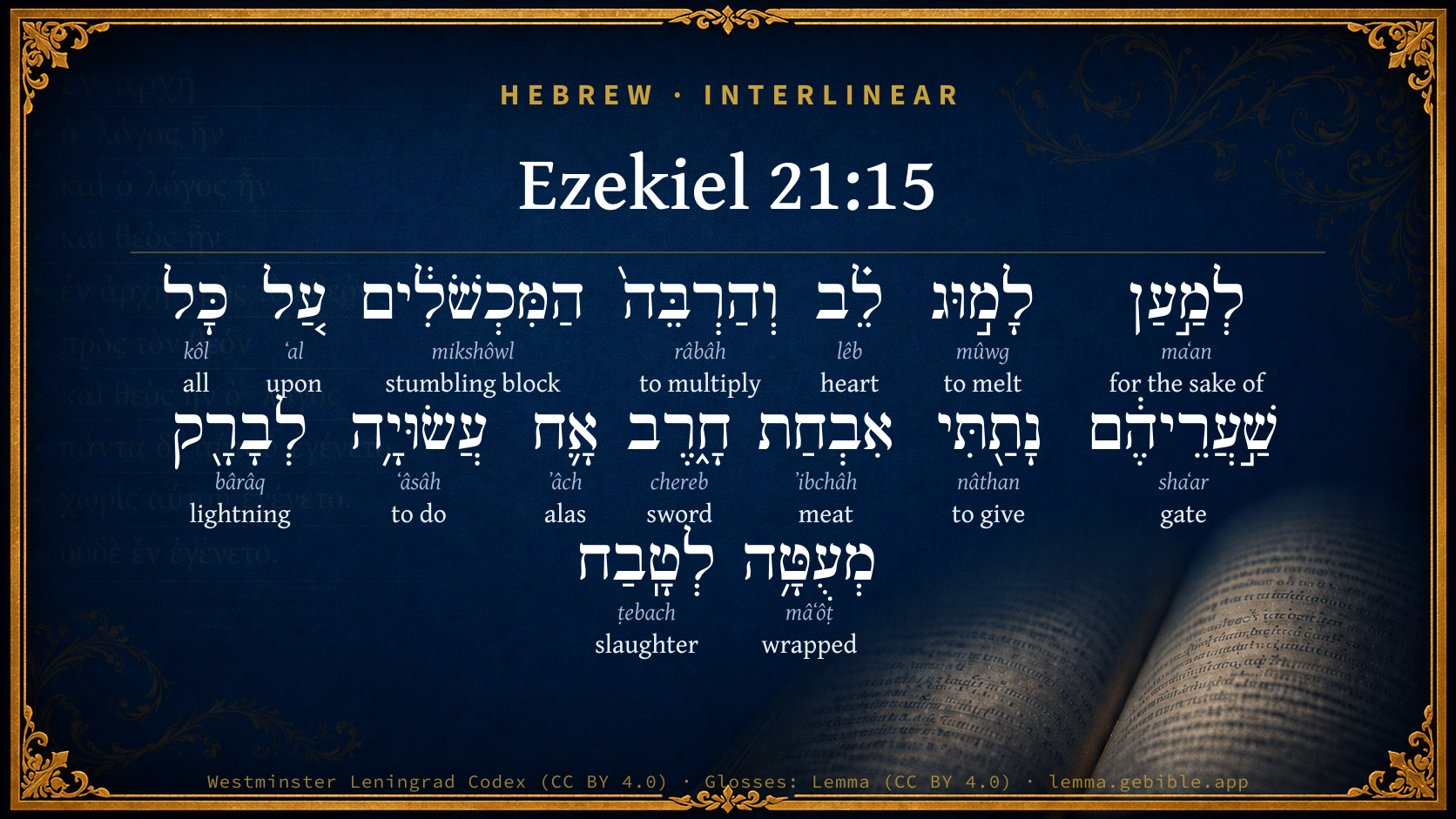
Ezekiel 21:15

Hebrew (Westminster Leningrad Codex) Ezekiel 21:15 appears in the Hebrew Old Testament. The text above is from the Westminster Leningrad Codex. Each word links to its Strong’s number, a concise gloss, and parsing drawn from the Open Scriptures Hebrew Bible morphology. Click any word for its full Brown-Driver-Briggs (BDB) entry.
Download image
Cite this verse

Ezekiel 21:15 (World English Bible). Public Domain. Lemma interlinear Bible study tool, https://lemma.gebible.app/v/ezekiel/21/15.

Show BibTeX & RIS
BibTeX
RIS
English Translation
I have set the threatening sword against all their gates, that their heart may melt, and their stumblings be multiplied: ah! it is made as lightning, it is pointed for slaughter.
World English Bible · Public Domain
Highlights
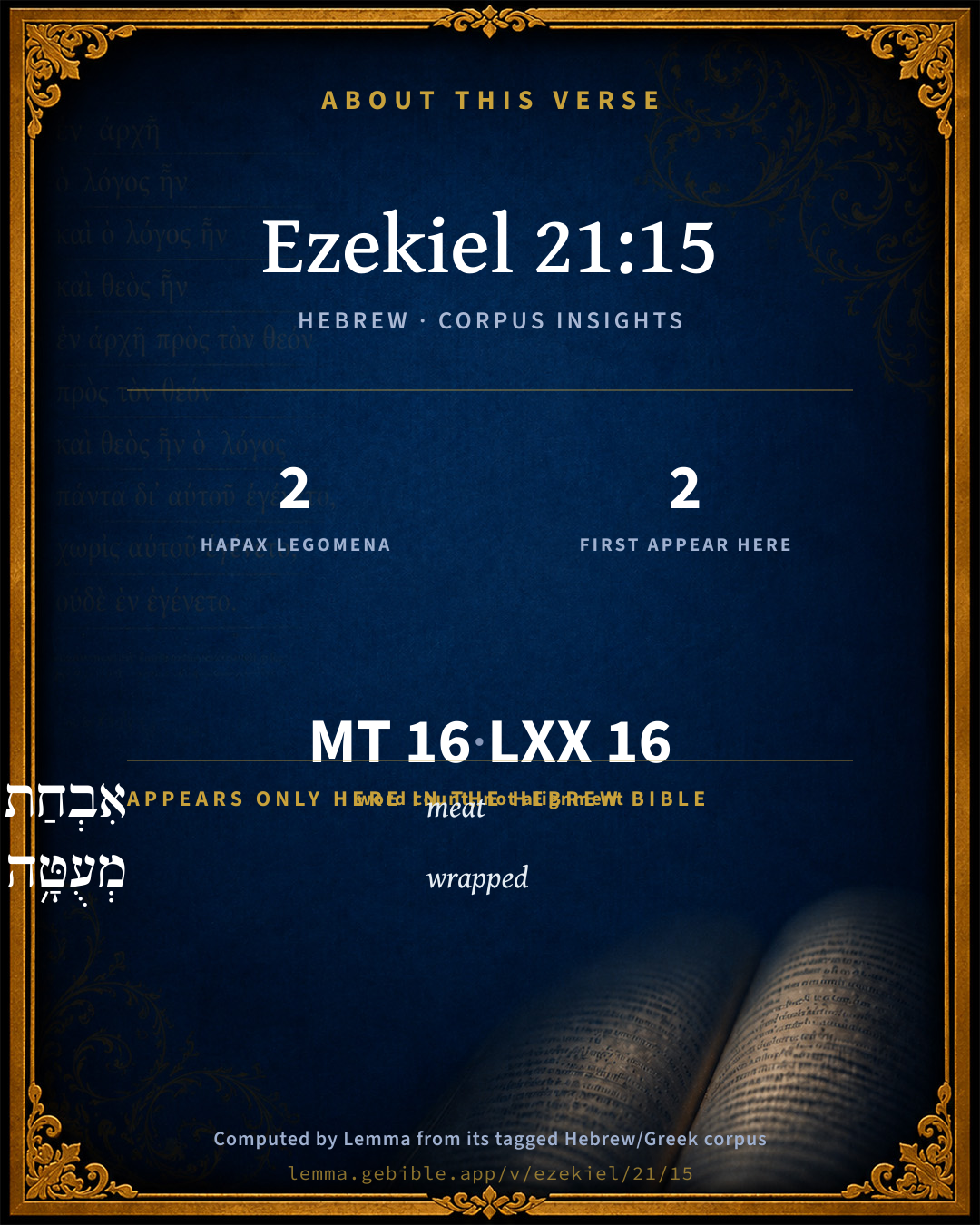
  • 2 hapax legomena — only here in the Hebrew Bible
  • 2 first appearances in the Hebrew Bible
Full analysis ↓
Download a study sheet

One document with this verse’s original text, its word-by-word gloss line, the meaning frame, cross-references with their text, attributed commentary, and full source and license credits — printable, and it pastes into notes with its structure intact.

This verse Autodidact and up

Study sheet (.html) Plain text (.txt)

A passage Seminary Student

Up to 50 verses in one chapter. A passage sheet keeps up to 6 commentary sources and 12 cross-references per verse, in the order this page ranks them, and says so on the sheet whenever that leaves anything out. Ask for a single verse and you get the Autodidact verse sheet above.

Everything on this page stays free to read, with no account — the sheet is a download of what is already on screen, not access to it.

Want to remove ads? Support Godless Engineer
Compare translations 3

The same verse in 3 English versions, stacked beneath the original-language interlinear above. Click any original word for its lexicon entry.

Each is an independent rendering of the whole verse — the interlinear is not word-aligned to these translations.

Highlighted words mark where these versions differ — a whole-verse word diff, not a word-by-word alignment.

  • World English Bible Public Domain
    I have set the threatening sword against all their gates, that their heart may melt, and their stumblings be multiplied: ah! it is made as lightning, it is pointed for slaughter.
  • King James Version Public Domain
    I have set the point of the sword against all their gates, that their heart may faint, and their ruins be multiplied: ah! it is made bright, it is wrapped up for the slaughter.
  • unfoldingWord Literal Text CC BY-SA 4.0
    In order to melt their hearts and to multiply their fallen, I have set the sword for slaughter at all their gates. Ah! It is made like lightning, it is grasped for slaughter.

unfoldingWord Literal Text — © unfoldingWord, licensed CC BY-SA 4.0. Word-aligned USFM3 via Door43 (git.door43.org/unfoldingWord/en_ult).

Versions to compare (up to 4)

3 of 4 selected

Show all 18 translations

Every available English version of this verse, each an independent rendering of the whole verse.

  • World English Bible Public Domain
    I have set the threatening sword against all their gates, that their heart may melt, and their stumblings be multiplied: ah! it is made as lightning, it is pointed for slaughter.
  • Berean Standard Bible Public Domain
    So that their hearts may melt and many may stumble, I have appointed at all their gates a sword for slaughter. Yes, it is ready to flash like lightning; it is drawn for slaughter.
  • Majority Standard Bible Public Domain
    So that their hearts may melt and many may stumble, I have appointed at all their gates a sword for slaughter. Yes, it is ready to flash like lightning; it is drawn for slaughter.
  • King James Version Public Domain
    I have set the point of the sword against all their gates, that their heart may faint, and their ruins be multiplied: ah! it is made bright, it is wrapped up for the slaughter.
  • American Standard Version (1901) Public Domain
    I have set the threatening sword against all their gates, that their heart may melt, and their stumblings be multiplied: ah! it is made as lightning, it is pointed for slaughter.
  • Revised Version (1885) Public Domain
    I have set the point of the sword against all their gates, that their heart may melt, and their stumblings be multiplied: ah! it is made as lightning, it is pointed for slaughter.
  • Geneva Bible (1599) Public Domain
    I haue brought the feare of the sword into all their gates to make their heart to faint, and to multiplie their ruines. Ah it is made bright, and it is dressed for the slaughter.
  • Douay-Rheims (1899) Public Domain
    And languish in heart, and that multiplieth ruins. In all their gates I have set the dread of the sharp sword, the sword that is furbished to glitter, that is made ready for slaughter.
  • Young's Literal Translation Public Domain
    To melt the heart, and to multiply the ruins, By all their gates I have set the point of a sword. Ah, it is made for brightness, Wrapt up for slaughter.
  • Literal Standard Version CC BY-SA 4.0
    To melt the heart, and to multiply the ruins, || I have set the point of a sword by all their gates. Aah! It is made for brightness, || Wrapped up for slaughter.
  • Unlocked Literal Bible CC BY-SA 4.0
    In order to melt their hearts and to multiply their fallen, I have set the sword for slaughter at all their gates. Ah! It is made like lightning, it is grasped for slaughter.
  • unfoldingWord Literal Text CC BY-SA 4.0
    In order to melt their hearts and to multiply their fallen, I have set the sword for slaughter at all their gates. Ah! It is made like lightning, it is grasped for slaughter.
  • Darby Bible Public Domain
    In order that the heart may melt, and the stumbling-blocks be multiplied, I have set the threatening sword against all their gates: ah! it is made glittering, it is whetted for the slaughter.
  • World Messianic Bible Public Domain
    I have set the threatening sword against all their gates, that their heart may melt, and their stumblings be multiplied. Ah! It is made as lightning. It is pointed for slaughter.
  • Webster's Bible Public Domain
    I have set the point of the sword against all their gates, that their heart may faint, and their ruins be multiplied: ah! it is made bright, it is sharpened for the slaughter.
  • Free Bible Version CC BY-SA 4.0
    I have placed a sword at all the gates of their city so that they may lose their courage, and many may fall. Oh no! It's made to flash like lightning and used to kill.
  • Bible in Basic English Public Domain
    In order that hearts may become soft, and the number of those who are falling may be increased, I have sent death by the sword against all their doors: you are made like a flame, you are polished for death.
  • JPS Tanakh (1917) Public Domain
    (21-20) I have set the point of the sword against all their gates, that their heart may melt, and their stumblings be multiplied; ah! it is made glittering, it is sharpened for slaughter.

Literal Standard Version (2020), Covenant Press — licensed CC BY-SA 4.0. Text via the HelloAO Bible API (eBible.org). Unlocked Literal Bible (unfoldingWord) — licensed CC BY-SA 4.0. Text via the HelloAO Bible API (eBible.org). unfoldingWord Literal Text — © unfoldingWord, licensed CC BY-SA 4.0. Word-aligned USFM3 via Door43 (git.door43.org/unfoldingWord/en_ult). Free Bible Version, Dr. Jonathan Gallagher — licensed CC BY-SA 4.0. Text via the HelloAO Bible API (eBible.org).

Word by word

More ways to search: Search by grammar → Find every occurrence → Compare this word →

Practice this passage: Drill this verse → Learn its vocabulary →

אִבְחַת
ʼibchâh
H19
“meat of”
Noun, Common, Feminine, Singular, Construct
Part of Speech
Noun
Type
Common
Gender
Feminine
Number
Singular
State
Construct
Full BDB Definition

Origin: from an unused root (apparently meaning to turn)

TWOT: 786b

slaughter, flesh, meat, slaughtered meat
  1. לְמַ֣עַן maʻan H4616 “for the sake of” Preposition
  2. לָמ֣וּג mûwg H4127 “to melt” Preposition + Verb, Qal, Infinitive Construct
  3. לֵ֗ב lêb H3820 “heart” Noun, Common, Masculine, Singular, Absolute
  4. וְהַרְבֵּה֙ râbâh H7235 “and · to multiply” Conjunction + Verb, Hiphil, Infinitive Absolute
  5. הַמִּכְשֹׁלִ֔ים mikshôwl H4383 “the · stumbling blocks” Particle, Definite Article + Noun, Common, Masculine, Plural, Absolute
  6. עַ֚ל ʻal H5921 “upon” Preposition
  7. כָּל kôl H3605 “all of” Noun, Common, Masculine, Singular, Construct
  8. שַׁ֣עֲרֵיהֶ֔ם shaʻar H8179 “gates · their” Noun, Common, Masculine, Plural, Construct + Suffix, Personal, 3rd Person, Masculine, Plural
  9. נָתַ֖תִּי nâthan H5414 “to give” Verb, Qal, Perfect, 1st Person, Common, Singular
  10. חָ֑רֶב chereb H2719 “sword” Noun, Common, Feminine, Singular, Absolute
  11. אָ֛ח ʼâch H253 “alas” Particle, Interjection
  12. עֲשׂוּיָ֥ה ʻâsâh H6213 “done” Verb, Qal, Participle Passive, Feminine, Singular, Absolute
  13. לְבָרָ֖ק bârâq H1300 “to/for · lightning” Preposition + Noun, Common, Masculine, Singular, Absolute
  14. מְעֻטָּ֥ה mâʻôṭ H4593 “wrapped” Adjective, Adjective, Feminine, Singular, Absolute
  15. לְטָֽבַח ṭebach H2874 “to/for · slaughter” Preposition + Noun, Common, Masculine, Singular, Absolute

About this verse

These counts appear in no published source. They are computed here, from the morphology-tagged text and Lemma’s own curated glosses. What Lemma adds →

16
words
16
distinct lemmas
Prophets
section

Notable vocabulary

2 hapax legomena — words that appear only here in the entire Hebrew Bible:

  • אִבְחַת meat H19
  • מְעֻטָּ֥ה wrapped H4593

First appearance in Scripture

These words make their first canonical appearance in the Hebrew Bible here:

  • אִבְחַת meat H19
  • מְעֻטָּ֥ה wrapped H4593

Shared distinctive vocabulary

אָ֛ח alas H253 occurs in 2 verses of the Hebrew Bible. Also found in:

Grammatical profile

  • 4 verbs
  • 8 nouns
  • 1 adjective
  • 2 prepositions
  • 1 particle

Verb forms

  • לָמ֣וּג Qal · Infinitive Construct
  • וְהַרְבֵּה֙ Hiphil · Infinitive Absolute
  • נָתַ֖תִּי Qal · Perfect
  • עֲשׂוּיָ֥ה Qal · Participle Passive

Hebrew & Septuagint length

In English translation the verse runs 31 words from the Hebrew and 30 from the Septuagint (LXX English) — closely comparable.

A rough comparison of the two English renderings, which tokenize alike — not a word-level alignment.

Word counts can differ between the Hebrew and the Greek without any difference in meaning — e.g. the Hebrew direct-object marker אֵת has no separate Greek word, and Greek often adds the article ὁ.

In the original languages it is 16 Hebrew tokens and 16 Greek tokens — but the two are counted differently (Hebrew bundles its prefixes and suffixes into one token; the Greek is in lemma form), so that isn’t a like-for-like length.

Cross-references

9

Topical passages linked to Ezekiel 21:15 in the Treasury of Scripture Knowledge — connected by theme and wording, ordered by reader-vote popularity; previews shown in the World English Bible.

  • Jeremiah 17:27 But if you will not listen to me to make the Sabbath day holy, and not to bear a burden and enter in at the gates of Jerusalem on the Sabbath day; then will I kindle a fire in the gates of it, and it shall devour the palaces of Jerusalem, and it shall not be quenched.
  • Ezekiel 21:10 it is sharpened that it may make a slaughter; it is furbished that it may be as lightning: shall we then make mirth? the rod of my son, it condemns every tree.
  • 2 Samuel 17:10 Even he who is valiant, whose heart is as the heart of a lion, will utterly melt; for all Israel knows that your father is a mighty man, and those who are with him are valiant men.
  • Psalms 22:14 I am poured out like water. All my bones are out of joint. My heart is like wax; It is melted within me.
  • Ezekiel 15:7 I will set my face against them; they shall go forth from the fire, but the fire shall devour them; and you shall know that I am Yahweh, when I set my face against them.
  • Ezekiel 20:47 and tell the forest of the South, Hear the word of Yahweh: Thus says the Lord Yahweh, Behold, I will kindle a fire in you, and it shall devour every green tree in you, and every dry tree: the flaming flame shall not be quenched, and all faces from the south to the north shall be burnt thereby.
  • Ezekiel 21:7 It shall be, when they tell you, Why do you sigh? that you shall say, Because of the news, for it comes; and every heart shall melt, and all hands shall be feeble, and every spirit shall faint, and all knees shall be weak as water: behold, it comes, and it shall be done, says the Lord Yahweh.
  • Ezekiel 21:22 In his right hand was the divination [for] Jerusalem, to set battering rams, to open the mouth in the slaughter, to lift up the voice with shouting, to set battering rams against the gates, to cast up mounds, to build forts.
  • Ezekiel 21:28 You, son of man, prophesy, and say, Thus says the Lord Yahweh concerning the children of Ammon, and concerning their reproach; and say you, A sword, a sword is drawn, for the slaughter it is furbished, to cause it to devour, that it may be as lightning;

Cross-references courtesy of OpenBible.info (CC BY 4.0).

Hebrew and Greek witnesses Masoretic Hebrew ↔ Greek Septuagint

The same verse in the two great witnesses to the Old Testament, shown verse-for-verse.

These are two independent witnesses, not word-aligned to each other, and the Septuagint is shown in lemma (dictionary) form.

Hebrew Ezekiel 21:15 Masoretic · Westminster Leningrad Codex

לְמַ֣עַן לָמ֣וּג לֵ֗ב וְהַרְבֵּה֙ הַמִּכְשֹׁלִ֔ים עַ֚ל כָּל שַׁ֣עֲרֵיהֶ֔ם נָתַ֖תִּי אִבְחַת חָ֑רֶב אָ֛ח עֲשׂוּיָ֥ה לְבָרָ֖ק מְעֻטָּ֥ה לְטָֽבַח

I have set the threatening sword against all their gates, that their heart may melt, and their stumblings be multiplied: ah! it is made as lightning, it is pointed for slaughter.

World English Bible · Public Domain

Greek LXX Ezekiel 21:15 Septuagint · lemma form

ὅπως σφάζω σφάγιον ὀξύνω ὅπως γίγνομαι εἰς στίλβωσις ἕτοιμος εἰς παράλυσις σφάζω ἐκοὐδενέω ἀποὠθέω πᾶς ξύλον

and the weak ones be multiplied at every gate—they are given up to the slaughter of the sword: it is well fitted for slaughter, it is well fitted for glittering.

LXX2012 (modern English Septuagint) · Public Domain

Hebrew: Westminster Leningrad Codex (CC BY 4.0). Greek: Septuagint (public domain); English from LXX2012 (modern English Septuagint) (Public Domain). How the Septuagint differs from the Hebrew →

Targum (Aramaic paraphrase)

1

The Targum is the ancient Jewish Aramaic paraphrase of the Hebrew Scriptures — an interpretive translation, not the Hebrew text itself. Onkelos (literal) and Pseudo-Jonathan (expansive) render the Torah, and Jonathan the Prophets. Coverage is partial: where no permissively-licensed English translation exists for a verse, only the Aramaic is shown. This is verse-level text, not a word-by-word alignment to the Hebrew.

  1. Targum Jonathan Prophets (Joshua–Malachi)
    בְּדִיל לְמִקְטַל קְטוֹל אִשְׁתְּלִיפַת בְּדִיל לְמֶעְבַּד פּוּרְעֲנוּת אִשְׁתַּנִינַת עַל דְחָדִיאוּ שִׁבְטָא דְבֵית יְהוּדָה וּבִנְיָמִין לְשִׁבְטֵי יִשְׂרָאֵל כַּד גְלוֹ עַל דִפְלָחוּ לְטַעֲוָתָא וְתָבוּ אִינוּן לְמִטְעֵי בָּתַר צַלְמֵי אָעַיָא:

    (no public-domain English translation for this verse)

    Targum Jonathan — Aramaic: “Mikraot Gedolot” (public domain). English: “Sefaria Community Translation” (CC0 1.0 (public-domain dedication)); “London "Chaldee Paraphrase," 1871” (public domain). Text via Sefaria.

Commentary

Notes on Ezekiel 21:15 from classic Christian and Jewish commentators (each source and its license shown beneath its notes). The classic Christian expositions comment on the surrounding passage and are grouped to its opening verse, so a note may address several verses; the Jewish commentaries on the Tanakh (Rashi and others) are per-verse, so they appear only where the commentator wrote on this verse.

Lemma curates 59 commentaries, every one of them public domain or Creative Commons licensed, each selected and text-cleaned for this edition rather than reprinted as found. About our sources →

Trapp's Complete Commentary

John Trapp

Eze 21:15 I have set the point of the sword against all their gates, that [their] heart may faint, and [their] ruins be multiplied: ah! [it is] made bright, [it is] wrapped up for the slaughter.

Ver. 15. Ah! it is made bright.] By this doleful exclamation the prophet venteth himself tanquam coram deformitatem cladis cerneret, {a} as if he had seen the execution.

{a} Oecolamp.

John Trapp, A Commentary or Exposition upon All the Books of the Old and New Testament (1647–1656) — public domain. Text from a community e-Sword module.

Jamieson, Fausset & Brown

Robert Jamieson, A. R. Fausset & David Brown

point--"the whirling glance of the sword" [FAIRBAIRN]. "The naked (bared) sword" [HENDERSON].

ruins--literally, "stumbling-blocks." Their own houses and walls shall be stumbling-blocks in their way, whether they wish to fight or flee.

made bright--made to glitter.

wrapped, &c.--namely, in the hand of him who holds the hilt, or in its scabbard, that the edge may not be blunt when it is presently drawn forth to strike. GESENIUS, translates, "sharpened," &c.

Jamieson, Fausset & Brown — Commentary Critical and Explanatory on the Whole Bible (1871) — public domain (CC PDM 1.0). Text via the HelloAO Bible API.

Adam Clarke's Commentary

Verse 15. Wrapped up] It is not a blunt sword, it is carefully sharpened and preserved for the slaughter.

Adam Clarke's Commentary on the Bible (1810–1826) — public domain. Text from a community e-Sword/MySword module.

Ellicott's Commentary for English Readers

(15) The point.—The Hebrew word occurs only here. The marginal rendering comes nearer its sense, but the exact meaning is the glance or the whirl of the sword. The glancing or the whirling motion of the sword was to be everywhere, “against all their gates.”

Their ruins be multiplied.—Literally, their stumbling blocks be multiplied. The thought is that in the coming desolation trouble shall be on every side and, in their perplexity, occasions for ill-advised action shall arise all around. “Bright” means “glittering.” (Comp. Deu_32:41; Job_20:25; Nah_3:3.)

It is wrapped.—The margin has sharpened, but the exact sense is drawn, “drawn out for the slaughter.”

A Bible Commentary for English Readers, edited by Charles John Ellicott (1878–1897) — public domain. Text from a community e-Sword module.

The Cambridge Bible for Schools and Colleges

gen. ed. J. J. S. Perowne

15. the point of the sword] Or, the glitter, lit. whirl or swing. Others by changing a letter would read “slaughter,” which Frd. Del. (Baer, Ezek.) by comparison of Assyr. considers the word to mean as it stands.

ruins be multiplied] Or, stumbling-blocks, Jer_6:21. Or, by a slight change in pointing: those overthrown may be multiplied; Jer_18:23; cf. Jer_46:16.

wrapt up] sharpened, as marg.

The Cambridge Bible for Schools and Colleges (gen. ed. J. J. S. Perowne; Cambridge University Press, 1878–1918) — public domain. Text from a community e-Sword module.

John Gill's Exposition

I will also smite my hands together,.... As well as the prophet was bid to do, Eze 21:14, either expressing a concern for the calamity of the people, or indignation at their sins: or rather as encouraging their enemies to make use of the sword pointed at them, and, as it were, rejoicing at their destruction for the honour of his justice. The Targum is,

"and even I will bring vengeance upon vengeance:''

and I will cause my fury to rest; when the sword has done its business, and just vengeance is taken, the fury of the Lord shall cease; it shall proceed no further, it shall be kept within due bounds, and no more or further rage:

I the Lord have said it; who is omnipotent, and can do all things, and will do everything that he has said, whether in a way of promise or threatening.

John Gill's Exposition of the Whole Bible (1746–1763) — public domain (CC PDM 1.0). Text via the HelloAO Bible API.

Haydock's Catholic Bible Commentary

Ready. Literally, "covered," (amicti. Haydock) in the scabbard, and quite new and sharp.

George Leo Haydock (1774–1849), Haydock's Catholic Family Bible and Commentary, 1859 edition — public domain. Excludes Psalms (Douay-Rheims chapter numbering differs from Protestant) and Deuterocanonical books (Catholic canon only).

Matthew Poole's English Annotations

The Lord hath gathered them together round about Jerusalem, with their swords sharpened and drawn at every gate to slay whosoever attempt to come out, or to slay all they meet with when they take the city.

All their gates; both of meaner cities, of their palaces, and private houses.

That their heart may faint; as what heart can be thought able to retain its courage, when beset with death by an enemy’s sword, which killeth all that come out, and entereth to kill all that stay within?

Multiplied; for number made many, for nature made very great.

Made bright; prepared, brightened, and sharpened.

Wrapped up; and hath been carefully kept in the scabbard, that it might keep its edge, and not be blunted.

Matthew Poole's English Annotations on the Holy Bible (1683–1685) — public domain. Text from a community e-Sword/MySword module.

Whedon's Commentary on the Bible

Daniel D. Whedon

15. Point — The word has been supposed to mean “threatening,” “terror,” “shouting,” “waving.”

Glitter — It literally means whirl. “Almost exactly the same word in Assyrian means slaughter.” — W.A.I., 2:23, 9.

Their ruins be multiplied — Rather, there be many to stumble over (Jer_6:21), or, by a slight change, those overthrown may be multiplied.

Daniel D. Whedon (gen. ed.), Commentary on the Old and New Testaments (1874–1909) — public domain. Text from a community e-Sword module.

The Pulpit Commentary

For their ruins shall be multiplied, read, with the Revised Version, that their stumblings; and for wrapped up, pointed, or sharpened.

The Pulpit Commentary (1880–1919), ed. H.D.M. Spence-Jones & Joseph S. Exell — public domain. Text from a community e-Sword module.

John Wesley's Explanatory Notes

All their gates - Both of cities, of palaces, and of private houses. Wrapt up - And hath been carefully kept in the scabbard, that it might not be blunted.

John Wesley, Explanatory Notes Upon the Whole Bible (1754–1765) — public domain. Text via the GEBible commentary corpus.

unfoldingWord translationNotes

Door43 World Missions Community

Connecting Statement:

Yahweh continues to describe the sword of Yahweh which is a metaphor for the enemy army that Yahweh will use to attack Jerusalem. (See: Metaphor)

to melt their hearts

This speaks of causing the people to be so terrified that it is as if their hearts were melting. AT: "to fill them with terror" or "to cause them to be terrified" (See: Metaphor)

to multiply their fallen

Here "fallen" refers to the people killed in battle. This means there will be a greater number of people killed. AT: "to kill many people among them" (See: Metonymy)

set the sword for slaughter

Here the sword of Yahweh represents men with swords that are to attack Jerusalem. Also, the word "slaughter" can be expressed as a verb. AT: "placed soldiers armed with swords at their gates, ready to slaughter the people" (See: Metaphor and Abstract Nouns)

their gates

The word "their" refers to the people of Jerusalem.

It is made like lightning

This compares how the sword is well polished and how it reflects light to appear like lightning. AT: "My sword is polished and flashes like lightning" or "It is polished and reflects light as being like lightning" (See: Simile)

it is grasped for slaughter

The sword of Yahweh represents the men with swords that are to attack Jerusalem. AT: "released to slaughter the people" (See: Metaphor)

You, sword! Strike to the right! ... Go wherever your face is turned. For

Here Yahweh speaks to those who will attack his people as if they could hear him and as if they were a sword that they would use in the attack. He does this to emphasize that he is in control of what is happening during the attack. The phrase "wherever your face is turned" is an idiom for "wherever you desire to go." AT: "I tell those attacking with swords, 'Strike to the right! ... Attack in every direction.' For" (See: Apostrophe and Metonymy and Idiom)

hit my two hands together

"clap my hands." Here clapping hands is a sign of triumph. AT: "clap my hands in triumph" (See: Symbolic Action)

translationWords

heart

slaughter

gate

woe

Yahweh

declare

unfoldingWord translationNotes — © Distant Shores Media and the Door43 World Missions Community, licensed CC BY-SA 4.0. Source: git.door43.org/Door43/en_tn.

Rashi

Rabbi Shlomo Yitzchaki (Rashi)

that it may glitter Heb. בָּרָק, to have a glitter, a shine, flandours, a flash, flashing (as in Deut 32: 41).

Shall we rejoice? This is a rhetorical question. Do we have anything more to be happy about?

The rod for My son disdains every stick The rod with which I strike My son to chastise him is the hardest of all rods, and it disdains the blow of every staff and every stick, for they are like nothing to it.

Rashi on the Tanakh — English translations: “The Judaica Press complete Tanach with Rashi, translated by A. J. Rosenberg” (CC BY 4.0); “Pentateuch with Rashi's commentary by M. Rosenbaum and A.M. Silbermann, 1929-1934” (public domain); “The Metsudah Tanach series, Lakewood, N.J” (CC BY 4.0); and “The Book of Joshua, Metsudah Publications, 1997” (CC BY 4.0). Text via Sefaria.

Lesson kit

Teaching starters — assembled from the data on this page, not authored interpretation. Every prompt links to the verse data it draws on. Edit before teaching.

Ezekiel, in the Prophets, opens this verse with 16 words (16 distinct Hebrew lemmas). Its most distinctive word is ʼibchâh (“meat”). A historical commentator’s framing appears above. Read the whole chapter for the surrounding context.

Discussion questions

  1. What does “meat” (ʼibchâh) contribute to the verse as a whole?
  2. This verse holds 2 words here found nowhere else in the Hebrew Bible. What might the rare words draw attention to?
  3. 2 words here appear for the first time in Scripture. What is being introduced at this debut?
  4. Ezekiel 6:11 shares the word «alas» with this verse. How do the two illuminate each other?
  5. The translations on this page render this verse differently — a whole-verse word diff, not a word-by-word alignment. What might account for the different wordings?
  6. The verb «לָמ֣וּג» is Qal Infinitive Construct. How does its form color the action?
  7. Reading how Trapp's Complete Commentary and Jamieson, Fausset & Brown read this verse, where do the two commentators agree and where do they part?

Things to notice

Reading settings

Reading text

Shown beneath each verse's original-language words.

Old Testament
Old Testament edition

Read the OT as the Masoretic Hebrew (MT) or the Greek Septuagint (LXX).

English shown for the Greek Septuagint (in the Hebrew ↔ Greek comparison).

Comparing translations? Open the Compare panel on any verse page to stack up to four side by side.