
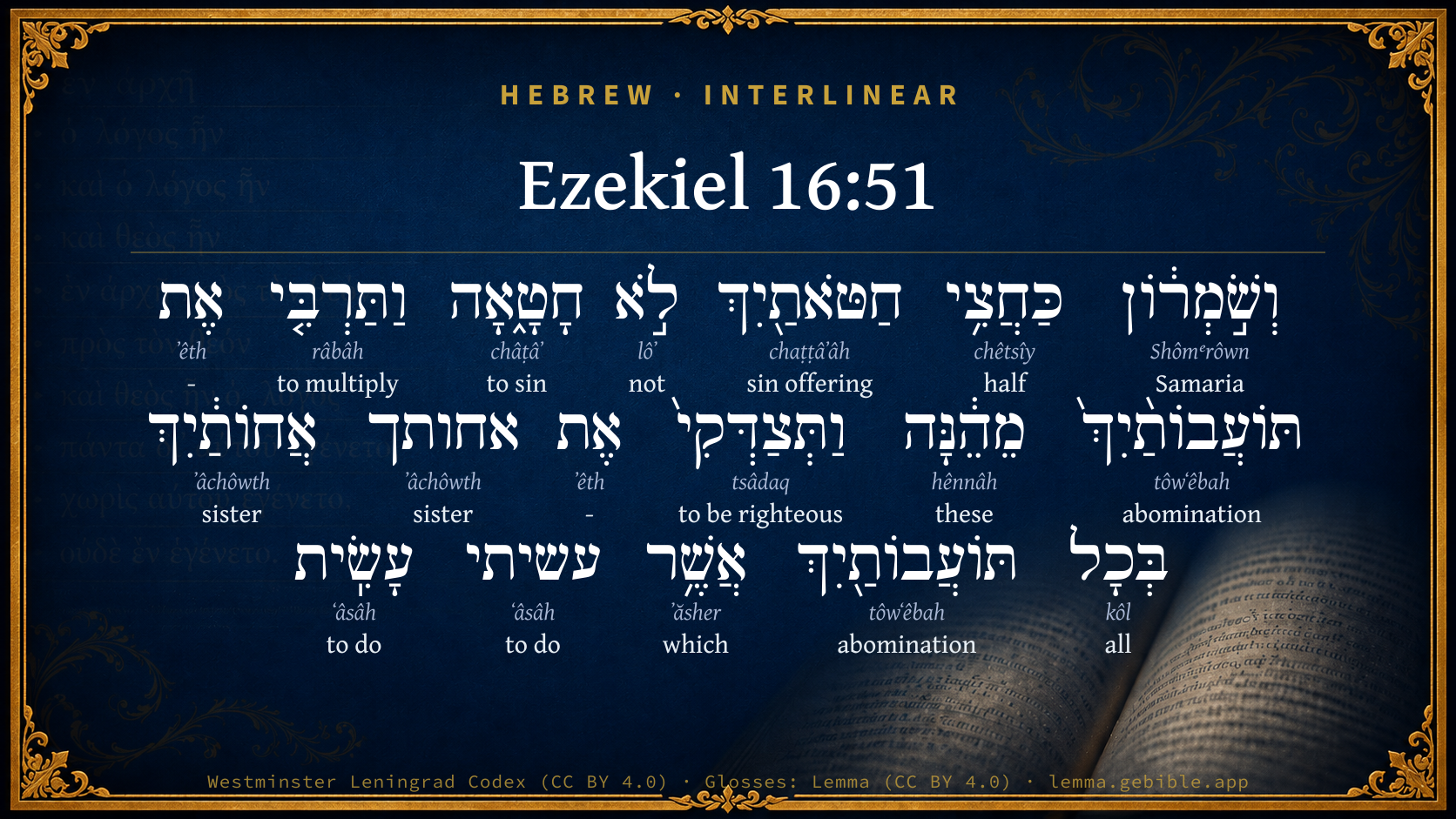
Ezekiel 16:51

Hebrew (Westminster Leningrad Codex) Ezekiel 16:51 appears in the Hebrew Old Testament. The text above is from the Westminster Leningrad Codex. Each word links to its Strong’s number, a concise gloss, and parsing drawn from the Open Scriptures Hebrew Bible morphology. Click any word for its full Brown-Driver-Briggs (BDB) entry.
Download image
Cite this verse

Ezekiel 16:51 (World English Bible). Public Domain. Lemma interlinear Bible study tool, https://lemma.gebible.app/v/ezekiel/16/51.

Show BibTeX & RIS
BibTeX
RIS
English Translation
Neither has Samaria committed half of your sins; but you have multiplied your abominations more than they, and have justified your sisters by all your abominations which you have done.
World English Bible · Public Domain
Download a study sheet

One document with this verse’s original text, its word-by-word gloss line, the meaning frame, cross-references with their text, attributed commentary, and full source and license credits — printable, and it pastes into notes with its structure intact.

This verse Autodidact and up

Study sheet (.html) Plain text (.txt)

A passage Seminary Student

Up to 50 verses in one chapter. A passage sheet keeps up to 6 commentary sources and 12 cross-references per verse, in the order this page ranks them, and says so on the sheet whenever that leaves anything out. Ask for a single verse and you get the Autodidact verse sheet above.

Everything on this page stays free to read, with no account — the sheet is a download of what is already on screen, not access to it.

Want to remove ads? Support Godless Engineer
Compare translations 3

The same verse in 3 English versions, stacked beneath the original-language interlinear above. Click any original word for its lexicon entry.

Each is an independent rendering of the whole verse — the interlinear is not word-aligned to these translations.

Highlighted words mark where these versions differ — a whole-verse word diff, not a word-by-word alignment.

  • World English Bible Public Domain
    Neither has Samaria committed half of your sins; but you have multiplied your abominations more than they, and have justified your sisters by all your abominations which you have done.
  • King James Version Public Domain
    Neither hath Samaria committed half of thy sins; but thou hast multiplied thine abominations more than they, and hast justified thy sisters in all thine abominations which thou hast done.
  • unfoldingWord Literal Text CC BY-SA 4.0
    Neither did Samaria commit even half of your sins; instead, you have done many more disgusting things than they did, and you have shown that your sisters were better than you because of all the disgusting things that you do!

unfoldingWord Literal Text — © unfoldingWord, licensed CC BY-SA 4.0. Word-aligned USFM3 via Door43 (git.door43.org/unfoldingWord/en_ult).

Versions to compare (up to 4)

3 of 4 selected

Show all 18 translations

Every available English version of this verse, each an independent rendering of the whole verse.

  • World English Bible Public Domain
    Neither has Samaria committed half of your sins; but you have multiplied your abominations more than they, and have justified your sisters by all your abominations which you have done.
  • Berean Standard Bible Public Domain
    Furthermore, Samaria did not commit half the sins you did. You have multiplied your abominations beyond theirs, and all the abominations you have committed have made your sisters appear righteous.
  • Majority Standard Bible Public Domain
    Furthermore, Samaria did not commit half the sins you did. You have multiplied your abominations beyond theirs, and all the abominations you have committed have made your sisters appear righteous.
  • King James Version Public Domain
    Neither hath Samaria committed half of thy sins; but thou hast multiplied thine abominations more than they, and hast justified thy sisters in all thine abominations which thou hast done.
  • American Standard Version (1901) Public Domain
    Neither hath Samaria committed half of thy sins; but thou hast multiplied thine abominations more than they, and hast justified thy sisters by all thine abominations which thou hast done.
  • Revised Version (1885) Public Domain
    Neither hath Samaria committed half of thy sins; but thou hast multiplied thine abominations more than they, and hast justified thy sisters by all thine abominations which thou hast done.
  • Geneva Bible (1599) Public Domain
    Neither hath Samaria committed halfe of thy sinnes, but thou hast exceeded them in thine abominations, and hast iustified thy sisters in all thine abominations, which thou hast done.
  • Douay-Rheims (1899) Public Domain
    And Samaria committed not half thy sins: but thou hast surpassed them with thy crimes, and hast justified thy sisters by all thy abominations which thou hast done.
  • Young's Literal Translation Public Domain
    As to Samaria, as the half of thy sins -- she hath not sinned, And thou dost multiply thine abominations more than they, And dost justify thy sisters by all thy abominations that thou hast done.
  • Literal Standard Version CC BY-SA 4.0
    And Samaria has not sinned even half of your sins, || But you multiply your abominations more than they, || And justify your sisters by all your abominations that you have done.
  • Unlocked Literal Bible CC BY-SA 4.0
    Neither did Samaria commit even half of your sins; instead, you have done many more disgusting things than they did, and you have shown that your sisters were better than you because of all the disgusting things that you do!
  • unfoldingWord Literal Text CC BY-SA 4.0
    Neither did Samaria commit even half of your sins; instead, you have done many more disgusting things than they did, and you have shown that your sisters were better than you because of all the disgusting things that you do!
  • Darby Bible Public Domain
    And Samaria hath not sinned according to the half of thy sins; but thou hast multiplied thine abominations more than they, and hast justified thy sisters by all thine abominations which thou hast done.
  • World Messianic Bible Public Domain
    Samaria hasn’t committed half of your sins; but you have multiplied your abominations more than they, and have justified your sisters by all your abominations which you have done.
  • Webster's Bible Public Domain
    Neither hath Samaria committed half of thy sins; but thou hast multiplied thy abominations more than they, and hast justified thy sisters in all thy abominations which thou hast done.
  • Free Bible Version CC BY-SA 4.0
    Samaria didn't sin half as badly as you did. You have done far more disgusting things than they did. In fact, all the revolting things you've done make your sisters look good!
  • Bible in Basic English Public Domain
    And Samaria has not done half your sins; but you have made the number of your disgusting acts greater than theirs, making your sisters seem more upright than you by all the disgusting things which you have done.
  • JPS Tanakh (1917) Public Domain
    Neither hath Samaria committed even half of thy sins; but thou hast multiplied thine abominations more than they, and hast justified thy sisters by all thine abominations which thou hast done.

Literal Standard Version (2020), Covenant Press — licensed CC BY-SA 4.0. Text via the HelloAO Bible API (eBible.org). Unlocked Literal Bible (unfoldingWord) — licensed CC BY-SA 4.0. Text via the HelloAO Bible API (eBible.org). unfoldingWord Literal Text — © unfoldingWord, licensed CC BY-SA 4.0. Word-aligned USFM3 via Door43 (git.door43.org/unfoldingWord/en_ult). Free Bible Version, Dr. Jonathan Gallagher — licensed CC BY-SA 4.0. Text via the HelloAO Bible API (eBible.org).

Word by word

More ways to search: Search by grammar → Find every occurrence → Compare this word →

Practice this passage: Drill this verse → Learn its vocabulary →

וַתְּצַדְּקִי֙
tsâdaq
H6663
“and · to be righteous”
Conjunction + Verb, Piel, Sequential Imperfect, 2nd Person, Feminine, Singular
Part of Speech
Conjunction + Verb
Stem
Piel
Form
Sequential Imperfect
Person
2nd Person
Gender
Feminine
Number
Singular
Full BDB Definition

Origin: a primitive root

TWOT: 1879

to be just, be righteous - (Qal) - to have a just cause, be in the right - to be justified - to be just (of God) - to be just, be righteous (in conduct and character) - (Niphal) to be put or made right, be justified - (Piel) justify, make to appear righteous, make someone righteous - (Hiphil) - to do or bring justice (in administering law) - to declare righteous, justify - to justify, vindicate the cause of, save - to make righteous, turn to righteousness - (Hithpael) to justify oneself
  1. וְשֹׁ֣מְר֔וֹן Shômᵉrôwn H8111 “and · Samaria” Conjunction + Noun, Proper
  2. כַּחֲצִ֥י chêtsîy H2677 “like/as · half of” Preposition + Noun, Common, Masculine, Singular, Construct
  3. חַטֹּאתַ֖יִךְ chaṭṭâʼâh H2403 “sin offerings · your” Noun, Common, Feminine, Plural, Construct + Suffix, Personal, 2nd Person, Feminine, Singular
  4. לֹ֣א lôʼ H3808 “not” Particle, Negative
  5. חָטָ֑אָה châṭâʼ H2398 “to sin” Verb, Qal, Perfect, 3rd Person, Feminine, Singular
  6. וַתַּרְבִּ֤י râbâh H7235 “and · to multiply” Conjunction + Verb, Hiphil, Sequential Imperfect, 2nd Person, Feminine, Singular
  7. אֶת ʼêth H853 “-” Particle, Direct Object
  8. תּוֹעֲבוֹתַ֨יִךְ֙ tôwʻêbah H8441 “abominations · your” Noun, Common, Feminine, Plural, Construct + Suffix, Personal, 2nd Person, Feminine, Singular
  9. מֵהֵ֔נָּה hênnâh H2007 “from · these” Preposition + Pronoun, Personal, 3rd Person, Feminine, Plural
  10. אֶת ʼêth H853 “-” Particle, Direct Object
  11. אחותך ʼâchôwth H269 “sister · your” Noun, Common, Feminine, Singular, Construct + Suffix, Personal, 2nd Person, Feminine, Singular
  12. אֲחוֹתַ֔יִךְ ʼâchôwth H269 “sisters · your” Noun, Common, Feminine, Plural, Construct + Suffix, Personal, 2nd Person, Feminine, Singular
  13. בְּכָל kôl H3605 “in/at · all of” Preposition + Noun, Common, Masculine, Singular, Construct
  14. תּוֹעֲבוֹתַ֖יִךְ tôwʻêbah H8441 “abominations · your” Noun, Common, Feminine, Plural, Construct + Suffix, Personal, 2nd Person, Feminine, Singular
  15. אֲשֶׁ֥ר ʼăsher H834 “which” Particle, Relative
  16. עשיתי ʻâsâh H6213 “to do” Verb, Qal, Perfect, 2nd Person, Feminine, Singular
  17. עָשִֽׂית ʻâsâh H6213 “to do” Verb, Qal, Perfect, 2nd Person, Feminine, Singular

About this verse

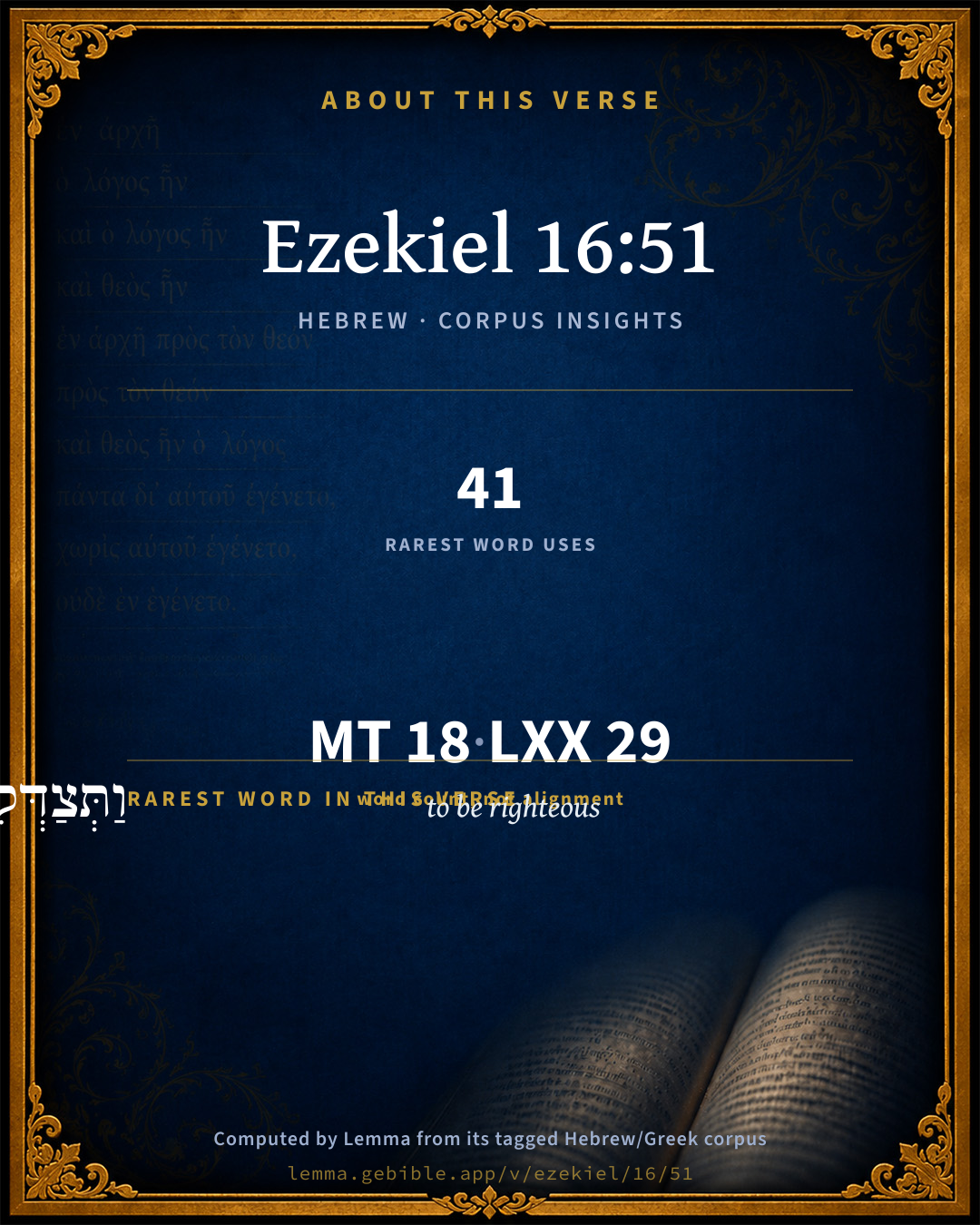
These counts appear in no published source. They are computed here, from the morphology-tagged text and Lemma’s own curated glosses. What Lemma adds →

18
words
14
distinct lemmas
Prophets
section

Shared distinctive vocabulary

וַתְּצַדְּקִי֙ to be righteous H6663 occurs in 40 verses of the Hebrew Bible. Also found in:

Grammatical profile

  • 5 verbs
  • 8 nouns
  • 1 pronoun
  • 4 particles

Verb forms

  • חָטָ֑אָה Qal · Perfect
  • וַתַּרְבִּ֤י Hiphil · Sequential Imperfect
  • וַתְּצַדְּקִי֙ Piel · Sequential Imperfect
  • עשיתי Qal · Perfect
  • עָשִֽׂית Qal · Perfect

Repetition

Words recur within this verse — often emphatic in Hebrew:

  • תּוֹעֲבוֹתַ֨יִךְ֙ abomination H8441 ×2
  • אחותך sister H269 ×2
  • עשיתי to do H6213 ×2

Hebrew & Septuagint length

In English translation the verse runs 30 words from the Hebrew and 33 from the Septuagint (LXX English) — closely comparable.

A rough comparison of the two English renderings, which tokenize alike — not a word-level alignment.

Word counts can differ between the Hebrew and the Greek without any difference in meaning — e.g. the Hebrew direct-object marker אֵת has no separate Greek word, and Greek often adds the article ὁ.

In the original languages it is 18 Hebrew tokens and 29 Greek tokens — but the two are counted differently (Hebrew bundles its prefixes and suffixes into one token; the Greek is in lemma form), so that isn’t a like-for-like length.

Cross-references

4

Topical passages linked to Ezekiel 16:51 in the Treasury of Scripture Knowledge — connected by theme and wording, ordered by reader-vote popularity; previews shown in the World English Bible.

  • Jeremiah 3:8–11 I saw, when, for this very cause that backsliding Israel had committed adultery, I had put her away and given her a bill of divorce, yet treacherous Judah, her sister, didn't fear; but she also went and played the prostitute.
  • Matthew 12:41–42 The men of Nineveh will stand up in the judgment with this generation, and will condemn it, for they repented at the preaching of Jonah; and behold, someone greater than Jonah is here.
  • Luke 12:47–48 That servant, who knew his lord's will, and didn't prepare, nor do what he wanted, will be beaten with many stripes,
  • Romans 3:9–20 What then? Are we better than they? No, in no way. For we previously charged both Jews and Greeks, that they are all under sin.

Cross-references courtesy of OpenBible.info (CC BY 4.0).

Hebrew and Greek witnesses Masoretic Hebrew ↔ Greek Septuagint

The same verse in the two great witnesses to the Old Testament, shown verse-for-verse.

These are two independent witnesses, not word-aligned to each other, and the Septuagint is shown in lemma (dictionary) form.

Hebrew Ezekiel 16:51 Masoretic · Westminster Leningrad Codex

וְשֹׁ֣מְר֔וֹן כַּחֲצִ֥י חַטֹּאתַ֖יִךְ לֹ֣א חָטָ֑אָה וַתַּרְבִּ֤י אֶת תּוֹעֲבוֹתַ֨יִךְ֙ מֵהֵ֔נָּה וַתְּצַדְּקִי֙ אֶת אחותך אֲחוֹתַ֔יִךְ בְּכָל תּוֹעֲבוֹתַ֖יִךְ אֲשֶׁ֥ר עשיתי עָשִֽׂית

Neither has Samaria committed half of your sins; but you have multiplied your abominations more than they, and have justified your sisters by all your abominations which you have done.

World English Bible · Public Domain

Greek LXX Ezekiel 16:51 Septuagint · lemma form

καί σαμαρεία κατά ὁ ἥμισυς ὁ ἁμαρτία σύ οὐ ἁμαρτάνω καί πληθύνω ὁ ἀνομία σύ ὑπέρ αὐτός καί δικαιόω ὁ ἀδελφή σύ ἐν πᾶς ὁ ἀνομία σύ ὅς ποιέω

Also Samaria has not sinned according to half of your sins; but you have multiplied your iniquities beyond them, and you have justified your sisters in all your iniquities which you have committed.

LXX2012 (modern English Septuagint) · Public Domain

Hebrew: Westminster Leningrad Codex (CC BY 4.0). Greek: Septuagint (public domain); English from LXX2012 (modern English Septuagint) (Public Domain). How the Septuagint differs from the Hebrew →

Targum (Aramaic paraphrase)

1

The Targum is the ancient Jewish Aramaic paraphrase of the Hebrew Scriptures — an interpretive translation, not the Hebrew text itself. Onkelos (literal) and Pseudo-Jonathan (expansive) render the Torah, and Jonathan the Prophets. Coverage is partial: where no permissively-licensed English translation exists for a verse, only the Aramaic is shown. This is verse-level text, not a word-by-word alignment to the Hebrew.

  1. Targum Jonathan Prophets (Joshua–Malachi)
    וְשׁוֹמְרוֹן כְּפַלְגוּת חוֹבַיִךְ לָא חָבַת וְאַסְגֵית יַת תּוֹעֲבוֹתַיִךְ מִנְהוֹן וְזַכֵּית יַת אֲחָתַיִךְ בְּכָל תּוֹעֲבָתַיִךְ דַעֲבַדְתְּ:

    (no public-domain English translation for this verse)

    Targum Jonathan — Aramaic: “Mikraot Gedolot” (public domain). English: “Sefaria Community Translation” (CC0 1.0 (public-domain dedication)); “London "Chaldee Paraphrase," 1871” (public domain). Text via Sefaria.

Commentary

Notes on Ezekiel 16:51 from classic Christian and Jewish commentators (each source and its license shown beneath its notes). The classic Christian expositions comment on the surrounding passage and are grouped to its opening verse, so a note may address several verses; the Jewish commentaries on the Tanakh (Rashi and others) are per-verse, so they appear only where the commentator wrote on this verse.

Lemma curates 59 commentaries, every one of them public domain or Creative Commons licensed, each selected and text-cleaned for this edition rather than reprinted as found. About our sources →

Trapp's Complete Commentary

John Trapp

Eze 16:51 Neither hath Samaria committed half of thy sins; but thou hast multiplied thine abominations more than they, and hast justified thy sisters in all thine abominations which thou hast done.

Ver. 51. Neither hath Samaria committed half thy sins.] And yet thou lookest aloof upon her as a far greater sinner than thyself, because already carried captive, whenas thou hast done and spoken evil things as thou couldst, {Jer 3:5} outdone her a fair deal.

And hast justified thy sisters.] Who may well seem saints in comparison of thee, and yet are as naught as need to be.

John Trapp, A Commentary or Exposition upon All the Books of the Old and New Testament (1647–1656) — public domain. Text from a community e-Sword module.

The Biblical Illustrator

Joseph S. Exell

Eze_16:51-52

Neither hath Samaria committed half thy sins.

Sinners compared

The sins of one people may be greater than the sins of another; all sins are not equal, nor all sinners equally guilty. Jerusalems sins exceeded Samarias and Sodoms; they were not half so great sinners as she was. The more mercies any people enjoy, the greater are their sins if they answer not those mercies. Christians sins will be found the scarlet and unparallelable sins.

2. Comparing of sins and sinners together, makes great sins seem little and great sinners seem righteous. Great things when they are exceeded by greater in view, they seem little; a great house is nothing to a great rock, a great mountain or city; a great river is nothing to the ocean; so a great heap of sins is as nothing to a greater; what is a cartful of dung to a great dunghill? And as it is in quantities, so in qualities: some poisons are so poisonous, so strong, that they kill immediately; others, though more in quantity, yet are longer in producing such an effect, and in comparison they are no poisons; so some sins and sinners compared with others, are as none. Luk_18:14, the publican went down to his house justified rather than the Pharisee: this Pharisee compared himself with the publican, and thought himself righteous; but the publican in comparison of him was righteous. Take heed therefore of comparing yourselves with others who are worse and greater sinners than you, and from thence of framing a righteousness to yourselves notwithstanding. Sodom and Samaria were less sinners, more righteous than Jerusalem, yet you know how God dealt with them, and destruction will be the end of all those who trust to such righteousness.

3. Great sinners see not, or forget their own sins, and are apt to censure, judge, and condemn others who are less sinful than themselves, and especially when they are under the hand of God.

4. It is a shame for those who are guilty of the same or greater sins to judge others.

5. Sin brings shame. What a shame was it to Jerusalem that she was a greater sinner than Samaria, than Sodom; that she did such things as made the daughters of the Philistines ashamed of her (verse 27). Shame is the lackey that waits upon sin, and causeth the conscience to blush as well as the face (Pro_14:34): sin is a reproach to nations.

6. Shame in itself, or as it accompanies the judgments of God upon sinners, is a burdensome thing. Bear thine own shame, reproach, disgrace.

7. Sinners must bear the judgments of God, and the shame that is due unto them, whoever they be. Thou also, even thou Jerusalem, bear thine own shame. (W. Greenhill, M. A.)

Degrees of sin

He that will not be persuaded to leap down from an high chamber at once, cometh willingly down by the stairs; and yet the declining degrees of his winding descent make it not less downward to him, but less perceived of him. His leap might have brought him down sooner; it could not have brought him down lower. As I am then fearful to act great sins, so I will be careful to avoid small sins. He that contemns a small fault commits a great one. I see many drops make a shower; and what difference is it whether I be wet either in the rain or in the river, if both be to the skin? There is small benefit in the choice whether we go down to hell by degrees or at once. (A. Warwick.)

Shame ever attendant on sin

Manton says: The conscience of a sinner is like a clock, dull, calm, and at rest, when the weights are down; but when wound up, it is full of motion. Sometimes God winds up conscience in this life, and then it works vigorously, and strikes the time of day in the sinners ears. Shame attends his sin, and he trembles in secret, A dreadful sound is in his ears, and like the troubled sea he cannot rest. This is far better than a dead calm. Alas, in many cases the clock runs down, conscience is again still, and the man returns to his false peace. Of all states this is most dangerous. (C. H. Spurgeon.)

The Biblical Illustrator, edited by Joseph S. Exell (c. 1880s–1900s) — public domain. Text from a community e-Sword module.

Joseph Benson's Commentary

Eze 16:51-52. Neither hath Samaria — The kingdom of the ten tribes, founded in rebellion and idolatry; committed half of thy sins — The sin of Jerusalem was greater than that of Samaria, because God had placed his name and the ordinances of his worship there; and she had profaned his temple by placing idols in it, which was a degree of idolatry beyond any thing the ten tribes had been guilty of. And probably, with respect to other crimes, Jerusalem went beyond, or exceeded Samaria. But thou hast multiplied thine abominations more than they — Hast worshipped more idols, and slain more prophets; and hast justified thy sisters, &c. — Not made them righteous, but declared them less unrighteous than thou art; hast made them appear less guilty through the greatness of thy sins. Thou also, who hast judged thy sisters — Hast condemned their apostacy, and judged their punishment just; bear thy shame — For wherein thou hast judged them, or declared them to be deservedly punished, thou hast condemned thyself, having been guilty of the same sins, and those accompanied with greater aggravations. The inhabitants of Judea allowed that the ten tribes were justly punished when they were carried into captivity, and yet fell into the same and greater crimes themselves.

Joseph Benson's Commentary on the Old and New Testaments (1811–1818) — public domain. Text from a community e-Sword module.

Tyndale Open Study Notes

Tyndale Open Resources

16:51-52 In comparison to Jerusalem, Samaria and Sodom seemed virtuous. If God had justly destroyed both of Jerusalem’s sisters for their sins, how would Jerusalem escape God’s coming wrath?

Tyndale Open Study Notes — © Tyndale Open Resources, licensed CC BY-SA 4.0. Text via the HelloAO Bible API.

Geneva Bible (1599)

Geneva Bible translators

Which worshipped the calves in Bethel and Dan.

Thou art so wicked, that in respect of thee Sodom and Samaria were just.

Geneva Bible (1599) marginal notes — public domain. Text via Bolls.life.

Jamieson, Fausset & Brown

Robert Jamieson, A. R. Fausset & David Brown

Samaria--the kingdom of the ten tribes of Israel less guilty than Judah; for Judah betrayed greater ingratitude, having greater privileges, namely, the temple, the priesthood, and the regular order of kings.

justified thy sisters--made them appear almost innocent by comparison with thy guilt (Jer 3:11; Mat 12:41-42).

Jamieson, Fausset & Brown — Commentary Critical and Explanatory on the Whole Bible (1871) — public domain (CC PDM 1.0). Text via the HelloAO Bible API.

John Calvin's Commentaries

God now pronounces the same thing concerning Samaria, whom he had formerly called the younger sister. By Samaria, as we said, he means the Israelites, because that city was the head of the Kingdom of Israel: the ten tribes had been already driven into exile; and he says they were not half so wicked when compared with the Jews. This, at the first glance, may seem absurd; for we know that God’s worship was continued at Jerusalem when the Israelites rejected the law, and basely and openly turned aside to idolatry. Since, therefore, some sound piety flourished at Jerusalem when the Israelites wickedly revolted from God’s law, what can it mean by the Jews being censured as worse than they were? We must always come to the fountain which I have pointed out; for ingratitude has great influence in exaggerating men’s crimes. But another reason must also be remarked. The Jews had seen how severely God had avenged the superstitions of the kingdom of Israel: they were so far from repenting that they rather courted their alliance, as if for the very purpose of provoking God afresh. If we reflect upon these two points, the question will be solved as far as relates to the present passage. God says what is incredible to us, that the Jews were worse than the Israelites: but he asserts this, because ingratitude had rendered them less excusable; for God had retained them under his own charge when that wretched dispersion happened, and the ten tribes were all but absorbed. God’s candle was always shinning at Jerusalem, as it is said. (Exodus 27:20.) When, therefore, God had preserved for himself that small band as the very flower of the people, safe and sound, the revolt of this people was far more criminal than that of the ten tribes: for these tribes were drawn away from the worship of God by little and little, as is well known. For Jeroboam always set before himself one definite object — the worship of God as the liberator of the people, (1 Kings 12:) for the Israelites did not look on themselves as apostates, although they had degenerated from their fathers. But the Jews addicted themselves to gross superstitions, of which the Israelites at first were ashamed; and then they were warned by many penalties not to imitate their kinsmen: still, as we saw before, the temple was defiled by many pollution’s; for Ezekiel, in the eighth chapter, says that he saw there many defilement’s. Since then the Jews profited so badly, though God set his vengeance before their eyes, it is not surprising that they are said to have sinned grievously.

In conclusion, he adds, thou hast multiplied your abominations beyond them; and you have justified thy sisters in all the abominations which you have perpetrated. Here the word “justified” is to be received at first comparatively: it does not signify that the fault of others is extenuated by the wickedness of the Jews; but if the people wished to offer excuses, they might easily be convinced that both Sodom and the kingdom of Israel were just in comparison with the Jews. To justify is usually received for to absolve; and we must observe this when we treat of justification, since the papists always seize upon the quality, as if to be justified was in reality to be just. Hence they are unable to comprehend a doctrine sufficiently familiar to Scripture, and plain enough — that we are justified by faith: for they examine man, that they may find justice there, and do not ascend any higher: but to be justified by faith signifies nothing but to be absolved, though we are not just in ourselves; hence a justification by faith without us must be sought for, and hence we gather that it is not a quality. Hence Jerusalem justified her sisters, although Sodom and Samaria were found worse than herself. It follows —

John Calvin's Commentaries (1540-1563) — public domain. Text from the Calvin Translation Society English edition (1840s-50s) via the Christian Classics Ethereal Library (ccel.org). Calvin's coverage is partial (roughly two-thirds of the Bible); uncommented books and verses are honest gaps, never fabricated. The 19th-century editor's footnotes and remarks are omitted so the notes are faithfully Calvin's own voice.

Ellicott's Commentary for English Readers

(51) Hast justified thy sisters.—The same expression is repeated in the following verse. In both it is evidently used in a comparative sense. By the greatness of Judah’s sins even Sodom and Samaria were made to appear innocent in comparison.

A Bible Commentary for English Readers, edited by Charles John Ellicott (1878–1897) — public domain. Text from a community e-Sword module.

The Cambridge Bible for Schools and Colleges

gen. ed. J. J. S. Perowne

51. hast justified] Jer_3:11, “Backsliding Israel hath justified herself more than treacherous Judah.” The abominations of Judah set Samaria and Sodom in a comparatively righteous light.

The Cambridge Bible for Schools and Colleges (gen. ed. J. J. S. Perowne; Cambridge University Press, 1878–1918) — public domain. Text from a community e-Sword module.

John Gill's Exposition

Thou also which hast judged thy sisters,.... Sodom and Samaria, by censuring and condemning them for their sins; see Ch2 13:8; in which sense Jarchi and Kimchi interpret the word; or by defending and patronizing them, acquitting and absolving them, by committing the same sins, and more heinous ones:

bear thine own shame for thy sins that thou hast committed more abominable than they; look upon thy sins, and blush at them; confess them with shame and confusion of face; take shame to thyself for them, in that thou hast censured and condemned these sins in others thou hast been guilty of thyself; and the rather, since thy sins are greater, and attended with more aggravating circumstances, than those thou hast blamed in others; or this is a prophecy of their punishment for their sins, when they should be carried captive, and be put to shame before their neighbours: or, "thou shalt bear" (d); shame is the fruit of sin, sooner or later:

they are more righteous than thou; in comparison of her; though neither of them were righteous in the sight of God, yet comparatively one was more righteous than another, having committed fewer sins, and lesser abominations:

yea, be thou confounded also, and bear thy shame, in that thou hast justified thy sisters; this is repeated in stronger expressions, and with the reasons of it, to show the great confusion they should be brought unto, and the certainty of it, the more to strike and affect their minds with it.

(d) imperat. pro fut. i.e. "confunderis", Vatablus.

John Gill's Exposition of the Whole Bible (1746–1763) — public domain (CC PDM 1.0). Text via the HelloAO Bible API.

Albert Barnes' Notes on the Bible

Justified thy sisters - Made them appear just in comparison with thee.

Albert Barnes' Notes on the Bible (1834–1885) — public domain. Text from a community e-Sword/MySword module.

Haydock's Catholic Bible Commentary

Justified, as they are comparatively innocent. (St. Augustine, contra Faust. xxii. 61.) --- They had not the like advantages, (Matthew xi. 23.) nor the example of others’ punishment to open their eyes. Thou hast pleaded for or with them, and hast lost thy cause. (Calmet)

George Leo Haydock (1774–1849), Haydock's Catholic Family Bible and Commentary, 1859 edition — public domain. Excludes Psalms (Douay-Rheims chapter numbering differs from Protestant) and Deuterocanonical books (Catholic canon only).

Matthew Poole's English Annotations

Samaria; the ten tribes, or kingdom of Israel, founded in rebellion and idolatry.

Committed half of thy sins; a proverbial speech, usual in comparison to set forth the lesser part, as 1Ki 10:7.

But thou hast multiplied: this explains the former.

More; more, or greater, the Hebrew word signifieth both.

Justified; not made them righteous, but declared them less unrighteous than thou in thy aboniinations; of the two they are less faulty.

Matthew Poole's English Annotations on the Holy Bible (1683–1685) — public domain. Text from a community e-Sword/MySword module.

Whedon's Commentary on the Bible

Daniel D. Whedon

51. Thou hast multiplied thine abominations… and [thus] hast justified thy sisters — Jerusalem makes the iniquities of these less favored cities seem almost excusable. If Jerusalem can justify herself, surely these must be justified (see Jer_3:11); when compared with her own black deeds the wicked acts of other nations look almost white.

Daniel D. Whedon (gen. ed.), Commentary on the Old and New Testaments (1874–1909) — public domain. Text from a community e-Sword module.

The Pulpit Commentary

Vers. 51, 52. Thou hast justified, etc. The word has a touch of sarcasm. Sodom and Samaria might claim a verdict of acquittal ("justify," in its technical sense) as compared with Judah. They had not presented, as she had done, a confluence of all the worst idolatries. The words find something like an echo in our Lord"s teaching Mat_10:15 Mat_11:24. And, as is common m such eases," she had judged," i.e. had passed sentence of condemnation on those who were more righteous than herself. The Revised Version changes both meaning and punctuation: Bear thine own shame, in that thou hast given judgment for thy sisters; through thy sins that thou hast committed more abominable than they, they are more righteous than thou; but the Authorized Version seems preferable. It may be questioned whether the word for judged is ever used of an acquittal. The point of the sentence is that Judah condemned those who were less guilty than herself. (comp. Rom_2:17-23)

The Pulpit Commentary (1880–1919), ed. H.D.M. Spence-Jones & Joseph S. Exell — public domain. Text from a community e-Sword module.

John Wesley's Explanatory Notes

Hast justified - Not made them righteous, but declared them less unrighteous, than thou; of the two they are less faulty.

John Wesley, Explanatory Notes Upon the Whole Bible (1754–1765) — public domain. Text via the GEBible commentary corpus.

unfoldingWord translationNotes

Door43 World Missions Community

General Information:

Yahweh continues to speak about Jerusalem as if the city were his unfaithful wife. The city represents the people who live there. (See: Metaphor and Metonymy)

you have shown that your sisters were better than you

Yahweh uses this phrase three times to emphasize that the wicked cities of Samaria and Sodom were more righteous than Jerusalem.

Especially you, show your own shame

Yahweh uses this phrase twice to emphasize how shamefully the people of Jerusalem have acted.

show your own shame

"be ashamed" or "bear your disgrace"

translationWords

Samaria

sin

shame

unfoldingWord translationNotes — © Distant Shores Media and the Door43 World Missions Community, licensed CC BY-SA 4.0. Source: git.door43.org/Door43/en_tn.

Rashi

Rabbi Shlomo Yitzchaki (Rashi)

and you vindicated your sisters Before you had committed abominations more than they, they would have been a judged guilty, but since you became more wicked than they, you made them [appear] as righteous women, and you gave them an excuse to say, “There are some who have provoked you more than I.”

Rashi on the Tanakh — English translations: “The Judaica Press complete Tanach with Rashi, translated by A. J. Rosenberg” (CC BY 4.0); “Pentateuch with Rashi's commentary by M. Rosenbaum and A.M. Silbermann, 1929-1934” (public domain); “The Metsudah Tanach series, Lakewood, N.J” (CC BY 4.0); and “The Book of Joshua, Metsudah Publications, 1997” (CC BY 4.0). Text via Sefaria.

Lesson kit

Teaching starters — assembled from the data on this page, not authored interpretation. Every prompt links to the verse data it draws on. Edit before teaching.

Ezekiel, in the Prophets, opens this verse with 18 words (14 distinct Hebrew lemmas). Its most distinctive word is tsâdaq (“to be righteous”). A historical commentator’s framing appears above. Read the whole chapter for the surrounding context.

Discussion questions

  1. The word tsâdaq carries the sense “to be righteous.” How does it shape the verse?
  2. Genesis 38:26 shares the word «to be righteous» with this verse. How do the two illuminate each other?
  3. “abomination” occurs 2× in this one verse. What is the effect of the repetition?
  4. The translations on this page render this verse differently — a whole-verse word diff, not a word-by-word alignment. What might account for the different wordings?
  5. The verb «חָטָ֑אָה» is Qal Perfect. How does its form color the action?
  6. Reading how Trapp's Complete Commentary and The Biblical Illustrator read this verse, where do the two commentators agree and where do they part?

Things to notice

Reading settings

Reading text

Shown beneath each verse's original-language words.

Old Testament
Old Testament edition

Read the OT as the Masoretic Hebrew (MT) or the Greek Septuagint (LXX).

English shown for the Greek Septuagint (in the Hebrew ↔ Greek comparison).

Comparing translations? Open the Compare panel on any verse page to stack up to four side by side.