

1 Samuel 1:12

Hebrew (Westminster Leningrad Codex) 1 Samuel 1:12 appears in the Hebrew Old Testament. The text above is from the Westminster Leningrad Codex. Each word links to its Strong’s number, a concise gloss, and parsing drawn from the Open Scriptures Hebrew Bible morphology. Click any word for its full Brown-Driver-Briggs (BDB) entry.
Download image
Cite this verse

1 Samuel 1:12 (World English Bible). Public Domain. Lemma interlinear Bible study tool, https://lemma.gebible.app/v/1-samuel/1/12.

Show BibTeX & RIS
BibTeX
RIS
English Translation
It happened, as she continued praying before Yahweh, that Eli marked her mouth.
World English Bible · Public Domain
Download a study sheet

One document with this verse’s original text, its word-by-word gloss line, the meaning frame, cross-references with their text, attributed commentary, and full source and license credits — printable, and it pastes into notes with its structure intact.

This verse Autodidact and up

Study sheet (.html) Plain text (.txt)

A passage Seminary Student

Up to 50 verses in one chapter. A passage sheet keeps up to 6 commentary sources and 12 cross-references per verse, in the order this page ranks them, and says so on the sheet whenever that leaves anything out. Ask for a single verse and you get the Autodidact verse sheet above.

Everything on this page stays free to read, with no account — the sheet is a download of what is already on screen, not access to it.

Want to remove ads? Support Godless Engineer
Compare translations 3

The same verse in 3 English versions, stacked beneath the original-language interlinear above. Click any original word for its lexicon entry.

Each is an independent rendering of the whole verse — the interlinear is not word-aligned to these translations.

Highlighted words mark where these versions differ — a whole-verse word diff, not a word-by-word alignment.

  • World English Bible Public Domain
    It happened, as she continued praying before Yahweh, that Eli marked her mouth.
  • King James Version Public Domain
    And it came to pass, as she continued praying before the LORD, that Eli marked her mouth.
  • unfoldingWord Literal Text CC BY-SA 4.0
    And it happened, as she made much to pray to the face of Yahweh, that Eli was watching her mouth.

unfoldingWord Literal Text — © unfoldingWord, licensed CC BY-SA 4.0. Word-aligned USFM3 via Door43 (git.door43.org/unfoldingWord/en_ult).

Versions to compare (up to 4)

3 of 4 selected

Show all 18 translations

Every available English version of this verse, each an independent rendering of the whole verse.

  • World English Bible Public Domain
    It happened, as she continued praying before Yahweh, that Eli marked her mouth.
  • Berean Standard Bible Public Domain
    As Hannah kept on praying before the LORD, Eli watched her mouth.
  • Majority Standard Bible Public Domain
    As Hannah kept on praying before the LORD, Eli watched her mouth.
  • King James Version Public Domain
    And it came to pass, as she continued praying before the LORD, that Eli marked her mouth.
  • American Standard Version (1901) Public Domain
    And it came to pass, as she continued praying before Jehovah, that Eli marked her mouth.
  • Revised Version (1885) Public Domain
    And it came to pass, as she continued praying before the LORD, that Eli marked her mouth.
  • Geneva Bible (1599) Public Domain
    And as she continued praying before the Lord, Eli marked her mouth.
  • Douay-Rheims (1899) Public Domain
    And it came to pass, as she multiplied prayers before the Lord, that Heli observed her mouth.
  • Young's Literal Translation Public Domain
    And it hath been, when she multiplied praying before Jehovah, that Eli is watching her mouth,
  • Literal Standard Version CC BY-SA 4.0
    And it has been, when she multiplied praying before YHWH, that Eli is watching her mouth,
  • Unlocked Literal Bible CC BY-SA 4.0
    As she continued praying before Yahweh, Eli watched her mouth.
  • unfoldingWord Literal Text CC BY-SA 4.0
    And it happened, as she made much to pray to the face of Yahweh, that Eli was watching her mouth.
  • Darby Bible Public Domain
    And it came to pass as she continued praying before Jehovah, that Eli marked her mouth.
  • World Messianic Bible Public Domain
    As she continued praying before the LORD, Eli saw her mouth.
  • Webster's Bible Public Domain
    And it came to pass, as she continued praying before the LORD, that Eli observed her mouth.
  • Free Bible Version CC BY-SA 4.0
    As Hannah went on praying before the Lord, Eli watched her mouth.
  • Bible in Basic English Public Domain
    Now while she was a long time in prayer before the Lord, Eli was watching her mouth.
  • JPS Tanakh (1917) Public Domain
    And it came to pass, as she prayed long before the LORD, that Eli watched her mouth.

Literal Standard Version (2020), Covenant Press — licensed CC BY-SA 4.0. Text via the HelloAO Bible API (eBible.org). Unlocked Literal Bible (unfoldingWord) — licensed CC BY-SA 4.0. Text via the HelloAO Bible API (eBible.org). unfoldingWord Literal Text — © unfoldingWord, licensed CC BY-SA 4.0. Word-aligned USFM3 via Door43 (git.door43.org/unfoldingWord/en_ult). Free Bible Version, Dr. Jonathan Gallagher — licensed CC BY-SA 4.0. Text via the HelloAO Bible API (eBible.org).

Word by word

More ways to search: Search by grammar → Find every occurrence → Compare this word →

Practice this passage: Drill this verse → Learn its vocabulary →

About this verse

These counts appear in no published source. They are computed here, from the morphology-tagged text and Lemma’s own curated glosses. What Lemma adds →

10
words
10
distinct lemmas
Historical
section

Shared distinctive vocabulary

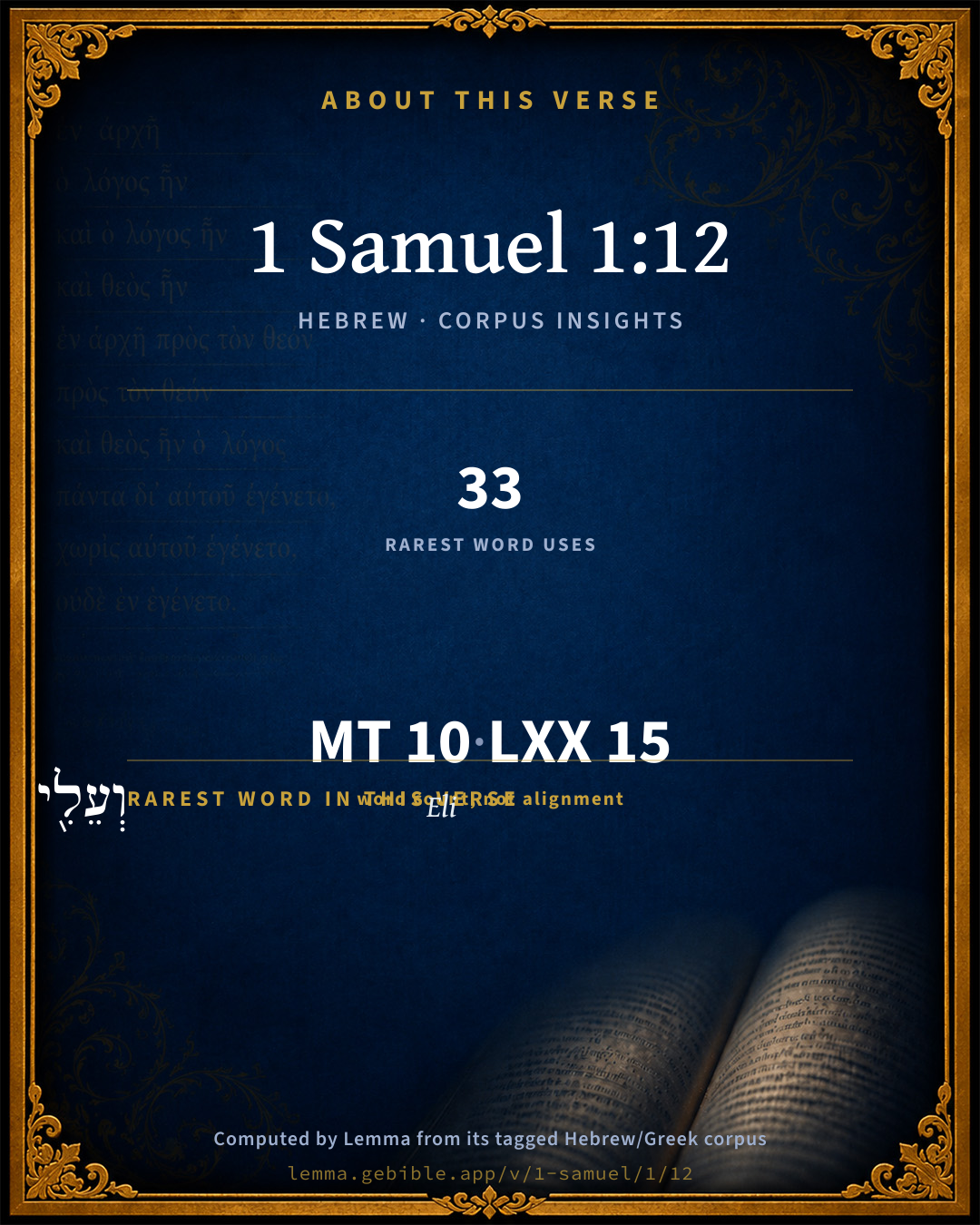
וְעֵלִ֖י Eli H5941 occurs in 30 verses of the Hebrew Bible. Also found in:

Grammatical profile

  • 4 verbs
  • 4 nouns
  • 1 conjunction
  • 1 particle

Verb forms

  • וְהָיָה֙ Qal · Perfect
  • הִרְבְּתָ֔ה Hiphil · Perfect
  • לְהִתְפַּלֵּ֖ל Hithpael · Infinitive Construct
  • שֹׁמֵ֥ר Qal · Participle Active

Hebrew & Septuagint length

In English translation the verse runs 13 words from the Hebrew and 20 from the Septuagint (LXX English) — the Septuagint runs noticeably longer here. See the side-by-side →

A rough comparison of the two English renderings, which tokenize alike — not a word-level alignment.

Word counts can differ between the Hebrew and the Greek without any difference in meaning — e.g. the Hebrew direct-object marker אֵת has no separate Greek word, and Greek often adds the article ὁ.

In the original languages it is 10 Hebrew tokens and 15 Greek tokens — but the two are counted differently (Hebrew bundles its prefixes and suffixes into one token; the Greek is in lemma form), so that isn’t a like-for-like length.

Cross-references

6

Topical passages linked to 1 Samuel 1:12 in the Treasury of Scripture Knowledge — connected by theme and wording, ordered by reader-vote popularity; previews shown in the World English Bible.

  • 1 Thessalonians 5:17 Pray without ceasing.
  • James 5:16 Confess your offenses to one another, and pray one for another, that you may be healed. The effective, earnest prayer of a righteous man is powerfully effective.
  • Luke 11:8–10 I tell you, although he will not rise and give it to him because he is his friend, yet because of his persistence, he will get up and give him as many as he needs.
  • Luke 18:1 He also spoke a parable to them that they must always pray, and not give up,
  • Ephesians 6:18 with all prayer and requests, praying at all times in the Spirit, and being watchful to this end in all perseverance and requests for all the saints:
  • Colossians 4:2 Continue steadfastly in prayer, watching therein with thanksgiving;

Cross-references courtesy of OpenBible.info (CC BY 4.0).

Hebrew and Greek witnesses Masoretic Hebrew ↔ Greek Septuagint

The same verse in the two great witnesses to the Old Testament, shown verse-for-verse.

Here the Septuagint runs noticeably longer than the Hebrew — LXX2012 (modern English Septuagint) 20 words vs World English Bible 13. A rough length comparison of the two English translations, not a word-level alignment — read both below.

These are two independent witnesses, not word-aligned to each other, and the Septuagint is shown in lemma (dictionary) form.

Hebrew 1 Samuel 1:12 Masoretic · Westminster Leningrad Codex

וְהָיָה֙ כִּ֣י הִרְבְּתָ֔ה לְהִתְפַּלֵּ֖ל לִפְנֵ֣י יְהוָ֑ה וְעֵלִ֖י שֹׁמֵ֥ר אֶת פִּֽיהָ

It happened, as she continued praying before Yahweh, that Eli marked her mouth.

World English Bible · Public Domain

Greek LXX 1 Samuel 1:12 Septuagint · lemma form

καί γίγνομαι ὅτε πληθύνω προςεὔχομαι ἐνώπιον κύριος καί ηλι ὁ ἱερεύς φυλάσσω ὁ στόμα αὐτός

And it came to pass, while she was long praying before the Lord, that Heli the priest marked her mouth.

LXX2012 (modern English Septuagint) · Public Domain

Hebrew: Westminster Leningrad Codex (CC BY 4.0). Greek: Septuagint (public domain); English from LXX2012 (modern English Septuagint) (Public Domain). How the Septuagint differs from the Hebrew →

Targum (Aramaic paraphrase)

1

The Targum is the ancient Jewish Aramaic paraphrase of the Hebrew Scriptures — an interpretive translation, not the Hebrew text itself. Onkelos (literal) and Pseudo-Jonathan (expansive) render the Torah, and Jonathan the Prophets. Coverage is partial: where no permissively-licensed English translation exists for a verse, only the Aramaic is shown. This is verse-level text, not a word-by-word alignment to the Hebrew.

  1. Targum Jonathan Prophets (Joshua–Malachi)
    וַהֲוָה מִדְאַסְגִיאַת לְצַלָאָה קֳדָם יְיָ וְעֵלִי אוֹרִיךְ לָהּ עַד דְתִפְסוֹק:

    (no public-domain English translation for this verse)

    Targum Jonathan — Aramaic: “Mikraot Gedolot” (public domain). English: “Sefaria Community Translation” (CC0 1.0 (public-domain dedication)); “London "Chaldee Paraphrase," 1871” (public domain). Text via Sefaria.

Commentary

Notes on 1 Samuel 1:12 from classic Christian and Jewish commentators (each source and its license shown beneath its notes). The classic Christian expositions comment on the surrounding passage and are grouped to its opening verse, so a note may address several verses; the Jewish commentaries on the Tanakh (Rashi and others) are per-verse, so they appear only where the commentator wrote on this verse.

Lemma curates 59 commentaries, every one of them public domain or Creative Commons licensed, each selected and text-cleaned for this edition rather than reprinted as found. About our sources →

Trapp's Complete Commentary

John Trapp

1Sa 1:12 And it came to pass, as she continued praying before the LORD, that Eli marked her mouth.

Ver. 12. And she continued praying.] Heb., Multiplied to pray; as resolved not to give over her suit. Prayer, like those arrows of deliverance, should be multiplied. {Luk 18:1} Misericordiam extorquemas, said those primitive Christians. We wring out of God’s holy hands that mercy which he with an unwilling willingness withholdeth for a while, that we may be the more importunate.

Eli marked her mouth.] Saw her lips walk with a strange unusual motion and writhing: but heard no voice, and thereupon misjudged her. Of Dr Gabriel Nele, Bartolus reporteth, {a} that by the motion of the lips only, without any utterance, he understood all men: yea, that he could read their thoughts in their looks. Whether he could or not, - which I much question, - old Eli it seems could not.

{a} Lib. i. De Ver. Oblig.

John Trapp, A Commentary or Exposition upon All the Books of the Old and New Testament (1647–1656) — public domain. Text from a community e-Sword module.

Joseph Benson's Commentary

1Sa 1:12-13. She continued praying — Hebrew, multiplied to pray. By which it appears that she said much more than is here expressed. And in the same light we must view most of the prayers and sermons of other holy persons recorded in the Scriptures, which give us only the sum and substance of what they expressed. This consideration may assist us much in interpreting many passages of Holy Writ. Eli marked her mouth — The inward anguish of her soul probably made the motions of her mouth and countenance very different from what is usual. Therefore Eli thought she had been drunken — Hearing her say nothing, but only seeing her lips move a long time, with such gestures, it is likely, of her body, hands, and eyes, as argued very great commotion of mind, being occasioned by the vehemence of her desire and grief, and her fervency in prayer, he took her to be disordered with the wine she had drunk at the forementioned feast.

Joseph Benson's Commentary on the Old and New Testaments (1811–1818) — public domain. Text from a community e-Sword module.

The Preacher's Complete Homiletical Commentary

Joseph S. Exell (gen. ed.)

CRITICAL AND EXPOSITORY NOTES.—

1Sa_1:13. “She spake in her heart.” Prayer is almost always oral in the East, even in public (Kitto).

1Sa_1:14. “Put away thy wine from thee,” i.e., sleep off the effects of intoxication.

1Sa_1:15. “Neither wine nor strong drink has been poured out unto me, but I have poured out my soul before the Lord” (A. Clarke).

1Sa_1:16. “Belial,” i.e., worthlessness or wickedness. The word is not a proper name, although it has become impersonified to indicate the “wicked one.” “Complaint,” “meditation, inward movement of the heart, sighing” (Keil).

1Sa_1:17. This word of the High Priest was not a prediction, but a pious wish (Keil).

MAIN HOMILETICS OF THE PARAGRAPH—1Sa_1:12-18

HANNAH AND ELI

I. The wrong interpretation which Eli put upon Hannah’s conduct shows—

1. That the occurrence was an uncommon one. It was not a common thing in those degenerate days for Eli to see a devout and deeply-moved worshipper in the house of God. His eyes were not accustomed to the sight of a soul so absorbed in wrestling with God, and so filled with a sense of the Divine presence as to be oblivious of all external things. He-was used probably to hear the audible, formal prayers of less spiritual worshippers, but the silent communion of the soul with its God was apparently beyond his power of spiritual apprehension. His explanation of the unwonted spectacle suggests the thought that Eli himself was not accustomed to very close communion with God—that he was not in the habit of coming into the presence of Jehovah with a heart full of emotions too deep for utterance. Be that as it may, it has never been uncommon for those who are ignorant of the deeper experiences of spiritual life—whether of a joyful or sorrowful nature—to refer them to a wrong source. The fervour of the Christian Church on the day of Pentecost was referred to the influence of “new wine” (Act_2:13). In the days of martyrdom those who faced death with joyful courage, being filled with the power of the Spirit of God, were sometimes charged by their enemies, or by those who had never drunk at the same fountain of Divine comfort, with being in league with the devil and with being supported by him. Uncommon spiritual phenomena, like any uncommon phenomenon in the natural world, are always liable to be wrongly interpreted and to be attributed to a wrong source by those who are utterly ignorant in such matters. Festus could only account for Paul’s enthusiasm concerning Jesus of Nazareth by—“Paul, thou art beside thyself, much learning doth make thee mad” (Act_26:24). The uncommon phenomenon of such a prisoner at his bar could be referred by him to nothing else. The harsh judgment passed by Eli upon Hannah—his entire misapprehension of her character and conduct—is a type of what has happened ten thousand times in the past, is happening now, and will go on to happen while men are imperfect. And it is to be especially noted that not only does the world thus misunderstand the actions of the saints of God, but one good man or woman often, through ignorance, thus misjudges another—often refers an act which lies outside his or her own range of experience to a motive or to a cause which is the very opposite of the real one.

2. That the kind of worshipper Eli supposed Hannah to be was not uncommon in the Tabernacle. Everybody who has had any experience in the professing Church of God, knows that indulgence in strong drink and attendance upon the services of God’s house are not incompatible. Men who are lovers of wine are sometimes also very fervent and devout in external service, and will even utter prayers while under the partial influence of intoxicating drink. There is abundant evidence in the Old Testament writings that drunkenness was one of the sins of the ancient people of God. It was inseparable from such a state of things as that described in chapter 1Sa_2:22. Doubtless many “daughters of Belial” and daughters of Bacchus frequented the house of God in Shiloh, and Eli had often good reason to say to a devout drunkard, “How long will thou be drunken? Put away thy wine from thee.”

3. How suspicion blunts the power of discrimination. If a man has reason to think he has been deceived in the past by certain characters or by certain aspects of character, he will find himself always prone to suspect any person or appearance of the same kind that is presented to him. And this suspicion will make him less impartial—more uncharitable—in his judgment than he otherwise would be. It is one of the saddest influences of crime upon good men that it sometimes makes them harsh and unjust to innoceut people. Eli had seen so many hypocritical and vicious worshippers in the tabernacle that he could not discern a really devout one when she came—he hastily leaped to the conclusion that this godly woman was like most of those who frequented the service of God.

II. Hannah’s reception of the unmerited accusation. Consider how keenly she must have felt Eli’s words. Constantly insulted and taunted as she was, by her rival at home, she would naturally look for sympathy from the priest of God—to receive from him an insult greater even than she could have ever received from Peninnah, must have been like a sword-thrust to one already deeply wounded. Her defence is at once—

1. Emphatic. She meets the accusation with a decided No. It is the duty of all, when wrongly accused, to meet such an accusation with an emphatic denial. We owe it to ourselves to declare that we are innocent.

2. Calm and respectful. “No, my lord.” “Count not thine handmaid a daughter of Belial.” Nothing is more likely than an unjust accusation to arouse angry feeling. We are, then, in imminent danger of forgetting not only what we owe to the person who accuses us, but what we owe to ourselves, and to let our indignation override our self-command. Hannah’s calm reply shows that she was a woman who knew how to rule her own spirit, that she had profited by the home discipline to which she had been subjected. There were many things connected with Eli’s family which, if she had been disposed to retaliate, she might have used to inflict a wound upon her accuser. But she was too high-minded a woman to descend to the use of such weapons. Spirited as was her reply, there was no lack of respect to God’s High Priest.

3. Explanatory. We may often be conscious, when wrongfully accused, that information only is needed to convince our accuser that he is in the wrong. It is our duty not to withhold this. Circumstances which admit of a very easy explanation may look sometimes very much against us. It was so in Hannah’s case. A bottle that is full will pour out its contents much more slowly than one which contains but little. So with the heart full of sorrow. Its feelings are long in finding an outlet—it is long before there is any feeling of relief in prayer. Hannah had continued long before the Lord in silent prayer, and this, doubtless, gave some colour to Eli’s suspicion. She was not too angry, or too proud, to give him a full explanation of all that had occurred.

III. Eli’s benediction. It involves the admission that he had erred. A block of ice and a block of marble may look equally hard and feel equally cold; but if the warm sun shine on them, how soon will the difference be seen. The one will remain as hard and cold as ever, the other will be melted into streams of refreshing water. So with a good and a bad man. Both may speak harsh words in haste, both are liable to err in judgment, but the one can be melted into contrition for the wrong he has done and will acknowledge his fault, while the other remains proud and unsubdued. Eli’s change of speech and of bearing towards the woman whom he had wronged, showed his desire to atone for his error, and gave evidence that he “rejoiced not in iniquity, but rejoiced in the truth” (1Co_13:6); that it gave him no pleasure to utter stern rebuke, but that it gladdened his heart to be able to say, “Go in peace, and the God of Israel grant thee thy petition that thou hast asked of Him.” Thus we have seen:

I. The best people and the purest actions may be misconstrued even by good men.

II. The most vicious men may be found observing the external forms of religion.

III. That care is needed lest much experience of the wickedness of the wicked harden us against the good.

IV. That a false accusation should not overthrow our self-command.

V. That a good man will not be too proud to confess himself in the wrong.

OUTLINES AND SUGGESTIVE COMMENTS

1Sa_1:12-13. A devout prayer must proceed from the very bottom of the heart, and may be offered without outward words (Psa_19:14; Psa_27:8; Psa_72:8; Isa_29:13-14).—Starke.

Her voice was not heard by man, but God heard it.—Chrysostom.

She continued praying, as resolved not to give over her suit. Prayer, like those arrows of deliverance, should be multiplied. We wring out of God’s holy hands that mercy which He with an unwilling willingness withholdeth for awhile, that we may be the more importunate.—Trapp.

Hannah had learned from Moses thus to pray, for when he fell upon his face before God, without uttering a sound, God grants his request, and says, “Why criest thou unto me?” (Exo_14:15).—Le Maistre de Sacy.

The fervent prayer of troubled souls measures itself not by time, but exalts the soul above time into eternity, and troubles itself not about human observation and judgment, but is a pouring out of the heart before the living God.—Lange’s Commentary.

1Sa_1:16. Here we see what account this holy woman made of drunken persons and of drunkenness; she counteth them the sons and daughters of Belial. And, indeed, unto them fitly agree all the significations of this word:—

(1) They are licentious and lawless, without any yoke or bridle to keep them in;

(2) they are altogether unprofitable, they neither do good to others nor to themselves;

(3) and such do neither prosper in this world, and without repentance do exclude themselves from the celestial inheritance.—Willet.

She calls herself Eli’s handmaid, and strives to remove his bad opinion of her. She does not say, “He has wantonly and thoughtlessly accused me; his suspicion is most ill-timed; my conscience is clear, I will let who will calumniate me.” But she conforms to that law of the Apostle who commands us “to appear honest in the sight of men.”—Chrysostom.

Defence against unjust accusations.

1. For what purpose? As a tribute to truth, for the honour of the Lord, as a tribute to our own moral worth.

2. In what manner? In quietness and gentleness, without sinful passion, in humility and modesty.

3. By God’s help, with what result? Convincing the accusers of their wrong, changing their bad words into blessings, lightening our own hearts of a heavy load.—Lange’s Commentary.

1Sa_1:17. Hannah turns her accuser into her advocate by her wisdom and discretion.—Chrysostom.

1Sa_1:18. She that began her prayers with fasting and heaviness rises up from them with cheerfulness and repast. The conscience may well rest when it tells us that we have neglected no means of redressing our affliction; for then it may resolve to look either for amendment or patience.—Bishop Hall.

The life of faith can take comfort from a word, and rest a world upon a promise. Hannah’s affairs without the sanctuary actually remained in the same state as before; but a transaction had taken place within it, which placed them in a new point of view. The favourable aspect of God gives a new aspect to everything besides.—Cecil.

I. It is a fact of history that prayer is answered. The history of the Church of God is a part of the history of the world—it is as much a part of it as the history of the empire of Rome, or the republics of Greece—and its existence and growth in the world is inseparably connected with the fact that God hears and answers prayer. The blessings that have descended upon her members in answer to their supplications are matters of historical fact. So with the history of the Hebrew nation. It is an incontestible fact that their history, as given in the Scriptures, is true, and this being admitted, it cannot be denied that the cases of special Divine interposition in answer to prayer are true also. Their wilderness history has many instances of forgiveness and help being accorded to the earnest supplications of Moses on their behalf, and their entire early history is interwoven with records of prayers offered and prayers answered. The life of the prophet Samuel is an important part of Hebrew history—he was destined to take a foremost place among its heroes—and his very name is a record that God gives ear to the supplications of his children, and often grants to them the very gift they ask for.

II. The immediate effect of prayer upon the human spirit. “The woman went her way, … and her countenance was no more sad.” Hannah’s sorrow vanished from the hour in which she poured out her soul before the Lord in Shiloh. A consciousness arose within her that her prayer was answered—not that the fulfilment of her desire was immediate, but she had an assurance that it was certain. This assurance made her as joyful in the anticipation as in the possession. An immediate blessing always follows earnest and heartfelt prayer, though the blessing sought may be long delayed, or never granted in the form which the petitioner desires at the time. There is joy from the asking as well as from the receiving—joy from the consciousness that our cry has entered into the ear of our Father in heaven, and will not be disregarded by Him, whatever be the issue.

III. A consciousness of accepted prayer sweetens every temporal blessing. “She did eat and drink.” A child who really loves his parent feels his young life darkened, and much of his joy in existence gone, if that parent looks coldly on him. Doubtless Hannah had regarded her past condition as a mark of the absence of Divine favour, and this had deprived all the common mercies of her life of sweetness. But now she felt that the sun of God’s approval was shining upon her, and this gilded with light every social and temporal blessing. It is this, and this only, that can turn life’s water into wine.

The Preacher's Complete Homiletical Commentary (gen. ed. Joseph S. Exell; Funk & Wagnalls, c. 1892) — public domain (pre-1929). A full-Bible homiletical/sermon-outline anthology covering 65 of 66 books (2 John is absent from the source module). Text from a community e-Sword module.

Jamieson, Fausset & Brown

Robert Jamieson, A. R. Fausset & David Brown

Eli marked her mouth--The suspicion of the aged priest seems to indicate that the vice of intemperance was neither uncommon nor confined to one sex in those times of disorder. This mistaken impression was immediately removed, and, in the words, "God grant," or rather, "will grant," was followed by an invocation which, as Hannah regarded it in the light of a prophecy pointing to the accomplishment of her earnest desire, dispelled her sadness, and filled her with confident hope [Sa1 1:18]. The character and services of the expected child were sufficiently important to make his birth a fit subject for prophecy.

Jamieson, Fausset & Brown — Commentary Critical and Explanatory on the Whole Bible (1871) — public domain (CC PDM 1.0). Text via the HelloAO Bible API.

The Cambridge Bible for Schools and Colleges

gen. ed. J. J. S. Perowne

12. continued praying] Lit. “multiplied to pray,” i.e. “prayed long and earnestly.”

The Cambridge Bible for Schools and Colleges (gen. ed. J. J. S. Perowne; Cambridge University Press, 1878–1918) — public domain. Text from a community e-Sword module.

John Gill's Exposition

And it came to pass, as she continued praying before the Lord,.... Being very earnest and importunate with him to grant her request, and therefore repeated her petition, and prolonged her prayer, being unwilling to let the Lord go, until she had a promise, or some satisfaction, that she should have the thing she liked; some think she continued an hour in prayer:

that Eli marked her mouth; observed the motion of her lips, and no doubt her distorted countenance, and uplifted eyes and hands, but chiefly the former; not knowing what the woman was at, and what could be the meaning of such motions.

John Gill's Exposition of the Whole Bible (1746–1763) — public domain (CC PDM 1.0). Text via the HelloAO Bible API.

Haydock's Catholic Bible Commentary

Prayers, out of fervour; not through vain superstition and ostentation, as the Pharisees and pagans did, Matthew xxiii. 14. Christ does not condemn many, or long prayers, since he prayed whole nights for our instruction, Luke xxi. 43., and vi. 12., and 1 Thessalonians v. 17. --- Mouth. He tried, but could not hear what she said. (Calmet)

George Leo Haydock (1774–1849), Haydock's Catholic Family Bible and Commentary, 1859 edition — public domain. Excludes Psalms (Douay-Rheims chapter numbering differs from Protestant) and Deuterocanonical books (Catholic canon only).

Matthew Poole's English Annotations

As she continued praying, Heb. multiplied to pray. By which it appears that she said much more than is here expressed. And the like you are to judge of the prayers and sermons of other holy persons recorded in Scripture, which gives us only the sum and substance of them; which consideration may help us much in the understanding of some passages of the Bible.

Her mouth, i.e. the motion of her lips, as it follows.

Matthew Poole's English Annotations on the Holy Bible (1683–1685) — public domain. Text from a community e-Sword/MySword module.

The Pulpit Commentary

Vers. 12-18. She continued praying. Hannah"s prayer was long and earnest, but in silence. She spake not in, but "to her heart," to herself. It was an inward supplication, which only her own heart and God heard. Eli watched, and was displeased. Possibly silent prayer was something unusual. It requires a certain advance in civilisation and refinement to enable a supplicant to separate the petition from the outward expression of it in spoken words, and a strong faith before any one can feel that God hears and knows the silent utterances of the heart (comp. Mat_8:8-10) Naturally men think that they shall be heard for their much speaking, and for speaking aloud. Unused then to such real prayer, Eli, as he marked the quivering lips, the prostrate form, the face flushed with earnestness, came to the coarse conclusion that she was drunken, and with equal coarseness bids her "put away her wine from her," that is, go and sleep off the effects of her debauch. Hannah answers indignantly, "No, my lord." She is "a woman hard of spirit;" (see marg.), heavy hearted, as we should say, and she had been lightening her heart by pouring out her troubles before Jehovah. She is no "worthless woman;" for Belial is not a proper name, though gradually it became one, (2Co_6:15) but means worthlessness, and "a daughter of worthlessness" means a bad woman. "Grief is rather provocation, vexation. Hannah cannot forget the triumph of her rival, exulting over her many portions, while for her there had been only one. Convinced by the modesty and earnestness of her answer, Eli retracts his accusation, gives her his blessing, and prays that her petition may be granted. And Hannah, comforted by such words spoken by the high priest, (Joh_11:51) returned to the sacrificial feast, which apparentlywas not yet finished, and joined in it, for "she did eat, and her countenance was to her no more," that is, the grieved and depressed look which she had so long borne had now departed from her. There is no reason for the insertion of the word sad.

The Pulpit Commentary (1880–1919), ed. H.D.M. Spence-Jones & Joseph S. Exell — public domain. Text from a community e-Sword module.

John Wesley's Explanatory Notes

Continued - Hebrew. multiplied to pray. By which it appears that she said much more than is here expressed. And the like you are to judge of the prayers and sermons of other holy persons recorded in scripture, which gives us only the sum and substance of them. This consideration may help us much to understand some passages of the bible.

John Wesley, Explanatory Notes Upon the Whole Bible (1754–1765) — public domain. Text via the GEBible commentary corpus.

Keil & Delitzsch

C. F. Keil & F. Delitzsch

But when Hannah prayed much (i.e., a long time) before the Lord, and Eli noticed her mouth, and, as she was praying inwardly, only saw her lips move, but did not hear her voice, he thought she was drunken, and called out to her: "How long dost thou show thyself drunken? put away thy wine from thee," i.e., go away and sleep off thine intoxication (cf. Sa1 25:37). לבּהּ על מדבּרת, lit. speaking to her heart. על is not to be confounded with אל (Gen 24:45), but has the subordinate idea of a comforting address, as in Gen 34:3, etc.

Keil & Delitzsch — Biblical Commentary on the Old Testament (1861–1891) — public domain (CC PDM 1.0). Text via the HelloAO Bible API. (Old Testament only.)

unfoldingWord translationNotes

Door43 World Missions Community

Eli watched her

Eli was the chief priest, so he was in the tabernacle of God and in charge of it. (See: How to Translate Names)

translationWords

pray

Yahweh

heart

voice

drunk

wine

unfoldingWord translationNotes — © Distant Shores Media and the Door43 World Missions Community, licensed CC BY-SA 4.0. Source: git.door43.org/Door43/en_tn.

Rashi

Rabbi Shlomo Yitzchaki (Rashi)

Watched her mouth. He waited for her to stop, as Targum Yonoson renders, 'and Eili waited until she stopped.'

Watched. An expression of waiting, as in, "[and his father] kept the matter in mind ]שָׁמַר[" i.e., waited, [and similarly] "do not wait [תִשְׁמוֹר] for my sin."

Rashi on the Tanakh — English translations: “The Judaica Press complete Tanach with Rashi, translated by A. J. Rosenberg” (CC BY 4.0); “Pentateuch with Rashi's commentary by M. Rosenbaum and A.M. Silbermann, 1929-1934” (public domain); “The Metsudah Tanach series, Lakewood, N.J” (CC BY 4.0); and “The Book of Joshua, Metsudah Publications, 1997” (CC BY 4.0). Text via Sefaria.

Radak

Rabbi David Kimhi (Radak)

And as she kept on: In the homiletical teachings (Talmud Yerushalmi Berakhot 4:1): Rebbi Levi said [that] Rabbi Shimon [said] in the name of Rabbi Chalafta and in the name of Rabbi Meir, "From here, [we learn that] everyone who increases his prayers will be answered." The position of Rabbi Meir is inverted. There Rabbi Abbahu, the son of Rabbi Pappai and Rabbi Yehoshua of Sakhnin in the name of Rebbi Levi say, "'In all excitement there is something superfluous; and the word of the lips is but for deficit' (Proverbs 14:23) - Hannah, because she prayed too long, reduced the years of Samuel. As it is stated (I Samuel 1:22), 'He shall dwell there forever'; and 'forever,' for a Levite is only fifty years, as it is written (Numbers 8:25), 'And from age fifty, [he should return, etc.].'" Yet he was fifty-two! Rabbi Yose bar Bun said, "[That was because of the] two [years until] she weaned him."

Watched (shomer) her mouth: He watched and analyzed her mouth - what was this long prayer? He did not hear her voice, "only her lips moved." Therefore he thought her to be drunk. And Yonatan translated it [in the Targum] as, shomer, like, await - as in (Genesis 37:11), "he shamar the thing"; (Job 14:16), "and not tishmor my sin." And the explanation of, "her mouth," is like her utterance and her speech. And likewise did Yonatan translate it as, "and he waited for her until she ceased."

Radak on the Tanakh — English translations: “Sefaria Community Translation” (CC0 1.0 (public-domain dedication)); “Eliyahu Munk, HaChut Hameshulash” (CC BY 4.0); “Rabbi Mike Feuer, Jerusalem Anthology” (CC BY 4.0); and “R. David Kimhi on the first book of Psalms, Translated by R.G. Finch, London, 1919” (public domain). Text via Sefaria.

Lesson kit

Teaching starters — assembled from the data on this page, not authored interpretation. Every prompt links to the verse data it draws on. Edit before teaching.

1 Samuel, in the Historical, opens this verse with 10 words (10 distinct Hebrew lemmas). Its most distinctive word is ʻÊlîy (“Eli”). The Greek Septuagint runs longer here. A historical commentator’s framing appears above. Read the whole chapter for the surrounding context.

Discussion questions

  1. The word ʻÊlîy carries the sense “Eli.” How does it shape the verse?
  2. 1 Samuel 1:3 shares the word «Eli» with this verse. How do the two illuminate each other?
  3. Compared with the Hebrew, the Septuagint runs longer here. What questions does that raise?
  4. The translations on this page render this verse differently — a whole-verse word diff, not a word-by-word alignment. What might account for the different wordings?
  5. The verb «וְהָיָה֙» is Qal Perfect. How does its form color the action?
  6. Reading how Trapp's Complete Commentary and Joseph Benson's Commentary read this verse, where do the two commentators agree and where do they part?

Things to notice

Reading settings

Reading text

Shown beneath each verse's original-language words.

Old Testament
Old Testament edition

Read the OT as the Masoretic Hebrew (MT) or the Greek Septuagint (LXX).

English shown for the Greek Septuagint (in the Hebrew ↔ Greek comparison).

Comparing translations? Open the Compare panel on any verse page to stack up to four side by side.