Ezekiel 36:29

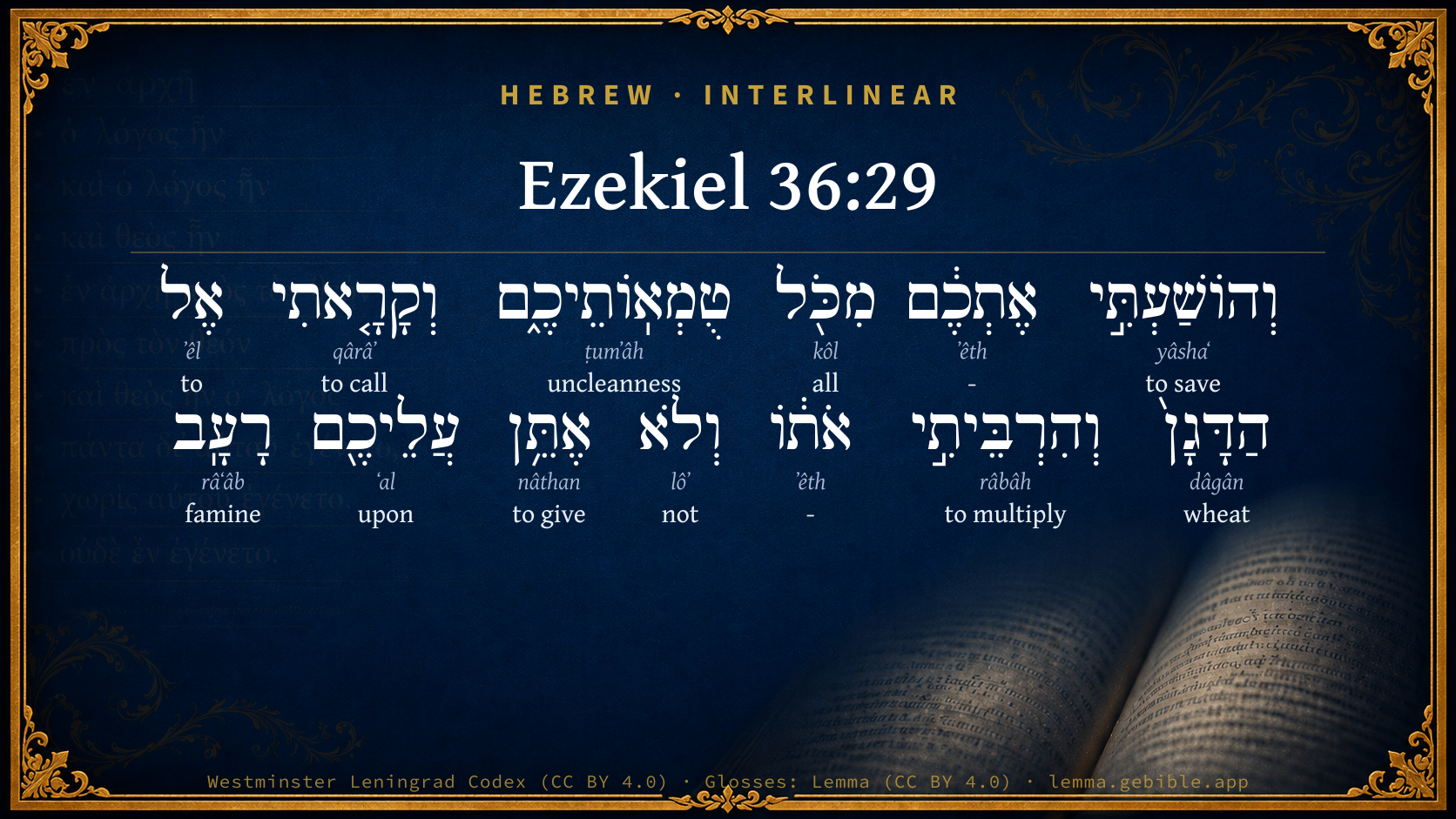
Hebrew (Westminster Leningrad Codex) Ezekiel 36:29 appears in the Hebrew Old Testament. The text above is from the Westminster Leningrad Codex. Each word links to its Strong’s number, a concise gloss, and parsing drawn from the Open Scriptures Hebrew Bible morphology. Click any word for its full Brown-Driver-Briggs (BDB) entry.
Download image
Cite this verse

Ezekiel 36:29 (World English Bible). Public Domain. Lemma interlinear Bible study tool, https://lemma.gebible.app/v/ezekiel/36/29.

Show BibTeX & RIS
BibTeX
RIS
English Translation
I will save you from all your uncleanness: and I will call for the grain, and will multiply it, and lay no famine on you.
World English Bible · Public Domain
Download a study sheet

One document with this verse’s original text, its word-by-word gloss line, the meaning frame, cross-references with their text, attributed commentary, and full source and license credits — printable, and it pastes into notes with its structure intact.

This verse Autodidact and up

Study sheet (.html) Plain text (.txt)

A passage Seminary Student

Up to 50 verses in one chapter. A passage sheet keeps up to 6 commentary sources and 12 cross-references per verse, in the order this page ranks them, and says so on the sheet whenever that leaves anything out. Ask for a single verse and you get the Autodidact verse sheet above.

Everything on this page stays free to read, with no account — the sheet is a download of what is already on screen, not access to it.

Want to remove ads? Support Godless Engineer
Compare translations 3

The same verse in 3 English versions, stacked beneath the original-language interlinear above. Click any original word for its lexicon entry.

Each is an independent rendering of the whole verse — the interlinear is not word-aligned to these translations.

Highlighted words mark where these versions differ — a whole-verse word diff, not a word-by-word alignment.

  • World English Bible Public Domain
    I will save you from all your uncleanness: and I will call for the grain, and will multiply it, and lay no famine on you.
  • King James Version Public Domain
    I will also save you from all your uncleannesses: and I will call for the corn, and will increase it, and lay no famine upon you.
  • unfoldingWord Literal Text CC BY-SA 4.0
    For I will save you from all of your uncleanness. I will summon the grain and multiply it. I will no longer put famine upon you.

unfoldingWord Literal Text — © unfoldingWord, licensed CC BY-SA 4.0. Word-aligned USFM3 via Door43 (git.door43.org/unfoldingWord/en_ult).

Versions to compare (up to 4)

3 of 4 selected

Show all 18 translations

Every available English version of this verse, each an independent rendering of the whole verse.

  • World English Bible Public Domain
    I will save you from all your uncleanness: and I will call for the grain, and will multiply it, and lay no famine on you.
  • Berean Standard Bible Public Domain
    I will save you from all your uncleanness. I will summon the grain and make it plentiful, and I will not bring famine upon you.
  • Majority Standard Bible Public Domain
    I will save you from all your uncleanness. I will summon the grain and make it plentiful, and I will not bring famine upon you.
  • King James Version Public Domain
    I will also save you from all your uncleannesses: and I will call for the corn, and will increase it, and lay no famine upon you.
  • American Standard Version (1901) Public Domain
    And I will save you from all your uncleannesses: and I will call for the grain, and will multiply it, and lay no famine upon you.
  • Revised Version (1885) Public Domain
    And I will save you from all your uncleannesses: and I will call for the corn, and will multiply it, and lay no famine upon you.
  • Geneva Bible (1599) Public Domain
    I will also deliuer you from all your filthinesse, and I will call for corne, and will increase it, and lay no famine vpon you.
  • Douay-Rheims (1899) Public Domain
    And I will save you from all your uncleannesses: and I will call for corn, and will multiply it, and will lay no famine upon you.
  • Young's Literal Translation Public Domain
    And I have saved you from all your uncleannesses, And I have called unto the corn, and multiplied it, And I have put no famine upon you.
  • Literal Standard Version CC BY-SA 4.0
    And I have saved you from all your uncleannesses, || And I have called to the grain, and multiplied it, || And I have put no famine on you.
  • Unlocked Literal Bible CC BY-SA 4.0
    For I will save you from all of your uncleanness. I will summon the grain and multiply it. I will no longer put famine upon you.
  • unfoldingWord Literal Text CC BY-SA 4.0
    For I will save you from all of your uncleanness. I will summon the grain and multiply it. I will no longer put famine upon you.
  • Darby Bible Public Domain
    And I will save you from all your uncleannesses; and I will call for the corn and will multiply it, and lay no famine upon you.
  • World Messianic Bible Public Domain
    I will save you from all your uncleanness. I will call for the grain and will multiply it, and lay no famine on you.
  • Webster's Bible Public Domain
    I will also save you from all your uncleannesses: and I will call for the corn, and will increase it, and lay no famine upon you.
  • Free Bible Version CC BY-SA 4.0
    I will save you from everything that makes you unclean. I will make sure you have plenty of grain. I won't send you any famines.
  • Bible in Basic English Public Domain
    And I will make you free from all your unclean ways: and at my voice the grain will come up and be increased, and I will not let you be short of food.
  • JPS Tanakh (1917) Public Domain
    And I will save you from all your uncleannesses; and I will call for the corn, and will increase it, and lay no famine upon you.

Literal Standard Version (2020), Covenant Press — licensed CC BY-SA 4.0. Text via the HelloAO Bible API (eBible.org). Unlocked Literal Bible (unfoldingWord) — licensed CC BY-SA 4.0. Text via the HelloAO Bible API (eBible.org). unfoldingWord Literal Text — © unfoldingWord, licensed CC BY-SA 4.0. Word-aligned USFM3 via Door43 (git.door43.org/unfoldingWord/en_ult). Free Bible Version, Dr. Jonathan Gallagher — licensed CC BY-SA 4.0. Text via the HelloAO Bible API (eBible.org).

Word by word

More ways to search: Search by grammar → Find every occurrence → Compare this word →

Practice this passage: Drill this verse → Learn its vocabulary →

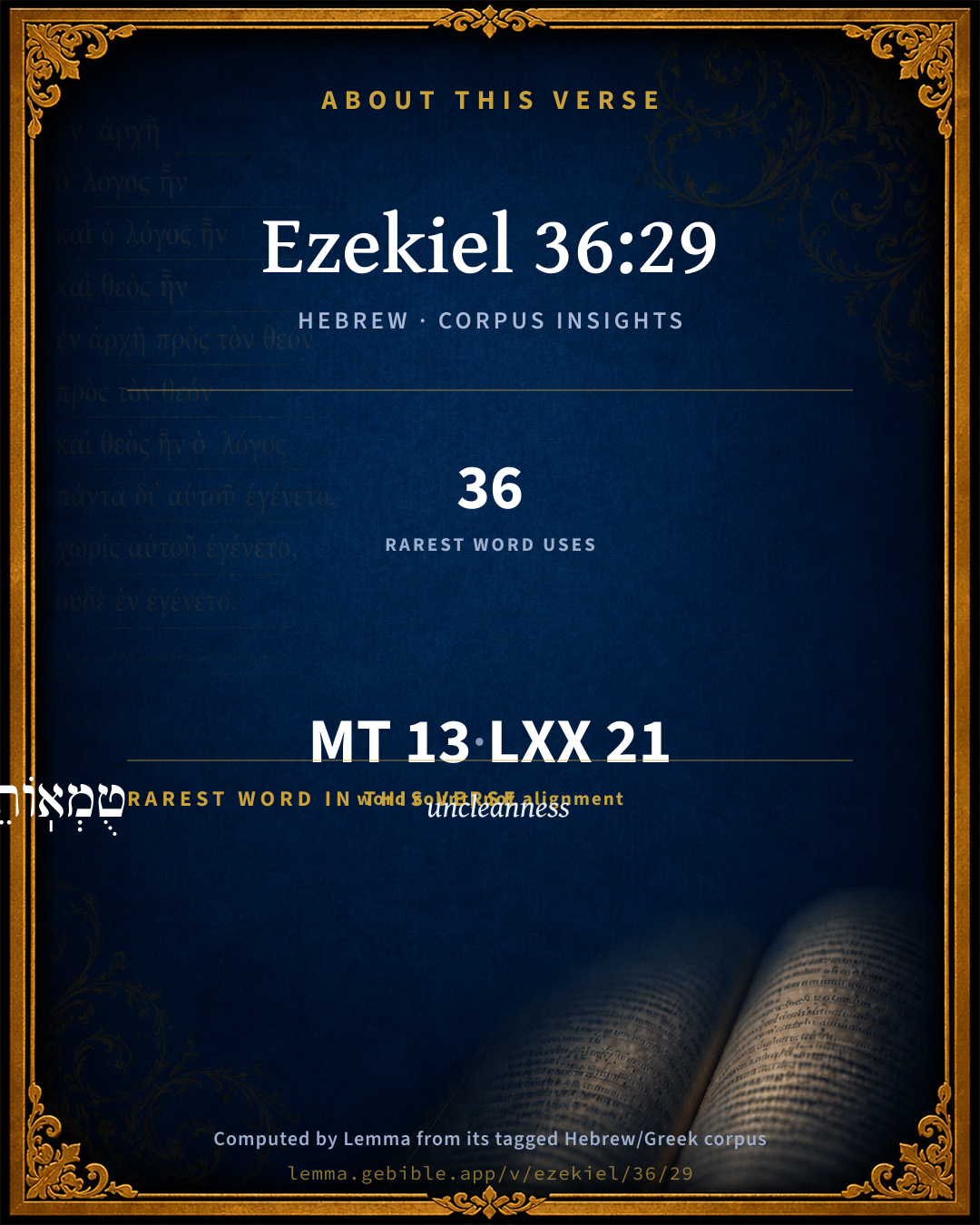
טֻמְאֽוֹתֵיכֶ֑ם
ṭumʼâh
H2932
“uncleannesses · your”
Noun, Common, Feminine, Plural, Construct + Suffix, Personal, 2nd Person, Masculine, Plural
Part of Speech
Noun
Type
Common
Gender
Feminine
Number
Plural
State
Construct
Full BDB Definition

Origin: from H2930

TWOT: 809b

uncleanness - sexual - of filthy mass - ethical and religious - ritual - local (of nations)
  1. וְהוֹשַׁעְתִּ֣י yâshaʻ H3467 “and · to save” Conjunction + Verb, Hiphil, Sequential Perfect, 1st Person, Common, Singular
  2. אֶתְכֶ֔ם ʼêth H853 “- · you” Particle, Direct Object + Suffix, Personal, 2nd Person, Masculine, Plural
  3. מִכֹּ֖ל kôl H3605 “from · all of” Preposition + Noun, Common, Masculine, Singular, Construct
  4. וְקָרָ֤אתִי qârâʼ H7121 “and · to call” Conjunction + Verb, Qal, Sequential Perfect, 1st Person, Common, Singular
  5. אֶל ʼêl H413 “to” Preposition
  6. הַדָּגָן֙ dâgân H1715 “the · wheat” Particle, Definite Article + Noun, Common, Masculine, Singular, Absolute
  7. וְהִרְבֵּיתִ֣י râbâh H7235 “and · to multiply” Conjunction + Verb, Hiphil, Sequential Perfect, 1st Person, Common, Singular
  8. אֹת֔וֹ ʼêth H853 “- · him” Particle, Direct Object + Suffix, Personal, 3rd Person, Masculine, Singular
  9. וְלֹא lôʼ H3808 “and · not” Conjunction + Particle, Negative
  10. אֶתֵּ֥ן nâthan H5414 “to give” Verb, Qal, Imperfect, 1st Person, Common, Singular
  11. עֲלֵיכֶ֖ם ʻal H5921 “upon · you” Preposition + Suffix, Personal, 2nd Person, Masculine, Plural
  12. רָעָֽב râʻâb H7458 “famine” Noun, Common, Masculine, Singular, Absolute

About this verse

These counts appear in no published source. They are computed here, from the morphology-tagged text and Lemma’s own curated glosses. What Lemma adds →

13
words
12
distinct lemmas
Prophets
section

Shared distinctive vocabulary

טֻמְאֽוֹתֵיכֶ֑ם uncleanness H2932 occurs in 31 verses of the Hebrew Bible. Also found in:

Grammatical profile

  • 4 verbs
  • 4 nouns
  • 2 prepositions
  • 3 particles

Verb forms

  • וְהוֹשַׁעְתִּ֣י Hiphil · Sequential Perfect
  • וְקָרָ֤אתִי Qal · Sequential Perfect
  • וְהִרְבֵּיתִ֣י Hiphil · Sequential Perfect
  • אֶתֵּ֥ן Qal · Imperfect

Hebrew & Septuagint length

In English translation the verse runs 25 words from the Hebrew and 26 from the Septuagint (LXX English) — closely comparable.

A rough comparison of the two English renderings, which tokenize alike — not a word-level alignment.

Word counts can differ between the Hebrew and the Greek without any difference in meaning — e.g. the Hebrew direct-object marker אֵת has no separate Greek word, and Greek often adds the article ὁ.

In the original languages it is 13 Hebrew tokens and 21 Greek tokens — but the two are counted differently (Hebrew bundles its prefixes and suffixes into one token; the Greek is in lemma form), so that isn’t a like-for-like length.

Cross-references

18

Topical passages linked to Ezekiel 36:29 in the Treasury of Scripture Knowledge — connected by theme and wording, ordered by reader-vote popularity; previews shown in the World English Bible.

  • Hosea 2:21–23 It will happen in that day, I will respond," says Yahweh, I will respond to the heavens, And they will respond to the earth;
  • Matthew 1:21 She shall bring forth a son. You shall call his name Jesus, for it is he who shall save his people from their sins."
  • John 1:7–9 The same came as a witness, that he might testify about the light, that all might believe through him.
  • Hosea 14:4 "I will heal their waywardness. I will love them freely; For my anger is turned away from him.
  • Romans 11:26 and so all Israel will be saved. Even as it is written, "There will come out of Zion the Deliverer, And he will turn away ungodliness from Jacob.
  • Titus 2:14 who gave himself for us, that he might redeem us from all iniquity, and purify for himself a people for his own possession, zealous for good works.
  • Psalms 105:6 You seed of Abraham, his servant, You children of Jacob, his chosen ones.
  • Jeremiah 33:8 I will cleanse them from all their iniquity, by which they have sinned against me; and I will pardon all their iniquities, by which they have sinned against me, and by which they have transgressed against me.
  • Ezekiel 34:27–29 The tree of the field shall yield its fruit, and the earth shall yield its increase, and they shall be secure in their land; and they shall know that I am Yahweh, when I have broken the bars of their yoke, and have delivered them out of the hand of those who made slaves of them.
  • Ezekiel 36:8–9 But you, mountains of Israel, you shall shoot forth your branches, and yield your fruit to my people Israel; for they are at hand to come.
  • Ezekiel 36:25 I will sprinkle clean water on you, and you shall be clean: from all your filthiness, and from all your idols, will I cleanse you.
  • Hosea 14:2 Take words with you, and return to Yahweh. Tell him, "Forgive all our sins, And accept that which is good: So we offer like bulls our lips.
  • Hosea 14:8 Ephraim, what have I to do any more with idols? I answer, and will take care of him. I am like a green fir tree; From me your fruit is found."
  • Joel 3:21 I will cleanse their blood, That I have not cleansed: For Yahweh dwells in Zion."
  • Zechariah 13:1 "In that day there will be a spring opened to the house of David and to the inhabitants of Jerusalem, for sin and for uncleanness.
  • Matthew 6:33 But seek first God's Kingdom, and his righteousness; and all these things will be given to you as well.
  • Romans 6:14 For sin will not have dominion over you. For you are not under law, but under grace.
  • Micah 7:19 He will again have compassion on us. He will tread our iniquities under foot; And you will cast all their sins into the depths of the sea.

Cross-references courtesy of OpenBible.info (CC BY 4.0).

Hebrew and Greek witnesses Masoretic Hebrew ↔ Greek Septuagint

The same verse in the two great witnesses to the Old Testament, shown verse-for-verse.

These are two independent witnesses, not word-aligned to each other, and the Septuagint is shown in lemma (dictionary) form.

Hebrew Ezekiel 36:29 Masoretic · Westminster Leningrad Codex

וְהוֹשַׁעְתִּ֣י אֶתְכֶ֔ם מִכֹּ֖ל טֻמְאֽוֹתֵיכֶ֑ם וְקָרָ֤אתִי אֶל הַדָּגָן֙ וְהִרְבֵּיתִ֣י אֹת֔וֹ וְלֹא אֶתֵּ֥ן עֲלֵיכֶ֖ם רָעָֽב

I will save you from all your uncleanness: and I will call for the grain, and will multiply it, and lay no famine on you.

World English Bible · Public Domain

Greek LXX Ezekiel 36:29 Septuagint · lemma form

καί σώζω σύ ἐκ πᾶς ὁ ἀκαθαρσία σύ καί καλέω ὁ σῖτος καί πληθύνω αὐτός καί οὐ δίδωμι ἐπί σύ λιμός

And I will save you from all your uncleannesses: and I will call for the corn, and multiply it, and will not bring famine upon you.

LXX2012 (modern English Septuagint) · Public Domain

Hebrew: Westminster Leningrad Codex (CC BY 4.0). Greek: Septuagint (public domain); English from LXX2012 (modern English Septuagint) (Public Domain). How the Septuagint differs from the Hebrew →

Targum (Aramaic paraphrase)

1

The Targum is the ancient Jewish Aramaic paraphrase of the Hebrew Scriptures — an interpretive translation, not the Hebrew text itself. Onkelos (literal) and Pseudo-Jonathan (expansive) render the Torah, and Jonathan the Prophets. Coverage is partial: where no permissively-licensed English translation exists for a verse, only the Aramaic is shown. This is verse-level text, not a word-by-word alignment to the Hebrew.

  1. Targum Jonathan Prophets (Joshua–Malachi)
    וְאֶפְרוֹק יַתְכוֹן מִכָּל סוֹאֲבָתְכוֹן וַאֲבָרֵךְ יַת עִבּוּרָא וְאַסְגֵי יָתֵיהּ וְלָא אֶתֵּן עֲלֵיכוֹן כַּפָנָא:

    (no public-domain English translation for this verse)

    Targum Jonathan — Aramaic: “Mikraot Gedolot” (public domain). English: “Sefaria Community Translation” (CC0 1.0 (public-domain dedication)); “London "Chaldee Paraphrase," 1871” (public domain). Text via Sefaria.

Commentary

Notes on Ezekiel 36:29 from classic Christian and Jewish commentators (each source and its license shown beneath its notes). The classic Christian expositions comment on the surrounding passage and are grouped to its opening verse, so a note may address several verses; the Jewish commentaries on the Tanakh (Rashi and others) are per-verse, so they appear only where the commentator wrote on this verse.

Lemma curates 59 commentaries, every one of them public domain or Creative Commons licensed, each selected and text-cleaned for this edition rather than reprinted as found. About our sources →

Trapp's Complete Commentary

John Trapp

Eze 36:29 I will also save you from all your uncleannesses: and I will call for the corn, and will increase it, and lay no famine upon you.

Ver. 29. I will also save you from all your uncleannesses.] This is often promised, because not easily believed. No article of our creed is so much opposed by Satan, as that of the forgiveness of sin by Christ’s merits, which is the very life and soul of a Church. All the former articles of the creed are perfected in this, and all the following articles are effects thereof: hold it fast, therefore.

And I will call for the corn.] I have it at my call, and a mandamus from me will do it at any time. See Hos 2:21-22. {See Trapp on "Hos 2:21"} {See Trapp on "Hos 2:22"}

And lay no famine.] Which comes also at God Almighty’s call. {Psa 105:16}

John Trapp, A Commentary or Exposition upon All the Books of the Old and New Testament (1647–1656) — public domain. Text from a community e-Sword module.

Tyndale Open Study Notes

Tyndale Open Resources

36:29-32 This transformation would bring the blessings of the covenant made with Moses, not its curses, and a new glory among the surrounding nations. This blessing would cause God’s people to be profoundly ashamed of their past and to appreciate both their lack of merit and God’s overwhelming grace.

Tyndale Open Study Notes — © Tyndale Open Resources, licensed CC BY-SA 4.0. Text via the HelloAO Bible API.

Geneva Bible (1599)

Geneva Bible translators

Under the abundance of temporal benefits he concludeth the spiritual graces.

Geneva Bible (1599) marginal notes — public domain. Text via Bolls.life.

Jamieson, Fausset & Brown

Robert Jamieson, A. R. Fausset & David Brown

save . . . from all . . . uncleannesses--the province of Jesus, according to the signification of His name (Mat 1:21). To be specially exercised in behalf of the Jews in the latter days (Rom 11:26).

call for . . . corn--as a master "calls for" a servant; all the powers and productions of nature are the servants of Jehovah (Psa 105:16; Mat 8:8-9). Compare as to the subordination of all the intermediate agents to the Great First Cause, who will give "corn" and all good things to His people, Hos 2:21-22; Zac 8:12.

Jamieson, Fausset & Brown — Commentary Critical and Explanatory on the Whole Bible (1871) — public domain (CC PDM 1.0). Text via the HelloAO Bible API.

Adam Clarke's Commentary

Verse 29. I will also save you from all your uncleannesses] I repeat it; "I WILL save you from all your sins."

Adam Clarke's Commentary on the Bible (1810–1826) — public domain. Text from a community e-Sword/MySword module.

Ellicott's Commentary for English Readers

(29) Your uncleannesses.—In Eze_36:25 they had already been made clean, and in Eze_36:26 a new heart had been given them; why, then, was there yet further need of cleansing? This cannot, therefore, refer to the idolatries from which they had been already purged, but is plain enough if understood of that ordinary sinfulness of man which, being continually renewed, needs continual forgiveness.

A Bible Commentary for English Readers, edited by Charles John Ellicott (1878–1897) — public domain. Text from a community e-Sword module.

The Cambridge Bible for Schools and Colleges

gen. ed. J. J. S. Perowne

29. save you from … uncleannesses] Or, I will save (deliver) you out of your … The phrase “save out of” is pregnant, meaning “save you by purifying you from” …, hardly, save you from the consequences of … Cf. Eze_37:23, and reading there.

call for the corn] Cf. Eze_34:27; Eze_34:29; Hos_2:21; Jer_31:12 (cf. 2Ki_8:1).

The Cambridge Bible for Schools and Colleges (gen. ed. J. J. S. Perowne; Cambridge University Press, 1878–1918) — public domain. Text from a community e-Sword module.

John Gill's Exposition

And I will also save you from all your uncleannesses,.... From all their filthy lusts of pride, envy, malice, covetousness, whoredom, blasphemy, and infidelity, to which the Jews are now addicted; but at this time shall be saved from the power and dominion of them by the sanctifying grace of the Spirit; and from the guilt and pollution of them by the blood of Christ sprinkled on them; and this, not from one, or some of them only, but from all of them; all Israel will be saved, and they will be saved from all their sins, Rom 11:25,

and I will call for the corn, and will increase it; which shall answer to the call of God, as a servant to his master; and shall spring up out of the earth in great abundance; and which shall grow, and increase, and bring forth much fruit; and yield bread to the eater, and seed to the sower: and which is to be understood, not of corn in a literal sense only, but of corn in a spiritual sense; of all spiritual provisions, the word and ordinances, and especially the corn of wheat, Christ Jesus; who is the sum and substance of the Gospel and his ordinances, and is in them food for the faith of his people; see Zac 9:17, and

lay no famine upon you; neither a famine of bread, or of water; nor of hearing the word of the Lord; but shall have plenty of provisions, both for soul and body; see Amo 8:11.

John Gill's Exposition of the Whole Bible (1746–1763) — public domain (CC PDM 1.0). Text via the HelloAO Bible API.

Matthew Poole's English Annotations

Perhaps the former part of this verse would have been better joined with the former verse, as a glorious fruit of God’s taking them to be his people, and his condescending to be their God. Salvation from all uncleannesses includeth justification, in our pardon, sanctification, the renewing our minds, somewhat of adoption in peace and hope, and a consummate glorification in heaven, that state of absolute purity. All this God gives when he is our God. Corn; all necessaries for aliment comprised in one, and these brought to them at God’s call, which they will hear, Psa 105:16,40; Ho 2:21,22.

Famine is God’s arrow, he shoots it; where it is, he layeth it; but his people shall neither have it their misery nor their reproach any more; as in the next verse.

Matthew Poole's English Annotations on the Holy Bible (1683–1685) — public domain. Text from a community e-Sword/MySword module.

The Pulpit Commentary

From all your uncleannesses. The same word as in ver. 25, though with difference in meaning. From their uncleanness of the past they have already been saved (ver. 25); the present promise guarantees preservation against future lapsing into uncleanness, i.e. the filthiness of idol-service. "With this," writes Plumptre, "the necessity for temporal chastisements as a corrective discipline should cease, and there would be nothing to check the full outpouring of all material as well as spiritual blessings." With the phrase, I will call for the corn, compare the similar expressions in 2Ki_8:1; Hos_2:23, etc.; Jer_31:12; Zec_9:17.

The Pulpit Commentary (1880–1919), ed. H.D.M. Spence-Jones & Joseph S. Exell — public domain. Text from a community e-Sword module.

John Wesley's Explanatory Notes

I will also save you - I will continue to save you. From all your uncleannesses - Salvation from all uncleannessess, includes justification, entire sanctification, and meetness for glory. The corn - All necessaries comprised in one.

John Wesley, Explanatory Notes Upon the Whole Bible (1754–1765) — public domain. Text via the GEBible commentary corpus.

unfoldingWord translationNotes

Door43 World Missions Community

General Information:

Yahweh continues giving Ezekiel his message to Israel.

For I will save you from all of your uncleanness

Something that is unacceptable to Yahweh is spoken of as if it were physically unclean. AT: "For I will save you from everything that made me reject you" (See: Metaphor)

I will summon the grain

"I will call the grain to come." This phrase presents the grain as a servant of Yahweh. AT: "I will cause there to be grain in the land of Israel" (See: Personification)

I will no longer put famine upon you

Yahweh causing a famine in the land is spoken of as if he put famine on the people. AT: "I will no longer cause there to be a famine" or "I will no longer cause there to be no food" (See: Metaphor)

you will no longer bear the shame of famine among the nations

Experiencing shame is spoken of as if the people had to carry the shame. AT: "the nations will no longer make you feel ashamed because you suffer from famine" (See: Metaphor)

translationWords

save

clean

grain

famine

shame

nation

evil

works

sin

unfoldingWord translationNotes — © Distant Shores Media and the Door43 World Missions Community, licensed CC BY-SA 4.0. Source: git.door43.org/Door43/en_tn.

Lesson kit

Teaching starters — assembled from the data on this page, not authored interpretation. Every prompt links to the verse data it draws on. Edit before teaching.

Ezekiel, in the Prophets, opens this verse with 13 words (12 distinct Hebrew lemmas). Its most distinctive word is ṭumʼâh (“uncleanness”). A historical commentator’s framing appears above. Read the whole chapter for the surrounding context.

Discussion questions

  1. The word ṭumʼâh carries the sense “uncleanness.” How does it shape the verse?
  2. How does Leviticus 5:3, which shares the word «uncleanness», read alongside this verse?
  3. These translations render this verse differently; the difference is in the English rendering, not the original. What questions does that raise?
  4. «וְהוֹשַׁעְתִּ֣י» is a Hiphil Sequential Perfect verb. How does that grammatical form shape the action described?
  5. Compare how Trapp's Complete Commentary and Tyndale Open Study Notes read this verse. Where do they agree or differ?

Things to notice

Reading settings

Reading text

Shown beneath each verse's original-language words.

Old Testament
Old Testament edition

Read the OT as the Masoretic Hebrew (MT) or the Greek Septuagint (LXX).

English shown for the Greek Septuagint (in the Hebrew ↔ Greek comparison).

Comparing translations? Open the Compare panel on any verse page to stack up to four side by side.