
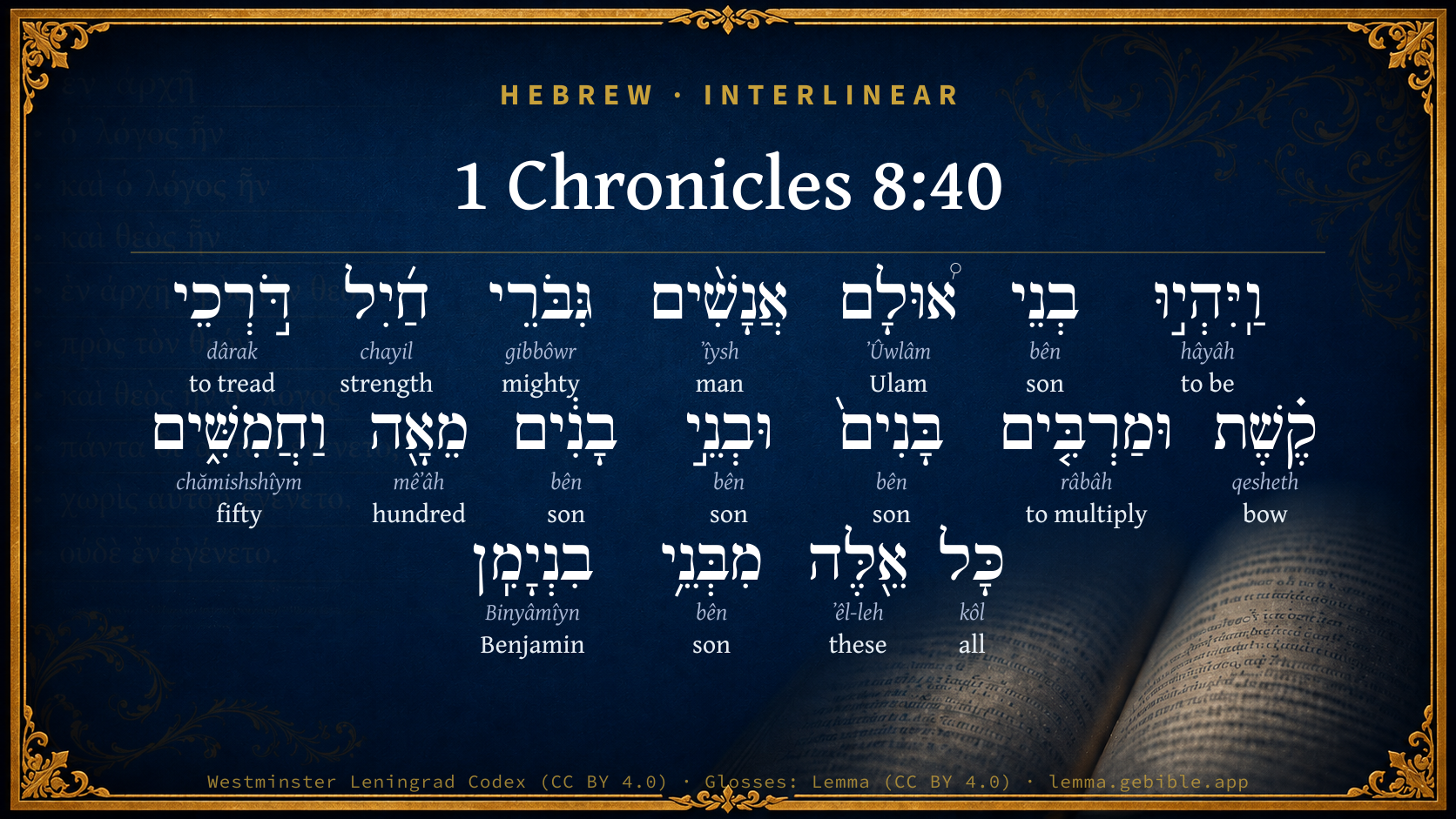
1 Chronicles 8:40

Hebrew (Westminster Leningrad Codex) 1 Chronicles 8:40 appears in the Hebrew Old Testament. The text above is from the Westminster Leningrad Codex. Each word links to its Strong’s number, a concise gloss, and parsing drawn from the Open Scriptures Hebrew Bible morphology. Click any word for its full Brown-Driver-Briggs (BDB) entry.
Download image
Cite this verse

1 Chronicles 8:40 (World English Bible). Public Domain. Lemma interlinear Bible study tool, https://lemma.gebible.app/v/1-chronicles/8/40.

Show BibTeX & RIS
BibTeX
RIS
English Translation
The sons of Ulam were mighty men of valor, archers, and had many sons, and sons' sons, one hundred fifty. All these were of the sons of Benjamin.
World English Bible · Public Domain
Download a study sheet

One document with this verse’s original text, its word-by-word gloss line, the meaning frame, cross-references with their text, attributed commentary, and full source and license credits — printable, and it pastes into notes with its structure intact.

This verse Autodidact and up

Study sheet (.html) Plain text (.txt)

A passage Seminary Student

Up to 50 verses in one chapter. A passage sheet keeps up to 6 commentary sources and 12 cross-references per verse, in the order this page ranks them, and says so on the sheet whenever that leaves anything out. Ask for a single verse and you get the Autodidact verse sheet above.

Everything on this page stays free to read, with no account — the sheet is a download of what is already on screen, not access to it.

Want to remove ads? Support Godless Engineer
Compare translations 3

The same verse in 3 English versions, stacked beneath the original-language interlinear above. Click any original word for its lexicon entry.

Each is an independent rendering of the whole verse — the interlinear is not word-aligned to these translations.

Highlighted words mark where these versions differ — a whole-verse word diff, not a word-by-word alignment.

  • World English Bible Public Domain
    The sons of Ulam were mighty men of valor, archers, and had many sons, and sons' sons, one hundred fifty. All these were of the sons of Benjamin.
  • King James Version Public Domain
    And the sons of Ulam were mighty men of valor, archers, and had many sons, and sons' sons, an hundred and fifty. All these are of the sons of Benjamin.
  • unfoldingWord Literal Text CC BY-SA 4.0
    And the sons of Ulam were men, warriors of valor, treaders of the bow and multipliers of sons and sons of sons, 150. All of these from the sons of Benjamin.

unfoldingWord Literal Text — © unfoldingWord, licensed CC BY-SA 4.0. Word-aligned USFM3 via Door43 (git.door43.org/unfoldingWord/en_ult).

Versions to compare (up to 4)

3 of 4 selected

Show all 18 translations

Every available English version of this verse, each an independent rendering of the whole verse.

  • World English Bible Public Domain
    The sons of Ulam were mighty men of valor, archers, and had many sons, and sons' sons, one hundred fifty. All these were of the sons of Benjamin.
  • Berean Standard Bible Public Domain
    The sons of Ulam were mighty men of valor, archers, and they had many sons and grandsons—150 in all. All these were the descendants of Benjamin.
  • Majority Standard Bible Public Domain
    The sons of Ulam were mighty men of valor, archers, and they had many sons and grandsons—150 in all. All these were the descendants of Benjamin.
  • King James Version Public Domain
    And the sons of Ulam were mighty men of valor, archers, and had many sons, and sons' sons, an hundred and fifty. All these are of the sons of Benjamin.
  • American Standard Version (1901) Public Domain
    And the sons of Ulam were mighty men of valor, archers, and had many sons, and sons' sons, a hundred and fifty. All these were of the sons of Benjamin.
  • Revised Version (1885) Public Domain
    And the sons of Ulam were mighty men of valour, archers, and had many sons, and sons’ sons, an hundred and fifty. All these were of the sons of Benjamin.
  • Geneva Bible (1599) Public Domain
    And the sonnes of Vlam were valiant men of warre which shot with the bow, and had many sonnes and nephewes, an hundreth and fiftie: all these were of the sonnes of Beniamin.
  • Douay-Rheims (1899) Public Domain
    And the sons of Ulam were most valiant men, and archers of great strength: and they had many sons and grandsons, even to a hundred and fifty. All these were children of Benjamin.
  • Young's Literal Translation Public Domain
    And the sons of Ulam are men mighty in valour, treading bow, and multiplying sons and son's sons, a hundred and fifty. All these `are' of the sons of Benjamin.
  • Literal Standard Version CC BY-SA 4.0
    And the sons of Ulam are men mighty in valor, treading bow, and multiplying sons and son’s sons—one hundred and fifty. All these [are] of the sons of Benjamin.
  • Unlocked Literal Bible CC BY-SA 4.0
    Ulam's sons were fighting men and archers. They had many sons and grandsons, a total of 150. All these belonged to the descendants of Benjamin.
  • unfoldingWord Literal Text CC BY-SA 4.0
    And the sons of Ulam were men, warriors of valor, treaders of the bow and multipliers of sons and sons of sons, 150. All of these from the sons of Benjamin.
  • Darby Bible Public Domain
    And the sons of Ulam were mighty men of valour, archers; and they had many sons, and sons' sons, a hundred and fifty. All these were of the sons of Benjamin.
  • World Messianic Bible Public Domain
    The sons of Ulam were mighty men of valor, archers, and had many sons, and grandsons, one hundred fifty. All these were of the sons of Benjamin.
  • Webster's Bible Public Domain
    And the sons of Ulam were mighty men of valor, archers, and had many sons, and sons' sons a hundred and fifty. All these are of the sons of Benjamin.
  • Free Bible Version CC BY-SA 4.0
    The sons of Ulam were strong warriors and skilled archers. They had many sons and grandsons—a total of 150. All of them were the sons of Benjamin.
  • Bible in Basic English Public Domain
    And the sons of Ulam were men of war, bowmen, and had a great number of sons and sons' sons, a hundred and fifty. All these were the sons of Benjamin.
  • JPS Tanakh (1917) Public Domain
    And the sons of Ulam were mighty men of valour, archers; and had many sons, and sons' sons, a hundred and fifty. All these were of the sons of Benjamin.

Literal Standard Version (2020), Covenant Press — licensed CC BY-SA 4.0. Text via the HelloAO Bible API (eBible.org). Unlocked Literal Bible (unfoldingWord) — licensed CC BY-SA 4.0. Text via the HelloAO Bible API (eBible.org). unfoldingWord Literal Text — © unfoldingWord, licensed CC BY-SA 4.0. Word-aligned USFM3 via Door43 (git.door43.org/unfoldingWord/en_ult). Free Bible Version, Dr. Jonathan Gallagher — licensed CC BY-SA 4.0. Text via the HelloAO Bible API (eBible.org).

Word by word

More ways to search: Search by grammar → Find every occurrence → Compare this word →

Practice this passage: Drill this verse → Learn its vocabulary →

א֠וּלָם
ʼÛwlâm
H198
“Ulam”
Noun, Proper
Part of Speech
Noun
Type
Proper
Full BDB Definition

Origin: apparently from H481 (in the sense of dumbness)

TWOT: None

Ulam = "their leader: vestibule" - a Manassite - a Benjamite of Saul's family
  1. וַֽיִּהְי֣וּ hâyâh H1961 “and · to be” Conjunction + Verb, Qal, Sequential Imperfect, 3rd Person, Masculine, Plural
  2. בְנֵי bên H1121 “sons of” Noun, Common, Masculine, Plural, Construct
  3. אֲנָשִׁ֨ים ʼîysh H376 “men” Noun, Common, Masculine, Plural, Absolute
  4. גִּבֹּרֵי gibbôwr H1368 “mighty of” Adjective, Adjective, Masculine, Plural, Construct
  5. חַ֜יִל chayil H2428 “strength” Noun, Common, Masculine, Singular, Absolute
  6. דֹּ֣רְכֵי dârak H1869 “treading” Verb, Qal, Participle Active, Masculine, Plural, Construct
  7. קֶ֗שֶׁת qesheth H7198 “bow” Noun, Common, Feminine, Singular, Absolute
  8. וּמַרְבִּ֤ים râbâh H7235 “and · multiplying” Conjunction + Verb, Hiphil, Participle Active, Masculine, Plural, Absolute
  9. בָּנִים֙ bên H1121 “sons” Noun, Common, Masculine, Plural, Absolute
  10. וּבְנֵ֣י bên H1121 “and · sons of” Conjunction + Noun, Common, Masculine, Plural, Construct
  11. בָנִ֔ים bên H1121 “sons” Noun, Common, Masculine, Plural, Absolute
  12. מֵאָ֖ה mêʼâh H3967 “hundred” Adjective, Cardinal number, Both, Singular, Absolute
  13. וַחֲמִשִּׁ֑ים chămishshîym H2572 “and · fifty” Conjunction + Adjective, Cardinal number, Both, Plural, Absolute
  14. כָּל kôl H3605 “all of” Noun, Common, Masculine, Singular, Construct
  15. אֵ֖לֶּה ʼêl-leh H428 “these” Pronoun, Demonstrative, Common, Plural
  16. מִבְּנֵ֥י bên H1121 “from · sons of” Preposition + Noun, Common, Masculine, Plural, Construct
  17. בִנְיָמִֽן Binyâmîyn H1144 “Benjamin” Noun, Proper

About this verse

These counts appear in no published source. They are computed here, from the morphology-tagged text and Lemma’s own curated glosses. What Lemma adds →

18
words
14
distinct lemmas
Historical
section

Notable vocabulary

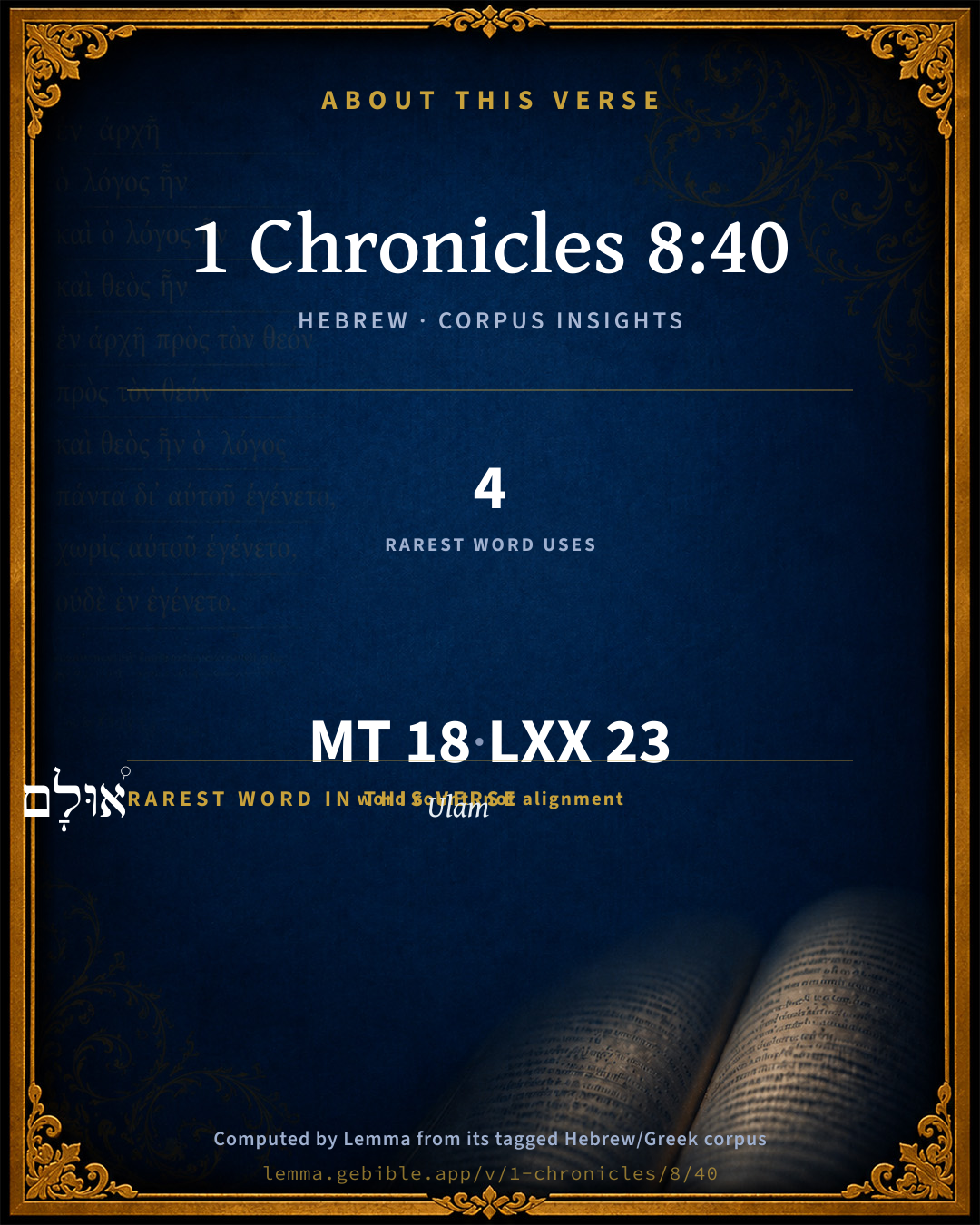
The rarest word here is א֠וּלָם Ulam H198 — appearing just 4 times in the whole Hebrew Bible.

Shared distinctive vocabulary

א֠וּלָם Ulam H198 occurs in 4 verses of the Hebrew Bible. Also found in:

Grammatical profile

  • 3 verbs
  • 11 nouns
  • 3 adjectives
  • 1 pronoun

Verb forms

  • וַֽיִּהְי֣וּ Qal · Sequential Imperfect
  • דֹּ֣רְכֵי Qal · Participle Active
  • וּמַרְבִּ֤ים Hiphil · Participle Active

Repetition

A word recurs within this verse — often emphatic in Hebrew:

  • בְנֵי son H1121 ×5

Hebrew & Septuagint length

In English translation the verse runs 28 words from the Hebrew and 28 from the Septuagint (LXX English) — the same length.

A rough comparison of the two English renderings, which tokenize alike — not a word-level alignment.

Word counts can differ between the Hebrew and the Greek without any difference in meaning — e.g. the Hebrew direct-object marker אֵת has no separate Greek word, and Greek often adds the article ὁ.

In the original languages it is 18 Hebrew tokens and 23 Greek tokens — but the two are counted differently (Hebrew bundles its prefixes and suffixes into one token; the Greek is in lemma form), so that isn’t a like-for-like length.

Cross-references

4

Topical passages linked to 1 Chronicles 8:40 in the Treasury of Scripture Knowledge — connected by theme and wording, ordered by reader-vote popularity; previews shown in the World English Bible.

  • Psalms 127:3–5 Behold, children are a heritage of Yahweh. The fruit of the womb is his reward.
  • Psalms 128:3–6 Your wife will be as a fruitful vine, In the innermost parts of your house; Your children like olive plants, Around your table.
  • 1 Chronicles 12:2 They were armed with bows, and could use both the right hand and the left in slinging stones and in shooting arrows from the bow: they were of Saul's brothers of Benjamin.
  • 2 Chronicles 14:8 Asa had an army that bore bucklers and spears, out of Judah three hundred thousand; and out of Benjamin, that bore shields and drew bows, two hundred eighty thousand: all these were mighty men of valor.

Cross-references courtesy of OpenBible.info (CC BY 4.0).

Hebrew and Greek witnesses Masoretic Hebrew ↔ Greek Septuagint

The same verse in the two great witnesses to the Old Testament, shown verse-for-verse.

These are two independent witnesses, not word-aligned to each other, and the Septuagint is shown in lemma (dictionary) form.

Hebrew 1 Chronicles 8:40 Masoretic · Westminster Leningrad Codex

וַֽיִּהְי֣וּ בְנֵי א֠וּלָם אֲנָשִׁ֨ים גִּבֹּרֵי חַ֜יִל דֹּ֣רְכֵי קֶ֗שֶׁת וּמַרְבִּ֤ים בָּנִים֙ וּבְנֵ֣י בָנִ֔ים מֵאָ֖ה וַחֲמִשִּׁ֑ים כָּל אֵ֖לֶּה מִבְּנֵ֥י בִנְיָמִֽן

The sons of Ulam were mighty men of valor, archers, and had many sons, and sons' sons, one hundred fifty. All these were of the sons of Benjamin.

World English Bible · Public Domain

Greek LXX 1 Chronicles 8:40 Septuagint · lemma form

καί εἰμί υἱός αιλαμ ἰσχυρός ἀνήρ δύναμις τείνω τόξον καί πληθύνω υἱός καί υἱός ὁ υἱός ἑκατόν πεντήκοντα πᾶς οὗτος ἐκ υἱός βενιαμίν

And the sons of Aelam were mighty men, bending the bow, and multiplying sons and grandsons, one hundred and fifty. All these were of the sons of Benjamin.

LXX2012 (modern English Septuagint) · Public Domain

Hebrew: Westminster Leningrad Codex (CC BY 4.0). Greek: Septuagint (public domain); English from LXX2012 (modern English Septuagint) (Public Domain). How the Septuagint differs from the Hebrew →

Commentary

Notes on 1 Chronicles 8:40 from classic Christian and Jewish commentators (each source and its license shown beneath its notes). The classic Christian expositions comment on the surrounding passage and are grouped to its opening verse, so a note may address several verses; the Jewish commentaries on the Tanakh (Rashi and others) are per-verse, so they appear only where the commentator wrote on this verse.

Lemma curates 59 commentaries, every one of them public domain or Creative Commons licensed, each selected and text-cleaned for this edition rather than reprinted as found. About our sources →

Joseph Benson's Commentary

1Ch 8:40. Archers — Hebrew, that tread the bow: for the bows of steel, which these used, required great strength to bend them; which therefore they did by treading the bow with their feet, and pulling the string with both their hands.

Joseph Benson's Commentary on the Old and New Testaments (1811–1818) — public domain. Text from a community e-Sword module.

Jamieson, Fausset & Brown

Robert Jamieson, A. R. Fausset & David Brown

mighty men of valour, archers--(see on Jdg 20:16). Great strength as well as skill was requisite in ancient archery, as the bow, which was of steel, was bent by treading with the feet, and pulling the string with both hands.

Next: 1 Chronicles Chapter 9

Jamieson, Fausset & Brown — Commentary Critical and Explanatory on the Whole Bible (1871) — public domain (CC PDM 1.0). Text via the HelloAO Bible API.

Adam Clarke's Commentary

Verse 40. The sons of Ulam were mighty men of valour] The Targum speaks honourably of them: "The sons of Ulam were mighty and strong men, subduing by wisdom their evil concupiscence, as men bend a bow; therefore they had many sons and grandsons."

Of the six sons of Azel, mentioned 1Ch 8:38, R. S. Jarchi says that their allegorical expositions were sufficient to load thirteen thousand camels! No doubt these were reputed to be deeply learned men. There was a time when the allegorizers and metaphor-men ranked very high among theologians, even in our own enlightened and critical country. At present they are almost totally out of fashion. May they never recover their footing! But what a shameful hyperbole is that of Jarchi! The writings of six men a load for thirteen thousand camels!

Adam Clarke's Commentary on the Bible (1810–1826) — public domain. Text from a community e-Sword/MySword module.

Ellicott's Commentary for English Readers

(40) And the sons of Ulam were mighty men of valour, archers.—The ancient prowess of the Benjamites is recorded in Judges 20. Their left-handed slingers were famous. (See also Jdg_3:15 seq.)

Archers.—Literally, treaders of the bow (1Ch_5:18). The meaning is that they drew their bows by resting the foot against them, the bows being large.

Had many sons, and sons’ sons, an hundred and fifty.—What was their date? If we may assume that no names have been omitted, we are concerned with the fourteenth generation from Jonathan, the friend of David. The era of David has been fixed at about 1055-1045 B.C. ; so that the great-grandsons of Ulam may have flourished about 635-625 B.C. (1055 minus 420), in the reign of Josiah. The omission of names, however, is as possible and as likely in the present series as elsewhere; and it is obvious that one or two additional members would carry the list past the exile (B.C. 588). There are reasons for believing that the posterity of Ulam really represent a family of the period of the Return. Their number is favourable to the supposition. Comp. Ezr_2:18; Ezr_2:21; Ezr_2:23; Ezr_2:27; Ezr_2:30 for families of about the same dimensions, which returned with Zerubbabel. Further, the reference in 1Ch_8:8-10 to a sojourn of certain Benjamite houses in Moab may be connected with the mention in Ezr_2:6; Ezr_8:4; Neh_3:11, and elsewhere, of the “sons of the Pasha of Moab” (Pahath Mo’ab. This word pahath used to be reckoned among the indications of the late origin of the Chronicle. Now, however, it is known to be an ancient Semitic term. Comp. the Assyrian pihatu). Ono and Lod (1Ch_8:12) may be compared with Ezr_2:33, and the singular names Elam (1Ch_8:24) and Azmaveth (1Ch_8:36), with the “sons of Elam” (Ezr_2:7), and “the sons of Azmaveth,” or “Beth-azmaveth” (Ezr_2:24; Neh_7:28). The name Bocheru (in 1Ch_8:38) has been classed with Gashmu (Neh_6:6), but the latter is an Arab, and there is seemingly no MS. authority for Bocheru. Ishmael (1Ch_8:38) reminds us of “Ishmael son of Nethaniah, of the seed royal” (2Ki_25:25), who survived the fall of Jerusalem.

A Bible Commentary for English Readers, edited by Charles John Ellicott (1878–1897) — public domain. Text from a community e-Sword module.

Albert Barnes' Notes on the Bible

Sons, and sons’ sons - This genealogy of the house of Saul appears by the number of the generations to belong probably to the time of Hezekiah (compare 1Ch 4:41). Ulam’s “sons’ sons” are in the 13th generation from Jonathan, as Hezekiah is in the 13th generation from David.

Albert Barnes' Notes on the Bible (1834–1885) — public domain. Text from a community e-Sword/MySword module.

Haydock's Catholic Bible Commentary

CHAPTER VIII.

Archers, particularly the natives of Gabaa, Judges xx. 16. Jonathan is praised for his skill, 2 Kings i. 22. (Menochius) --- Benjamin. We might hence conclude that here ended the genealogy of that family. Yet we find it partly repeated in the following chapter, ver. 35. (Haydock)

George Leo Haydock (1774–1849), Haydock's Catholic Family Bible and Commentary, 1859 edition — public domain. Excludes Psalms (Douay-Rheims chapter numbering differs from Protestant) and Deuterocanonical books (Catholic canon only).

Matthew Poole's English Annotations

Archers, Heb. that tread the bow; for the bows of steel, which these used, required great strength to bend them; which therefore they did by treading the bow with their feet, and pulling the string with both their hands.

Matthew Poole's English Annotations on the Holy Bible (1683–1685) — public domain. Text from a community e-Sword/MySword module.

John Wesley's Explanatory Notes

Archers - Hebrew. that tread the bow; for the bows of steel, which these used, required great strength to bend them; which therefore they did by treading the bow with their feet, and pulling the string with both their hands.

John Wesley, Explanatory Notes Upon the Whole Bible (1754–1765) — public domain. Text via the GEBible commentary corpus.

Lesson kit

Teaching starters — assembled from the data on this page, not authored interpretation. Every prompt links to the verse data it draws on. Edit before teaching.

1 Chronicles, in the Historical, opens this verse with 18 words (14 distinct Hebrew lemmas). Its most distinctive word is ʼÛwlâm (“Ulam”). A historical commentator’s framing appears above. Read the whole chapter for the surrounding context.

Discussion questions

  1. How does “Ulam” (ʼÛwlâm) shape what this verse is saying?
  2. How does 1 Chronicles 7:16, which shares the word «Ulam», read alongside this verse?
  3. What does the repetition of “son” (5× in this one verse) do in this verse?
  4. These translations render this verse differently. What is at stake in choosing one wording over another?
  5. «וַֽיִּהְי֣וּ» is a Qal Sequential Imperfect verb. How does that grammatical form shape the action described?
  6. Compare how Joseph Benson's Commentary and Jamieson, Fausset & Brown read this verse. Where do they agree or differ?

Things to notice

Reading settings

Reading text

Shown beneath each verse's original-language words.

Old Testament
Old Testament edition

Read the OT as the Masoretic Hebrew (MT) or the Greek Septuagint (LXX).

English shown for the Greek Septuagint (in the Hebrew ↔ Greek comparison).

Comparing translations? Open the Compare panel on any verse page to stack up to four side by side.