Nehemiah 6:17

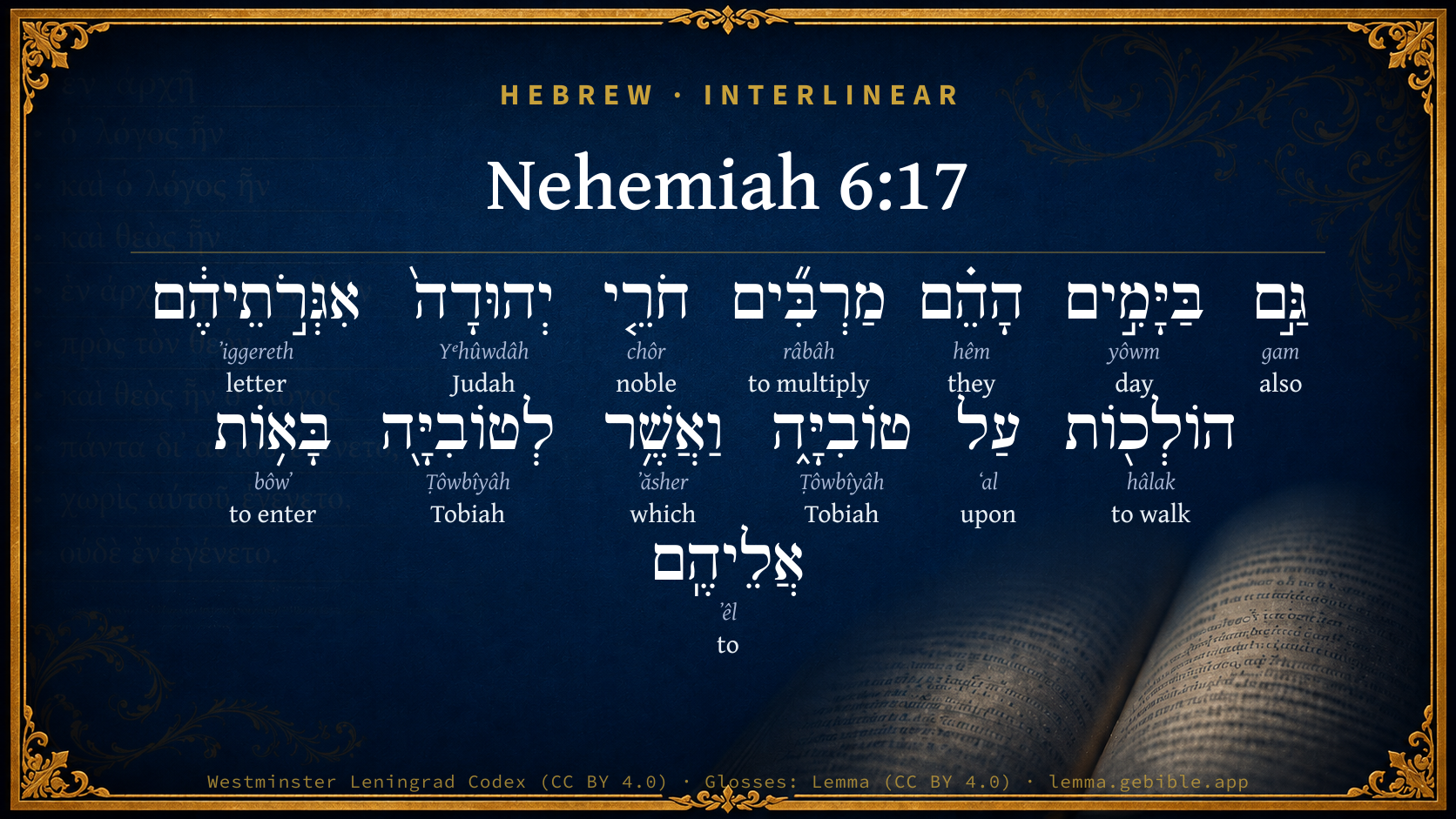
Hebrew (Westminster Leningrad Codex) Nehemiah 6:17 appears in the Hebrew Old Testament. The text above is from the Westminster Leningrad Codex. Each word links to its Strong’s number, a concise gloss, and parsing drawn from the Open Scriptures Hebrew Bible morphology. Click any word for its full Brown-Driver-Briggs (BDB) entry.
Download image
Cite this verse

Nehemiah 6:17 (World English Bible). Public Domain. Lemma interlinear Bible study tool, https://lemma.gebible.app/v/nehemiah/6/17.

Show BibTeX & RIS
BibTeX
RIS
English Translation
Moreover in those days the nobles of Judah sent many letters to Tobiah, and [the letters] of Tobiah came to them.
World English Bible · Public Domain
Download a study sheet

One document with this verse’s original text, its word-by-word gloss line, the meaning frame, cross-references with their text, attributed commentary, and full source and license credits — printable, and it pastes into notes with its structure intact.

This verse Autodidact and up

Study sheet (.html) Plain text (.txt)

A passage Seminary Student

Up to 50 verses in one chapter. A passage sheet keeps up to 6 commentary sources and 12 cross-references per verse, in the order this page ranks them, and says so on the sheet whenever that leaves anything out. Ask for a single verse and you get the Autodidact verse sheet above.

Everything on this page stays free to read, with no account — the sheet is a download of what is already on screen, not access to it.

Want to remove ads? Support Godless Engineer
Compare translations 3

The same verse in 3 English versions, stacked beneath the original-language interlinear above. Click any original word for its lexicon entry.

Each is an independent rendering of the whole verse — the interlinear is not word-aligned to these translations.

Highlighted words mark where these versions differ — a whole-verse word diff, not a word-by-word alignment.

  • World English Bible Public Domain
    Moreover in those days the nobles of Judah sent many letters to Tobiah, and [the letters] of Tobiah came to them.
  • King James Version Public Domain
    Moreover in those days the nobles of Judah sent many letters unto Tobiah, and the letters of Tobiah came unto them.
  • unfoldingWord Literal Text CC BY-SA 4.0
    Also, in those days, the nobles of Judah were multiplying their letters going to Tobiah, and those belonging to Tobiah were coming to them.

unfoldingWord Literal Text — © unfoldingWord, licensed CC BY-SA 4.0. Word-aligned USFM3 via Door43 (git.door43.org/unfoldingWord/en_ult).

Versions to compare (up to 4)

3 of 4 selected

Show all 18 translations

Every available English version of this verse, each an independent rendering of the whole verse.

  • World English Bible Public Domain
    Moreover in those days the nobles of Judah sent many letters to Tobiah, and [the letters] of Tobiah came to them.
  • Berean Standard Bible Public Domain
    Also in those days, the nobles of Judah sent many letters to Tobiah, and Tobiah’s letters came back to them.
  • Majority Standard Bible Public Domain
    Also in those days, the nobles of Judah sent many letters to Tobiah, and Tobiah’s letters kept coming to them.
  • King James Version Public Domain
    Moreover in those days the nobles of Judah sent many letters unto Tobiah, and the letters of Tobiah came unto them.
  • American Standard Version (1901) Public Domain
    Moreover in those days the nobles of Judah sent many letters unto Tobiah, and `the letters' of Tobiah came unto them.
  • Revised Version (1885) Public Domain
    Moreover in those days the nobles of Judah sent many letters unto Tobiah, and the letters of Tobiah came unto them.
  • Geneva Bible (1599) Public Domain
    And in these dayes were there many of the princes of Iudah, whose letters went vnto Tobiah, and those of Tobiah came vnto them.
  • Douay-Rheims (1899) Public Domain
    Moreover in those days many letters were sent by the principal men of the Jews to Tobias, and from Tobias there came letters to them.
  • Young's Literal Translation Public Domain
    Also, in those days the freemen of Judah are multiplying their letters going unto Tobiah, and those of Tobiah are coming in unto them;
  • Literal Standard Version CC BY-SA 4.0
    Also, in those days the nobles of Judah are multiplying their letters going to Tobiah, and those of Tobiah are coming to them;
  • Unlocked Literal Bible CC BY-SA 4.0
    At this time the nobles of Judah sent many letters to Tobiah, and Tobiah's letters came to them.
  • unfoldingWord Literal Text CC BY-SA 4.0
    Also, in those days, the nobles of Judah were multiplying their letters going to Tobiah, and those belonging to Tobiah were coming to them.
  • Darby Bible Public Domain
    Moreover in those days the nobles of Judah sent many letters to Tobijah, and those of Tobijah came to them.
  • World Messianic Bible Public Domain
    Moreover in those days the nobles of Judah sent many letters to Tobiah, and Tobiah’s letters came to them.
  • Webster's Bible Public Domain
    Moreover, in those days the nobles of Judah sent many letters to Tobiah, and the letters of Tobiah came to them.
  • Free Bible Version CC BY-SA 4.0
    At that time the nobles of Judah were exchanging many letters with Tobiah,
  • Bible in Basic English Public Domain
    And further, in those days the chiefs of Judah sent a number of letters to Tobiah, and his letters came to them.
  • JPS Tanakh (1917) Public Domain
    Moreover in those days the nobles of Judah sent many letters unto Tobiah, and the letters of Tobiah came unto them.

Literal Standard Version (2020), Covenant Press — licensed CC BY-SA 4.0. Text via the HelloAO Bible API (eBible.org). Unlocked Literal Bible (unfoldingWord) — licensed CC BY-SA 4.0. Text via the HelloAO Bible API (eBible.org). unfoldingWord Literal Text — © unfoldingWord, licensed CC BY-SA 4.0. Word-aligned USFM3 via Door43 (git.door43.org/unfoldingWord/en_ult). Free Bible Version, Dr. Jonathan Gallagher — licensed CC BY-SA 4.0. Text via the HelloAO Bible API (eBible.org).

Word by word

More ways to search: Search by grammar → Find every occurrence → Compare this word →

Practice this passage: Drill this verse → Learn its vocabulary →

אִגְּרֹ֣תֵיהֶ֔ם
ʼiggereth
H107
“letters · their”
Noun, Common, Feminine, Plural, Construct + Suffix, Personal, 3rd Person, Masculine, Plural
Part of Speech
Noun
Type
Common
Gender
Feminine
Number
Plural
State
Construct
Full BDB Definition

Origin: from H104

TWOT: 23b

letter, missive
  1. גַּ֣ם gam H1571 “also” Particle, Accusative
  2. בַּיָּמִ֣ים yôwm H3117 “in/at the · days” Preposition, Determined + Noun, Common, Masculine, Plural, Absolute
  3. הָהֵ֗ם hêm H1992 “the · they” Particle, Definite Article + Pronoun, Personal, 3rd Person, Masculine, Plural
  4. מַרְבִּ֞ים râbâh H7235 “multiplying” Verb, Hiphil, Participle Active, Masculine, Plural, Absolute
  5. חֹרֵ֤י chôr H2715 “nobles of” Noun, Common, Masculine, Plural, Construct
  6. יְהוּדָה֙ Yᵉhûwdâh H3063 “Judah” Noun, Proper
  7. הוֹלְכ֖וֹת hâlak H1980 “walking” Verb, Qal, Participle Active, Feminine, Plural, Absolute
  8. עַל ʻal H5921 “upon” Preposition
  9. טוֹבִיָּ֑ה Ṭôwbîyâh H2900 “Tobiah” Noun, Proper
  10. וַאֲשֶׁ֥ר ʼăsher H834 “and · which” Conjunction + Particle, Relative
  11. לְטוֹבִיָּ֖ה Ṭôwbîyâh H2900 “to/for · Tobiah” Preposition + Noun, Proper
  12. בָּא֥וֹת bôwʼ H935 “entering” Verb, Qal, Participle Active, Feminine, Plural, Absolute
  13. אֲלֵיהֶֽם ʼêl H413 “to · them” Preposition + Suffix, Personal, 3rd Person, Masculine, Plural

About this verse

These counts appear in no published source. They are computed here, from the morphology-tagged text and Lemma’s own curated glosses. What Lemma adds →

14
words
13
distinct lemmas
Historical
section

Notable vocabulary

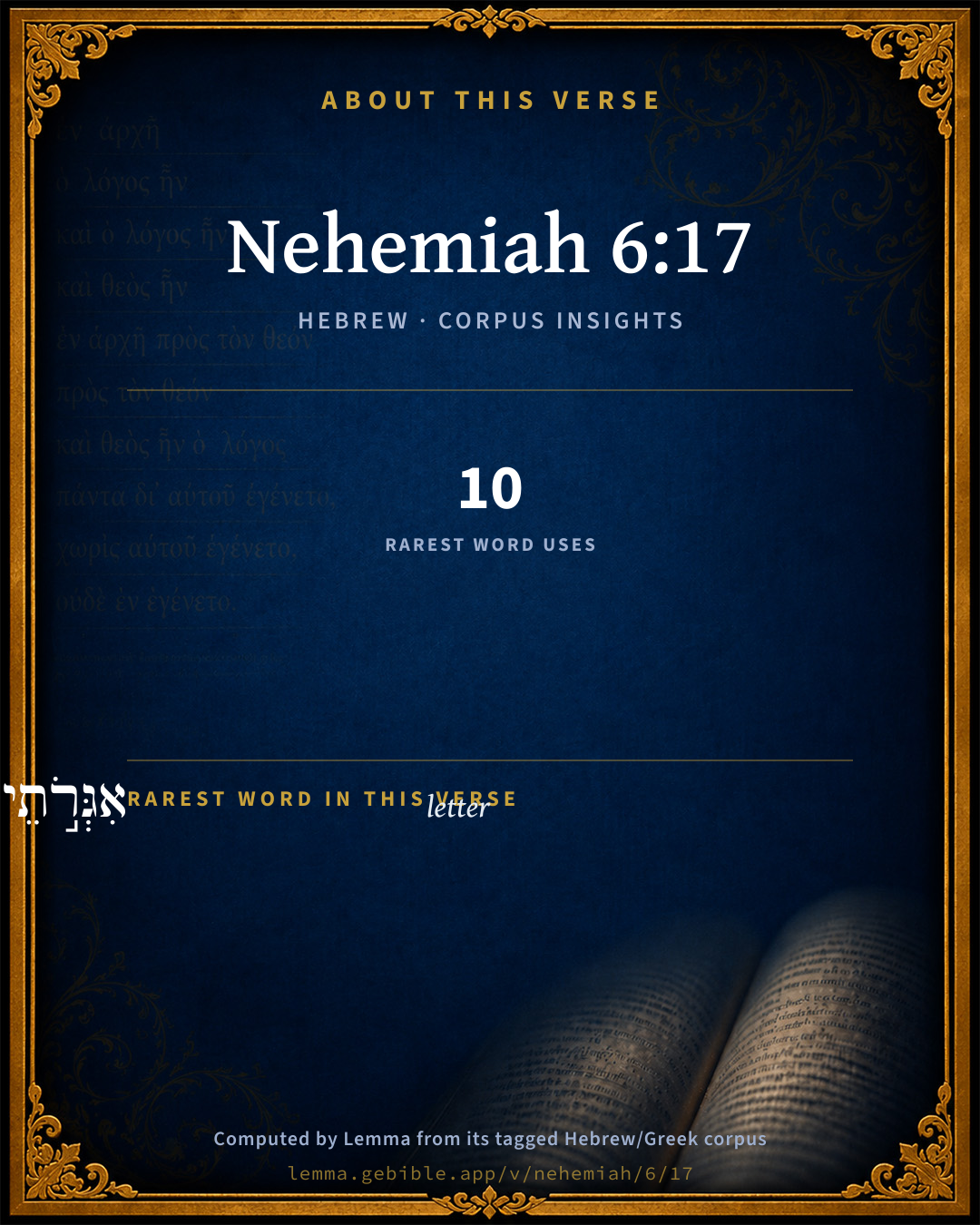
The rarest word here is אִגְּרֹ֣תֵיהֶ֔ם letter H107 — appearing just 10 times in the whole Hebrew Bible.

Shared distinctive vocabulary

אִגְּרֹ֣תֵיהֶ֔ם letter H107 occurs in 10 verses of the Hebrew Bible. Also found in:

Grammatical profile

  • 3 verbs
  • 6 nouns
  • 1 pronoun
  • 2 prepositions
  • 2 particles

Verb forms

  • מַרְבִּ֞ים Hiphil · Participle Active
  • הוֹלְכ֖וֹת Qal · Participle Active
  • בָּא֥וֹת Qal · Participle Active

Repetition

A word recurs within this verse — often emphatic in Hebrew:

  • טוֹבִיָּ֑ה Tobiah H2900 ×2

Cross-references

5

Topical passages linked to Nehemiah 6:17 in the Treasury of Scripture Knowledge — connected by theme and wording, ordered by reader-vote popularity; previews shown in the World English Bible.

  • Nehemiah 3:5 Next to them the Tekoites repaired; but their nobles didn't put their necks to the work of their lord.
  • Nehemiah 5:7 Then I consulted with myself, and contended with the nobles and the rulers, and said to them, You exact usury, everyone of his brother. I held a great assembly against them.
  • Nehemiah 13:28 One of the sons of Joiada, the son of Eliashib the high priest, was son-in-law to Sanballat the Horonite: therefore I chased him from me.
  • Micah 7:1–6 Misery is mine! Indeed, I am like one who gathers the summer fruits, as gleanings of the vinyard: There is no cluster of grapes to eat. My soul desires to eat the early fig.
  • Matthew 24:10–12 Then many will stumble, and will deliver up one another, and will hate one another.

Cross-references courtesy of OpenBible.info (CC BY 4.0).

Hebrew and Greek witnesses Masoretic Hebrew ↔ Greek Septuagint

The same verse in the two great witnesses to the Old Testament, shown verse-for-verse.

These are two independent witnesses, not word-aligned to each other, and the Septuagint is shown in lemma (dictionary) form.

Hebrew Nehemiah 6:17 Masoretic · Westminster Leningrad Codex

גַּ֣ם בַּיָּמִ֣ים הָהֵ֗ם מַרְבִּ֞ים חֹרֵ֤י יְהוּדָה֙ אִגְּרֹ֣תֵיהֶ֔ם הוֹלְכ֖וֹת עַל טוֹבִיָּ֑ה וַאֲשֶׁ֥ר לְטוֹבִיָּ֖ה בָּא֥וֹת אֲלֵיהֶֽם

Moreover in those days the nobles of Judah sent many letters to Tobiah, and [the letters] of Tobiah came to them.

World English Bible · Public Domain

Greek LXX Structure differs

The Septuagint has no separate book of Nehemiah. Its Greek text is the second half of Esdras B (2 Esdras), chapters 11–23; Ezra is the first half (1–10).

A verse-for-verse comparison isn’t shown here because the chapters and verses don’t line up. Switch to the LXX edition with the MT / LXX toggle above to read the Greek directly.

Hebrew: Westminster Leningrad Codex (CC BY 4.0). Greek: Septuagint (public domain); English from a public-domain English Septuagint. How the Septuagint differs from the Hebrew →

Commentary

Notes on Nehemiah 6:17 from classic Christian and Jewish commentators (each source and its license shown beneath its notes). The classic Christian expositions comment on the surrounding passage and are grouped to its opening verse, so a note may address several verses; the Jewish commentaries on the Tanakh (Rashi and others) are per-verse, so they appear only where the commentator wrote on this verse.

Lemma curates 59 commentaries, every one of them public domain or Creative Commons licensed, each selected and text-cleaned for this edition rather than reprinted as found. About our sources →

Trapp's Complete Commentary

John Trapp

Neh 6:17 Moreover in those days the nobles of Judah sent many letters unto Tobiah, and [the letters] of Tobiah came unto them.

Ver. 17. Moreover in those days the nobles of Judah] Heb. The white ones; either, because they went in white garments, as Joseph, Mordecai, &c., or because they were illustrious and famous for wisdom and virtue. But in these nobles of Judah was nomen inane, crimen immune. Here was sedes prima, vita ima, dignitas in indigno; hoc est, ornamentum in lute, white garments they might have, but with sooty souls, and black manners.

Sent many letters unto Tobiah] Heb. Multiplied their letters (or packets), walking to Tobiah, with whom thereby they held correspondency; as at this day they do with the Turkish viziers and bashaws of state, giving them continual intelligence of the affairs of Christendom, and advising most of that mischief which the Turk puts in execution against us.

John Trapp, A Commentary or Exposition upon All the Books of the Old and New Testament (1647–1656) — public domain. Text from a community e-Sword module.

Joseph Benson's Commentary

Neh 6:17-18. The nobles of Judah sent many letters unto Tobiah — Corresponding with him against Nehemiah, and against their own city and nation. So that, added to all the other wickedness of this people, there were false brethren among their great men, who favoured, aided, and abetted the designs of their enemies, Neh 6:18. There were many in Judah sworn unto him — To be true to him in the prosecution of his wicked designs. Because his son had taken the daughter of Meshullam — This is mentioned to show the mischief of such unequal and forbidden marriages, and how reasonable and necessary Ezra’s action was in the dissolution of them.

Joseph Benson's Commentary on the Old and New Testaments (1811–1818) — public domain. Text from a community e-Sword module.

Keil & Delitzsch

C. F. Keil & F. Delitzsch

To this Nehemiah adds the supplementary remark, that in those days even nobles of Judah were in alliance and active correspondence with Tobiah, because he had married into a respectable Jewish family.

Neh 6:17

"Also in those days the nobles of Judah wrote many letters (אגּרתיהם מרבּים, they made many, multiplied, their letters) passing to Tobiah, and those of Tobiah came to them."

Neh 6:18

For many in Judah were sworn unto him, for he was the son-in-law of Shecaniah the son of Arah; and his son Johanan had taken (to wife) the daughter of Meshullam the son of Berechiah. In this case Tobiah was connected with two Jewish families, - a statement which is made to confirm the fact that many in Judah were שׁבוּעה בּעלי, associates of an oath, joined to him by an oath, not allies in consequence of a treaty sworn to (Bertheau). From this reason being given, we may conclude his affinity by marriage was confirmed by an oath. Shecaniah ben Arah was certainly a respectable Jew of the race of Arah, Ezr 2:5. Meshullam ben Berechiah appears among those who shared in the work of building, Neh 3:4 and Neh 3:30. According to Neh 13:4, the high priest Eliashib was also related to Tobiah. From the fact that both Tobiah and his son Jehohanan have genuine Jewish names, Bertheau rightly infers that they were probably descended from Israelites of the northern kingdom of the ten tribes. With this the designation of Tobiah as "the Ammonite" may be harmonized by the supposition that his more recent or remote ancestors were naturalized Ammonites.

Neh 6:19

"Also they reported his good deeds before me, and uttered my words to him." טּובתיו, the good things in him, or "his good qualities and intentions" (Bertheau). The subject of the sentence is the nobles of Judah. לו מוציאים, they were bringing forth to him. On this matter Bertheau remarks, that there is no reason for assuming that the nobles of Judah endeavoured, by misrepresenting and distorting the words of Nehemiah, to widen the breach between him and Tobiah. This is certainly true; but, at the same time, we cannot further infer from these words that they were trying to effect an understanding between the two, and representing to Nehemiah how dangerous and objectionable his undertaking was; but were by this very course playing into the hands of Tobiah. For an understanding between two individuals, hostile the one to the other, is not to be brought about by reporting to the one what is the other's opinion of him. Finally, Nehemiah mentions also that Tobiah also sent letters to put him in fear (יראני, infin. Piel, like Ch2 32:18; comp. the participle above, Neh 6:9 and Neh 6:14). The letters were probably of similar contents with the letter of Sanballat given in Neh 6:6.

Keil & Delitzsch — Biblical Commentary on the Old Testament (1861–1891) — public domain (CC PDM 1.0). Text via the HelloAO Bible API. (Old Testament only.)

Geneva Bible (1599)

Geneva Bible translators

Thus the Church of God hath evermore enemies within itself, which are more dangerous than the outward and professed enemy.

Geneva Bible (1599) marginal notes — public domain. Text via Bolls.life.

Adam Clarke's Commentary

Verse 17. The nobles of Judah sent many letters] The circumstances marked in this and the following verses show still more clearly the difficulties which Nehemiah had to encounter; he had enemies without and false friends within. A treacherous correspondence was carried on between the nobles of Judah and the Ammonites; and had almost any other man been at the head of the Jewish affairs, Jerusalem had never been re-established.

Adam Clarke's Commentary on the Bible (1810–1826) — public domain. Text from a community e-Sword/MySword module.

Ellicott's Commentary for English Readers

(17) Many letters.—There was a large correspondence between Tobiah and the nobles of Judah.

(17-19) A supplementary account is here introduced, explaining the intrigues within Jerusalem to which reference has been made.

A Bible Commentary for English Readers, edited by Charles John Ellicott (1878–1897) — public domain. Text from a community e-Sword module.

The Cambridge Bible for Schools and Colleges

gen. ed. J. J. S. Perowne

17. in those days] i.e. during the whole of this period a treasonable correspondence was carried on between Tobiah and the disaffected Jewish nobles. That these included the family of the High-priest is rendered probable by Chap. Neh_13:4.

The Cambridge Bible for Schools and Colleges (gen. ed. J. J. S. Perowne; Cambridge University Press, 1878–1918) — public domain. Text from a community e-Sword module.

John Gill's Exposition

Moreover, in those days,.... While the wall was building:

the nobles of Judah sent many letters to Tobiah, and the letters of Tobiah came unto them; letters passed between them frequently, they informing him how things went on at Jerusalem, and he advising them to what was detrimental to the true interest of their nation; such false friends had Nehemiah about him, and yet the work succeeded under him; which showed it the more to be of God.

John Gill's Exposition of the Whole Bible (1746–1763) — public domain (CC PDM 1.0). Text via the HelloAO Bible API.

Matthew Poole's English Annotations

Corresponding with him against Nehemiah, and against their own city and nation.

Matthew Poole's English Annotations on the Holy Bible (1683–1685) — public domain. Text from a community e-Sword/MySword module.

Whedon's Commentary on the Bible

Daniel D. Whedon

17. The nobles of Judah… letters unto Tobiah — This secret correspondence between some of the nobles and Tobiah shows still more clearly the fearful embarrassments of Nehemiah. The enemy not only bribed some of the prophets, but also some of the nobles, to act the part of traitors. Neh_6:12; Neh_6:14.

Daniel D. Whedon (gen. ed.), Commentary on the Old and New Testaments (1874–1909) — public domain. Text from a community e-Sword module.

The Pulpit Commentary

Moreover in those days. Ewald supposes that the circumstances here related (vers. 17-19) were subsequent to the completion of the wall ("History of Israel," vol. 5. p. 157); but the expression "in those days" seems rather to throw back the events into the time during which the wall was in building. The passage is a sort of explanatory note, showing us how Tobiah came to be able to raise those intrigues inside Jerusalem which have been mentioned in vers. 12-14. And the letters of Tobiah came unto them. Rather, "and many were the letters of Tobiah which came to them."

The Pulpit Commentary (1880–1919), ed. H.D.M. Spence-Jones & Joseph S. Exell — public domain. Text from a community e-Sword module.

Scofield Reference Notes

C. I. Scofield

Tobiah

(See Scofield "Neh 2:10").

The Scofield Reference Bible (1917 edition), notes by C. I. Scofield — public domain. Text from a community e-Sword module.

unfoldingWord translationNotes

Door43 World Missions Community

sent many letters

The nobles sent messengers to bring these letters to Tobiah. AT: "sent many messengers with letters" (See: Metonymy)

Tobiah's letters came

Here Tobiah's letters are personified as coming by themselves, when they were actually brought by messengers. AT: "Tobiah sent letters" or "Tobiah sent many messengers with letters" (See: Personification)

Tobiah

See how you translated this man's name in Nehemiah 2:10. (See: How to Translate Names)

who were bound by an oath to him

This speaks of people being loyal to Tobiah because they had pledged an oath to him as if their oath were a rope that bound their bodies. AT: "who had sworn an oath to him" or "who had made an oath and were loyal to him" (See: Metaphor)

he was the son-in-law of Shecaniah

This means that Tobiah was married to the daughter of Shecaniah. See how you translated "Shecaniah" in Nehemiah 3:29. (See: How to Translate Names)

Arah ... Jehohanan

These are the names of men. (See: How to Translate Names)

Meshullam ... Berechiah

These are the names of men. See how you translated this in Nehemiah 3:4. (See: How to Translate Names)

They also spoke to me about his good deeds and reported my words back to him

"The Jewish nobles told me about Tobiah's good deeds and then told him about my responses"

Letters were sent to me from Tobiah

This can be stated in active form. Tobiah sent messengers to bring the letters to Nehemiah. AT: "Tobiah sent letters to me" or "Tobiah sent messengers to bring letters to me" (See: Active or Passive and Metonymy)

translationWords

kingdom of Judah

epistle

oath

son

good

works

report

word

unfoldingWord translationNotes — © Distant Shores Media and the Door43 World Missions Community, licensed CC BY-SA 4.0. Source: git.door43.org/Door43/en_tn.

Rashi

Rabbi Shlomo Yitzchaki (Rashi)

the rulers of Judea Heb. חֹרֵי, the princes of Judea.

to Tobiah Heb. עַל-טוֹבִיָה. He was a renegade Israelite.

and Tobiah’s i.e., Tobiah’s letters.

Rashi on the Tanakh — English translations: “The Judaica Press complete Tanach with Rashi, translated by A. J. Rosenberg” (CC BY 4.0); “Pentateuch with Rashi's commentary by M. Rosenbaum and A.M. Silbermann, 1929-1934” (public domain); “The Metsudah Tanach series, Lakewood, N.J” (CC BY 4.0); and “The Book of Joshua, Metsudah Publications, 1997” (CC BY 4.0). Text via Sefaria.

Lesson kit

Teaching starters — assembled from the data on this page, not authored interpretation. Every prompt links to the verse data it draws on. Edit before teaching.

Nehemiah, in the Historical, opens this verse with 14 words (13 distinct Hebrew lemmas). Its most distinctive word is ʼiggereth (“letter”). A historical commentator’s framing appears above. Read the whole chapter for the surrounding context.

Discussion questions

  1. How does “letter” (ʼiggereth) shape what this verse is saying?
  2. How does 2 Chronicles 30:1, which shares the word «letter», read alongside this verse?
  3. What does the repetition of “Tobiah” (2× in this one verse) do in this verse?
  4. These translations render this verse differently. What is at stake in choosing one wording over another?
  5. «מַרְבִּ֞ים» is a Hiphil Participle Active verb. How does that grammatical form shape the action described?
  6. Compare how Trapp's Complete Commentary and Joseph Benson's Commentary read this verse. Where do they agree or differ?

Things to notice

Reading settings

Reading text

Shown beneath each verse's original-language words.

Old Testament
Old Testament edition

Read the OT as the Masoretic Hebrew (MT) or the Greek Septuagint (LXX).

English shown for the Greek Septuagint (in the Hebrew ↔ Greek comparison).

Comparing translations? Open the Compare panel on any verse page to stack up to four side by side.