Ecclesiastes 12:9

Hebrew (Westminster Leningrad Codex) Ecclesiastes 12:9 appears in the Hebrew Old Testament. The text above is from the Westminster Leningrad Codex. Each word links to its Strong’s number, a concise gloss, and parsing drawn from the Open Scriptures Hebrew Bible morphology. Click any word for its full Brown-Driver-Briggs (BDB) entry.
Download image
Cite this verse

Ecclesiastes 12:9 (World English Bible). Public Domain. Lemma interlinear Bible study tool, https://lemma.gebible.app/v/ecclesiastes/12/9.

Show BibTeX & RIS
BibTeX
RIS
English Translation
Further, because the Preacher was wise, he still taught the people knowledge. Yes, he pondered, sought out, and set in order many proverbs.
World English Bible · Public Domain
Highlights
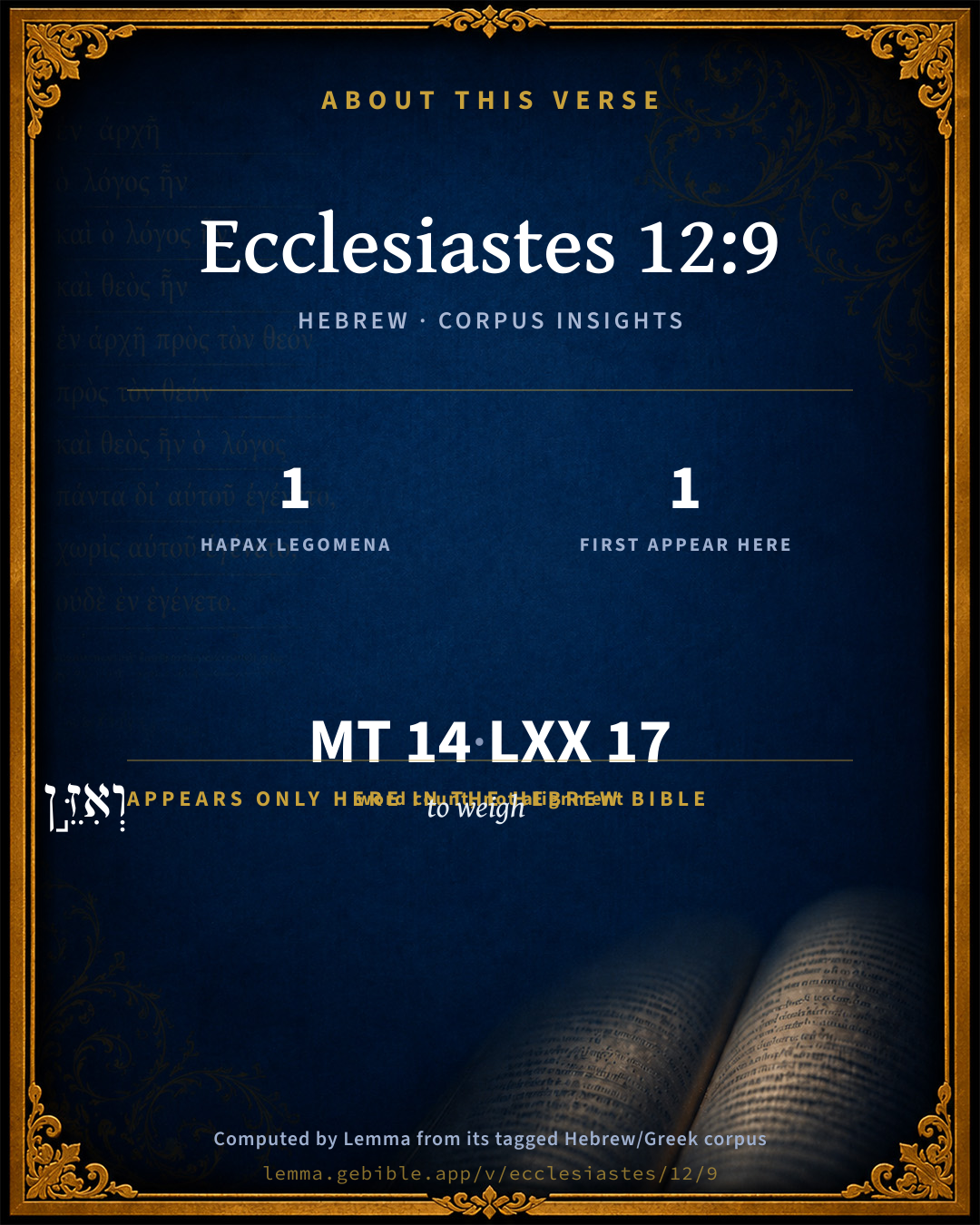
  • 1 hapax legomenon — only here in the Hebrew Bible
  • 1 first appearance in the Hebrew Bible
Full analysis ↓
Download a study sheet

One document with this verse’s original text, its word-by-word gloss line, the meaning frame, cross-references with their text, attributed commentary, and full source and license credits — printable, and it pastes into notes with its structure intact.

This verse Autodidact and up

Study sheet (.html) Plain text (.txt)

A passage Seminary Student

Up to 50 verses in one chapter. A passage sheet keeps up to 6 commentary sources and 12 cross-references per verse, in the order this page ranks them, and says so on the sheet whenever that leaves anything out. Ask for a single verse and you get the Autodidact verse sheet above.

Everything on this page stays free to read, with no account — the sheet is a download of what is already on screen, not access to it.

Want to remove ads? Support Godless Engineer
Compare translations 3

The same verse in 3 English versions, stacked beneath the original-language interlinear above. Click any original word for its lexicon entry.

Each is an independent rendering of the whole verse — the interlinear is not word-aligned to these translations.

Highlighted words mark where these versions differ — a whole-verse word diff, not a word-by-word alignment.

  • World English Bible Public Domain
    Further, because the Preacher was wise, he still taught the people knowledge. Yes, he pondered, sought out, and set in order many proverbs.
  • King James Version Public Domain
    And moreover, because the preacher was wise, he still taught the people knowledge; yea, he gave good heed, and sought out, and set in order many proverbs.
  • unfoldingWord Literal Text CC BY-SA 4.0
    More that Qoheleth was wise, again, he taught the people knowledge, and he weighed, and he searched. He ordered many proverbs.

unfoldingWord Literal Text — © unfoldingWord, licensed CC BY-SA 4.0. Word-aligned USFM3 via Door43 (git.door43.org/unfoldingWord/en_ult).

Versions to compare (up to 4)

3 of 4 selected

Show all 18 translations

Every available English version of this verse, each an independent rendering of the whole verse.

  • World English Bible Public Domain
    Further, because the Preacher was wise, he still taught the people knowledge. Yes, he pondered, sought out, and set in order many proverbs.
  • Berean Standard Bible Public Domain
    Not only was the Teacher wise, but he also taught the people knowledge; he pondered, searched out, and arranged many proverbs.
  • Majority Standard Bible Public Domain
    Not only was the Teacher wise, but he also taught the people knowledge; he pondered, searched out, and arranged many proverbs.
  • King James Version Public Domain
    And moreover, because the preacher was wise, he still taught the people knowledge; yea, he gave good heed, and sought out, and set in order many proverbs.
  • American Standard Version (1901) Public Domain
    And further, because the Preacher was wise, he still taught the people knowledge; yea, he pondered, and sought out, `and' set in order many proverbs.
  • Revised Version (1885) Public Domain
    And further, because the Preacher was wise, he still taught the people knowledge; yea, he pondered, and sought out, and set in order many proverbs.
  • Geneva Bible (1599) Public Domain
    And the more wise the Preacher was, the more he taught the people knowledge, and caused them to heare, and searched foorth, and prepared many parables.
  • Douay-Rheims (1899) Public Domain
    And whereas Ecclesiastes was very wise, he taught the people, and declared the things that he had done: and seeking out, he set forth many parables.
  • Young's Literal Translation Public Domain
    And further, because the preacher was wise, he still taught the people knowledge, and gave ear, and sought out -- he made right many similes.
  • Literal Standard Version CC BY-SA 4.0
    And further, because the preacher was wise, he still taught the people knowledge, and gave ear, and sought out—he made right many allegories.
  • Unlocked Literal Bible CC BY-SA 4.0
    The Teacher was wise and he taught the people knowledge. He studied and contemplated and set in order many proverbs.
  • unfoldingWord Literal Text CC BY-SA 4.0
    More that Qoheleth was wise, again, he taught the people knowledge, and he weighed, and he searched. He ordered many proverbs.
  • Darby Bible Public Domain
    And moreover, because the Preacher was wise, he still taught the people knowledge; and he pondered, and sought out, [and] set in order many proverbs.
  • World Messianic Bible Public Domain
    Further, because Kohelet was wise, he still taught the people knowledge. Yes, he pondered, sought out, and set in order many proverbs.
  • Webster's Bible Public Domain
    And moreover, because the preacher was wise, he still taught the people knowledge: yes, he gave good heed, and sought out, and set in order many proverbs.
  • Free Bible Version CC BY-SA 4.0
    Not only was the Teacher a wise man, he also taught what he knew to others. He thought about many proverbs, studying them and arranging them.
  • Bible in Basic English Public Domain
    And because the Preacher was wise he still gave the people knowledge; searching out, testing, and putting in order a great number of wise sayings.
  • JPS Tanakh (1917) Public Domain
    And besides that Koheleth was wise, he also taught the people knowledge; yea, he pondered, and sought out, and set in order many proverbs.

Literal Standard Version (2020), Covenant Press — licensed CC BY-SA 4.0. Text via the HelloAO Bible API (eBible.org). Unlocked Literal Bible (unfoldingWord) — licensed CC BY-SA 4.0. Text via the HelloAO Bible API (eBible.org). unfoldingWord Literal Text — © unfoldingWord, licensed CC BY-SA 4.0. Word-aligned USFM3 via Door43 (git.door43.org/unfoldingWord/en_ult). Free Bible Version, Dr. Jonathan Gallagher — licensed CC BY-SA 4.0. Text via the HelloAO Bible API (eBible.org).

Word by word

More ways to search: Search by grammar → Find every occurrence → Compare this word →

Practice this passage: Drill this verse → Learn its vocabulary →

וְאִזֵּ֣ן
ʼâzan
H239
“and · to weigh”
Conjunction + Verb, Piel, Perfect, 3rd Person, Masculine, Singular
Part of Speech
Conjunction + Verb
Stem
Piel
Form
Perfect
Person
3rd Person
Gender
Masculine
Number
Singular
Full BDB Definition

Origin: a primitive root [rather identical with H238 through the idea of scales as if two ears]

TWOT: 58

(Piel) weigh, test, prove, consider
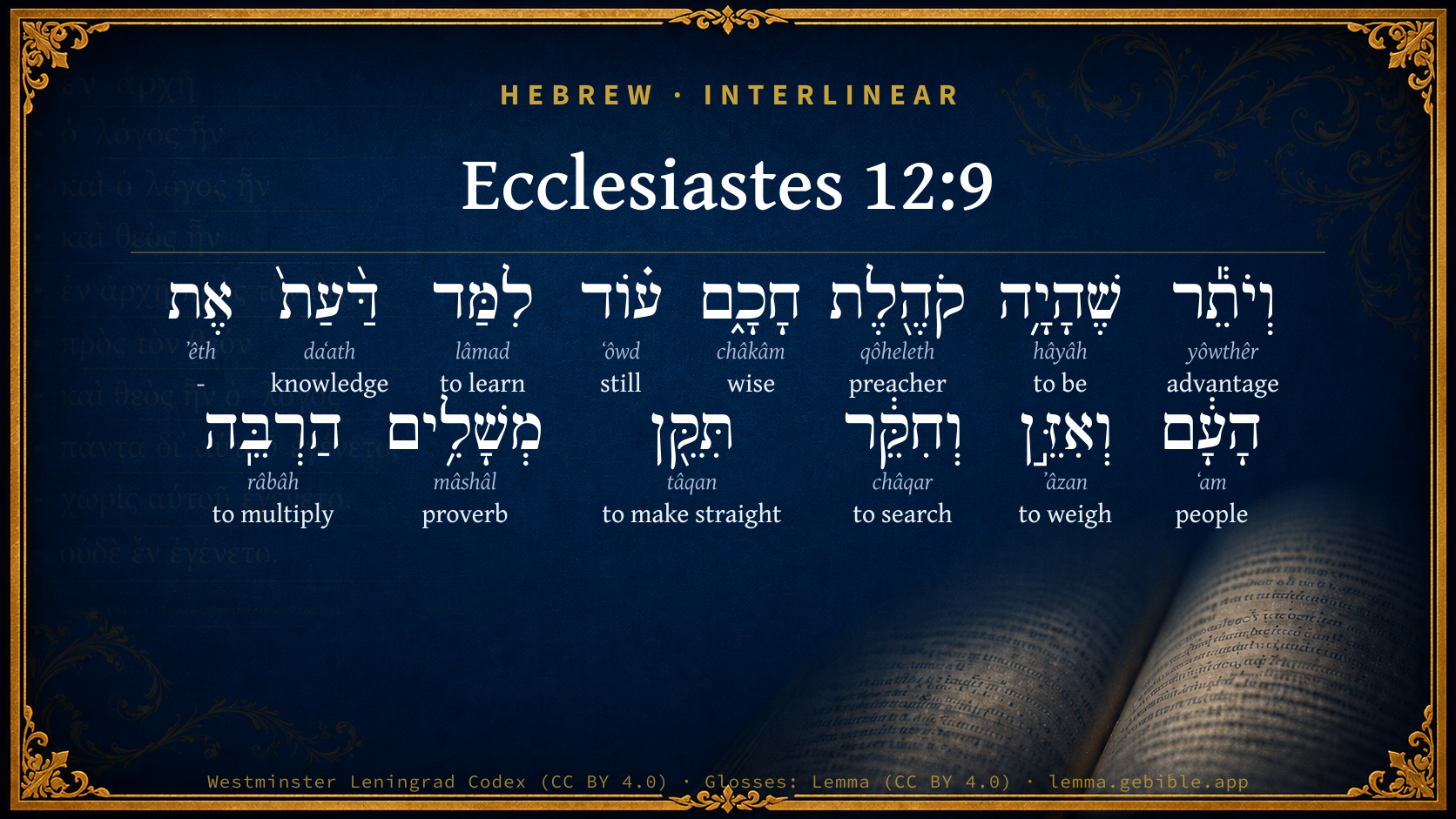
  1. וְיֹתֵ֕ר yôwthêr H3148 “and · advantage” Conjunction + Noun, Common, Masculine, Singular, Absolute
  2. שֶׁהָיָ֥ה hâyâh H1961 “who/which · to be” Particle, Relative + Verb, Qal, Perfect, 3rd Person, Masculine, Singular
  3. קֹהֶ֖לֶת qôheleth H6953 “preacher” Noun, Common, Masculine, Singular, Absolute
  4. חָכָ֑ם châkâm H2450 “wise” Adjective, Adjective, Masculine, Singular, Absolute
  5. ע֗וֹד ʻôwd H5750 “still” Adverb
  6. לִמַּד lâmad H3925 “to learn” Verb, Piel, Perfect, 3rd Person, Masculine, Singular
  7. דַּ֨עַת֙ daʻath H1847 “knowledge” Noun, Common, Feminine, Singular, Absolute
  8. אֶת ʼêth H853 “-” Particle, Direct Object
  9. הָעָ֔ם ʻam H5971 “the · people” Particle, Definite Article + Noun, Common, Masculine, Singular, Absolute
  10. וְחִקֵּ֔ר châqar H2713 “and · to search” Conjunction + Verb, Piel, Perfect, 3rd Person, Masculine, Singular
  11. תִּקֵּ֖ן tâqan H8626 “to make straight” Verb, Piel, Perfect, 3rd Person, Masculine, Singular
  12. מְשָׁלִ֥ים mâshâl H4912 “proverbs” Noun, Common, Masculine, Plural, Absolute
  13. הַרְבֵּֽה râbâh H7235 “to multiply” Verb, Hiphil, Infinitive Absolute

About this verse

These counts appear in no published source. They are computed here, from the morphology-tagged text and Lemma’s own curated glosses. What Lemma adds →

14
words
14
distinct lemmas
Wisdom
section

Notable vocabulary

1 hapax legomenon — a word that appears only here in the entire Hebrew Bible:

  • וְאִזֵּ֣ן to weigh H239

First appearance in Scripture

This word makes its first canonical appearance in the Hebrew Bible here:

  • וְאִזֵּ֣ן to weigh H239

Shared distinctive vocabulary

תִּקֵּ֖ן to make straight H8626 occurs in 3 verses of the Hebrew Bible. Also found in:

Grammatical profile

  • 6 verbs
  • 5 nouns
  • 1 adjective
  • 1 adverb
  • 1 particle

Verb forms

  • שֶׁהָיָ֥ה Qal · Perfect
  • לִמַּד Piel · Perfect
  • וְאִזֵּ֣ן Piel · Perfect
  • וְחִקֵּ֔ר Piel · Perfect
  • תִּקֵּ֖ן Piel · Perfect
  • הַרְבֵּֽה Hiphil · Infinitive Absolute

Hebrew & Septuagint length

In English translation the verse runs 23 words from the Hebrew and 25 from the Septuagint (LXX English) — closely comparable.

A rough comparison of the two English renderings, which tokenize alike — not a word-level alignment.

Word counts can differ between the Hebrew and the Greek without any difference in meaning — e.g. the Hebrew direct-object marker אֵת has no separate Greek word, and Greek often adds the article ὁ.

In the original languages it is 14 Hebrew tokens and 17 Greek tokens — but the two are counted differently (Hebrew bundles its prefixes and suffixes into one token; the Greek is in lemma form), so that isn’t a like-for-like length.

Cross-references

5

Topical passages linked to Ecclesiastes 12:9 in the Treasury of Scripture Knowledge — connected by theme and wording, ordered by reader-vote popularity; previews shown in the World English Bible.

  • 1 Kings 4:32 He spoke three thousand proverbs; and his songs were one thousand five.
  • Proverbs 1:1 The proverbs of Solomon, the son of David, king of Israel:
  • Proverbs 25:1 These also are proverbs of Solomon, which the men of Hezekiah king of Judah copied out.
  • 1 Kings 10:8 Happy are your men, happy are these your servants, who stand continually before you, [and] who hear your wisdom.
  • Proverbs 10:1 The proverbs of Solomon. A wise son makes a glad father; But a foolish son brings grief to his mother.

Cross-references courtesy of OpenBible.info (CC BY 4.0).

Hebrew and Greek witnesses Masoretic Hebrew ↔ Greek Septuagint

The same verse in the two great witnesses to the Old Testament, shown verse-for-verse.

These are two independent witnesses, not word-aligned to each other, and the Septuagint is shown in lemma (dictionary) form.

Hebrew Ecclesiastes 12:9 Masoretic · Westminster Leningrad Codex

וְיֹתֵ֕ר שֶׁהָיָ֥ה קֹהֶ֖לֶת חָכָ֑ם ע֗וֹד לִמַּד דַּ֨עַת֙ אֶת הָעָ֔ם וְאִזֵּ֣ן וְחִקֵּ֔ר תִּקֵּ֖ן מְשָׁלִ֥ים הַרְבֵּֽה

Further, because the Preacher was wise, he still taught the people knowledge. Yes, he pondered, sought out, and set in order many proverbs.

World English Bible · Public Domain

Greek LXX Ecclesiastes 12:9 Septuagint · lemma form

καί περισσόν ὅτι γίγνομαι ἐκκλησιαστής σοφός ἔτι διδάσκω γνῶσις σύν ὁ λαός καί οὖς ἐκἰχνιάζω κόσμιον παραβολή

And because the Preacher was wise above others, so it was that he taught man excellent knowledge, and the ear will trace out the parables.

LXX2012 (modern English Septuagint) · Public Domain

On this verse, The Cambridge Bible for Schools and Colleges discusses the Septuagint’s reading. Read the note in Commentary ↓

Hebrew: Westminster Leningrad Codex (CC BY 4.0). Greek: Septuagint (public domain); English from LXX2012 (modern English Septuagint) (Public Domain). How the Septuagint differs from the Hebrew →

Commentary

Notes on Ecclesiastes 12:9 from classic Christian and Jewish commentators (each source and its license shown beneath its notes). The classic Christian expositions comment on the surrounding passage and are grouped to its opening verse, so a note may address several verses; the Jewish commentaries on the Tanakh (Rashi and others) are per-verse, so they appear only where the commentator wrote on this verse.

Lemma curates 59 commentaries, every one of them public domain or Creative Commons licensed, each selected and text-cleaned for this edition rather than reprinted as found. About our sources →

John Gill's Exposition

And moreover,.... Or "besides" (z) what has been said; or "as to what remains" (a); or "but what is better", or "more excellent" (b), is to "hear the conclusion of the whole matter", the sum and substance of the whole book in a few words, Ecc 12:13; to which Ecc 12:9; are a preface; and in which the wise man recommends the reading of this book, and other writings of his, and of other wise men inspired of God; and his own he particularly recommends, from his character as wise and industrious, in this verse; and from the subject matter of them, their nature, use, and excellency, and their efficacy and authority, in the two next;

because the preacher was wise; he was a "preacher", a royal one, an extraordinary preacher, and to be regarded; he urges not his title as a king, but his character as a preacher, to recommend what he had written: every good preacher should be regarded; not such who are ignorant preachers of the law, but faithful ministers of the Gospel, who are sent of God, and have felt and experienced what they deliver to others; and especially who are wise as well as faithful, as Solomon was; he had much wisdom given him at first, Kg1 3:12; and in which he improved; and though he turned to folly in his old age, he recovered from that, and gained more wisdom through his fall, and to which he here seems to have reference; for "Koheleth", which some render the "gatherer", because he gathered much wisdom, and much people to hear it; others render "gathered", that is, into the flock and fold again, the church of God, from which he had strayed; See Gill on Ecc 1:1; and having seen through the follies and vanities of life, and being recovered and restored, was a fitter person to teach and instruct others; see Psa 51:12;

he still taught the people knowledge; or "again", as the Targum; after his fall and recovery he was communicative of his knowledge; he did not hide his talent in the earth, nor in a napkin; but having freely received he freely gave, and kept back nothing from his people, the people of the house of Israel, as the Targum, that might be profitable to them; he taught them the knowledge of themselves, as fallen men, impure, impotent, and unrighteous; the knowledge of the creatures, and the vanity of them, of riches, honours, and pleasures; and of works of righteousness to save men; the knowledge of Christ the Wisdom of God, the antiquity of his person, his glories, excellencies, and beauties, as in the books of Proverbs and Canticles; the knowledge of God, his fear and worship, mind and will; and the knowledge of a future state, and of the general judgment, as in this book; and in proportion to his own knowledge so he taught: for thus the words with the preceding may be rendered, that "the more that the preacher was wise, the more he taught the people knowledge" (c); he taught according to the abilities he had received, as preachers should; the more he grew in grace and knowledge, the more largely be shared with others; and this he did "daily", as Aben Ezra renders the words, constantly, continually, incessantly, in season and out of season, as faithful Gospel ministers do;

yea, he gave good heed; to what he heard and to what be read, to which the apostle's advice agrees, Ti1 4:13; or he caused others to hear, and give good heed to what is said, as Aben Ezra; he engaged their attention by his enlivening discourses; or, as Kimchi, he weighed things in his own mind, and in the balance of the sanctuary; and thoroughly considered and digested them before he delivered them to others;

and sought out; was very diligent in investigating truth, he searched into the mines of knowledge for it, the sacred writings, as one would for gold and silver, and as he himself directs, Pro 2:4;

and set in order many proverbs; three thousand of them, Kg1 4:32; particularly those which are in the book of that name, penned by him; he selected the most choice, pithy, and sententious sayings, of his own and others; and these he huddled not up, or threw them together in a disorderly and confused manner; but put them together in proper order and method, under proper heads, as well as in a correct style, that they might be more received, and more easily retained. The Targum is,

"he attended to the voice of the wise men, and searched the books of wisdom; and by a spirit of prophecy from the Lord composed books of wisdom, and very many proverbs of understanding.''

(z) "praeterea", Tigurine version, Vatablus, Schmidt. (a) "Quod reliquum est", Piscator, Gejerus, Amama. (b) "Quamobrem potius", Junius & Tremeillius; "and this is a matter of excellency", Broughton, (c) Mercerus and Cocceius.

John Gill's Exposition of the Whole Bible (1746–1763) — public domain (CC PDM 1.0). Text via the HelloAO Bible API.

Trapp's Complete Commentary

John Trapp

Ecc 12:9 And moreover, because the preacher was wise, he still taught the people knowledge; yea, he gave good heed, and sought out, [and] set in order many proverbs.

Ver. 9. And moreover, because the Preacher was wise.] He well knew how hard it was to work men to a belief of what he had affirmed concerning earthly vanities, and therefore heaps up here many forcible and cogent arguments; as, first, that himself was no baby, but wise above all men in the world, by God’s own testimony; therefore his words should be well regarded. Oι σοφοι ημων δευτερωσι, Our wise men expound today (said the Jews one to another), "Come, let us go up to the house of the Lord," &c. Cicero had that high opinion of Plato for his wisdom, that he professed that he would rather go wrong with him than go right with others. Averroes overly admired Aristotle, as if he had been infallible. But this is a praise proper to the holy penman, guided by the spirit of truth, and filled with wisdom from on high for the purpose. To them, therefore, and to the word of prophecy by them, must men "give heed, as unto a light that shineth in a dark place," &c. {2Pe 1:19}

He still taught the people knowledge.] He hid not his talent in a napkin, but used it to the instruction of his people. "Have not I written for thee excellent things" (or three various types of books - viz., proverbial, penitential, nuptial) "in counsels and knowledge?" {Pro 22:20} Synesius speaks of some that, having great worth in them, will as soon part with their hearts {a} as with their conceptions. And Gregory observeth, {b} that there are not a few who, being enriched with spiritual gifts and abilities to do good, dum solis contemplationis studiis inardescunt, parere utilitati proximorum praedicatione refugiunt, while they burn in the studies of contemplation only, do shun to seek by preaching to profit their neighbours. Solomon was none of these.

Yea, he gave good heed.] Or, He made them to take good heed; {c} he called upon them ever and anon, as our Saviour did upon his hearers, "Let him that hath an ear to hear, hear." Or as the deacons in Chrysostom’s and Basil’s time used to call upon the people, in these words, Oremus, attendamus, Let us pray, let us give heed.

And sought out.] By diligent scrutiny and hard study, beating his brains, as the fowl beats the shell to get out the fish, with great vehemence. The staves were always in the ark, to show, saith Gregory, that preachers should always meditate in their hearts upon the sacred Scriptures, that if need require they may without delay take up the ark, teach the people.

And set in order many proverbs.] Marshalled them in a fit method, and set others awork for to do the like. For, Regis ad exemplum, &c. Our Henry I, surnamed Beauclerc, had in his youth some taste of learning; and this put many of his subjects into the fashion of the book, so that various learned men flourished in his time, {d} as Ethan, Heman, Chalcola as Agur, and other compilers of proverbs did in Solomon’s.

{a} Yαρρον μεν την καρδιαν. - Synes.

{b} Past. Cur., p. i. c. 5.

{c} Auscultare fecit. - Pag. Ar. Montan.

{d} Daniel’s History. 68.

John Trapp, A Commentary or Exposition upon All the Books of the Old and New Testament (1647–1656) — public domain. Text from a community e-Sword module.

Joseph Benson's Commentary

Ecc 12:9-12. He still taught the people knowledge — As God gave him this wisdom, that he might be a teacher of others, so he used it to that end. Gave heed — He did not utter whatever came into his mind, but seriously pondered both his matter and his words. Therefore despise not his counsel. The preacher sought to find out acceptable words — Hebrew, רבי חפצ, words of desire, or, of delight: worthy of all acceptation, such as would minister comfort or profit to the hearers or readers. And that which was written — By the preacher, in this and his other books; was upright — Hebrew, רשׁי, right, or, straight, agreeable to the mind or will of God, which is the rule of right, not crooked or perverse; even words of truth — Not fables, cunningly devised to deceive the simple; but true and certain doctrines, which commend themselves to men’s reason and consciences; wholesome and edifying counsels. The words of the wise — Of spiritually wise and holy men of God; are as goads and as nails — Piercing into men’s dull minds, and quickening and exciting them to the practice of all duties; fastened by the masters of assemblies — Fixed in men’s memories and hearts, in which they make powerful and abiding impressions, by the ministry of the teachers of God’s church and people, whether prophets or others, appointed by God for that work; which are given from one shepherd — From God, or from Christ, the great Shepherd and Teacher of the church in all ages, by whose Spirit the ancient prophets, as well as other succeeding teachers, were inspired and taught, Jer 3:15; 1Pe 1:11; and 2Pe 1:21. And further, by these — By these wise men, and their words or writings; be admonished — Take your instructions from them; for their words are right and true, as he said, Ecc 12:10; whereas the words of other men are often false, or at best, doubtful. Of making many books there is no end — As if he had said, I could easily write many and large books upon these matters; but that would be an endless and needless work; seeing things necessary to be known and done lie in a little compass, as he informs us, Ecc 12:13. And much study — The reading and considering of many books, as well as the writing of them; is a weariness to the flesh — Wasteth a man’s strength and spirits, and yet does not give satisfaction to his mind, nor sufficiently recompense the trouble and inconvenience to which man is exposed by it.

Joseph Benson's Commentary on the Old and New Testaments (1811–1818) — public domain. Text from a community e-Sword module.

Tyndale Open Study Notes

Tyndale Open Resources

12:9-14 This coda by the editor (see “Author and Recipients” in the Book Introduction) expresses the editor’s respect for the Teacher, exhorts readers to apply his teaching, and gives the editor’s own conclusion from studying the Teacher (12:13-14).

12:9 Even as king (1:1), the Teacher found time to study wisdom. He collected and arranged proverbs (see also 1 Kgs 4:29-34; Prov 1:1; 10:1; 25:1).

Tyndale Open Study Notes — © Tyndale Open Resources, licensed CC BY-SA 4.0. Text via the HelloAO Bible API.

Jamieson, Fausset & Brown

Robert Jamieson, A. R. Fausset & David Brown

gave good heed--literally, "he weighed." The "teaching the people" seems to have been oral; the "proverbs," in writing. There must then have been auditories assembled to hear the inspired wisdom of the Preacher. See the explanation of Koheleth in the Introduction, and chapter 1 (Kg1 4:34).

that which is written, &c.--rather, (he sought) "to write down uprightly (or, 'aright') words of truth" [HOLDEN and WEISS]. "Acceptable" means an agreeable style; "uprightly . . . truth," correct sentiment.

Jamieson, Fausset & Brown — Commentary Critical and Explanatory on the Whole Bible (1871) — public domain (CC PDM 1.0). Text via the HelloAO Bible API.

Adam Clarke's Commentary

Verse 9. Because the Preacher was wise, he still taught the people knowledge] And in order to do this he took good heed - considered what would be most useful. He set in order - collected and arranged, many parables, probably alluding to the book over which we have already passed.

Adam Clarke's Commentary on the Bible (1810–1826) — public domain. Text from a community e-Sword/MySword module.

Ellicott's Commentary for English Readers

(9) In the introduction I have stated my conviction that the epilogue which here follows is an integral part of the book. If so, it seems to me clear that the writer, who has up to this recorded the words of Kohéleth, now speaks in his own name, and informs his readers that the preacher, whose teaching of the people he preserves, was also a writer, and the author of the well-known Proverbs.

Moreover.—This, the first word of the epilogue, is one of the specialties of the book of Ecclesiastes. (See Ecc_2:15.) So is also the word for “set in order” (Ecc_1:15; Ecc_7:13).

A Bible Commentary for English Readers, edited by Charles John Ellicott (1878–1897) — public domain. Text from a community e-Sword module.

The Cambridge Bible for Schools and Colleges

gen. ed. J. J. S. Perowne

9. And moreover, because the Preacher was wise] The opening words, closely linked on, as they are, to the preceding, confirm the conclusion just stated that Ecc_12:8 belongs to this postscript of attestation. The unknown writer of the attestation (probably the President of the Sanhedrin, or some other Master of the Wise, such as were Hillel and Gamaliel) begins by repeating the key-note of the opening of the book. So taken, the words are every way significant. They do not name Solomon as the author, but content themselves with recognising the enigmatic name with which the unknown writer had veiled himself. He, they say, belonged to the company of the sages. He “gave good heed” (literally, he hearkened or gave ear), he “sought out” (we note how exactly the word describes the tentative, investigating character of the book, as in Jdg_18:2; 2Sa_10:3; Pro_28:11; Job_5:27; Job_28:27), he “set in order” (i.e. composed) “many proverbs.” The word for “proverbs” is that which stands as the title of the Book of Proverbs, but it expresses, more than the English term does, the parabolic, half-enigmatic character which is characteristic of most sayings of this nature in the East, and as such is translated by “parables” in the LXX. here, and in the A.V. in Eze_20:49; Psa_49:4; Num_23:7; Num_23:18; Num_23:24 and elsewhere. The words have been pressed by some interpreters as a testimony to the Salomonic authorship, but it is obvious that though they fit in with that hypothesis, they are equally applicable to any one who followed in the same track and adopted the same method of teaching.

The Cambridge Bible for Schools and Colleges (gen. ed. J. J. S. Perowne; Cambridge University Press, 1878–1918) — public domain. Text from a community e-Sword module.

Matthew Poole's English Annotations

The preacher was wise; which he affirmeth not out of vain ostentation, but partly to procure the more credit and acceptance to his doctrine and, counsel here delivered; and partly to declare his repentance for his former follies, and God’s great mercy in restoring his wisdom to him.

Taught the people knowledge; as God gave him this wisdom, that he might be a teacher of others, so he used it to that end; therefore despise not his counsel.

He gave good heed; he did not rashly and foolishly utter whatsoever came into his mind or mouth, but seriously pondered both his matter and words.

Sought out; both by the exercise of his own mind, and by reading and learning from others.

Set in order; or, directed or fitted. He selected such as were most useful.

Many proverbs; excellent and wise sayings, which are oft called proverbs, as was noted before upon the Book of Proverbs.

Matthew Poole's English Annotations on the Holy Bible (1683–1685) — public domain. Text from a community e-Sword/MySword module.

Whedon's Commentary on the Bible

Daniel D. Whedon

9. Because the Preacher was wise — Koheleth now defines himself in what may be reckoned his true character. He is a “hakam,” (Arabic, hakim,) or “physician,” like the Greek επαιων — a professional man, a public teacher, one devoted to the solution of moral and practical problems. He also discoursed to the people on instructive subjects, and with care and research framed proverbs to guide the public thought. In his various functions of teacher, sage, and author he must have led a laborious and benevolent life. If Solomon be Koheleth his conception of such a life is singularly truthful.

Daniel D. Whedon (gen. ed.), Commentary on the Old and New Testaments (1874–1909) — public domain. Text from a community e-Sword module.

The Pulpit Commentary

Vers. 9-14. THE EPILOGUE. This contains some observations commendatory of the author, explaining his standpoint and the object of the book, the great conclusion to which it leads.

Vers. 9-11. Koheleth as teacher of wisdom.

And moreover; rteyOw; kain (Septuagint); rather, with the following ve, besides that. The Preacher was wise. If we render "because the Preacher was wise," we are making an unnecessary statement, as the whole book has demonstrated this fact, which goes without saying. What the writer here asserts is that Koheleth did not merely possess wisdom, but had made good use of it for the instruction of others. The author throws aside his disguise, and speaks of his object in composing the book, with a glance at the historical Solomon whom he had personated. That he uses the third person in relation to himself is nothing uncommon in historical memoirs, etc. Thus Daniel writes; and St. John, Thucydides, Xenophon, Caesar, mask their personality by dropping their identity with the author. (comp. also Ecc_1:2 Ecc_7:27) The attestation that follows is compared with that at the end of St. John"s Gospel, (Joh_21:24) and is plainly intended to confirm the authority of the writer, and to enforce on the hearer the conviction that, though Solomon himself did not compose the work, it has every claim to receive attention, and possesses intrinsic value. He still taught the people knowledge. As well as being esteemed one of the company of sages, he further (od) took pains to instruct his contemporaries (ton anqrwpon, Septuagint), to apply his wisdom to educational purposes. Yea, he gave good heed; literally, he weighed (like our word "ponder"); only thus used in this passage. It denotes the careful examination of every fact and argument before it was presented to the public. Sought out, and set in order many proverbs. There is no copula in the original; the weighing and the investigation issued in the composition of "proverbs," which term includes not only the wit and wisdom of past ages in the form of pithy sayings and apophthegms, but also parables, truths in metaphorical guise, riddles, instructions, allegories, etc., all those forms which are found in the canonical Book of Proverbs. The same word (mishle) is used here as in the title of that book. Koheleth, however, is not necessarily referring to that work, (or to 1Ki_4:29, etc.) or implying that he himself wrote it; he is only putting forth his claim to attention by showing his patient assiduity in the pursuit of wisdom, and how that he adopted a particular method of teaching. For the idea contained in the verb taqan, "to place or make straight", (Ecc_1:15 Ecc_7:13) applied to literary composition, Delitzsch compares the German word for" author" (Schriftsteller). The notion of the mashal being similitude, comparison, the writer"s pondering and searching were needed to discover hidden analogies, and, by means of the known and familiar, to lead up to the more obscure and abstruse. The Septuagint has a curious and somewhat unintelligible rendering, Kaisetai kosmion parabolwn, "And the ear will trace out the order of parables," which Schleusner translates, "elegantes parabolas.

Vers. 9, 10.

A model preacher.

I A WISE MAN.

1. Possessed of secular knowledge. Gathered as precious spoil from all departments of human learning and experience. As much of this sort of wisdom as possible; the more of it the better. All knowledge can be rendered subservient to the preacher"s art, and may be utilized by him for the instruction of his hearers.

2. Endowed with heavenly wisdom. If that, much more this, is indispensable to an ideal preacher. The wisdom that cometh from above as much superior to that which springeth from below as heaven is higher than earth, and eternity longer than time. A preacher without the former wisdom may be rude; without the latter he must be ineffective.

II A DILIGENT STUDENT. Like Koheleth, he must ponder, seek out, and set in order the truth he desires to communicate to others; like Timothy, he must give attendance to reading. (1Ti_4:13) In particular, he should be a student:

1. Of the sacred Scriptures. These divinely inspired writings, being the principal source of heavenly wisdom accessible to man, (2Ti_3:16) should be the preacher"s vade mecum, or constant companion.

2. Of human nature. Having to deal directly with this, in the way of bringing to bear upon it the teachings of Scripture, he ought to acquaint himself accurately with it, by a close and patient study of it in himself and others. Much of a preacher"s efficiency is derived from his knowledge of the audience to which he speaks.

3. Of the material creation. Like Job, (Job_37:14) David, (Psa_8:3 Psa_143:5) and Koheleth, (Ecc_7:13) he should consider the works of God. Besides having much to tell him of God"s glory (Psa_8:1; Rom_1:20) the physical universe can impart to him valuable counsel of a moral kind concerning man and his duties (Job_12:7; Mat_5:26)

III A SKILLFUL TEACHER. AS Koheleth taught the people knowledge, as Ezra caused the people to understand the reading, (Neh_8:8) as Christ according to his Word taught such as listened to him, (Mar_10:1) as the apostles taught the things of the Lord to their hearers, (Act_4:2 Act_11:26 Act_18:25) so must a model preacher be an instructor (1Ti_3:2 1Ti_4:11 1Ti_6:2; 2Ti_2:2) To be this successfully, in addition to the wisdom and study above described, he will need four kinds of words.

1. Words of truth. These must constitute the burden of his discourse, whether oral or written. What he publishes to others must be objectively true, and no mere guesswork or speculation. Such a word of truth was the Law of God in the Hebrew Scriptures, (Psa_119:43) and is the gospel or the doctrine of Christ in the New Testament (Eph_1:13; Col_1:5; 2Ti_2:15; Jam_1:18)

2. Words of uprightness. Whether he writes or speaks, he must do so sincerely, with perfect integrity of heart, "not handling the Word of God deceitfully", (2Co_4:2) but teaching out of honest personal conviction, saying, "We believe, therefore do we speak". (2Co_4:13)

3. Words of delight. Selected and intended, not to gratify the heater"s corrupt inclinations and perverted tastes, or minister to that love of novelty and sensation which is the peculiar characteristic of itching ears, (2Ti_4:3) but to set forth the truth in such a way as to win for it entrance into the bearer"s heart and mind. For this purpose the preacher"s words should be such as to interest and sway the listener, arresting his attention, exciting his imagination, instructing his understanding, moving his affections, quickening, his conscience, and impelling his will. Dullness, darkness, dryness, deadness, are inexcusable faults in a preacher.

Vers. 9-11.

The religious thinker and teacher.

The author of this book was himself a profound thinker and an earnest teacher, and it is evident that his great aim was to use his gifts of observation, meditation, and discourse for the enlightenment and the spiritual profit of all whom his words might reach. Taught in the quiet of his heart by the Spirit of the Eternal, he labored, by the presentation of truth and the inculcation of piety, to promote the religious life among his fellow-men. His aim as he himself conceived it, his methods as practiced by him in his literary productions, are deserving of the attentive consideration and the diligent imitation of those who are called upon to use thought and speech for the spiritual good of their fellow-creatures. Words are the utterance of the convictions and the desires of the inner nature, and when spoken deliberately and in public they involve a peculiar responsibility.

I THE WORDS OF THE RELIGIOUS TEACHER SHOULD BE THE EXPRESSION OF WISDOM. They should not be thrown off carelessly, but should be the fruit of deep study and meditation. For the most part, they should embody either original thought, or thought which the teacher should have assimilated and made part of his own nature, and tested in his own individual experience. They should be the utterance of knowledge rather than of opinion; and they should be set forth in the order which comes from reflection, and not in an incoherent, desultory, and unconnected form.

II THE WORDS OF THE RELIGIOUS TEACHER SHOULD BE WORDS OF UPRIGHTNESS. In order to this they must be the utterance of sincere conviction; they must harmonize with moral intuitions; they must be such as consequently appeal to the same conscience in the hearer or reader, which approves them in the speaker or writer. Crafty arguments, specious and sophistical appeals, sentimental absurdities, do not fulfill these conditions, and for them there is no place in the Christian preacher"s discourses, in the volumes of the Christian author.

III THE WORDS OF THE RELIGIOUS TEACHER SHOULD BE WORDS OF PERSUASIVENESS. The author of Ecclesiastes commends "proverbs" and "words of delight." Harshness, coldness, contemptuousness, severity, are unbecoming to the expositor of a religion of compassion and love. A winning manner., a sympathizing spirit, language and illustrations adapted to the intelligence, the habits, the circumstances of auditors, go far to open up a way to their hearts. No doubt there is a side of danger to this requirement; the pleasing word may be the substitute for the truth instead of its vehicle, and the preacher may simply be as one that playeth upon a very pleasant instrument. But the example of our Lord Jesus, "the great Teacher," abundantly shows how winning, gracious, condescending, and touching language is divinely adapted to reach the hearts of men.

IV THE WORDS OF THE RELIGIOUS TEACHER SHOULD BE CONVINCING AND EFFECTIVE. The goads that pierce, the nails that penetrate and bind, are images of the language of him who beateth not the air. Let the aim be kept steadily before the eye, and the mark will not be missed. Let the blow be delivered strongly and decisively, and the work will be well done. The understanding has to be convinced, the conscience awakened, the heart touched, the evil passions stilled, the endeavor and determination aroused; and the Word is, by the accompanying energy of the Spirit of God, able to effect all this. "Who is sufficient for these things?

V THE WORDS OF THE RELIGIOUS TEACHER MAY BE THE MEANS OF RELIGIOUS, SPIRITUAL, IMPERISHABLE BLESSING. If his word be the Word of God, who commissions and strengthens every faithful herald and ambassador, then he may comfort himself with the promise, "My Word shall not return unto me void; it shall accomplish that which I please, and it shall prosper in the thing whereto I sent it. T.

Vers. 9-12.

The function of the teacher.

1. The wise man, because he is wise (ver. 9), teaches. There is no better, no other thing that he can do, both for his own sake and for the sake of his fellow-men. To know and not to speak is a sin and a cruelty, when men are perishing for lack of knowledge." To know and to speak is an elevated joy and a sacred duty; we cannot but speak the things we have learned of God, the truth as it is in Jesus.

2. The wise man also takes what measures he can to perpetuate the truth he knows; he wants to preserve it, to hand it down to another time; he therefore "writes down the words with truth and uprightness" (ver. 10); or, if he cannot do this, be labors to put his thought into those parabolic or proverbial forms which will not only be preserved in the memory of those to whom he utters them, but can be readily repeated, and will become embedded in the traditions and, ultimately, into the literature of his country (ver. 9).

3. The wise man restrains his literary ardor within due bounds (ver. 12). Otherwise he not only causes a drug in the market, but seriously injures his own health. He knows it is better to do a little and do that thoroughly, than to do much and do it hastily and imperfectly. But what is the teacher"s function, his sacred duty, as related to the people of his charge or his acquaintance?

I To SEARCH DILIGENTLY FOR THE TRUTH. It is for him "to ponder and seek out," or to "compose with care and thought" (Cox"s transl.). Divine truth, in its various aspects and applications, is manifold and profound; it demands our most patient study, our most reverent inquiry; we should gain help from all possible sources, more particularly should we seek it from the Spirit and from the Word of God.

II TO INTEREST AND TO CONSOLE. The Preacher sought to find out "acceptable" or "comfortable" words of delight" (literally). This is not the main duty of the teacher, but it is one to which he should seriously address himself.

1. A teacher may be speaking in the highest strain, and may be uttering the deepest wisdom, but if his words are unintelligible and, therefore, unacceptable, he will make no way and do no good. We must speak in the language of those whom we address. Our thoughts may be far higher than theirs, but our language must be on their level at any rate, on the level of their understanding.

2. The teacher will do wisely to spend much time and strength in consoling; for in this world of trouble and sorrow no words are more often or more urgently needed than "comfortable words.

III TO RETAIN. "The words of the "masters of assemblies" are like stakes (nails) which the shepherds drive into the ground when they pitch their tents;" i.e. they are instruments of fastening or of securing; they act as things which keep the cords in their place, and keep the roof over the head of the traveler. It is one function of the Christian teacher and a most valuable one so to speak that men shall retain their hold on the great verities of the faith, on the true and real Fatherhood of God, on the atonement of Jesus Christ, on the openness of the kingdom of heaven to every seeking soul, on the blessedness of self-forgetful love, on the offer of eternal life to all who believe, etc.

IV TO INSPIRE. At other times the Preacher"s words are "as goads" that urge the cattle to other fields. To comfort and to secure is much, but it is not all that they who speak for Christ have to do. They have to illumine and to enlarge men"s views, to shed fresh light on the sacred page, to invite those that hear them to accompany them to fields of thought hitherto untrodden, to induce them to think and study for themselves, to unveil the beauties and glories of the wisdom "that remains to be revealed," to inspire them with a yearning desire and with a full purpose of heart to enter upon works of helpfulness and usefulness; he has to "provoke them to love and to good works. C.

The Pulpit Commentary (1880–1919), ed. H.D.M. Spence-Jones & Joseph S. Exell — public domain. Text from a community e-Sword module.

John Wesley's Explanatory Notes

Taught - As God gave him this wisdom, that he might be a teacher of others. So he used it to that end. Gave heed - He did not utter whatever came into his mind, but seriously pondered both his matter and words.

John Wesley, Explanatory Notes Upon the Whole Bible (1754–1765) — public domain. Text via the GEBible commentary corpus.

Keil & Delitzsch

C. F. Keil & F. Delitzsch

In connection with Ecc 12:8, where Koheleth has spoken his last word, the author, who has introduced him as speaking thereto, continues: "And, moreover, because Koheleth was wise he taught the people knowledge; he applied and searched out and formed may proverbs." The postscript begins with "and" because it is connected with the concluding words of the book - only externally, however; nothing is more unwarrantable than to make Ecc 12:8 the beginning of the postscript on account of the vav. The lxx translate καὶ περισσὸν (Venet. περιττὸν) ὃτι; as Hitz.: "it remains (to be said) that Koheleth was a wise man," etc.; and Dale may be right, that ויתר is in this sense as subj., pointed with Zakeph gadhol (cf. Gen 16:16; Gen 20:4, and the obj. thus pointed, Exo 23:3). But that Koheleth was "a wise man" is nothing remaining to be said, for as such he certainly speaks in the whole book from beginning to end; the עוד, unconnected, following, shows that this his property is presupposed as needing no further testimony. But untenable also is the translation: So much the greater Koheleth was as a wise man so much the more, etc. (Heinem., Sdfeld); עוד does not signify eo magis; the Heb. language has a different way of expressing such an intensification: כל הגדול מחברו יצרו גדול ממנו, i.e., the higher the position is which one assumes, so much the greater are the temptations to which he is exposed. Rightly, Luther: "This same preacher was not only wise, but," etc. ויתר signifies, Ecc 7:11, "and an advance (benefit, gain);" here שׁ ויתר, "and something going beyond this, that," etc. - thought of as accus.-adv.: "going beyond this, that = moreover, because" (Gesen., Knobel, Vaih., Ginsb., Grtz); vid. Thus 'od is in order, which introduces that which goes beyond the property and position of a "wise man" as such. That which goes beyond does not consist in this, that he taught the people knowledge, for that is just the meaning of the name Koheleth; the statement which 'od introduces is contained in the concluding member of the compound sentence; the after-word begins with this, that it designates the Koheleth who appears in the more esoteric book before us as חכם, as the very same person who also composed the comprehensive people's book, the Mishle. He has taught the people knowledge; for he has placed, i.e., formed "stellen," to place, as "Schriftsteller" = author; modern Heb. מחבּר; Arab. muṣannif),

(Note: Cogn. in the meaning "verfassen" = to compose, is יסד; vid., Zunz' Aufs.: "To compose and to translate," expressed in Heb. in Deut. Morg. Zeitsch. xxv. p. 435ff.)

many proverbs, as the fruit of nature reflection and diligent research. The obj. meshalim harbēh belongs only to tiqqēn, which ἀσυνδέτως (according to the style of the epilogue and of the book, as is shown above) follows the two preparative mental efforts, whose resultat it was. Rightly, as to the syntax, Zckler, and, as to the matter, Hitzig: "Apparently the author has here not Kg1 5:12, but the canonical Book of Proverbs in his eye." The language is peculiar. Not only is תּקּן exclusively peculiar to the Book of Koheleth, but also אזן, perpendere (cf. Assyr. uzunu, reflection), to consider, and the Pih. חקּר. Regarding the position of harbeh,

(Note: Harbeh běchěh, Ezr 10:1, which signifies "making much weeping," makes not exception in favour of the scribe. Cf. hatsne'a lecheth, Mic 6:8; haphlē vaphělě, Isa 29:14.)

Keil & Delitzsch — Biblical Commentary on the Old Testament (1861–1891) — public domain (CC PDM 1.0). Text via the HelloAO Bible API. (Old Testament only.)

Rashi

Rabbi Shlomo Yitzchaki (Rashi)

And more [than this], Koheleth was wise And more than what is written in this Book, Koheleth was wise.

he listened Heb. אִזֵן. He made ears (handles) for the Torah, like a basket which has no ears with which to hold it, and he came and made ears for it, for he instituted “Eruvin” as a safeguard for the observance of the Sabbath, and he instituted the ritual washing of the hands as a safeguard for purity, and he instituted secondary forbidden marriages as a safeguard for the prohibitions against incest.

Rashi on the Tanakh — English translations: “The Judaica Press complete Tanach with Rashi, translated by A. J. Rosenberg” (CC BY 4.0); “Pentateuch with Rashi's commentary by M. Rosenbaum and A.M. Silbermann, 1929-1934” (public domain); “The Metsudah Tanach series, Lakewood, N.J” (CC BY 4.0); and “The Book of Joshua, Metsudah Publications, 1997” (CC BY 4.0). Text via Sefaria.

Lesson kit

Teaching starters — assembled from the data on this page, not authored interpretation. Every prompt links to the verse data it draws on. Edit before teaching.

Ecclesiastes, in the Wisdom, opens this verse with 14 words (14 distinct Hebrew lemmas). Its most distinctive word is ʼâzan (“to weigh”). A historical commentator’s framing appears above. Read the whole chapter for the surrounding context.

Discussion questions

  1. The word ʼâzan carries the sense “to weigh.” How does it shape the verse?
  2. This verse holds 1 word here found nowhere else in the Hebrew Bible. What might the rare word draw attention to?
  3. The word “to weigh” first appears here in Scripture. What is being introduced at this debut?
  4. Ecclesiastes 1:15 shares the word «to make straight» with this verse. How do the two illuminate each other?
  5. The translations on this page render this verse differently — a whole-verse word diff, not a word-by-word alignment. What might account for the different wordings?
  6. The verb «שֶׁהָיָ֥ה» is Qal Perfect. How does its form color the action?
  7. Reading how John Gill's Exposition and Trapp's Complete Commentary read this verse, where do the two commentators agree and where do they part?

Things to notice

Reading settings

Reading text

Shown beneath each verse's original-language words.

Old Testament
Old Testament edition

Read the OT as the Masoretic Hebrew (MT) or the Greek Septuagint (LXX).

English shown for the Greek Septuagint (in the Hebrew ↔ Greek comparison).

Comparing translations? Open the Compare panel on any verse page to stack up to four side by side.