
Jeremiah 3:16

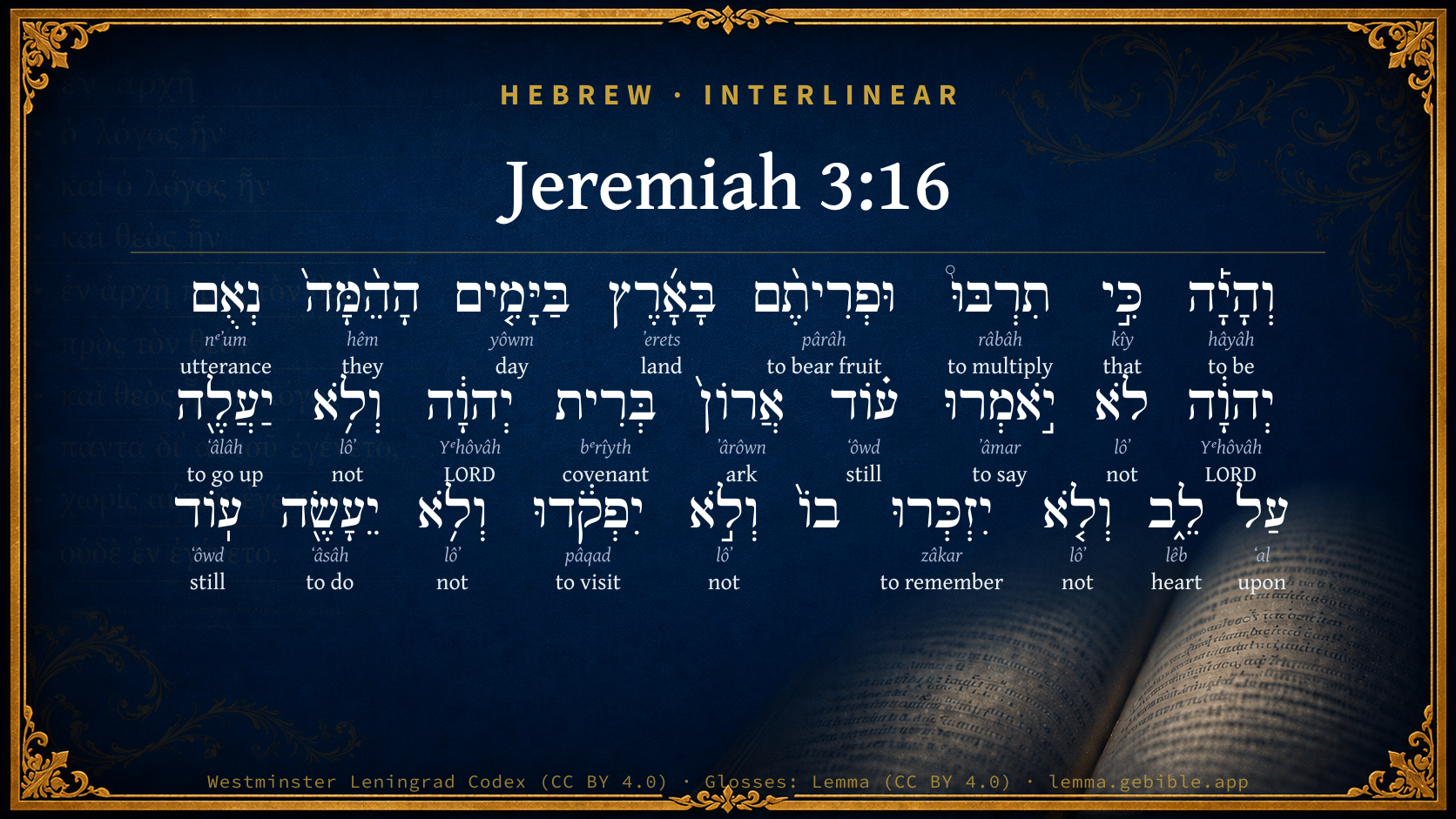
Hebrew (Westminster Leningrad Codex) Jeremiah 3:16 appears in the Hebrew Old Testament. The text above is from the Westminster Leningrad Codex. Each word links to its Strong’s number, a concise gloss, and parsing drawn from the Open Scriptures Hebrew Bible morphology. Click any word for its full Brown-Driver-Briggs (BDB) entry.
Download image
Cite this verse

Jeremiah 3:16 (World English Bible). Public Domain. Lemma interlinear Bible study tool, https://lemma.gebible.app/v/jeremiah/3/16.

Show BibTeX & RIS
BibTeX
RIS
English Translation
It shall come to pass, when you are multiplied and increased in the land, in those days, says Yahweh, they shall say no more, The ark of the covenant of Yahweh; neither shall it come to mind; neither shall they remember it; neither shall they miss it; neither shall it be made any more.
World English Bible · Public Domain
Download a study sheet

One document with this verse’s original text, its word-by-word gloss line, the meaning frame, cross-references with their text, attributed commentary, and full source and license credits — printable, and it pastes into notes with its structure intact.

This verse Autodidact and up

Study sheet (.html) Plain text (.txt)

A passage Seminary Student

Up to 50 verses in one chapter. A passage sheet keeps up to 6 commentary sources and 12 cross-references per verse, in the order this page ranks them, and says so on the sheet whenever that leaves anything out. Ask for a single verse and you get the Autodidact verse sheet above.

Everything on this page stays free to read, with no account — the sheet is a download of what is already on screen, not access to it.

Want to remove ads? Support Godless Engineer
Compare translations 3

The same verse in 3 English versions, stacked beneath the original-language interlinear above. Click any original word for its lexicon entry.

Each is an independent rendering of the whole verse — the interlinear is not word-aligned to these translations.

Highlighted words mark where these versions differ — a whole-verse word diff, not a word-by-word alignment.

  • World English Bible Public Domain
    It shall come to pass, when you are multiplied and increased in the land, in those days, says Yahweh, they shall say no more, The ark of the covenant of Yahweh; neither shall it come to mind; neither shall they remember it; neither shall they miss it; neither shall it be made any more.
  • King James Version Public Domain
    And it shall come to pass, when ye be multiplied and increased in the land, in those days, saith the LORD, they shall say no more, The ark of the covenant of the LORD: neither shall it come to mind: neither shall they remember it; neither shall they visit it; neither shall that be done any more.
  • unfoldingWord Literal Text CC BY-SA 4.0
    And it will happen that you will increase and be fruitful in the land in those days—the declaration of Yahweh—they will no longer say, “The Box of the Covenant of Yahweh!” And it will not come up in heart, and they will not remember it. And they will not miss, and another will not be made.’

unfoldingWord Literal Text — © unfoldingWord, licensed CC BY-SA 4.0. Word-aligned USFM3 via Door43 (git.door43.org/unfoldingWord/en_ult).

Versions to compare (up to 4)

3 of 4 selected

Show all 18 translations

Every available English version of this verse, each an independent rendering of the whole verse.

  • World English Bible Public Domain
    It shall come to pass, when you are multiplied and increased in the land, in those days, says Yahweh, they shall say no more, The ark of the covenant of Yahweh; neither shall it come to mind; neither shall they remember it; neither shall they miss it; neither shall it be made any more.
  • Berean Standard Bible Public Domain
    “In those days, when you multiply and increase in the land,” declares the LORD, “they will no longer discuss the ark of the covenant of the LORD. It will never come to mind, and no one will remember it or miss it, nor will another one be made.
  • Majority Standard Bible Public Domain
    “In those days, when you multiply and increase in the land,” declares the LORD, “they will no longer discuss the ark of the covenant of the LORD. It will never come to mind, and no one will remember it or miss it, nor will another one be made.
  • King James Version Public Domain
    And it shall come to pass, when ye be multiplied and increased in the land, in those days, saith the LORD, they shall say no more, The ark of the covenant of the LORD: neither shall it come to mind: neither shall they remember it; neither shall they visit it; neither shall that be done any more.
  • American Standard Version (1901) Public Domain
    And it shall come to pass, when ye are multiplied and increased in the land, in those days, saith Jehovah, they shall say no more, The ark of the covenant of Jehovah; neither shall it come to mind; neither shall they remember it; neither shall they miss it; neither shall it be made any more.
  • Revised Version (1885) Public Domain
    And it shall come to pass, when ye be multiplied and increased in the land, in those days, saith the LORD, they shall say no more, The ark of the covenant of the LORD; neither shall it come to mind: neither shall they remember it; neither shall they visit it; neither shall that be done any more.
  • Geneva Bible (1599) Public Domain
    Moreouer, when yee be increased and multiplied in the land, in those daies, saieth the Lord, they shall say no more, The Arke of the couenant of the Lord: for it shall come no more to minde, neither shall they remember it, neither shall they visite it, for that shalbe no more done.
  • Douay-Rheims (1899) Public Domain
    And when you shall be multiplied, and increase in the land in those days, saith the Lord, they shall say no more: The ark of the covenant of the Lord: neither shall it come upon the heart, neither shall they remember it, neither shall it be visited, neither shall that be done any more.
  • Young's Literal Translation Public Domain
    And it hath come to pass, when ye are multiplied, And have been fruitful in the land, In those days -- an affirmation of Jehovah, They say not any more, `The ark of the covenant of Jehovah,' Nor doth it go up on the heart, Nor do they remember concerning it, Nor do they inspect, nor is it made again.
  • Literal Standard Version CC BY-SA 4.0
    And it has come to pass, when you are multiplied, || And have been fruitful in the land, || In those days,” || A declaration of YHWH, || “They no longer say, The Ark of the Covenant of YHWH, || Nor does it go up on the heart, || Nor do they remember concerning it, || Nor do they inspect, nor is it made again.
  • Unlocked Literal Bible CC BY-SA 4.0
    Then it will happen that you will increase and bear fruit in the land in those days—this is Yahweh's declaration-they will no longer say, “The ark of the covenant of Yahweh!” This matter will no longer come up in their hearts or be remembered; it will not be missed, and another one will not be made.'
  • unfoldingWord Literal Text CC BY-SA 4.0
    And it will happen that you will increase and be fruitful in the land in those days—the declaration of Yahweh—they will no longer say, “The Box of the Covenant of Yahweh!” And it will not come up in heart, and they will not remember it. And they will not miss, and another will not be made.’
  • Darby Bible Public Domain
    And it shall come to pass, when ye are multiplied in the land and become fruitful, in those days, saith Jehovah, they shall say no more, Ark of the covenant of Jehovah! neither shall it come to mind, nor shall they remember it, nor shall they visit [it]; neither shall it be done any more.
  • World Messianic Bible Public Domain
    It will come to pass, when you are multiplied and increased in the land in those days,” says the LORD, “they will no longer say, ‘the ark of the LORD’s covenant!’ It will not come to mind. They won’t remember it. They won’t miss it, nor will another be made.
  • Webster's Bible Public Domain
    And it shall come to pass, when ye shall be multiplied and increased in the land, in those days, saith the LORD, they shall say no more, The ark of the covenant of the LORD: neither shall it come to mind: neither shall they remember it; neither shall they visit it; neither shall that be done any more.
  • Free Bible Version CC BY-SA 4.0
    At that time as you increase in number in the country, declares the Lord, no one will be talking about the Ark of the Lord's Agreement anymore. People won't need to think about it or remember it or wonder what happened to it; and certainly won't need to make a new one.
  • Bible in Basic English Public Domain
    And it will come about, when your numbers are increased in the land, in those days, says the Lord, that they will no longer say, The ark of the agreement of the Lord: it will not come into their minds, they will not have any memory of it, or be conscious of the loss of it, and it will not be made again.
  • JPS Tanakh (1917) Public Domain
    And it shall come to pass, when ye are multiplied and increased in the land, in those days, saith the LORD, they shall say no more: The ark of the covenant of the LORD; neither shall it come to mind; neither shall they make mention of it; neither shall they miss it; neither shall it be made any more.

Literal Standard Version (2020), Covenant Press — licensed CC BY-SA 4.0. Text via the HelloAO Bible API (eBible.org). Unlocked Literal Bible (unfoldingWord) — licensed CC BY-SA 4.0. Text via the HelloAO Bible API (eBible.org). unfoldingWord Literal Text — © unfoldingWord, licensed CC BY-SA 4.0. Word-aligned USFM3 via Door43 (git.door43.org/unfoldingWord/en_ult). Free Bible Version, Dr. Jonathan Gallagher — licensed CC BY-SA 4.0. Text via the HelloAO Bible API (eBible.org).

Word by word

More ways to search: Search by grammar → Find every occurrence → Compare this word →

Practice this passage: Drill this verse → Learn its vocabulary →

וּפְרִיתֶ֨ם
pârâh
H6509
“and · to bear fruit”
Conjunction + Verb, Qal, Sequential Perfect, 2nd Person, Masculine, Plural
Part of Speech
Conjunction + Verb
Stem
Qal
Form
Sequential Perfect
Person
2nd Person
Gender
Masculine
Number
Plural
Full BDB Definition

Origin: a primitive root

TWOT: 1809

to bear fruit, be fruitful, branch off - (Qal) to bear fruit, be fruitful - (Hiphil) - to cause to bear fruit - to make fruitful - to show fruitfulness, bear fruit
  1. וְהָיָ֡ה hâyâh H1961 “and · to be” Conjunction + Verb, Qal, Sequential Perfect, 3rd Person, Masculine, Singular
  2. כִּ֣י kîy H3588 “that” Conjunction
  3. תִרְבּוּ֩ râbâh H7235 “to multiply” Verb, Qal, Imperfect, 2nd Person, Masculine, Plural
  4. בָּאָ֜רֶץ ʼerets H776 “in/at the · land” Preposition, Determined + Noun, Common, Both, Singular, Absolute
  5. בַּיָּמִ֤ים yôwm H3117 “in/at the · days” Preposition, Determined + Noun, Common, Masculine, Plural, Absolute
  6. הָהֵ֨מָּה֙ hêm H1992 “the · they” Particle, Definite Article + Pronoun, Personal, 3rd Person, Masculine, Plural
  7. נְאֻם nᵉʼum H5002 “utterance of” Noun, Common, Masculine, Singular, Construct
  8. יְהוָ֔ה Yᵉhôvâh H3068 “LORD” Noun, Proper
  9. לֹא lôʼ H3808 “not” Particle, Negative
  10. יֹ֣אמְרוּ ʼâmar H559 “to say” Verb, Qal, Imperfect, 3rd Person, Masculine, Plural
  11. ע֗וֹד ʻôwd H5750 “still” Adverb
  12. אֲרוֹן֙ ʼârôwn H727 “ark of” Noun, Common, Both, Singular, Construct
  13. בְּרִית bᵉrîyth H1285 “covenant of” Noun, Common, Feminine, Singular, Construct
  14. יְהוָ֔ה Yᵉhôvâh H3068 “LORD” Noun, Proper
  15. וְלֹ֥א lôʼ H3808 “and · not” Conjunction + Particle, Negative
  16. יַעֲלֶ֖ה ʻâlâh H5927 “to go up” Verb, Qal, Imperfect, 3rd Person, Masculine, Singular
  17. עַל ʻal H5921 “upon” Preposition
  18. לֵ֑ב lêb H3820 “heart” Noun, Common, Masculine, Singular, Absolute
  19. וְלֹ֤א lôʼ H3808 “and · not” Conjunction + Particle, Negative
  20. יִזְכְּרוּ zâkar H2142 “to remember” Verb, Qal, Imperfect, 3rd Person, Masculine, Plural
  21. וְלֹ֣א lôʼ H3808 “and · not” Conjunction + Particle, Negative
  22. יִפְקֹ֔דוּ pâqad H6485 “to visit” Verb, Qal, Imperfect, 3rd Person, Masculine, Plural
  23. וְלֹ֥א lôʼ H3808 “and · not” Conjunction + Particle, Negative
  24. יֵעָשֶׂ֖ה ʻâsâh H6213 “to do” Verb, Niphal, Imperfect, 3rd Person, Masculine, Singular
  25. עֽוֹד ʻôwd H5750 “still” Adverb

About this verse

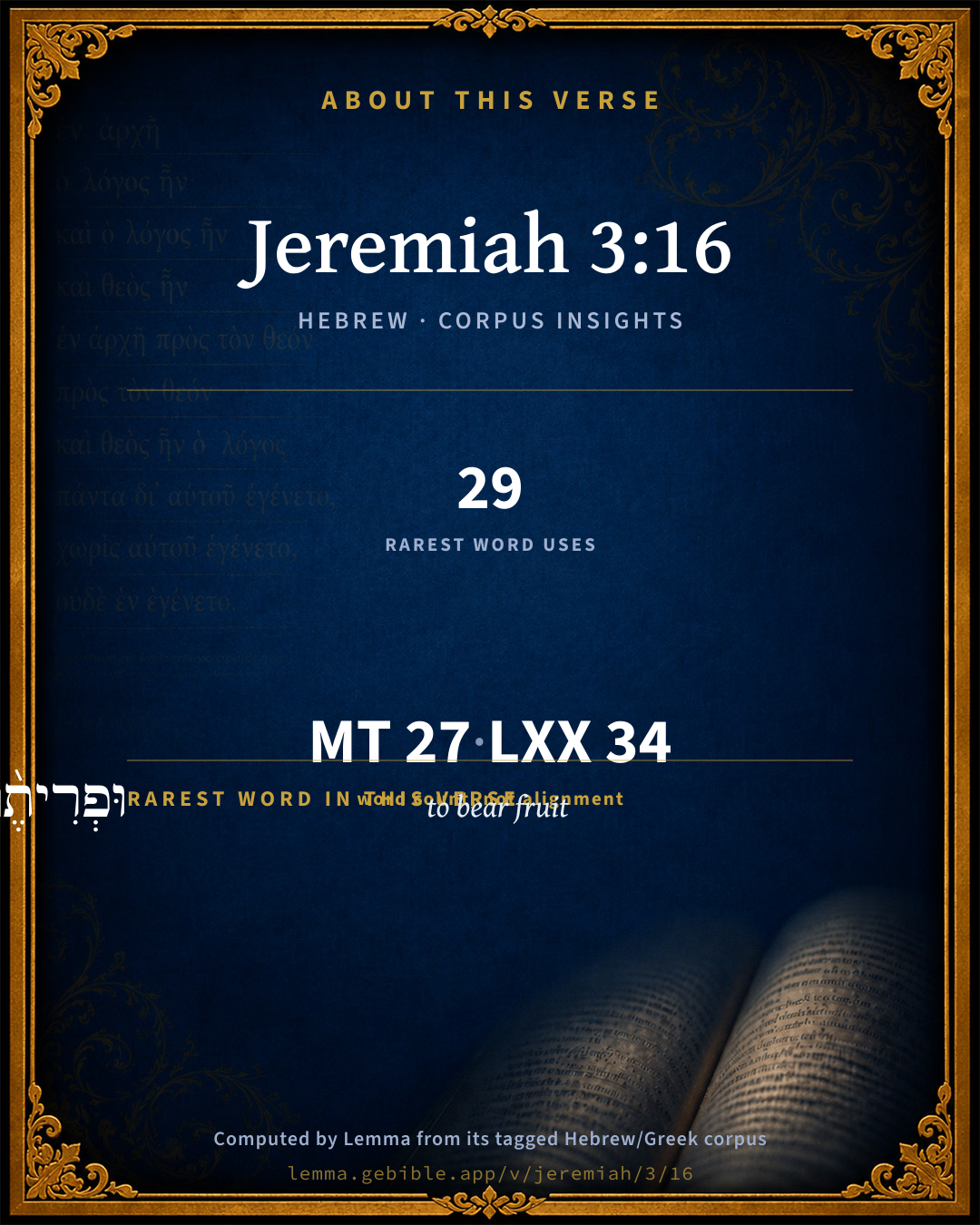
These counts appear in no published source. They are computed here, from the morphology-tagged text and Lemma’s own curated glosses. What Lemma adds →

27
words
20
distinct lemmas
Prophets
section

Shared distinctive vocabulary

וּפְרִיתֶ֨ם to bear fruit H6509 occurs in 28 verses of the Hebrew Bible. Also found in:

Grammatical profile

  • 8 verbs
  • 8 nouns
  • 1 pronoun
  • 2 prepositions
  • 1 conjunction
  • 2 adverbs
  • 5 particles

Verb forms

  • וְהָיָ֡ה Qal · Sequential Perfect
  • תִרְבּוּ֩ Qal · Imperfect
  • וּפְרִיתֶ֨ם Qal · Sequential Perfect
  • יֹ֣אמְרוּ Qal · Imperfect
  • יַעֲלֶ֖ה Qal · Imperfect
  • יִזְכְּרוּ Qal · Imperfect
  • יִפְקֹ֔דוּ Qal · Imperfect
  • יֵעָשֶׂ֖ה Niphal · Imperfect

Repetition

Words recur within this verse — often emphatic in Hebrew:

  • יְהוָ֔ה LORD H3068 ×2
  • ע֗וֹד still H5750 ×2
  • לֹא not H3808 ×5

Hebrew & Septuagint length

In the original languages it is 27 Hebrew tokens and 34 Greek tokens — but the two are counted differently (Hebrew bundles its prefixes and suffixes into one token; the Greek is in lemma form), so that isn’t a like-for-like length.

Cross-references

22

Topical passages linked to Jeremiah 3:16 in the Treasury of Scripture Knowledge — connected by theme and wording, ordered by reader-vote popularity; previews shown in the World English Bible.

  • Amos 9:14–15 I will bring back the captivity of my people Israel, And they will rebuild the ruined cities, and inhabit them; and they will plant vineyards, and drink wine from them. They shall also make gardens, And eat the fruit of them.
  • Isaiah 65:17 For, behold, I create new heavens and a new earth; and the former things shall not be remembered, nor come into mind.
  • Ezekiel 37:26 Moreover I will make a covenant of peace with them; it shall be an everlasting covenant with them; and I will place them, and multiply them, and will set my sanctuary in the midst of them forevermore.
  • Isaiah 66:1–2 Thus says Yahweh, heaven is my throne, and the earth is my footstool: what manner of house will you build to me? and what place shall be my rest?
  • Hosea 1:10–11 Yet the number of the children of Israel will be as the sand of the sea, which can't be measured nor numbered; and it will come to pass that, in the place where it was said to them, 'You are not my people,' they will be called 'sons of the living God.'
  • Zechariah 8:4–5 Thus says Yahweh of Hosts: "Old men and old women will again dwell in the streets of Jerusalem, every man with his staff in his hand for very age.
  • Isaiah 60:22 The little one shall become a thousand, and the small one a strong nation; I, Yahweh, will hasten it in its time.
  • Isaiah 61:4 They shall build the old wastes, they shall raise up the former desolations, and they shall repair the waste cities, the desolations of many generations.
  • Jeremiah 30:19 Out of them shall proceed thanksgiving and the voice of those who make merry: and I will multiply them, and they shall not be few; I will also glorify them, and they shall not be small.
  • Jeremiah 31:8 Behold, I will bring them from the north country, and gather them from the uttermost parts of the earth, [and] with them the blind and the lame, the woman with child and her who travails with child together: a great company shall they return here.
  • Ezekiel 36:8–12 But you, mountains of Israel, you shall shoot forth your branches, and yield your fruit to my people Israel; for they are at hand to come.
  • Zechariah 10:7–9 Ephraim will be like a mighty man, And their heart will rejoice as through wine; Yes, their children will see it, and rejoice. Their heart will be glad in Yahweh.
  • Matthew 3:9 Don't think to yourselves, 'We have Abraham for our father,' for I tell you that God is able to raise up children to Abraham from these stones.
  • Hebrews 10:19–21 Having therefore, brothers, boldness to enter into the holy place by the blood of Jesus,
  • Jeremiah 7:4 Don't you trust in lying words, saying, The temple of Yahweh, the temple of Yahweh, the temple of Yahweh, are these.
  • Jeremiah 31:27 Behold, the days come, says Yahweh, that I will sow the house of Israel and the house of Judah with the seed of man, and with the seed of animal.
  • Amos 9:9 "For, behold, I will command, and I will sift the house of Israel among all the nations, as grain is sifted in a sieve, yet not the least kernel will fall on the earth.
  • Zephaniah 3:11 In that day you will not be disappointed for all your doings, in which you have transgressed against me; for then I will take away out of the midst of you your proudly exulting ones, and you will no more be haughty in my holy mountain.
  • Matthew 1:11 Josiah became the father of Jechoniah and his brothers, at the time of the exile to Babylon.
  • John 4:20–24 Our fathers worshiped in this mountain, and you Jews say that in Jerusalem is the place where people ought to worship."
  • Hebrews 9:9–12 which is a symbol of the present age, where gifts and sacrifices are offered that are incapable, concerning the conscience, of making the worshipper perfect;
  • Hebrews 10:8–9 Previously saying, "Sacrifices and offerings and whole burnt offerings and sacrifices for sin you didn't desire, neither had pleasure in them" (those which are offered according to the law),

Cross-references courtesy of OpenBible.info (CC BY 4.0).

Hebrew and Greek witnesses Masoretic Hebrew ↔ Greek Septuagint

The same verse in the two great witnesses to the Old Testament, shown verse-for-verse.

These are two independent witnesses, not word-aligned to each other, and the Septuagint is shown in lemma (dictionary) form.

Hebrew Jeremiah 3:16 Masoretic · Westminster Leningrad Codex

וְהָיָ֡ה כִּ֣י תִרְבּוּ֩ וּפְרִיתֶ֨ם בָּאָ֜רֶץ בַּיָּמִ֤ים הָהֵ֨מָּה֙ נְאֻם יְהוָ֔ה לֹא יֹ֣אמְרוּ ע֗וֹד אֲרוֹן֙ בְּרִית יְהוָ֔ה וְלֹ֥א יַעֲלֶ֖ה עַל לֵ֑ב וְלֹ֤א יִזְכְּרוּ בוֹ֙ וְלֹ֣א יִפְקֹ֔דוּ וְלֹ֥א יֵעָשֶׂ֖ה עֽוֹד

It shall come to pass, when you are multiplied and increased in the land, in those days, says Yahweh, they shall say no more, The ark of the covenant of Yahweh; neither shall it come to mind; neither shall they remember it; neither shall they miss it; neither shall it be made any more.

World English Bible · Public Domain

Greek LXX Structure differs

In the Septuagint, Jeremiah is about an eighth shorter than the Hebrew and arranges its material differently — the Oracles Against the Nations (Hebrew chapters 46–51) appear in the middle of the Greek book, after 25:13. Because the chapter and verse boundaries do not line up, a verse-for-verse comparison with the Hebrew is not shown.

A verse-for-verse comparison isn’t shown here because the chapters and verses don’t line up. Switch to the LXX edition with the MT / LXX toggle above to read the Greek directly.

On this verse, Joseph Benson's Commentary discusses the Septuagint’s reading. Read the note in Commentary ↓

Hebrew: Westminster Leningrad Codex (CC BY 4.0). Greek: Septuagint (public domain); English from a public-domain English Septuagint. How the Septuagint differs from the Hebrew →

Targum (Aramaic paraphrase)

1

The Targum is the ancient Jewish Aramaic paraphrase of the Hebrew Scriptures — an interpretive translation, not the Hebrew text itself. Onkelos (literal) and Pseudo-Jonathan (expansive) render the Torah, and Jonathan the Prophets. Coverage is partial: where no permissively-licensed English translation exists for a verse, only the Aramaic is shown. This is verse-level text, not a word-by-word alignment to the Hebrew.

  1. Targum Jonathan Prophets (Joshua–Malachi)
    וִיהֵי אֲרֵי תִסְגוּן וְתִפְשׁוּן בְּאַרְעָא בְּיוֹמַיָא הָאִינוּן אֲמַר יְיָ לָא יֵימְרוּן עוֹד אֲרוֹן קְיָמָא דַייָ וְלָא יִסַק עַל לֵב וְלָא יִדְכְּרוּן עוֹד בֵּיהּ וְלָא יְזוּעוּן וְלָא יְגִיחוּן בֵּיהּ עוֹד קְרָב:

    (no public-domain English translation for this verse)

    Targum Jonathan — Aramaic: “Mikraot Gedolot” (public domain). English: “Sefaria Community Translation” (CC0 1.0 (public-domain dedication)); “London "Chaldee Paraphrase," 1871” (public domain). Text via Sefaria.

Commentary

Notes on Jeremiah 3:16 from classic Christian and Jewish commentators (each source and its license shown beneath its notes). The classic Christian expositions comment on the surrounding passage and are grouped to its opening verse, so a note may address several verses; the Jewish commentaries on the Tanakh (Rashi and others) are per-verse, so they appear only where the commentator wrote on this verse.

Lemma curates 59 commentaries, every one of them public domain or Creative Commons licensed, each selected and text-cleaned for this edition rather than reprinted as found. About our sources →

Trapp's Complete Commentary

John Trapp

Jer 3:16 And it shall come to pass, when ye be multiplied and increased in the land, in those days, saith the LORD, they shall say no more, The ark of the covenant of the LORD: neither shall it come to mind: neither shall they remember it; neither shall they visit [it]; neither shall [that] be done any more.

Ver. 16. They shall say no more, The ark, &c.] When the gospel shall be preached, the ancient ceremonies shall be abolished. {a} This was not so easily believed, and is therefore here again and again assured.

{a} Paulus ea vocat stercora et rudera.

John Trapp, A Commentary or Exposition upon All the Books of the Old and New Testament (1647–1656) — public domain. Text from a community e-Sword module.

Albert Barnes' Notes on the Bible

In those days - This and the phrase “the latter days,” had become under the Messianic teaching of the prophets a regular formula for the time of Christ’s coming, when all the nation’s hopes would be fulfilled.

The ark was the center of the Mosaic economy, containing within it the two tables’ of the Law as the conditions of the covenant and having over it, upon the mercy-seat, the Shechinah as the visible sign of God’s presence. But “in those days” the symbol must pass away, because God will then dwell in His people by the gift of the Holy Spirit 1Co 3:16, and the terms of the covenant will be written on their hearts Jer 31:33.

Neither shall they visit it - Rather, neither shall they miss it; i. e., they will not trouble about it, nor regret its loss.

Neither shall that be done anymore - Rather, “neither shall it (the ark) be made anymore;” it shall not be renewed or repaired, because the tabernacle of God will be one “made without hands” Heb 9:11, even the heart of His believing people.

Albert Barnes' Notes on the Bible (1834–1885) — public domain. Text from a community e-Sword/MySword module.

The Biblical Illustrator

Joseph S. Exell

Jer_3:16

The ark of the covenant of the Lord.

The ark of the covenant

When inward piety is low the externals of religion are frequently cried up. Those who know nothing of God are the very people to exclaim concerning themselves and their brethren, The temple of the Lord, the temple of the Lord are these. The more phylactery, the less sanctity. On the other hand, whenever the Spirit of God is largely poured out, although the ordinances of God are carefully attended to, yet as external things they are sure to be put into their proper place, and that proper place is a secondary one.

I. The symbol reverenced.

1. The ark of the covenant was the object of great reverence, and very fitly so, because it symbolised Gods presence, the presence of Jehovah, the living God, in the midst of His people.

2. That presence of God meant blessing; for God was with His people in love to them. The Lord abides not with His enemies, but with His chosen. So long as He gave the token of His presence it was a sign that He had not cast them off as hopeless.

3. The ark was held in reverence by the Israelites because it was their leader. When the time came to march through the wilderness the ark went in the forefront.

4. The ark was to the Israelites, after their wanderings were over, the fixed centre of their nationality, even as while they were in the wilderness it had always been placed in the centre of the camp.

5. Marvel not that the men of Judah paid great reverence to this ark when, in so many ways, it was a token for good to them. What they did to this ark is mentioned in the text. First, they recognised it as the ark of the covenant of the Lord. They were wont to say, The ark of the covenant of the Lord. They spoke much of it, and prided themselves upon the possession of it. Nay, they not only spoke of it: but they loved it; for we read, Neither shall it come to mind, or as the margin has it, Neither shall it come upon the heart. In the next place, they remembered it, as the text plainly informs us. If they were captives they prayed in the direction in which the ark was situated; wherever they wandered they thought of God and of the coffer which represented His presence. Next, they visited it. On certain holy days they came from the utmost ends of their land, in joyful companies, singing from stage to stage, and making joyful holiday as they went up to the place where God did dwell between the cherubim. Visiting it, they were accustomed also to speak highly of it; for in the margin of your Bibles you will find, Neither shall they magnify it any more. They used to tell to one another what the ark had done; the glory that shone forth from it, the acceptance of the offering whose blood was sprinkled upon it on the day of atonement, and the testimony which was heard from between the cherubic wings.

II. That reverence obliterated. They were to say no more, The ark of the covenant of the Lord. Yet that fact was to be a blessing. They were no more to speak of the ark itself, because they would have that which the ark was intended to foreshadow.

1. Our Lord Jesus by His coming has put out of His peoples thoughts the material ark of the covenant, because its meaning is fulfilled in Him; and this, first, in the sense of preservation. He said, Thy law is within My heart. It was not within His heart alone, but within all. His life; His whole thoughts, words, and acts went to make up a golden chest in which the precious treasure of the perfect law of God should be contained.

2. Next, the ark signified propitiation; for over the top of the sacred box, which held the two tables of the law, was the slab of gold called the mercy seat, which covered all. When God looks down upon His law, He does not see it nakedly, but He beholds it in the person of His Son. He sees it there perfectly preserved, without taint or flaw of any kind, and He rejoices therein.

3. The next word is a very blessed one, and that is covenant. The ark was called the ark of the covenant. Ah, how soon we should lose the sweet things of God if we were under the covenant of works, and how soon we should miss the gentle sovereignty of His shepherd rod! I thank God that in Christ Jesus we have a covenant of grace which can never fail, and never can be broken, and in Him we have all that our souls desire: pot of manna and rod of Aaron, covenant provision and covenant rule we find in Him.

4. Because this ark was the ark of the covenant of God it was from it that He was accustomed to reveal Himself, and so it is called the ark of testimony. We say no more, The ark of the testimony, but we rejoice that God was made flesh, and dwelt among us, and we beheld His glory, and saw the Father in the Son.

5. This ark also signified enthronement; for the top of the ark was, so to speak, the throne of God. It was the throne of the heavenly grace. If you would see the throne of God, behold the person of the Christ; for in Him dwelleth all the fulness of the Godhead bodily. Oh, what a blessing to have such a throne to come to--to Jesus Himself, who is the throne of the invisible God!

6. As it was the place of Gods enthronement, so it was the door of mans approach. You and I need not speak of the ark of the covenant; for we have a blessed way of approach. We do not come to Christ once in the year only, but every day in the year, and every hour of the day.

7. The ark was the place of gracious power. On the top of the mercy seat stood cherubic figures, types of angelic power, and of all the powers of providence which God is pleased to use in the behalf of His people. Yet we will not speak of the ark, neither will we remember it, neither will we visit it; for we see in Christ Jesus that all the power of God is on our side: He is God with us, and if God be with us, who can be against us?

8. The ark was much reverenced by the Jews, because it was the centre of their nationality. Find me a dozen spiritual men, and describe their different modes of thought; but let them sit together and begin to talk of the things of God, and of the covenant of grace, and of the work of the Spirit in the soul, and of the preciousness of the blood of Jesus, and you will see that they are one. There is, there must be, an essential unity among those who are quickened by the Spirit: and I rejoice that the name, the person, and the work of Jesus are at this hour the centre of Christendom.

III. This reverence transferred.

1. Let us say that Jesus is our covenant. We are told, They shall say no more, The ark of the covenant of the Lord. People must talk, it is natural to them--what else are their tongues for? Let us, then, say concerning Christ that He is the ark of the covenant of the Lord. Say this, say it often, nobody will rebuke you; it is a subject upon which you may be as fluent as you please. This is a kind of note of which the human ear, when once it is cleansed, never grows weary.

2. The text takes you a step further; for it says of the original ark, Neither shall it come to mind. or (I give the margin), Neither shall it come upon your heart. Let Christ come upon your heart and dwell there. Oh, love the Lord, alive His saints! You can love other things too much; but not your Lord.

3. And, next, if we should ever grow dull or cold at any time, let us take the third step in the text, and let us remember the Lord. O memory, leave no other name than that of Jesus recorded upon thy tablets.

4. The next thing is, let us visit Him. We cannot set out on journeys now to go to Jerusalem on foot,--little bands of us together; yet let us visit Jesus. Let us continually come to the mercy seat. No prayer, no power. The ark of the covenant is gone when the people no longer come together to cry unto the Lord.

5. The last thing is, Neither shall that he done any more; but the margin has it, Neither shall that be magnified any more. Transfer your reverence, then, and as you cannot magnify the literal mercy seat, come and magnify Christ, who is the real mercy seat. (C. H. Spurgeon.)

Christ, the true ark of the covenant

I. A most alarming and unwelcome announcement. That the ark would disappear, and another not be made. Israels safety and prosperity were connected with the ark of covenant. By some regarded with superstitious awe rather than reverential fear; yet by all as of incalculable value to the nations.

II. A bitter and irreconcilable loss.

1. Prophecy soon fulfilled.

2. Loss deeply lamented.

III. A surpassing compensation predicted.

1. Must have seemed incredible at the time; yet afterwards proved consolatory.

2. How was the prediction fulfilled? In the appearing of Christ, the antitype of the ark.

IV. The realisation in Christ of the ark symbolised.

1. The Divine nearness.

2. The Deity bending mercifully over mere

3. The helpful and healing grace of God.

Conclusion--

1. Israelites who early became Christians, and enjoyed the presence of Christ on earth, must have readily surrendered and forgotten the ark in the realisation of Jesus and His tender grace.

2. Believers, though now not realising Christ bodily among them, experience His Spirits indwelling, revealing Christ within.

3. Contrite sinners can rejoice in the tenderness, lowliness, and compassion of Christ. (R. Gordon, D. D.)

The Biblical Illustrator, edited by Joseph S. Exell (c. 1880s–1900s) — public domain. Text from a community e-Sword module.

Joseph Benson's Commentary

Jer 3:16. And when ye be multiplied — That is, when the kingdom of the Messiah shall be set up, and there shall be a vast increase of the members of the church by the accession of the Gentiles: for that the days of the Messiah are here intended, the Jewish masters themselves acknowledge; they shall say no more, The ark, &c. — The ark is here put for all the legal ceremonies, being, with the rites connected with it, the chief part thereof. The sense is, that whole worship, with all the rites and ceremonies belonging to it, shall wholly cease, Christ being come, who was the substance of what the ark and all other rites did but shadow out for a time. “Here,” says Blaney, “God comforts the Jews with an assurance that, though upon their return to him they might not find themselves in possession of exactly the same privileges as they had before, they should be no losers, but should receive ample indemnification, so as to leave them no just cause of regret. The ark of the covenant was the visible seat of God’s residence among his people; it was therefore the object of their boast; but after the destruction of the first temple they had it no more. But, to compensate this loss, they are told, in the next verse, that Jerusalem should be called the throne of Jehovah, to which, not the Jews only, but all nations should resort. By Jerusalem is probably meant the Christian Church: see Gal 4:26; Rev 21:2-3. The greater privileges of this latter would, of course, supersede all boast on account of those which had belonged to the Jewish Church at any time.”

Neither shall it come to mind — Hebrew, ולא יעלה על לב, which Blaney renders, Nor shall it be the delight of their heart; namely, as it formerly was, observing, that several passages of Scripture where the same phrase occurs show this to be the import of it. What value the Israelites set upon the ark, and how much they were attached to it, appears from many parts of their history. Neither shall they remember it — They shall forget the less in contemplation of the greater benefit. Neither shall they visit it — Or care for it, as Blaney translates יפקדו, which often signifies to look after a thing, which has been long lost or neglected, with a wish or design to recover or restore it. In this sense God is said to have visited his people, Exo 3:16; Luk 1:68; that is, he again showed that he concerned himself about them. And so it is said of the people, Isa 26:16, O Lord, in trouble have they visited thee; that is, they, who before neglected thee, in their affliction turned their thoughts and desires toward thee. Neither shall that be done any more — It shall be no more in use; neither shall men trouble their thoughts about it, or mention it. The Hebrew, ולא יעשׂה עוד, is literally rendered by the LXX., και ου ποιηθησεται ετι, Nor shall it be made any more. So also the Vulgate, nec fiet ultra. The ark, once lost, was never to be made again, or restored: and for a good reason, which immediately follows; because, instead of the ark, Jerusalem itself, that is, the Christian Church, was to become the seat of God’s residence. It is probable that this great variety of expressions is used, not only to show that the ceremonies of the law of Moses should be totally and finally abolished, never to be used any more, but that it would be with difficulty that those who had been so long wedded to them would be weaned from them; and that they would not quite relinquish them till their holy city and holy house should both be levelled with the ground.

Joseph Benson's Commentary on the Old and New Testaments (1811–1818) — public domain. Text from a community e-Sword module.

Keil & Delitzsch

C. F. Keil & F. Delitzsch

In Jer 3:16 and Jer 3:17 also the thought is clothed in a form characteristic of the Old Testament. When the returned Israelites shall increase and be fruitful in the land, then shall they no more remember the ark of the covenant of the Lord or feel the want of it, because Jerusalem will then be the throne of the Lord. The fruitfulness and increase of the saved remnant is a constant feature in the picture of Israel's Messianic future; cf. Jer 23:3; Eze 36:11; Hos 2:1. This promise rests on the blessing given at the creation, Gen 1:28. God as creator and preserver of the world increases mankind together with the creatures; even so, as covenant God, He increases His people Israel. Thus He increased the sons of Israel in Egypt to be a numerous nation, Exo 1:12; thus, too, He will again make fruitful and multiply the small number of those who have been saved from the judgment that scattered Israel amongst the heathen. In the passages which treat of this blessing, פּרה generally precedes רבה; here, on the contrary, and in Eze 36:11, the latter is put first. The words 'לא יאמרוּ וגו must not be translated: they will speak no more of the ark of the covenant; אמר c. accus. never has this meaning. They must be taken as the substance of what is said, the predicate being omitted for rhetorical effect, so that the words are to be taken as an exclamation. Hgstb. supplies: It is the aim of all our wishes, the object of our longing. Mov. simply: It is our most precious treasure, or the glory of Israel, Sa1 4:21.; Psa 78:61. And they will no more remember it. Ascend into the heart, i.e., come to mind, joined with זכר here and in Isa 65:17; cf. Jer 7:31; Jer 32:35; Jer 51:50; Co1 2:9. ולא יפקדוּ, and they will not miss it; cf. Isa 34:16; Sa1 20:6, etc. This meaning is called for by the context, and especially by the next clause: it will not be made again. Hitz.'s objection against this, that the words cannot mean this, is an arbitrary dictum. Non fiet amplius (Chr. B. Mich.), or, it will not happen any more, is an unsuitable translation, for this would be but an unmeaning addition; and the expansion, that the ark will be taken into the battle as it formerly was, is such a manifest rabbinical attempt to twist the words, that it needs no further refutation. Luther's translation, nor offer more there, is untenable, since עשׂה by itself never means offer.

The thought is this: then they will no longer have any feeling of desire or want towards the ark. And wherefore? The answer is contained in Jer 3:17: At that time will they call Jerusalem the throne of Jahveh. The ark was the throne of Jahveh, inasmuch as Jahveh, in fulfilment of His promise in Exo 25:22, and as covenant God, was ever present to His people in a cloud over the extended wings of the two cherubim that were upon the covering of the ark of the law; from the mercy-seat too, between the two cherubs, He spake with His people, and made known to them His gracious presence: Lev 16:2; cf. Ch1 13:6; Psa 80:2; Sa1 4:4. The ark was therefore called the footstool of God, Ch1 28:2; Psa 99:5; Psa 132:7; Lam 2:1. But in future Jerusalem is to be, and to be called, the throne of Jahveh; and it is in such a manner to take the place of the ark, that the people will neither miss it nor make any more mention of it. The promise by no means presumes that when Jeremiah spoke or wrote this prophecy the ark was no longer in existence; "was gone out of sight in some mysterious manner," as Movers, Chron. S. 139, and Hitz. suppose,

(Note: Against this Hgstb. well says, that this allegation springs from the incapacity of modern exegesis to accommodate itself to the prophetic anticipation of the future; and that we might as well infer from Jer 3:18, that at the time these words were spoken, the house of Judah must already in some mysterious manner have come into the land of the north. Ch2 35:5 furnishes unimpeachable testimony to the existence of the ark in the 18th year of Josiah. And even Graf says he cannot find anything to justify Movers' conclusion, since from the special stress laid on the fact that at a future time they will have the ark no longer, it might more naturally be inferred that the ark was still in the people's possession, and was an object of care to them.)

but only that it will be lost or destroyed. This could happen only at and along with the destruction of Jerusalem; and history testifies that the temple after the exile had no ark. Hence it is justly concluded that the ark had perished in the destruction of Jerusalem by the Chaldeans, and that upon the rebuilding of the temple after the exile, the ark was not restored, because the nucleus of it, the tables of the law written by the finger of God, could not be constructed by the hand of man. Without the ark the second temple was also without the gracious presence of Jahveh, the Shechinah or dwelling-place of God; so that this temple was no longer the throne of God, but only a seeming temple, without substance or reality. And thus the Old Testament covenant had come to an end. "We have here then before us," Hgstb. truly observes, "the announcement of an entire overthrow of the earlier form of the kingdom; but it is such an overthrow of the form that it is at the same time the highest perfection of the substance - a process like that in seed-corn, which only dies in order to bring forth much fruit; like that in the body, which is sown a corruptible that it may rise an incorruptible." For the dwelling and enthronement of the Lord amidst His people was again to come about, but in a higher form. Jerusalem is to become the throne of Jahveh, i.e., Jerusalem is to be for the renewed Israel that which the ark had been for the former Israel, the holy dwelling-place of God. Under the old covenant Jerusalem had been the city of Jahveh, of the great King (Psa 48:3); because Jerusalem had possessed the temple, in which the Lord sat enthroned in the holy of holies over the ark. If in the future Jerusalem is to become the throne of the Lord instead of the ark, Jerusalem must itself become a sanctuary of God; God the Lord must fill all Jerusalem with His glory (כּבוד), as Isaiah prophesied He would in Isaiah 60, of which prophecy we have the fulfilment portrayed in Apoc. 21 and 22. Jeremiah does not more particularly explain how this is to happen, or how the raising of Jerusalem to be the throne of the Lord is to be accomplished; for he is not seeking in this discourse to proclaim the future reconstitution of the kingdom of God. His immediate aim is to clear away the false props of their confidence from a people that set its trust in the possession of the temple and the ark, and further to show it that the presence of the temple and ark will not protect it from judgment; that, on the contrary, the Lord will reject faithless Judah, destroying Jerusalem and the temple; that nevertheless He will keep His covenant promises, and that by receiving again as His people the repentant members of the ten tribes, regarded by Judah as wholly repudiated, with whom indeed He will renew His covenant.

As a consequence of Jerusalem's being raised to the glory of being the Lord's throne, all nations will gather themselves to her, the city of God; cf. Zac 2:1-13 :15. Indeed in the Old Testament every revelation of the glory of God amongst His people attracted the heathen; cf. Jos 9:9. לשׁם יהוה, not, to the name of Jahveh towards Jerusalem (Hitz.), but, because of the name of Jahveh at Jerusalem (as in Jos 9:9), i.e., because Jahveh reveals His glory there; for the name of Jahveh is Jahveh Himself in the making of His glorious being known in deeds of almighty power and grace. לירוּשׁלם, prop. belonging to Jerusalem, because the name makes itself known there; cf. Jer 16:19; Mic 4:2; Zac 8:22. - The last clause, they will walk no more, etc., refers not to the heathen peoples, but to the Israelites as being the principal subject of the discourse (cf. Jer 5:16), since שׁררוּת is used of Israel in all the cases (Jer 7:24; Jer 9:13; Jer 11:8; Jer 13:10; Jer 16:12; Jer 18:12; Jer 23:17, and Psa 81:13), thus corresponding to the original in Deu 29:18, whence it is taken. שׁררוּת prop. firmness, but in Hebr. always sensu malo: obstinacy, obduracy of heart, see in Deut. l.c.; here strengthened by the adjective הרע belonging to לבּם.

Keil & Delitzsch — Biblical Commentary on the Old Testament (1861–1891) — public domain (CC PDM 1.0). Text via the HelloAO Bible API. (Old Testament only.)

Tyndale Open Study Notes

Tyndale Open Resources

3:16 When Judah was decimated and Jerusalem was destroyed, the land was nearly empty of people. But in the future, the devastated land would once more be filled with people. Its inhabitants would not dwell on the past or need the Ark to remind them of God’s presence (23:3; Isa 49:19; 65:17).

Tyndale Open Study Notes — © Tyndale Open Resources, licensed CC BY-SA 4.0. Text via the HelloAO Bible API.

Geneva Bible (1599)

Geneva Bible translators

This is to be understood of the coming of Christ: for then they shall not seek the Lord by ceremonies, and all figures shall cease.

Geneva Bible (1599) marginal notes — public domain. Text via Bolls.life.

Jamieson, Fausset & Brown

Robert Jamieson, A. R. Fausset & David Brown

they shall say no more--The Jews shall no longer glory in the possession of the ark; it shall not be missed, so great shall be the blessings of the new dispensation. The throne of the Lord, present Himself, shall eclipse and put out of mind the ark of the covenant and the mercy seat between the cherubim, God's former throne. The ark, containing the two tables of the law, disappeared at the Babylonian captivity, and was not restored to the second temple, implying that the symbolical "glory" was to be superseded by a "greater glory" (Hag 2:9).

neither . . . visit it--rather, "neither shall it be missed" (so in Jer 23:4).

done--rather, "neither shall it (the ark) be made (that is, be restored) any more" [MAURER].

Jamieson, Fausset & Brown — Commentary Critical and Explanatory on the Whole Bible (1871) — public domain (CC PDM 1.0). Text via the HelloAO Bible API.

Adam Clarke's Commentary

Verse 16. The ark of the covenant of the Lord] This symbol of the Divine presence, given to the Jews as a token and pledge of God's dwelling among them, shall be no longer necessary, and shall no longer exist; for in the days of the Messiah, to which this promise seems to relate, God's worship shall not be confined either to one place or to one people. The temple of God shall be among men, and every where God be adored through Christ Jesus.

Neither shall that be done any more.] The ark shall be no more established, nor carried from place to place, nor shall men go to visit it. All its ceremonies and importance shall cease; and, if lost, shall never be rebuilt.

Adam Clarke's Commentary on the Bible (1810–1826) — public domain. Text from a community e-Sword/MySword module.

John Calvin's Commentaries

Interpreters have perverted this verse, for none of them have understood the design of the Prophet. The Jews, for the most part, have adduced frigid and far — fetched glosses, — that they would no more bring out to battles the Ark of the Covenant, as no enemy would invade their land. They think then that a peaceable state is promised to the people, as they would be constrained by no hostile force to carry the Ark of the Covenant here and there. But we clearly see that the words mean no such thing: it is then a comment wholly foreign to the subject. Others say, that what is said must be applied to the time of the Messiah, and none even of the Jews deny this; for it afterwards follows, that the Israelites would return with the tribe of Judah. This had not yet been fulfilled; it hence follows, that the Prophet here predicts of the kingdom of Christ. But the Jews, while allowing this, do not understand that anything is said of the abrogation of legal ceremonies; it has yet been thought by almost all Christians, that the Prophet here teaches us, that when Christ should come, an end would be put to all the shadows of the law, so that there would be no more any Ark of the Covenant, as the fullness of the Godhead would dwell in Christ.

This indeed is a view which seems plausible, but the meaning of the Prophet, as I think, is wholly different: for he refers here to that divorce or division which had for a long time existed between the kingdom of Judah and the kingdom of Israel. Though the kingdom of Israel, as to the number of its men, largeness of territory and wealth, was more flourishing and prosperous than the kingdom of Judah; yet there remained these advantages to the Jews, — that they had a Temple built according to God’s command, — that its place had been chosen by God, — that they had the Ark of the Covenant as a symbol of God’s presence. Hence there was contention between the kingdom of Judah and the ten tribes: the Israelites were elated on account of their number and their riches, and other temporal advantages; and the Jews gloried in their Temple and the Ark of the Covenant. And what now does the Prophet say? He declares that such would be the concord between the Israelites and the Jews, that the Jews would no more say, “The Ark of the Covenant,” “The Temple of God;” for God would be present with them all. And the Prophet proceeds to confirm more fully what I have just said: it is therefore necessary to add the two following verses. He then says —

John Calvin's Commentaries (1540-1563) — public domain. Text from the Calvin Translation Society English edition (1840s-50s) via the Christian Classics Ethereal Library (ccel.org). Calvin's coverage is partial (roughly two-thirds of the Bible); uncommented books and verses are honest gaps, never fabricated. The 19th-century editor's footnotes and remarks are omitted so the notes are faithfully Calvin's own voice.

Ellicott's Commentary for English Readers

(16) In those days.—No time had been named, but the phrase had become familiar for the far-off better time of the true king of the Messianic kingdom.

They shall say no more, The ark of the covenant of the Lord.—Noteworthy both for its exceeding boldness and as containing the germ, or more than the germ, of the great thought of the New Covenant developed in Jer_31:31. The ark, the very centre of the worship of Israel, the symbol and, it might seem, more than the symbol, of the Divine presence, that, too, should pass away, as the brasen serpent had become Nehushtan (2Ki_18:4), and take its place as belonging only to the past. Foremost among the prophets was Jeremiah to perceive and proclaim that

“God fulfils Himself in many ways.”

The legend of 2Ma_2:4-5, that Jeremiah had hidden the tabernacle and the ark in a cave that they might be restored in the latter days, presents a singular contrast to the higher thoughts of the prophet.

Neither shall it come to mind.—Literally, come upon the heart, which throughout the Old Testament implies the intellect rather than the affections.

Neither shall they visit it.—Better, shall they miss it, as men miss what they value. The words probably refer to the feelings with which the ark had been restored to its place by Josiah (2Ch_35:3) after its displacement by Manasseh (2Ch_33:7).

Neither shall that be done any more.—Better, neither shall it [the ark] be made any more. It shall be left to decay and perish, and none shall care to reconstruct it. The words had, of course, a fulfilment in the ritual of the second Temple, where there was no ark in the Holy of Holies, and that loss was probably what Jeremiah foresaw most clearly, and for which he sought to prepare his people, as the writer of the Epistle to the Hebrews (Heb_8:13) did to prepare those of his time for the more entire destruction of the Temple and its worship. But even within this horizon the thought was bold in itself and pregnant with yet greater truths.

A Bible Commentary for English Readers, edited by Charles John Ellicott (1878–1897) — public domain. Text from a community e-Sword module.

The Cambridge Bible for Schools and Colleges

gen. ed. J. J. S. Perowne

16. The Ark, which had been the seat of the special manifestation of Jehovah, shall be forgotten, because the whole city shall be filled with His presence.

And it shall … in the land] Probably a later insertion in the passage, connecting with the “one” and “two” of Jer_3:14, and implying that when they came to be numerous, they would no longer need the Ark as symbol, while till then it would be essential. In accordance with this view are the words “be multiplied and increased,” as being an expression characteristic of the exilic document (P), which forms one of the component parts of the Pentateuch. Cp. the same two verbs (identical in the Hebrew) in Jer_23:3, and so in Eze_36:2.

in those days] a phrase denoting the ideal future. Cp. Jer_5:18, Jer_33:16.

visit] rather (with mg.) miss, feel the want of.

neither shall that be done any more] rather (with mg.) neither shall it (the Ark) be made any more; no visible symbol shall be needed.

The Cambridge Bible for Schools and Colleges (gen. ed. J. J. S. Perowne; Cambridge University Press, 1878–1918) — public domain. Text from a community e-Sword module.

John Gill's Exposition

And it shall come to pass, when ye be multiplied and increased in the land,.... That is, when the number of the disciples and followers of Christ, and true believers in him, shall be multiplied and increased in the land of Judea, and in the Gentile world also, under the ministry of the above said pastors, apostles, and ministers of the Gospel, who should be succeeded everywhere, as they were; see Act 6:1,

in those days, saith the Lord of hosts, they shall say no more, the ark of the covenant of the Lord; because the antitype of it would be come, our Lord Jesus Christ, the Word that is made flesh and dwelt among men; and in whom the Shechinah, or divine Majesty, dwells in a more glorious manner than it did over the ark, for in him dwells the fulness of the Godhead bodily; and the ark may be put for the whole ceremonial law, which was abolished at the death of Christ, and to be used and spoken of no more; and whereas it was, for a good while after the abrogation of it, a matter of debate and contention, and was not wholly under the church's feet until about the times of Constantine, when there was a great multiplication and increase of Christians throughout the Roman empire, the prophecy may be thought to belong to those times, at least there was then a greater accomplishment of it; see Rev 12:1,

neither shall it come to mind, neither shall they remember it; as it should not be spoken of, so it should not be thought of any more than if it had never been:

neither shall they visit it; to inquire of the Lord, before it, about what they wanted to be informed of, as they used to do, Jdg 20:23,

neither shall that be done any more; or, "made any more" (g) the Jews (h) say, the ark was wanting in the second temple, and was never afterwards remade: all the expressions denote the utter abolition of legal rites and ceremonies, never to be revived more. The Targum paraphrases the last clause,

"neither shall they make war with it any more;''

and so Jarchi and Kimchi interpret it as if it was a prophecy of such a time of profound peace, that there would be no need of bringing out the ark as formerly; this use of it would be quite forgotten; but this was not the principal use of the ark, and very rarely was it ever used in this way.

(g) "neque reparabitur amplius, vel et non constuetur amplius", Schmidt. (h) T. Bab. Yoma, fol. 21. 2.

John Gill's Exposition of the Whole Bible (1746–1763) — public domain (CC PDM 1.0). Text via the HelloAO Bible API.

Haydock's Catholic Bible Commentary

Ark. It was no longer at Jerusalem. The law and its figures cease.

George Leo Haydock (1774–1849), Haydock's Catholic Family Bible and Commentary, 1859 edition — public domain. Excludes Psalms (Douay-Rheims chapter numbering differs from Protestant) and Deuterocanonical books (Catholic canon only).

Matthew Poole's English Annotations

When ye be multiplied; after the growth of the church under the Messiah.

In those days; pointing at the great work of conversion that should be among them, especially in the days of the Messias, and how greatly the church should be increased by the accession of the Gentiles, a beginning whereof we read Act 2:41; 4:4.

The ark; a synecdoehical expression for all the legal ceremonies, whereof the ark was a chief part: the sense is, that whole worship, with all the rites and ceremonies belonging to it, should wholly cease, Christ being come, who was the substance of what the ark and all other rites did but shadow out for a time he being now our propitiatory, instead of the covering of the ark or mercy-seat, Rom 3:25; he answers all the uses and purposes thereof. In the ark was laid up the manna, Aaron’s rod, and the tables of the law, Heb 9:4. He is now the bread of life, Joh 6 35, he is our rod of government, Psa 23:4, in him is the whole law fulfilled, Rom 10:4; and now God shall reign gloriously in his church by his word and Spirit, and shall be so worshipped without ceremony, Joh 4:21,23. For if this so eminent and comprehensive a token of God’s presence must cease in the days of the gospel, much more the temple service, with all the rites belonging to it, Joh 1:17; Col 2:17; Heb 10:8,9.

The ark of the covenant; called also the ark of the testimony, Exo 25:22; 30:26; 31:7; and the reason is, because the two tables of the law, which were the testimony or witness of the covenant, were closed up in it, Exo 25:16,21; 40:20.

Neither shall it come to mind, & c., i.e. it shall be no more in use, neither shall there be any miss of it, or any thing like it, there shall be no such thing; men shall not trouble their thoughts about it, or mention it; compare Isa 65:17; or repair to it as an oracle to receive the answers of God; nor for God’s worship; compare Jer 16:14,15; or the place of its residence, as if no where else to be had; in a word, it shall not at all be had in honour or respect, or made much of. The word עשה hhasah, done or made, signifies to magnify, as it seems to be used, Deu 32:6; 1Sa 12:6. The whole church shall now be the throne of God, Jer 3:17, to which purpose the ark formerly served; now God foreseeing, partly how hard a thing it would be to be believed, and partly the pleas that the corrupt wit and invention of man would find out for the retaining of these rites, and by consequence their lothness to forego them, he useth such a heap and variety of expressions to the same thing, that he may leave no room for doubting in a thing so plainly and fully prohibited in gospel times.

Matthew Poole's English Annotations on the Holy Bible (1683–1685) — public domain. Text from a community e-Sword/MySword module.

Whedon's Commentary on the Bible

Daniel D. Whedon

16. No more, The ark, etc. — They shall not want the symbol, because they have the high and glorious reality. They shall not need the tables of stone, for God shall write the law on the tables of their hearts. They shall no longer need the symbolized presence of Jehovah, for Jerusalem shall be his throne and dwellingplace. This passage has an exact parallel ina higher plane in Rev_21:22. “And I saw no temple therein.” Heaven, as has been well said, will be “a templeless, because an all-temple, state.” So the full spiritual revelation of God must of necessity do away with all material symbols.

Daniel D. Whedon (gen. ed.), Commentary on the Old and New Testaments (1874–1909) — public domain. Text from a community e-Sword module.

The Pulpit Commentary

When ye be multiplied; a common feature in pictures of the latter days. (Jer_23:3 Eze_36:11 Hos_2:1) They shall say no more, The ark of the covenant of the Lord. A definition of the Messianic period on its negative side the ark shall he no longer the center of religious worship. We must remember that the ark is represented in the Law as the throne of Jehovah, who was "enthroned upon the cherubim" on the lid of the ark. It is in virtue of this sacramental presence that the temple is called the "dwelling-places" of Jehovah. (e.g. Psa_46:4 Psa_84:1, where Authorized Version has wrongly "tabernacles Now, in the Messianic period the consciousness of Jehovah"s presence was to be so widely spread, at any rate in the center of God"s kingdom, the holy city, that the ark would no longer be thought of; it would be, if not destroyed (we know, as a matter of fact, that the ark was destroyed in some unrecorded way), yet at least become utterly unimportant. Jerusalem would then naturally succeed to the title "Jehovah"s throne". (applied to the temple Jer_14:12) Neither shall it come to mind. The same phrase is used of the old heaven and earth as compared with the new. (Isa_65:17) In the concluding clauses, "visit" should rather be "miss," and "that be done" should be "it viz. the ark be made." On the whole subject of the prophetic descriptions of the worship of the Messianic period descriptions which often wear at any rate a superficial appearance of inconsistency, see the luminous remarks of Professor Riehm, "Messianic Prophecy," pp. 161-163. At the same time, we must be extremely cautious how far we admit that Old Testament prophecies of the latter days have received a complete fulfillment in the Christian Church, considering how far the latter is from the realizable ideal, and also the importance attached in the New Testament as well as in the Old to the continuance of Israel as a nation.

Vers. 16-18. The blessings of redemption.

The blessings which are here described as following the restoration of Israel are partly national and material in form, but they contain, in the heart of them, those deep spiritual elements of the Messianic ideas which constitute the blessings of redemption. Note the chief characteristics of these

I THE NEGATIVE CHARACTERISTICS OF THE BLESSINGS OF REDEMPTION.

1. Freedom from the old life of sin. "Neither shall they walk any more after the stubbornness of their evil hearts." This implies

(1) that the conquest of sin is itself a good to God"s people, and not merely a painful and self-denying means for securing some other good; and

(2) that this conquest is to be complete and final. Bad as were the subsequent failings of the Jews after the Captivity, they were cured forever of their old sins of idolatry and of participation in the immoral and cruel rites of their neighbors" religions. Many as are the defects and falls of the Christian, these do not equal the evil of his old life.

2. A change from the old habits of religion. The Jews will no longer have the ark, the seat of a localized Divine presence, and they will not want this. We can never exactly recover the past. Paradise cannot be regained. The new Jerusalem will not be like the old garden of Eden. The restored Christian cannot return to the primitive innocence of childhood. But he need not altogether regret this impossibility. With the innocence of childhood there were associated its ignorance, its weakness, its restraints. With redemption there comes a new and larger life. The ark is lost; but this need not be regretted since with it the limitations and material conditions of the Divine visitations are gone also.

II THE POSITIVE CHARACTERISTICS OF THE BLESSINGS OF REDEMPTION.

1. The enjoyment of God"s full presence. God"s throne is to be no longer the mercy-seat at the ark:

(1) confined to one small sanctuary;

(2) separating the religious from the secular;

(3) hidden from the common gaze of men.

All Jerusalem will be God"s throne. God will dwell in the midst of his people, revealed to all, consecrating the affairs of daily life. (Zec_14:20)

2. The glorifying of God in the earth through the instrumentality of his people. "All the nations shall be gathered," etc. God"s people are honored by being the means of attracting others to him. Thus they are "a city set on a hill". (Mat_5:14) The blessings of the gospel in Christ are offered to the world. The glory of the Savior and the joy of his people will be completed by the acceptance of them by all nations.

3. Brotherly love. The old enmity of Israel and Judah will cease. (Isa_11:12, Isa_11:13) Christ is the Prince of peace. His advent prepared the way for peace on earth. As his kingdom spreads, peace must also extend over the troubled world. Even now the individual Christian must find his joy in exercising the peaceful spirit and practicing brotherly love. (Heb_13:1)

III THE CONDITIONS FOR RECEIVING THE BLESSINGS OF REDEMPTION.

1. Return to God in repentance. This is implied in the previous verses. Repentance precedes restoration.

2. Multiplication of numbers. These blessings were to come after the people were "multiplied and increased." We cannot expect the full Christian blessings till the Church has grown largely in numbers. God has special blessings for his Church. The Holy Spirit came at Pentecost, when the whole Church was gathered together. (Act_2:1) These privileges of Christianity are of such a nature that they are not lessened by distribution, but the more they are scattered abroad, the more valuable do they become to every individual who enjoys them.

3. A fitting time. These blessings were not enjoyed at once. For some we still wait. "The kingdom of heaven is like a grain of mustard seed." Its growth is gradual; so is also the enjoyment of its blessings.

The superseding of the ark.

Along with the denunciations and painful descriptions which Jehovah has put into the mouth of the prophet, there now begins to be mingled a gracious, evangelical element. God"s severest condemnations are meant to pave the way for return, repentance, reconciliation, and a reception of still more abundant gifts than before. Far and wide Israel has been scattered, but scattered only to be brought together again. Though there be but one in a city and two in a nation, God will find out the isolated ones and draw them back to him. Then, with pastors after God"s own heart, what can there be but increase and multiplication of the flock of God? And then comes what is evidently meant to be considered as a great blessing, though at first it seems to point to another sad apostasy, and to forgetfulness of one of the holiest and most precious treasures of the past. The ark of the covenant, with the tables of the Law deposited within, was the very center of religious associations to the nation. But now it is to be no more spoken of God, indeed, trusts that the memory of it was to pass away. Reading such a verse as this, how one is made to feel the importance of time as an element necessary to the proper understanding of things! Such words as these spoken by Israel at an earlier date would have been a very bad sign, but spoken at the time when all was ripe for them, they become just as much a sign for good. The ark of the covenant the literal ark with the literal tables of stone could not be a permanent institution. For centuries it had been holy holy not in word only, but also in deed. Consider how God honored it, when for a time it was lodged in Philistia; consider the calamities that came upon the men of Bethshemesh and upon Uzziah, for their thoughtless handling of the ark. Much thus happened to make the Israelite very careful how he dealt with it. David and Solomon in particular were very solicitous to honor the ark to the utmost of their power. This is seen not only in the bringing of the ark up into the city of David, and the putting of it into the temple by Solomon, but perhaps even more in the conduct of Solomon to Abiathar, when Abiathar was implicated in the offence of Adonijah. Solomon spared the man he would otherwise have slain, because he had borne the ark of the Lord God before David. (1Ki_2:26) But there can be no doubt that as generation succeeded generation, the general feeling would become so mixed with superstition as to do more harm than good. The people had said, "The ark of the covenant of the Lord," but their saying had not amounted to much. The ark had been remembered, but the writing on the stones within had been forgotten. The longer it stood as the central object of a unique ritual, the more it became a symbol of separation from other nations. That which had been given so that one set of thoughts should be associated with it, thoughts to help in making pure, reverent, and watchful, had ended in having quite another set of thoughts associated with it. And so both the object itself seems to have vanished, and at the same time its dominion to have ceased. It is surely a very remarkable thing that all through the Books of Ezra and Nehemiah there is no reference to the ark. The vessels of God"s house are mentioned, an altar was set up and offerings made, and in due time a temple built; but there is no word of the ark. Its work was done, and we are not so much as told what became of it. We know that the brazen serpent was declared Nehushtan, but the withdrawal of the ark God manages in complete silence. So true it is thatGod fulfils himself in many ways, Lest one good custom should corrupt the world. Y.

HOMILIES BY A.F. MUIR Ver. 16. Supercession of external religious ordinances and institutions.

This is because of the necessarily temporary nature of these, and the spirituality to which they are intended to minister, and which subsequently they may hinder.

I THE TRUE WORSHIP OF GOD IS SPIRITUAL. It is not to bow before an altar or an ark that God calls us to his temple, but to see himself face to face, to discover our need of him, and to delight in his presence. Nor is this communion to be occasional or intermittent, The whole life is to be affected by spiritual influences. A true life may thereby become worship, and "daily toil temple service." This arises from the nature of God. "God is a Spirit: and they that worship him must worship him in spirit and in truth

II THE MOST SACRED SYMBOLS ARE ONLY USEFUL AS THEY HELP TO THIS, AND WHEN IT IS ATTAINED ARE NO LONGER REQUIRED. This may be said not only of external church furniture, rites of worship, etc., but even of words and doctrines themselves, which are but imperfect representations of the Divine glory. When the building is finished the scaffolding is removed. The final end of education is not to load the mind with dead knowledge, but to culture and strengthen it. Ceremonial and doctrinal teaching are intended to lead men into personal experience of God and communion with him. When that is attained they fall into the background.

III THAT RITUAL WORSHIP SHALL GIVE PLACE TO SPIRITUAL IS DISTINCTLY PROMISED.

1. An incentive to the spiritual use of rites.

2. An assurance of Divine favor and love.

3. A promise of Christ and communion through him. M.

The Pulpit Commentary (1880–1919), ed. H.D.M. Spence-Jones & Joseph S. Exell — public domain. Text from a community e-Sword module.

John Wesley's Explanatory Notes

Multiplied - After the growth of the church under the Messiah. The ark - That whole worship with all the rites and ceremonies belonging to it shall cease, Christ being come, who was the substance of what the ark, and all other rites shadowed. Covenant - Called also the ark of the testimony, because the two tables of the law, which were the testimony, or witness of the covenant were in it. Any more - It shall be no more in use; neither shall men trouble their thoughts about it, or mention it.

John Wesley, Explanatory Notes Upon the Whole Bible (1754–1765) — public domain. Text via the GEBible commentary corpus.

unfoldingWord translationNotes

Door43 World Missions Community

you will increase and bear fruit

The word "you" refers to the people of Israel. The phrase "bear fruit" is a metaphor for having many descendants. AT: "you will increase greatly in number" (See: Metaphor and Doublet)

this is Yahweh's declaration

Yahweh speaks of himself by name to express the certainty of what he is declaring. See how you translated this in Jeremiah 1:8. AT: "this is what Yahweh has declared" or "this is what I, Yahweh, have declared" (See: First, Second, or Third Person)

This matter will no longer come up in their hearts

Here "come up in their hearts" represents thinking about it. AT: "They will no longer think of this matter" (See: Metonymy)

translationWords

ark of the covenant

unfoldingWord translationNotes — © Distant Shores Media and the Door43 World Missions Community, licensed CC BY-SA 4.0. Source: git.door43.org/Door43/en_tn.

Rashi

Rabbi Shlomo Yitzchaki (Rashi)

they will no longer say, “The ark of the Lord’s covenant” For your entire assembly will be holy, and I will dwell therein as though it were an ark.

nor shall they remember it Heb. יפקדו, like יזכרוּ, remember or mention.

nor shall it be done anymore i.e., it shall not be done what was done with it already in Shiloh, that they brought it into the battle with the Philistines in the days of Eli.

Rashi on the Tanakh — English translations: “The Judaica Press complete Tanach with Rashi, translated by A. J. Rosenberg” (CC BY 4.0); “Pentateuch with Rashi's commentary by M. Rosenbaum and A.M. Silbermann, 1929-1934” (public domain); “The Metsudah Tanach series, Lakewood, N.J” (CC BY 4.0); and “The Book of Joshua, Metsudah Publications, 1997” (CC BY 4.0). Text via Sefaria.

Lesson kit

Teaching starters — assembled from the data on this page, not authored interpretation. Every prompt links to the verse data it draws on. Edit before teaching.

Jeremiah, in the Prophets, opens this verse with 27 words (20 distinct Hebrew lemmas). Its most distinctive word is pârâh (“to bear fruit”). A historical commentator’s framing appears above. Read the whole chapter for the surrounding context.

Discussion questions

  1. How does “to bear fruit” (pârâh) shape what this verse is saying?
  2. How does Genesis 1:22, which shares the word «to bear fruit», read alongside this verse?
  3. What does the repetition of “LORD” (2× in this one verse) do in this verse?
  4. The translations on this page render this verse differently — a whole-verse word diff, not a word-by-word alignment. What might account for the different wordings?
  5. «וְהָיָ֡ה» is a Qal Sequential Perfect verb. How does that grammatical form shape the action described?
  6. Compare how Trapp's Complete Commentary and Albert Barnes' Notes on the Bible read this verse. Where do they agree or differ?

Things to notice

Reading settings

Reading text

Shown beneath each verse's original-language words.

Old Testament
Old Testament edition

Read the OT as the Masoretic Hebrew (MT) or the Greek Septuagint (LXX).

English shown for the Greek Septuagint (in the Hebrew ↔ Greek comparison).

Comparing translations? Open the Compare panel on any verse page to stack up to four side by side.