
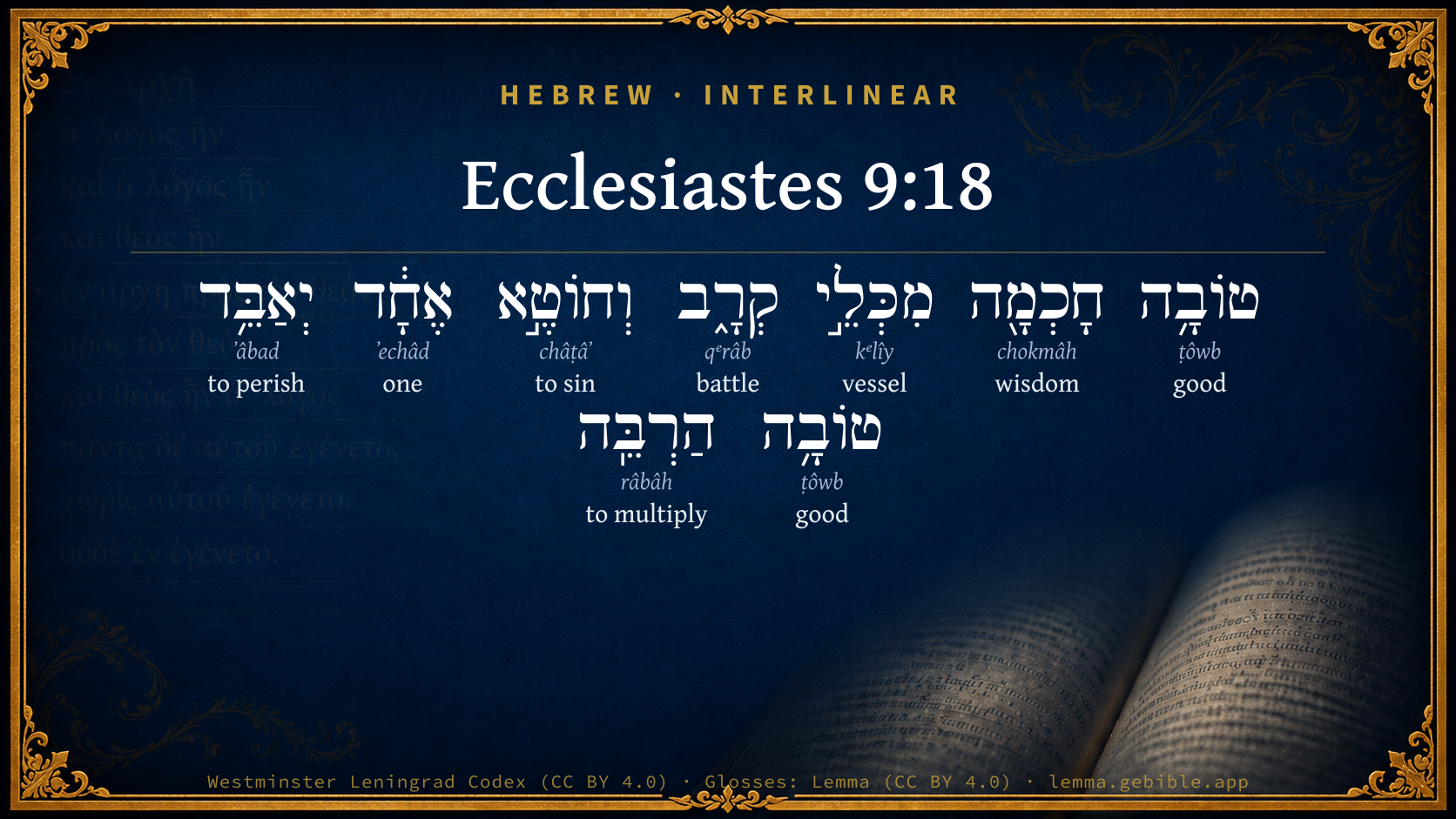
Ecclesiastes 9:18

Hebrew (Westminster Leningrad Codex) Ecclesiastes 9:18 appears in the Hebrew Old Testament. The text above is from the Westminster Leningrad Codex. Each word links to its Strong’s number, a concise gloss, and parsing drawn from the Open Scriptures Hebrew Bible morphology. Click any word for its full Brown-Driver-Briggs (BDB) entry.
Download image
Cite this verse

Ecclesiastes 9:18 (World English Bible). Public Domain. Lemma interlinear Bible study tool, https://lemma.gebible.app/v/ecclesiastes/9/18.

Show BibTeX & RIS
BibTeX
RIS
English Translation
Wisdom is better than weapons of war; but one sinner destroys much good.
World English Bible · Public Domain
Download a study sheet

One document with this verse’s original text, its word-by-word gloss line, the meaning frame, cross-references with their text, attributed commentary, and full source and license credits — printable, and it pastes into notes with its structure intact.

This verse Autodidact and up

Study sheet (.html) Plain text (.txt)

A passage Seminary Student

Up to 50 verses in one chapter. A passage sheet keeps up to 6 commentary sources and 12 cross-references per verse, in the order this page ranks them, and says so on the sheet whenever that leaves anything out. Ask for a single verse and you get the Autodidact verse sheet above.

Everything on this page stays free to read, with no account — the sheet is a download of what is already on screen, not access to it.

Want to remove ads? Support Godless Engineer
Compare translations 3

The same verse in 3 English versions, stacked beneath the original-language interlinear above. Click any original word for its lexicon entry.

Each is an independent rendering of the whole verse — the interlinear is not word-aligned to these translations.

Highlighted words mark where these versions differ — a whole-verse word diff, not a word-by-word alignment.

  • World English Bible Public Domain
    Wisdom is better than weapons of war; but one sinner destroys much good.
  • King James Version Public Domain
    Wisdom is better than weapons of war: but one sinner destroyeth much good.
  • unfoldingWord Literal Text CC BY-SA 4.0
    Better wisdom than weapons of battle, but one sinner will destroy much good.

unfoldingWord Literal Text — © unfoldingWord, licensed CC BY-SA 4.0. Word-aligned USFM3 via Door43 (git.door43.org/unfoldingWord/en_ult).

Versions to compare (up to 4)

3 of 4 selected

Show all 18 translations

Every available English version of this verse, each an independent rendering of the whole verse.

  • World English Bible Public Domain
    Wisdom is better than weapons of war; but one sinner destroys much good.
  • Berean Standard Bible Public Domain
    Wisdom is better than weapons of war, but one sinner destroys much good.
  • Majority Standard Bible Public Domain
    Wisdom is better than weapons of war, but one sinner destroys much good.
  • King James Version Public Domain
    Wisdom is better than weapons of war: but one sinner destroyeth much good.
  • American Standard Version (1901) Public Domain
    Wisdom is better than weapons of war; but one sinner destroyeth much good.
  • Revised Version (1885) Public Domain
    Wisdom is better than weapons of war: but one sinner destroyeth much good.
  • Geneva Bible (1599) Public Domain
    Better is wisedome then weapons of warre: but one sinner destroyeth much good.
  • Douay-Rheims (1899) Public Domain
    Better is wisdom, than weapons of war: and he that shall offend in one, shall lose many good things.
  • Young's Literal Translation Public Domain
    Better `is' wisdom than weapons of conflict, And one sinner destroyeth much good!
  • Literal Standard Version CC BY-SA 4.0
    Better [is] wisdom than weapons of conflict, || And one sinner destroys much good!
  • Unlocked Literal Bible CC BY-SA 4.0
    Wisdom is better than weapons of war, but one sinner can ruin much good.
  • unfoldingWord Literal Text CC BY-SA 4.0
    Better wisdom than weapons of battle, but one sinner will destroy much good.
  • Darby Bible Public Domain
    Wisdom is better than weapons of war; but one sinner destroyeth much good.
  • World Messianic Bible Public Domain
    Wisdom is better than weapons of war; but one sinner destroys much good.
  • Webster's Bible Public Domain
    Wisdom is better than weapons of war: but one sinner destroyeth much good.
  • Free Bible Version CC BY-SA 4.0
    It's better to have wisdom than weapons of war; but a sinner can destroy a lot of good.
  • Bible in Basic English Public Domain
    Wisdom is better than instruments of war, but one sinner is the destruction of much good.
  • JPS Tanakh (1917) Public Domain
    Wisdom is better than weapons of war; but one sinner destroyeth much good.

Literal Standard Version (2020), Covenant Press — licensed CC BY-SA 4.0. Text via the HelloAO Bible API (eBible.org). Unlocked Literal Bible (unfoldingWord) — licensed CC BY-SA 4.0. Text via the HelloAO Bible API (eBible.org). unfoldingWord Literal Text — © unfoldingWord, licensed CC BY-SA 4.0. Word-aligned USFM3 via Door43 (git.door43.org/unfoldingWord/en_ult). Free Bible Version, Dr. Jonathan Gallagher — licensed CC BY-SA 4.0. Text via the HelloAO Bible API (eBible.org).

Word by word

More ways to search: Search by grammar → Find every occurrence → Compare this word →

Practice this passage: Drill this verse → Learn its vocabulary →

About this verse

These counts appear in no published source. They are computed here, from the morphology-tagged text and Lemma’s own curated glosses. What Lemma adds →

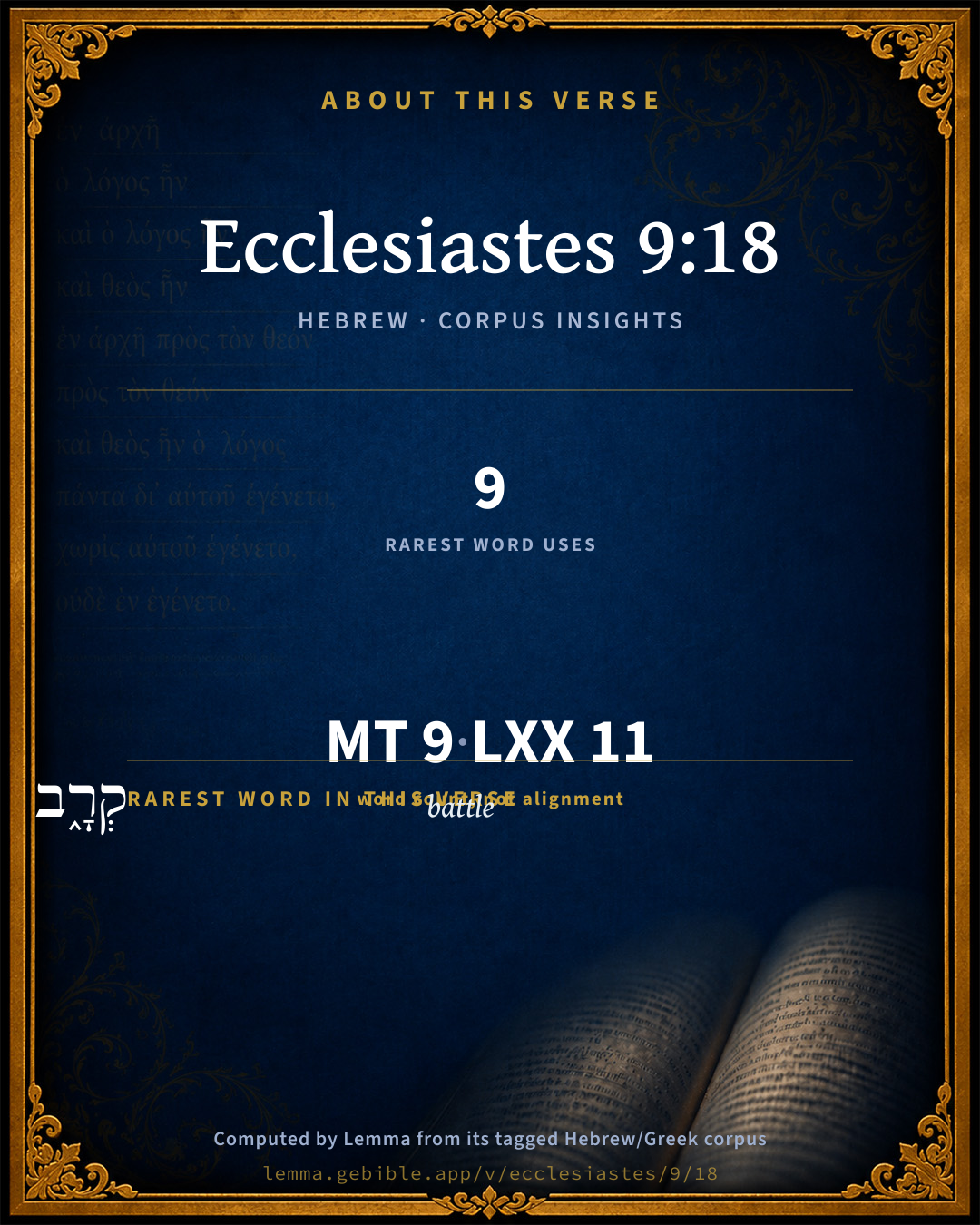
9
words
8
distinct lemmas
Wisdom
section

Notable vocabulary

The rarest word here is קְרָ֑ב battle H7128 — appearing just 9 times in the whole Hebrew Bible.

Shared distinctive vocabulary

קְרָ֑ב battle H7128 occurs in 9 verses of the Hebrew Bible. Also found in:

Grammatical profile

  • 3 verbs
  • 3 nouns
  • 3 adjectives

Verb forms

  • וְחוֹטֶ֣א Qal · Participle Active
  • יְאַבֵּ֥ד Piel · Imperfect
  • הַרְבֵּֽה Hiphil · Infinitive Absolute

Repetition

A word recurs within this verse — often emphatic in Hebrew:

  • טוֹבָ֥ה good H2896 ×2

Hebrew & Septuagint length

In English translation the verse runs 13 words from the Hebrew and 14 from the Septuagint (LXX English) — closely comparable.

A rough comparison of the two English renderings, which tokenize alike — not a word-level alignment.

Word counts can differ between the Hebrew and the Greek without any difference in meaning — e.g. the Hebrew direct-object marker אֵת has no separate Greek word, and Greek often adds the article ὁ.

In the original languages it is 9 Hebrew tokens and 11 Greek tokens — but the two are counted differently (Hebrew bundles its prefixes and suffixes into one token; the Greek is in lemma form), so that isn’t a like-for-like length.

Cross-references

14

Topical passages linked to Ecclesiastes 9:18 in the Treasury of Scripture Knowledge — connected by theme and wording, ordered by reader-vote popularity; previews shown in the World English Bible.

  • Joshua 7:1 But the children of Israel committed a trespass in the devoted thing; for Achan, the son of Carmi, the son of Zabdi, the son of Zerah, of the tribe of Judah, took of the devoted thing: and the anger of Yahweh was kindled against the children of Israel.
  • Joshua 7:11–12 Israel has sinned; yes, they have even transgressed my covenant which I commanded them: yes, they have even taken of the devoted thing, and have also stolen, and dissembled also; and they have even put it among their own stuff.
  • Joshua 7:5 The men of Ai struck of them about thirty-six men; and they chased them [from] before the gate even to Shebarim, and struck them at the descent; and the hearts of the people melted, and became as water.
  • Ecclesiastes 9:16 Then said I, Wisdom is better than strength. Nevertheless the poor man's wisdom is despised, and his words are not heard.
  • 2 Timothy 2:16–18 But shun empty chatter, for they will proceed further in ungodliness,
  • 2 Timothy 4:3–4 For the time will come when they will not listen to the sound doctrine, but, having itching ears, will heap up for themselves teachers after their own lusts;
  • 2 Timothy 3:8 Even as Jannes and Jambres opposed Moses, so do these also oppose the truth; men corrupted in mind, reprobate concerning the faith.
  • Titus 1:10–11 For there are also many unruly men, vain talkers and deceivers, especially those of the circumcision,
  • Joshua 22:20 Didn't Achan the son of Zerah commit a trespass in the devoted thing, and wrath fell on all the congregation of Israel? and that man didn't perish alone in his iniquity.
  • 1 Samuel 14:28–29 Then answered one of the people, and said, Your father directly charged the people with an oath, saying, Cursed be the man who eats food this day. The people were faint.
  • 1 Samuel 14:36–46 Saul said, Let us go down after the Philistines by night, and take spoil among them until the morning light, and let us not leave a man of them. They said, Do whatever seems good to you. Then said the priest, Let us draw near here to God.
  • 2 Samuel 20:1–2 There happened to be there a base fellow, whose name was Sheba, the son of Bichri, a Benjamite: and he blew the trumpet, and said, We have no portion in David, neither have we inheritance in the son of Jesse: every man to his tents, Israel.
  • 2 Thessalonians 2:8–12 Then the lawless one will be revealed, whom the Lord will kill with the breath of his mouth, and bring to nothing by the brightness of his coming;
  • Hebrews 12:15–16 looking carefully lest there be any man who falls short of the grace of God; lest any root of bitterness springing up trouble you, and thereby the many be defiled;

Cross-references courtesy of OpenBible.info (CC BY 4.0).

Hebrew and Greek witnesses Masoretic Hebrew ↔ Greek Septuagint

The same verse in the two great witnesses to the Old Testament, shown verse-for-verse.

These are two independent witnesses, not word-aligned to each other, and the Septuagint is shown in lemma (dictionary) form.

Hebrew Ecclesiastes 9:18 Masoretic · Westminster Leningrad Codex

טוֹבָ֥ה חָכְמָ֖ה מִכְּלֵ֣י קְרָ֑ב וְחוֹטֶ֣א אֶחָ֔ד יְאַבֵּ֥ד טוֹבָ֥ה הַרְבֵּֽה

Wisdom is better than weapons of war; but one sinner destroys much good.

World English Bible · Public Domain

Greek LXX Ecclesiastes 9:18 Septuagint · lemma form

ἀγαθός σοφία ὑπέρ σκεῦος πόλεμος καί ἁμαρτάνω εἷς ἀποὀλλύω ἀγαθωσύνη πολύς

Wisdom is better than weapons of war: and one sinner will destroy much good.

LXX2012 (modern English Septuagint) · Public Domain

Hebrew: Westminster Leningrad Codex (CC BY 4.0). Greek: Septuagint (public domain); English from LXX2012 (modern English Septuagint) (Public Domain). How the Septuagint differs from the Hebrew →

Commentary

Notes on Ecclesiastes 9:18 from classic Christian and Jewish commentators (each source and its license shown beneath its notes). The classic Christian expositions comment on the surrounding passage and are grouped to its opening verse, so a note may address several verses; the Jewish commentaries on the Tanakh (Rashi and others) are per-verse, so they appear only where the commentator wrote on this verse.

Lemma curates 59 commentaries, every one of them public domain or Creative Commons licensed, each selected and text-cleaned for this edition rather than reprinted as found. About our sources →

Trapp's Complete Commentary

John Trapp

Ecc 9:18 Wisdom [is] better than weapons of war: but one sinner destroyeth much good.

Ver. 18. Wisdom is better than weapons of war.] As David found it in his encounter with Goliath, Gideon in his stratagem against the Midianites, and our renowned Drake in dissipating that Invincible Armada, which being three years in preparing with incredible cost, was by his wisdom within a month overthrown and confounded, with the loss of one English ship only, and not a hundred persons. Romani sedendo vincunt. This was the glory of the Romans, that they conquered the world by wisdom, not by weapons.

“ Unus homo nobis cunctando restituit rem. ”

Not Achilles, but Ulysses is termed πολιοπορθος, the sacker of cities; {a} Cyneas took mere towns by his policy than Pyrrhus by his prowess.

But one sinner destroyeth much good.] He may be as an Achan in the army, as a Jonah in the ship, a trouble-town, a common mischief, a traitor to the state; especially if he be an eminent man, as Jeroboam, that ringleader of rebellion, and Manasseh, who "made Judah also to sin," {2Ki 21:11} and so brought such evil upon them, that whosoever heard of it, "both his ears tingled." {Ecc 9:12} Great men’s sins do more hurt (1.) By imitation; for Regis ad exemplnm, &c.; ( 2.) By imputation, for plectuntur Achivi; the poor people pay for such men’s faults, as they did for David’s. {2Sa 24:15-17} I shall close up this chapter with that memorable passage of a reverend writer, yet alive: If England’s fears were greater, thy reformation may save it. {Jer 5:1} If our hopes were greater, thy sin and security might undo it. {Ecc 9:18} One sinner destroys much good. I only add, how much more a rabble of rebels, conspiring to provoke God. Sure I am, we have great cause to wish for our country, as Ferus did for the Romish synagogue; I would we had some Moses, said he, to take away the evils, Non enim unum tantum vitulum, sed multos habemus, for we have not only one golden calf, but many among us.

{a} Plutarch.

John Trapp, A Commentary or Exposition upon All the Books of the Old and New Testament (1647–1656) — public domain. Text from a community e-Sword module.

Tyndale Open Study Notes

Tyndale Open Resources

9:18–10:1 one sinner can destroy . . . a little foolishness spoils: Sin and foolishness can undo a lot of good in a very short time.

Tyndale Open Study Notes — © Tyndale Open Resources, licensed CC BY-SA 4.0. Text via the HelloAO Bible API.

Jamieson, Fausset & Brown

Robert Jamieson, A. R. Fausset & David Brown

one sinner, &c.-- (Jos 7:1, Jos 7:11-12). Though wisdom excels folly (Ecc 9:16; Ecc 7:19), yet a "little folly (equivalent to sin) can destroy much good," both in himself (Ecc 10:1; Jam 2:10) and in others. "Wisdom" must, from the antithesis to "sinner," mean religion. Thus typically, the "little city" may be applied to the Church (Luk 12:32; Heb 12:22); the great king to Satan (Joh 12:31); the despised poor wise man, Jesus Christ (Isa 53:2-3; Mar 6:3; Co2 8:9; Eph 1:7-8; Col 2:3).

Next: Ecclesiastes Chapter 10

Jamieson, Fausset & Brown — Commentary Critical and Explanatory on the Whole Bible (1871) — public domain (CC PDM 1.0). Text via the HelloAO Bible API.

Adam Clarke's Commentary

Verse 18. Wisdom is better than weapons of war] So proved in the case of Archimedes.

But one sinner] Such as the Roman butcher above mentioned.

Destroyeth much good] Such as were the life and skill of the Syracusan mathematician. One sinner has often injured the work of God; one stumbling-block has sometimes destroyed a revival of religion. Sin acts like a ferment; whatever comes in contact with it, it assimilates to itself.

Adam Clarke's Commentary on the Bible (1810–1826) — public domain. Text from a community e-Sword/MySword module.

The Cambridge Bible for Schools and Colleges

gen. ed. J. J. S. Perowne

18. Wisdom is better than weapons of war] The maxim presents another illustration of the irony of history. The excellence of wisdom is acknowledged. Counsel is more than the materiel of war; the statesman more than the general, and yet one man by his guilt or folly, by the perversity which includes both (the Hebrew verb for “sinneth” has this meaning, as in Pro_8:36), may mar what it has taken years to bring to a good issue. The defeat of an army, the most terrible catastrophe, may often be traced to the fact that “some one has blundered,” in carelessness or passion. It is probable enough that, as in Ecc_9:14, the writer had some definite historical fact present to his thoughts which we are unable to identify. The history of Achan, in Jos_7:1-12, presents a sufficient illustration.

The Cambridge Bible for Schools and Colleges (gen. ed. J. J. S. Perowne; Cambridge University Press, 1878–1918) — public domain. Text from a community e-Sword module.

John Gill's Exposition

Wisdom is better than weapons of war,.... And does what they cannot do; of which the wisdom of the poor wise man is a full proof, which delivered the city from a potent prince, when weapons of war could not: see Ecc 7:10;

but one sinner destroyeth much good: his own soul by his sins, and the souls of others by his counsels, example, and conversation, which corrupt good manners; so does one sinner in a family, neighbourhood, and town; as one poor wise man does much good, one sinner mars much; one Achan in a camp or army, one bad counsel for in a cabinet, one false teacher in the church, will do a great deal of mischief, as well as one debauchee in a town or city. The Vulgate Latin version is, "who sins in one"; offends or sins in one, as in Jam 2:10; so the Syriac version, "one sin destroys much good", or many good things; and to the same purpose the Arabic version, "he that committeth one sin".

Next: Ecclesiastes Chapter 10

John Gill's Exposition of the Whole Bible (1746–1763) — public domain (CC PDM 1.0). Text via the HelloAO Bible API.

Albert Barnes' Notes on the Bible

Sinner - The word in the original indicates intellectual as well as moral error.

Albert Barnes' Notes on the Bible (1834–1885) — public domain. Text from a community e-Sword/MySword module.

Haydock's Catholic Bible Commentary

Things. A woman saved Abela; and Achan almost ruined Israel. Want of prudence in a general is often fatal. Virtues are connected, as well as vices. (Calmet) --- For one transgression, many acts of virtue are lost. (St. Jerome)

George Leo Haydock (1774–1849), Haydock's Catholic Family Bible and Commentary, 1859 edition — public domain. Excludes Psalms (Douay-Rheims chapter numbering differs from Protestant) and Deuterocanonical books (Catholic canon only).

Matthew Poole's English Annotations

Than weapons of war; than armed power.

Sinner; a wicked fool; by which expression and opposition of a sinner to a wise man he gives us a key to understand his meaning in divers places of his books, that by wisdom he means true piety, and by folly wickedness; and withal, showeth that sin, as it is the greatest folly, so it is more pernicious to men than mere folly properly so called.

Destroyeth much good; by his wicked counsels and courses brings much damage and mischief, both to himself and others.

Matthew Poole's English Annotations on the Holy Bible (1683–1685) — public domain. Text from a community e-Sword/MySword module.

Whedon's Commentary on the Bible

Daniel D. Whedon

18. Wisdom… weapons — The antithesis is continued, Though wisdom be better. The anecdote given above illustrates this. The “poor wise man” prevaileth over the army and the bulwarks.

But — Better, yet.

One sinner — One fool. Said the French king of his heir and grandson, Francis I., “This great boy will spoil all.” And so he did; and illustrations of the like are sadly frequent. A fool may mar and baffle the wisest plans of the wise.

Daniel D. Whedon (gen. ed.), Commentary on the Old and New Testaments (1874–1909) — public domain. Text from a community e-Sword module.

The Pulpit Commentary

Wisdom is better than weapons of war. Such is the moral which Koheleth desires to draw from the little narrative given above. (see vers. 14-16; and Ecc_7:19) Wisdom can do what no material force can effect, and often produces results which all the implements of war could not command. But one sinner destroyeth much good. The happy consequences which the wise man"s counsel might accomplish, or has already accomplished, may be overthrown or rendered useless by the villany or perversity of a bad man. The Vulgate, reading differently, has, Qui in uno peccaverit, multa bona perdet. But this seems to be out of keeping with the context. Adam"s sin infected the whole race of man; Achau"s transgression caused Israel"s defeat; (Jos_7:11, Jos_7:12) Rehoboam"s folly occasioned the great schism. (1Ki_12:16) The wide-reaching effects of one little error are illustrated by the proverbial saying which every one knows, and which runs in Latin thus: "Clavus unus perdit equi soleam, soles equum, equus equitem, eques castra, castro rempublicam.

The destructiveness of one evil life.

How much of destruction may flow from one single life may be seen if we look at the subject

I NEGATIVELY. We may judge of the magnitude of the evil by considering:

1. How one evil life may hinder the work of God; e.g. Achan, Sanballat, Herod, Nero. Who shall say how much of Christian influence has been arrested by one grossly inconsistent member of a Church, or by one arch-persecutor of the gospel of Christ?

2. How much a man may fail to do by refusing to spend his powers in the service of God. To a man with large means, great resources, brilliant capacities, almost anything is open in the direction of holy usefulness, of widespread and far-descending influence. All this is lost, and in a sense destroyed, by a selfish and guilty withholdment of it all from the service of God and man.

II POSITIVELY. We may estimate the serious and lamentable mischief of an evil life if we think that a godless man may be injuring his neighbors:

1. By weakening or undermining their faith; causing them to lose their hold on Divine truth, and thus sinking into the miseries of doubt or into the darkness and despair of utter unbelief.

2. By undoing the integrity of the upright; leading them into the fatal morass of an immoral life.

3. By cooling, or even killing, the consecration of the zealous; causing them to slacken their speed or even to leave the field of noble service. One man, by his own evil example, by his words of folly and falsity, by his deeds of wrong, may enfeeble many minds, may despoil many hearts, may misguide many souls, may blight and darken many lives. C.

The Pulpit Commentary (1880–1919), ed. H.D.M. Spence-Jones & Joseph S. Exell — public domain. Text from a community e-Sword module.

Keil & Delitzsch

C. F. Keil & F. Delitzsch

The following proverb also leans on the history above narrated: "Better is wisdom than weapons of war; and one sinner destroyeth much good." The above history has shown by way of example that wisdom accomplishes more than implements of war, כּלי ק = כּלי מל (Assyr. unut tahazi)

(Note: Vid., Fried. Delitzsch's Assyr. Stud. p. 129.)

i.e., than all the apparatus belonging to preparation for war. But the much good which a wise man is accomplishing or has accomplished, one sinner (חוטא)

(Note: The Syr. (not the Targ.) had חטא before it, and thus realized it, which appears to correspond better with the parall. חכמה.)

by treachery or calumny may render vain, or may even destroy, through mere malicious pleasure in evil. This is a synthetic distich whose two parts may be interpreted independently. As wisdom accomplishes something great, so a single villain may have a far-reaching influence, viz., such as destroys much good.

Keil & Delitzsch — Biblical Commentary on the Old Testament (1861–1891) — public domain (CC PDM 1.0). Text via the HelloAO Bible API. (Old Testament only.)

Rashi

Rabbi Shlomo Yitzchaki (Rashi)

Wisdom is better This refers to the wisdom of Serah, of whom it is said (II Sam. 20:22): “And the woman came to all the people in her wisdom,” [which] availed them more than the weapons that were in their hands, to fight with Joab.

and one sinner destroys much good Had she not slain Sheba the son of Bichri, they would all have been destroyed by him. (Ecc. Rabbah).

Another explanation: and one sinner destroys much good If Israel were [composed] half of righteous people and half of wicked ones, and one person came and sinned, making the wicked the majority, the result would be that he weighed them all down to the guilty side.

Rashi on the Tanakh — English translations: “The Judaica Press complete Tanach with Rashi, translated by A. J. Rosenberg” (CC BY 4.0); “Pentateuch with Rashi's commentary by M. Rosenbaum and A.M. Silbermann, 1929-1934” (public domain); “The Metsudah Tanach series, Lakewood, N.J” (CC BY 4.0); and “The Book of Joshua, Metsudah Publications, 1997” (CC BY 4.0). Text via Sefaria.

Lesson kit

Teaching starters — assembled from the data on this page, not authored interpretation. Every prompt links to the verse data it draws on. Edit before teaching.

Ecclesiastes, in the Wisdom, opens this verse with 9 words (8 distinct Hebrew lemmas). Its most distinctive word is qᵉrâb (“battle”). A historical commentator’s framing appears above. Read the whole chapter for the surrounding context.

Discussion questions

  1. What does “battle” (qᵉrâb) contribute to the verse as a whole?
  2. 2 Samuel 17:11 shares the word «battle» with this verse. How do the two illuminate each other?
  3. “good” occurs 2× in this one verse. What is the effect of the repetition?
  4. These translations render this verse differently. What is at stake in choosing one wording over another?
  5. The verb «וְחוֹטֶ֣א» is Qal Participle Active. How does its form color the action?
  6. Reading how Trapp's Complete Commentary and Tyndale Open Study Notes read this verse, where do the two commentators agree and where do they part?

Things to notice

Reading settings

Reading text

Shown beneath each verse's original-language words.

Old Testament
Old Testament edition

Read the OT as the Masoretic Hebrew (MT) or the Greek Septuagint (LXX).

English shown for the Greek Septuagint (in the Hebrew ↔ Greek comparison).

Comparing translations? Open the Compare panel on any verse page to stack up to four side by side.