1 Chronicles 5:23

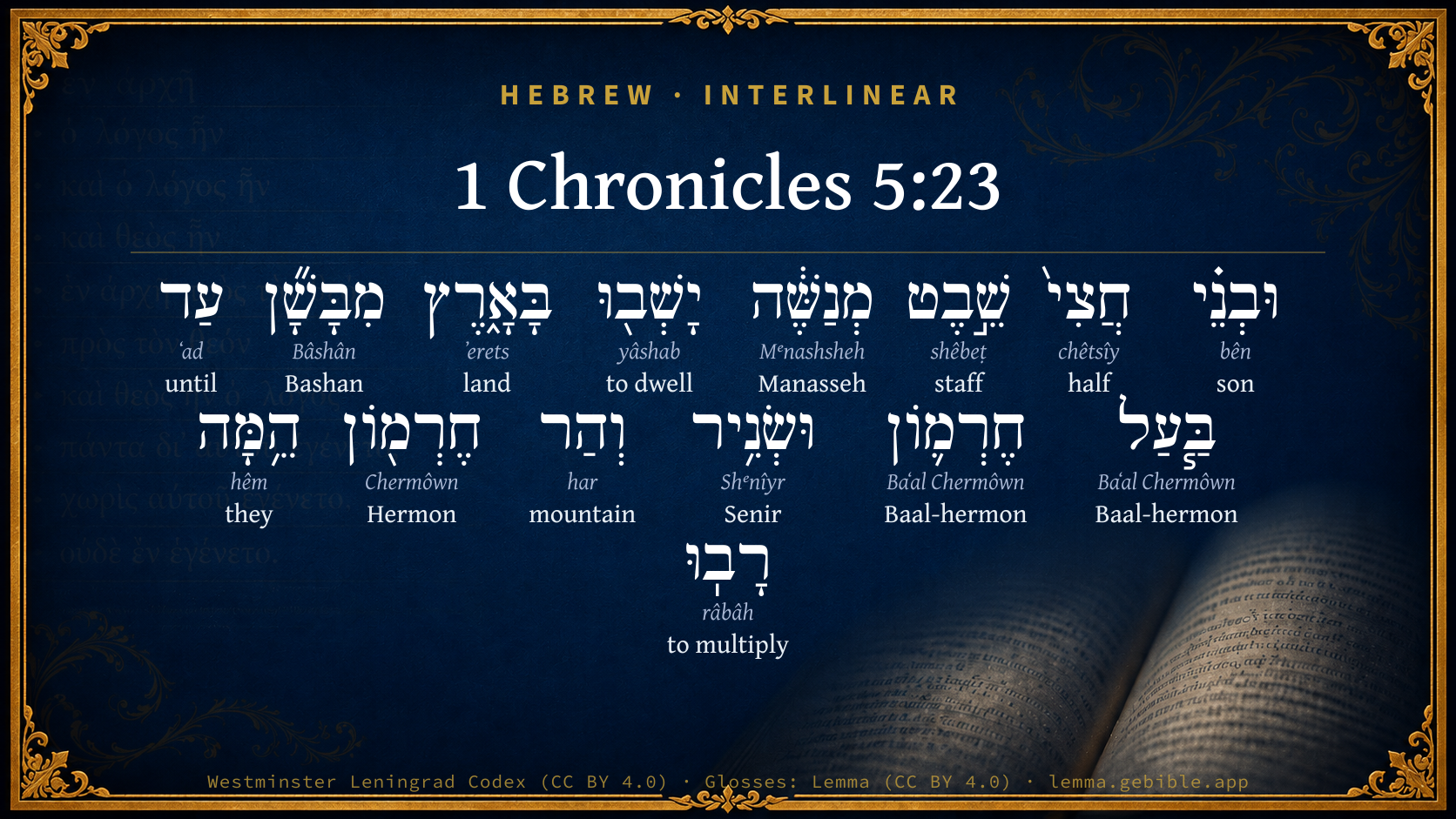
Hebrew (Westminster Leningrad Codex) 1 Chronicles 5:23 appears in the Hebrew Old Testament. The text above is from the Westminster Leningrad Codex. Each word links to its Strong’s number, a concise gloss, and parsing drawn from the Open Scriptures Hebrew Bible morphology. Click any word for its full Brown-Driver-Briggs (BDB) entry.
Download image
Cite this verse

1 Chronicles 5:23 (World English Bible). Public Domain. Lemma interlinear Bible study tool, https://lemma.gebible.app/v/1-chronicles/5/23.

Show BibTeX & RIS
BibTeX
RIS
English Translation
The children of the half-tribe of Manasseh lived in the land: they increased from Bashan to Baal Hermon and Senir and Mount Hermon.
World English Bible · Public Domain
Download a study sheet

One document with this verse’s original text, its word-by-word gloss line, the meaning frame, cross-references with their text, attributed commentary, and full source and license credits — printable, and it pastes into notes with its structure intact.

This verse Autodidact and up

Study sheet (.html) Plain text (.txt)

A passage Seminary Student

Up to 50 verses in one chapter. A passage sheet keeps up to 6 commentary sources and 12 cross-references per verse, in the order this page ranks them, and says so on the sheet whenever that leaves anything out. Ask for a single verse and you get the Autodidact verse sheet above.

Everything on this page stays free to read, with no account — the sheet is a download of what is already on screen, not access to it.

Want to remove ads? Support Godless Engineer
Compare translations 3

The same verse in 3 English versions, stacked beneath the original-language interlinear above. Click any original word for its lexicon entry.

Each is an independent rendering of the whole verse — the interlinear is not word-aligned to these translations.

Highlighted words mark where these versions differ — a whole-verse word diff, not a word-by-word alignment.

  • World English Bible Public Domain
    The children of the half-tribe of Manasseh lived in the land: they increased from Bashan to Baal Hermon and Senir and Mount Hermon.
  • King James Version Public Domain
    And the children of the half tribe of Manasseh dwelt in the land: they increased from Bashan unto Baalhermon and Senir, and unto mount Hermon.
  • unfoldingWord Literal Text CC BY-SA 4.0
    And the sons of half of the tribe of Manasseh dwelled in the land from Bashan unto Baal Hermon and Senir and Mount Hermon. They, they multiplied.

unfoldingWord Literal Text — © unfoldingWord, licensed CC BY-SA 4.0. Word-aligned USFM3 via Door43 (git.door43.org/unfoldingWord/en_ult).

Versions to compare (up to 4)

3 of 4 selected

Show all 18 translations

Every available English version of this verse, each an independent rendering of the whole verse.

  • World English Bible Public Domain
    The children of the half-tribe of Manasseh lived in the land: they increased from Bashan to Baal Hermon and Senir and Mount Hermon.
  • Berean Standard Bible Public Domain
    Now the people of the half-tribe of Manasseh were numerous. They settled in the land from Bashan to Baal-hermon (that is, Senir, also known as Mount Hermon).
  • Majority Standard Bible Public Domain
    Now the people of the half-tribe of Manasseh were numerous. They settled in the land from Bashan to Baal-hermon (that is, Senir, also known as Mount Hermon).
  • King James Version Public Domain
    And the children of the half tribe of Manasseh dwelt in the land: they increased from Bashan unto Baalhermon and Senir, and unto mount Hermon.
  • American Standard Version (1901) Public Domain
    And the children of the half-tribe of Manasseh dwelt in the land: they increased from Bashan unto Baal-hermon and Senir and mount Hermon.
  • Revised Version (1885) Public Domain
    And the children of the half tribe of Manasseh dwelt in the land: they increased from Bashan unto Baal-hermon and Senir and mount Hermon.
  • Geneva Bible (1599) Public Domain
    And the children of the halfe tribe of Manasseh dwelt in the land, from Baashan vnto Baal Hermon, and Senir, and vnto mount Hermon: for they increased.
  • Douay-Rheims (1899) Public Domain
    And the children of the half tribe of Manasses possessed the land, from the borders of Basan unto Baal, Hermon, and Sanir, and mount Hermon, for their number was great.
  • Young's Literal Translation Public Domain
    And the sons of the half of the tribe of Manasseh dwelt in the land, from Bashan unto Baal-Hermon, and Senir, and mount Hermon, they have multiplied.
  • Literal Standard Version CC BY-SA 4.0
    And the sons of the half of the tribe of Manasseh dwelt in the land, from Bashan to Ba‘al-Hermon, and Senir, and Mount Hermon; they have multiplied.
  • Unlocked Literal Bible CC BY-SA 4.0
    The half tribe of Manasseh lived in the land of Bashan as far as Baal Hermon and Senir (that is, Mount Hermon).
  • unfoldingWord Literal Text CC BY-SA 4.0
    And the sons of half of the tribe of Manasseh dwelled in the land from Bashan unto Baal Hermon and Senir and Mount Hermon. They, they multiplied.
  • Darby Bible Public Domain
    And the children of the half tribe of Manasseh dwelt in the land, from Bashan as far as Baal-Hermon and Senir, and mount Hermon; they were many.
  • World Messianic Bible Public Domain
    The children of the half-tribe of Manasseh lived in the land. They increased from Bashan to Baal Hermon, Senir, and Mount Hermon.
  • Webster's Bible Public Domain
    And the children of the half tribe of Manasseh dwelt in the land: they increased from Bashan to Baal-hermon and Senir, and to mount Hermon.
  • Free Bible Version CC BY-SA 4.0
    The half-tribe of Manasseh had grown very large. They lived in the land from Bashan to Baal Hermon (otherwise known as Senir and Mount Hermon).
  • Bible in Basic English Public Domain
    And the men of the half-tribe of Manasseh were living in the land: and their numbers were increased till all the land from Bashan to Baal-hermon and Senir and the mountain Hermon was theirs.
  • JPS Tanakh (1917) Public Domain
    And the children of the half-tribe of Manasseh dwelt in the land, from Bashan unto Baal-hermon and Senir and mount Hermon, where they increased.

Literal Standard Version (2020), Covenant Press — licensed CC BY-SA 4.0. Text via the HelloAO Bible API (eBible.org). Unlocked Literal Bible (unfoldingWord) — licensed CC BY-SA 4.0. Text via the HelloAO Bible API (eBible.org). unfoldingWord Literal Text — © unfoldingWord, licensed CC BY-SA 4.0. Word-aligned USFM3 via Door43 (git.door43.org/unfoldingWord/en_ult). Free Bible Version, Dr. Jonathan Gallagher — licensed CC BY-SA 4.0. Text via the HelloAO Bible API (eBible.org).

Word by word

More ways to search: Search by grammar → Find every occurrence → Compare this word →

Practice this passage: Drill this verse → Learn its vocabulary →

בַּ֧עַל
Baʻal Chermôwn
H1179
“Baal-hermon”
Noun, Proper
Part of Speech
Noun
Type
Proper
Full BDB Definition

Origin: from H1167 and H2768

TWOT: None

Baal-hermon or Baal-chermon = "lord of destruction" - a city near or on Mount Hermon, named as a seat of Baal worship
  1. וּבְנֵ֗י bên H1121 “and · sons of” Conjunction + Noun, Common, Masculine, Plural, Construct
  2. חֲצִי֙ chêtsîy H2677 “half of” Noun, Common, Masculine, Singular, Construct
  3. שֵׁ֣בֶט shêbeṭ H7626 “staff of” Noun, Common, Masculine, Singular, Construct
  4. מְנַשֶּׁ֔ה Mᵉnashsheh H4519 “Manasseh” Noun, Proper
  5. יָשְׁב֖וּ yâshab H3427 “to dwell” Verb, Qal, Perfect, 3rd Person, Common, Plural
  6. בָּאָ֑רֶץ ʼerets H776 “in/at the · land” Preposition, Determined + Noun, Common, Both, Singular, Absolute
  7. מִבָּשָׁ֞ן Bâshân H1316 “from · Bashan” Preposition + Noun, Proper
  8. עַד ʻad H5704 “until” Preposition
  9. חֶרְמ֛וֹן Baʻal Chermôwn H1179 “Baal-hermon” Noun, Proper
  10. וּשְׂנִ֥יר Shᵉnîyr H8149 “and · Senir” Conjunction + Noun, Proper
  11. וְהַר har H2022 “and · mountain of” Conjunction + Noun, Common, Masculine, Singular, Construct
  12. חֶרְמ֖וֹן Chermôwn H2768 “Hermon” Noun, Proper
  13. הֵ֥מָּה hêm H1992 “they” Pronoun, Personal, 3rd Person, Masculine, Plural
  14. רָבֽוּ râbâh H7235 “to multiply” Verb, Qal, Perfect, 3rd Person, Common, Plural

About this verse

These counts appear in no published source. They are computed here, from the morphology-tagged text and Lemma’s own curated glosses. What Lemma adds →

15
words
14
distinct lemmas
Historical
section

Notable vocabulary

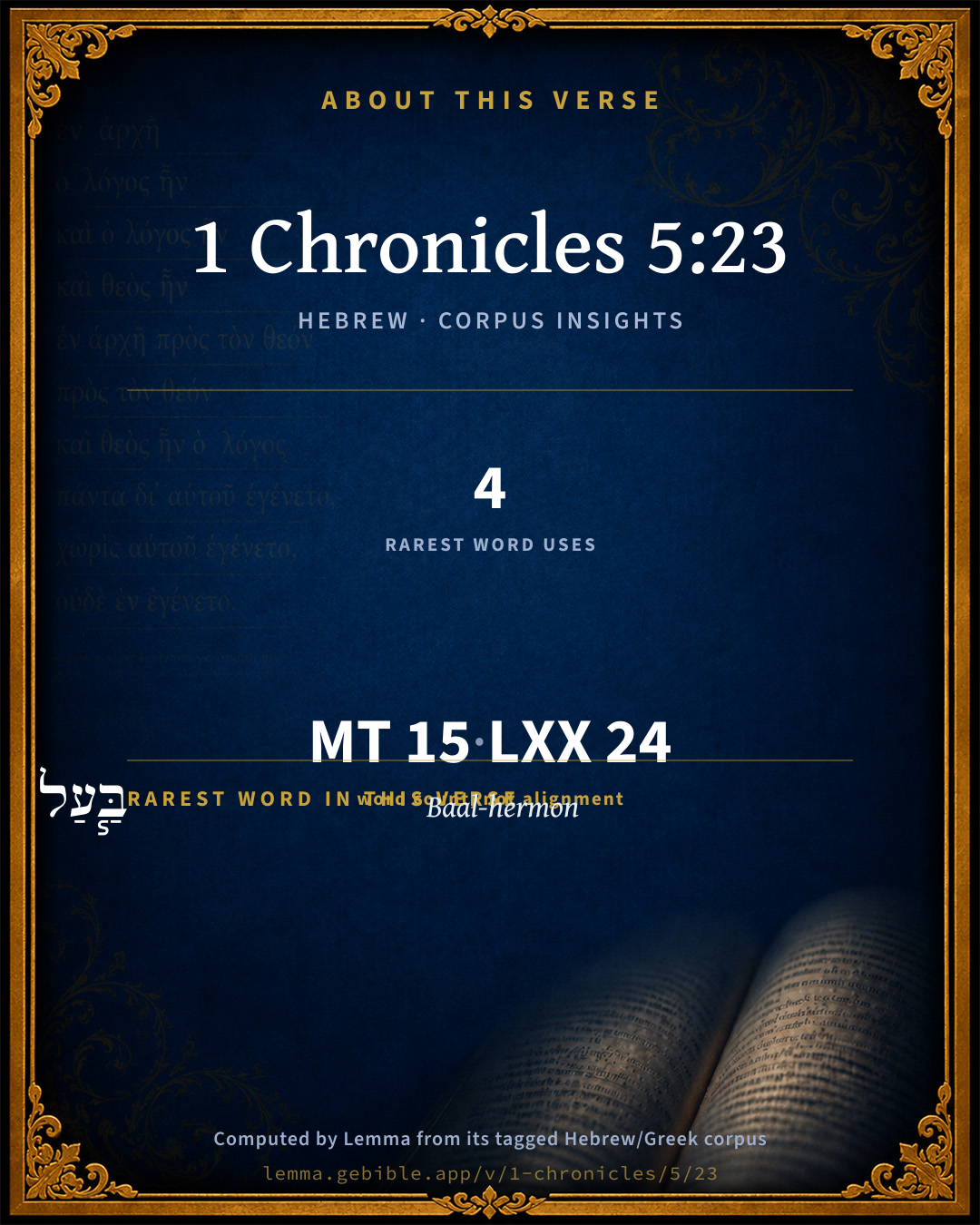
The rarest word here is בַּ֧עַל Baal-hermon H1179 — appearing just 4 times in the whole Hebrew Bible.

Shared distinctive vocabulary

בַּ֧עַל Baal-hermon H1179 occurs in 2 verses of the Hebrew Bible. Also found in:

Grammatical profile

  • 2 verbs
  • 11 nouns
  • 1 pronoun
  • 1 preposition

Verb forms

  • יָשְׁב֖וּ Qal · Perfect
  • רָבֽוּ Qal · Perfect

Repetition

A word recurs within this verse — often emphatic in Hebrew:

  • בַּ֧עַל Baal-hermon H1179 ×2

Hebrew & Septuagint length

In English translation the verse runs 23 words from the Hebrew and 23 from the Septuagint (LXX English) — the same length.

A rough comparison of the two English renderings, which tokenize alike — not a word-level alignment.

Word counts can differ between the Hebrew and the Greek without any difference in meaning — e.g. the Hebrew direct-object marker אֵת has no separate Greek word, and Greek often adds the article ὁ.

In the original languages it is 15 Hebrew tokens and 24 Greek tokens — but the two are counted differently (Hebrew bundles its prefixes and suffixes into one token; the Greek is in lemma form), so that isn’t a like-for-like length.

Cross-references

5

Topical passages linked to 1 Chronicles 5:23 in the Treasury of Scripture Knowledge — connected by theme and wording, ordered by reader-vote popularity; previews shown in the World English Bible.

  • Deuteronomy 3:8–9 We took the land at that time out of the hand of the two kings of the Amorites who were beyond the Jordan, from the valley of the Arnon to Mount Hermon;
  • Song of Solomon 4:8 Come with me from Lebanon, my bride, With me from Lebanon. Look from the top of Amana, From the top of Senir and Hermon, From the lions' dens, From the mountains of the leopards.
  • Joshua 13:11 and Gilead, and the border of the Geshurites and Maacathites, and all Mount Hermon, and all Bashan to Salecah;
  • Joshua 13:29–31 Moses gave [inheritance] to the half-tribe of Manasseh: and it was for the half-tribe of the children of Manasseh according to their families.
  • Psalms 133:3 Like the dew of Hermon, That comes down on the hills of Zion: For there Yahweh gives the blessing, Even life forevermore.

Cross-references courtesy of OpenBible.info (CC BY 4.0).

Hebrew and Greek witnesses Masoretic Hebrew ↔ Greek Septuagint

The same verse in the two great witnesses to the Old Testament, shown verse-for-verse.

These are two independent witnesses, not word-aligned to each other, and the Septuagint is shown in lemma (dictionary) form.

Hebrew 1 Chronicles 5:23 Masoretic · Westminster Leningrad Codex

וּבְנֵ֗י חֲצִי֙ שֵׁ֣בֶט מְנַשֶּׁ֔ה יָשְׁב֖וּ בָּאָ֑רֶץ מִבָּשָׁ֞ן עַד בַּ֧עַל חֶרְמ֛וֹן וּשְׂנִ֥יר וְהַר חֶרְמ֖וֹן הֵ֥מָּה רָבֽוּ

The children of the half-tribe of Manasseh lived in the land: they increased from Bashan to Baal Hermon and Senir and Mount Hermon.

World English Bible · Public Domain

Greek LXX 1 Chronicles 5:23 Septuagint · lemma form

καί ὁ ἥμισυς φυλή μανασσή καταοἰκέω ἐν ὁ γῆ ἀπό βασαν ἕως βααλερμων καί σανιρ καί ὄρος αερμων καί ἐν ὁ λίβανος αὐτός πλεονάζω

And the half-tribe of Manasse lived from Basan to Baal, Ermon, and Sanir, and to the mount Aermon: and they increased in Libanus.

LXX2012 (modern English Septuagint) · Public Domain

On this verse, The Pulpit Commentary discusses the Septuagint’s reading. Read the note in Commentary ↓

Hebrew: Westminster Leningrad Codex (CC BY 4.0). Greek: Septuagint (public domain); English from LXX2012 (modern English Septuagint) (Public Domain). How the Septuagint differs from the Hebrew →

Commentary

Notes on 1 Chronicles 5:23 from classic Christian and Jewish commentators (each source and its license shown beneath its notes). The classic Christian expositions comment on the surrounding passage and are grouped to its opening verse, so a note may address several verses; the Jewish commentaries on the Tanakh (Rashi and others) are per-verse, so they appear only where the commentator wrote on this verse.

Lemma curates 59 commentaries, every one of them public domain or Creative Commons licensed, each selected and text-cleaned for this edition rather than reprinted as found. About our sources →

Joseph Benson's Commentary

1Ch 5:23. The half-tribe of Manasseh — Having spoken of the Reubenites, (1Ch 5:3-10,) and next of the Gadites, (1Ch 5:11, &c.,) he now comes to the Manassites. Dwelt in the land — In the same country with the Reubenites and Gadites, on the other side of Jordan, namely, in the northern part of that land.

Joseph Benson's Commentary on the Old and New Testaments (1811–1818) — public domain. Text from a community e-Sword module.

Geneva Bible (1599)

Geneva Bible translators

Otherwise called Baal Gad.

Geneva Bible (1599) marginal notes — public domain. Text via Bolls.life.

Ellicott's Commentary for English Readers

(23) Baal-hermon.—Perhaps the same as Baal-gad (Jos_12:7; Jos_13:5), the modern town of Banias.

Senir.—The Amorite name of the range of Hermon (Deu_3:9). The principal summit is now called Jebel esh-Sheikh, “hill of the chief,” and Jebel eth-Thelj, “Snow Hill.”

(23, 24) The sons of half-Manasseh “in the land” east of Jordan. The translation should be: “And the children . . . dwelt in the land, from Bashan unto Baal-hermon and Senir and mount Hermon. These were many.” Their territory extended from “Bashan,” the domain of Gad, in the south, to the mountains of Hermon, or Antilibanus, in the north.

A Bible Commentary for English Readers, edited by Charles John Ellicott (1878–1897) — public domain. Text from a community e-Sword module.

The Cambridge Bible for Schools and Colleges

gen. ed. J. J. S. Perowne

23, 24. The Half Tribe of Manasseh

23. Baal-hermon] In Jdg_3:3 a mount Baal-hermon is mentioned. Here probably a city is meant, possibly Banias.

Senir] the name given by the Amorites to Hermon (Deu_3:9, R.V.).

The Cambridge Bible for Schools and Colleges (gen. ed. J. J. S. Perowne; Cambridge University Press, 1878–1918) — public domain. Text from a community e-Sword module.

John Gill's Exposition

And they transgressed against the God their fathers,.... Against his law, will, word, and ordinances, not only the half tribe of Manasseh, hut the Reubenites and Gadites also:

and went a whoring after the gods of the people of the land, whom God destroyed before them; that is, committed idolatry, which is spiritual fornication or whoredom; worshipped the idols either of the Amorites, who were destroyed by the Lord to make way for their first settlement; or of the Ishmaelites, whom they conquered, and whose land they dwelt in to the captivity.

John Gill's Exposition of the Whole Bible (1746–1763) — public domain (CC PDM 1.0). Text via the HelloAO Bible API.

Albert Barnes' Notes on the Bible

“Baal-Hermon,” “Senir” Deu 3:9, and “Mount Hermon,” are here not so much three names of the one great snow-clad eminence in which the Anti-Lebanon terminates toward the south, as three parts of the mountain - perhaps the “three summits” in which it terminates.

Albert Barnes' Notes on the Bible (1834–1885) — public domain. Text from a community e-Sword/MySword module.

Haydock's Catholic Bible Commentary

Basan, which belonged to Gad. (Haydock) --- In Josue (xvii. 5.) Basan and Galaad seem to be given to Manasses; but the former there denotes all the level country, from the Jabok to the Jordan, as Galaad is put for the mountains on the East. (Calmet) --- Great. It would take thirty hours to travel from the torrent Jabok to Baal Hermon. (Adrichomius) (Menochius)

George Leo Haydock (1774–1849), Haydock's Catholic Family Bible and Commentary, 1859 edition — public domain. Excludes Psalms (Douay-Rheims chapter numbering differs from Protestant) and Deuterocanonical books (Catholic canon only).

Matthew Poole's English Annotations

Having discoursed of the Reubenites, 1Ch 5:3, &c., and next of the Gadites, 1Ch 5:11, &c., he now comes to the Manassites.

In the land, i.e. in their land, to wit, in the northern part of the land beyond Jordan.

Matthew Poole's English Annotations on the Holy Bible (1683–1685) — public domain. Text from a community e-Sword/MySword module.

The Pulpit Commentary

Vers. 23, 24. half-tribe of Manasseh" is here very briefly treated of. Manasseh and his brother Ephraim stand in the place of Joseph, both the children of Joseph"s Egyptian wife, Asenath, and born before the famine. Though Manasseh was the elder, Jacob gave the chief blessing (Gen_48:10-22) to Ephraim. The Manassites were descended from Manasseh through his son Machir, born of a Syrian concubine (Septuagint, Gen_46:20 Gen_1:23; Num_26:28-34; Jos_17:1-3; 1Ch_7:14, 1Ch_7:15) Machir evidently was spes gregis (though apparently not the only son, for see Asriel, or Ashriel, in above references), and is repeatedly mentioned with his son Gilead. It is probable that the division of the tribe was determined partly according to the energy of those who composed it at the time of division the more warlike being more adapted to the east of Jordan. Nevertheless Machir is distinctly mentioned westward, as well as with Gilead eastward (comp. Jud 5:14-17; Jos_13:29-31) (For the further prosecution of this part of the subject, see Exposition, 1Ch_7:14-19) Baal-hermon, etc. These three names need scarcely be read as different names for exactly the same region, but as designating different sides or heights of what was essentially one and the same well-known mountain district, with which would agree Psa_43:5, "Therefore will I remember thee from the land of Jordan and of the Hermonites, from the hill Mizar." So, Deu_3:8-10 tells us that Hermon was called Sirion by the Sidonians; Shenir, i.q. Senir (rynic) exactly the same word in the Hebrew text in all the four places of its occurrence Song of Solomon, (Eze_27:5) by the Amorites. And the suggestion of Grove is likely enough, that Baal-hermon was the Phoenician cast of the name. If any point were to be gained by reading the names, however, as intended to cover exactly the same tract, it may be noted

(1) that the Hebrew conjunction will perfectly admit of being translated "even;" and

(2) that the order of the names, going from the foreign to the native Hermon itself, would so far favour it.

The Pulpit Commentary (1880–1919), ed. H.D.M. Spence-Jones & Joseph S. Exell — public domain. Text from a community e-Sword module.

Keil & Delitzsch

C. F. Keil & F. Delitzsch

And they transgressed against the God their fathers,.... Against his law, will, word, and ordinances, not only the half tribe of Manasseh, hut the Reubenites and Gadites also:

and went a whoring after the gods of the people of the land, whom God destroyed before them; that is, committed idolatry, which is spiritual fornication or whoredom; worshipped the idols either of the Amorites, who were destroyed by the Lord to make way for their first settlement; or of the Ishmaelites, whom they conquered, and whose land they dwelt in to the captivity.

Keil & Delitzsch — Biblical Commentary on the Old Testament (1861–1891) — public domain (CC PDM 1.0). Text via the HelloAO Bible API. (Old Testament only.)

unfoldingWord translationNotes

Door43 World Missions Community

Baal Hermon ... Senir

These are the names of mountains. (See: How to Translate Names)

Epher ... Ishi ... Eliel ... Azriel ... Jeremiah ... Hodaviah ... Jahdiel

These are the names of men. (See: How to Translate Names)

fathers' houses

extended families, people related to each other who usually lived in different houses, what the UDB calls "clans"

translationWords

Manasseh

Bashan

Mount Hermon

family

unfoldingWord translationNotes — © Distant Shores Media and the Door43 World Missions Community, licensed CC BY-SA 4.0. Source: git.door43.org/Door43/en_tn.

Lesson kit

Teaching starters — assembled from the data on this page, not authored interpretation. Every prompt links to the verse data it draws on. Edit before teaching.

1 Chronicles, in the Historical, opens this verse with 15 words (14 distinct Hebrew lemmas). Its most distinctive word is Baʻal Chermôwn (“Baal-hermon”). A historical commentator’s framing appears above. Read the whole chapter for the surrounding context.

Discussion questions

  1. How does “Baal-hermon” (Baʻal Chermôwn) shape what this verse is saying?
  2. How does Judges 3:3, which shares the word «Baal-hermon», read alongside this verse?
  3. What does the repetition of “Baal-hermon” (2× in this one verse) do in this verse?
  4. These translations render this verse differently; the difference is in the English rendering, not the original. What questions does that raise?
  5. «יָשְׁב֖וּ» is a Qal Perfect verb. How does that grammatical form shape the action described?
  6. Compare how Joseph Benson's Commentary and Geneva Bible (1599) read this verse. Where do they agree or differ?

Things to notice

Reading settings

Reading text

Shown beneath each verse's original-language words.

Old Testament
Old Testament edition

Read the OT as the Masoretic Hebrew (MT) or the Greek Septuagint (LXX).

English shown for the Greek Septuagint (in the Hebrew ↔ Greek comparison).

Comparing translations? Open the Compare panel on any verse page to stack up to four side by side.