1 Chronicles 7:4

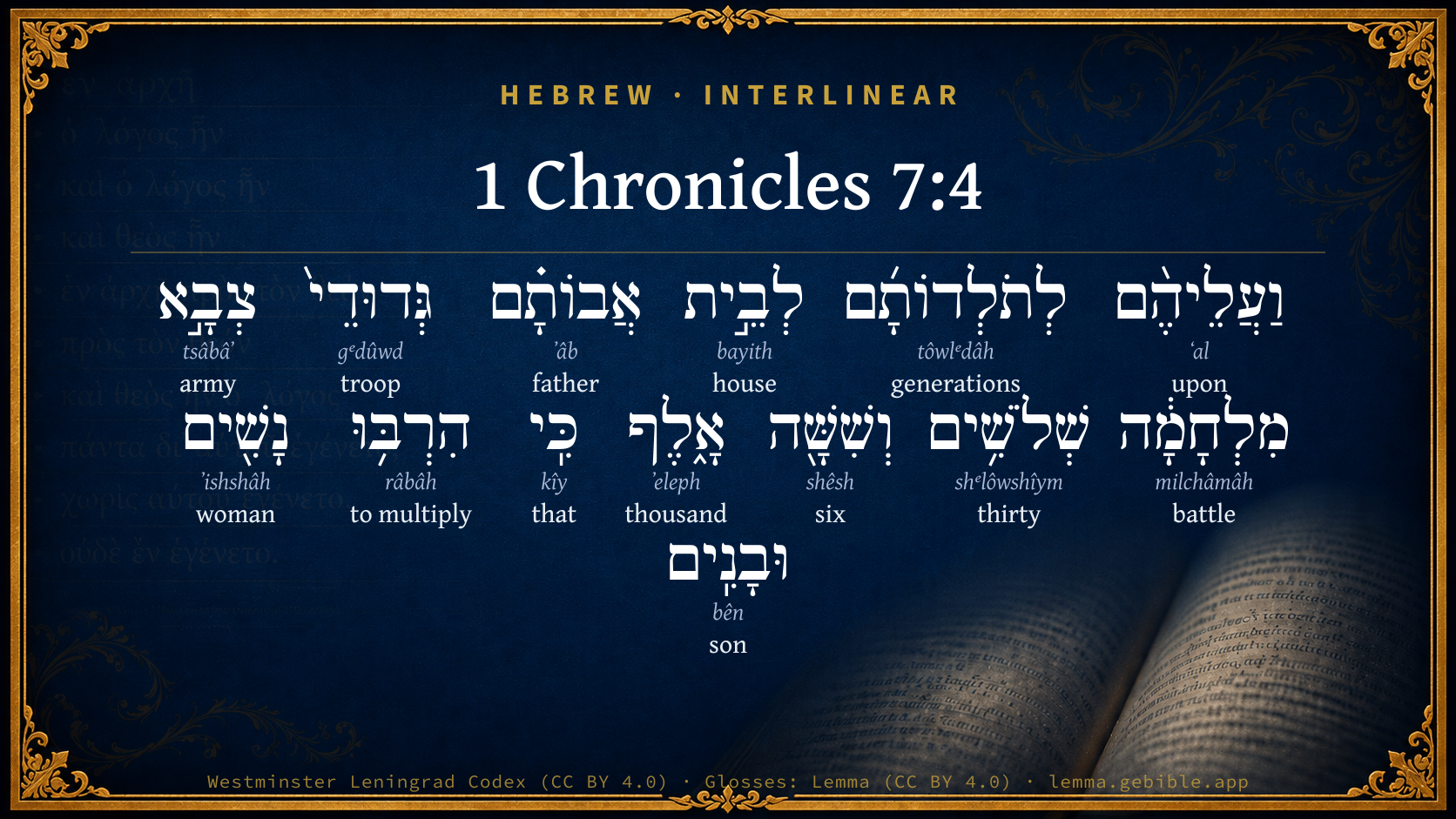
Hebrew (Westminster Leningrad Codex) 1 Chronicles 7:4 appears in the Hebrew Old Testament. The text above is from the Westminster Leningrad Codex. Each word links to its Strong’s number, a concise gloss, and parsing drawn from the Open Scriptures Hebrew Bible morphology. Click any word for its full Brown-Driver-Briggs (BDB) entry.
Download image
Cite this verse

1 Chronicles 7:4 (World English Bible). Public Domain. Lemma interlinear Bible study tool, https://lemma.gebible.app/v/1-chronicles/7/4.

Show BibTeX & RIS
BibTeX
RIS
English Translation
With them, by their generations, after their fathers' houses, were bands of the host for war, thirty-six thousand; for they had many wives and sons.
World English Bible · Public Domain
Download a study sheet

One document with this verse’s original text, its word-by-word gloss line, the meaning frame, cross-references with their text, attributed commentary, and full source and license credits — printable, and it pastes into notes with its structure intact.

This verse Autodidact and up

Study sheet (.html) Plain text (.txt)

A passage Seminary Student

Up to 50 verses in one chapter. A passage sheet keeps up to 6 commentary sources and 12 cross-references per verse, in the order this page ranks them, and says so on the sheet whenever that leaves anything out. Ask for a single verse and you get the Autodidact verse sheet above.

Everything on this page stays free to read, with no account — the sheet is a download of what is already on screen, not access to it.

Want to remove ads? Support Godless Engineer
Compare translations 3

The same verse in 3 English versions, stacked beneath the original-language interlinear above. Click any original word for its lexicon entry.

Each is an independent rendering of the whole verse — the interlinear is not word-aligned to these translations.

Highlighted words mark where these versions differ — a whole-verse word diff, not a word-by-word alignment.

  • World English Bible Public Domain
    With them, by their generations, after their fathers' houses, were bands of the host for war, thirty-six thousand; for they had many wives and sons.
  • King James Version Public Domain
    And with them, by their generations, after the house of their fathers, were bands of soldiers for war, six and thirty thousand men: for they had many wives and sons.
  • unfoldingWord Literal Text CC BY-SA 4.0
    And with them, according to their generations in the house of their fathers, warriors of an army of battle, 36,000, for they multiplied wives and sons.

unfoldingWord Literal Text — © unfoldingWord, licensed CC BY-SA 4.0. Word-aligned USFM3 via Door43 (git.door43.org/unfoldingWord/en_ult).

Versions to compare (up to 4)

3 of 4 selected

Show all 18 translations

Every available English version of this verse, each an independent rendering of the whole verse.

  • World English Bible Public Domain
    With them, by their generations, after their fathers' houses, were bands of the host for war, thirty-six thousand; for they had many wives and sons.
  • Berean Standard Bible Public Domain
    In addition to them, according to their genealogy, they had 36,000 troops for battle, for they had many wives and children.
  • Majority Standard Bible Public Domain
    In addition to them, according to their genealogy, they had 36,000 troops for battle, for they had many wives and children.
  • King James Version Public Domain
    And with them, by their generations, after the house of their fathers, were bands of soldiers for war, six and thirty thousand men: for they had many wives and sons.
  • American Standard Version (1901) Public Domain
    And with them, by their generations, after their fathers' houses, were bands of the host for war, six and thirty thousand; for they had many wives and sons.
  • Revised Version (1885) Public Domain
    And with them, by their generations, after their fathers’ houses, were bands of the host for war, six and thirty thousand: for they had many wives and sons.
  • Geneva Bible (1599) Public Domain
    And with them in their generations after the houshold of their fathers were bandes of men of warre for battel, sixe and thirtie thousand: for they had many wiues and children.
  • Douay-Rheims (1899) Public Domain
    And there were with them by their families and peoples, six and thirty thousand most valiant men ready for war: for they had many wives and children.
  • Young's Literal Translation Public Domain
    And beside them, by their generations, of the house of their fathers, `are' troops of the host of battle, thirty and six thousand, for they multiplied wives and sons;
  • Literal Standard Version CC BY-SA 4.0
    And beside them, by their generations, of the house of their fathers, [are] thirty-six thousand troops of the host of battle, for they multiplied wives and sons;
  • Unlocked Literal Bible CC BY-SA 4.0
    Along with them they had thirty-six thousand troops for battle, according to the lists belonging to their ancestors' clans, for they had many wives and sons.
  • unfoldingWord Literal Text CC BY-SA 4.0
    And with them, according to their generations in the house of their fathers, warriors of an army of battle, 36,000, for they multiplied wives and sons.
  • Darby Bible Public Domain
    And with them by their generations, according to their fathers' houses, were military bands for war, thirty-six thousand; for they had many wives and sons.
  • World Messianic Bible Public Domain
    With them, by their generations, after their fathers’ houses, were bands of the army for war, thirty-six thousand; for they had many wives and sons.
  • Webster's Bible Public Domain
    And with them, by their generations, after the house of their fathers, were bands of soldiers for war, six and thirty thousand men: for they had many wives and sons.
  • Free Bible Version CC BY-SA 4.0
    They had many wives and sons and so in their genealogy they list 36,000 battle-ready fighting men.
  • Bible in Basic English Public Domain
    And with them, recorded in generations by their families, were bands of fighting-men, thirty-six thousand of them, for they had a great number of wives and sons.
  • JPS Tanakh (1917) Public Domain
    And with them, by their generations, after their fathers' houses, were bands of the host for war, six and thirty thousand; for they had many wives and sons.

Literal Standard Version (2020), Covenant Press — licensed CC BY-SA 4.0. Text via the HelloAO Bible API (eBible.org). Unlocked Literal Bible (unfoldingWord) — licensed CC BY-SA 4.0. Text via the HelloAO Bible API (eBible.org). unfoldingWord Literal Text — © unfoldingWord, licensed CC BY-SA 4.0. Word-aligned USFM3 via Door43 (git.door43.org/unfoldingWord/en_ult). Free Bible Version, Dr. Jonathan Gallagher — licensed CC BY-SA 4.0. Text via the HelloAO Bible API (eBible.org).

Word by word

More ways to search: Search by grammar → Find every occurrence → Compare this word →

Practice this passage: Drill this verse → Learn its vocabulary →

גְּדוּדֵי֙
gᵉdûwd
H1416
“troops of”
Noun, Common, Masculine, Plural, Construct
Part of Speech
Noun
Type
Common
Gender
Masculine
Number
Plural
State
Construct
Full BDB Definition

Origin: from H1413

TWOT: 313a

a band, troop, marauding band - marauding band, raiding band - troop, band (of divisions of army) - foray, raid
  1. וַעֲלֵיהֶ֨ם ʻal H5921 “and · upon · them” Conjunction + Preposition + Suffix, Personal, 3rd Person, Masculine, Plural
  2. לְתֹלְדוֹתָ֜ם tôwlᵉdâh H8435 “to/for · generations · their” Preposition + Noun, Common, Feminine, Plural, Construct + Suffix, Personal, 3rd Person, Masculine, Plural
  3. לְבֵ֣ית bayith H1004 “to/for · house of” Preposition + Noun, Common, Masculine, Singular, Construct
  4. אֲבוֹתָ֗ם ʼâb H1 “fathers · their” Noun, Common, Masculine, Plural, Construct + Suffix, Personal, 3rd Person, Masculine, Plural
  5. צְבָ֣א tsâbâʼ H6635 “army of” Noun, Common, Both, Singular, Construct
  6. מִלְחָמָ֔ה milchâmâh H4421 “battle” Noun, Common, Feminine, Singular, Absolute
  7. שְׁלֹשִׁ֥ים shᵉlôwshîym H7970 “thirty” Adjective, Cardinal number, Both, Plural, Absolute
  8. וְשִׁשָּׁ֖ה shêsh H8337 “and · six” Conjunction + Adjective, Cardinal number, Masculine, Singular, Absolute
  9. אָ֑לֶף ʼeleph H505 “thousand” Adjective, Cardinal number, Both, Singular, Absolute
  10. כִּֽי kîy H3588 “that” Conjunction
  11. הִרְבּ֥וּ râbâh H7235 “to multiply” Verb, Hiphil, Perfect, 3rd Person, Common, Plural
  12. נָשִׁ֖ים ʼishshâh H802 “women” Noun, Common, Feminine, Plural, Absolute
  13. וּבָנִֽים bên H1121 “and · sons” Conjunction + Noun, Common, Masculine, Plural, Absolute

About this verse

These counts appear in no published source. They are computed here, from the morphology-tagged text and Lemma’s own curated glosses. What Lemma adds →

14
words
14
distinct lemmas
Historical
section

Shared distinctive vocabulary

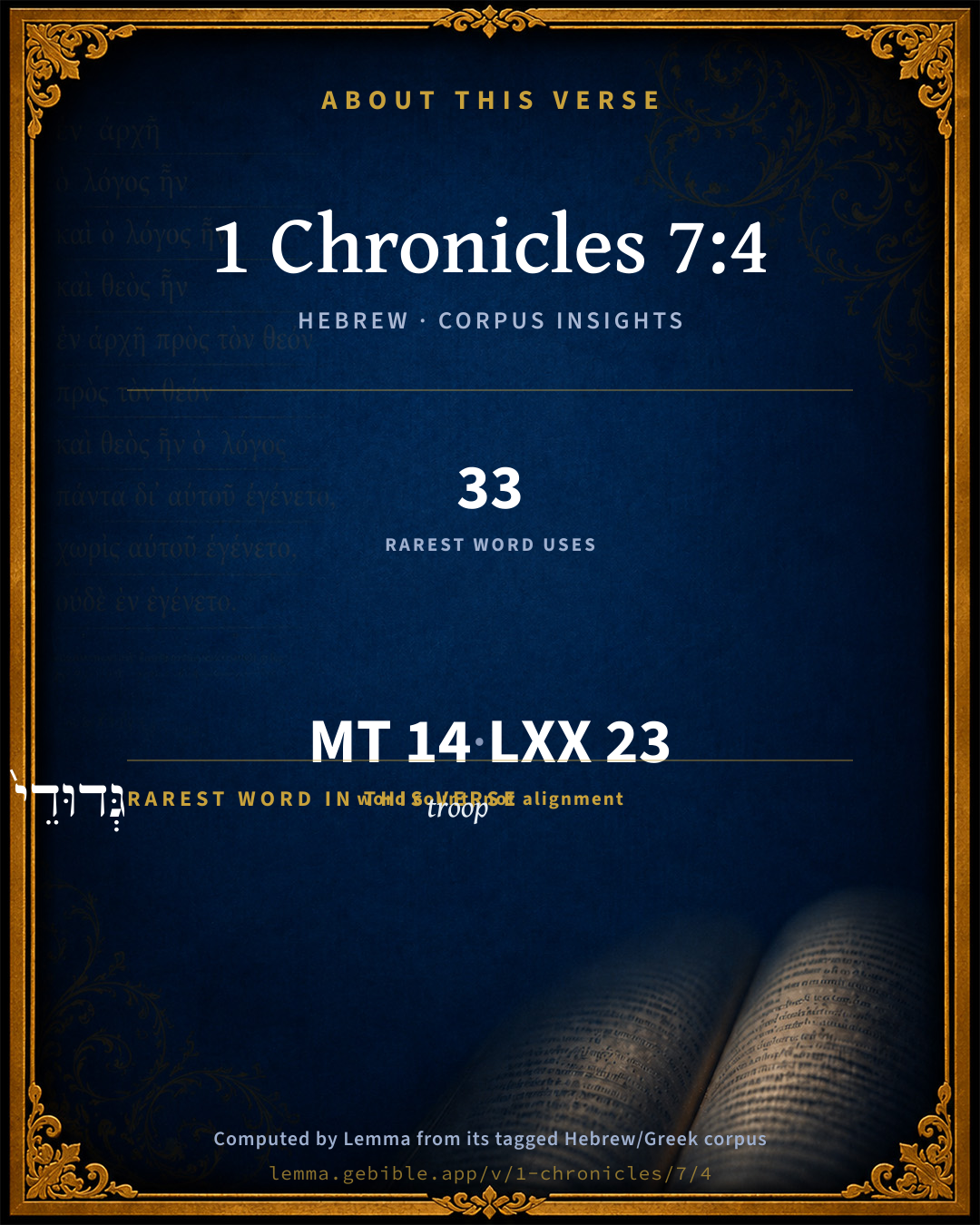
גְּדוּדֵי֙ troop H1416 occurs in 29 verses of the Hebrew Bible. Also found in:

Grammatical profile

  • 1 verb
  • 8 nouns
  • 3 adjectives
  • 1 preposition
  • 1 conjunction

Verb forms

  • הִרְבּ֥וּ Hiphil · Perfect

Hebrew & Septuagint length

In English translation the verse runs 25 words from the Hebrew and 36 from the Septuagint (LXX English) — the Septuagint runs noticeably longer here. See the side-by-side →

A rough comparison of the two English renderings, which tokenize alike — not a word-level alignment.

Word counts can differ between the Hebrew and the Greek without any difference in meaning — e.g. the Hebrew direct-object marker אֵת has no separate Greek word, and Greek often adds the article ὁ.

In the original languages it is 14 Hebrew tokens and 23 Greek tokens — but the two are counted differently (Hebrew bundles its prefixes and suffixes into one token; the Greek is in lemma form), so that isn’t a like-for-like length.

Cross-references

1

Topical passages linked to 1 Chronicles 7:4 in the Treasury of Scripture Knowledge — connected by theme and wording, ordered by reader-vote popularity; previews shown in the World English Bible.

  • 1 Chronicles 12:32 Of the children of Issachar, men who had understanding of the times, to know what Israel ought to do, the heads of them were two hundred; and all their brothers were at their commandment.

Cross-references courtesy of OpenBible.info (CC BY 4.0).

Hebrew and Greek witnesses Masoretic Hebrew ↔ Greek Septuagint

The same verse in the two great witnesses to the Old Testament, shown verse-for-verse.

Here the Septuagint runs noticeably longer than the Hebrew — LXX2012 (modern English Septuagint) 36 words vs World English Bible 25. A rough length comparison of the two English translations, not a word-level alignment — read both below.

These are two independent witnesses, not word-aligned to each other, and the Septuagint is shown in lemma (dictionary) form.

Hebrew 1 Chronicles 7:4 Masoretic · Westminster Leningrad Codex

וַעֲלֵיהֶ֨ם לְתֹלְדוֹתָ֜ם לְבֵ֣ית אֲבוֹתָ֗ם גְּדוּדֵי֙ צְבָ֣א מִלְחָמָ֔ה שְׁלֹשִׁ֥ים וְשִׁשָּׁ֖ה אָ֑לֶף כִּֽי הִרְבּ֥וּ נָשִׁ֖ים וּבָנִֽים

With them, by their generations, after their fathers' houses, were bands of the host for war, thirty-six thousand; for they had many wives and sons.

World English Bible · Public Domain

Greek LXX 1 Chronicles 7:4 Septuagint · lemma form

καί ἐπί αὐτός κατά γένεσις αὐτός κατά οἶκος πατρικός αὐτός ἰσχυρός παρατάσσω εἰς πόλεμος τριάκοντα καί ἕξ χιλιάς ὅτι πληθύνω γυνή καί υἱός

And with them, according to their generations, according to the houses of their families, were men mighty to set armies in array for war, thirty and six thousand, for they had multiplied their wives and children.

LXX2012 (modern English Septuagint) · Public Domain

Hebrew: Westminster Leningrad Codex (CC BY 4.0). Greek: Septuagint (public domain); English from LXX2012 (modern English Septuagint) (Public Domain). How the Septuagint differs from the Hebrew →

Commentary

Notes on 1 Chronicles 7:4 from classic Christian and Jewish commentators (each source and its license shown beneath its notes). The classic Christian expositions comment on the surrounding passage and are grouped to its opening verse, so a note may address several verses; the Jewish commentaries on the Tanakh (Rashi and others) are per-verse, so they appear only where the commentator wrote on this verse.

Lemma curates 59 commentaries, every one of them public domain or Creative Commons licensed, each selected and text-cleaned for this edition rather than reprinted as found. About our sources →

Trapp's Complete Commentary

John Trapp

1Ch 7:4 And with them, by their generations, after the house of their fathers, [were] bands of soldiers for war, six and thirty thousand [men]: for they had many wives and sons.

Ver. 4. Were bands of soldiers for war.] Though they affected peace, as 1Ch 7:2, yet they were apti et parati ad bellum, ready pressed for war.

For they had many wives and sons.] Polygamy passed for current in the Church, because Abraham used it; though directly against the institution, and that plain law, {Lev 18:18} neither was it cast out of the Church till the captivity of Babylon.

John Trapp, A Commentary or Exposition upon All the Books of the Old and New Testament (1647–1656) — public domain. Text from a community e-Sword module.

The Cambridge Bible for Schools and Colleges

gen. ed. J. J. S. Perowne

4. by their generations] i.e. according to descent. Each head commanded men that were his kinsfolk.

the house of their fathers] R.V. their fathers’ houses.

of soldiers for war] R.V. of the host for war.

The Cambridge Bible for Schools and Colleges (gen. ed. J. J. S. Perowne; Cambridge University Press, 1878–1918) — public domain. Text from a community e-Sword module.

John Gill's Exposition

And their brethren among all the families of Issachar,.... As those of Puah, Jashub, and Shimron, Ch1 7:1.

were men of might; valiant and courageous:

reckoned in all, by their genealogies, fourscore and seven thousand; that is, including with these those of Tola and Uzzi before given.

John Gill's Exposition of the Whole Bible (1746–1763) — public domain (CC PDM 1.0). Text via the HelloAO Bible API.

Haydock's Catholic Bible Commentary

Children, who had numerous offspring; (Haydock) so that, in the days of David, these descendants of Thola, amounted to so many. (Menochius)

George Leo Haydock (1774–1849), Haydock's Catholic Family Bible and Commentary, 1859 edition — public domain. Excludes Psalms (Douay-Rheims chapter numbering differs from Protestant) and Deuterocanonical books (Catholic canon only).

Matthew Poole's English Annotations

Six and thirty thousand men, to wit, of the posterity of Uzzi, as the other twenty-two thousand six hundred, 1Ch 7:2, were the posterity of Tola.

Matthew Poole's English Annotations on the Holy Bible (1683–1685) — public domain. Text from a community e-Sword/MySword module.

The Pulpit Commentary

Vers. 4, 5. The meaning of these verses, especially of the former of them, is not quite evident. This seems to say that as the Tolaites were in David"s time twenty-two thousand six hundred, so the Uzzites taken from among them (or the "sons of Izrahiah," as the case may be) numbered thirty-six thousand additional. But were not the Uzzites included in the Tolaites? and did not the figure thirty-six thousand embrace the accumulated numbers, whilst the balance of fifty-one thousand necessary to make up the eighty-seven thousand of ver. 5, was drawn from all the other branches of the Issachar tribe? This is not the view, however, generally taken, and if the numbers of vers. 2 and 4 are distinct, the balance needful for ver. 5 will, of course, be twenty-eight thousand four hundred. It cannot be denied that this view is favoured by the special description applied to these Uzzites, or Izrahiahites, as bands of soldiers for war; their disposition and their training constituting possibly the reason of their being singled out for further description from among the sons of Tola. The statement of the total number of the tribe of Issachar in David"s time is wonderfully corroborated by the two censuses of Moses Num_1:28, Num_1:29, fifty-four thousand four hundred; and Num_26:23-25, sixty-four thousand three hundred. The total of Issachar, four score and seven thousand, is a good proportion of the aggregate total of all the tribes, (2Sa_24:8, 2Sa_24:9) as eight hundred thousand. Grove, however, adds all the above numbers, and makes thereby Issachar"s total (see Smith"s "Bible Dictionary," 1:901 b) one hundred and forty-five thousand six hundred, which seems disfavoured by the numbers at the second census of Moses. At the time of this census Issachar came third of all the tribes, only Judah and Dan taking precedence. The bands of soldiers for war. This expression culminates in the word ( "bands," which is applied (Gen_49:19) to Gad, and almost invariably to the irregular but special bodies of fighting men of the nations round (Authorized Version,. 1Ch_12:23 is incorrect, the Hebrew word being different) The examples are too numerous to quote, but some of the more important instances are 2Ki_6:23 2Ki_13:20 2Ki_24:2; Hos_6:9 Hos_7:1.

The Pulpit Commentary (1880–1919), ed. H.D.M. Spence-Jones & Joseph S. Exell — public domain. Text from a community e-Sword module.

Keil & Delitzsch

C. F. Keil & F. Delitzsch

And their brethren among all the families of Issachar,.... As those of Puah, Jashub, and Shimron, Ch1 7:1.

were men of might; valiant and courageous:

reckoned in all, by their genealogies, fourscore and seven thousand; that is, including with these those of Tola and Uzzi before given.

Keil & Delitzsch — Biblical Commentary on the Old Testament (1861–1891) — public domain (CC PDM 1.0). Text via the HelloAO Bible API. (Old Testament only.)

unfoldingWord translationNotes

Door43 World Missions Community

Along with them they had

Another possible meaning is "Among them were."

thirty-six thousand troops for battle

"36,000 soldiers who were ready for battle" (See: Numbers)

eighty-seven thousand fighting men

"87,000 fighting men" (See: Numbers)

translationWords

clan

brother

tribe

unfoldingWord translationNotes — © Distant Shores Media and the Door43 World Missions Community, licensed CC BY-SA 4.0. Source: git.door43.org/Door43/en_tn.

Lesson kit

Teaching starters — assembled from the data on this page, not authored interpretation. Every prompt links to the verse data it draws on. Edit before teaching.

1 Chronicles, in the Historical, opens this verse with 14 words (14 distinct Hebrew lemmas). Its most distinctive word is gᵉdûwd (“troop”). The Greek Septuagint runs longer here. A historical commentator’s framing appears above. Read the whole chapter for the surrounding context.

Discussion questions

  1. What does “troop” (gᵉdûwd) contribute to the verse as a whole?
  2. Genesis 49:19 shares the word «troop» with this verse. How do the two illuminate each other?
  3. Compared with the Hebrew, the Septuagint runs longer here. What questions does that raise?
  4. The translations on this page render this verse differently — a whole-verse word diff, not a word-by-word alignment. What might account for the different wordings?
  5. The verb «הִרְבּ֥וּ» is Hiphil Perfect. How does its form color the action?
  6. Reading how Trapp's Complete Commentary and The Cambridge Bible for Schools and Colleges read this verse, where do the two commentators agree and where do they part?

Things to notice

Reading settings

Reading text

Shown beneath each verse's original-language words.

Old Testament
Old Testament edition

Read the OT as the Masoretic Hebrew (MT) or the Greek Septuagint (LXX).

English shown for the Greek Septuagint (in the Hebrew ↔ Greek comparison).

Comparing translations? Open the Compare panel on any verse page to stack up to four side by side.