Deuteronomy 3:5

Hebrew (Westminster Leningrad Codex) Deuteronomy 3:5 appears in the Hebrew Old Testament. The text above is from the Westminster Leningrad Codex. Each word links to its Strong’s number, a concise gloss, and parsing drawn from the Open Scriptures Hebrew Bible morphology. Click any word for its full Brown-Driver-Briggs (BDB) entry.
Download image
Cite this verse

Deuteronomy 3:5 (World English Bible). Public Domain. Lemma interlinear Bible study tool, https://lemma.gebible.app/v/deuteronomy/3/5.

Show BibTeX & RIS
BibTeX
RIS
English Translation
All these were cities fortified with high walls, gates, and bars; besides the unwalled towns a great many.
World English Bible · Public Domain
Highlights
  • 1 first appearance in the Hebrew Bible
Full analysis ↓
Download a study sheet

One document with this verse’s original text, its word-by-word gloss line, the meaning frame, cross-references with their text, attributed commentary, and full source and license credits — printable, and it pastes into notes with its structure intact.

This verse Autodidact and up

Study sheet (.html) Plain text (.txt)

A passage Seminary Student

Up to 50 verses in one chapter. A passage sheet keeps up to 6 commentary sources and 12 cross-references per verse, in the order this page ranks them, and says so on the sheet whenever that leaves anything out. Ask for a single verse and you get the Autodidact verse sheet above.

Everything on this page stays free to read, with no account — the sheet is a download of what is already on screen, not access to it.

Want to remove ads? Support Godless Engineer
Compare translations 3

The same verse in 3 English versions, stacked beneath the original-language interlinear above. Click any original word for its lexicon entry.

Each is an independent rendering of the whole verse — the interlinear is not word-aligned to these translations.

Highlighted words mark where these versions differ — a whole-verse word diff, not a word-by-word alignment.

  • World English Bible Public Domain
    All these were cities fortified with high walls, gates, and bars; besides the unwalled towns a great many.
  • King James Version Public Domain
    All these cities were fenced with high walls, gates, and bars; beside unwalled towns a great many.
  • unfoldingWord Literal Text CC BY-SA 4.0
    All these inaccessible cities high walls gates and bars, besides very many unwalled villages.

unfoldingWord Literal Text — © unfoldingWord, licensed CC BY-SA 4.0. Word-aligned USFM3 via Door43 (git.door43.org/unfoldingWord/en_ult).

Versions to compare (up to 4)

3 of 4 selected

Show all 18 translations

Every available English version of this verse, each an independent rendering of the whole verse.

  • World English Bible Public Domain
    All these were cities fortified with high walls, gates, and bars; besides the unwalled towns a great many.
  • Berean Standard Bible Public Domain
    All these cities were fortified with high walls and gates and bars, and there were many more unwalled villages.
  • Majority Standard Bible Public Domain
    All these cities were fortified with high walls and gates and bars, and there were many more unwalled villages.
  • King James Version Public Domain
    All these cities were fenced with high walls, gates, and bars; beside unwalled towns a great many.
  • American Standard Version (1901) Public Domain
    All these were cities fortified with high walls, gates, and bars; besides the unwalled towns a great many.
  • Revised Version (1885) Public Domain
    All these were cities fenced with high walls, gates, and bars; beside the unwalled towns a great many.
  • Geneva Bible (1599) Public Domain
    All these cities were fenced with hie walles, gates and barres, beside vnwalled townes a great many.
  • Douay-Rheims (1899) Public Domain
    All the cities were fenced with very high walls, and with gates and bars, be- sides innumerable towns that had no walls.
  • Young's Literal Translation Public Domain
    All these `are' cities fenced with high walls, two-leaved doors and bar, apart from cities of villages very many;
  • Literal Standard Version CC BY-SA 4.0
    All these [are] cities fortified with high walls, double gates, and bar, apart from very many cities of the open place;
  • Unlocked Literal Bible CC BY-SA 4.0
    These were all cities fortified with high walls, gates, and bars; this was besides very many unwalled villages.
  • unfoldingWord Literal Text CC BY-SA 4.0
    All these inaccessible cities high walls gates and bars, besides very many unwalled villages.
  • Darby Bible Public Domain
    All these cities were fortified with high walls, gates, and bars; besides unwalled towns very many.
  • World Messianic Bible Public Domain
    All these were cities fortified with high walls, gates, and bars, in addition to a great many villages without walls.
  • Webster's Bible Public Domain
    All these cities were fortified with high walls, gates, and bars; besides unwalled towns a great number.
  • Free Bible Version CC BY-SA 4.0
    All of these towns were fortified with high walls and gates with bars. There were many more villages as well, those that didn't have walls.
  • Bible in Basic English Public Domain
    All these towns had high walls round them with doors and locks; and in addition we took a great number of unwalled towns.
  • JPS Tanakh (1917) Public Domain
    All these were fortified cities, with high walls, gates, and bars; beside the unwalled towns a great many.

Literal Standard Version (2020), Covenant Press — licensed CC BY-SA 4.0. Text via the HelloAO Bible API (eBible.org). Unlocked Literal Bible (unfoldingWord) — licensed CC BY-SA 4.0. Text via the HelloAO Bible API (eBible.org). unfoldingWord Literal Text — © unfoldingWord, licensed CC BY-SA 4.0. Word-aligned USFM3 via Door43 (git.door43.org/unfoldingWord/en_ult). Free Bible Version, Dr. Jonathan Gallagher — licensed CC BY-SA 4.0. Text via the HelloAO Bible API (eBible.org).

Word by word

More ways to search: Search by grammar → Find every occurrence → Compare this word →

Practice this passage: Drill this verse → Learn its vocabulary →

הַפְּרָזִ֖י
pᵉrâzîy
H6521
“the · villager”
Particle, Definite Article + Noun, Common, Masculine, Singular, Absolute
Part of Speech
Particle + Noun
Type
Common
Gender
Masculine
Number
Singular
State
Absolute
Full BDB Definition

Origin: from H6519

TWOT: 1812c

villager, rural dweller, hamlet-dweller - (TWOT) open region
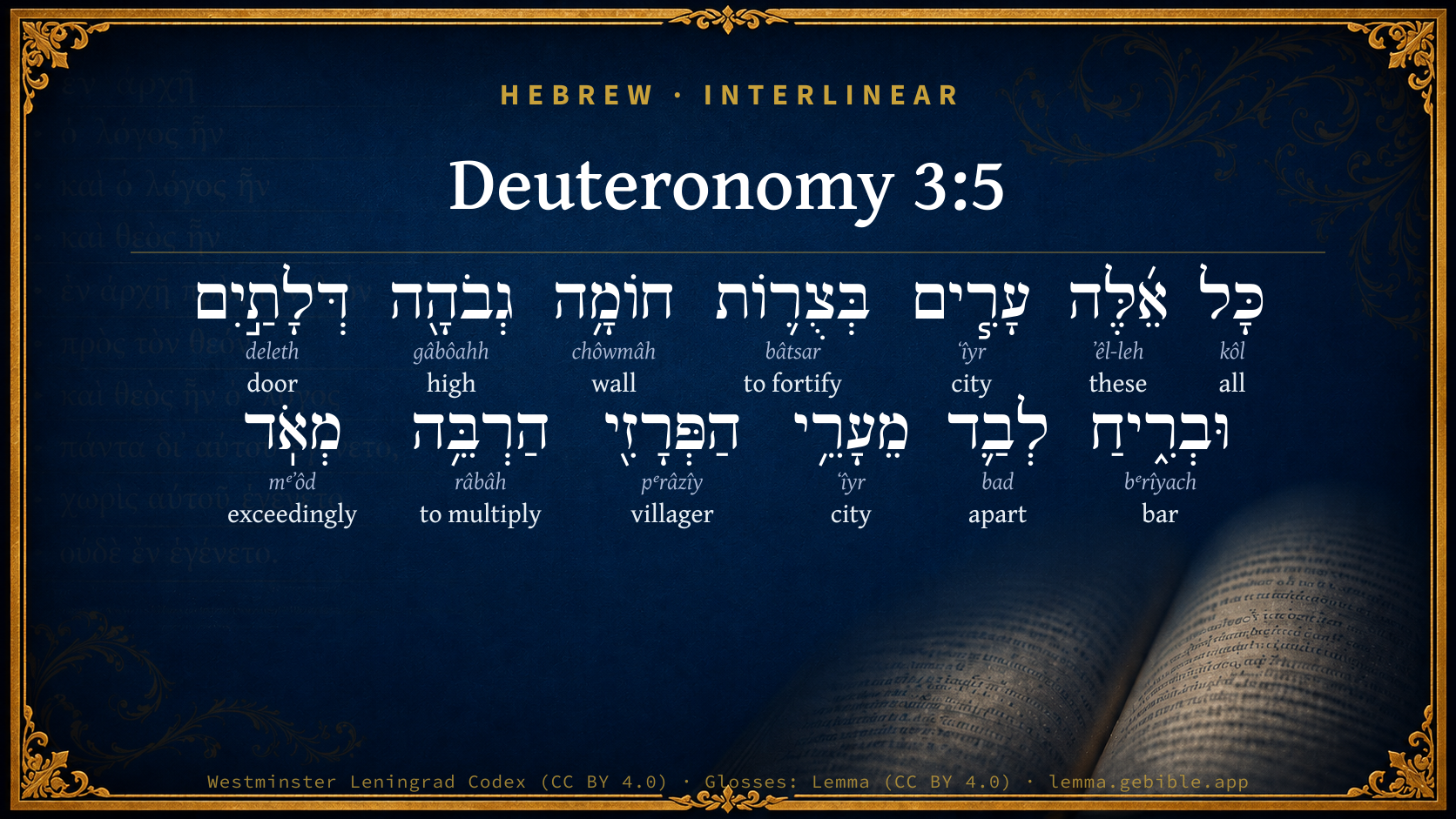
  1. כָּל kôl H3605 “all of” Noun, Common, Masculine, Singular, Construct
  2. אֵ֜לֶּה ʼêl-leh H428 “these” Pronoun, Demonstrative, Common, Plural
  3. עָרִ֧ים ʻîyr H5892 “cities” Noun, Common, Feminine, Plural, Absolute
  4. בְּצֻר֛וֹת bâtsar H1219 “fortified” Adjective, Adjective, Feminine, Plural, Absolute
  5. חוֹמָ֥ה chôwmâh H2346 “wall” Noun, Common, Feminine, Singular, Absolute
  6. גְבֹהָ֖ה gâbôahh H1364 “high” Adjective, Adjective, Feminine, Singular, Absolute
  7. דְּלָתַ֣יִם deleth H1817 “doors” Noun, Common, Feminine, Dual, Absolute
  8. וּבְרִ֑יחַ bᵉrîyach H1280 “and · bar” Conjunction + Noun, Common, Masculine, Singular, Absolute
  9. לְבַ֛ד bad H905 “to/for · apart” Preposition + Noun, Common, Masculine, Singular, Absolute
  10. מֵעָרֵ֥י ʻîyr H5892 “from · cities of” Preposition + Noun, Common, Feminine, Plural, Construct
  11. הַרְבֵּ֥ה râbâh H7235 “to multiply” Verb, Hiphil, Infinitive Absolute
  12. מְאֹֽד mᵉʼôd H3966 “exceedingly” Adverb

About this verse

These counts appear in no published source. They are computed here, from the morphology-tagged text and Lemma’s own curated glosses. What Lemma adds →

13
words
12
distinct lemmas
Pentateuch
section

Notable vocabulary

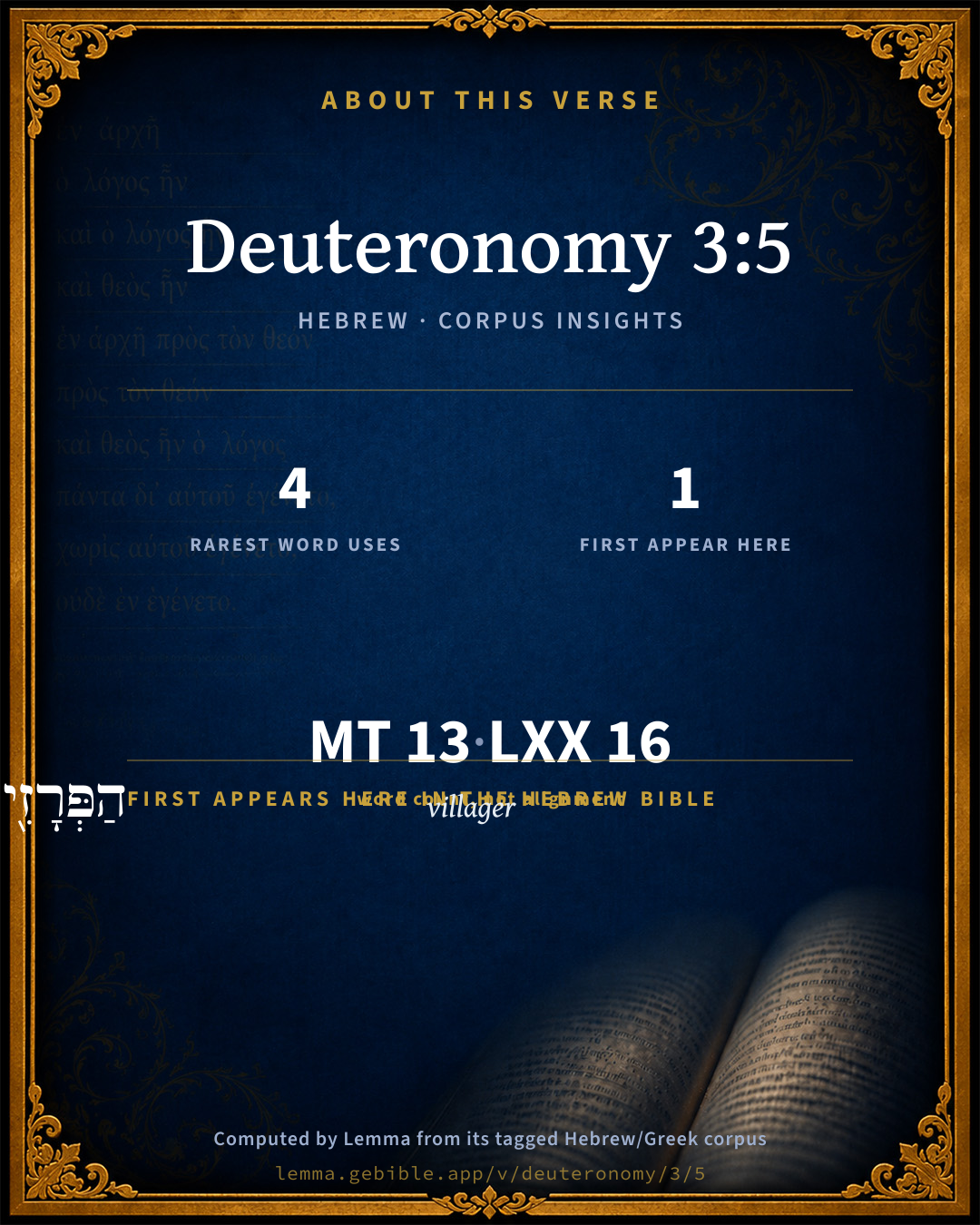
The rarest word here is הַפְּרָזִ֖י villager H6521 — appearing just 4 times in the whole Hebrew Bible.

First appearance in Scripture

This word makes its first canonical appearance in the Hebrew Bible here:

  • הַפְּרָזִ֖י villager H6521

Shared distinctive vocabulary

הַפְּרָזִ֖י villager H6521 occurs in 3 verses of the Hebrew Bible. Also found in:

Grammatical profile

  • 1 verb
  • 8 nouns
  • 2 adjectives
  • 1 pronoun
  • 1 adverb

Verb forms

  • הַרְבֵּ֥ה Hiphil · Infinitive Absolute

Repetition

A word recurs within this verse — often emphatic in Hebrew:

  • עָרִ֧ים city H5892 ×2

Hebrew & Septuagint length

In English translation the verse runs 18 words from the Hebrew and 16 from the Septuagint (LXX English) — closely comparable.

A rough comparison of the two English renderings, which tokenize alike — not a word-level alignment.

Word counts can differ between the Hebrew and the Greek without any difference in meaning — e.g. the Hebrew direct-object marker אֵת has no separate Greek word, and Greek often adds the article ὁ.

In the original languages it is 13 Hebrew tokens and 16 Greek tokens — but the two are counted differently (Hebrew bundles its prefixes and suffixes into one token; the Greek is in lemma form), so that isn’t a like-for-like length.

Cross-references

3

Topical passages linked to Deuteronomy 3:5 in the Treasury of Scripture Knowledge — connected by theme and wording, ordered by reader-vote popularity; previews shown in the World English Bible.

  • Numbers 13:28 However the people who dwell in the land are strong, and the cities are fortified, [and] very great: and moreover we saw the children of Anak there.
  • Deuteronomy 1:28 Where are we going up? our brothers have made our heart to melt, saying, The people are greater and taller than we; the cities are great and fortified up to the sky; and moreover we have seen the sons of the Anakim there.
  • Hebrews 11:30 By faith, the walls of Jericho fell down, after they had been encircled for seven days.

Cross-references courtesy of OpenBible.info (CC BY 4.0).

Hebrew and Greek witnesses Masoretic Hebrew ↔ Greek Septuagint

The same verse in the two great witnesses to the Old Testament, shown verse-for-verse.

These are two independent witnesses, not word-aligned to each other, and the Septuagint is shown in lemma (dictionary) form.

Hebrew Deuteronomy 3:5 Masoretic · Westminster Leningrad Codex

כָּל אֵ֜לֶּה עָרִ֧ים בְּצֻר֛וֹת חוֹמָ֥ה גְבֹהָ֖ה דְּלָתַ֣יִם וּבְרִ֑יחַ לְבַ֛ד מֵעָרֵ֥י הַפְּרָזִ֖י הַרְבֵּ֥ה מְאֹֽד

All these were cities fortified with high walls, gates, and bars; besides the unwalled towns a great many.

World English Bible · Public Domain

Greek LXX Deuteronomy 3:5 Septuagint · lemma form

πᾶς πόλις ὀχυρός τεῖχος ὑψηλός πύλη καί μοχλός πλήν ὁ πόλις ὁ φερεζαίος ὁ πολύς σφόδρα

all strong cities, lofty walls, gates and bars; besides the very many cities of the Pherezites.

LXX2012 (modern English Septuagint) · Public Domain

On this verse, Haydock's Catholic Bible Commentary discusses the Septuagint’s reading. Read the note in Commentary ↓

Hebrew: Westminster Leningrad Codex (CC BY 4.0). Greek: Septuagint (public domain); English from LXX2012 (modern English Septuagint) (Public Domain). How the Septuagint differs from the Hebrew →

Targum (Aramaic paraphrase)

2

The Targum is the ancient Jewish Aramaic paraphrase of the Hebrew Scriptures — an interpretive translation, not the Hebrew text itself. Onkelos (literal) and Pseudo-Jonathan (expansive) render the Torah, and Jonathan the Prophets. Coverage is partial: where no permissively-licensed English translation exists for a verse, only the Aramaic is shown. This is verse-level text, not a word-by-word alignment to the Hebrew.

  1. Targum Onkelos Torah (Genesis–Deuteronomy)
    כָּל אִלֵין קִרְוִין כְּרִיכָן מַקְפָן שׁוּר רָם דִילְהֶן דָשִׁין וְעַבְּרִין בַּר מִקִרְוֵי פַּצְחַיָא סַגִי לַחֲדָא

    (no public-domain English translation for this verse)

    Targum Onkelos — Aramaic: “Onkelos Genesis” (public domain); “Onkelos Exodus” (public domain); “Onkelos Leviticus” (public domain); “Onkelos Numbers” (public domain); “Onkelos Deuteronomy” (public domain). English: “Sefaria Community Translation” (CC0 1.0 (public-domain dedication)); “J.W. Etheridge. The Targums of Onkelos and Jonathan Ben Uzziel on the Pentateuch. London: Longmans, Green, 1862” (public domain). Text via Sefaria.

  2. Targum Pseudo-Jonathan Torah (Genesis–Deuteronomy)
    כָּל אִלֵין קִירְוִין חַקְרָא מַקְפִין שׁוּרִין רָמִין אֲחִידָן בְּתַרְעִין וּנְגָרִין בַּר מִקִּרְוֵי פַּצְחַיָיא סַגִי לַחֲדָא

    All these cities were fortified, surrounded with high walls, shut up with gates and bars; besides open towns very many.

    Targum Pseudo-Jonathan — Aramaic: “Targum Jonathan on Genesis” (public domain); “Targum Jonathan on Exodus” (public domain); “Targum Jonathan on Leviticus” (public domain); “Targum Jonathan on Numbers” (public domain); “Targum Jonathan on Deuteronomy” (public domain). English: “The Targum of Jonathan ben Uzziel, trans. J. W. Etheridge, London, 1862” (public domain). Text via Sefaria.

Commentary

Notes on Deuteronomy 3:5 from classic Christian and Jewish commentators (each source and its license shown beneath its notes). The classic Christian expositions comment on the surrounding passage and are grouped to its opening verse, so a note may address several verses; the Jewish commentaries on the Tanakh (Rashi and others) are per-verse, so they appear only where the commentator wrote on this verse.

Lemma curates 59 commentaries, every one of them public domain or Creative Commons licensed, each selected and text-cleaned for this edition rather than reprinted as found. About our sources →

Trapp's Complete Commentary

John Trapp

Deu 3:5 All these cities [were] fenced with high walls, gates, and bars; beside unwalled towns a great many.

Ver. 5. All those cities.] And they were threescore. How well might Moses have been styled πτολιπορθης? or, as King Demetrius was, Poliorcetes, the city taker?

John Trapp, A Commentary or Exposition upon All the Books of the Old and New Testament (1647–1656) — public domain. Text from a community e-Sword module.

Geneva Bible (1599)

Geneva Bible translators

As villages and small towns.

Geneva Bible (1599) marginal notes — public domain. Text via Bolls.life.

The Cambridge Bible for Schools and Colleges

gen. ed. J. J. S. Perowne

5. the unwalled towns] Heb. towns of the Perazi, or country-folk; perazôth, Eze_38:11, are open, rural places in contrast to fenced cities.

The Cambridge Bible for Schools and Colleges (gen. ed. J. J. S. Perowne; Cambridge University Press, 1878–1918) — public domain. Text from a community e-Sword module.

John Gill's Exposition

All these cities were fenced with high walls, gates, and bars,.... That is, all the cities in the kingdom of Bashan; and though they were, it hindered not their falling into the hands of the Israelites; and this might serve to encourage them against those fears they were possessed of by the spies, with respect to the cities in the land of Canaan; see Num 13:28.

besides unwalled towns a great many; small towns and villages adjacent to the several cities, as is common.

John Gill's Exposition of the Whole Bible (1746–1763) — public domain (CC PDM 1.0). Text via the HelloAO Bible API.

Albert Barnes' Notes on the Bible

Gates, and bars - literally, “Double gates and a bar.” The stone doors of Bashan, their height pointing to a race of great stature, and the numerous cities (deserted) exist to illustrate the statements of these verses.

Albert Barnes' Notes on the Bible (1834–1885) — public domain. Text from a community e-Sword/MySword module.

Haydock's Catholic Bible Commentary

Walls. Tacitus remarks, that "a great part of Judea is covered with villages, though towns may likewise be found in the country. (Hist. v. 8.) See 3 Kings iv. 13. Septuagint, "besides the towns of Pherezites, which were very numerous." (Calmet) --- The spies had not travelled in this county, when they gave an account of the walled towns being as high as heaven. But Moses here informs us, that the cities on the east side of the Jordan were not much inferior to those on the west, and the land was infested also with giants, ver. 13. (Haydock)

George Leo Haydock (1774–1849), Haydock's Catholic Family Bible and Commentary, 1859 edition — public domain. Excludes Psalms (Douay-Rheims chapter numbering differs from Protestant) and Deuterocanonical books (Catholic canon only).

Matthew Poole's English Annotations

High walls, gates, and bars; which may encourage you in your attempt upon Canaan, notwithstanding the fenced cities which the spies told you of, and you must expect to find.

Matthew Poole's English Annotations on the Holy Bible (1683–1685) — public domain. Text from a community e-Sword/MySword module.

Whedon's Commentary on the Bible

Daniel D. Whedon

5. These cities were fenced — The ruins of these cities are seen to-day. Porter thus describes the region of the captured cities: “The hills of Bashan were close in front, their summits clothed with oak forests and their sides studded with old towns. As we ascended them the rock fields of the Lejah were spread out on the right, and there too the ancient cities were thickly planted. Not less than thirty of the threescore cities of Argob were in view at one time on that day, their black houses and ruins half concealed by the black rocks amid which they are built, and their massive towers rising up here and there like the ‘keeps’ of old Norman fortresses.”

Daniel D. Whedon (gen. ed.), Commentary on the Old and New Testaments (1874–1909) — public domain. Text from a community e-Sword module.

The Pulpit Commentary

All these cities were fenced with high walls, gates, and bars; literally, double gates and a bar. These cities, with their marvelous erections, are believed to be still existing in the Hauran. Over that district tire strewn a multitude of towns of various sizes, all constructed after the same remarkable fashion. "The streets are perfect, the walls perfect, and, what seems more astonish. tug, the stone doors are still hanging on their hinges, so little impression has been made during these many centuries on the hard and durable stone of which they are built" (Graham, Cambridge Essays, p. 160). These doors are "formed of slabs of stone, opening on pivots which are projecting parts of the stone itself, and working in sockets in the lintel and threshold." Some of these gates are large enough to admit of a camel passing through them, and the doors are of proportionate dimensions, some of the stones of which they are formed being eighteen inches in thickness. The roofs also are formed of huge stone slabs resting on the massive walls. All betoken the workmanship of a race endowed with powers far exceeding those of ordinary men; and give credibility to the supposition that we have in them the dwellings of the giant race that occupied that district before it was invaded by the Israelites. "We could not help," says Mr. Graham, "being impressed with the belief that had we never known anything of the early portion of Scripture history before visiting this country, we should have been forced to the conclusion that its original inhabitants, the people who had constructed those cities, were not only a powerful and mighty nation, but individuals of greater strength than ourselves."

The Pulpit Commentary (1880–1919), ed. H.D.M. Spence-Jones & Joseph S. Exell — public domain. Text from a community e-Sword module.

unfoldingWord translationNotes

Door43 World Missions Community

General Information:

Moses continues reminding the people of Israel of what happened in the past.

These were all cities fortified with

"These were all cities protected by"

besides very many

"in addition to very many" or "not including very many"

Sihon

This is the name of a king. See how you translated this in Deuteronomy 1:4. (See: How to Translate Names)

Heshbon

This is the name of a city. See how you translated this in Deuteronomy 1:4. (See: How to Translate Names)

completely destroying every city

"killing all the people who lived in every city"

translationWords

gate

king

cow

unfoldingWord translationNotes — © Distant Shores Media and the Door43 World Missions Community, licensed CC BY-SA 4.0. Source: git.door43.org/Door43/en_tn.

Rashi

Rabbi Shlomo Yitzchaki (Rashi)

מערי הפרזי [BESIDES] UNWALLED CITIES — unconfined and open, i.e. without a wall. Similar is, (Zechariah 2:8) “As open spaces (פרזות) shall Jerusalem be inhabited”.

Rashi on the Tanakh — English translations: “The Judaica Press complete Tanach with Rashi, translated by A. J. Rosenberg” (CC BY 4.0); “Pentateuch with Rashi's commentary by M. Rosenbaum and A.M. Silbermann, 1929-1934” (public domain); “The Metsudah Tanach series, Lakewood, N.J” (CC BY 4.0); and “The Book of Joshua, Metsudah Publications, 1997” (CC BY 4.0). Text via Sefaria.

Lesson kit

Teaching starters — assembled from the data on this page, not authored interpretation. Every prompt links to the verse data it draws on. Edit before teaching.

Deuteronomy, in the Pentateuch, opens this verse with 13 words (12 distinct Hebrew lemmas). Its most distinctive word is pᵉrâzîy (“villager”). A historical commentator’s framing appears above. Read the whole chapter for the surrounding context.

Discussion questions

  1. How does “villager” (pᵉrâzîy) shape what this verse is saying?
  2. This is the first place “villager” appears in Scripture (first appears here). What does its debut here establish?
  3. How does 1 Samuel 6:18, which shares the word «villager», read alongside this verse?
  4. What does the repetition of “city” (2× in this one verse) do in this verse?
  5. The translations on this page render this verse differently — a whole-verse word diff, not a word-by-word alignment. What might account for the different wordings?
  6. «הַרְבֵּ֥ה» is a Hiphil Infinitive Absolute verb. How does that grammatical form shape the action described?
  7. Compare how Trapp's Complete Commentary and Geneva Bible (1599) read this verse. Where do they agree or differ?

Things to notice

Reading settings

Reading text

Shown beneath each verse's original-language words.

Old Testament
Old Testament edition

Read the OT as the Masoretic Hebrew (MT) or the Greek Septuagint (LXX).

English shown for the Greek Septuagint (in the Hebrew ↔ Greek comparison).

Comparing translations? Open the Compare panel on any verse page to stack up to four side by side.