Isaiah 57:9

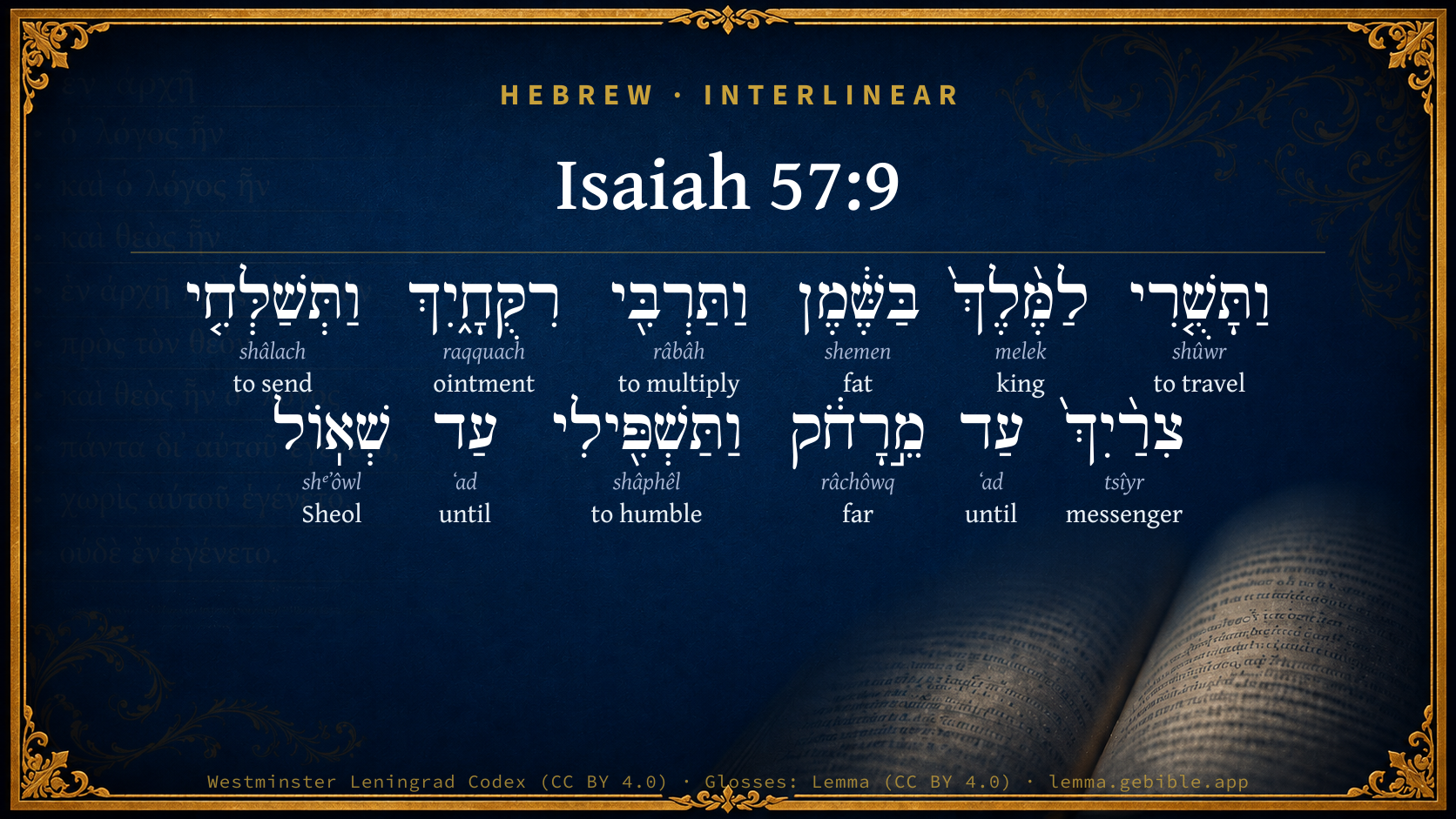
Hebrew (Westminster Leningrad Codex) Isaiah 57:9 appears in the Hebrew Old Testament. The text above is from the Westminster Leningrad Codex. Each word links to its Strong’s number, a concise gloss, and parsing drawn from the Open Scriptures Hebrew Bible morphology. Click any word for its full Brown-Driver-Briggs (BDB) entry.
Download image
Cite this verse

Isaiah 57:9 (World English Bible). Public Domain. Lemma interlinear Bible study tool, https://lemma.gebible.app/v/isaiah/57/9.

Show BibTeX & RIS
BibTeX
RIS
English Translation
You went to the king with oil, and did increase your perfumes, and did send your ambassadors far off, and did debase yourself even to Sheol.
World English Bible · Public Domain
Highlights
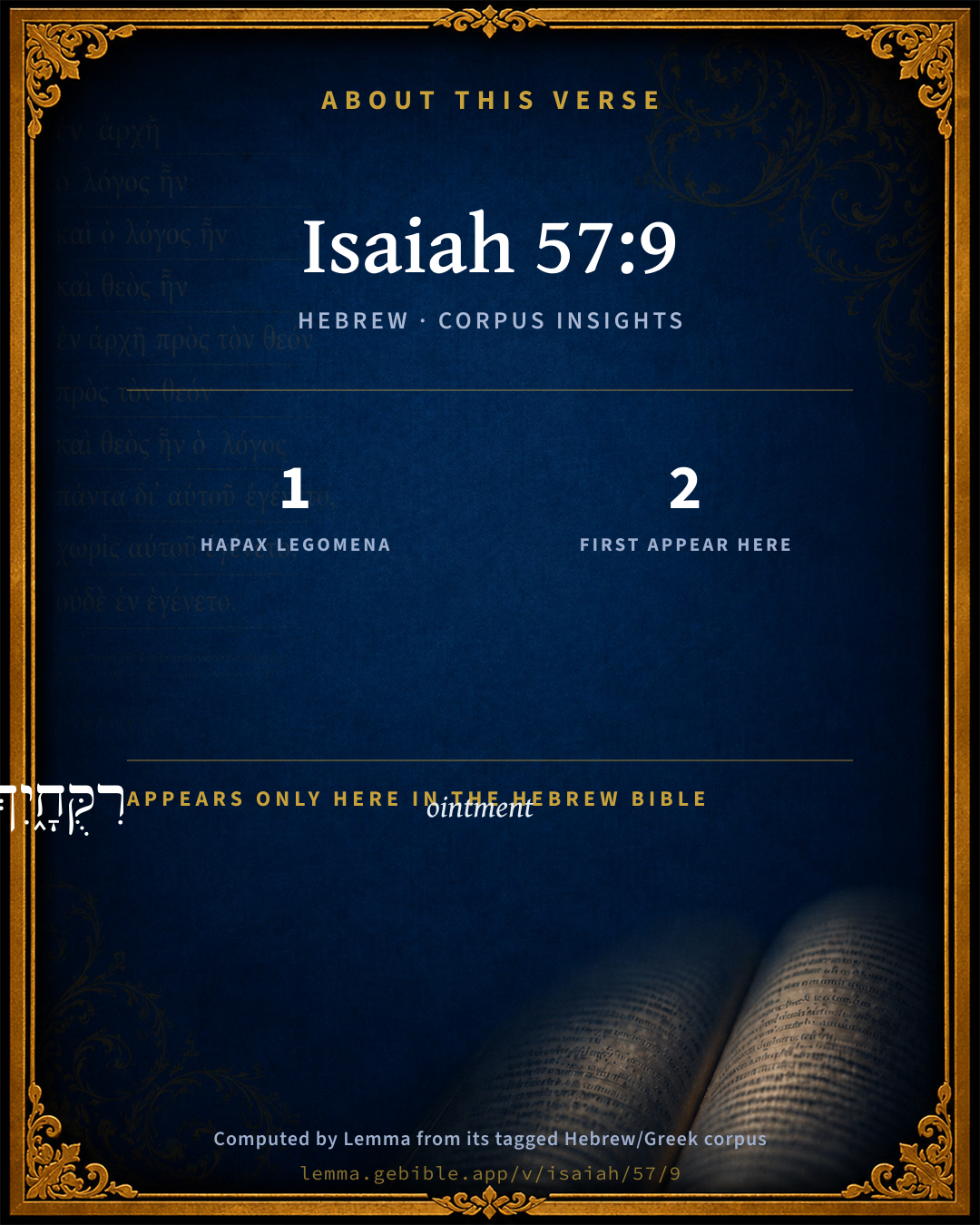
  • 1 hapax legomenon — only here in the Hebrew Bible
  • 2 first appearances in the Hebrew Bible
Full analysis ↓
Download a study sheet

One document with this verse’s original text, its word-by-word gloss line, the meaning frame, cross-references with their text, attributed commentary, and full source and license credits — printable, and it pastes into notes with its structure intact.

This verse Autodidact and up

Study sheet (.html) Plain text (.txt)

A passage Seminary Student

Up to 50 verses in one chapter. A passage sheet keeps up to 6 commentary sources and 12 cross-references per verse, in the order this page ranks them, and says so on the sheet whenever that leaves anything out. Ask for a single verse and you get the Autodidact verse sheet above.

Everything on this page stays free to read, with no account — the sheet is a download of what is already on screen, not access to it.

Want to remove ads? Support Godless Engineer
Compare translations 3

The same verse in 3 English versions, stacked beneath the original-language interlinear above. Click any original word for its lexicon entry.

Each is an independent rendering of the whole verse — the interlinear is not word-aligned to these translations.

Highlighted words mark where these versions differ — a whole-verse word diff, not a word-by-word alignment.

  • World English Bible Public Domain
    You went to the king with oil, and did increase your perfumes, and did send your ambassadors far off, and did debase yourself even to Sheol.
  • King James Version Public Domain
    And thou wentest to the king with ointment, and didst increase thy perfumes, and didst send thy messengers far off, and didst debase thyself even unto hell.
  • unfoldingWord Literal Text CC BY-SA 4.0
    And you turn to Molech with oil, and you multiply your perfumes. And you send your envoys to faraway, and you lower to Sheol.

unfoldingWord Literal Text — © unfoldingWord, licensed CC BY-SA 4.0. Word-aligned USFM3 via Door43 (git.door43.org/unfoldingWord/en_ult).

Versions to compare (up to 4)

3 of 4 selected

Show all 18 translations

Every available English version of this verse, each an independent rendering of the whole verse.

  • World English Bible Public Domain
    You went to the king with oil, and did increase your perfumes, and did send your ambassadors far off, and did debase yourself even to Sheol.
  • Berean Standard Bible Public Domain
    You went to Molech with oil and multiplied your perfumes. You have sent your envoys a great distance; you have descended even to Sheol itself.
  • Majority Standard Bible Public Domain
    You went to Molech with oil and multiplied your perfumes. You have sent your envoys a great distance; you have descended even to Sheol itself.
  • King James Version Public Domain
    And thou wentest to the king with ointment, and didst increase thy perfumes, and didst send thy messengers far off, and didst debase thyself even unto hell.
  • American Standard Version (1901) Public Domain
    And thou wentest to the king with oil, and didst increase thy perfumes, and didst send thine ambassadors far off, and didst debase thyself even unto Sheol.
  • Revised Version (1885) Public Domain
    And thou wentest to the king with ointment, and didst increase thy perfumes, and didst send thine ambassadors far off, and didst debase thyself even unto hell.
  • Geneva Bible (1599) Public Domain
    Thou wentest to the Kings with oyle, and diddest increase thine oyntments and sende thy messengers farre off, and diddest humble thy selfe vnto hell.
  • Douay-Rheims (1899) Public Domain
    And thou hast adorned thyself for the king with ointment, and hast multiplied thy perfumes. Thou hast sent thy messengers far off, and wast debased even to hell.
  • Young's Literal Translation Public Domain
    And goest joyfully to the king in ointment, And dost multiply thy perfumes, And sendest thine ambassadors afar off, And humblest thyself unto Sheol.
  • Literal Standard Version CC BY-SA 4.0
    And go joyfully to the king in ointment, || And multiply your perfumes, || And send your ambassadors far off, || And humble yourself to Sheol.
  • Unlocked Literal Bible CC BY-SA 4.0
    You went to Molech with oil; you multiplied perfumes. You send your ambassadors far away; you went down to Sheol.
  • unfoldingWord Literal Text CC BY-SA 4.0
    And you turn to Molech with oil, and you multiply your perfumes. And you send your envoys to faraway, and you lower to Sheol.
  • Darby Bible Public Domain
    And thou wentest to the king with ointment, and didst multiply thy perfumes, and didst send thy messengers afar off, and didst debase thyself unto Sheol.
  • World Messianic Bible Public Domain
    You went to the king with oil, increased your perfumes, sent your ambassadors far off, and degraded yourself even to Sheol.
  • Webster's Bible Public Domain
    And thou wentest to the king with ointment, and didst increase thy perfumes, and didst send thy messengers far off, and didst debase thyself even to hell.
  • Free Bible Version CC BY-SA 4.0
    You went to offer Molech olive oil, covering yourselves with many perfumes. You sent your messengers to distant places; you even went down into the world of the dead.
  • Bible in Basic English Public Domain
    And you went to Melech with oil and much perfume, and you sent your representatives far off, and went as low as the underworld.
  • JPS Tanakh (1917) Public Domain
    And thou wentest to the king with ointment, and didst increase thy perfumes, and didst send thine ambassadors far off, even down to the nether-world.

Literal Standard Version (2020), Covenant Press — licensed CC BY-SA 4.0. Text via the HelloAO Bible API (eBible.org). Unlocked Literal Bible (unfoldingWord) — licensed CC BY-SA 4.0. Text via the HelloAO Bible API (eBible.org). unfoldingWord Literal Text — © unfoldingWord, licensed CC BY-SA 4.0. Word-aligned USFM3 via Door43 (git.door43.org/unfoldingWord/en_ult). Free Bible Version, Dr. Jonathan Gallagher — licensed CC BY-SA 4.0. Text via the HelloAO Bible API (eBible.org).

Word by word

More ways to search: Search by grammar → Find every occurrence → Compare this word →

Practice this passage: Drill this verse → Learn its vocabulary →

רִקֻּחָ֑יִךְ
raqquach
H7547
“ointments · your”
Noun, Common, Masculine, Plural, Construct + Suffix, Personal, 2nd Person, Feminine, Singular
Part of Speech
Noun
Type
Common
Gender
Masculine
Number
Plural
State
Construct
Full BDB Definition

Origin: from H7543

TWOT: 2215e

perfumery, perfume, unguent
  1. וַתָּשֻׁ֤רִי shûwr H7788 “and · to travel” Conjunction + Verb, Qal, Sequential Imperfect, 2nd Person, Feminine, Singular
  2. לַמֶּ֨לֶךְ֙ melek H4428 “to/for the · king” Preposition, Determined + Noun, Common, Masculine, Singular, Absolute
  3. בַּשֶּׁ֔מֶן shemen H8081 “in/at the · fat” Preposition, Determined + Noun, Common, Masculine, Singular, Absolute
  4. וַתַּרְבִּ֖י râbâh H7235 “and · to multiply” Conjunction + Verb, Hiphil, Sequential Imperfect, 2nd Person, Feminine, Singular
  5. וַתְּשַׁלְּחִ֤י shâlach H7971 “and · to send” Conjunction + Verb, Piel, Sequential Imperfect, 2nd Person, Feminine, Singular
  6. צִרַ֨יִךְ֙ tsîyr H6735 “messengers · your” Noun, Common, Masculine, Plural, Construct + Suffix, Personal, 2nd Person, Feminine, Singular
  7. עַד ʻad H5704 “until” Preposition
  8. מֵ֣רָחֹ֔ק râchôwq H7350 “from · far” Preposition + Adjective, Adjective, Masculine, Singular, Absolute
  9. וַתַּשְׁפִּ֖ילִי shâphêl H8213 “and · to humble” Conjunction + Verb, Hiphil, Sequential Imperfect, 2nd Person, Feminine, Singular
  10. עַד ʻad H5704 “until” Preposition
  11. שְׁאֽוֹל shᵉʼôwl H7585 “Sheol” Noun, Proper

About this verse

These counts appear in no published source. They are computed here, from the morphology-tagged text and Lemma’s own curated glosses. What Lemma adds →

12
words
11
distinct lemmas
Prophets
section

Notable vocabulary

1 hapax legomenon — a word that appears only here in the entire Hebrew Bible:

  • רִקֻּחָ֑יִךְ ointment H7547

First appearance in Scripture

These words make their first canonical appearance in the Hebrew Bible here:

  • וַתָּשֻׁ֤רִי to travel H7788
  • רִקֻּחָ֑יִךְ ointment H7547

Shared distinctive vocabulary

וַתָּשֻׁ֤רִי to travel H7788 occurs in 2 verses of the Hebrew Bible. Also found in:

Grammatical profile

  • 4 verbs
  • 5 nouns
  • 1 adjective
  • 2 prepositions

Verb forms

  • וַתָּשֻׁ֤רִי Qal · Sequential Imperfect
  • וַתַּרְבִּ֖י Hiphil · Sequential Imperfect
  • וַתְּשַׁלְּחִ֤י Piel · Sequential Imperfect
  • וַתַּשְׁפִּ֖ילִי Hiphil · Sequential Imperfect

Repetition

A word recurs within this verse — often emphatic in Hebrew:

Hebrew & Septuagint length

In English translation the verse runs 26 words from the Hebrew and 35 from the Septuagint (LXX English) — closely comparable.

A rough comparison of the two English renderings, which tokenize alike — not a word-level alignment.

Word counts can differ between the Hebrew and the Greek without any difference in meaning — e.g. the Hebrew direct-object marker אֵת has no separate Greek word, and Greek often adds the article ὁ.

Cross-references

11

Topical passages linked to Isaiah 57:9 in the Treasury of Scripture Knowledge — connected by theme and wording, ordered by reader-vote popularity; previews shown in the World English Bible.

  • Ezekiel 23:16 As soon as she saw them she doted on them, and sent messengers to them into Chaldea.
  • Isaiah 30:1–6 Woe to the rebellious children, says Yahweh, who take counsel, but not of me; and who make a league, but not of my Spirit, that they may add sin to sin,
  • Isaiah 31:1–3 Woe to those who go down to Egypt for help, and rely on horses, and trust in chariots because they are many, and in horsemen because they are very strong, but they don't look to the Holy One of Israel, neither seek Yahweh!
  • Ezekiel 23:40 Furthermore you have sent for men who come from far, to whom a messenger was sent, and, behold, they came; for whom you did wash yourself, paint your eyes, and deck yourself with ornaments,
  • Colossians 2:18 Let no one rob you of your prize by a voluntary humility and worshipping of the angels, dwelling in the things which he has not seen, vainly puffed up by his fleshly mind,
  • 2 Kings 16:7–11 So Ahaz sent messengers to Tiglath Pileser king of Assyria, saying, I am your servant and your son: come up, and save me out of the hand of the king of Syria, and out of the hand of the king of Israel, who rise up against me.
  • Proverbs 7:17 I have perfumed my bed with myrrh, aloes, and cinnamon.
  • Isaiah 2:9 Man is brought low, And mankind is humbled; Therefore don't forgive them.
  • Ezekiel 16:33 They give gifts to all prostitutes; but you give your gifts to all your lovers, and bribe them, that they may come to you on every side for your prostitution.
  • Hosea 7:11 "Ephraim is like an easily deceived dove, without understanding. They call to Egypt. They go to Assyria.
  • Hosea 12:1 Ephraim feeds on wind, And chases the east wind. He continually multiplies lies and desolation. They make a covenant with Assyria, And oil is carried into Egypt.

Cross-references courtesy of OpenBible.info (CC BY 4.0).

Hebrew and Greek witnesses Masoretic Hebrew ↔ Greek Septuagint

The same verse in the two great witnesses to the Old Testament, shown verse-for-verse.

These are two independent witnesses, not word-aligned to each other, and the Septuagint is shown in lemma (dictionary) form.

Hebrew Isaiah 57:9 Masoretic · Westminster Leningrad Codex

וַתָּשֻׁ֤רִי לַמֶּ֨לֶךְ֙ בַּשֶּׁ֔מֶן וַתַּרְבִּ֖י רִקֻּחָ֑יִךְ וַתְּשַׁלְּחִ֤י צִרַ֨יִךְ֙ עַד מֵ֣רָחֹ֔ק וַתַּשְׁפִּ֖ילִי עַד שְׁאֽוֹל

You went to the king with oil, and did increase your perfumes, and did send your ambassadors far off, and did debase yourself even to Sheol.

World English Bible · Public Domain

Greek LXX Isaiah 57:9 Septuagint · lemma form

καί πληθύνω ὁ πορνεία σύ μετά αὐτός καί πολύς ποιέω ὁ μακράν ἀπό σύ καί ἀποστέλλω πρέσβυς ὑπέρ ὁ ὅριον σύ καί ἀποστρέφω καί ταπεινόω ἕως ᾅδης

and you have multiplied your whoredom with them, and you have increased the number of them that are far from you, and have sent ambassadors beyond your borders, and have been debased even to hell.

LXX2012 (modern English Septuagint) · Public Domain

On this verse, Albert Barnes' Notes on the Bible discusses the Septuagint’s reading. Read the note in Commentary ↓

Hebrew: Westminster Leningrad Codex (CC BY 4.0). Greek: Septuagint (public domain); English from LXX2012 (modern English Septuagint) (Public Domain). How the Septuagint differs from the Hebrew →

Targum (Aramaic paraphrase)

1

The Targum is the ancient Jewish Aramaic paraphrase of the Hebrew Scriptures — an interpretive translation, not the Hebrew text itself. Onkelos (literal) and Pseudo-Jonathan (expansive) render the Torah, and Jonathan the Prophets. Coverage is partial: where no permissively-licensed English translation exists for a verse, only the Aramaic is shown. This is verse-level text, not a word-by-word alignment to the Hebrew.

  1. Targum Jonathan Prophets (Joshua–Malachi)
    כַּד עֲבַדְתְּ לִיךְ אוֹרַיְתָא אַצְלַחְתְּ בְּמַלְכוּתָא וְכִדְאַסְגֵית לִיךְ עוֹבָדִין טָבִין סַגִיאָה מַשִׁרְיָתִיךְ וּשְׁלַחְתְּ אִזְגַדָךְ עַד מֵרָחִיק וְאַמְאֵיכְתְּ תַּקִיפֵי עַמְמַיָא עַד לִשְׁאוֹל:

    When thou didst keep the law, thou didst prosper in the kingdom; and when thou didst multiply for thyself good works, thy camp was enlarged, and thou didst send thy messengers to a distant land; and thou didst humble mighty nations unto bades.

    Targum Jonathan — Aramaic: “Mikraot Gedolot” (public domain). English: “Sefaria Community Translation” (CC0 1.0 (public-domain dedication)); “London "Chaldee Paraphrase," 1871” (public domain). Text via Sefaria.

Commentary

Notes on Isaiah 57:9 from classic Christian and Jewish commentators (each source and its license shown beneath its notes). The classic Christian expositions comment on the surrounding passage and are grouped to its opening verse, so a note may address several verses; the Jewish commentaries on the Tanakh (Rashi and others) are per-verse, so they appear only where the commentator wrote on this verse.

Lemma curates 59 commentaries, every one of them public domain or Creative Commons licensed, each selected and text-cleaned for this edition rather than reprinted as found. About our sources →

Trapp's Complete Commentary

John Trapp

Isa 57:9 And thou wentest to the king with ointment, and didst increase thy perfumes, and didst send thy messengers far off, and didst debase [thyself even] unto hell.

Ver. 9. And thou wentest to the king.] The King of Assyria, who styled himself the Great King, to whom Ahaz both sent and went. {2Ki 16:8; 2Ki 16:10}

With ointment.] Heb., With oil - that is, with balsam, such as Judea only afforded, and was therefore highly esteemed in other countries.

And didst debase thyself even unto hell.] By crouching and cringing to those foreign states in a most submissive and servile way, as Ahaz had done with his, "I am thy servant and thy son," {2Ki 16:7} to the dishonour of God, and to the reproach of Israel, who was God’s "firstborn, higher than the kings of the earth." {Psa 89:27}

John Trapp, A Commentary or Exposition upon All the Books of the Old and New Testament (1647–1656) — public domain. Text from a community e-Sword module.

Joseph Benson's Commentary

Isa 57:9. Thou wentest to the king, &c. — That is, the king of Assyria or Egypt, to whom the Israelites were very prone to seek, and trust, and send presents. Hosea reproaches the Israelites for the same practice: They make a covenant with Assyria, and oil is carried into Egypt, Hos 12:1. Thus the prophet passes from their idolatry to another sin, even to their carnal confidence in heathen princes, for which they are often severely reproved. These two sins indeed were commonly joined together; for they easily received idolatry from those kings whose help they desired. With ointment — With precious ointment, particularly with balm, which was of great price, was a commodity peculiar to those parts, and sometimes sent as a present, Gen 13:11. And didst increase thy perfumes — Didst send great quantities thereof to them, to procure their aid. Didst send thy messengers far off — Into Assyria, which was far from Judea, or into Egypt. And didst debase thyself, &c. — Thou wast willing to submit to the basest terms to procure their aid. “It is well known, that in all parts of the East, whoever visits a great person must carry him a present. ‘It is accounted uncivil,’ says Maundrell, p. 26, ‘to visit in this country without an offering in hand. All great men expect it, as a tribute due to their character and authority; and look upon themselves as affronted, and indeed defrauded, when the compliment is omitted.’” — Bishop Lowth. According to the interpretation of this part of the prophecy, adopted by Vitringa, the king, in this verse, must mean the head of mystical Babylon, the pope, to whom indeed the particulars here very aptly pertain, as they who are acquainted with the history of that antichristian ruler will easily discern. See Rev 18:13.

Joseph Benson's Commentary on the Old and New Testaments (1811–1818) — public domain. Text from a community e-Sword module.

Geneva Bible (1599)

Geneva Bible translators

Thou didst seek the favor of the Assyrians by gifts and presents to help thee against the Egyptians: and when they failed thou soughtest to the Babylonians, and more and more didst torment thyself.

Geneva Bible (1599) marginal notes — public domain. Text via Bolls.life.

Jamieson, Fausset & Brown

Robert Jamieson, A. R. Fausset & David Brown

the king--the idol which they came to worship, perfumed with oil, like harlots (Jer 4:30; Eze 23:16, Eze 23:40). So "king" means idol (Amo 5:26; Zep 1:5); (malcham meaning "king") [ROSENMULLER]. Rather, the king of Assyria or Egypt, and other foreign princes, on whom Israel relied, instead of on God; the "ointment" will thus refer to the presents (Hos 12:1), and perhaps the compliances with foreigners idolatries, whereby Israel sought to gain their favor [LOWTH] (Isa 30:6; Eze 16:33; Eze 23:16; Hos 7:11).

send . . . messengers far off--not merely to neighboring nations, but to those "far off," in search of new idols, or else alliances.

even unto hell--the lowest possible degradation.

Jamieson, Fausset & Brown — Commentary Critical and Explanatory on the Whole Bible (1871) — public domain (CC PDM 1.0). Text via the HelloAO Bible API.

Adam Clarke's Commentary

Verse 9. And thou wentest to the king with ointment - "And thou hast visited the king with a present of oil"] That is, the king of Assyria, or Egypt. Hosea, Ho 12:1, reproaches the Israelites for the same practice: -

"They make a covenant with Assyria,

And oil is carried to Egypt."

It is well known, that in all parts of the east, whoever visits a great person must carry him a present. "It is counted uncivil," says Maundrell, p. 26, "to visit in this country without an offering in hand. All great men expect it as a tribute due to their character and authority; and look upon themselves as affronted, and indeed defrauded, when the compliment is omitted." Hence שור shur, to visit a person, is equivalent to making him a present; and תשורה teshurah signifies a present made on such occasions; as our translators have rightly rendered it, 1Sa 9:7; on which Jarchi says Menachem exponit תשורה teshurah, quod significat oblationem sive manus, ut aliquis aspiciat faciem regis, aut alicuius magnatis. "Menachem expounds תשורה teshurah of an offering or gift which is presented in order to be admitted into the presence of the king or some great man."

Adam Clarke's Commentary on the Bible (1810–1826) — public domain. Text from a community e-Sword/MySword module.

Ellicott's Commentary for English Readers

(9) Thou wentest to the king . . .—The alteration of a single letter would give to Molech; and this may be the meaning even of the text as it stands. Looking to the Manasseh-surroundings of the passage, however, it is more natural to refer the words to the king, the great king of Assyria, whose religion Judah had basely and shamefully adopted. The sin of Ahaz (2Ki_16:11) had been reproduced by his grandson. The description that follows is that of a harlot adorning herself for her evil calling, and finds its best illustration in Pro_7:14-17. Looking to the previous traces of Isaiah’s study of that book (Isa_11:1-4, &c) we may, perhaps, find in it a deliberate reproduction of that passage. The “ointment” and “perfumes” are symbols of the treasures which were lavished to secure the Assyrian alliance. The words help us to understand Isaiah’s indignation at what must have seemed to him the initial step of a like policy on the part of Hezekiah (Isa_39:3-7). The words which point to the “far-off” land, to which the messengers were sent, seem almost like an echo from that king’s apology.

Even unto hell—i.e., Hades or Sheol, the world of the dead—as the symbol of an abysmal depth of degradation.

A Bible Commentary for English Readers, edited by Charles John Ellicott (1878–1897) — public domain. Text from a community e-Sword module.

The Cambridge Bible for Schools and Colleges

gen. ed. J. J. S. Perowne

9. Pilgrimages and deputations to the shrines of foreign deities form a fitting conclusion to the enumeration of their idolatries. Another view taken of the verse is that it refers to political embassies sent to court the favour of some great heathen power. This idea derives support from the resemblance of the passage to Eze_23:16; Eze_23:40, but it is out of keeping with the other allusions of the verse. Oil and ointment have nothing to do with politics; on the other hand unguents of various kinds played a great part in the cultus of the Semites. (See W. R. Smith, Religion of the Semites2, pp. 232 f., 382 f.) And the last line of the verse is most naturally explained as an allusion to infernal deities.

And thou wentest to the king, &c.] Rather, And thou hast journeyed to Melek with oil. “Melek” means king, and is here understood by many of the Great King of Assyria or Babylon. But for the reasons given above it is necessary to explain it as the name of a deity. It is, in fact, the word which has come to us in the Hebrew Bible under the form Molech, its proper vowels having been replaced in Jewish tradition by those of bôsheth, “shameful thing.” (see W. R. Smith, l.c. p. 372.) It was a title applied by the Northern Semites to many gods, and even (among the Israelites) to Jehovah, as “king.’ ” Here it seems to be used as a proper name, and the verb “journey” shows that a foreign god is meant; possibly, as Duhm thinks, Milkom, the chief god of the Ammonites, with whom the Samaritans seem to have been in close alliance (Neh_2:10; Neh_4:7; Neh_6:1 ff.).

thy perfumes] or ointments.

and didst send thy messengers far off] Where they could not go in person they sent messengers with offerings.

and didst debase thyself even unto hell] Rather, and hast sent deep to Sheol (lit. “hast deepened [sc. thy sending] to Sheol”), i.e. they sought the favour of the deities of the underworld, by consulting their oracles etc.

The Cambridge Bible for Schools and Colleges (gen. ed. J. J. S. Perowne; Cambridge University Press, 1878–1918) — public domain. Text from a community e-Sword module.

John Gill's Exposition

And thou wentest to the king with ointment,.... To the kings of the earth, the singular for the plural, with whom the whore of Rome has committed fornication or idolatry, in allusion to harlots, who, in order to render themselves the more agreeable to their lovers, anointed themselves with ointment: this may respect the grace of the Spirit of God, which the church of Rome pretends to give by administration of the sacraments, which it is said confer grace "ex opere operato"; and the extreme unction given as a meetness for heaven, in the last moments of life:

and didst increase thy perfumes; after the manner of harlots, who, to ingratiate themselves with men, use much perfumes: this may signify the many ways the whore of Rome takes to make herself regarded by the kings and nations of the earth; pretending to antiquity, infallibility, power of working miracles, works of supererogation, primacy and superiority over all other churches; using great pomp and splendour in places of worship, and in all religious services:

and didst send thy messengers far off; not only into neighbouring kingdoms and states, into all the nations of Europe; but even into the most distant parts of the world, into both the Indies, in order to make proselytes, spread the religion of the see of Rome, and increase its power. The pope's "nuncios" and "legates a latere", may be here pointed at, as well as the Jesuits his emissaries, sent into all parts to promote his interest. Jarchi's note is,

"to exact tribute of the kings of the nations;''

which has been the business of the pope's legates:

and didst debase thyself even unto hell; or lay thyself low; prostitute thyself as harlots do to every lover; or didst feign thyself very lowly and humble, as the pope does when he calls himself "servus servorum"; or rather, "thou didst depress", or "bring low, even unto hell" (t); that is, multitudes of men and women, who are brought down to hell by the false doctrine and worship of the church of Rome; and the followers of the man of sin say, that if he brings down thousands into hell, none ought to say, what dost thou? Cocceius thinks it may have respect to his pretended power over hell, to send as many there as do not please him; arrogating to himself the keys of heaven and hell; or over purgatory, a figment of his brain, where he pretends the souls of men are for a time, and from whence, for a sum of money, he delivers them. The Targum is,

"thou hast depressed the strength of the people; or, as some copies, the strong of the people unto hell.''

(t) "et demisti usque ad infernum", Cocceius.

John Gill's Exposition of the Whole Bible (1746–1763) — public domain (CC PDM 1.0). Text via the HelloAO Bible API.

Albert Barnes' Notes on the Bible

And thou wentest to the king - Margin, ‘Respectedst.’ Jerome renders this, ‘Thou hast adorned thyself with royal ointment, and hast multiplied thy painting; and evidently understands it as a continuance of the sentiment in the previous verses as referring to the kind of decoration which harlots used. The Septuagint renders it, ‘Thou hast multiplied thy fornication with them, and hast done it with many who are far from thee.’ The Chaldee renders it, ‘When thou didst keep the law thou wert prosperous in the kingdom; and when thou didst abound in good works, then thine armies were multiplied.’ Lowth supposes that the king of Egypt or Assyria is intended, and that the prophet refers to the fact, that the Hebrews had sought an alliance with them, and in order to secure it, had carried a present of valuable unguents, after the manner of the East. Rosenmuller supposes, that by the king an idol was intended, and that the sense is, that they had anointed themselves with oil, and prepared perfumes, in order to be acceptable to the idol; that is, had decorated themselves as harlots did.

Grotius supposes that it means that they had imitated foreign kings, and copied the customs of other nations, and refers to the example of Ahaz 2Ki 16:10. Others suppose that the word ‘king’ is to be taken collectively, and that it means that they had sought the alliance, and imitated the customs of foreign nations in general. It is probable that the prophet refers to some such fact. On former occasions, they had sought the alliance of the king of Assyria (see Isa 7:1); and on one occasion, at least, they had meditated an alliance with the king of Egypt (Isa 30:2 ff.) The essential idea is, that they had proved unfaithful to Yahweh. This idea is presented here under the image of a female unfaithful to her husband, who had decorated and perfumed herself that she might allure others. Thus the Jews had forsaken God, and had endeavored to make themselves agreeable in the sight of other nations, and had courted their friendship and alliance. The word I ‘king,’ according to this, refers not to idols, but to foreign princes, whose assistance had been sought.

And didst increase thy perfumes - That is, for the purpose of rendering thyself agreeable, after the manner of a licentious female (see Pro 7:17). The custom of perfuming the person was common in the East, and is still practiced there.

And didst send thy messengers - That is, to distant nations, for the purpose of securing their alliance.

And didst debase thyself even unto hell - On the meaning of the word ‘hell,’ see the notes at Isa 5:14. The idea is, that they had sunk to the deepest possible debasement. In forsaking Yahweh; in seeking foreign alliances; in their anxiety to secure their aid when Yahweh was abundantly able and willing to protect them, they had sunk to the lowest degradation of character and condition. The sentiment is, that people degrade themselves when they do not put confidence in God, and when, distrusting his ability, they put reliance on any other aid than his. If people have God for their protector, why should they court the friendship of earthly princes and kings?

Albert Barnes' Notes on the Bible (1834–1885) — public domain. Text from a community e-Sword/MySword module.

Haydock's Catholic Bible Commentary

King. Moloc, or (Calmet) any foreign king, of whose alliance God did not approve. (Theodoret) --- To please them, the true religion was adulterated.

George Leo Haydock (1774–1849), Haydock's Catholic Family Bible and Commentary, 1859 edition — public domain. Excludes Psalms (Douay-Rheims chapter numbering differs from Protestant) and Deuterocanonical books (Catholic canon only).

Matthew Poole's English Annotations

Thou wentest, either by thyself, or by thy messengers, as it follows. Or, thou didst look, to wit, earnestly, with expectation and vehement affection.

To the king; either to Moloch, which was as it were the king or chief of their idols, and which signifies a king. Or to the great king of Assyria, called the king by way of eminency, to whom the Israelites in the days of Isaiah were very prone to seek, and trust, and send presents. Although the word king may be here taken collectively for the kings of Assyria or Egypt, or any other king, from whom they desired or expected help in their straits. And so the prophet passeth here from their idolatry to another sin, even to their carnal confidence in heathen princes, for which they are oft severely reproved; although these two sins were commonly joined together, and they easily received idolatry from those kings whose help they desired.

With ointment; with precious ointments, and particularly with balm, which was of great price, and was a commodity peculiar to those parts, and was sometimes sent as a present: see Gen 43:11; Jer 8:22; 46:11.

Didst increase thy perfumes; didst send great quantities thereof to them to procure their aid.

Didst send thy messengers far off; into Assyria, which was far from Judea.

Didst debase thyself even unto hell; thou wast willing to submit to the basest terms to procure their aid.

Matthew Poole's English Annotations on the Holy Bible (1683–1685) — public domain. Text from a community e-Sword/MySword module.

Whedon's Commentary on the Bible

Daniel D. Whedon

9, 10. To the king — Or, possibly, to Moloch, as both words have the same radical letters, and differ only in vowels. If so, the meaning is plain. Or it may be “king,” and refer to some foreign idolatrous king to whom suit had been made for aid, instead of to Jehovah.

With ointment — Perfumery was in choicest request among oriental princes.

Debase thyself… unto hell — That is, to the lowest degradation into which one can sink — the most degrading practices of idolatry.

Wearied in the greatness of thy way — In this low service no wearing toil is too great, no sacrifice spared; with a zeal worthy of a better business thou dost never despond.

The life of thine hand — Or, life enough hast thou in thy hand, never to weary in idol making; never to pine as in sickness. Is is not better to take “the life of thine hand” as denoting illicit gains rather than illicit pleasures?

Daniel D. Whedon (gen. ed.), Commentary on the Old and New Testaments (1874–1909) — public domain. Text from a community e-Sword module.

The Pulpit Commentary

And thou wentest to the king, Delitzsch and Mr. Cheyne understand "the King of Assyria," and regard the verse as bringing forward a new subject of complaint: Not only hast thou deserted me tot other gods, but thou trustest for aid, not to me, but to the Assyrian monarch." But there is no indication of the Jews having put any trust in Assyria after the reign of Ahaz, to which this chapter, by its position in the prophecy, cannot belong. Moreover, the King of Assyria is never called simply" the king." It is, therefore, better to regard "the king" as Moloch, whom the Jews of Isaiah"s time certainly worshipped (see ver. 5), and whose name was a mere dialectic variety of Melech, king" (see Dean Payne Smith"s "Sermons on Isaiah," sermon 4. p. 119). Ointment... perfumes. Either bearing them as offerings, or herself perfumed with them, as was the practice of lewd women. (Pro_7:17) And didst send thy messengers far off; i.e. to distant Moloch-shrines. And didst debase thyself even unto hell; i.e. "didst take on thee the yoke of a mean and grovelling superstition, which debased thee to the lowest point conceivable." There was nothing lower in religion than the worship of Moloch.

The Pulpit Commentary (1880–1919), ed. H.D.M. Spence-Jones & Joseph S. Exell — public domain. Text from a community e-Sword module.

John Wesley's Explanatory Notes

The King - The king of Assyria, called the king by way of eminency, to whom the Israelites in the days of Isaiah were very prone to trust, and send presents. And so the prophet passes from their idolatry to another sin, even their confidence in Heathen princes. Increase - Didst send great quantities. Far off - Into Assyria, which was far from Judea. Debase - Thou wast willing to submit to the basest terms to procure their aid.

John Wesley, Explanatory Notes Upon the Whole Bible (1754–1765) — public domain. Text via the GEBible commentary corpus.

Keil & Delitzsch

C. F. Keil & F. Delitzsch

In the closest reciprocal connection with this God-forgetting, adulterous craving for the favour of heathen gods, stood their coquetting with the heathen power of the world. "And thou wentest to the king with oil, and didst measure copiously thy spices, and didst send thy messengers to a great distance, and didst deeply abase thyself, even to Hades. Thou didst become weary of the greatness of thy way; yet thou saidst not, It is unattainable: thou obtainedst the revival of thy strength: therefore thou wast not pained." The first thing to be noticed here, is one that has been overlooked by nearly all the modern commentators, viz., that we have here a historical retrospect before us. And secondly, a single glance at Isa 57:11 is sufficient to show that the words refer to a servile coquetry from the fear of man, and therefore to a wicked craving for the favour of man; so that "the king," is not Baal, or any heathen god whatever (according to Isa 8:21 and Zep 1:5), but the Asiatic ruler of the world. Ahaz sent messengers, as we read in Kg2 16:7., to Tiglath-pileser, the king of Assyria, to say to Him, "I am thy servant and thy son." And Ahaz took the silver and gold that were in the house of Jehovah, and in the treasures of the palace, and sent a bribe to the king of Assyria. And again, at Kg2 16:10., Ahaz went to Damascus to meet the king of Assyria, and there he saw an altar, and sent a model of it to Jerusalem, and had one like it put in the place of the altar of burnt-offering. Such acts as these are here described in the figure of Israel travelling with oil to the king, and taking a quantity of choice spices with it to gain his favour, and also sending messengers, and not only bowing itself to the earth, but even stooping to Hades, that is to say, standing as it were on its head in its excessive servility, for the purpose of obtaining allies. It seems most natural to take בּשׁמן as equivalent to בשמן משׁוּחה: thou wentest in oil (dripping with pomade), and didst apply to thyself many spices; but Beth after verbs of going signifies to go with anything, to take it with one and bring it, so that the oil and spices are thought of here as presents, which she took with her as sensual stimulants, with a view to the amorous pleasures she was seeking (Eze 23:41, cf., Hos 12:2). השׁפּיל signifies to go deep down in Jer 13:18; the meaning here is, to bow very low, or to degrade one's self. By "the greatness or breadth of the way" (a similar expression to that in Jos 9:13), all the great sacrifices are intended which it cost her to purchase the favour of the heathen ruler. Although they were a great trouble to her, yet she did not say נואש, "it is hopeless;" the niphal of יאשׁ signifies in Sa1 27:1, to betake one's self to a thing with despair of its success. The participle in Job 6:26 means a despairing person; it also occurs in a neuter sense in Jer 2:26; Jer 18:12, viz., given up, i.e., absolutely in vain. She did not give up hope, although the offerings nearly exhausted her strength; on the contrary, she gained יד חיּת, "life of her arm," i.e., (according to the use of חיה in the sense of reviving, and החיה, to bring to life again) new life in her arm, in other words, "the renewing of her strength" (recentem vigorem virium suarum). Thus, without noticing the sighs and groans forced from her by the excessive toil and fatigue, but stirring herself up again and again, she pursued the plan of strengthening her alliances with the heathen. Ezekiel's picture of Aholah and Aholibah is like a commentary on Isa 57:3-10 (see Ezek 23).

Keil & Delitzsch — Biblical Commentary on the Old Testament (1861–1891) — public domain (CC PDM 1.0). Text via the HelloAO Bible API. (Old Testament only.)

J. A. Alexander on Isaiah

Joseph Addison Alexander

“And thou hast gone to the king in oil and hast multiplied thine unguents, and hast sent thine ambassadors even to a far off (land,) and hast gone (or sent) down even to hell.” The first verb has been variously explained as meaning ‘to see, to look around, to appear, to be adorned, to sing, to carry gifts.’ By ‘the king’ some understand the king of Babylon or Egypt, and refer the clause to the eagerness with which the Prophet’s contemporaries sought out foreign alliances. Most writers understand it as a name for idols generally, or for Moloch in particular. Bashemen (in oil) is commonly explained to mean with oil or ointment (as a gift); but some understand it to mean in oil, (i.e., anointed, beautified, adorned). Upon the explanation of this phrase of course depends that of the next, where unguents are said to be multiplied, either in the way of gifts to others or as means of self-adornment.

Joseph Addison Alexander, The Prophecies of Isaiah (1846–1847; New York: Scribner, 1870–1878) — public domain. Text from a community e-Sword module.

Scofield Reference Notes

C. I. Scofield

hell

Heb. "Sheol," (See Scofield "Hab 2:5")

The Scofield Reference Bible (1917 edition), notes by C. I. Scofield — public domain. Text from a community e-Sword module.

unfoldingWord translationNotes

Door43 World Missions Community

General Information:

Yahweh continues speaking to the unfaithful people of Israel.

you went down to Sheol

The people did not literally go to Sheol, the world of the dead. Instead, Yahweh is indicating by exaggeration that the people were willing to go anywhere to find new gods to worship. (See: Hyperbole and Generalization)

You found life in your hand

After trying so hard, the idolators found they still had strength to keep going. Here "hand" equals "strength" or "capacity." (See: Metaphor)

translationWords

Molech

oil

ambassador

Hades

life

hand

unfoldingWord translationNotes — © Distant Shores Media and the Door43 World Missions Community, licensed CC BY-SA 4.0. Source: git.door43.org/Door43/en_tn.

Rashi

Rabbi Shlomo Yitzchaki (Rashi)

And you brought a gift to the king with oil Heb. וַתָּשֻׁרִי. Originally, I aggrandized you, and you would greet your king with all sorts of delights. וַתָּשֻׁרִי is an expression of an audience. Comp. (Num. 24:17) “I see him (אֲשׁוּרֶנוּ) but he is not near.” [Also] (I Sam. 9:7), “And there is no present (תְּשׁוּרָה) to bring,” [i.e.,] a gift for an audience.

and you sent your ambassadors Your messenger afar to collect tribute from the heathen kings. ([Manuscripts and K’li Paz read:] the kings of the nations.)

and you humbled the laws of the heathens (of the nations [Mss. and K’li Paz]) to the grave. Jonathan rendered it in this manner.

Rashi on the Tanakh — English translations: “The Judaica Press complete Tanach with Rashi, translated by A. J. Rosenberg” (CC BY 4.0); “Pentateuch with Rashi's commentary by M. Rosenbaum and A.M. Silbermann, 1929-1934” (public domain); “The Metsudah Tanach series, Lakewood, N.J” (CC BY 4.0); and “The Book of Joshua, Metsudah Publications, 1997” (CC BY 4.0). Text via Sefaria.

Ibn Ezra

Rabbi Abraham ibn Ezra

ותשרי וגו׳ And thou gavest, etc. There is yet another evil, says the Lord, to Israel; thou hast not only worshipped idols, thou hast also sent presents to the kings of Assyria or Egypt, and hast relied on them. As to the meaning of ותשרי and thou gavest a present, comp. ותשורה and a present (1 Sam. 9:7); R. Moses Hannagid derives תשורה from שור to see, and explains it to signify the fees for the vision and prophecy; according to this explanation ותשרי may be compared with אשורנו I shall see him (Num. 24:17), and explained thou didst go to see him.

With oil. Oil was exported from Palestine.

ציריך Thy messengers.

זתשפילי And didst debase thyself.

Ibn Ezra on the Tanakh — English translations: “Sefaria Community Translation” (CC0 1.0 (public-domain dedication)); “Yalkut, Sifsei Chachomim Chumash, Metsudah Publications, 2009” (CC BY 4.0); and “Commentary of Ibn Ezra on Isaiah - trans. by M. Friedlander, 1873” (public domain). Text via Sefaria.

Lesson kit

Teaching starters — assembled from the data on this page, not authored interpretation. Every prompt links to the verse data it draws on. Edit before teaching.

Isaiah, in the Prophets, opens this verse with 12 words (11 distinct Hebrew lemmas). Its most distinctive word is raqquach (“ointment”). A historical commentator’s framing appears above. Read the whole chapter for the surrounding context.

Discussion questions

  1. How does “ointment” (raqquach) shape what this verse is saying?
  2. This verse holds 1 word here found nowhere else in the Hebrew Bible. What might the rare word draw attention to?
  3. 2 words here appear for the first time in Scripture. What is being introduced at this debut?
  4. Ezekiel 27:25 shares the word «to travel» with this verse. How do the two illuminate each other?
  5. “until” occurs 2× in this one verse. What is the effect of the repetition?
  6. These translations render this verse differently; the difference is in the English rendering, not the original. What questions does that raise?
  7. The verb «וַתָּשֻׁ֤רִי» is Qal Sequential Imperfect. How does its form color the action?
  8. Reading how Trapp's Complete Commentary and Joseph Benson's Commentary read this verse, where do the two commentators agree and where do they part?

Things to notice

  • 1 word in this verse appears nowhere else in the Hebrew Bible.
  • 2 words make their first canonical appearance in Scripture here.
  • These translations choose different wording for 25 words in this verse.
  • “until” occurs 2× in this single verse.
  • 11 distinct Hebrew lemmas span 12 words in this verse.

Reading settings

Reading text

Shown beneath each verse's original-language words.

Old Testament
Old Testament edition

Read the OT as the Masoretic Hebrew (MT) or the Greek Septuagint (LXX).

English shown for the Greek Septuagint (in the Hebrew ↔ Greek comparison).

Comparing translations? Open the Compare panel on any verse page to stack up to four side by side.