
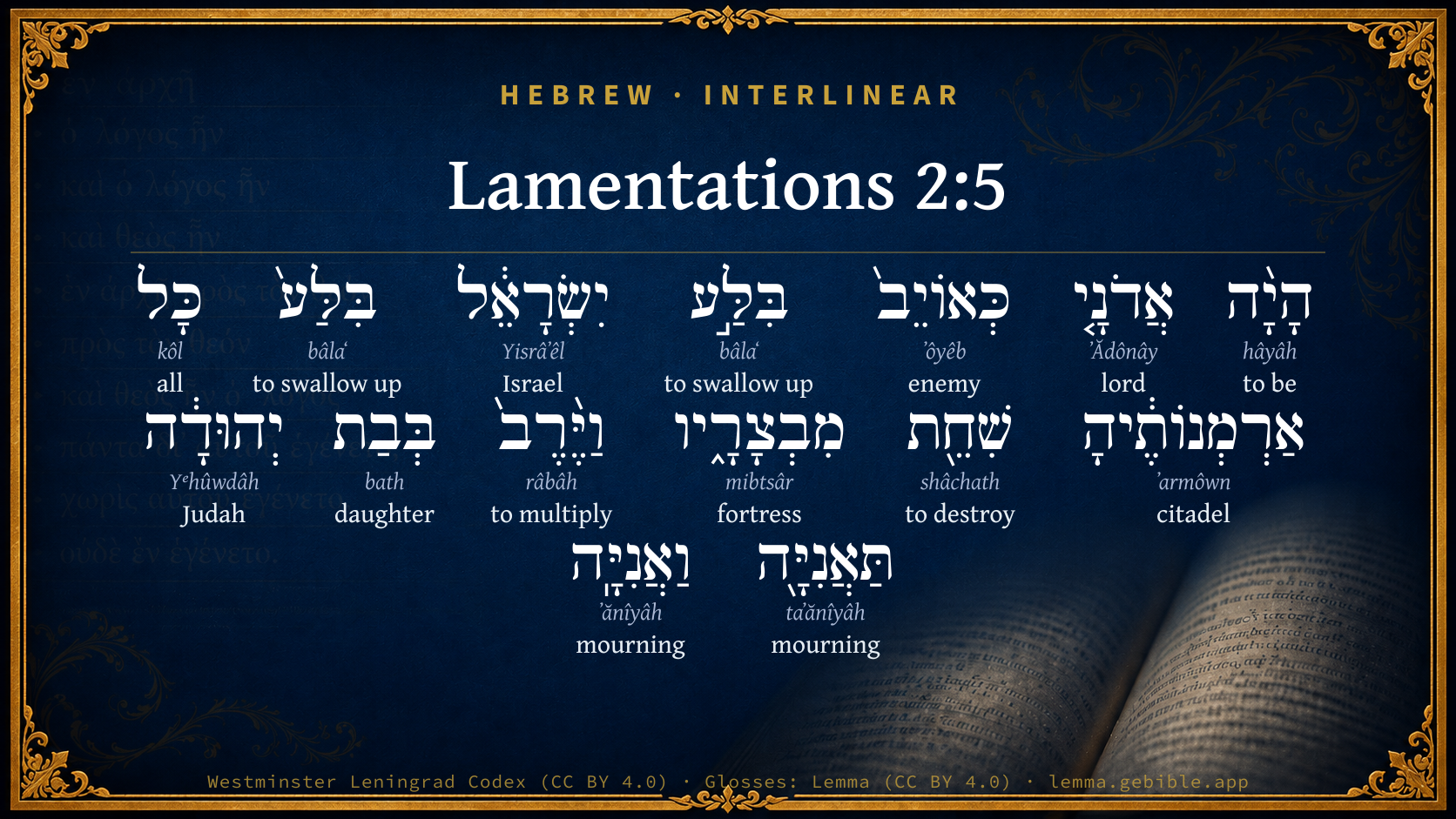
Lamentations 2:5

Hebrew (Westminster Leningrad Codex) Lamentations 2:5 appears in the Hebrew Old Testament. The text above is from the Westminster Leningrad Codex. Each word links to its Strong’s number, a concise gloss, and parsing drawn from the Open Scriptures Hebrew Bible morphology. Click any word for its full Brown-Driver-Briggs (BDB) entry.
Download image
Cite this verse

Lamentations 2:5 (World English Bible). Public Domain. Lemma interlinear Bible study tool, https://lemma.gebible.app/v/lamentations/2/5.

Show BibTeX & RIS
BibTeX
RIS
English Translation
The Lord is become as an enemy, he has swallowed up Israel; He has swallowed up all her palaces, he has destroyed his strongholds; He has multiplied in the daughter of Judah mourning and lamentation.
World English Bible · Public Domain
Download a study sheet

One document with this verse’s original text, its word-by-word gloss line, the meaning frame, cross-references with their text, attributed commentary, and full source and license credits — printable, and it pastes into notes with its structure intact.

This verse Autodidact and up

Study sheet (.html) Plain text (.txt)

A passage Seminary Student

Up to 50 verses in one chapter. A passage sheet keeps up to 6 commentary sources and 12 cross-references per verse, in the order this page ranks them, and says so on the sheet whenever that leaves anything out. Ask for a single verse and you get the Autodidact verse sheet above.

Everything on this page stays free to read, with no account — the sheet is a download of what is already on screen, not access to it.

Want to remove ads? Support Godless Engineer
Compare translations 3

The same verse in 3 English versions, stacked beneath the original-language interlinear above. Click any original word for its lexicon entry.

Each is an independent rendering of the whole verse — the interlinear is not word-aligned to these translations.

Highlighted words mark where these versions differ — a whole-verse word diff, not a word-by-word alignment.

  • World English Bible Public Domain
    The Lord is become as an enemy, he has swallowed up Israel; He has swallowed up all her palaces, he has destroyed his strongholds; He has multiplied in the daughter of Judah mourning and lamentation.
  • King James Version Public Domain
    The LORD was as an enemy: he hath swallowed up Israel, he hath swallowed up all her palaces: he hath destroyed his strong holds, and hath increased in the daughter of Judah mourning and lamentation.
  • unfoldingWord Literal Text CC BY-SA 4.0
    The Lord has become like an enemy; he has swallowed up Israel. He has swallowed up all her citadels; he has destroyed his fortifications, and he has multiplied in the daughter of Judah mourning and groaning. WAW

unfoldingWord Literal Text — © unfoldingWord, licensed CC BY-SA 4.0. Word-aligned USFM3 via Door43 (git.door43.org/unfoldingWord/en_ult).

Versions to compare (up to 4)

3 of 4 selected

Show all 18 translations

Every available English version of this verse, each an independent rendering of the whole verse.

  • World English Bible Public Domain
    The Lord is become as an enemy, he has swallowed up Israel; He has swallowed up all her palaces, he has destroyed his strongholds; He has multiplied in the daughter of Judah mourning and lamentation.
  • Berean Standard Bible Public Domain
    The Lord is like an enemy; He has swallowed up Israel. He has swallowed up all her palaces and destroyed her strongholds. He has multiplied mourning and lamentation for the Daughter of Judah.
  • Majority Standard Bible Public Domain
    The Lord is like an enemy; He has swallowed up Israel. He has swallowed up all her palaces and destroyed her strongholds. He has multiplied mourning and lamentation for the Daughter of Judah.
  • King James Version Public Domain
    The LORD was as an enemy: he hath swallowed up Israel, he hath swallowed up all her palaces: he hath destroyed his strong holds, and hath increased in the daughter of Judah mourning and lamentation.
  • American Standard Version (1901) Public Domain
    The Lord is become as an enemy, he hath swallowed up Israel; He hath swallowed up all her palaces, he hath destroyed his strongholds; And he hath multiplied in the daughter of Judah mourning and lamentation.
  • Revised Version (1885) Public Domain
    The Lord is become as an enemy, he hath swallowed up Israel; he hath swallowed up all her palaces, he hath destroyed his strong holds: and he hath multiplied in the daughter of Judah mourning and lamentation.
  • Geneva Bible (1599) Public Domain
    The Lord was as an enemie: he hath deuoured Israel, and consumed all his palaces: hee hath destroyed his strong holdes, and hath increased in the daughter of Iudah lamentation and mourning.
  • Douay-Rheims (1899) Public Domain
    He. The Lord is become as an enemy: he hath cast down Israel headlong, he hath overthrown all the walls thereof: he hath destroyed his strong holds, and hath multiplied in the daughter of Juda the afflicted, both men and women.
  • Young's Literal Translation Public Domain
    The Lord hath been as an enemy, He hath swallowed up Israel, He hath swallowed up all her palaces, He hath destroyed His fortresses, And He multiplieth in the daughter of Judah Mourning and moaning.
  • Literal Standard Version CC BY-SA 4.0
    The Lord has been as an enemy, || He has swallowed up Israel, || He has swallowed up all her palaces, || He has destroyed His fortresses, || And He multiplies in the daughter of Judah || Mourning and moaning.
  • Unlocked Literal Bible CC BY-SA 4.0
    The Lord has become like an enemy. He has swallowed up Israel. He has swallowed up all her palaces. He has destroyed her strongholds. He has increased mourning and lamentation within the daughter of Judah.
  • unfoldingWord Literal Text CC BY-SA 4.0
    The Lord has become like an enemy; he has swallowed up Israel. He has swallowed up all her citadels; he has destroyed his fortifications, and he has multiplied in the daughter of Judah mourning and groaning. WAW
  • Darby Bible Public Domain
    The Lord is become as an enemy: he hath swallowed up Israel; he hath swallowed up all her palaces; he hath destroyed his strongholds, and hath multiplied in the daughter of Judah mourning and lamentation.
  • World Messianic Bible Public Domain
    The Lord has become as an enemy. He has swallowed up Israel. He has swallowed up all her palaces. He has destroyed his strongholds. He has multiplied mourning and lamentation in the daughter of Judah.
  • Webster's Bible Public Domain
    The Lord was as an enemy: he hath swallowed up Israel, he hath swallowed up all her palaces: he hath destroyed his strong holds, and hath increased in the daughter of Judah mourning and lamentation.
  • Free Bible Version CC BY-SA 4.0
    The Lord has become like an enemy, completely destroying Israel and its palaces, demolishing its fortresses, making the Daughter of Judah cry and mourn more and more.
  • Bible in Basic English Public Domain
    The Lord has become like one fighting against her, sending destruction on Israel; he has sent destruction on all her great houses, making waste his strong places: increasing the grief and the sorrow of the daughter of Judah.
  • JPS Tanakh (1917) Public Domain
    The Lord is become as an enemy, He hath swallowed up Israel; He hath swallowed up all her palaces, He hath destroyed his strongholds; and He hath multiplied in the daughter of Judah mourning and moaning.

Literal Standard Version (2020), Covenant Press — licensed CC BY-SA 4.0. Text via the HelloAO Bible API (eBible.org). Unlocked Literal Bible (unfoldingWord) — licensed CC BY-SA 4.0. Text via the HelloAO Bible API (eBible.org). unfoldingWord Literal Text — © unfoldingWord, licensed CC BY-SA 4.0. Word-aligned USFM3 via Door43 (git.door43.org/unfoldingWord/en_ult). Free Bible Version, Dr. Jonathan Gallagher — licensed CC BY-SA 4.0. Text via the HelloAO Bible API (eBible.org).

Word by word

More ways to search: Search by grammar → Find every occurrence → Compare this word →

Practice this passage: Drill this verse → Learn its vocabulary →

תַּאֲנִיָּ֖ה
taʼănîyâh
H8386
“mourning”
Noun, Common, Feminine, Singular, Absolute
Part of Speech
Noun
Type
Common
Gender
Feminine
Number
Singular
State
Absolute
Full BDB Definition

Origin: from H578

TWOT: 124b

mourning, grieving
  1. הָיָ֨ה hâyâh H1961 “to be” Verb, Qal, Perfect, 3rd Person, Masculine, Singular
  2. אֲדֹנָ֤י ʼĂdônây H136 “Lord · my” Noun, Common, Masculine, Plural, Construct + Suffix, Personal, 1st Person, Common, Singular
  3. כְּאוֹיֵב֙ ʼôyêb H341 “like/as · enemy” Preposition + Verb, Qal, Participle Active, Masculine, Singular, Absolute
  4. בִּלַּ֣ע bâlaʻ H1104 “to swallow up” Verb, Piel, Perfect, 3rd Person, Masculine, Singular
  5. יִשְׂרָאֵ֔ל Yisrâʼêl H3478 “Israel” Noun, Proper
  6. בִּלַּע֙ bâlaʻ H1104 “to swallow up” Verb, Piel, Perfect, 3rd Person, Masculine, Singular
  7. כָּל kôl H3605 “all of” Noun, Common, Masculine, Singular, Construct
  8. אַרְמְנוֹתֶ֔יהָ ʼarmôwn H759 “citadels · her” Noun, Common, Masculine, Plural, Construct + Suffix, Personal, 3rd Person, Feminine, Singular
  9. שִׁחֵ֖ת shâchath H7843 “to destroy” Verb, Piel, Perfect, 3rd Person, Masculine, Singular
  10. מִבְצָרָ֑יו mibtsâr H4013 “fortresses · his” Noun, Common, Masculine, Plural, Construct + Suffix, Personal, 3rd Person, Masculine, Singular
  11. וַיֶּ֨רֶב֙ râbâh H7235 “and · to multiply” Conjunction + Verb, Hiphil, Sequential Imperfect, 3rd Person, Masculine, Singular
  12. בְּבַת bath H1323 “in/at · daughter of” Preposition + Noun, Common, Feminine, Singular, Construct
  13. יְהוּדָ֔ה Yᵉhûwdâh H3063 “Judah” Noun, Proper
  14. וַאֲנִיָּֽה ʼănîyâh H592 “and · mourning” Conjunction + Noun, Common, Feminine, Singular, Absolute

About this verse

These counts appear in no published source. They are computed here, from the morphology-tagged text and Lemma’s own curated glosses. What Lemma adds →

15
words
14
distinct lemmas
Prophets
section

Notable vocabulary

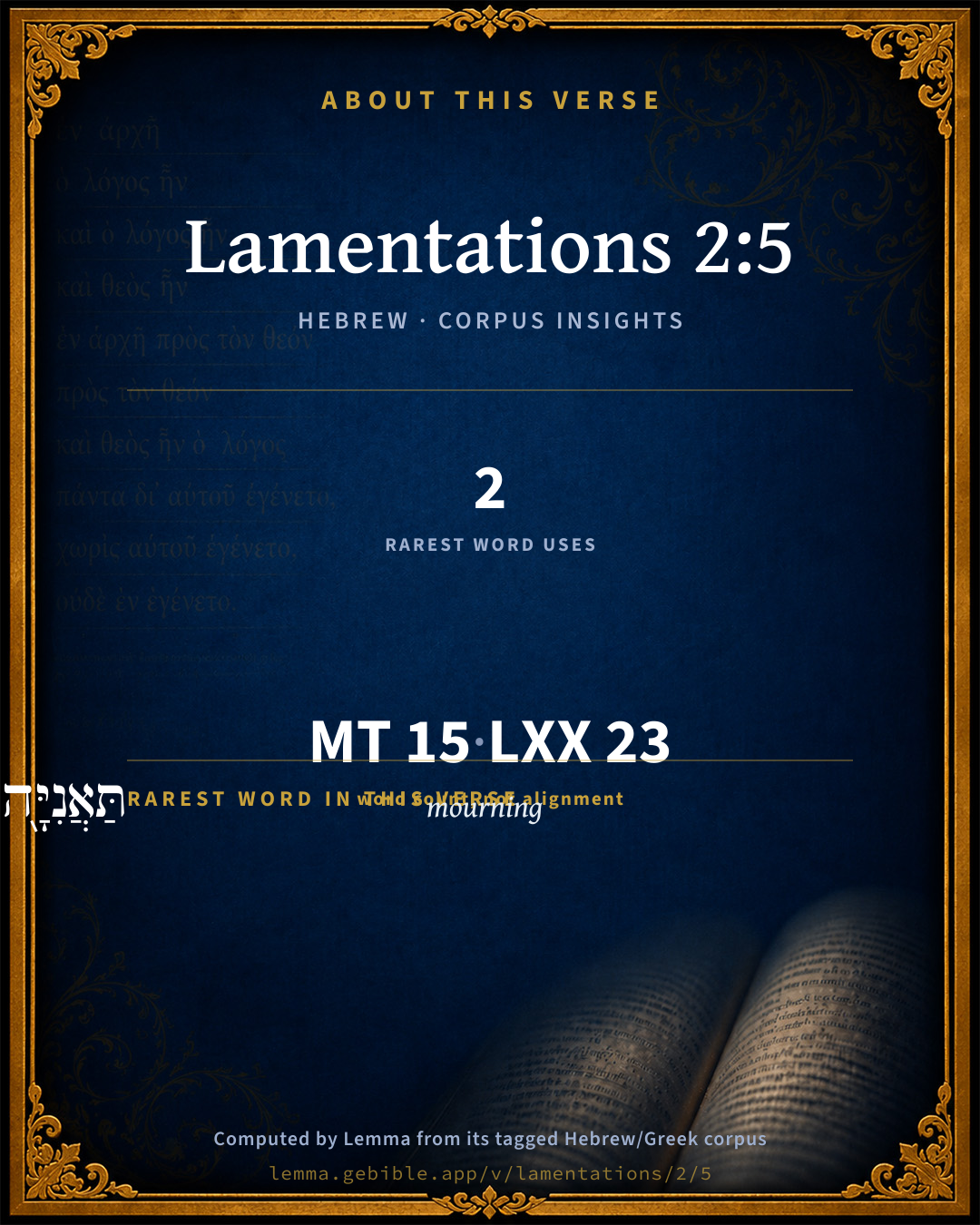
The rarest word here is תַּאֲנִיָּ֖ה mourning H8386 — appearing just 2 times in the whole Hebrew Bible.

Shared distinctive vocabulary

תַּאֲנִיָּ֖ה mourning H8386 occurs in 2 verses of the Hebrew Bible. Also found in:

Grammatical profile

  • 6 verbs
  • 9 nouns

Verb forms

  • הָיָ֨ה Qal · Perfect
  • כְּאוֹיֵב֙ Qal · Participle Active
  • בִּלַּ֣ע Piel · Perfect
  • בִּלַּע֙ Piel · Perfect
  • שִׁחֵ֖ת Piel · Perfect
  • וַיֶּ֨רֶב֙ Hiphil · Sequential Imperfect

Repetition

A word recurs within this verse — often emphatic in Hebrew:

  • בִּלַּ֣ע to swallow up H1104 ×2

Hebrew & Septuagint length

In English translation the verse runs 35 words from the Hebrew and 39 from the Septuagint (LXX English) — closely comparable.

A rough comparison of the two English renderings, which tokenize alike — not a word-level alignment.

Word counts can differ between the Hebrew and the Greek without any difference in meaning — e.g. the Hebrew direct-object marker אֵת has no separate Greek word, and Greek often adds the article ὁ.

In the original languages it is 15 Hebrew tokens and 23 Greek tokens — but the two are counted differently (Hebrew bundles its prefixes and suffixes into one token; the Greek is in lemma form), so that isn’t a like-for-like length.

Cross-references

9

Topical passages linked to Lamentations 2:5 in the Treasury of Scripture Knowledge — connected by theme and wording, ordered by reader-vote popularity; previews shown in the World English Bible.

  • Lamentations 2:2 The Lord has swallowed up all the habitations of Jacob, and has not pitied: He has thrown down in his wrath the strongholds of the daughter of Judah; He has brought them down to the ground; he has profaned the kingdom and the princes of it.
  • 2 Kings 25:9 He burnt the house of Yahweh, and the king's house; and all the houses of Jerusalem, even every great house, burnt he with fire.
  • Jeremiah 30:14 All your lovers have forgotten you; they don't seek you: for I have wounded you with the wound of an enemy, with the chastisement of a cruel one, for the greatness of your iniquity, because your sins were increased.
  • Jeremiah 52:13 and he burned the house of Yahweh, and the king's house; and all the houses of Jerusalem, even every great house, burned he with fire.
  • Lamentations 2:4 He has bent his bow like an enemy, he has stood with his right hand as an adversary, Has killed all that were pleasant to the eye: In the tent of the daughter of Zion he has poured out his wrath like fire.
  • 2 Chronicles 36:16–17 but they mocked the messengers of God, and despised his words, and scoffed at his prophets, until the wrath of Yahweh arose against his people, until there was no remedy.
  • Jeremiah 9:17–20 Thus says Yahweh of Hosts, Consider you, and call for the mourning women, that they may come; and send for the skillful women, that they may come:
  • Jeremiah 15:1 Then said Yahweh to me, Though Moses and Samuel stood before me, yet my mind would not be toward this people: cast them out of my sight, and let them go forth.
  • Ezekiel 2:10 He spread it before me: and it was written within and without; and there were written therein lamentations, and mourning, and woe.

Cross-references courtesy of OpenBible.info (CC BY 4.0).

Hebrew and Greek witnesses Masoretic Hebrew ↔ Greek Septuagint

The same verse in the two great witnesses to the Old Testament, shown verse-for-verse.

These are two independent witnesses, not word-aligned to each other, and the Septuagint is shown in lemma (dictionary) form.

Hebrew Lamentations 2:5 Masoretic · Westminster Leningrad Codex

הָיָ֨ה אֲדֹנָ֤י כְּאוֹיֵב֙ בִּלַּ֣ע יִשְׂרָאֵ֔ל בִּלַּע֙ כָּל אַרְמְנוֹתֶ֔יהָ שִׁחֵ֖ת מִבְצָרָ֑יו וַיֶּ֨רֶב֙ בְּבַת יְהוּדָ֔ה תַּאֲנִיָּ֖ה וַאֲנִיָּֽה

The Lord is become as an enemy, he has swallowed up Israel; He has swallowed up all her palaces, he has destroyed his strongholds; He has multiplied in the daughter of Judah mourning and lamentation.

World English Bible · Public Domain

Greek LXX Lamentations 2:5 Septuagint · lemma form

γίγνομαι κύριος ὡς ἐχθρός καταποντίζω ἰσραήλ καταποντίζω πᾶς ὁ βάρις αὐτός διαφθείρω ὁ ὀχύρωμα αὐτός καί πληθύνω ὁ θυγάτηρ ιουδα ταπεινόω καί ταπεινόω

HE. The Lord is become as an enemy: he has overwhelmed Israel as in the sea, he has overwhelmed her palaces: he has destroyed her strongholds, and has multiplied the afflicted and humbled ones to the daughter of Juda.

LXX2012 (modern English Septuagint) · Public Domain

Hebrew: Westminster Leningrad Codex (CC BY 4.0). Greek: Septuagint (public domain); English from LXX2012 (modern English Septuagint) (Public Domain). How the Septuagint differs from the Hebrew →

Commentary

Notes on Lamentations 2:5 from classic Christian and Jewish commentators (each source and its license shown beneath its notes). The classic Christian expositions comment on the surrounding passage and are grouped to its opening verse, so a note may address several verses; the Jewish commentaries on the Tanakh (Rashi and others) are per-verse, so they appear only where the commentator wrote on this verse.

Lemma curates 59 commentaries, every one of them public domain or Creative Commons licensed, each selected and text-cleaned for this edition rather than reprinted as found. About our sources →

Trapp's Complete Commentary

John Trapp

Lam 2:5 The Lord was as an enemy: he hath swallowed up Israel, he hath swallowed up all her palaces: he hath destroyed his strong holds, and hath increased in the daughter of Judah mourning and lamentation.

Ver. 5. The Lord was an enemy.] This the secure and foolish people would not be drawn to believe, till now they felt it; therefore it is so reiterated.

He hath swallowed up Israel, he hath destroyed, &c.] This he had said before, {Lam 2:2} but in cases of this kind people love to say the same things over and over. Redundanti copia exponit quae antea dixerat.

And hath increased … mourning and lamentation.] Heb., Lamentation and lamentation - q.d., this is all he hath left us. And this she speaketh mourning, but not murmuring: Non litem intendit Deo, sed confessionem edit.

John Trapp, A Commentary or Exposition upon All the Books of the Old and New Testament (1647–1656) — public domain. Text from a community e-Sword module.

Jamieson, Fausset & Brown

Robert Jamieson, A. R. Fausset & David Brown

an enemy-- (Jer 30:14).

mourning and lamentation--There is a play of similar sounds in the original, "sorrow and sadness," to heighten the effect (Job 30:3, Hebrew; Eze 35:3, Margin).

Jamieson, Fausset & Brown — Commentary Critical and Explanatory on the Whole Bible (1871) — public domain (CC PDM 1.0). Text via the HelloAO Bible API.

John Calvin's Commentaries

These words might seem superfluous, since the Prophet has often repeated, that God was become an enemy to his own people; but we shall hereafter see, that though they were extremely afflicted, they yet did not rightly consider whence their calamity arose. As, then, they had become so stupified by their evils, that they did not turn their eyes to God, they were on this account often urged and stimulated, that they might at length understand by their evils that God was a judge. Now, as it was difficult to convince them of this truth, the Prophet did not think it enough briefly to touch on it, but found it necessary to dwell on it at large, so that the people might at length be roused from their insensibility.

He then says that God himself was to them as an enemy, lest the Israelites should fix their eyes on the Chaldeans, and thus think that they had been the chief movers of the war. He therefore says, that they had undertaken that war through the secret influence of God, and had carried it on successfully, because God endued them with his own power. And hence the faithful ought to have concluded, that nothing could have been more grievous than to have God as their adversary; for as long as they had suffered themselves to be defended by the hand of God, they were victorious, we know, over all their enemies, so that they could then brave all dangers with impunity. The Prophet now reminds them, that as they had been successful and prosperous under the defense and protection of God, so now they were miserable, for no other reason but that God fought against them. But we ought at the same time to bear in mind the truth, which we have noticed, that God is never angry with men without reason; and since he was especially inclined to shew favor to his people, we must understand that he would not have been thus indignant, had not necessity constrained him.

He has destroyed Israel, he says; he has destroyed all his palaces; and afterwards, he has dissipated or demolished all his fortresses; and finally, he has increased in the daughter of Judah mourning and lamentation; תאניה ואניה tanie veanie, words derived from the same root, but joined together for the sake of amplifying, not only in this place, but also in the twenty-ninth chapter of Isaiah, and in other places. The meaning is, that God had not put an end to his vengeance, because the people had not resolved to put an end to their obstinate wickedness. He afterwards adds, —

John Calvin's Commentaries (1540-1563) — public domain. Text from the Calvin Translation Society English edition (1840s-50s) via the Christian Classics Ethereal Library (ccel.org). Calvin's coverage is partial (roughly two-thirds of the Bible); uncommented books and verses are honest gaps, never fabricated. The 19th-century editor's footnotes and remarks are omitted so the notes are faithfully Calvin's own voice.

Ellicott's Commentary for English Readers

(5) Her palaces: . . . his strong holds . . .—The change of gender is remarkable, probably rising from the fact that the writer thought of the “palaces” in connection with the “daughters of Zion,” and of the “strong holds” in connection with the land or people. A like combination is found in Hos_8:14.

Mourning and lamentation.—The two Hebrew nouns are formed from the same root, and have an assonance like “the sorrow and sighing” of Isa_35:10.

A Bible Commentary for English Readers, edited by Charles John Ellicott (1878–1897) — public domain. Text from a community e-Sword module.

The Cambridge Bible for Schools and Colleges

gen. ed. J. J. S. Perowne

5. her palaces … his strong holds] In “her” Jeremiah was thinking of the city, in “his” of the people at large; hence the change in the gender of the pronouns.

mourning and lamentation] groaning and moaning, or better (as Cheyne) moaning and bemoaning. The original words are substantives from the same root, and occur again (there also in combination) only in Isa_29:2.

The Cambridge Bible for Schools and Colleges (gen. ed. J. J. S. Perowne; Cambridge University Press, 1878–1918) — public domain. Text from a community e-Sword module.

John Gill's Exposition

The Lord was as an enemy,.... Who formerly was on their side, their God and guardian, their protector and deliverer, but now against them; and a terrible thing it is to have God for an enemy, or even to be as one; this is repeated, as being exceeding distressing, and even intolerable. Mr. Broughton renders it, "the Lord is become a very enemy"; taking "caph" for a note of reality, and not of similitude;

he hath swallowed up Israel; the ten tribes, or the Jewish nation in general; as a lion, or any other savage beast, swallows its prey, and makes nothing of it, and leaves none behind:

he hath swallowed up all her palaces: the palaces of Zion or Jerusalem; the palaces of the king, princes, nobles, and great men; as an earthquake or inundation swallows up whole streets and cities at once; See Gill on Lam 2:2;

he hath destroyed his strong holds: the fortified places of the land of Israel, the towers and castles:

and hath increased in the daughter of Judah mourning and lamentation; exceeding great lamentation, for the destruction of its cities, towns, villages, and the inhabitants of them.

John Gill's Exposition of the Whole Bible (1746–1763) — public domain (CC PDM 1.0). Text via the HelloAO Bible API.

Albert Barnes' Notes on the Bible

Literally, אדני 'ădonāy has become “as an enemy.”

Albert Barnes' Notes on the Bible (1834–1885) — public domain. Text from a community e-Sword/MySword module.

Haydock's Catholic Bible Commentary

Women, suffering them to be abused, chap. v. 11, 13.

George Leo Haydock (1774–1849), Haydock's Catholic Family Bible and Commentary, 1859 edition — public domain. Excludes Psalms (Douay-Rheims chapter numbering differs from Protestant) and Deuterocanonical books (Catholic canon only).

Matthew Poole's English Annotations

See Lam 2:2. Several pathetical expressions signifying the same things, properly imitating the dialect of mourners, whose passion suffers them not to speak according to art, but frequently they say the same things over and over.

Matthew Poole's English Annotations on the Holy Bible (1683–1685) — public domain. Text from a community e-Sword/MySword module.

Whedon's Commentary on the Bible

Daniel D. Whedon

5. Her palaces… his strongholds — The change of gender here is explained by Keil by the fact that when the “palaces,” or, more correctly, citadels, are mentioned, the city is in the mind of the writer, but when the “strongholds” are mentioned he was thinking of the whole country, Judah.

Daniel D. Whedon (gen. ed.), Commentary on the Old and New Testaments (1874–1909) — public domain. Text from a community e-Sword module.

The Pulpit Commentary

Was as an enemy: he hath swallowed, etc. The threefold division of the verse is, unfortunately, concealed in the Authorized Version, owing to the arbitrary stopping. The grouping suggested by the Massoretic text is"The Lord is become an enemy, he hath swallowed up Israel; He hath swallowed up all her palaces, he hath destroyed all his strongholds; And hath increased in the daughter of Judah moaning and bemoaning.

The change of gender in the second line is easily explicable. In the first case the poet is thinking of the city; in the second, of the people of Israel. The rendering "moaning and bemoaning" is designed to reproduce, to some extent, the Hebrew phrase, in which two words, derived from the same root, and almost exactly the same, are placed side by side, to give a more intense expression to the idea.

Jehovah reckoned as an enemy.

I HOW FAR WAS THERE REALITY UNDER THIS APPEARANCE OF ENMITY? God might look like an enemy, but it did not therefore follow that he was one. But even if Jehovah behaved himself like an enemy, it must also be asked whether there was not a necessity that he should do so. If Israel had to say, "Jehovah acts as an enemy towards us," Jehovah had to say, "My people act as an enemy towards me." These people had now for a long time been travelling in the wrong way, and it was in the very nature of things that the more they advanced the morn opposition should multiply and become intensified. God not only appeared to be an enemy, but in certain respects he really was an enemy. He hated the evil that had risen to such a height among those whom he had taken for his own. Our love for evil is ever the measure of his hate of it; and the more determined we are to cling to it, the more his hostility will appear. God himself always keeps in the same path of law and righteousness and order. When we, according to our measure, follow in his footsteps, then real opposition there cannot be; but the moment we think fit to become a law to ourselves and do what is right in our own eyes, then inevitably he must oppose us.

II THIS ENMITY WAS LARGELY IN APPEARANCE ONLY. When Israel said that Jehovah was as an enemy, they got their idea of enmity from the hostile proceedings of individuals and communities. But God cannot be the enemy of any man as men are enemies one to another. His motives are different and so are the results of all his opposition. One man forming hostile plans against another acts from malicious motives, or at all events from selfish ones. There is no basis of reason in what he does. He is not hostile to the lower in order that he may show himself friendly to the higher. Besides, we must not look merely at outward manifestations of enmity. There may be the deepest enmity and greatest power of inflicting injury where outwardly all looks harmless. Those who profess to be our friends and whom we reckon to be our friends may yet inflict worse injuries than all avowed enemies taken together. God is the true Friend of every man, however he may be thought at times to put on the appearance of an enemy. Y.

The Pulpit Commentary (1880–1919), ed. H.D.M. Spence-Jones & Joseph S. Exell — public domain. Text from a community e-Sword module.

Keil & Delitzsch

C. F. Keil & F. Delitzsch

The Lord has become like an enemy. כּאויב is not separated from היה by the accents (Pesik and Mahpak before, and Kadma after); so that there appears to be nothing to justify the remark of Gerlach, that, "as if the prophet were hesitating whether he should state explicitly that the Lord had become an enemy, he breaks off the sentence he had begun, 'The Lord hath become...,' and continues, 'He hath destroyed like a mighty one.' " As to בּלּע, cf. Lam 2:2. "Israel" is the name of Judah viewed as the covenant people. The swallowing or destruction of Israel is explained in the clauses which follow as a destruction of the palaces and fortresses. The mention of the palaces points to the destruction of Jerusalem, while the "fortresses" similarly indicate the destruction of the strong cities in the country. The interchange of the suffixes ־יה and ־יו is accounted for on the ground that, when the writer was thinking of the citadels, the city hovered before his mind; and when he regarded the fortresses, the people of Israel similarly presented themselves. The same interchange is found in Hos 8:14; the assumption of a textual error, therefore, together with the conjectures based on that assumption, is shown to be untenable. On the expression, "He hath destroyed his strongholds," cf. Jer 47:1-7 :18; on תּאניּה ואניּה, Isa 29:2 : in this latter case, two word-forms derived from the same stem are combined for the sake of emphasis. "Daughter of Judah," as in Lam 2:2, cf. Lam 1:15.

Keil & Delitzsch — Biblical Commentary on the Old Testament (1861–1891) — public domain (CC PDM 1.0). Text via the HelloAO Bible API. (Old Testament only.)

unfoldingWord translationNotes

Door43 World Missions Community

swallowed up

This speaks of the Lord completely destroying Israel as if he were animal who ate them. See how you translated this in Lamentations 2:2. AT: "completely destroyed" (See: Metaphor)

her palaces ... her strongholds

Israel is spoken of as if it were female.

He has increased mourning and lamentation within the daughter of Judah

The words "mourning" and "lamentation" can be expressed as verbs. AT: "He has caused more and more people within the daughter of Judah to mourn and lament" (See: Abstract Nouns)

daughter of Judah

This is a poetic name for Jerusalem, which is spoken of here as if it were a woman. AT: "Judah" (See: Personification)

He has attacked his tabernacle like a garden hut

This speaks of the tabernacle being easily destroyed, as if it were a garden hut. The Lord caused Israel's enemies to destroy it. He did not destroy it himself. AT: "He has caused their enemies to attack his tabernacle as easily as if it were a garden hut" (See: Simile and Metonymy)

a garden hut

a very small building for holding farming tools or for sheltering someone who is guarding a garden

He has destroyed the place of the solemn assembly

The Lord caused Israel's enemies to destroy it. He did not destroy it himself. AT: "He has caused the place of the solemn assembly to be destroyed" or "He has caused their enemies to destroy the place of the solemn assembly" (See: Metonymy)

caused both solemn assembly and Sabbath to be forgotten in Zion

This can be stated in active form. AT: "caused the people in Zion to forget both solemn assembly and Sabbath" (See: Active or Passive)

in the indignation of his anger

"because he was extremely angry with them"

translationWords

palace

mourn

lament

tabernacle

assembly

Yahweh

Sabbath

king

priest

unfoldingWord translationNotes — © Distant Shores Media and the Door43 World Missions Community, licensed CC BY-SA 4.0. Source: git.door43.org/Door43/en_tn.

Rashi

Rabbi Shlomo Yitzchaki (Rashi)

and He increased in the daughter of Judah He increased in the congregation of Judah.

pain and wailing Heb. תַּאֲנִיָה וַאֲנִיָה, pain and wailing.

and He increased Heb. וַיֶרֶב. The “yud” is vowelized with a small “pattah” (seggol), which is an expression of increasing others. (Exod. 1:20): “and the people multiplied (וַיִרֶב) and became very strong,” is vowelized with a “hirik”, which is an expression meaning that he himself increased, and so every word whose radical ends with a “hey,” e.g. פנה, to turn, זנה to go astray, בכה, to weep, are vowelized in that manner when the “hey” is missing, when it speaks of itself [i.e., the simple (קַל) conjugation, not the causative], e.g. (Exod. 7:23): “And Pharaoh turned (וַיִפֶן).” But when he speaks of others [i.e, the causative conjugation (הפעיל)], it is vowelized with a small “pattah” (seggol), e.g. (Jud. 15:4): “and he turned (וַיֶפֶן) tail to tail”; (II Kings 25: 21): “And Judah went into exile (וַיִגֶל) from his land”; (ibid. 18:11): “and the king of Babylon (sic) exiled (וַיֶגֶל) Israel to Assyria.”

Rashi on the Tanakh — English translations: “The Judaica Press complete Tanach with Rashi, translated by A. J. Rosenberg” (CC BY 4.0); “Pentateuch with Rashi's commentary by M. Rosenbaum and A.M. Silbermann, 1929-1934” (public domain); “The Metsudah Tanach series, Lakewood, N.J” (CC BY 4.0); and “The Book of Joshua, Metsudah Publications, 1997” (CC BY 4.0). Text via Sefaria.

Lesson kit

Teaching starters — assembled from the data on this page, not authored interpretation. Every prompt links to the verse data it draws on. Edit before teaching.

Lamentations, in the Prophets, opens this verse with 15 words (14 distinct Hebrew lemmas). Its most distinctive word is taʼănîyâh (“mourning”). A historical commentator’s framing appears above. Read the whole chapter for the surrounding context.

Discussion questions

  1. What does “mourning” (taʼănîyâh) contribute to the verse as a whole?
  2. Isaiah 29:2 shares the word «mourning» with this verse. How do the two illuminate each other?
  3. “to swallow up” occurs 2× in this one verse. What is the effect of the repetition?
  4. The translations on this page render this verse differently — a whole-verse word diff, not a word-by-word alignment. What might account for the different wordings?
  5. The verb «הָיָ֨ה» is Qal Perfect. How does its form color the action?
  6. Reading how Trapp's Complete Commentary and Jamieson, Fausset & Brown read this verse, where do the two commentators agree and where do they part?

Things to notice

Reading settings

Reading text

Shown beneath each verse's original-language words.

Old Testament
Old Testament edition

Read the OT as the Masoretic Hebrew (MT) or the Greek Septuagint (LXX).

English shown for the Greek Septuagint (in the Hebrew ↔ Greek comparison).

Comparing translations? Open the Compare panel on any verse page to stack up to four side by side.