
Deuteronomy 13:17

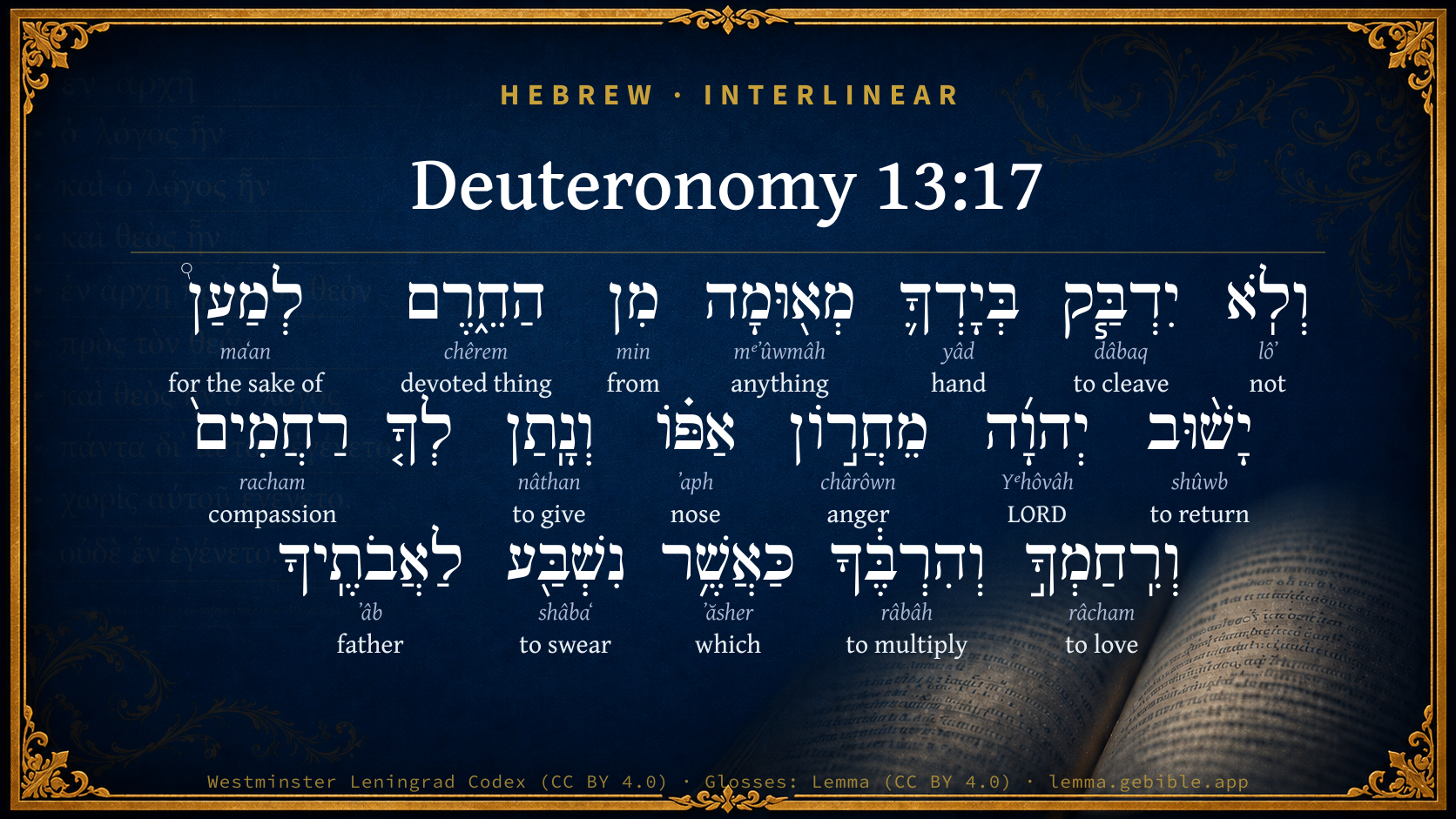
Hebrew (Westminster Leningrad Codex) Deuteronomy 13:17 appears in the Hebrew Old Testament. The text above is from the Westminster Leningrad Codex. Each word links to its Strong’s number, a concise gloss, and parsing drawn from the Open Scriptures Hebrew Bible morphology. Click any word for its full Brown-Driver-Briggs (BDB) entry.
Download image
Cite this verse

Deuteronomy 13:17 (World English Bible). Public Domain. Lemma interlinear Bible study tool, https://lemma.gebible.app/v/deuteronomy/13/17.

Show BibTeX & RIS
BibTeX
RIS
English Translation
There shall cleave nothing of the devoted thing to your hand; that Yahweh may turn from the fierceness of his anger, and show you mercy, and have compassion on you, and multiply you, as he has sworn to your fathers;
World English Bible · Public Domain
Download a study sheet

One document with this verse’s original text, its word-by-word gloss line, the meaning frame, cross-references with their text, attributed commentary, and full source and license credits — printable, and it pastes into notes with its structure intact.

This verse Autodidact and up

Study sheet (.html) Plain text (.txt)

A passage Seminary Student

Up to 50 verses in one chapter. A passage sheet keeps up to 6 commentary sources and 12 cross-references per verse, in the order this page ranks them, and says so on the sheet whenever that leaves anything out. Ask for a single verse and you get the Autodidact verse sheet above.

Everything on this page stays free to read, with no account — the sheet is a download of what is already on screen, not access to it.

Want to remove ads? Support Godless Engineer
Compare translations 3

The same verse in 3 English versions, stacked beneath the original-language interlinear above. Click any original word for its lexicon entry.

Each is an independent rendering of the whole verse — the interlinear is not word-aligned to these translations.

Highlighted words mark where these versions differ — a whole-verse word diff, not a word-by-word alignment.

  • World English Bible Public Domain
    There shall cleave nothing of the devoted thing to your hand; that Yahweh may turn from the fierceness of his anger, and show you mercy, and have compassion on you, and multiply you, as he has sworn to your fathers;
  • King James Version Public Domain
    And there shall cleave nought of the cursed thing to thine hand: that the LORD may turn from the fierceness of his anger, and show thee mercy, and have compassion upon thee, and multiply thee, as he hath sworn unto thy fathers;
  • unfoldingWord Literal Text CC BY-SA 4.0
    And in your hand you shall not cling to anything from the devoted thing, so that Yahweh will turn from the burning of his nose and give to you compassion and have compassion on you and make you increase, as he has sworn to your fathers,

unfoldingWord Literal Text — © unfoldingWord, licensed CC BY-SA 4.0. Word-aligned USFM3 via Door43 (git.door43.org/unfoldingWord/en_ult).

Versions to compare (up to 4)

3 of 4 selected

Show all 18 translations

Every available English version of this verse, each an independent rendering of the whole verse.

  • World English Bible Public Domain
    There shall cleave nothing of the devoted thing to your hand; that Yahweh may turn from the fierceness of his anger, and show you mercy, and have compassion on you, and multiply you, as he has sworn to your fathers;
  • Berean Standard Bible Public Domain
    Nothing devoted to destruction shall cling to your hands, so that the LORD will turn from His fierce anger, grant you mercy, show you compassion, and multiply you as He swore to your fathers,
  • Majority Standard Bible Public Domain
    Nothing devoted to destruction shall cling to your hands, so that the LORD will turn from His fierce anger, grant you mercy, show you compassion, and multiply you as He swore to your fathers,
  • King James Version Public Domain
    And there shall cleave nought of the cursed thing to thine hand: that the LORD may turn from the fierceness of his anger, and show thee mercy, and have compassion upon thee, and multiply thee, as he hath sworn unto thy fathers;
  • American Standard Version (1901) Public Domain
    And there shall cleave nought of the devoted thing to thy hand; that Jehovah may turn from the fierceness of his anger, and show thee mercy, and have compassion upon thee, and multiply thee, as he hath sworn unto thy fathers;
  • Revised Version (1885) Public Domain
    And there shall cleave nought of the devoted thing to thine hand: that the LORD may turn from the fierceness of his anger, and shew thee mercy, and have compassion upon thee, and multiply thee, as he hath sworn unto thy fathers;
  • Geneva Bible (1599) Public Domain
    And there shall cleaue nothing of ye damned thing to thine hand, that the Lord may turne from the fiercenes of his wrath, and shewe thee mercie, and haue compassion on thee and multiplie thee, as he hath sworne vnto thy fathers:
  • Douay-Rheims (1899) Public Domain
    And there shall nothing of that anathema stick to thy hand: that the Lord may turn from the wrath of his fury, and may have mercy on thee, and multiply thee as he swore to thy fathers,
  • Young's Literal Translation Public Domain
    and there doth not cleave to thy hand any of the devoted thing, so that Jehovah doth turn back from the fierceness of His anger, and hath given to thee mercies, and loved thee, and multiplied thee, as He hath sworn to thy fathers,
  • Literal Standard Version CC BY-SA 4.0
    and nothing from any of that [which is] devoted stays in your hand, so that YHWH turns back from the fierceness of His anger, and has given mercies to you, and loved you, and multiplied you, as He has sworn to your fathers,
  • Unlocked Literal Bible CC BY-SA 4.0
    None of those things set apart for destruction must stick in your hand. This must be the case, so that Yahweh will turn from the fierceness of his anger, show you mercy, have compassion on you, and make you increase in numbers, as he has sworn to your fathers.
  • unfoldingWord Literal Text CC BY-SA 4.0
    And in your hand you shall not cling to anything from the devoted thing, so that Yahweh will turn from the burning of his nose and give to you compassion and have compassion on you and make you increase, as he has sworn to your fathers,
  • Darby Bible Public Domain
    And thou shalt not let anything cleave to thy hand of the devoted thing; that Jehovah may turn from the fierceness of his anger, and shew thee mercy, and have compassion upon thee, and multiply thee, as he hath sworn unto thy fathers;
  • World Messianic Bible Public Domain
    Nothing of the devoted thing shall cling to your hand, that the LORD may turn from the fierceness of his anger and show you mercy, and have compassion on you and multiply you, as he has sworn to your fathers,
  • Webster's Bible Public Domain
    And there shall cleave naught of the cursed thing to thy hand: that the LORD may turn from the fierceness of his anger, and show thee mercy, and have compassion upon thee, and multiply thee, as he hath sworn to thy fathers;
  • Free Bible Version CC BY-SA 4.0
    Don't take for yourselves anything that has been set apart for destruction so that the Lord won't be angry any more. He will be merciful to you, showing you compassion, and giving you many descendants as he promised to your forefathers,
  • Bible in Basic English Public Domain
    Keep not a thing of what is cursed for yourselves: so the Lord may be turned away from the heat of his wrath, and have mercy on you, and give you increase as he said in his oath to your fathers:
  • JPS Tanakh (1917) Public Domain
    (13-18) And there shall cleave nought of the devoted thing to thy hand, that the LORD may turn from the fierceness of His anger, and show thee mercy, and have compassion upon thee, and multiply thee, as He hath sworn unto thy fathers;

Literal Standard Version (2020), Covenant Press — licensed CC BY-SA 4.0. Text via the HelloAO Bible API (eBible.org). Unlocked Literal Bible (unfoldingWord) — licensed CC BY-SA 4.0. Text via the HelloAO Bible API (eBible.org). unfoldingWord Literal Text — © unfoldingWord, licensed CC BY-SA 4.0. Word-aligned USFM3 via Door43 (git.door43.org/unfoldingWord/en_ult). Free Bible Version, Dr. Jonathan Gallagher — licensed CC BY-SA 4.0. Text via the HelloAO Bible API (eBible.org).

Word by word

More ways to search: Search by grammar → Find every occurrence → Compare this word →

Practice this passage: Drill this verse → Learn its vocabulary →

מְא֖וּמָה
mᵉʼûwmâh
H3972
“anything”
Noun, Common, Feminine, Singular, Absolute
Part of Speech
Noun
Type
Common
Gender
Feminine
Number
Singular
State
Absolute
Full BDB Definition

Origin: apparently a form of H3971

TWOT: 1136

anything
  1. וְלֹֽא lôʼ H3808 “and · not” Conjunction + Particle, Negative
  2. יִדְבַּ֧ק dâbaq H1692 “to cleave” Verb, Qal, Imperfect, 3rd Person, Masculine, Singular
  3. בְּיָדְךָ֛ yâd H3027 “in/at · hand · your” Preposition + Noun, Common, Both, Singular, Construct + Suffix, Personal, 2nd Person, Masculine, Singular
  4. מִן min H4480 “from” Preposition
  5. הַחֵ֑רֶם chêrem H2764 “the · devoted thing” Particle, Definite Article + Noun, Common, Masculine, Singular, Absolute
  6. לְמַעַן֩ maʻan H4616 “for the sake of” Preposition
  7. יָשׁ֨וּב shûwb H7725 “to return” Verb, Qal, Imperfect, 3rd Person, Masculine, Singular
  8. יְהוָ֜ה Yᵉhôvâh H3068 “LORD” Noun, Proper
  9. מֵחֲר֣וֹן chârôwn H2740 “from · anger of” Preposition + Noun, Common, Masculine, Singular, Construct
  10. אַפּ֗וֹ ʼaph H639 “nose · his” Noun, Common, Masculine, Singular, Construct + Suffix, Personal, 3rd Person, Masculine, Singular
  11. וְנָֽתַן nâthan H5414 “and · to give” Conjunction + Verb, Qal, Sequential Perfect, 3rd Person, Masculine, Singular
  12. רַחֲמִים֙ racham H7356 “compassion” Noun, Common, Masculine, Plural, Absolute
  13. וְרִֽחַמְךָ֣ râcham H7355 “and · to love · you” Conjunction + Verb, Piel, Sequential Perfect, 3rd Person, Masculine, Singular + Suffix, Personal, 2nd Person, Masculine, Singular
  14. וְהִרְבֶּ֔ךָ râbâh H7235 “and · to multiply · you” Conjunction + Verb, Hiphil, Sequential Perfect, 3rd Person, Masculine, Singular + Suffix, Personal, 2nd Person, Masculine, Singular
  15. כַּאֲשֶׁ֥ר ʼăsher H834 “like/as · which” Preposition + Particle, Relative
  16. נִשְׁבַּ֖ע shâbaʻ H7650 “to swear” Verb, Niphal, Perfect, 3rd Person, Masculine, Singular
  17. לַאֲבֹתֶֽיךָ ʼâb H1 “to/for · fathers · your” Preposition + Noun, Common, Masculine, Plural, Construct + Suffix, Personal, 2nd Person, Masculine, Singular

About this verse

These counts appear in no published source. They are computed here, from the morphology-tagged text and Lemma’s own curated glosses. What Lemma adds →

19
words
18
distinct lemmas
Pentateuch
section

Shared distinctive vocabulary

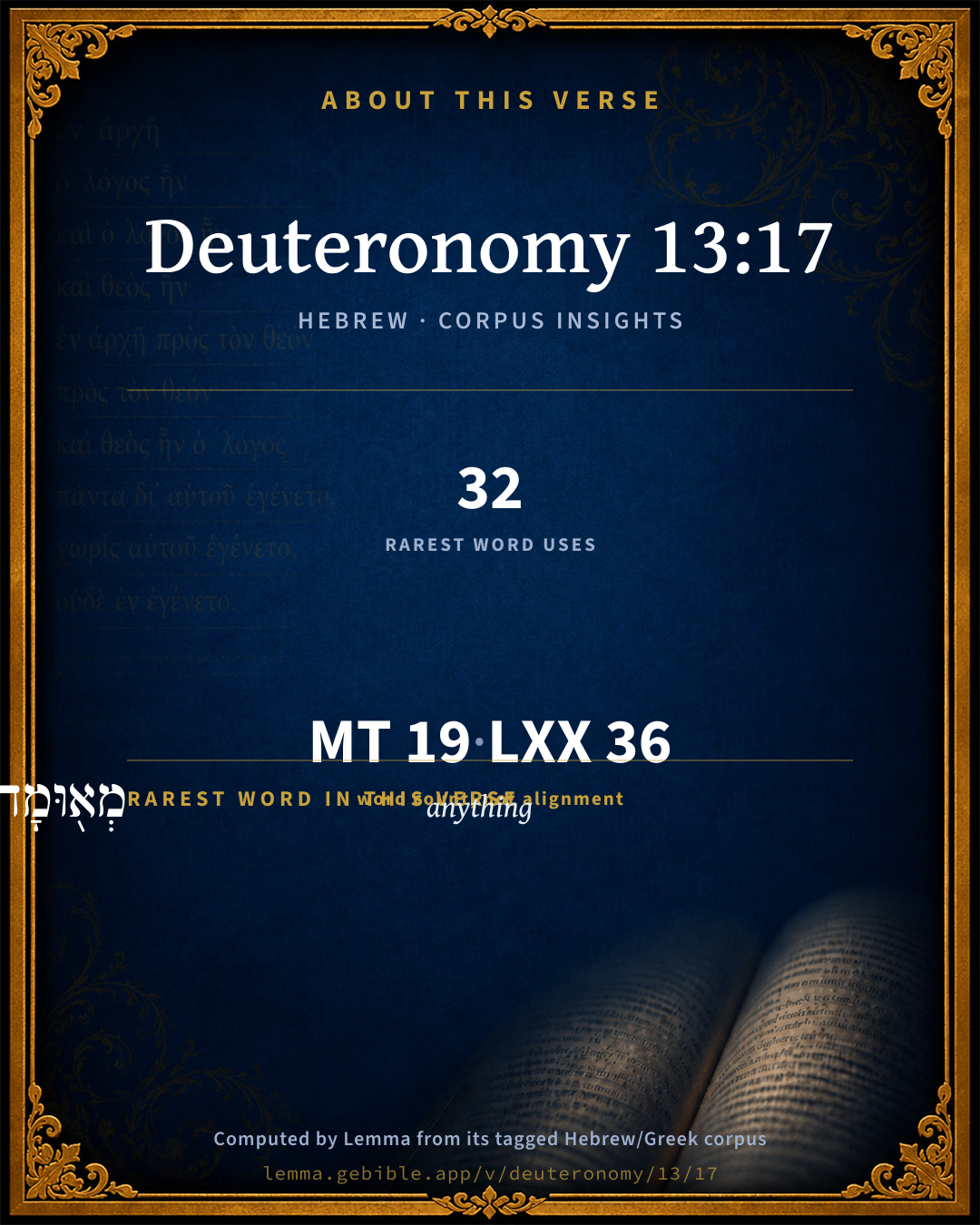
מְא֖וּמָה anything H3972 occurs in 32 verses of the Hebrew Bible. Also found in:

Grammatical profile

  • 6 verbs
  • 8 nouns
  • 3 prepositions
  • 2 particles

Verb forms

  • יִדְבַּ֧ק Qal · Imperfect
  • יָשׁ֨וּב Qal · Imperfect
  • וְנָֽתַן Qal · Sequential Perfect
  • וְרִֽחַמְךָ֣ Piel · Sequential Perfect
  • וְהִרְבֶּ֔ךָ Hiphil · Sequential Perfect
  • נִשְׁבַּ֖ע Niphal · Perfect

Hebrew & Septuagint length

In English translation the verse runs 40 words from the Hebrew and 37 from the Septuagint (LXX English) — closely comparable.

A rough comparison of the two English renderings, which tokenize alike — not a word-level alignment.

Word counts can differ between the Hebrew and the Greek without any difference in meaning — e.g. the Hebrew direct-object marker אֵת has no separate Greek word, and Greek often adds the article ὁ.

In the original languages it is 19 Hebrew tokens and 36 Greek tokens — but the two are counted differently (Hebrew bundles its prefixes and suffixes into one token; the Greek is in lemma form), so that isn’t a like-for-like length.

Cross-references

19

Topical passages linked to Deuteronomy 13:17 in the Treasury of Scripture Knowledge — connected by theme and wording, ordered by reader-vote popularity; previews shown in the World English Bible.

  • Genesis 26:4 I will multiply your seed as the stars of the sky, and will give to your seed all these lands. In your seed will all the nations of the earth be blessed,
  • Genesis 26:24 Yahweh appeared to him the same night, and said, "I am the God of Abraham your father. Don't be afraid, for I am with you, and will bless you, and multiply your seed for my servant Abraham's sake."
  • Deuteronomy 7:26 You shall not bring an abomination into your house, and become a devoted thing like it: you shall utterly detest it, and you shall utterly abhor it; for it is a devoted thing.
  • Joshua 7:26 They raised over him a great heap of stones, to this day; and Yahweh turned from the fierceness of his anger. Therefore the name of that place was called "The valley of Achor" to this day.
  • Genesis 28:14 Your seed will be as the dust of the earth, and you will spread abroad to the west, and to the east, and to the north, and to the south. In you and in your seed will all the families of the earth be blessed.
  • Deuteronomy 30:3 that then Yahweh your God will turn your captivity, and have compassion on you, and will return and gather you from all the peoples, where Yahweh your God has scattered you.
  • Joshua 6:18 But as for you, only keep yourselves from the devoted thing, lest when you have devoted it, you take of the devoted thing; so would you make the camp of Israel accursed, and trouble it.
  • Genesis 22:16–17 and said, "I have sworn by myself, says Yahweh, because you have done this thing, and have not withheld your son, your only son,
  • Exodus 20:6 and showing loving kindness to thousands of those who love me and keep my commandments.
  • Leviticus 27:28–29 "'Notwithstanding, no devoted thing, that a man shall devote to Yahweh of all that he has, whether of man or animal, or of the field of his possession, shall be sold or redeemed: every devoted thing is most holy to Yahweh.
  • Numbers 25:4 Yahweh said to Moses, Take all the chiefs of the people, and hang them up to Yahweh before the sun, that the fierce anger of Yahweh may turn away from Israel.
  • Deuteronomy 7:13 and he will love you, and bless you, and multiply you; he will also bless the fruit of your body and the fruit of your ground, your grain and your new wine and your oil, the increase of your cattle and the young of your flock, in the land which he swore to your fathers to give you.
  • Joshua 6:26 Joshua charged them with an oath at that time, saying, Cursed be the man before Yahweh, that rises up and builds this city Jericho: with the loss of his firstborn shall he lay the foundation of it, and with the loss of his youngest son shall he set up the gates of it.
  • Joshua 7:1 But the children of Israel committed a trespass in the devoted thing; for Achan, the son of Carmi, the son of Zabdi, the son of Zerah, of the tribe of Judah, took of the devoted thing: and the anger of Yahweh was kindled against the children of Israel.
  • Joshua 22:20 Didn't Achan the son of Zerah commit a trespass in the devoted thing, and wrath fell on all the congregation of Israel? and that man didn't perish alone in his iniquity.
  • Psalms 78:38 But he, being merciful, forgave iniquity, and didn't destroy them. Yes, many times he turned his anger away, And didn't stir up all his wrath.
  • Lamentations 3:32 For though he cause grief, yet will he have compassion according to the multitude of his loving kindnesses.
  • Ezekiel 37:26 Moreover I will make a covenant of peace with them; it shall be an everlasting covenant with them; and I will place them, and multiply them, and will set my sanctuary in the midst of them forevermore.
  • 1 Corinthians 16:22 If any man doesn't love the Lord Jesus Christ, let him be accursed. Come, Lord!

Cross-references courtesy of OpenBible.info (CC BY 4.0).

Hebrew and Greek witnesses Masoretic Hebrew ↔ Greek Septuagint

The same verse in the two great witnesses to the Old Testament, shown verse-for-verse.

These are two independent witnesses, not word-aligned to each other, and the Septuagint is shown in lemma (dictionary) form.

Hebrew Deuteronomy 13:17 Masoretic · Westminster Leningrad Codex

וְלֹֽא יִדְבַּ֧ק בְּיָדְךָ֛ מְא֖וּמָה מִן הַחֵ֑רֶם לְמַעַן֩ יָשׁ֨וּב יְהוָ֜ה מֵחֲר֣וֹן אַפּ֗וֹ וְנָֽתַן לְךָ֤ רַחֲמִים֙ וְרִֽחַמְךָ֣ וְהִרְבֶּ֔ךָ כַּאֲשֶׁ֥ר נִשְׁבַּ֖ע לַאֲבֹתֶֽיךָ

There shall cleave nothing of the devoted thing to your hand; that Yahweh may turn from the fierceness of his anger, and show you mercy, and have compassion on you, and multiply you, as he has sworn to your fathers;

World English Bible · Public Domain

Greek LXX Deuteronomy 13:17 Septuagint · lemma form

καί πᾶς ὁ σκῦλον αὐτός συνἄγω εἰς ὁ δίοδος αὐτός καί ἐνπίπρημι ὁ πόλις ἐν πῦρ καί πᾶς ὁ σκῦλον αὐτός πανδημεί ἐναντίον κύριος ὁ θεός σύ καί εἰμί ἀοίκητος εἰς ὁ αἰών οὐ ἀναοἰκοδομέω ἔτι

And there shall nothing of the cursed thing cleave to your hand, that the Lord may turn from his fierce anger, and show you mercy, and pity you, and multiply you, as he swore to your fathers;

LXX2012 (modern English Septuagint) · Public Domain

Hebrew: Westminster Leningrad Codex (CC BY 4.0). Greek: Septuagint (public domain); English from LXX2012 (modern English Septuagint) (Public Domain). How the Septuagint differs from the Hebrew →

Targum (Aramaic paraphrase)

2

The Targum is the ancient Jewish Aramaic paraphrase of the Hebrew Scriptures — an interpretive translation, not the Hebrew text itself. Onkelos (literal) and Pseudo-Jonathan (expansive) render the Torah, and Jonathan the Prophets. Coverage is partial: where no permissively-licensed English translation exists for a verse, only the Aramaic is shown. This is verse-level text, not a word-by-word alignment to the Hebrew.

  1. Targum Onkelos Torah (Genesis–Deuteronomy)
    וְיָת כָּל עֲדָאַהּ תִּכְנוֹשׁ לְגוֹ פְתָיַהּ וְתוֹקֵד בְּנוּרָא יָת קַרְתָּא וְיָת כָּל עֲדָאַהּ גְמִיר קֳדָם יְיָ אֱלָהָךְ וּתְהֵי תֵּל חָרִיב לְעָלָם לָא תִתְבְּנֵי עוֹד

    (no public-domain English translation for this verse)

    Targum Onkelos — Aramaic: “Onkelos Genesis” (public domain); “Onkelos Exodus” (public domain); “Onkelos Leviticus” (public domain); “Onkelos Numbers” (public domain); “Onkelos Deuteronomy” (public domain). English: “Sefaria Community Translation” (CC0 1.0 (public-domain dedication)); “J.W. Etheridge. The Targums of Onkelos and Jonathan Ben Uzziel on the Pentateuch. London: Longmans, Green, 1862” (public domain). Text via Sefaria.

  2. Targum Pseudo-Jonathan Torah (Genesis–Deuteronomy)
    וְיַת כָּל עֲדָאָה תִּכְנְשׁוּן בִּמְצַע פַּלְטִיתָא וְתוּקְדוּן בְּנוּרָא יַת קַרְתָּא וְיַת כָּל עֲדָאָה גְמִיר קֳדָם יְיָ אֱלָהָכוֹן וּתְהֵי תֵּל חָרוֹב לְעַלָם לָא תִתְבְּנֵי תוּב

    You shall gather all its spoil into the midst of the street, and burn the city with fire, together with the whole of the spoil, before the Lord your God; and it shall be a desolate heap for ever, never to be builded again:

    Targum Pseudo-Jonathan — Aramaic: “Targum Jonathan on Genesis” (public domain); “Targum Jonathan on Exodus” (public domain); “Targum Jonathan on Leviticus” (public domain); “Targum Jonathan on Numbers” (public domain); “Targum Jonathan on Deuteronomy” (public domain). English: “The Targum of Jonathan ben Uzziel, trans. J. W. Etheridge, London, 1862” (public domain). Text via Sefaria.

Commentary

Notes on Deuteronomy 13:17 from classic Christian and Jewish commentators (each source and its license shown beneath its notes). The classic Christian expositions comment on the surrounding passage and are grouped to its opening verse, so a note may address several verses; the Jewish commentaries on the Tanakh (Rashi and others) are per-verse, so they appear only where the commentator wrote on this verse.

Lemma curates 59 commentaries, every one of them public domain or Creative Commons licensed, each selected and text-cleaned for this edition rather than reprinted as found. About our sources →

The Biblical Illustrator

Joseph S. Exell

Deu_13:17

There shall cleave nought of the cursed thing.

Destroy the cursed thing

Israel must conquer idolatrous cities, and destroy all the spoil, regarding all that had been polluted by idolatry as an accursed thing to be burned with fire. Now, sin of all sorts must be treated by Christians in the same manner. We must not allow a single evil habit to remain. It is now war to the knife with sins of all sorts and sizes, whether of the body, the mind, or the spirit. We do not look upon this giving up of evil as deserving mercy, but we regard it as a fruit of the grace of God, which we would on no account miss. When God causes us to have no mercy on our sins, then He has great mercy on us. When we are angry with evil, God is no more angry with us. When we multiply our efforts against iniquity, the Lord multiplies our blessings. (C. H. Spurgeon.)

The Biblical Illustrator, edited by Joseph S. Exell (c. 1880s–1900s) — public domain. Text from a community e-Sword module.

Geneva Bible (1599)

Geneva Bible translators

Of the spoil of that idolatrous and cursed city, Read Deut. 7:26 and Josh. 7:11.

Geneva Bible (1599) marginal notes — public domain. Text via Bolls.life.

Jamieson, Fausset & Brown

Robert Jamieson, A. R. Fausset & David Brown

there shall cleave naught of the cursed thing to thine hand--No spoil shall be taken from a city thus solemnly devoted to destruction. Every living creature must be put to the sword--everything belonging to it reduced to ashes--that nothing but its infamy may remain.

Next: Deuteronomy Chapter 14

Jamieson, Fausset & Brown — Commentary Critical and Explanatory on the Whole Bible (1871) — public domain (CC PDM 1.0). Text via the HelloAO Bible API.

Adam Clarke's Commentary

Verse 17. And there shall cleave naught of the cursed thing] As God did not permit them to take the spoils of these idolatrous cities, they could be under no temptation to make war upon them. It could only be done through a merely religious motive, in obedience to the command of God, as they could have no profit by the subversion of such places. How few religious wars would there ever have been in the world had they been regulated by this principle: "Thou shalt neither extend thy territory, nor take any spoils!"

Adam Clarke's Commentary on the Bible (1810–1826) — public domain. Text from a community e-Sword/MySword module.

Ellicott's Commentary for English Readers

(17) We seem to hear an echo of this verse in the close of the story of Achan (Jos_7:26): “And all Israel stoned him with stones, and burned them with fire after they had stoned them with stones, and they raised over him a great heap of stones unto this day. So the Lord turned from the fierceness of his anger”

A Bible Commentary for English Readers, edited by Charles John Ellicott (1878–1897) — public domain. Text from a community e-Sword module.

John Gill's Exposition

And there shall cleave nought of the cursed thing to thine hand,.... That is, they might not take anything whatever to their own use; for all being devoted to destruction, was cursed, and brought a curse upon the man that should make it his own property, as Achan did, when Jericho was destroyed:

that the Lord may turn from the fierceness of his anger; stirred up by the idolatry of the city:

and show thee mercy, and have compassion upon thee; who, seeing wrath gone forth, might dread the consequences, lest it should spread itself further:

and multiply thee, as he hath sworn to thy fathers; Abraham, Isaac, and Jacob; this is observed to encourage them to execute his orders punctually in the destruction of the idolatrous city; since God could and would multiply them, as he had promised their fathers, with an oath, so that they should not be the fewer by such an instance of his severity.

John Gill's Exposition of the Whole Bible (1746–1763) — public domain (CC PDM 1.0). Text via the HelloAO Bible API.

Haydock's Catholic Bible Commentary

Hand. Thou shalt reserve nothing for thyself, (Menochius) as Achan did, Josue vii. (Haydock)

George Leo Haydock (1774–1849), Haydock's Catholic Family Bible and Commentary, 1859 edition — public domain. Excludes Psalms (Douay-Rheims chapter numbering differs from Protestant) and Deuterocanonical books (Catholic canon only).

Matthew Poole's English Annotations

Of the cursed thing, i.e. of the goods of that accursed city.

And multiply thee; so thou shalt have no loss of thy numbers by cutting off so many people.

Matthew Poole's English Annotations on the Holy Bible (1683–1685) — public domain. Text from a community e-Sword/MySword module.

Whedon's Commentary on the Bible

Daniel D. Whedon

17. There shall cleave naught… to thine hand — How the violation of this command brought the anger of Jehovah upon the whole people is seen in the case of Achan. Joshua 7.

Daniel D. Whedon (gen. ed.), Commentary on the Old and New Testaments (1874–1909) — public domain. Text from a community e-Sword module.

John Wesley's Explanatory Notes

Multiply thee - So thou shalt have no loss of thy numbers by cutting off so many people.

John Wesley, Explanatory Notes Upon the Whole Bible (1754–1765) — public domain. Text via the GEBible commentary corpus.

Keil & Delitzsch

C. F. Keil & F. Delitzsch

To enforce this command still more strongly, it is expressly stated, that of all that was burned, nothing whatever was to cleave or remain hanging to the hand of Israel, that the Lord might turn from His wrath and have compassion upon the nation, i.e., not punish the sin of one town upon the nation as a whole, but have mercy upon it and multiply it, - make up the diminution consequent upon the destruction of the inhabitants of that town, and so fulfil the promise given to the fathers of the multiplication of their seed.

Keil & Delitzsch — Biblical Commentary on the Old Testament (1861–1891) — public domain (CC PDM 1.0). Text via the HelloAO Bible API. (Old Testament only.)

unfoldingWord translationNotes

Door43 World Missions Community

None of those things set apart for destruction must stick in your hand

Yahweh cursing something and promising to destroy it is spoken of as if Yahweh were setting the object apart from other things. This can be stated in active form. AT: "You must not keep any of the things God has commanded you to destroy" (See: Metaphor and Active or Passive)

must stick in your hand

This is a way of saying a person keeps something. AT: "must you keep" (See: Idiom)

Yahweh will turn from the fierceness of his anger

Yahweh no longer being angry is spoken of as his anger were an object and Yahweh physically turns away from it. AT: "Yahweh will stop being angry" (See: Metaphor)

to your fathers

Here "fathers" means ancestors or forefathers.

you are listening to the voice of Yahweh

Here "voice" represents what Yahweh says. AT: "you are obeying what Yahweh says" (See: Metonymy)

that which is right in the eyes of Yahweh your God

The eyes represent seeing, and seeing represents thoughts or judgment. AT: "that which is right in Yahweh's judgment" or "that which Yahweh your God considers to be right" (See: Metaphor)

translationWords

Yahweh

turn

anger

mercy

compassion

oath

ancestor

voice

God

command

unfoldingWord translationNotes — © Distant Shores Media and the Door43 World Missions Community, licensed CC BY-SA 4.0. Source: git.door43.org/Door43/en_tn.

Rashi

Rabbi Shlomo Yitzchaki (Rashi)

לה' אלהיך [AND THOU SHALT BURN WITH FIRE THE CITY …] FOR THE LORD THY GOD — i.e. for the honor of His name and for His sake.

Rashi on the Tanakh — English translations: “The Judaica Press complete Tanach with Rashi, translated by A. J. Rosenberg” (CC BY 4.0); “Pentateuch with Rashi's commentary by M. Rosenbaum and A.M. Silbermann, 1929-1934” (public domain); “The Metsudah Tanach series, Lakewood, N.J” (CC BY 4.0); and “The Book of Joshua, Metsudah Publications, 1997” (CC BY 4.0). Text via Sefaria.

Lesson kit

Teaching starters — assembled from the data on this page, not authored interpretation. Every prompt links to the verse data it draws on. Edit before teaching.

Deuteronomy, in the Pentateuch, opens this verse with 19 words (18 distinct Hebrew lemmas). Its most distinctive word is mᵉʼûwmâh (“anything”). A historical commentator’s framing appears above. Read the whole chapter for the surrounding context.

Discussion questions

  1. How does “anything” (mᵉʼûwmâh) shape what this verse is saying?
  2. How does Genesis 22:12, which shares the word «anything», read alongside this verse?
  3. The translations on this page render this verse differently — a whole-verse word diff, not a word-by-word alignment. What might account for the different wordings?
  4. «יִדְבַּ֧ק» is a Qal Imperfect verb. How does that grammatical form shape the action described?
  5. Compare how The Biblical Illustrator and Geneva Bible (1599) read this verse. Where do they agree or differ?

Things to notice

Reading settings

Reading text

Shown beneath each verse's original-language words.

Old Testament
Old Testament edition

Read the OT as the Masoretic Hebrew (MT) or the Greek Septuagint (LXX).

English shown for the Greek Septuagint (in the Hebrew ↔ Greek comparison).

Comparing translations? Open the Compare panel on any verse page to stack up to four side by side.