Isaiah 59:12

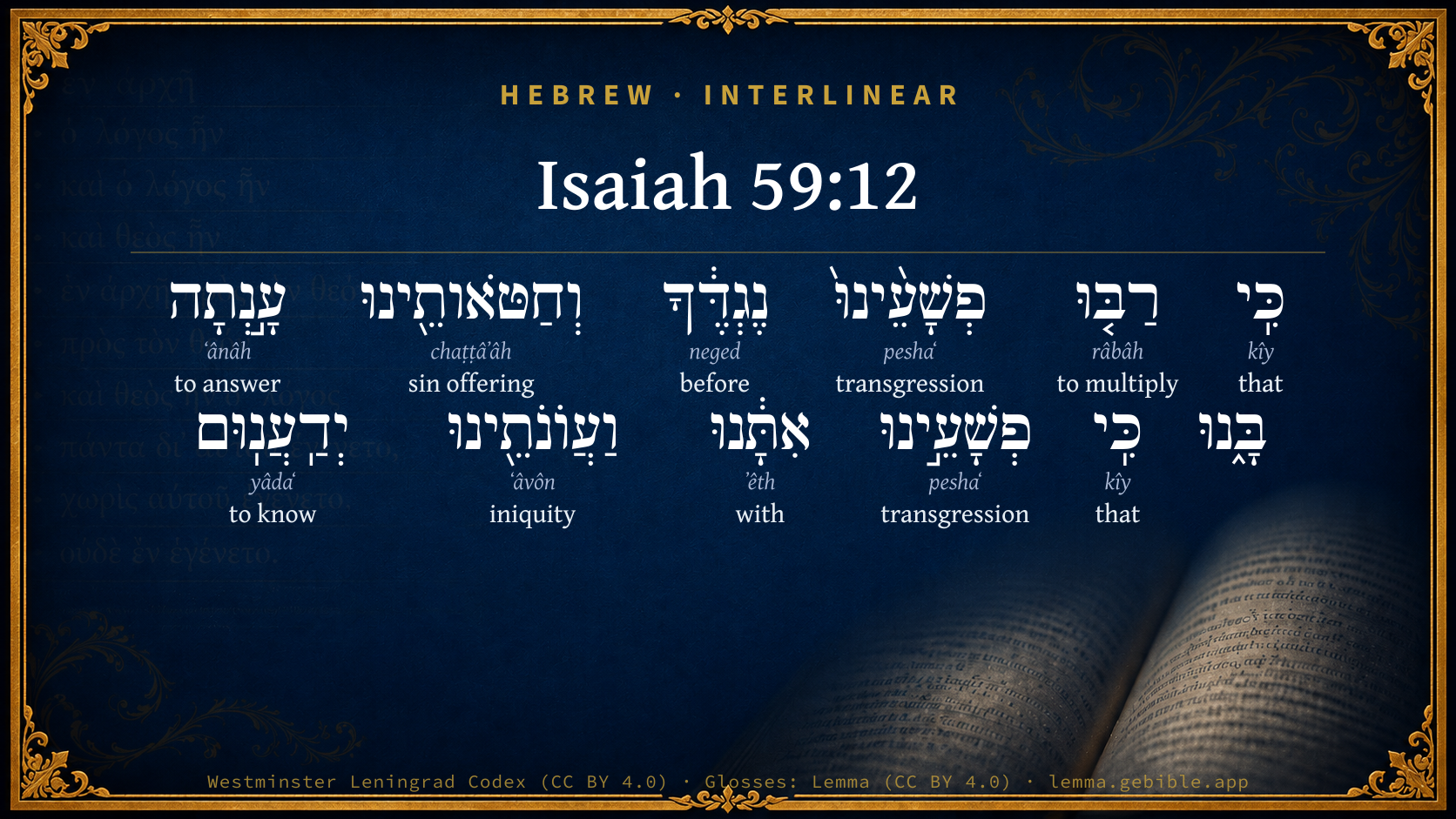
Hebrew (Westminster Leningrad Codex) Isaiah 59:12 appears in the Hebrew Old Testament. The text above is from the Westminster Leningrad Codex. Each word links to its Strong’s number, a concise gloss, and parsing drawn from the Open Scriptures Hebrew Bible morphology. Click any word for its full Brown-Driver-Briggs (BDB) entry.
Download image
Cite this verse

Isaiah 59:12 (World English Bible). Public Domain. Lemma interlinear Bible study tool, https://lemma.gebible.app/v/isaiah/59/12.

Show BibTeX & RIS
BibTeX
RIS
English Translation
For our transgressions are multiplied before you, and our sins testify against us; for our transgressions are with us, and as for our iniquities, we know them:
World English Bible · Public Domain
Download a study sheet

One document with this verse’s original text, its word-by-word gloss line, the meaning frame, cross-references with their text, attributed commentary, and full source and license credits — printable, and it pastes into notes with its structure intact.

This verse Autodidact and up

Study sheet (.html) Plain text (.txt)

A passage Seminary Student

Up to 50 verses in one chapter. A passage sheet keeps up to 6 commentary sources and 12 cross-references per verse, in the order this page ranks them, and says so on the sheet whenever that leaves anything out. Ask for a single verse and you get the Autodidact verse sheet above.

Everything on this page stays free to read, with no account — the sheet is a download of what is already on screen, not access to it.

Want to remove ads? Support Godless Engineer
Compare translations 3

The same verse in 3 English versions, stacked beneath the original-language interlinear above. Click any original word for its lexicon entry.

Each is an independent rendering of the whole verse — the interlinear is not word-aligned to these translations.

Highlighted words mark where these versions differ — a whole-verse word diff, not a word-by-word alignment.

  • World English Bible Public Domain
    For our transgressions are multiplied before you, and our sins testify against us; for our transgressions are with us, and as for our iniquities, we know them:
  • King James Version Public Domain
    For our transgressions are multiplied before thee, and our sins testify against us: for our transgressions are with us; and as for our iniquities, we know them;
  • unfoldingWord Literal Text CC BY-SA 4.0
    For our transgressions are many before you, and our sins, it testifies against us. For our transgressions with us, and our iniquities, we know them:

unfoldingWord Literal Text — © unfoldingWord, licensed CC BY-SA 4.0. Word-aligned USFM3 via Door43 (git.door43.org/unfoldingWord/en_ult).

Versions to compare (up to 4)

3 of 4 selected

Show all 18 translations

Every available English version of this verse, each an independent rendering of the whole verse.

  • World English Bible Public Domain
    For our transgressions are multiplied before you, and our sins testify against us; for our transgressions are with us, and as for our iniquities, we know them:
  • Berean Standard Bible Public Domain
    For our transgressions are multiplied before You, and our sins testify against us. Our transgressions are indeed with us, and we know our iniquities:
  • Majority Standard Bible Public Domain
    For our transgressions are multiplied before You, and our sins testify against us. Our transgressions are indeed with us, and we know our iniquities:
  • King James Version Public Domain
    For our transgressions are multiplied before thee, and our sins testify against us: for our transgressions are with us; and as for our iniquities, we know them;
  • American Standard Version (1901) Public Domain
    For our transgressions are multiplied before thee, and our sins testify against us; for our transgressions are with us, and as for our iniquities, we know them:
  • Revised Version (1885) Public Domain
    For our transgressions are multiplied before thee, and our sins testify against us: for our transgressions are with us, and as for our iniquities, we know them:
  • Geneva Bible (1599) Public Domain
    For our trespasses are many before thee, and our sinnes testifie against vs: for our trespasses are with vs, and we knowe our iniquities
  • Douay-Rheims (1899) Public Domain
    For our iniquities are multiplied before thee, and our sins have testified against us: for our wicked doings are with us, and we have known our iniquities:
  • Young's Literal Translation Public Domain
    For our transgressions have been multiplied before Thee, And our sins have testified against us, For our transgressions `are' with us, And our iniquities -- we have known them.
  • Literal Standard Version CC BY-SA 4.0
    For our transgressions have been multiplied before You, || And our sins have testified against us, || For our transgressions [are] with us, || And our iniquities—we have known them.
  • Unlocked Literal Bible CC BY-SA 4.0
    For our many transgressions are before you, and our sins testify against us; for our transgressions are with us, and we know our sins.
  • unfoldingWord Literal Text CC BY-SA 4.0
    For our transgressions are many before you, and our sins, it testifies against us. For our transgressions with us, and our iniquities, we know them:
  • Darby Bible Public Domain
    For our transgressions are multiplied before thee, and our sins testify against us; for our transgressions are with us; and our iniquities, we know them:
  • World Messianic Bible Public Domain
    For our transgressions are multiplied before you, and our sins testify against us; for our transgressions are with us, and as for our iniquities, we know them:
  • Webster's Bible Public Domain
    For our transgressions are multiplied before thee, and our sins testify against us: for our transgressions are with us; and as for our iniquities, we know them;
  • Free Bible Version CC BY-SA 4.0
    You are aware of all our rebellious acts; our sins witness against us. Yes, we acknowledge our rebellious acts; we know all about our sins.
  • Bible in Basic English Public Domain
    For our evil doings are increased before you, and our sins give witness against us: for our evil doings are with us, and we have knowledge of our sins:
  • JPS Tanakh (1917) Public Domain
    For our transgressions are multiplied before Thee, and our sins testify against us; for our transgressions are present to us, and as for our iniquities, we know them:

Literal Standard Version (2020), Covenant Press — licensed CC BY-SA 4.0. Text via the HelloAO Bible API (eBible.org). Unlocked Literal Bible (unfoldingWord) — licensed CC BY-SA 4.0. Text via the HelloAO Bible API (eBible.org). unfoldingWord Literal Text — © unfoldingWord, licensed CC BY-SA 4.0. Word-aligned USFM3 via Door43 (git.door43.org/unfoldingWord/en_ult). Free Bible Version, Dr. Jonathan Gallagher — licensed CC BY-SA 4.0. Text via the HelloAO Bible API (eBible.org).

Word by word

More ways to search: Search by grammar → Find every occurrence → Compare this word →

Practice this passage: Drill this verse → Learn its vocabulary →

פְשָׁעֵ֨ינוּ֙
peshaʻ
H6588
“transgressions · our”
Noun, Common, Masculine, Plural, Construct + Suffix, Personal, 1st Person, Common, Plural
Part of Speech
Noun
Type
Common
Gender
Masculine
Number
Plural
State
Construct
Full BDB Definition

Origin: from H6586

TWOT: 1846a

transgression, rebellion - transgression (against individuals) - transgression (nation against nation) - transgression (against God) - in general - as recognised by sinner - as God deals with it - as God forgives - guilt of transgression - punishment for transgression - offering for transgression
  1. כִּֽי kîy H3588 “that” Conjunction
  2. רַבּ֤וּ râbâh H7235 “to multiply” Verb, Qal, Perfect, 3rd Person, Common, Plural
  3. נֶגְדֶּ֔ךָ neged H5048 “before · you” Preposition + Suffix, Personal, 2nd Person, Masculine, Singular
  4. וְחַטֹּאותֵ֖ינוּ chaṭṭâʼâh H2403 “and · sin offerings · our” Conjunction + Noun, Common, Feminine, Plural, Construct + Suffix, Personal, 1st Person, Common, Plural
  5. עָ֣נְתָה ʻânâh H6030 “to answer” Verb, Qal, Perfect, 3rd Person, Feminine, Singular
  6. כִּֽי kîy H3588 “that” Conjunction
  7. פְשָׁעֵ֣ינוּ peshaʻ H6588 “transgressions · our” Noun, Common, Masculine, Plural, Construct + Suffix, Personal, 1st Person, Common, Plural
  8. אִתָּ֔נוּ ʼêth H854 “with · us” Preposition + Suffix, Personal, 1st Person, Common, Plural
  9. וַעֲוֺנֹתֵ֖ינוּ ʻâvôn H5771 “and · iniquities · our” Conjunction + Noun, Common, Both, Plural, Construct + Suffix, Personal, 1st Person, Common, Plural
  10. יְדַֽעֲנֽוּם yâdaʻ H3045 “to know · them” Verb, Qal, Perfect, 1st Person, Common, Plural + Suffix, Personal, 3rd Person, Masculine, Plural

About this verse

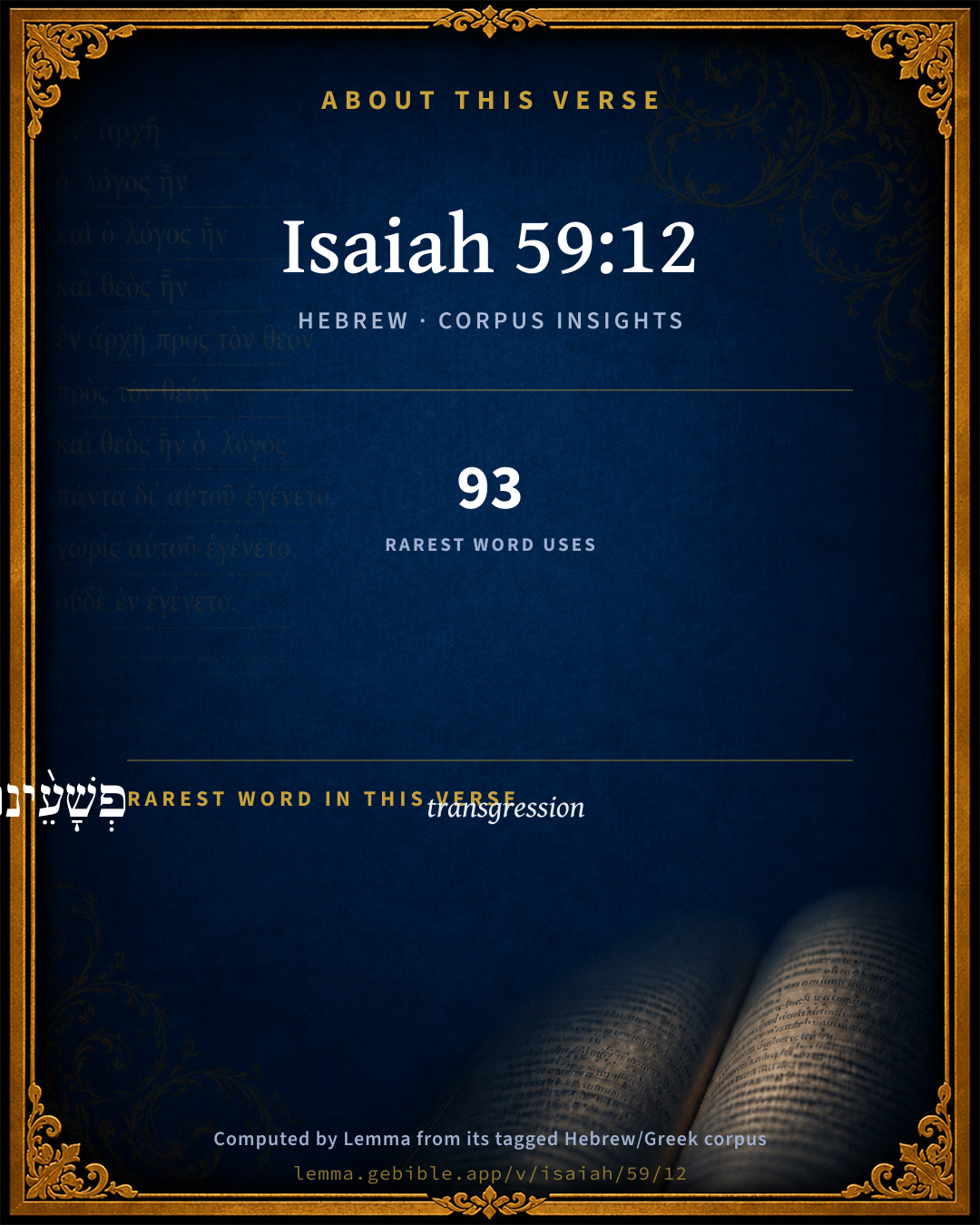
These counts appear in no published source. They are computed here, from the morphology-tagged text and Lemma’s own curated glosses. What Lemma adds →

12
words
9
distinct lemmas
Prophets
section

Grammatical profile

  • 3 verbs
  • 4 nouns
  • 3 prepositions
  • 2 conjunctions

Verb forms

  • רַבּ֤וּ Qal · Perfect
  • עָ֣נְתָה Qal · Perfect
  • יְדַֽעֲנֽוּם Qal · Perfect

Repetition

Words recur within this verse — often emphatic in Hebrew:

  • פְשָׁעֵ֨ינוּ֙ transgression H6588 ×2
  • כִּֽי that H3588 ×2

Hebrew & Septuagint length

In English translation the verse runs 27 words from the Hebrew and 27 from the Septuagint (LXX English) — the same length.

A rough comparison of the two English renderings, which tokenize alike — not a word-level alignment.

Word counts can differ between the Hebrew and the Greek without any difference in meaning — e.g. the Hebrew direct-object marker אֵת has no separate Greek word, and Greek often adds the article ὁ.

Cross-references

25

Topical passages linked to Isaiah 59:12 in the Treasury of Scripture Knowledge — connected by theme and wording, ordered by reader-vote popularity; previews shown in the World English Bible.

  • Ezra 9:6 and I said, my God, I am ashamed and blush to lift up my face to you, my God; for our iniquities are increased over our head, and our guiltiness is grown up to the heavens.
  • Jeremiah 14:7 Though our iniquities testify against us, work you for your name's sake, Yahweh; for our backslidings are many; we have sinned against you.
  • Hosea 5:5 The pride of Israel testifies to his face. Therefore Israel and Ephraim will stumble in their iniquity. Judah also will stumble with them.
  • Isaiah 1:4 Ah sinful nation, A people loaded with iniquity, A seed of evil-doers, Children who deal corruptly! They have forsaken Yahweh. They have despised the Holy One of Israel. They are estranged and backward.
  • Ezekiel 5:6 She has rebelled against my ordinances in doing wickedness more than the nations, and against my statutes more than the countries that are round about her; for they have rejected my ordinances, and as for my statutes, they have not walked in them.
  • Hosea 4:2 There is cursing, lying, murder, stealing, and committing adultery; They break boundaries, and bloodshed causes bloodshed.
  • Ezra 9:13 After all that is come on us for our evil deeds, and for our great guilt, seeing that you our God have punished us less than our iniquities deserve, and have given us such a remnant,
  • Nehemiah 9:33 However you are just in all that is come on us; for you have dealt truly, but we have done wickedly;
  • Isaiah 3:9 The look of their faces testify against them. They parade their sin like Sodom. They don't hide it. Woe to their soul! For they have brought disaster upon themselves.
  • Jeremiah 3:2 Lift up your eyes to the bare heights, and see; where have you not been lain with? By the ways have you sat for them, as an Arabian in the wilderness; and you have polluted the land with your prostitution and with your wickedness.
  • Jeremiah 5:3–9 O Yahweh, don't your eyes look on truth? you have stricken them, but they were not grieved; you have consumed them, but they have refused to receive correction: they have made their faces harder than a rock; they have refused to return.
  • Jeremiah 5:25–29 Your iniquities have turned away these things, and your sins have withheld good from you.
  • Jeremiah 7:8–10 Behold, you trust in lying words, that can't profit.
  • Ezekiel 7:23 Make the chain; for the land is full of bloody crimes, and the city is full of violence.
  • Ezekiel 8:8–16 Then said he to me, Son of man, dig now in the wall: and when I had dug in the wall, behold, a door.
  • Ezekiel 16:51–52 Neither has Samaria committed half of your sins; but you have multiplied your abominations more than they, and have justified your sisters by all your abominations which you have done.
  • Ezekiel 22:2–12 You, son of man, will you judge, will you judge the bloody city? then cause her to know all her abominations.
  • Ezekiel 22:24–30 Son of man, tell her, You are a land that is not cleansed, nor rained on in the day of indignation.
  • Ezekiel 23:2–49 Son of man, there were two women, the daughters of one mother:
  • Ezekiel 24:6–14 Therefore thus says the Lord Yahweh: Woe to the bloody city, to the caldron whose rust is therein, and whose rust is not gone out of it! take out of it piece after piece; No lot is fallen on it.
  • Daniel 9:5–8 we have sinned, and have dealt perversely, and have done wickedly, and have rebelled, even turning aside from your precepts and from your ordinances;
  • Hosea 7:10 The pride of Israel testifies to his face; Yet they haven't returned to Yahweh their God, Nor sought him, for all this.
  • Matthew 23:32–33 Fill up, then, the measure of your fathers.
  • Romans 3:19–20 Now we know that whatever things the law says, it speaks to those who are under the law, that every mouth may be closed, and all the world may be brought under the judgment of God.
  • 1 Thessalonians 2:15–16 who killed both the Lord Jesus and their own prophets, and drove us out, and didn't please God, and are contrary to all men;

Cross-references courtesy of OpenBible.info (CC BY 4.0).

Hebrew and Greek witnesses Masoretic Hebrew ↔ Greek Septuagint

The same verse in the two great witnesses to the Old Testament, shown verse-for-verse.

These are two independent witnesses, not word-aligned to each other, and the Septuagint is shown in lemma (dictionary) form.

Hebrew Isaiah 59:12 Masoretic · Westminster Leningrad Codex

כִּֽי רַבּ֤וּ פְשָׁעֵ֨ינוּ֙ נֶגְדֶּ֔ךָ וְחַטֹּאותֵ֖ינוּ עָ֣נְתָה בָּ֑נוּ כִּֽי פְשָׁעֵ֣ינוּ אִתָּ֔נוּ וַעֲוֺנֹתֵ֖ינוּ יְדַֽעֲנֽוּם

For our transgressions are multiplied before you, and our sins testify against us; for our transgressions are with us, and as for our iniquities, we know them:

World English Bible · Public Domain

Greek LXX Isaiah 59:12 Septuagint · lemma form

πολύς γάρ ἐγώ ὁ ἀνομία ἐναντίον σύ καί ὁ ἁμαρτία ἐγώ ἀντιἵστημι ἐγώ ὁ γάρ ἀνομία ἐγώ ἐν ἐγώ καί ὁ ἀδίκημα ἐγώ γιγνώσκω

For our iniquity is great before you, and our sins have risen up against us: for our iniquities are in us, and we know our unrighteous deeds.

LXX2012 (modern English Septuagint) · Public Domain

Hebrew: Westminster Leningrad Codex (CC BY 4.0). Greek: Septuagint (public domain); English from LXX2012 (modern English Septuagint) (Public Domain). How the Septuagint differs from the Hebrew →

Targum (Aramaic paraphrase)

1

The Targum is the ancient Jewish Aramaic paraphrase of the Hebrew Scriptures — an interpretive translation, not the Hebrew text itself. Onkelos (literal) and Pseudo-Jonathan (expansive) render the Torah, and Jonathan the Prophets. Coverage is partial: where no permissively-licensed English translation exists for a verse, only the Aramaic is shown. This is verse-level text, not a word-by-word alignment to the Hebrew.

  1. Targum Jonathan Prophets (Joshua–Malachi)
    אֲרֵי סַגִיאִין חוֹבָנָא קֳדָמָךְ וְחַטָאנָא אַסְהִידוּ בָנָא אֲרֵי חוֹבָנָא גְלַן לָנָא זַעֲוָיָתָנָא יְדַעְנָא לְהוֹן:

    Because our iniquities are multiplied before Thee, and our sins testify against us: for our iniquities are revealed unto us, and our crimes we know them.

    Targum Jonathan — Aramaic: “Mikraot Gedolot” (public domain). English: “Sefaria Community Translation” (CC0 1.0 (public-domain dedication)); “London "Chaldee Paraphrase," 1871” (public domain). Text via Sefaria.

Commentary

Notes on Isaiah 59:12 from classic Christian and Jewish commentators (each source and its license shown beneath its notes). The classic Christian expositions comment on the surrounding passage and are grouped to its opening verse, so a note may address several verses; the Jewish commentaries on the Tanakh (Rashi and others) are per-verse, so they appear only where the commentator wrote on this verse.

Lemma curates 59 commentaries, every one of them public domain or Creative Commons licensed, each selected and text-cleaned for this edition rather than reprinted as found. About our sources →

Trapp's Complete Commentary

John Trapp

Isa 59:12 For our transgressions are multiplied before thee, and our sins testify against us: for our transgressions [are] with us; and [as for] our iniquities, we know them;

Ver. 12. For our transgressions are multiplied before thee.] When complaints end in confessions, it is right - the medicine worketh kindly. Some furious fools have brutish and fell affections, full of rage; when in pain or grief, they fly upon God and man, and all that comes next hand, hoping to ease themselves, not by confession or reformation, but by revenge.

And our sins testify against us.] {a} Sin put a sting into their cresses, and hence it was they lay so heavy. This brought such roarings and groanings upon them, and that also when salvation was looked for.

For our transgressions are with us.] They lie like a load of lead upon our consciences, where they are yet unpardoned.

And as for our iniquities, we know them.] Our consciences are burdened with them, and we feel the terrors of God in our souls. Conscientia nihil aliud est quam cordis scientia; Conscience is the reflection of the soul upon itself. See 1Co 4:4. So here, "As for our iniquities, we know them" - namely, by a second act of the understanding, whereby, after we think or know a thing, we think what we think, and know what we know, and this is properly the action of conscience.

{a} Heb., Peccatum respondit - i.e., Peccatorum unumquodque.

John Trapp, A Commentary or Exposition upon All the Books of the Old and New Testament (1647–1656) — public domain. Text from a community e-Sword module.

Joseph Benson's Commentary

Isa 59:12-13. For our transgressions — The word פשׁעונו, here used, signifies sins of a high nature, namely, such as were wilfully committed against light and knowledge; rebellious sins. Are multiplied before thee — They admit of no excuse; for they are committed before thee, and multiplied against thee, whereby thou art justly provoked to deny us all help. And our sins testify against us — The sins charged upon us are so many witnesses produced to prove our guilt. For our transgressions are with us — Are still unforgiven, and we lie under the divine wrath on account of them. As for our iniquities, we know them — We are convinced of them. In transgressing and lying, &c. — He now enumerates some of those particular sins which they profess themselves to be convinced of; by which he does not mean the sins of some particular persons, or some slight sins, but a general defection and corruption of the whole body. Transgressing here, and lying, seem to be one and the same thing, inasmuch as in their transgressing the law of God, they broke their solemn engagement to God, made upon mount Sinai. Departing away from God — Turning from God to idols. Speaking oppression, &c. — As it were, talking of little else one among another, but how to oppress their neighbours, and apostatize from God. Conceiving and uttering — That is, first contriving in their hearts false accusations against their neighbours, and false worship, to the dishonour of God; laying the contrivances so that they might be effectual, and then uttering them; from the heart — And when they dealt with men in ways of fraud, it was from the heart; but when they spake with God, it was but from the lips.

Joseph Benson's Commentary on the Old and New Testaments (1811–1818) — public domain. Text from a community e-Sword module.

Geneva Bible (1599)

Geneva Bible translators

This confession is general to the Church to obtain remission of sins, and the Prophets did not exempt themselves from the same.

Geneva Bible (1599) marginal notes — public domain. Text via Bolls.life.

Jamieson, Fausset & Brown

Robert Jamieson, A. R. Fausset & David Brown

(Dan 9:5, &c.).

thee . . . us--antithesis.

with us--that is, we are conscious of them (Job 12:3, Margin; Job 15:9).

know--acknowledge they are our iniquities.

Jamieson, Fausset & Brown — Commentary Critical and Explanatory on the Whole Bible (1871) — public domain (CC PDM 1.0). Text via the HelloAO Bible API.

Ellicott's Commentary for English Readers

(12) For our transgressions . . .—The parallelism with the confessions of Daniel (Isa_9:5-15) and Ezra (Isa_9:6-15) is singularly striking, but is as explicable on the hypothesis that they reproduced that of 2 Isaiah as on the assumption that this also was written at the close of the exile. It would, of course, be as true in the time of Manasseh as at any subsequent period. The self accusations of the people are now, as they ought to be, as full and severe as the prophet’s original indictment had been.

A Bible Commentary for English Readers, edited by Charles John Ellicott (1878–1897) — public domain. Text from a community e-Sword module.

The Cambridge Bible for Schools and Colleges

gen. ed. J. J. S. Perowne

12. our sins testify against us] So Jer_14:7.

our transgressions are with us] present to our conscience, Job_12:3; Job_14:5 &c.; comp. also Psa_51:3 (“my transgressions I know, and my sin is before me continually”).

The Cambridge Bible for Schools and Colleges (gen. ed. J. J. S. Perowne; Cambridge University Press, 1878–1918) — public domain. Text from a community e-Sword module.

John Gill's Exposition

For our transgressions are multiplied before thee,.... Not only an increase of immorality among the people in common, but among professors of religion; and as their transgressions are committed against the Lord, so they are in his sight taken notice of and observed by him, are loathsome and abominable to him, and call aloud for his judgments on them:

and our sins testify against us; God is a witness against us, in whose sight our sins are done; and our consciences are witnesses against us, which are as a thousand witnesses; and there is no denying facts; our sins stare us in the face, and we must confess our guilt: or, "our sins answer against us" (c); as witnesses called and examined answer to the questions put, so our sins, being brought as it were into open court, answer and bear testimony against us; or it must be owned, our punishment for our sins answers to them; it is the echo of our sins, what they call for, and righteously comes upon us:

for our transgressions are with us; or, "on us" (d); in our minds, on our consciences, loading us with guilt; continually accusing and condemning us; are manifest to us, as the Targum; too manifest to be denied:

and as for our iniquities, we know them; the nature and number of them, and the aggravating circumstances that attend them; and cannot but own and acknowledge them, confess, lament, and bewail them; an enumeration of which follows.

(c) "peccata nostra respondit contra nos", Montanus; "id ipsum respondit contra nos", Cocceius; "even everyone of them", so Junius & Tremellius; "peccatorum nostrorum quodque", sic (d) "super nos", Munster.

John Gill's Exposition of the Whole Bible (1746–1763) — public domain (CC PDM 1.0). Text via the HelloAO Bible API.

Albert Barnes' Notes on the Bible

Our sins testify against us - Hebrew, ‘Answer against us.’ The idea is, that their past lives had been so depraved that they became witnesses against them (compare the notes at Isa 3:9).

We know them - We recognize them as our sins, and we cannot conceal from ourselves the fact that we are transgressors.

Albert Barnes' Notes on the Bible (1834–1885) — public domain. Text from a community e-Sword/MySword module.

Matthew Poole's English Annotations

Our transgressions: the word here signifies sins of a high nature; such as wherein there is much of man’s will against light; rebellious sins.

Are multiplied before thee: q.d. They admit of no excuse; for they are acted before thee, and multiplied against thee, whereby thou art justly provoked to deny us all help.

Our sins testify; every sin that is charged upon is like so many witnesses produced to prove the guilt of our consciences; or, as the Hebrew word, do answer; and so some make it an elegant metaphorical allusion to the echo, which, as it returns the voice again, so those judgments they cry out of are but the meritorious repercussion of their sins. They had been cruel to others, neither had they executed judgment and justice, and here they suffer all kind of cruelties and indignities from the Chaldeans, as the true and just representation or echo of their own works: see a personal instance in Adoni-bezek, Jdg 1:6,7.

Our transgressions are with us, i.e. we lie under the guilt of them, they are a burden to us; God hath not yet forgiven them.

As for our iniquities, we know them; we are convinced of them; our guilty consciences must own and acknowledge them, Psa 2 3. It notes either their conviction or sorrow, or both. See Jer 14:7. Or, we know what are those sins thou art so angry with us for; and this is favoured by the sequel, where they seem to particularize those sins in the following verses.

Matthew Poole's English Annotations on the Holy Bible (1683–1685) — public domain. Text from a community e-Sword/MySword module.

Whedon's Commentary on the Bible

Daniel D. Whedon

12, 13. Our sins testify against us — Every page of our life history is a record against us.

Daniel D. Whedon (gen. ed.), Commentary on the Old and New Testaments (1874–1909) — public domain. Text from a community e-Sword module.

The Pulpit Commentary

Our transgressions are multiplied before thee; i.e. they are very numerous; and they come "before God," so as to attract his attention and call for his animadversion. Our sins testify against us; i.e. "rise up against us as witnesses, whose evidence we cannot disprove, and have not even the face to dispute." Our transgressions are with usi.e. "constantly haunt us and as for our iniquities, we know them; i.e. we are aware of them, we acknowledge them, we have them continually in our memories. It is one of the most certain phenomena of consciousness that grievous sins, deadly sins, haunt the mind, and cannot in this life be wiped out from the memory.

The Pulpit Commentary (1880–1919), ed. H.D.M. Spence-Jones & Joseph S. Exell — public domain. Text from a community e-Sword module.

John Wesley's Explanatory Notes

Transgressions - The word here signifies sins of an high nature, such as wherein there is much of man's will against light: rebellious sins. Multiplied - They admit of no excuse; for they are acted before thee, and multiplied against thee, whereby thou art justly provoked to deny us all help. Testify - As so many witnesses produced proves our guilt. Are with us - Are still unforgiven. We know - We are convinced of them.

John Wesley, Explanatory Notes Upon the Whole Bible (1754–1765) — public domain. Text via the GEBible commentary corpus.

Keil & Delitzsch

C. F. Keil & F. Delitzsch

The people have already indicated by על־כּן in Isa 59:9 that this benighted, hopeless state is the consequence of their prevailing sins; they now come back to this, and strike the note of penitence (viddui), which is easily recognised by the recurring rhymes ānu and ênu. The prophet makes the confession (as in Jer 14:19-20, cf., Isa 3:21.), standing at the head of the people as the leader of their prayer (ba‛al tephillâh): "For our transgressions are many before Thee, and our sins testify against us; for our transgressions are known to us, and our evil deeds well known: apostasy and denial of Jehovah, and turning back from following our God, oppressive and false speaking, receiving and giving out from the heart words of falsehood." The people acknowledge the multitude and magnitude of their apostate deeds, which are the object of the omniscience of God, and their sins which bear witness against them (ענתה the predicate of a neuter plural; Ges. 146, 3). The second כּי resumes the first: "our apostate deeds are with us (את as in Job 12:3; cf., עם, Job 15:9), i.e., we are conscious of them; and our misdeeds, we know them" (ידענוּם for ידענון, as in Gen 41:21, cf., Isa 59:8, and with ע, as is always the case with verbs ל ע before נ, and with a suffix; Ewald, 60). The sins are now enumerated in Isa 59:13 in abstract infinitive forms. At the head stands apostasy in thought and deed, which is expressed as a threefold sin. בּה (of Jehovah) belongs to both the "apostasy" (treachery; e.g., Isa 1:2) and the "denial" (Jer 5:12). נסוג is an inf. abs. (different from Psa 80:19). Then follow sins against the neighbour: viz., such speaking as leads to oppression, and consists of sârâh, that which deviates from or is opposed to the law and truth (Deu 19:16); also the conception (concipere) of lying words, and the utterance of them from the heart in which they are conceived (Mat 15:18; Mat 12:35). הרו and הגו are the only poel infinitives which occur in the Old Testament, just as שׁושׂתי (Isa 10:13) is the only example of a poel perfect of a verb ל ה. The pol is suitable throughout this passage, because the action expressed affects others, and is intended to do them harm. According to Ewald, the poel indicates the object or tendency: it is the conjugation employed to denote seeking, attacking, or laying hold of; e.g., לושׁן, lingua petere, i.e., to calumniate; עוין, oculo petere, i.e., to envy.

Keil & Delitzsch — Biblical Commentary on the Old Testament (1861–1891) — public domain (CC PDM 1.0). Text via the HelloAO Bible API. (Old Testament only.)

J. A. Alexander on Isaiah

Joseph Addison Alexander

“For our transgressions are multiplied before thee, and our sins testify against us; for our transgressions are with us, and our iniquities, we know them.” The Prophet here begins a general confession in the name of God’s people. For the form of expression, compare Psa 51:3.

Joseph Addison Alexander, The Prophecies of Isaiah (1846–1847; New York: Scribner, 1870–1878) — public domain. Text from a community e-Sword module.

unfoldingWord translationNotes

Door43 World Missions Community

General Information:

Isaiah continues speaking.

our many transgressions

Here "our" refers to Isaiah and the people of Israel. (See: Inclusive "We")

before you

Here "you" refers to Yahweh. (See: Forms of You)

our sins testify against us

Isaiah describes the sins as a person who goes before God to declare that the people are guilty. (See: Personification)

for our transgressions are with us

"With us" represents being aware of them. AT: "for we are aware of our transgressions" (See: Metaphor)

translationWords

transgress

sin

testimony

rebel

Yahweh

God

heart

word

unfoldingWord translationNotes — © Distant Shores Media and the Door43 World Missions Community, licensed CC BY-SA 4.0. Source: git.door43.org/Door43/en_tn.

Ibn Ezra

Rabbi Abraham ibn Ezra

For our transgressions, etc. The repenting Israelites are now represented by the prophet as speaking.

ענתה בנו Hath testified against us. Comp. לא תענה ברעך, thou shalt not testify against thy neighbour (Ex. 20:13).

For our iniquities are with us. Our iniquities are yet with us.

Ibn Ezra on the Tanakh — English translations: “Sefaria Community Translation” (CC0 1.0 (public-domain dedication)); “Yalkut, Sifsei Chachomim Chumash, Metsudah Publications, 2009” (CC BY 4.0); and “Commentary of Ibn Ezra on Isaiah - trans. by M. Friedlander, 1873” (public domain). Text via Sefaria.

Lesson kit

Teaching starters — assembled from the data on this page, not authored interpretation. Every prompt links to the verse data it draws on. Edit before teaching.

Isaiah, in the Prophets, opens this verse with 12 words (9 distinct Hebrew lemmas). Its most distinctive word is peshaʻ (“transgression”). A historical commentator’s framing appears above. Read the whole chapter for the surrounding context.

Discussion questions

  1. The word peshaʻ carries the sense “transgression.” How does it shape the verse?
  2. Ezra 9:6 shares this passage’s theme. How do the two illuminate each other?
  3. “transgression” occurs 2× in this one verse. What is the effect of the repetition?
  4. These translations render this verse differently; the difference is in the English rendering, not the original. What questions does that raise?
  5. The verb «רַבּ֤וּ» is Qal Perfect. How does its form color the action?
  6. Reading how Trapp's Complete Commentary and Joseph Benson's Commentary read this verse, where do the two commentators agree and where do they part?

Things to notice

  • These translations choose different wording for 5 words in this verse.
  • “transgression” occurs 2× in this single verse.
  • 9 distinct Hebrew lemmas span 12 words in this verse.

Reading settings

Reading text

Shown beneath each verse's original-language words.

Old Testament
Old Testament edition

Read the OT as the Masoretic Hebrew (MT) or the Greek Septuagint (LXX).

English shown for the Greek Septuagint (in the Hebrew ↔ Greek comparison).

Comparing translations? Open the Compare panel on any verse page to stack up to four side by side.