
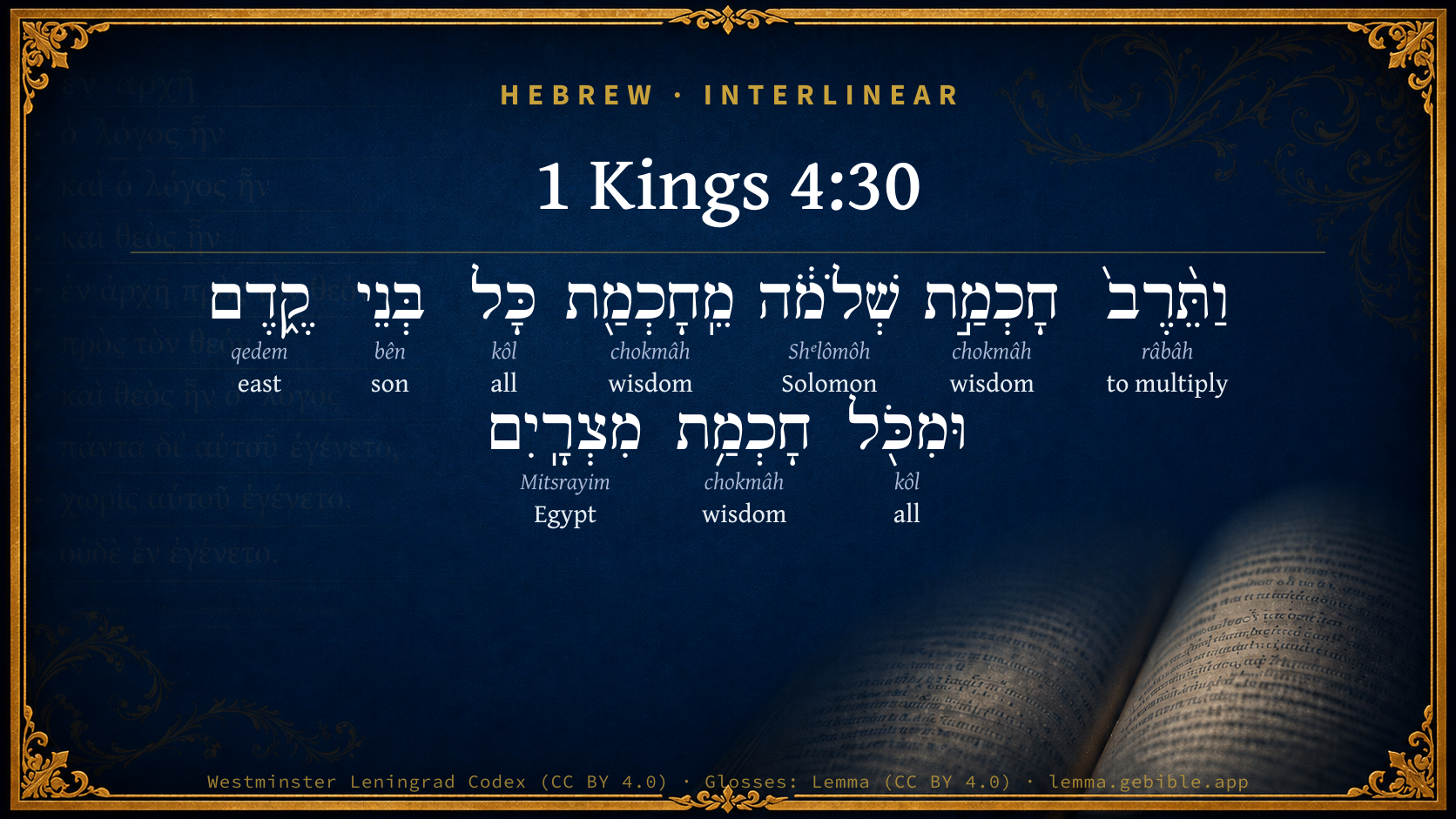
1 Kings 4:30

Hebrew (Westminster Leningrad Codex) 1 Kings 4:30 appears in the Hebrew Old Testament. The text above is from the Westminster Leningrad Codex. Each word links to its Strong’s number, a concise gloss, and parsing drawn from the Open Scriptures Hebrew Bible morphology. Click any word for its full Brown-Driver-Briggs (BDB) entry.
Download image
Cite this verse

1 Kings 4:30 (World English Bible). Public Domain. Lemma interlinear Bible study tool, https://lemma.gebible.app/v/1-kings/4/30.

Show BibTeX & RIS
BibTeX
RIS
English Translation
Solomon's wisdom excelled the wisdom of all the children of the east, and all the wisdom of Egypt.
World English Bible · Public Domain
Download a study sheet

One document with this verse’s original text, its word-by-word gloss line, the meaning frame, cross-references with their text, attributed commentary, and full source and license credits — printable, and it pastes into notes with its structure intact.

This verse Autodidact and up

Study sheet (.html) Plain text (.txt)

A passage Seminary Student

Up to 50 verses in one chapter. A passage sheet keeps up to 6 commentary sources and 12 cross-references per verse, in the order this page ranks them, and says so on the sheet whenever that leaves anything out. Ask for a single verse and you get the Autodidact verse sheet above.

Everything on this page stays free to read, with no account — the sheet is a download of what is already on screen, not access to it.

Want to remove ads? Support Godless Engineer
Compare translations 3

The same verse in 3 English versions, stacked beneath the original-language interlinear above. Click any original word for its lexicon entry.

Each is an independent rendering of the whole verse — the interlinear is not word-aligned to these translations.

Highlighted words mark where these versions differ — a whole-verse word diff, not a word-by-word alignment.

  • World English Bible Public Domain
    Solomon's wisdom excelled the wisdom of all the children of the east, and all the wisdom of Egypt.
  • King James Version Public Domain
    And Solomon's wisdom excelled the wisdom of all the children of the east country, and all the wisdom of Egypt.
  • unfoldingWord Literal Text CC BY-SA 4.0
    And the wisdom of Solomon was greater than the wisdom of all of the sons of the east and than all of the wisdom of Egypt.

unfoldingWord Literal Text — © unfoldingWord, licensed CC BY-SA 4.0. Word-aligned USFM3 via Door43 (git.door43.org/unfoldingWord/en_ult).

Versions to compare (up to 4)

3 of 4 selected

Show all 18 translations

Every available English version of this verse, each an independent rendering of the whole verse.

  • World English Bible Public Domain
    Solomon's wisdom excelled the wisdom of all the children of the east, and all the wisdom of Egypt.
  • Berean Standard Bible Public Domain
    Solomon’s wisdom was greater than that of all the men of the East, greater than all the wisdom of Egypt.
  • Majority Standard Bible Public Domain
    Solomon’s wisdom was greater than that of all the men of the East, greater than all the wisdom of Egypt.
  • King James Version Public Domain
    And Solomon's wisdom excelled the wisdom of all the children of the east country, and all the wisdom of Egypt.
  • American Standard Version (1901) Public Domain
    And Solomon's wisdom excelled the wisdom of all the children of the east, and all the wisdom of Egypt.
  • Revised Version (1885) Public Domain
    And Solomon’s wisdom excelled the wisdom of all the children of the east, and all the wisdom of Egypt.
  • Geneva Bible (1599) Public Domain
    And Salomons wisdome excelled the wisedome of all the children of the East and all the wisedome of Egypt.
  • Douay-Rheims (1899) Public Domain
    And the wisdom of Solomon surpassed the wisdom of all the Orientals, and of the Egyptians,
  • Young's Literal Translation Public Domain
    and the wisdom of Solomon is greater than the wisdom of any of the sons of the east, and than all the wisdom of Egypt;
  • Literal Standard Version CC BY-SA 4.0
    and the wisdom of Solomon is greater than the wisdom of any of the sons of the east, and [greater] than all the wisdom of Egypt;
  • Unlocked Literal Bible CC BY-SA 4.0
    Solomon's wisdom exceeded the wisdom of all the people of the east and all the wisdom of Egypt.
  • unfoldingWord Literal Text CC BY-SA 4.0
    And the wisdom of Solomon was greater than the wisdom of all of the sons of the east and than all of the wisdom of Egypt.
  • Darby Bible Public Domain
    And Solomon's wisdom excelled the wisdom of all the sons of the east, and all the wisdom of Egypt.
  • World Messianic Bible Public Domain
    Solomon’s wisdom excelled the wisdom of all the children of the east and all the wisdom of Egypt.
  • Webster's Bible Public Domain
    And Solomon's wisdom excelled the wisdom of all the children of the east country, and all the wisdom of Egypt.
  • Free Bible Version CC BY-SA 4.0
    Solomon's wisdom was greater than that of all the Eastern wise men, greater than all of Egypt's wisdom.
  • Bible in Basic English Public Domain
    And Solomon's wisdom was greater than the wisdom of all the people of the East and all the wisdom of Egypt.
  • JPS Tanakh (1917) Public Domain
    (5-10) And Solomon's wisdom excelled the wisdom of all the children of the east, and all the wisdom of Egypt.

Literal Standard Version (2020), Covenant Press — licensed CC BY-SA 4.0. Text via the HelloAO Bible API (eBible.org). Unlocked Literal Bible (unfoldingWord) — licensed CC BY-SA 4.0. Text via the HelloAO Bible API (eBible.org). unfoldingWord Literal Text — © unfoldingWord, licensed CC BY-SA 4.0. Word-aligned USFM3 via Door43 (git.door43.org/unfoldingWord/en_ult). Free Bible Version, Dr. Jonathan Gallagher — licensed CC BY-SA 4.0. Text via the HelloAO Bible API (eBible.org).

Word by word

More ways to search: Search by grammar → Find every occurrence → Compare this word →

Practice this passage: Drill this verse → Learn its vocabulary →

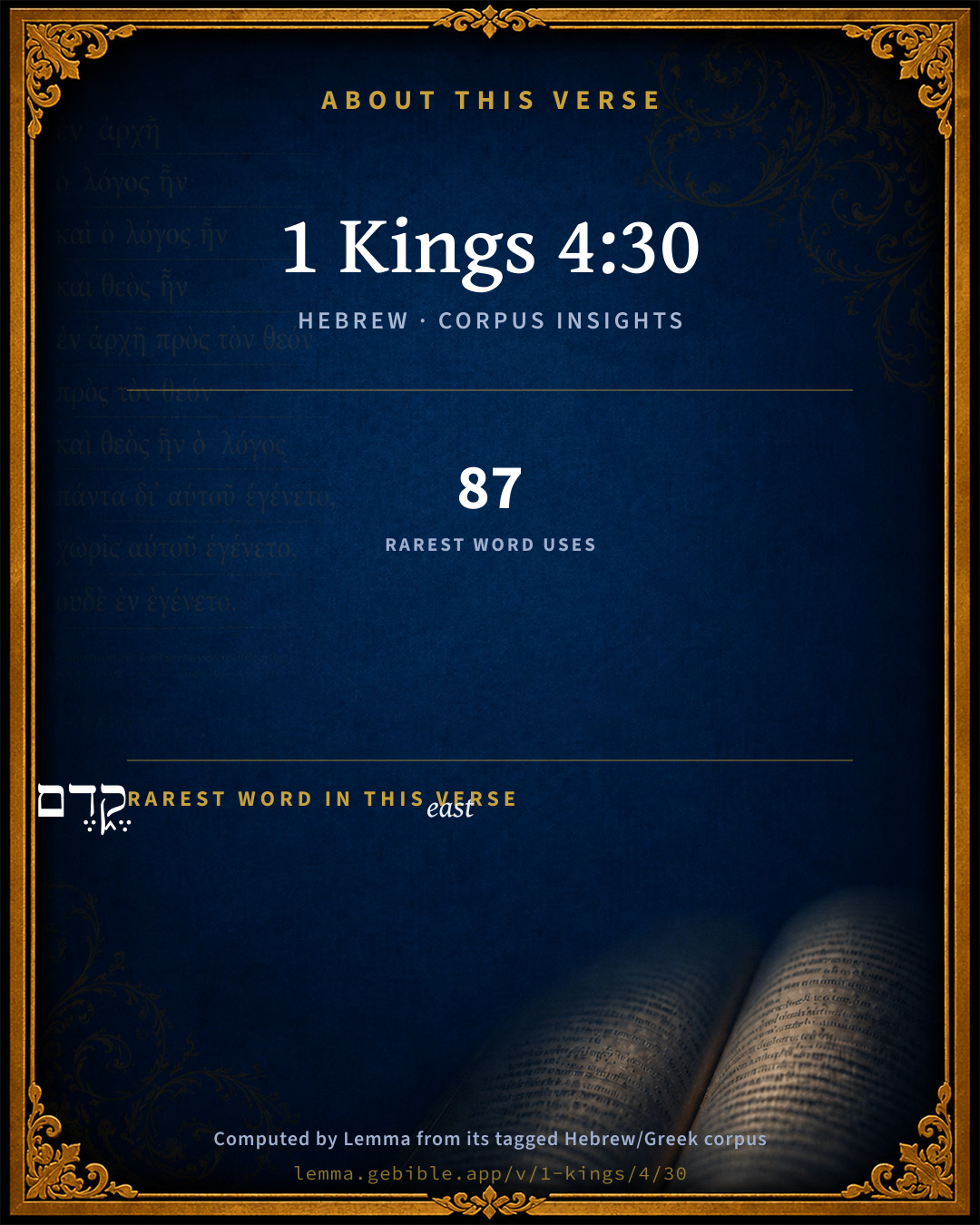
קֶ֑דֶם
qedem
H6924
“east”
Noun, Common, Masculine, Singular, Absolute
Part of Speech
Noun
Type
Common
Gender
Masculine
Number
Singular
State
Absolute
Full BDB Definition

Origin: from H6923

TWOT: 1988a

east, antiquity, front, that which is before, aforetime (noun masculine) - front, from the front or east, in front, mount of the East - ancient time, aforetime, ancient, from of old, earliest time - anciently, of old (adverb) - beginning - east - eastward, to or toward the East (adverb)
  1. וַתֵּ֨רֶב֙ râbâh H7235 “and · to multiply” Conjunction + Verb, Qal, Sequential Imperfect, 3rd Person, Feminine, Singular
  2. חָכְמַ֣ת chokmâh H2451 “wisdom of” Noun, Common, Feminine, Singular, Construct
  3. שְׁלֹמֹ֔ה Shᵉlômôh H8010 “Solomon” Noun, Proper
  4. מֵֽחָכְמַ֖ת chokmâh H2451 “from · wisdom of” Preposition + Noun, Common, Feminine, Singular, Construct
  5. כָּל kôl H3605 “all of” Noun, Common, Masculine, Singular, Construct
  6. בְּנֵי bên H1121 “sons of” Noun, Common, Masculine, Plural, Construct
  7. וּמִכֹּ֖ל kôl H3605 “and · from · all of” Conjunction + Preposition + Noun, Common, Masculine, Singular, Construct
  8. חָכְמַ֥ת chokmâh H2451 “wisdom of” Noun, Common, Feminine, Singular, Construct
  9. מִצְרָֽיִם Mitsrayim H4714 “Egypt” Noun, Proper

About this verse

These counts appear in no published source. They are computed here, from the morphology-tagged text and Lemma’s own curated glosses. What Lemma adds →

10
words
7
distinct lemmas
Historical
section

Grammatical profile

  • 1 verb
  • 9 nouns

Verb forms

  • וַתֵּ֨רֶב֙ Qal · Sequential Imperfect

Repetition

Words recur within this verse — often emphatic in Hebrew:

  • חָכְמַ֣ת wisdom H2451 ×3
  • כָּל all H3605 ×2

Hebrew & Septuagint length

In English translation the verse runs 18 words from the Hebrew and 19 from the Septuagint (LXX English) — closely comparable.

A rough comparison of the two English renderings, which tokenize alike — not a word-level alignment.

Word counts can differ between the Hebrew and the Greek without any difference in meaning — e.g. the Hebrew direct-object marker אֵת has no separate Greek word, and Greek often adds the article ὁ.

Cross-references

9

Topical passages linked to 1 Kings 4:30 in the Treasury of Scripture Knowledge — connected by theme and wording, ordered by reader-vote popularity; previews shown in the World English Bible.

  • Daniel 5:11–12 There is a man in your kingdom, in whom is the spirit of the holy gods; and in the days of your father light and understanding and wisdom, like the wisdom of the gods, were found in him; and the king Nebuchadnezzar your father, the king, [I say], your father, made him master of the magicians, enchanters, Chaldeans, and soothsayers;
  • Genesis 25:6 but to the sons of the concubines who Abraham had, Abraham gave gifts. He sent them away from Isaac his son, while he yet lived, eastward, to the east country.
  • Job 1:3 His possessions also were seven thousand sheep, three thousand camels, five hundred yoke of oxen, five hundred she-donkeys, and a very great household; so that this man was the greatest of all the children of the east.
  • Daniel 1:20 In every matter of wisdom and understanding, concerning which the king inquired of them, he found them ten times better than all the magicians and enchanters who were in all his realm.
  • Acts 7:22 Moses was instructed in all the wisdom of the Egyptians. He was mighty in his words and works.
  • Isaiah 19:11–12 The princes of Zoan are utterly foolish; the counsel of the wisest counselors of Pharaoh is become brutish: how do you say to Pharaoh, I am the son of the wise, the son of ancient kings?
  • Matthew 2:1 Now when Jesus was born in Bethlehem of Judea in the days of Herod the king, behold, wise men from the east came to Jerusalem, saying,
  • Matthew 2:16 Then Herod, when he saw that he was mocked by the wise men, was exceedingly angry, and sent out, and killed all the male children who were in Bethlehem and in all the surrounding countryside, from two years old and under, according to the exact time which he had learned from the wise men.
  • Daniel 4:7 Then came in the magicians, the enchanters, the Chaldeans, and the soothsayers; and I told the dream before them; but they did not make known to me the interpretation of it.

Cross-references courtesy of OpenBible.info (CC BY 4.0).

Hebrew and Greek witnesses Masoretic Hebrew ↔ Greek Septuagint

The same verse in the two great witnesses to the Old Testament, shown verse-for-verse.

These are two independent witnesses, not word-aligned to each other, and the Septuagint is shown in lemma (dictionary) form.

Hebrew 1 Kings 4:30 Masoretic · Westminster Leningrad Codex

וַתֵּ֨רֶב֙ חָכְמַ֣ת שְׁלֹמֹ֔ה מֵֽחָכְמַ֖ת כָּל בְּנֵי קֶ֑דֶם וּמִכֹּ֖ל חָכְמַ֥ת מִצְרָֽיִם

Solomon's wisdom excelled the wisdom of all the children of the east, and all the wisdom of Egypt.

World English Bible · Public Domain

Greek LXX 1 Kings 4:30 Septuagint · lemma form
And Solomon abounded greatly beyond the wisdom of all the ancients, and beyond all the wise men of Egypt.

LXX2012 (modern English Septuagint) · Public Domain

Hebrew: Westminster Leningrad Codex (CC BY 4.0). Greek: Septuagint (public domain); English from LXX2012 (modern English Septuagint) (Public Domain). How the Septuagint differs from the Hebrew →

Commentary

Notes on 1 Kings 4:30 from classic Christian and Jewish commentators (each source and its license shown beneath its notes). The classic Christian expositions comment on the surrounding passage and are grouped to its opening verse, so a note may address several verses; the Jewish commentaries on the Tanakh (Rashi and others) are per-verse, so they appear only where the commentator wrote on this verse.

Lemma curates 59 commentaries, every one of them public domain or Creative Commons licensed, each selected and text-cleaned for this edition rather than reprinted as found. About our sources →

Trapp's Complete Commentary

John Trapp

1Ki 4:30 And Solomon’s wisdom excelled the wisdom of all the children of the east country, and all the wisdom of Egypt.

Ver. 30. The wisdom of all the children of the east.] The Arabians and Chaldeans, {Mat 2:1 Dan 2:2} philosophers and astronomers.

And all the wisdom of Egypt.] See Isa 19:11-12 Act 7:22. Pythagoras, Plato, and many others, fetched much of their learning from Egypt: but all theirs was acquired; Solomon’s infused.

John Trapp, A Commentary or Exposition upon All the Books of the Old and New Testament (1647–1656) — public domain. Text from a community e-Sword module.

The Biblical Illustrator

Joseph S. Exell

1Ki_4:30-34

Solomons wisdom excelled the wisdom of all the children of the east country.

The aloneness of Jesus Christ

Christ towers up above the history of the world and the process of revelation, like Mount Everest among the Himalayas. To that great peak all the country on the one side runs upwards, and from it all the valleys on the other descend; and the springs are born there which carry verdure and life over the world. (Alex. Maclaren, D. D.)

The Biblical Illustrator, edited by Joseph S. Exell (c. 1880s–1900s) — public domain. Text from a community e-Sword module.

Geneva Bible (1599)

Geneva Bible translators

To wit, the Philosophers and Astronomers, which were judged most wise.

Geneva Bible (1599) marginal notes — public domain. Text via Bolls.life.

Jamieson, Fausset & Brown

Robert Jamieson, A. R. Fausset & David Brown

Solomon's wisdom excelled the wisdom of all the children of the east country--that is, the Arabians, Chaldeans, and Persians (Gen 25:6).

all the wisdom of Egypt--Egypt was renowned as the seat of learning and sciences, and the existing monuments, which so clearly describe the ancient state of society and the arts, show the high culture of the Egyptian people.

Jamieson, Fausset & Brown — Commentary Critical and Explanatory on the Whole Bible (1871) — public domain (CC PDM 1.0). Text via the HelloAO Bible API.

Adam Clarke's Commentary

Verse 30. The children of the east country] That is the Chaldeans, Persians, and Arabians, who, with the Egyptians, were famed for wisdom and knowledge through all the world.

Adam Clarke's Commentary on the Bible (1810–1826) — public domain. Text from a community e-Sword/MySword module.

Ellicott's Commentary for English Readers

(30) The wisdom of all the children of the east.—The phrase “children of the east” is apparently used (see Gen_29:1; Jdg_6:3; Jdg_6:33; Jdg_7:12; Jdg_8:10) for the tribes of the country lying between the country of Israel and Mesopotamia. Of these “men of the east,” Job is expressly said to be one, and among the chief (Job_1:3), What their wisdom was, the utterances of Job and his friends may testify, showing as they do large knowledge of nature and of man, speculating on the deepest moral questions, and throughout resting, though with an awe greater than was felt within the circle of the Abrahamic covenant, upon the consciousness of the one God. The Book of Job also shows that this wisdom was not unconnected with the proverbial “wisdom of Egypt,” with which it is here joined. The Egyptian wisdom (as the monuments show) was a part of a more advanced and elaborate civilisation, enriched by learning and culture, and manifesting itself in art and science, but perhaps less free and vigorous than the simpler patriarchal wisdom of the children of the east.

(30-34) The whole passage implies a general growth of wisdom, a largeness of knowledge, and an outburst of literature, of which, as usual with great men, Solomon is at once the child and the leader.

A Bible Commentary for English Readers, edited by Charles John Ellicott (1878–1897) — public domain. Text from a community e-Sword module.

The Cambridge Bible for Schools and Colleges

gen. ed. J. J. S. Perowne

30. the children of the east country] i.e. The Chaldæans and Arabians who from early times were noted for their astrological investigations and for their wisdom. Job is spoken of as among these children of the east (Job_1:3) and the character of their wisdom and scientific learning may be gathered in some degree from the speeches of his friends. Pythagoras is said to have visited Arabia and derived from thence some of the precepts of his philosophy. From the same quarter came ‘the wise men’ unto Bethlehem when Christ was born (Mat_2:1).

wisdom of Egypt] We read of ‘the wise men and sorcerers’ of Pharaoh as early as Exo_7:11, and ‘the wise men of Egypt’ are mentioned (Gen_41:8) in the history of Joseph, and the tradition of Egyptian wisdom is noticed in Stephen’s speech (Act_7:22).

The Cambridge Bible for Schools and Colleges (gen. ed. J. J. S. Perowne; Cambridge University Press, 1878–1918) — public domain. Text from a community e-Sword module.

John Gill's Exposition

And he spake of trees,.... Of all trees, herbs, and plants, of the nature, virtues, and use them:

from the cedar tree that is in Lebanon: a mountain on the northern border of Judea, famous for cedars, the tallest and largest of trees:

even unto the hyssop that springeth out of the wall; which grew about Jerusalem, and in the mountains of it, as an Arabic writes testifies (p), the lowest and least herb; so that what is between the cedar and hyssop include trees and plants of every kind and sort: whether the same herb we call hyssop is meant, is not certain; some take it to be mint; others marjoram; some houseleek; others the wallflower; Levinus Lemnius (q) supposes it to be Adiantum, or maiden hair: the Targum interprets it allegorically, that he prophesied of the kings of the house of David in this world, and in the world to come of the Messiah:

he spake also of beasts, and of fowls, and of creeping things, and of fishes; he understood the nature of all sorts of animals in the earth, air, and sea, and discoursed of their names, kinds, qualities, and use, with the greatest ease and perspicuity; the Jews fancy that Aristotle's History of Animals is his, which that philosopher came upon, and published it in his own name. Suidas (r) says it was reported that Solomon wrote a book of medicines for all diseases, which was fixed to the entrance of the temple, which Hezekiah took away, because sick people applied to that for cure of their disorders, and neglected to pray to God.

(p) Isaac Ben Omram apud Bochart. Hierozoic. par. 1. l. 2. c. 50. col. 590. (q) Herb. Bibl. Explicat. c. 26. (r) In voce

John Gill's Exposition of the Whole Bible (1746–1763) — public domain (CC PDM 1.0). Text via the HelloAO Bible API.

Albert Barnes' Notes on the Bible

Children of the east country - Rather, “of the East” - the Beni Kedem - a distinct tribe, who occupied both sides of the Euphrates along its middle course (marginal reference). They were mostly nomads, who dwelt in tents Jer 49:28-29. Job belonged to them Job 1:3, as did probably his three friends; and, perhaps, Balsam Num 23:7. They must have been either Arabs or Aramaeans. We may see in the Book of Job the character of their “wisdom.” Like Solomon’s, it was chiefly gnomic but included some knowledge of natural history. The “wisdom of Egypt” was of a different kind. It included magic Gen 41:8; Exo 7:11, geometry, medicine, astronomy, architecture, and a dreamy mystic philosophy, of which metempsychosis was the main principle. It is not probable that Solomon was, like Moses (marginal reference), deeply versed in Egyptian science. The writer only means to say that his wisdom was truer and more real than all the much-praised wisdom of Egypt.

Albert Barnes' Notes on the Bible (1834–1885) — public domain. Text from a community e-Sword/MySword module.

Haydock's Catholic Bible Commentary

Orientals of Chaldea, Arabia, Idumea, &c., Daniel ii. 2., Abdias viii., Numbers xxii. 5. Job and his friends were of this description. The Greeks acknowledged that they had received their philosophy from the barbarians; (Laertius, proem.) and Casaubon observes, that the ancient defendants of the Christian faith proved the same truth. (Not. Ibid.) They shewed that all true saving knowledge had been derived from the Hebrews. (Haydock) --- The Chaldeans maintain that their countrymen were the fountains of science; and many suppose that Abraham communicated these treasures to the Egyptians; whereas the latter pretend, that a colony from their country had imparted that blessing to the Chaldeans. Diodorus (B. i.) says that Belus conducted such a colony, and the Greeks chiefly owed their information to the Egyptians. God had communicated to Solomon all that was of real use in those sciences, in a superior degree, Wisdom vii. 17. (Josephus, [Antiquities?] viii. 2.) He was eminently skilled in natural philosophy, &c. (Calmet)

George Leo Haydock (1774–1849), Haydock's Catholic Family Bible and Commentary, 1859 edition — public domain. Excludes Psalms (Douay-Rheims chapter numbering differs from Protestant) and Deuterocanonical books (Catholic canon only).

Matthew Poole's English Annotations

The children of the east country; the Chaldeans, Persians, and Arabians, who all lay eastward from Canaan, and who were famous in ancient times for their wisdom and learning, as appears both from sacred and profane writers.

The wisdom of Egypt, i.e. the Egyptians, whose fame was then great for their skill in the arts and sciences, which made them despise the Grecians as children in knowledge. See Act 7:22.

Matthew Poole's English Annotations on the Holy Bible (1683–1685) — public domain. Text from a community e-Sword/MySword module.

Whedon's Commentary on the Bible

Daniel D. Whedon

30. The east country — A term used indiscriminately of all the vast region to the east, northeast, and southeast of Palestine, including Chaldea and Arabia. This East was noted for its wisdom, especially Chaldea for attainments in astronomy and astrology, and the farther East, with Arabia, for expressing thought and sage counsel in proverbs.

Wisdom of Egypt — Another land still more distinguished for wisdom. Compare Isa_19:11; Act_7:22. The Egyptians were distinguished for their knowledge of plants and animals, and their skill in geometry, arithmetic, astronomy, and other sciences. Herodotus speaks of them as “the wisest of men.”

Daniel D. Whedon (gen. ed.), Commentary on the Old and New Testaments (1874–1909) — public domain. Text from a community e-Sword module.

The Pulpit Commentary

And Solomon"s wisdom excelled or exceeded; same word as in ver. 29 the wisdom of all the children of the east country By the Beni-Kedem we are hardly to understand (with Rawlinson) a distinct tribe on the banks of the Euphrates. It is true that the land of the Beni-Kedem is identified with Haran or Mesopotamia, (Gen_29:1) and the mountains of Kedem (Num_23:7) are evidently those of Aram. It is also true that "the children of the East" are apparently distinguished from the Amalekites and Midianites. (Jud_1:6:8, 33 7:12 8:10) It is probable, nevertheless, $hat the name is here employed to designate all the Arabian tribes east and southeast of Palestine Sabaeans, Idumeans, Temanites, Chaldeans. What their wisdom was like, we may see in the Book of Job. Cf. Jer_49:7 Oba_1:8 and all the wisdom of Egypt. The learning of Egypt was of great repute in the Old World. It differed very considerably from the wisdom of Kedem, being scientific rather than gnomic (Isa_19:11, 12 31:2, 8; Act_7:22) and including geometry, astronomy, magic, and medicine. See Jos., Ant. 8:2.5; Heb 2:109. Heb 2:160. Wilkinson, "Ancient Egyptians" vol. 2. pp. 316-465.

The Pulpit Commentary (1880–1919), ed. H.D.M. Spence-Jones & Joseph S. Exell — public domain. Text from a community e-Sword module.

John Wesley's Explanatory Notes

East country - The Chaldeans, Persians, and Arabians, who all lay eastward from Canaan, and were famous in ancient times for their wisdom and learning. Egypt - The Egyptians, whose fame was then great for their skill in the arts and sciences, which made them despise the Grecians as children in knowledge.

John Wesley, Explanatory Notes Upon the Whole Bible (1754–1765) — public domain. Text via the GEBible commentary corpus.

Lesson kit

Teaching starters — assembled from the data on this page, not authored interpretation. Every prompt links to the verse data it draws on. Edit before teaching.

1 Kings, in the Historical, opens this verse with 10 words (7 distinct Hebrew lemmas). Its most distinctive word is qedem (“east”). A historical commentator’s framing appears above. Read the whole chapter for the surrounding context.

Discussion questions

  1. The word qedem carries the sense “east.” How does it shape the verse?
  2. Daniel 5:11–12 shares this passage’s theme. How do the two illuminate each other?
  3. “wisdom” occurs 3× in this one verse. What is the effect of the repetition?
  4. These translations render this verse differently. What is at stake in choosing one wording over another?
  5. The verb «וַתֵּ֨רֶב֙» is Qal Sequential Imperfect. How does its form color the action?
  6. Reading how Trapp's Complete Commentary and The Biblical Illustrator read this verse, where do the two commentators agree and where do they part?

Things to notice

  • These translations choose different wording for 7 words in this verse.
  • “wisdom” occurs 3× in this single verse.
  • 7 distinct Hebrew lemmas span 10 words in this verse.

Reading settings

Reading text

Shown beneath each verse's original-language words.

Old Testament
Old Testament edition

Read the OT as the Masoretic Hebrew (MT) or the Greek Septuagint (LXX).

English shown for the Greek Septuagint (in the Hebrew ↔ Greek comparison).

Comparing translations? Open the Compare panel on any verse page to stack up to four side by side.