
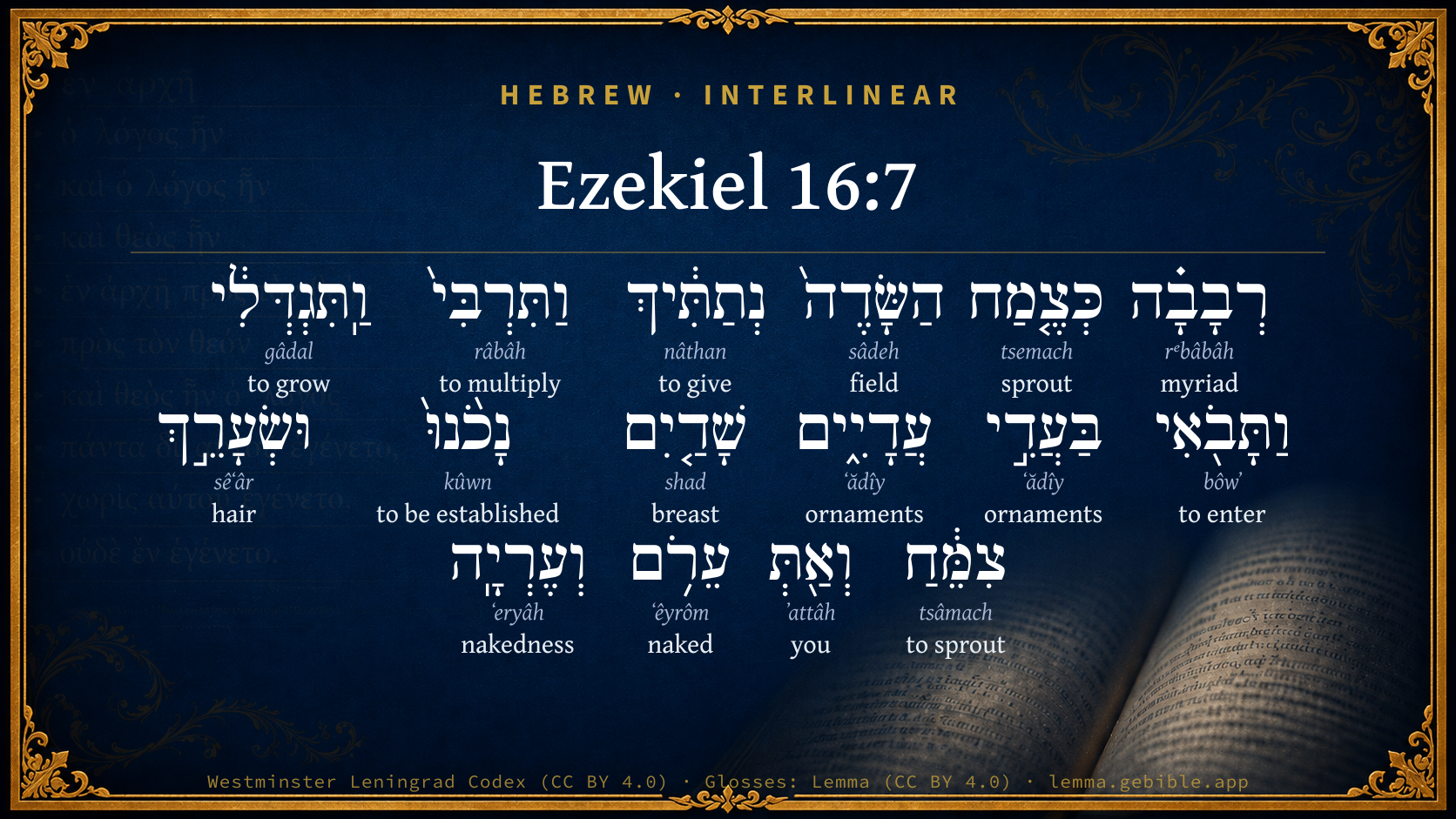
Ezekiel 16:7

Hebrew (Westminster Leningrad Codex) Ezekiel 16:7 appears in the Hebrew Old Testament. The text above is from the Westminster Leningrad Codex. Each word links to its Strong’s number, a concise gloss, and parsing drawn from the Open Scriptures Hebrew Bible morphology. Click any word for its full Brown-Driver-Briggs (BDB) entry.
Download image
Cite this verse

Ezekiel 16:7 (World English Bible). Public Domain. Lemma interlinear Bible study tool, https://lemma.gebible.app/v/ezekiel/16/7.

Show BibTeX & RIS
BibTeX
RIS
English Translation
I caused you to multiply as that which grows in the field, and you increased and grew great, and you attained to excellent ornament; your breasts were fashioned, and your hair was grown; yet you were naked and bare.
World English Bible · Public Domain
Highlights
  • 1 first appearance in the Hebrew Bible
Full analysis ↓
Download a study sheet

One document with this verse’s original text, its word-by-word gloss line, the meaning frame, cross-references with their text, attributed commentary, and full source and license credits — printable, and it pastes into notes with its structure intact.

This verse Autodidact and up

Study sheet (.html) Plain text (.txt)

A passage Seminary Student

Up to 50 verses in one chapter. A passage sheet keeps up to 6 commentary sources and 12 cross-references per verse, in the order this page ranks them, and says so on the sheet whenever that leaves anything out. Ask for a single verse and you get the Autodidact verse sheet above.

Everything on this page stays free to read, with no account — the sheet is a download of what is already on screen, not access to it.

Want to remove ads? Support Godless Engineer
Compare translations 3

The same verse in 3 English versions, stacked beneath the original-language interlinear above. Click any original word for its lexicon entry.

Each is an independent rendering of the whole verse — the interlinear is not word-aligned to these translations.

Highlighted words mark where these versions differ — a whole-verse word diff, not a word-by-word alignment.

  • World English Bible Public Domain
    I caused you to multiply as that which grows in the field, and you increased and grew great, and you attained to excellent ornament; your breasts were fashioned, and your hair was grown; yet you were naked and bare.
  • King James Version Public Domain
    I have caused thee to multiply as the bud of the field, and thou hast increased and waxen great, and thou art come to excellent ornaments: thy breasts are fashioned, and thine hair is grown, whereas thou wast naked and bare.
  • unfoldingWord Literal Text CC BY-SA 4.0
    I made you grow like a plant in a field. You multiplied and became great, and you became the jewel of jewels. Your breasts became firm, and your hair grew thick, though you had been naked and bare.

unfoldingWord Literal Text — © unfoldingWord, licensed CC BY-SA 4.0. Word-aligned USFM3 via Door43 (git.door43.org/unfoldingWord/en_ult).

Versions to compare (up to 4)

3 of 4 selected

Show all 18 translations

Every available English version of this verse, each an independent rendering of the whole verse.

  • World English Bible Public Domain
    I caused you to multiply as that which grows in the field, and you increased and grew great, and you attained to excellent ornament; your breasts were fashioned, and your hair was grown; yet you were naked and bare.
  • Berean Standard Bible Public Domain
    I made you thrive like a plant of the field. You grew up and matured and became very beautiful. Your breasts were formed and your hair grew, but you were naked and bare.
  • Majority Standard Bible Public Domain
    I made you thrive like a plant of the field. You grew up and matured and became very beautiful. Your breasts were formed and your hair grew, but you were naked and bare.
  • King James Version Public Domain
    I have caused thee to multiply as the bud of the field, and thou hast increased and waxen great, and thou art come to excellent ornaments: thy breasts are fashioned, and thine hair is grown, whereas thou wast naked and bare.
  • American Standard Version (1901) Public Domain
    I caused thee to multiply as that which groweth in the field, and thou didst increase and wax great, and thou attainedst to excellent ornament; thy breasts were fashioned, and thy hair was grown; yet thou wast naked and bare.
  • Revised Version (1885) Public Domain
    I caused thee to multiply as the bud of the field, and thou didst increase and wax great, and thou attainedst to excellent ornament; thy breasts were fashioned, and thine hair was grown; yet thou wast naked and bare.
  • Geneva Bible (1599) Public Domain
    I haue caused thee to multiplie as the bud of the fielde, and thou hast increased and waxen great, and thou hast gotten excellent ornaments: thy breastes are facioned, thine heare is growen, where as thou wast naked and bare.
  • Douay-Rheims (1899) Public Domain
    I caused thee to multiply as the bud of the field: and thou didst increase and grow great, and advancedst, and camest to woman's ornament: thy breasts were fashioned, and thy hair grew: and thou wast naked, and full of confusion.
  • Young's Literal Translation Public Domain
    A myriad -- as the shoot of the field I have made thee, And thou art multiplied, and art great, And comest in with an excellent adornment, Breasts have been formed, and thy hair hath grown -- And thou, naked and bare!
  • Literal Standard Version CC BY-SA 4.0
    I have made you a myriad as the shoot of the field, || And you are multiplied, and are great, || And come in with an excellent adornment, || Breasts have been formed, and your hair has grown—And you, naked and bare!
  • Unlocked Literal Bible CC BY-SA 4.0
    I made you grow like a plant in a field. You multiplied and became great, and you became the jewel of jewels. Your breasts became firm, and your hair grew thick, though you had been naked and bare.
  • unfoldingWord Literal Text CC BY-SA 4.0
    I made you grow like a plant in a field. You multiplied and became great, and you became the jewel of jewels. Your breasts became firm, and your hair grew thick, though you had been naked and bare.
  • Darby Bible Public Domain
    I caused thee to multiply, as the bud of the field; and thou didst increase and grow great, and thou camest to fulness of beauty; [thy] breasts were fashioned, and thy hair grew: but thou wast naked and bare.
  • World Messianic Bible Public Domain
    I caused you to multiply as that which grows in the field, and you increased and grew great, and you attained to excellent beauty. Your breasts were formed, and your hair grew; yet you were naked and bare.
  • Webster's Bible Public Domain
    I have caused thee to multiply as the bud of the field, and thou hast increased and become great, and thou art come to excellent ornaments: thy breasts are fashioned, and thy hair is grown, whereas thou wast naked and bare.
  • Free Bible Version CC BY-SA 4.0
    I helped you to grow like a plant in the field. You grew up into a beautiful young woman. Your breasts developed and your body hair grew, and you were completely naked.
  • Bible in Basic English Public Domain
    And be increased in number like the buds of the field; and you were increased and became great, and you came to the time of love: your breasts were formed and your hair was long; but you were uncovered and without clothing.
  • JPS Tanakh (1917) Public Domain
    I cause thee to increase, even as the growth of the field. And thou didst increase and grow up, and thou camest to excellent beauty: thy breasts were fashioned, and thy hair was grown; yet thou wast naked and bare.

Literal Standard Version (2020), Covenant Press — licensed CC BY-SA 4.0. Text via the HelloAO Bible API (eBible.org). Unlocked Literal Bible (unfoldingWord) — licensed CC BY-SA 4.0. Text via the HelloAO Bible API (eBible.org). unfoldingWord Literal Text — © unfoldingWord, licensed CC BY-SA 4.0. Word-aligned USFM3 via Door43 (git.door43.org/unfoldingWord/en_ult). Free Bible Version, Dr. Jonathan Gallagher — licensed CC BY-SA 4.0. Text via the HelloAO Bible API (eBible.org).

Word by word

More ways to search: Search by grammar → Find every occurrence → Compare this word →

Practice this passage: Drill this verse → Learn its vocabulary →

וְעֶרְיָֽה
ʻeryâh
H6181
“and · nakedness”
Conjunction + Noun, Common, Feminine, Singular, Absolute
Part of Speech
Conjunction + Noun
Type
Common
Gender
Feminine
Number
Singular
State
Absolute
Full BDB Definition

Origin: from H6172

TWOT: 1692c

nudity, nakedness
  1. רְבָבָ֗ה rᵉbâbâh H7233 “myriad” Noun, Common, Feminine, Singular, Absolute
  2. כְּצֶ֤מַח tsemach H6780 “like/as · sprout of” Preposition + Noun, Common, Masculine, Singular, Construct
  3. הַשָּׂדֶה֙ sâdeh H7704 “the · field” Particle, Definite Article + Noun, Common, Masculine, Singular, Absolute
  4. נְתַתִּ֔יךְ nâthan H5414 “to give · you” Verb, Qal, Perfect, 1st Person, Common, Singular + Suffix, Personal, 2nd Person, Feminine, Singular
  5. וַתִּרְבִּי֙ râbâh H7235 “and · to multiply” Conjunction + Verb, Qal, Sequential Imperfect, 2nd Person, Feminine, Singular
  6. וַֽתִּגְדְּלִ֔י gâdal H1431 “and · to grow” Conjunction + Verb, Qal, Sequential Imperfect, 2nd Person, Feminine, Singular
  7. וַתָּבֹ֖אִי bôwʼ H935 “and · to enter” Conjunction + Verb, Qal, Sequential Imperfect, 2nd Person, Feminine, Singular
  8. בַּעֲדִ֣י ʻădîy H5716 “in/at · ornaments of” Preposition + Noun, Common, Masculine, Singular, Construct
  9. עֲדָיִ֑ים ʻădîy H5716 “ornaments” Noun, Common, Masculine, Plural, Absolute
  10. שָׁדַ֤יִם shad H7699 “breasts” Noun, Common, Masculine, Dual, Absolute
  11. נָכֹ֨נוּ֙ kûwn H3559 “to be established” Verb, Niphal, Perfect, 3rd Person, Common, Plural
  12. וּשְׂעָרֵ֣ךְ sêʻâr H8181 “and · hair · your” Conjunction + Noun, Common, Masculine, Singular, Construct + Suffix, Personal, 2nd Person, Feminine, Singular
  13. צִמֵּ֔חַ tsâmach H6779 “to sprout” Verb, Piel, Perfect, 3rd Person, Masculine, Singular
  14. וְאַ֖תְּ ʼattâh H859 “and · you” Conjunction + Pronoun, Personal, 2nd Person, Feminine, Singular
  15. עֵרֹ֥ם ʻêyrôm H5903 “naked” Adjective, Adjective, Masculine, Singular, Absolute

About this verse

These counts appear in no published source. They are computed here, from the morphology-tagged text and Lemma’s own curated glosses. What Lemma adds →

16
words
15
distinct lemmas
Prophets
section

Notable vocabulary

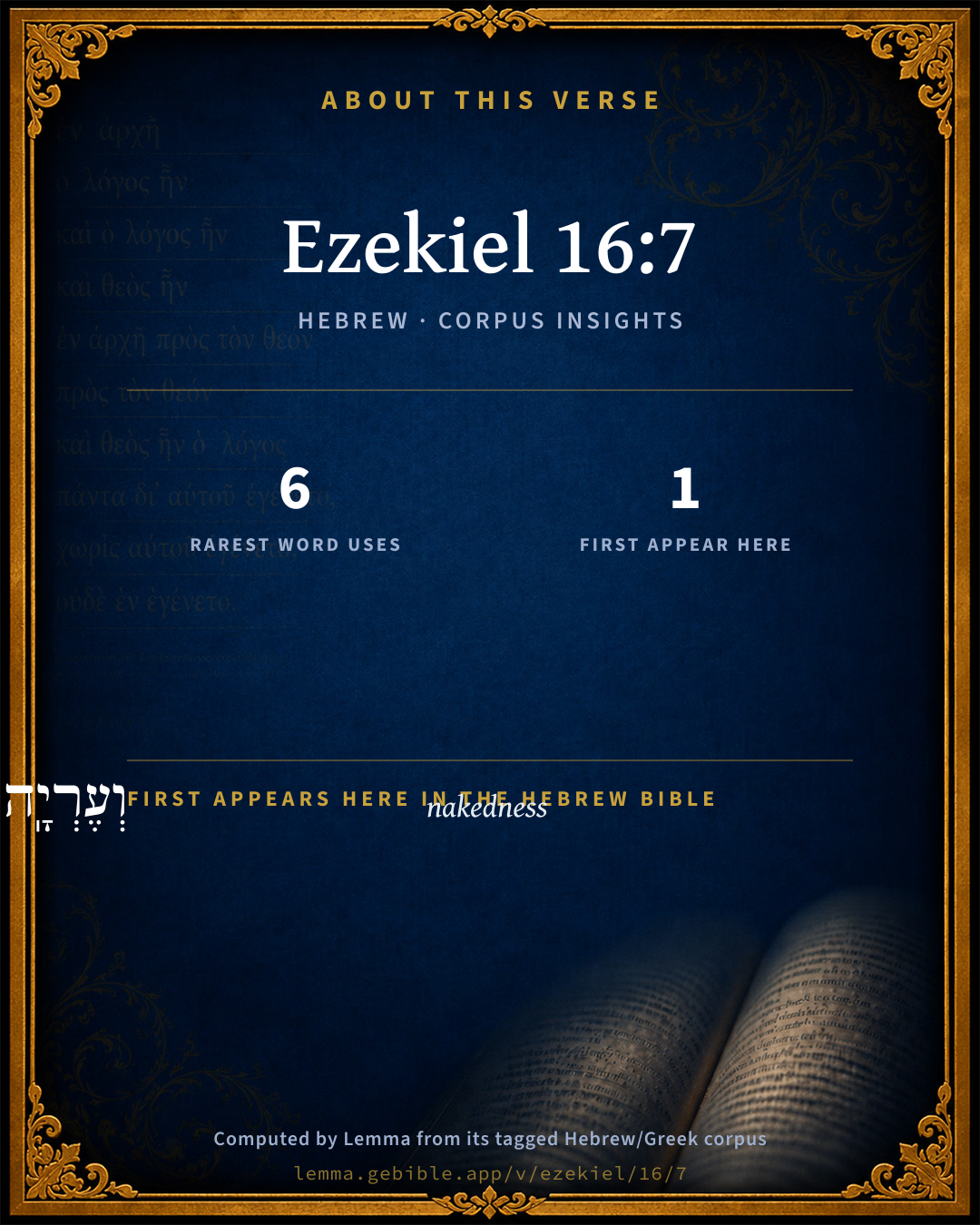
The rarest word here is וְעֶרְיָֽה nakedness H6181 — appearing just 6 times in the whole Hebrew Bible.

First appearance in Scripture

This word makes its first canonical appearance in the Hebrew Bible here:

  • וְעֶרְיָֽה nakedness H6181

Shared distinctive vocabulary

וְעֶרְיָֽה nakedness H6181 occurs in 6 verses of the Hebrew Bible. Also found in:

Grammatical profile

  • 6 verbs
  • 8 nouns
  • 1 adjective
  • 1 pronoun

Verb forms

  • נְתַתִּ֔יךְ Qal · Perfect
  • וַתִּרְבִּי֙ Qal · Sequential Imperfect
  • וַֽתִּגְדְּלִ֔י Qal · Sequential Imperfect
  • וַתָּבֹ֖אִי Qal · Sequential Imperfect
  • נָכֹ֨נוּ֙ Niphal · Perfect
  • צִמֵּ֔חַ Piel · Perfect

Repetition

A word recurs within this verse — often emphatic in Hebrew:

  • בַּעֲדִ֣י ornaments H5716 ×2

Hebrew & Septuagint length

In English translation the verse runs 39 words from the Hebrew and 38 from the Septuagint (LXX English) — closely comparable.

A rough comparison of the two English renderings, which tokenize alike — not a word-level alignment.

Word counts can differ between the Hebrew and the Greek without any difference in meaning — e.g. the Hebrew direct-object marker אֵת has no separate Greek word, and Greek often adds the article ὁ.

Cross-references

24

Topical passages linked to Ezekiel 16:7 in the Treasury of Scripture Knowledge — connected by theme and wording, ordered by reader-vote popularity; previews shown in the World English Bible.

  • Exodus 1:7 The children of Israel were fruitful, and increased abundantly, and multiplied, and grew exceedingly mighty; and the land was filled with them.
  • Deuteronomy 1:10 Yahweh your God has multiplied you, and, behold, you are this day as the stars of the sky for multitude.
  • Isaiah 62:3 You shall also be a crown of beauty in the hand of Yahweh, and a royal diadem in the hand of your God.
  • Ezekiel 16:10–13 I clothed you also with embroidered work, and shod you with sealskin, and I girded you about with fine linen, and covered you with silk.
  • Genesis 22:17 that in blessing I will bless you, and in multiplying I will multiply your seed as the stars of the heavens, and as the sand which is on the seashore. Your seed will possess the gate of his enemies.
  • Exodus 3:22 But every woman shall ask of her neighbor, and of her who visits her house, jewels of silver, jewels of gold, and clothing; and you shall put them on your sons, and on your daughters. You shall despoil the Egyptians.
  • Exodus 12:37 The children of Israel traveled from Rameses to Succoth, about six hundred thousand on foot who were men, besides children.
  • Deuteronomy 4:8 What great nation is there, that has statutes and ordinances so righteous as all this law, which I set before you this day?
  • Deuteronomy 32:10–14 He found him in a desert land, In the waste howling wilderness; He compassed him about, he cared for him, He kept him as the apple of his eye.
  • Deuteronomy 33:26–29 There is none like God, Jeshurun, Who rides on the heavens for your help, In his excellency on the skies.
  • Nehemiah 9:18–25 Yes, when they had made them a molten calf, and said, This is your God who brought you up out of Egypt, and had committed awful blasphemies;
  • Job 1:21 He said, "Naked I came out of my mother's womb, and naked shall I return there. Yahweh gave, and Yahweh has taken away. Blessed be the name of Yahweh."
  • Psalms 135:4 For Yah has chosen Jacob for himself; Israel for his own possession.
  • Psalms 147:20 He has not done this for just any nation. They don't know his ordinances. Praise Yah!
  • Psalms 148:14 He has lifted up the horn of his people, The praise of all his saints; Even of the children of Israel, a people near to him. Praise Yah!
  • Psalms 149:2–4 Let Israel rejoice in him who made them. Let the children of Zion be joyful in their King.
  • Song of Solomon 4:5 Your two breasts are like two fawns That are twins of a roe, Which feed among the lilies.
  • Isaiah 61:10 I will greatly rejoice in Yahweh, my soul shall be joyful in my God; for he has clothed me with the garments of salvation, he has covered me with the robe of righteousness, as a bridegroom decks himself with a garland, and as a bride adorns herself with her jewels.
  • Ezekiel 16:16 You took of your garments, and made for yourselves high places decked with various colors, and played the prostitute on them: [the like things] shall not come, neither shall it be [so].
  • Ezekiel 16:22 In all your abominations and your prostitution you have not remembered the days of your youth, when you were naked and bare, and was weltering in your blood.
  • Hosea 2:3 Lest I strip her naked, And make her bare as in the day that she was born, And make her like a wilderness, And set her like a dry land, And kill her with thirst.
  • Acts 7:17 "But as the time of the promise came close which God had sworn to Abraham, the people grew and multiplied in Egypt,
  • Hosea 2:9–10 Therefore I will take back my grain in its time, And my new wine in its season, And will pluck away my wool and my flax which should have covered her nakedness.
  • Revelation 3:17–18 Because you say, 'I am rich, and have gotten riches, and have need of nothing;' and don't know that you are the wretched one, miserable, poor, blind, and naked;

Cross-references courtesy of OpenBible.info (CC BY 4.0).

Hebrew and Greek witnesses Masoretic Hebrew ↔ Greek Septuagint

The same verse in the two great witnesses to the Old Testament, shown verse-for-verse.

These are two independent witnesses, not word-aligned to each other, and the Septuagint is shown in lemma (dictionary) form.

Hebrew Ezekiel 16:7 Masoretic · Westminster Leningrad Codex

רְבָבָ֗ה כְּצֶ֤מַח הַשָּׂדֶה֙ נְתַתִּ֔יךְ וַתִּרְבִּי֙ וַֽתִּגְדְּלִ֔י וַתָּבֹ֖אִי בַּעֲדִ֣י עֲדָיִ֑ים שָׁדַ֤יִם נָכֹ֨נוּ֙ וּשְׂעָרֵ֣ךְ צִמֵּ֔חַ וְאַ֖תְּ עֵרֹ֥ם וְעֶרְיָֽה

I caused you to multiply as that which grows in the field, and you increased and grew great, and you attained to excellent ornament; your breasts were fashioned, and your hair was grown; yet you were naked and bare.

World English Bible · Public Domain

Greek LXX Ezekiel 16:7 Septuagint · lemma form

πληθύνω καθώς ὁ ἀνατολή ὁ ἀγρός δίδωμι σύ καί πληθύνω καί μεγαλύνω καί εἰςἔρχομαι εἰς πόλις πόλις ὁ μαστός σύ ἀναὀρθόω καί ὁ θρίξ σύ ἀνατέλλω σύ δέ εἰμί γυμνός καί ἀσχημονέω

increase; I have made you as the springing grass of the field. So you did increase and grow, and did enter into great cities: your breasts were set, and your hair grew, whereas you were naked and bare.

LXX2012 (modern English Septuagint) · Public Domain

On this verse, The Cambridge Bible for Schools and Colleges discusses the Septuagint’s reading. Read the note in Commentary ↓

Hebrew: Westminster Leningrad Codex (CC BY 4.0). Greek: Septuagint (public domain); English from LXX2012 (modern English Septuagint) (Public Domain). How the Septuagint differs from the Hebrew →

Targum (Aramaic paraphrase)

1

The Targum is the ancient Jewish Aramaic paraphrase of the Hebrew Scriptures — an interpretive translation, not the Hebrew text itself. Onkelos (literal) and Pseudo-Jonathan (expansive) render the Torah, and Jonathan the Prophets. Coverage is partial: where no permissively-licensed English translation exists for a verse, only the Aramaic is shown. This is verse-level text, not a word-by-word alignment to the Hebrew.

  1. Targum Jonathan Prophets (Joshua–Malachi)
    רִבְבַת כְּצִימְחֵי חַקְלָא יְהַבְתִּיכוֹן וּסְגֵיתוּן וּתְקֵיפְתּוּן וַהֲוֵיתוּן לְזַרְעִין וּלְשִׁבְטִין וּכְעוֹבָדֵי אֲבָהַתְכוֹן תַּקָנַיָא עִידַן פּוּרְקַן כְּנִישַׁתְכוֹן מְטָא אֲרֵי אַתּוּן מְשַׁעְבְּדִין וּמְעַנָן:

    Myriad like the plants of the field I made you, and you increased and strengthened, and became families and tribes, and by the upright works of your ancestors the time to liberate your congregation had arrived, for you were enslaved and afflicted.

    Targum Jonathan — Aramaic: “Mikraot Gedolot” (public domain). English: “Sefaria Community Translation” (CC0 1.0 (public-domain dedication)); “London "Chaldee Paraphrase," 1871” (public domain). Text via Sefaria.

Commentary

Notes on Ezekiel 16:7 from classic Christian and Jewish commentators (each source and its license shown beneath its notes). The classic Christian expositions comment on the surrounding passage and are grouped to its opening verse, so a note may address several verses; the Jewish commentaries on the Tanakh (Rashi and others) are per-verse, so they appear only where the commentator wrote on this verse.

Lemma curates 59 commentaries, every one of them public domain or Creative Commons licensed, each selected and text-cleaned for this edition rather than reprinted as found. About our sources →

Trapp's Complete Commentary

John Trapp

Eze 16:7 I have caused thee to multiply as the bud of the field, and thou hast increased and waxen great, and thou art come to excellent ornaments: [thy] breasts are fashioned, and thine hair is grown, whereas thou [wast] naked and bare.

Ver. 7. As the bud of the field.] He prosecuteth the allegory of a miserable maiden, with whom the matter beginneth to mend. Iam enim menses patiebatur, ubera creverant et pili circa pubem; so that now she was marriageable.

And thou art come to excellent ornaments.] Heb., To ornaments of ornaments, such as virgo nobilis, cum iam est nubilis, habet, young ladies have, when grown up especially.

Whereas thou wast naked and bare.] Heb., Nakedness and rejection. God looked upon us and loved us, whenas yet we had not a rag to our backs. Cum tu nuda esses, argue nudissima.

John Trapp, A Commentary or Exposition upon All the Books of the Old and New Testament (1647–1656) — public domain. Text from a community e-Sword module.

Jamieson, Fausset & Brown

Robert Jamieson, A. R. Fausset & David Brown

caused . . . to multiply--literally, "I . . . made thee a myriad."

bud of . . . field--the produce of the field. In two hundred fifty years they increased from seventy-five persons to eight hundred thousand (Act 7:14) [CALVIN]. But see Exo 12:37-38.

excellent ornaments--literally, "ornament of ornaments."

naked . . . bare-- (Hos 2:3). Literally, "nakedness . . . bareness" itself; more emphatic.

Jamieson, Fausset & Brown — Commentary Critical and Explanatory on the Whole Bible (1871) — public domain (CC PDM 1.0). Text via the HelloAO Bible API.

John Calvin's Commentaries

Here what I lately touched upon is now clearly expressed, that the people in their extreme distress were not only safe, but increased by God’s singular favor. For if the infant after exposure retains its life, it will still be a weak abortion. Hence God here by this circumstance magnifies his favor, since the people increased as if it had been properly and attentively cared for, and as if no kind office had been omitted. This is the meaning of the words they were increased; for though he looks to the propagation of Abraham’s family, yet the simile is to be observed, for the people is compared to a girl exposed in a field from its birth, and their growth took place when God increased them so incredibly, as we know. And surely God’s blessing was great when they entered Egypt, 75 in number, and were many thousands when they left it. (Acts 7:14; Exodus 12:37.) For within 250 years, the family of Abraham was so multiplied, that they amounted to 800,000 when God freed them. But since the Prophet speaks metaphorically, when he says the people were increased, and, under the image of a tender girl, until they grew up to a proper age; meanwhile he shows that this was done only by the wonderful counsel and power of God. I placed thee, says he. God claims to himself the praise for this great multiplication, and then strengthens what I have said, namely, that the people’s safety was included in that phrase live in bloods: then he says, she came into ornament of ornaments. Here עדי, gnedi, cannot mean any occasional ornament, since it is added directly, thou wast naked and bare. It follows then that it refers to personal comeliness. It means not only that the girl grew in loftiness of stature but in beauty of person. Hence elegance and loveliness are here marked, as the context shows us. Thou camest then to excellent or exquisite beauty, for we know this to be the meaning of the genitive, signifying excellence. He adds at the same time, thy breasts were made ready, for כון, kon, means to prepare, to strengthen: but as he is speaking of breasts, I have no doubt that he means them to have swelled as they ought to do. Thy breasts then were fashioned, that is, of the right size, as in marriageable girls. Thy hair also grew long. Finally, the Prophet expresses thus grossly what he could have said more concisely, in consequence of the people’s rudeness. Thy hair grew long, whilst thou wast naked and bare; that is, as yet you had no outward ornament, you was like a marriageable girl — you had great beauty of person, a noble stature, and all parts of thy body mutually accordant, but you had cause to be ashamed of thy nakedness. And such was the condition of the people since the Egyptians devised everything against them, and conspired by all means for their destruction: we see then how God stretched forth his hand not only for the people’s defense, but to carry them forth against the tyranny of Pharaoh and of all Egypt. He points out the time of their redemption as near, because the people had increased and multiplied, just like a girl who had reached her twentieth year. Now it follows —

John Calvin's Commentaries (1540-1563) — public domain. Text from the Calvin Translation Society English edition (1840s-50s) via the Christian Classics Ethereal Library (ccel.org). Calvin's coverage is partial (roughly two-thirds of the Bible); uncommented books and verses are honest gaps, never fabricated. The 19th-century editor's footnotes and remarks are omitted so the notes are faithfully Calvin's own voice.

Ellicott's Commentary for English Readers

(7) I have caused thee.—Omit the “have,” and modify the tenses throughout the verse. “I caused thee . . . thou didst increase and wax tall . . . and came to beauty . . . were fashioned . . . was grown.” In the first clause, “caused thee to multiply,” the literal sense takes the place of the figurative; but the rest of the verse describes Israel as a young woman just growing up into the beauty of early womanhood. The phrase “excellent ornaments” is somewhat difficult; but is now generally understood as meaning literally “ornament of cheeks,” i.e., beauty. The whereas in the last clause may give the impression of a contrast between the state described and the former one of infancy; this is not intended. But the meaning is, that while Israel was thus growing into the full development and beauty of womanhood, she was still “naked and bare.”

A Bible Commentary for English Readers, edited by Charles John Ellicott (1878–1897) — public domain. Text from a community e-Sword module.

The Cambridge Bible for Schools and Colleges

gen. ed. J. J. S. Perowne

7. have caused … multiply] Lit. as marg. made thee a myriad. This idea of multiplication in number deserts the figure, introducing the notion of the numerical increase of the people (Exo_1:7; Deu_10:22; Deu_33:17). The rest of the verse, however, continues the figure of the child growing up to womanhood. For “myriad” LXX. has “do thou grow” (imper.). This is not natural, but probably some word signifying “growth” should be read, “I gave thee growth like the herb of the field; and thou didst grow and wax great.”

thou art come … ornaments] Thou didst come to excellent ornament, lit. ornament of ornaments. The connexion requires that “ornament” should mean graces and beauties of the person. The word has nowhere else this sense, being always employed of such ornaments as jewelry which are worn (Eze_16:11). The rendering “beauty of cheeks” (Hitz.) rests upon the supposed sense of Psa_32:9; Psa_103:5. In Isa_64:6 a word somewhat similar occurs: filthy (i.e. menstruous) garment, and several scholars (J. D. Michaelis, Cornill) assume this sense here. This requires considerable alteration of the text, which already lay before LXX. (though r was read for d, as often). Neither is Eze_16:22 in favour of it.

are fashioned] Better past tenses: were fashioned … was grown, but thou wast.

The passage is an allegorical description of the early history of the family of Israel, their struggles for existence in Canaan, their descent into Egypt, the oppressions suffered there, and the Lord’s care and protection of them (Exo_3:7; Exo_3:9; Psa_105:12 seq.). The unattractive character of the early patriarchal history as written in Genesis is plain enough (Genesis 29-31, 38.). This unattractive character is set forth in the blood and pollution of the new-born infant, and the Lord’s care of them in their dependent and defenceless condition under the figure of his pity and adoption of the outcast child. The truth conveyed in the allegory is more delicately expressed by another writer: “The Lord did not set his love upon you, nor choose you, because ye were more in number than any people; for ye were the fewest of all peoples; but because the Lord loved you” (Deu_7:7-8).

The Cambridge Bible for Schools and Colleges (gen. ed. J. J. S. Perowne; Cambridge University Press, 1878–1918) — public domain. Text from a community e-Sword module.

John Gill's Exposition

Now when I passed by thee, and looked upon thee,.... Which the Targum refers to the Lord's appearance to Moses in the bush; See Gill on Eze 16:6;

behold, thy time was the time of love; which the Targum explains of the time of redemption of the people of Israel out of Egypt, which was an instance of the great love of God unto that people; and which time was fixed by him; and when it was come, at the exact and precise time, the redemption was wrought; see Gen 15:13; and so there is a set time for the calling and conversion of God's elect, who are therefore said to be called according to purpose; and, when that time comes, all means are made to concur to bring it about: and this is a time of love; for though the love of God to his people is before all time, yet it is manifested in time; and there are particular times in which it is expressed unto them; and the time of conversion is one of them; and indeed it is the first time that there is a manifestation and application of the love of God made to the souls of his people: and this is a "time of loves" (o); as it is in the original text; denoting the large abundance of it which is now shown forth; and the various acts of it now done; as bringing of them out of a most miserable condition, out of a horrible pit; plucking them as brands out of the burning; quickening them when dead in sin; speaking comfortably to them, and applying pardoning grace and mercy to their souls: and it may include both the love of God to his people, and their love to him; for now is the love of their espousals, and the kindness of their youth, Jer 2:2; the grace of love is now implanted, to God and Christ, to his people, word, worship, and ordinances, which before had no place in them:

and I spread my skirt over thee, and covered thy nakedness; the Lord espoused the people of Israel to himself in the wilderness, after he had brought them out of Egypt, and took them under the wings of his protection; both which this phrase may be expressive of; see Rut 3:9. Some understand this of his giving them the spoils of the Egyptians, and also the law: it may very well be applied to the righteousness of Christ, which is often compared to a garment, for which the skirt, a part, is put; and this is put on as a garment, and answers all the purposes of one; and particularly covers the nakedness of men, which their own righteousness will not do; this the Lord spreads over his people, and covers them with; and being clothed with this, they shall not be found naked:

yea, I sware unto thee; to his love expressed to his people, and to his covenant he entered into with them, neither of which shall ever be removed; and this makes to their abundant comfort; see Psa 89:3;

and entered into covenant with thee, saith the Lord God; as he did with the people of Israel at Horeb, and which was a sort of a marriage contract with them; see Deu 29:1; the covenant of grace was made from everlasting with Christ, and the elect in him; but is made manifest at conversion, when the Lord makes himself known unto them as their covenant God; leads them to Christ the Mediator of it; sends his Spirit down into their hearts, to make them partakers of the grace of it; and shows them their interest in the blessings and promises of it; all which may be meant by the phrase here used:

and thou becamest mine; as Israel did at the time before mentioned, became the Lord's peculiar people, and were avouched as such by him, Exo 19:5; so, in conversion, those who before were secretly the Lord's by electing and redeeming grace, become openly his by calling and sanctifying grace.

(o) "tempus amorum", Pagninus, Montanus, Junius & Tremellius, Polanus, Piscator, Cocceius, Starckius.

John Gill's Exposition of the Whole Bible (1746–1763) — public domain (CC PDM 1.0). Text via the HelloAO Bible API.

Albert Barnes' Notes on the Bible

I caused “thee to multiply as the bud of the field, and thou” didst increase “and” wax “great, and thou” didst come “to excellent” beauty; “thy breasts” were “fashioned and thine hair” was grown, yet wast “thou naked and bare.” The prophet has arrived at the time at which the child grew up to maturity. God preserved the life of the infant which must without His help have died Eze 16:6; and the child grew up to womanhood, but was still desolate and unprotected. This represents the sojourn in Egypt, during which the people increased, but were not bound, as a nation, to God by a covenant.

Excellent ornaments - literally, as in the margin. Some render it: “ornament of cheeks,” i. e., beauty of face.

Albert Barnes' Notes on the Bible (1834–1885) — public domain. Text from a community e-Sword/MySword module.

Haydock's Catholic Bible Commentary

CHAPTER XVI.

Woman’s. Hebrew, "the ornament of ornaments;" hadaiim instead of harim in Septuagint, "the city of cities," (Calmet) or the highest glory, being arrived at that age when decorations are most sought after. --- Fashioned. Literally, "swelling." Septuagint, "erect." (Haydock) --- Hair, (pilus.) Women are allowed by canon law to marry at twelve. (Calmet)

George Leo Haydock (1774–1849), Haydock's Catholic Family Bible and Commentary, 1859 edition — public domain. Excludes Psalms (Douay-Rheims chapter numbering differs from Protestant) and Deuterocanonical books (Catholic canon only).

Matthew Poole's English Annotations

The Lord, who chose Abraham and his seed; by his blessing this people were increased as by millions. How inconsiderable is a clan of seventy-five persons! So many went with Jacob into Egypt, where in two hundred and fifty years they grew to six hundred and three thousand five hundred and fifty, beside women, and children under twenty years, and old men above sixty years old. So the promise, Gen 12:2; 15:5; 17:2,4, was fulfilled.

As the bud of the field: for multitude, they are compared to the numberless buds of the herb; for flourishing, they are like the bud in the beauty of its spring; and both include the goodness and richness of the land they dwelt in.

Increased; grown up to maturity or full age.

Waxen great; and in stature thou hast come to full, just proportions, or grown strong, mighty, and terrible to thy neighbours who were enemies, but honourable and a defence to thy friends.

Come to excellent ornaments: as jewels and rich vestments set off a beautiful person, so the successes in enterprises, rich returns in merchandise, fruitfulness of the country itself, were the lustre of thy beauty, which all thy neighbours courted; thou wast adorned with the choicest blessings of Divine Providence.

Thy breasts are fashioned: the prophet further describes the beauty and glory of the Jewish nation, grown up and fashioned under God’s own hand, in order to be solemnly affianced to God.

Thine hair, which is an ornament when well set, whereas baldness is a deformity.

Thou wast naked and bare, i.e. when in Egypt, poor, and oppressed, and despised.

Matthew Poole's English Annotations on the Holy Bible (1683–1685) — public domain. Text from a community e-Sword/MySword module.

Whedon's Commentary on the Bible

Daniel D. Whedon

7. I have caused thee to multiply — Literally, I have made thee to be myriads, etc. (Exo_1:7; Deu_10:22; Deu_33:17.)

To excellent ornaments — Literally, to ornament of ornaments; to superlative grace and beauty.

Thy breasts are fashioned,… whereas — Literally, thy breasts were fashioned,… yet. This is a vivid description in allegory of the patriarchal history and the bondage in Egypt. The nation was coming to maturity under the watch-care of the divine Friend, and yet was persisting in its idolatry (Genesis 29-31, 38).

Daniel D. Whedon (gen. ed.), Commentary on the Old and New Testaments (1874–1909) — public domain. Text from a community e-Sword module.

The Pulpit Commentary

The tenses should be in the simple historic past: I caused; thou didst increase and wax great; thou attainedst, and so on (Revised Version). In the word "multiply" (Exo_1:7) the figure passes into historical reality. To excellent ornaments; Hebrew, to ornament of ornaments. The word is commonly used of jewels, trinkets, and the like. (Exo_33:4; 2Sa_1:24; Isa_49:18) So Vulgate, mundus muliebris. Here, however, the external adorning comes in vers. 10, 11, and instead of the plural we have the dual. Hitzig is, perhaps, right in taking the phrase to refer to tide beauty of the cheeks, which are themselves the ornaments of the golden prime of wroth. The LXX, following either a different reading or paraphrasing, gives, "to cities of cities." The two clauses that fellow point to the most obvious signs of female puberty. For whereas, read, with the Revised Version, yet, etc., as describing, not as the Authorized Version seems to do, a state which trod passed away, but one which still continued even when full-grown girlhood would have demanded clothing.

The Pulpit Commentary (1880–1919), ed. H.D.M. Spence-Jones & Joseph S. Exell — public domain. Text from a community e-Sword module.

John Wesley's Explanatory Notes

Thou art come - Thou wast adorned with the choicest blessings of Divine Providence. Thy breasts - Grown up and fashioned under God's own hand in order to be solemnly affianced to God.

John Wesley, Explanatory Notes Upon the Whole Bible (1754–1765) — public domain. Text via the GEBible commentary corpus.

Rashi

Rabbi Shlomo Yitzchaki (Rashi)

with perfect beauty Heb. בַּעֲדִי עֲדָיִם, [a form] expressing perfection. But Menachem (p. 131) explained בַּעֲדִי עֲדָיִם as related to the word עַד, eternity, as (Isa. 26:4): “Trust in the Lord forever (עֲדֵי עַד)”; enjusque a s(i)egle in Old French, to eternity [lit. for centuries]. Dunash (p. 83), however, interpreted it as a word for ornaments. The declension of עַדִי עֲדָיִם is one of the ten nouns: lion, lions (אֲרִי אֲרָיִם); deer [sing.], deer [pl.] (צְבִי צְבָיִם); kid, kids (גְדִי גְּדָיִם).

fashioned Heb. נָכֹנוּ, furent efeties in Old French, were fashioned, developed.

and your hair grown Signs of puberty.

Rashi on the Tanakh — English translations: “The Judaica Press complete Tanach with Rashi, translated by A. J. Rosenberg” (CC BY 4.0); “Pentateuch with Rashi's commentary by M. Rosenbaum and A.M. Silbermann, 1929-1934” (public domain); “The Metsudah Tanach series, Lakewood, N.J” (CC BY 4.0); and “The Book of Joshua, Metsudah Publications, 1997” (CC BY 4.0). Text via Sefaria.

Lesson kit

Teaching starters — assembled from the data on this page, not authored interpretation. Every prompt links to the verse data it draws on. Edit before teaching.

Ezekiel, in the Prophets, opens this verse with 16 words (15 distinct Hebrew lemmas). Its most distinctive word is ʻeryâh (“nakedness”). A historical commentator’s framing appears above. Read the whole chapter for the surrounding context.

Discussion questions

  1. How does “nakedness” (ʻeryâh) shape what this verse is saying?
  2. This is the first place “nakedness” appears in Scripture (first appears here). What does its debut here establish?
  3. How does Ezekiel 16:22, which shares the word «nakedness», read alongside this verse?
  4. What does the repetition of “ornaments” (2× in this one verse) do in this verse?
  5. These translations render this verse differently. What is at stake in choosing one wording over another?
  6. «נְתַתִּ֔יךְ» is a Qal Perfect verb. How does that grammatical form shape the action described?
  7. Compare how Trapp's Complete Commentary and Jamieson, Fausset & Brown read this verse. Where do they agree or differ?

Things to notice

  • 1 word makes its first canonical appearance in Scripture here.
  • These translations choose different wording for 31 words in this verse.
  • “ornaments” occurs 2× in this single verse.
  • 15 distinct Hebrew lemmas span 16 words in this verse.

Reading settings

Reading text

Shown beneath each verse's original-language words.

Old Testament
Old Testament edition

Read the OT as the Masoretic Hebrew (MT) or the Greek Septuagint (LXX).

English shown for the Greek Septuagint (in the Hebrew ↔ Greek comparison).

Comparing translations? Open the Compare panel on any verse page to stack up to four side by side.