
Ecclesiastes 11:8

Hebrew (Westminster Leningrad Codex) Ecclesiastes 11:8 appears in the Hebrew Old Testament. The text above is from the Westminster Leningrad Codex. Each word links to its Strong’s number, a concise gloss, and parsing drawn from the Open Scriptures Hebrew Bible morphology. Click any word for its full Brown-Driver-Briggs (BDB) entry.
Download image
Cite this verse

Ecclesiastes 11:8 (World English Bible). Public Domain. Lemma interlinear Bible study tool, https://lemma.gebible.app/v/ecclesiastes/11/8.

Show BibTeX & RIS
BibTeX
RIS
English Translation
Yes, if a man lives many years, let him rejoice in them all; But let him remember the days of darkness, for they shall be many. All that comes is vanity.
World English Bible · Public Domain
Download a study sheet

One document with this verse’s original text, its word-by-word gloss line, the meaning frame, cross-references with their text, attributed commentary, and full source and license credits — printable, and it pastes into notes with its structure intact.

This verse Autodidact and up

Study sheet (.html) Plain text (.txt)

A passage Seminary Student

Up to 50 verses in one chapter. A passage sheet keeps up to 6 commentary sources and 12 cross-references per verse, in the order this page ranks them, and says so on the sheet whenever that leaves anything out. Ask for a single verse and you get the Autodidact verse sheet above.

Everything on this page stays free to read, with no account — the sheet is a download of what is already on screen, not access to it.

Want to remove ads? Support Godless Engineer
Compare translations 3

The same verse in 3 English versions, stacked beneath the original-language interlinear above. Click any original word for its lexicon entry.

Each is an independent rendering of the whole verse — the interlinear is not word-aligned to these translations.

Highlighted words mark where these versions differ — a whole-verse word diff, not a word-by-word alignment.

  • World English Bible Public Domain
    Yes, if a man lives many years, let him rejoice in them all; But let him remember the days of darkness, for they shall be many. All that comes is vanity.
  • King James Version Public Domain
    But if a man live many years, and rejoice in them all; yet let him remember the days of darkness; for they shall be many. All that cometh is vanity.
  • unfoldingWord Literal Text CC BY-SA 4.0
    For if the man will live many years, in all of them let him rejoice. But let him remember the days of darkness, that they will be many. Everything that is coming vapor.

unfoldingWord Literal Text — © unfoldingWord, licensed CC BY-SA 4.0. Word-aligned USFM3 via Door43 (git.door43.org/unfoldingWord/en_ult).

Versions to compare (up to 4)

3 of 4 selected

Show all 18 translations

Every available English version of this verse, each an independent rendering of the whole verse.

  • World English Bible Public Domain
    Yes, if a man lives many years, let him rejoice in them all; But let him remember the days of darkness, for they shall be many. All that comes is vanity.
  • Berean Standard Bible Public Domain
    So if a man lives many years, let him rejoice in them all. But let him remember the days of darkness, for they will be many. Everything to come is futile.
  • Majority Standard Bible Public Domain
    So if a man lives many years, let him rejoice in them all. But let him remember the days of darkness, for they will be many. Everything to come is futile.
  • King James Version Public Domain
    But if a man live many years, and rejoice in them all; yet let him remember the days of darkness; for they shall be many. All that cometh is vanity.
  • American Standard Version (1901) Public Domain
    Yea, if a man live many years, let him rejoice in them all; but let him remember the days of darkness, for they shall be many. All that cometh is vanity.
  • Revised Version (1885) Public Domain
    Yea, if a man live many years, let him rejoice in them all; but let him remember the days of darkness, for they shall be many. All that cometh is vanity.
  • Geneva Bible (1599) Public Domain
    Though a man liue many yeeres, and in them all he reioyce, yet hee shall remember the daies of darkenesse, because they are manie, all that commeth is vanitie.
  • Douay-Rheims (1899) Public Domain
    If a man live many years, and have rejoiced in them all, he must remember the darksome time, and the many days: which when they shall come, the things past shall be accused of vanity.
  • Young's Literal Translation Public Domain
    But, if man liveth many years, In all of them let him rejoice, And remember the days of darkness, For they are many! all that is coming `is' vanity.
  • Literal Standard Version CC BY-SA 4.0
    But if man lives many years, || In all of them let him rejoice, || And remember the days of darkness, || For they are many! All that is coming [is] vanity.
  • Unlocked Literal Bible CC BY-SA 4.0
    If someone lives many years, let him be happy in all of them, but let him think about the coming days of darkness, for they will be many. Everything to come is vanishing vapor.
  • unfoldingWord Literal Text CC BY-SA 4.0
    For if the man will live many years, in all of them let him rejoice. But let him remember the days of darkness, that they will be many. Everything that is coming vapor.
  • Darby Bible Public Domain
    but if a man live many years, [and] rejoice in them all, yet let him remember the days of darkness; for they shall be many: all that cometh is vanity.
  • World Messianic Bible Public Domain
    Yes, if a man lives many years, let him rejoice in them all; but let him remember the days of darkness, for they shall be many. All that comes is vanity.
  • Webster's Bible Public Domain
    But if a man shall live many years, and rejoice in them all; yet let him remember the days of darkness; for they shall be many. All that cometh is vanity.
  • Free Bible Version CC BY-SA 4.0
    May you live for many years, and may you enjoy them all. But remember there will be many days of darkness, and all that is to come is uncertain.
  • Bible in Basic English Public Domain
    But even if a man's life is long and he has joy in all his years, let him keep in mind the dark days, because they will be great in number. Whatever may come is to no purpose.
  • JPS Tanakh (1917) Public Domain
    For if a man live many years, let him rejoice in them all, and remember the days of darkness, for they shall be many. All that cometh is vanity.

Literal Standard Version (2020), Covenant Press — licensed CC BY-SA 4.0. Text via the HelloAO Bible API (eBible.org). Unlocked Literal Bible (unfoldingWord) — licensed CC BY-SA 4.0. Text via the HelloAO Bible API (eBible.org). unfoldingWord Literal Text — © unfoldingWord, licensed CC BY-SA 4.0. Word-aligned USFM3 via Door43 (git.door43.org/unfoldingWord/en_ult). Free Bible Version, Dr. Jonathan Gallagher — licensed CC BY-SA 4.0. Text via the HelloAO Bible API (eBible.org).

Word by word

More ways to search: Search by grammar → Find every occurrence → Compare this word →

Practice this passage: Drill this verse → Learn its vocabulary →

הָֽבֶל
hebel
H1892
“vapor”
Noun, Common, Masculine, Singular, Absolute
Part of Speech
Noun
Type
Common
Gender
Masculine
Number
Singular
State
Absolute
Full BDB Definition

Origin: from H1891

TWOT: 463a

vapour, breath - breath, vapour - vanity (figuratively) - vainly
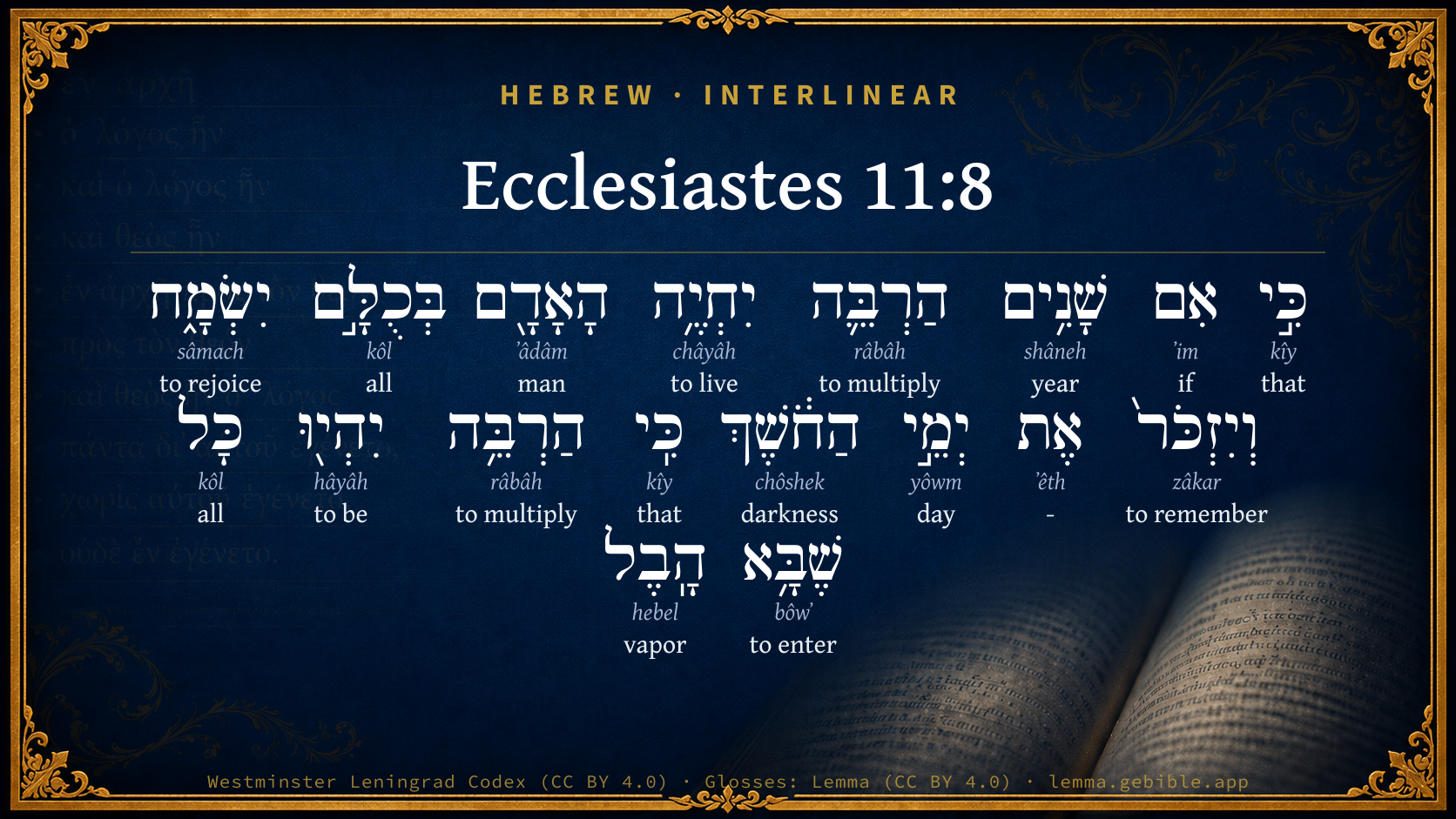
  1. כִּ֣י kîy H3588 “that” Conjunction
  2. אִם ʼim H518 “if” Conjunction
  3. שָׁנִ֥ים shâneh H8141 “years” Noun, Common, Feminine, Plural, Absolute
  4. הַרְבֵּ֛ה râbâh H7235 “to multiply” Verb, Hiphil, Infinitive Absolute
  5. יִחְיֶ֥ה châyâh H2421 “to live” Verb, Qal, Imperfect, 3rd Person, Masculine, Singular
  6. הָאָדָ֖ם ʼâdâm H120 “the · man” Particle, Definite Article + Noun, Common, Masculine, Singular, Absolute
  7. בְּכֻלָּ֣ם kôl H3605 “in/at · all · their” Preposition + Noun, Common, Masculine, Singular, Construct + Suffix, Personal, 3rd Person, Masculine, Plural
  8. יִשְׂמָ֑ח sâmach H8055 “to rejoice” Verb, Qal, Jussive, 3rd Person, Masculine, Singular
  9. וְיִזְכֹּר֙ zâkar H2142 “and · to remember” Conjunction + Verb, Qal, Jussive, 3rd Person, Masculine, Singular
  10. אֶת ʼêth H853 “-” Particle, Direct Object
  11. יְמֵ֣י yôwm H3117 “days of” Noun, Common, Masculine, Plural, Construct
  12. הַחֹ֔שֶׁךְ chôshek H2822 “the · darkness” Particle, Definite Article + Noun, Common, Masculine, Singular, Absolute
  13. כִּֽי kîy H3588 “that” Conjunction
  14. הַרְבֵּ֥ה râbâh H7235 “to multiply” Verb, Hiphil, Infinitive Absolute
  15. יִהְי֖וּ hâyâh H1961 “to be” Verb, Qal, Imperfect, 3rd Person, Masculine, Plural
  16. כָּל kôl H3605 “all” Noun, Common, Masculine, Singular, Absolute
  17. שֶׁבָּ֥א bôwʼ H935 “who/which · to enter” Particle, Relative + Verb, Qal, Perfect, 3rd Person, Masculine, Singular

About this verse

These counts appear in no published source. They are computed here, from the morphology-tagged text and Lemma’s own curated glosses. What Lemma adds →

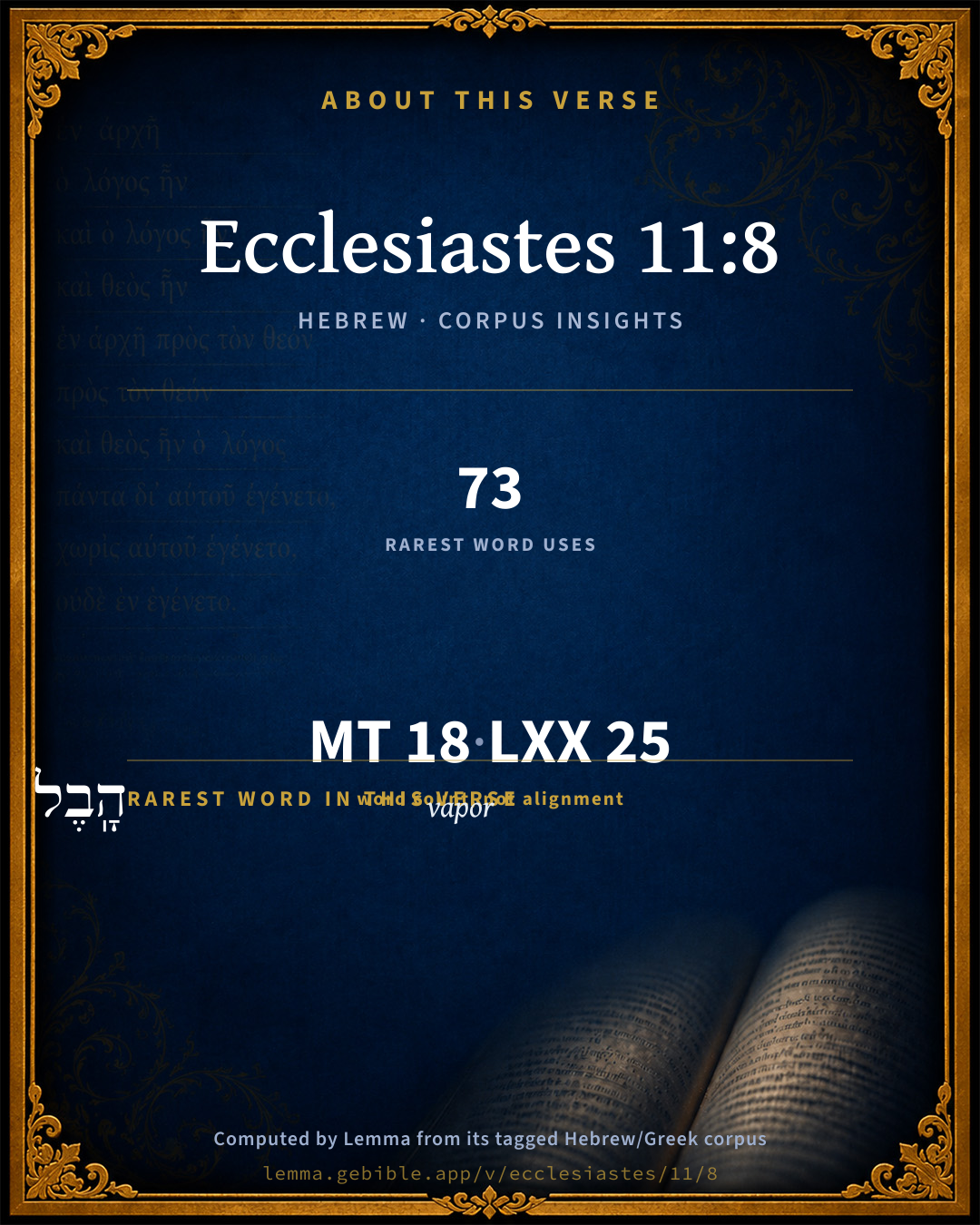
18
words
15
distinct lemmas
Wisdom
section

Grammatical profile

  • 7 verbs
  • 7 nouns
  • 3 conjunctions
  • 1 particle

Verb forms

  • הַרְבֵּ֛ה Hiphil · Infinitive Absolute
  • יִחְיֶ֥ה Qal · Imperfect
  • יִשְׂמָ֑ח Qal · Jussive
  • וְיִזְכֹּר֙ Qal · Jussive
  • הַרְבֵּ֥ה Hiphil · Infinitive Absolute
  • יִהְי֖וּ Qal · Imperfect
  • שֶׁבָּ֥א Qal · Perfect

Repetition

Words recur within this verse — often emphatic in Hebrew:

  • הַרְבֵּ֛ה to multiply H7235 ×2
  • בְּכֻלָּ֣ם all H3605 ×2
  • כִּ֣י that H3588 ×2

Hebrew & Septuagint length

In English translation the verse runs 31 words from the Hebrew and 32 from the Septuagint (LXX English) — closely comparable.

A rough comparison of the two English renderings, which tokenize alike — not a word-level alignment.

Word counts can differ between the Hebrew and the Greek without any difference in meaning — e.g. the Hebrew direct-object marker אֵת has no separate Greek word, and Greek often adds the article ὁ.

In the original languages it is 18 Hebrew tokens and 25 Greek tokens — but the two are counted differently (Hebrew bundles its prefixes and suffixes into one token; the Greek is in lemma form), so that isn’t a like-for-like length.

Cross-references

27

Topical passages linked to Ecclesiastes 11:8 in the Treasury of Scripture Knowledge — connected by theme and wording, ordered by reader-vote popularity; previews shown in the World English Bible.

  • John 12:35 Jesus therefore said to them, "Yet a little while the light is with you. Walk while you have the light, that darkness doesn't overtake you. He who walks in the darkness doesn't know where he is going.
  • Deuteronomy 32:29 Oh that they were wise, that they understood this, That they would consider their latter end!
  • Ecclesiastes 7:14 In the day of prosperity be joyful, and in the day of adversity consider; yes, God has made the one side by side with the other, to the end that man should not find out anything after him.
  • Joel 2:2 A day of darkness and gloominess, A day of clouds and thick darkness. As the dawn spreading on the mountains, A great and strong people; There has never been the like, Neither will there be any more after them, Even to the years of many generations.
  • Job 14:10 But man dies, and is laid low. Yes, man gives up the spirit, and where is he?
  • Ecclesiastes 6:11 For there are many words that create vanity. What does that profit man?
  • Ecclesiastes 8:12 Though a sinner commits crimes a hundred times, and lives long, yet surely I know that it will be better with those who fear God, who are reverent before him.
  • Ecclesiastes 8:15 Then I commended mirth, because a man has no better thing under the sun, than to eat, and to drink, and to be joyful: for that will accompany him in his labor all the days of his life which God has given him under the sun.
  • Ecclesiastes 12:1–5 Remember also your Creator in the days of your youth, Before the evil days come, and the years draw near, When you will say, "I have no pleasure in them;"
  • Jeremiah 13:16 Give glory to Yahweh your God, before he cause darkness, and before your feet stumble on the dark mountains, and, while you look for light, he turn it into the shadow of death, and make it gross darkness.
  • Jude 1:18 They said to you that "In the last time there will be mockers, walking after their own ungodly lusts."
  • Job 10:22 The land dark as midnight, Of the shadow of death, without any order, Where the light is as midnight.'"
  • Job 15:23 He wanders abroad for bread, saying, 'Where is it?' He knows that the day of darkness is ready at his hand.
  • Job 18:18 He shall be driven from light into darkness, And chased out of the world.
  • Ecclesiastes 2:1–11 I said in my heart, "Come now, I will test you with mirth: therefore enjoy pleasure;" and, behold, this also was vanity.
  • Ecclesiastes 2:15 Then said I in my heart, "As it happens to the fool, so will it happen even to me; and why was I then more wise?" Then said I in my heart that this also is vanity.
  • Ecclesiastes 2:17 So I hated life, because the work that is worked under the sun was grievous to me; for all is vanity and a chasing after wind.
  • Ecclesiastes 2:19 Who knows whether he will be a wise man or a fool? Yet he will have rule over all of my labor in which I have labored, and in which I have shown myself wise under the sun. This also is vanity.
  • Ecclesiastes 2:21–23 For there is a man whose labor is with wisdom, with knowledge, and with skillfulness; yet he shall leave it for his portion to a man who has not labored for it. This also is vanity and a great evil.
  • Ecclesiastes 2:26 For to the man who pleases him, God gives wisdom, knowledge, and joy; but to the sinner he gives travail, to gather and to heap up, that he may give to him who pleases God. This also is vanity and a chasing after wind.
  • Ecclesiastes 3:12–13 I know that there is nothing better for them than to rejoice, and to do good as long as they live.
  • Ecclesiastes 4:8 There is one who is alone, and he has neither son nor brother. There is no end to all of his labor, neither are his eyes satisfied with wealth. For whom then, do I labor, and deprive my soul of enjoyment? This also is vanity, yes, it is a miserable business.
  • Ecclesiastes 4:16 There was no end of all the people, even of all them over whom he was--yet those who come after shall not rejoice in him. Surely this also is vanity and a chasing after wind.
  • Ecclesiastes 5:15–16 As he came forth from his mother's womb, naked shall he go again as he came, and shall take nothing for his labor, which he may carry away in his hand.
  • Ecclesiastes 5:18–20 Behold, that which I have seen to be good and proper is for one to eat and to drink, and to enjoy good in all his labor, in which he labors under the sun, all the days of his life which God has given him; for this is his portion.
  • Ecclesiastes 6:6 Yes, though he live a thousand years twice told, and yet fails to enjoy good, don't all go to one place?
  • Matthew 22:13 Then the king said to the servants, 'Bind him hand and foot, take him away, and throw him into the outer darkness; there is where the weeping and grinding of teeth will be.'

Cross-references courtesy of OpenBible.info (CC BY 4.0).

Hebrew and Greek witnesses Masoretic Hebrew ↔ Greek Septuagint

The same verse in the two great witnesses to the Old Testament, shown verse-for-verse.

These are two independent witnesses, not word-aligned to each other, and the Septuagint is shown in lemma (dictionary) form.

Hebrew Ecclesiastes 11:8 Masoretic · Westminster Leningrad Codex

כִּ֣י אִם שָׁנִ֥ים הַרְבֵּ֛ה יִחְיֶ֥ה הָאָדָ֖ם בְּכֻלָּ֣ם יִשְׂמָ֑ח וְיִזְכֹּר֙ אֶת יְמֵ֣י הַחֹ֔שֶׁךְ כִּֽי הַרְבֵּ֥ה יִהְי֖וּ כָּל שֶׁבָּ֥א הָֽבֶל

Yes, if a man lives many years, let him rejoice in them all; But let him remember the days of darkness, for they shall be many. All that comes is vanity.

World English Bible · Public Domain

Greek LXX Ecclesiastes 11:8 Septuagint · lemma form

ὅτι καί ἐάν ἔτος πολύς ζάω ὁ ἄνθρωπος ἐν πᾶς αὐτός εὐφραίνω καί μιμνήσκω ὁ ἡμέρα ὁ σκότος ὅτι πολύς εἰμί πᾶς ὁ ἔρχομαι ματαιότης

For even if a man should live many years, and rejoice in them all; yet let him remember the days of darkness; for they shall be many. All that comes is vanity.

LXX2012 (modern English Septuagint) · Public Domain

Hebrew: Westminster Leningrad Codex (CC BY 4.0). Greek: Septuagint (public domain); English from LXX2012 (modern English Septuagint) (Public Domain). How the Septuagint differs from the Hebrew →

Commentary

Notes on Ecclesiastes 11:8 from classic Christian and Jewish commentators (each source and its license shown beneath its notes). The classic Christian expositions comment on the surrounding passage and are grouped to its opening verse, so a note may address several verses; the Jewish commentaries on the Tanakh (Rashi and others) are per-verse, so they appear only where the commentator wrote on this verse.

Lemma curates 59 commentaries, every one of them public domain or Creative Commons licensed, each selected and text-cleaned for this edition rather than reprinted as found. About our sources →

Trapp's Complete Commentary

John Trapp

Ecc 11:8 But if a man live many years, [and] rejoice in them all; yet let him remember the days of darkness; for they shall be many. All that cometh [is] vanity.

Ver. 8. But if a man live many years and rejoice, &c., ] q.d., Say he live pancratice et basilice, and sit many years in the world’s warm sunshine, yet he must not build upon a perpetuity, as good Job did, but was deceived, when he said, "I shall die in my nest," {Job 29:18} and holy David, when he concluded, "I shall never be moved." {Psa 30:6} For as sure as the night follows the day, a change will come, a storm will rise, and such a storm as to wicked worldlings will never be blown over. Look for it, therefore, and be wise in time. "Remember the days of darkness," that is, of adversity, but especially of death and the grave. The hottest season hath lightning and thunder. The sea is never so smooth but it may be troubled; the mountain not so firm but it may be shaken with an earthquake. Light will be one day turned into darkness, pleasure into pain, delights into wearisomeness, and the dark days of old age and death far exceed in number the lightsome days of life, which are but a warm gleam, a momentary glance. Let this be seriously pondered, and it will much rebate the edge of our desires after earthly vanities. "Dearly beloved," saith St Peter, "I beseech you, as pilgrims and strangers abstain from fleshy lust," &c., {1Pe 2:12} q.d., The sad and sober apprehension of this, that you are here but sojourners for a season, and must away to your long home, will lay your lusts a-bleeding and a-dying at your feet. It is an observation of a commentator upon this text, that when Samuel had anointed Saul to be king, to confirm unto him the truth of the joy, and by it to teach him how to be careful in governing his joy, he gave him this sign, "When thou art departed from me today, thou shalt find two men at Rachel’s sepulchre." {1Sa 10:2} For he that findeth in his mind a remembrance of his grave and sepulchre, will not easily be found exorbitant in his delights and joys; for this it was, belike, that Joseph of Arimathea had his sepulchre ready hewn out in his garden. The Egyptians carried about the table a death’s head at their feasts; {a} and the emperors of Constantinople, on their coronation day, had a mason appointed to present unto them certain marble stones, using these ensuing words -

“ Elige ab his saxis ex quo, invictissime Caesar,

Ipse tibi tumulum me fabricare velis. ”

“Choose, mighty sir, under which of these stones,

Your pleasure is, erelong, to lay your bones.”

{a} Isidor.

John Trapp, A Commentary or Exposition upon All the Books of the Old and New Testament (1647–1656) — public domain. Text from a community e-Sword module.

Geneva Bible (1599)

Geneva Bible translators

That is, of affliction and trouble.

Geneva Bible (1599) marginal notes — public domain. Text via Bolls.life.

Jamieson, Fausset & Brown

Robert Jamieson, A. R. Fausset & David Brown

But while man thankfully enjoys life, "let him remember" it will not last for ever. The "many days of darkness," that is, the unseen world (Job 10:21-22; Psa 88:12), also days of "evil" in this world (Ecc 11:2), are coming; therefore sow the good seed while life and good days last, which are not too long for accomplishing life's duties.

All that cometh--that is, All that followeth in the evil and dark days is vain, as far as work for God is concerned (Ecc 9:10).

Jamieson, Fausset & Brown — Commentary Critical and Explanatory on the Whole Bible (1871) — public domain (CC PDM 1.0). Text via the HelloAO Bible API.

Adam Clarke's Commentary

Verse 8. If a man live many years] And even have prosperity through the whole; yet the days of darkness-times of affliction, weakness, and perhaps old age, will be many. If he die not a violent death, which no man can wish, he will die a lingering death; and this is ordinarily attended with many pains, and many sorrows; therefore let him prepare to meet his God; and to carry this thought through life, that all must terminate in death. The writer of Ecclesiasticus, Eccl 7:36, has a good saying, similar to this: "Whatsoever thou takest in hand, remember thy END; and thou shalt never do amiss;" ουκ αμαρτησεις, thou wilt not sin.

Adam Clarke's Commentary on the Bible (1810–1826) — public domain. Text from a community e-Sword/MySword module.

Ellicott's Commentary for English Readers

(8) Days of darkness.—Psa_88:12; Psa_143:3; Job_10:21. (Comp. also Psa_56:13; Job_33:30.)

A Bible Commentary for English Readers, edited by Charles John Ellicott (1878–1897) — public domain. Text from a community e-Sword module.

The Cambridge Bible for Schools and Colleges

gen. ed. J. J. S. Perowne

8. But if a man live many years …] Better, For if a man … The relation is one of connexion rather than contrast. In the calm, enjoyable because beneficent, life which the thinker now contemplates as within his reach, the remembrance of the darkness which lies beyond is to be a motive, not for a fretful pessimism, but for a deliberate effort to enjoy rightly. The figure of a corpse which was carried about in the banquets of the Egyptians was intended not to destroy or damp the joy, but to make it more lasting by making it more controlled (Herod. ii. 78). The teaching now is something more than the “Let us eat and drink, for to-morrow we die” of the sensualist (Wis_2:1-6; 1Co_15:32). “Respice finem; Memento mori,” these rules teach us to use life wisely and therefore well.

let him remember the days of darkness] These are clearly not the days of sorrow or adversity (though the phrase as such might admit that meaning), but those of the darkness which is contrasted with the light of the sun, with the light of life, the land that lies behind the veil, in the unseen world of Hades or of Sheol, the darkness of the valley of the shadow of death. As the Greeks spoke of the dead as οἱ πλείονες “the many,” so does the writer speak of the days after death as “many.” The night will be long and dreary, therefore it is well to make the most of the day. The teaching of the whole verse finds, as might be expected, an echo in that of the Epicurean poet, when he greets his friend on the return of spring, but the echo is in a lower key.

Nunc decet aut viridi nitidum caput impedire myrto

Aut flore, terræ quem ferunt solutæ,

Pallida Mors æquo pulsat pede pauperum tabernas

Regumque turres. O beate Sexti,

Vitæ summa brevis spem nos vetat inchoare longam,

Jam te premet nox, fabulæque Manes

Et domus exilis Plutonia.

“Now is it meet to crown bright brow

With wreaths of fresh green myrtle; now.

With flowers that owe their timely birth

To spring’s soft influence o’er the earth.

With equal foot the pauper’s cell

Death visits, and where emperors dwell,

Wherefore my Sextus, good and dear,

Life’s little span forbids us here

To start, if we indeed are wise,

On some far-reaching enterprise:

Soon Night and fabled forms of dread,

Where Pluto lords it o’er the dead,

Shall meet thee in thy narrow bed.”

Hor. Od. i. 4.

All that cometh is vanity] There is a significance in the new form of the burden of the Debater’s song. The sentence of “vanity,” i.e. of shadowy transitoriness, is passed not only on the years in which he is, in a measure, capable of enjoyment, and on the days of darkness, but even on that which lies beyond them. The unknown future—the undiscovered country—it was, from the point of view from which, for the time, he looked at it, “vanity” to build too much even on that. Men speculated much and knew but little, and there was an unreality in sacrificing the present to that undefined future. What has been called “other-worldliness,” involving the contempt at once of the duties and enjoyments of this world, was but a form of unwisdom. Asceticism, looking to that other world, needed to be balanced by the better form of Epicureanism.

The Cambridge Bible for Schools and Colleges (gen. ed. J. J. S. Perowne; Cambridge University Press, 1878–1918) — public domain. Text from a community e-Sword module.

John Gill's Exposition

But if a man live many years,.... Enjoying light and life, and beholding the sun with much delight and pleasure. The days of men on earth, or under the sun, are but few at most; but some live many days, in comparison of others; they come to a good old age, as Abraham did; and to their graves like a shock of corn fully ripe; and arrive to, or beyond, the common term of human life;

and rejoice in them all; in and throughout the many years he lives, even all his days; that is, is blessed with a plentiful portion of the good things of life, and enjoys them in a free and comfortable manner, with moderation and thankfulness; partakes of the good of his labour, and rejoices in his works, in the fruit and effects of them, through the blessing of divine Providence; not only is blessed with many days, but those days good ones, days of prosperity: such a man is in a happy case; and especially if he is possessed of spiritual joy, of joy in the Holy Ghost; if he rejoices in Christ, and in what he is to him, and has done for him; and having professed him, and submitted to his ordinances, goes on his way, rejoicing. Some render it, "let him rejoice in them all" (w); a good man has reason to rejoice always, throughout the whole course of his life; because of the goodness of divine Providence to him; because of the blessings of grace bestowed on him; and because of his good hope of eternal glory and happiness. The Targum is,

"in all these it becomes him to rejoice, and to study in the law of the Lord;''

yet let him remember the days of darkness, for they shall be many; or, "they may be" (x); meaning either, that though persons may live long, and enjoy much health and prosperity; yet, in the midst of all, they should consider, that it is possible that days of adversity and distress may come upon them, and continue; and therefore should not please themselves, as Job did, that they shall die in their nest in the height their prosperity, since they know not what days of evil may come, and how long they will last; or, however, they should remember the night of death, that is hastening, the land of darkness, and the shadow of death, they are going to; the dark grave, they will soon be laid in, where they will remain many days; many more than those in which they have lived, enjoying the light of the sun, even till the heavens shall be no more; though these days will not be infinite, they will have an end, and there will be a resurrection from the dead: and particularly if a man is a wicked man, that has lived a long and prosperous life, he should not only remember the above things; but also that outer darkness, that blackness of darkness reserved for him, the darkness of eternal death, which will be his portion for evermore. The Targum is,

"he shall remember the days of the darkness of death, and shall not sin; for many are the days that he shall lie dead in the house of the grave.''

All that cometh is vanity; Aben Ezra interprets this of every man that comes into the world, as in Ecc 1:2; whether high or low, rich or poor, in prosperity or adversity; man, at his best estate, is vanity: let a man therefore be in what circumstances he will, he should not take up his rest here; all that comes to him, everything that befalls him, is vanity. The wise man keeps in view the main thing he proposed, to prove that is vanity, all in this life; for what is to come hereafter, in a future state of happiness, cannot come under this name and character.

(w) "in eis omnibus laetetur", Junius & Tremellius, Mercerus, Cocceius, Gejerus. (x) "quia multi sint", Amama, so some in Drusius; "quod multi futuri sint", Piscator, Gejerus, Rambachius.

John Gill's Exposition of the Whole Bible (1746–1763) — public domain (CC PDM 1.0). Text via the HelloAO Bible API.

Haydock's Catholic Bible Commentary

And the. Hebrew, "for they are many. What comes to pass is vanity." (Montanus) --- Nothing can more effectually repress the love of this world, Ecclesiasticus vii. 40. After Solomon has presented the objections of the wicked, he comes to this conclusion.

George Leo Haydock (1774–1849), Haydock's Catholic Family Bible and Commentary, 1859 edition — public domain. Excludes Psalms (Douay-Rheims chapter numbering differs from Protestant) and Deuterocanonical books (Catholic canon only).

Matthew Poole's English Annotations

Live many years; which is a privilege granted but to few persons comparatively.

And rejoice in them all; and suppose he enjoy all the comforts, and escape all the embitterments, of human life, all his days; which also is a great rarity.

Let him remember, it is his duty and interest seriously to consider, the days of darkness; of death, or of the state of the dead, which is oft expressed by darkness, as Job 10:21; Psa 88:12, &c., and here is opposed to the foregoing light.

They shall be many, i.e. far more than the days of this short life, especially if to the time of lying in the grave be added that greater and utter darkness which is reserved for impenitent sinners, and which is everlasting, Mat 22:13; 25:30; 2Pe 2:17; Jud 1:13. And this is added for the caution of mankind, that they may not rejoice excessively in, nor content themselves with, the happiness of the present life, but may seek for something more durable, and more satisfactory.

All that cometh; all things which befall any man belonging only to this life, whether they be comfortable or vexatious, they are but vain and inconsiderable, because they are short and transitory.

Matthew Poole's English Annotations on the Holy Bible (1683–1685) — public domain. Text from a community e-Sword/MySword module.

Whedon's Commentary on the Bible

Daniel D. Whedon

8. But if, etc. — Better, Even though a man live many years let him rejoice in them all. This course of activity and kindness should be maintained to the last. In this way the longest life will have the longest sunshine. Not long ago Koheleth was urging the brevity of life, and the length of the abode in the grave, as the reason for grasping the largest possible amount of pleasure: now, from a higher view, he urges the same as the reason for the unceasing activity of nobler things — of kindness and generosity and benevolence.

Daniel D. Whedon (gen. ed.), Commentary on the Old and New Testaments (1874–1909) — public domain. Text from a community e-Sword module.

The Pulpit Commentary

But if a man live many years, and rejoice in them all. The conjunction ki at the commencement of the verse is causal rather than adversative, and should be rendered "for." The insertion of "and" before "rejoice" mars the sentence. The apodosis begins with "rejoice," and the translation is, For if a man live many years, he ought to rejoice in them all. Koheleth has said (ver. 7) that life is sweet and precious; now he adds that it is therefore man"s duty to enjoy it; God has ordained that he should do so, whether his days on earth be many or few. Yet let him remember the days of darkness. The apodosis is continued, and the clause should run, And remember, etc. "The days of darkness" do not mean times of calamity as contrasted with the light of prosperity, as though the writer were bidding one to be mindful of the prospect of disastrous change in the midst of happiness; nor, again, the period of old age distinguished from the glowing light of youth (Virgil, "AEneid," L 590, 591). The days of darkness signify the life in Hades, far from the light of the sun, gloomy, uncheered. The thought of this state should not make us hopeless and reckless, like the sensualists whose creed is to "eat and drink, for tomorrow we die", (1Co 15:82 RAPC Wis 2:1, etc.) but rouse us to make the best of life, to be contented and cheerful, doing our daily duties with the consciousness that this is our day of labor and joy, and that "the night cometh when no man can work". (Joh_9:4) Wisely says Beu-Sira, "Whatsoever thou takest in hand, remember the end, and thou shalt never do amiss" (Ecc 7:36). We are reminded of the Egyptian custom, mentioned by Herodotus (2. 78), of carrying a figure of a corpse among the guests at a banquet, not in order to damp pleasure, but to give zest to the enjoyment of the present and to keep it under proper control. "Look on this!" it was cried; "drink, and enjoy thyself; for when thou diest thou shalt he such." The Roman poet has many a passage like this, though, of course, of lower tendency. Thus Horace, "Carm.," 2:3

Preserve, O my Dellius, whatever thy fortunes, A mind undisturbed, "midst life"s changes and ills; Not cast down by its sorrows, nor too much elated If sudden good fortune thy cup overfills," etc. (Stanley. )

(See also "Carm.," 1:4.) For they shall be many; rather, that they shall be many. This is one of the things to remember. The time in Sheol will be long. How to be passed when, if ever, to end he says not; he looks forward to a dreary protracted period, when joy shall be unattainable, and therefore he bids men to use the present, which is all they can claim. All that cometh is vanity. All that comes after this life is ended, the great future, is nothingness; shadow, not substance; a state from which is absent all that made life, and over which we have no control. Koheleth had passed the sentence of vanity on all the pursuits of the living man; now he gives the same verdict upon the unknown condition of the departed soul. (comp, Ecc_9:5) Till the gospel had brought life and immortality to light, the view of the future was dark and gloomy. So we read in Job, (Job_10:21, Job_10:22) "I go whence I shall not return, even to the land of darkness and of the shadow of death; a land of thick darkness, as darkness itself; a land of the shadow of death, without any order, and where the light is as darkness." The Vulgate gives quite a different turn to the clause, rendering, Meminisse debet tenebrosi temporis, et dierum multorum; qui cum venerint, vanitatis arguentur praeterita, "He ought to remember the many days; and when these have come, things passed shall be charged with vanity which implies, in accordance with a haggadic interpretation of the passage, that the sinner shall suffer for his transgressions, and shall then learn to acknowledge his folly in the past. It is unnecessary to say that the present text is at variance with this rendering.

The Pulpit Commentary (1880–1919), ed. H.D.M. Spence-Jones & Joseph S. Exell — public domain. Text from a community e-Sword module.

John Wesley's Explanatory Notes

Rejoice - Enjoy all the comforts, and escape all the embitterments of human life, all his days. Darkness - Of death, or of the state of the dead. Many - Far more than the days of this short life. All - All things which befall any man belonging only to this life, are but vain, because they are short and transitory.

John Wesley, Explanatory Notes Upon the Whole Bible (1754–1765) — public domain. Text via the GEBible commentary corpus.

Rashi

Rabbi Shlomo Yitzchaki (Rashi)

let him rejoice in them all Let him be happy with his lot, provided that he remember the days of darkness and improve his deeds so that he be saved from them, and these are the days of eternal death; they are the days of the wicked.

for they will be many in those days, more than the days of life.

all that befalls him will be vanity and darkness. There is הֶבֶל, that is an expression of retribution and troubles, like (above 6:4): “for he comes in vanity and goes in darkness.”

Rashi on the Tanakh — English translations: “The Judaica Press complete Tanach with Rashi, translated by A. J. Rosenberg” (CC BY 4.0); “Pentateuch with Rashi's commentary by M. Rosenbaum and A.M. Silbermann, 1929-1934” (public domain); “The Metsudah Tanach series, Lakewood, N.J” (CC BY 4.0); and “The Book of Joshua, Metsudah Publications, 1997” (CC BY 4.0). Text via Sefaria.

Lesson kit

Teaching starters — assembled from the data on this page, not authored interpretation. Every prompt links to the verse data it draws on. Edit before teaching.

Ecclesiastes, in the Wisdom, opens this verse with 18 words (15 distinct Hebrew lemmas). Its most distinctive word is hebel (“vapor”). A historical commentator’s framing appears above. Read the whole chapter for the surrounding context.

Discussion questions

  1. The word hebel carries the sense “vapor.” How does it shape the verse?
  2. John 12:35 shares this passage’s theme. How do the two illuminate each other?
  3. “to multiply” occurs 2× in this one verse. What is the effect of the repetition?
  4. The translations on this page render this verse differently — a whole-verse word diff, not a word-by-word alignment. What might account for the different wordings?
  5. The verb «הַרְבֵּ֛ה» is Hiphil Infinitive Absolute. How does its form color the action?
  6. Reading how Trapp's Complete Commentary and Geneva Bible (1599) read this verse, where do the two commentators agree and where do they part?

Things to notice

Reading settings

Reading text

Shown beneath each verse's original-language words.

Old Testament
Old Testament edition

Read the OT as the Masoretic Hebrew (MT) or the Greek Septuagint (LXX).

English shown for the Greek Septuagint (in the Hebrew ↔ Greek comparison).

Comparing translations? Open the Compare panel on any verse page to stack up to four side by side.