
Jeremiah 33:22

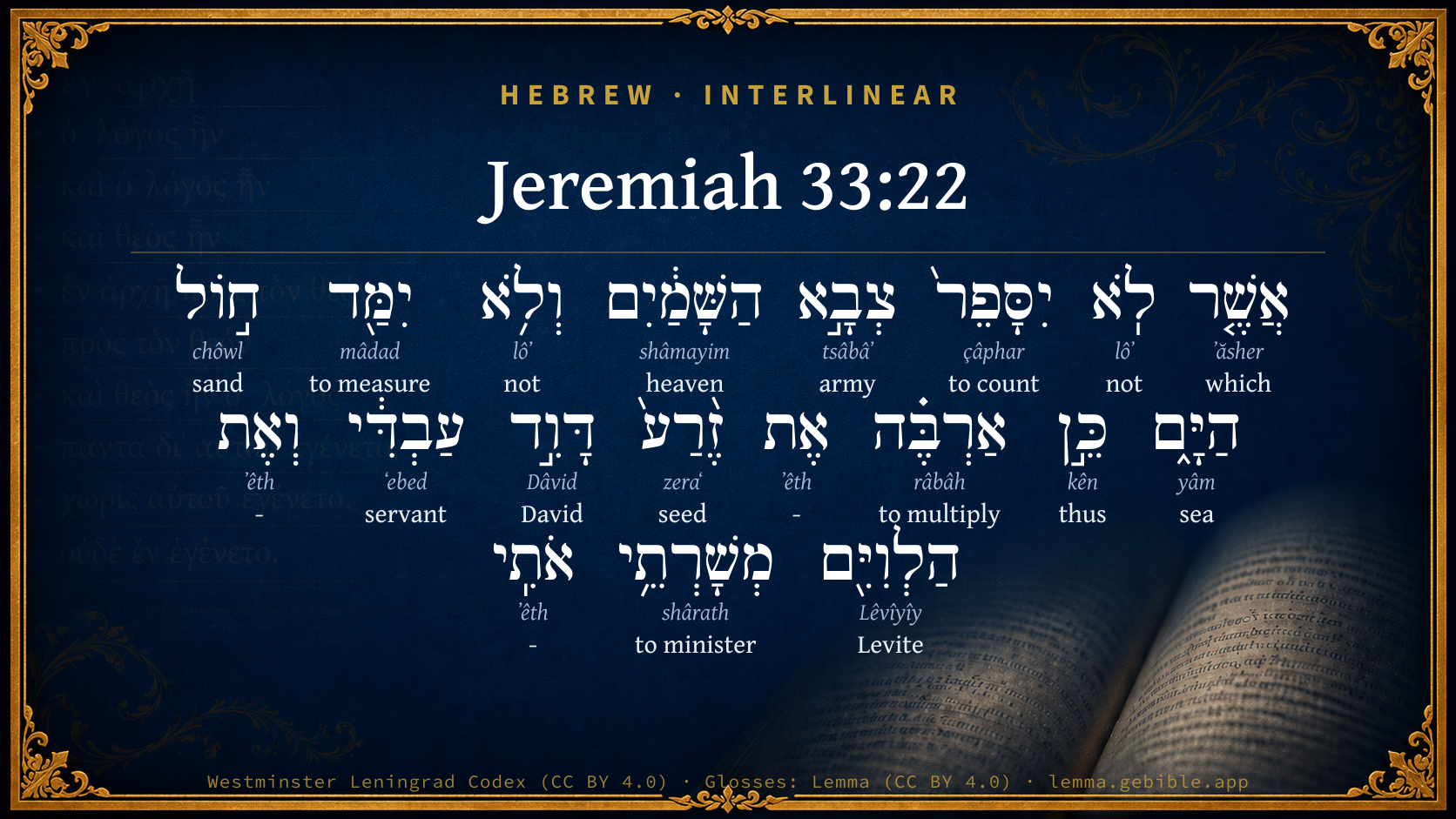
Hebrew (Westminster Leningrad Codex) Jeremiah 33:22 appears in the Hebrew Old Testament. The text above is from the Westminster Leningrad Codex. Each word links to its Strong’s number, a concise gloss, and parsing drawn from the Open Scriptures Hebrew Bible morphology. Click any word for its full Brown-Driver-Briggs (BDB) entry.
Download image
Cite this verse

Jeremiah 33:22 (World English Bible). Public Domain. Lemma interlinear Bible study tool, https://lemma.gebible.app/v/jeremiah/33/22.

Show BibTeX & RIS
BibTeX
RIS
English Translation
As the host of the sky can't be numbered, neither the sand of the sea measured; so will I multiply the seed of David my servant, and the Levites who minister to me.
World English Bible · Public Domain
Download a study sheet

One document with this verse’s original text, its word-by-word gloss line, the meaning frame, cross-references with their text, attributed commentary, and full source and license credits — printable, and it pastes into notes with its structure intact.

This verse Autodidact and up

Study sheet (.html) Plain text (.txt)

A passage Seminary Student

Up to 50 verses in one chapter. A passage sheet keeps up to 6 commentary sources and 12 cross-references per verse, in the order this page ranks them, and says so on the sheet whenever that leaves anything out. Ask for a single verse and you get the Autodidact verse sheet above.

Everything on this page stays free to read, with no account — the sheet is a download of what is already on screen, not access to it.

Want to remove ads? Support Godless Engineer
Compare translations 3

The same verse in 3 English versions, stacked beneath the original-language interlinear above. Click any original word for its lexicon entry.

Each is an independent rendering of the whole verse — the interlinear is not word-aligned to these translations.

Highlighted words mark where these versions differ — a whole-verse word diff, not a word-by-word alignment.

  • World English Bible Public Domain
    As the host of the sky can't be numbered, neither the sand of the sea measured; so will I multiply the seed of David my servant, and the Levites who minister to me.
  • King James Version Public Domain
    As the host of heaven cannot be numbered, neither the sand of the sea measured: so will I multiply the seed of David my servant, and the Levites that minister unto me.
  • unfoldingWord Literal Text CC BY-SA 4.0
    As the hosts of heaven cannot be counted, and as the sand of the seashores cannot be measured, so I will increase the descendants of David my servant and the Levites who serve before me.’”

unfoldingWord Literal Text — © unfoldingWord, licensed CC BY-SA 4.0. Word-aligned USFM3 via Door43 (git.door43.org/unfoldingWord/en_ult).

Versions to compare (up to 4)

3 of 4 selected

Show all 18 translations

Every available English version of this verse, each an independent rendering of the whole verse.

  • World English Bible Public Domain
    As the host of the sky can't be numbered, neither the sand of the sea measured; so will I multiply the seed of David my servant, and the Levites who minister to me.
  • Berean Standard Bible Public Domain
    As the hosts of heaven cannot be counted and as the sand on the seashore cannot be measured, so too will I multiply the descendants of My servant David and the Levites who minister before Me.”
  • Majority Standard Bible Public Domain
    As the hosts of heaven cannot be counted and as the sand on the seashore cannot be measured, so too will I multiply the descendants of My servant David and the Levites who minister before Me.”
  • King James Version Public Domain
    As the host of heaven cannot be numbered, neither the sand of the sea measured: so will I multiply the seed of David my servant, and the Levites that minister unto me.
  • American Standard Version (1901) Public Domain
    As the host of heaven cannot be numbered, neither the sand of the sea measured; so will I multiply the seed of David my servant, and the Levites that minister unto me.
  • Revised Version (1885) Public Domain
    As the host of heaven cannot be numbered, neither the sand of the sea measured; so will I multiply the seed of David my servant, and the Levites that minister unto me.
  • Geneva Bible (1599) Public Domain
    As the army of heauen can not be nombred, neither the sand of the sea measured: so wil I multiplie the seede of Dauid my seruant, and the Leuites, that minister vnto me.
  • Douay-Rheims (1899) Public Domain
    As the stars of heaven cannot be numbered, nor the sand of the sea be measured: so will I multiply the seed of David my servant, and the Levites my ministers.
  • Young's Literal Translation Public Domain
    As the host of the heavens is not numbered, Nor the sand of the sea measured, So I multiply the seed of David My servant, And the Levites My ministers.'
  • Literal Standard Version CC BY-SA 4.0
    As the host of the heavens is not numbered, || Nor the sand of the sea measured, || So I multiply the seed of My servant David, || And My ministers the Levites.”
  • Unlocked Literal Bible CC BY-SA 4.0
    As the hosts of heaven cannot be counted, and as the sand of the seashores cannot be measured, so I will increase the descendants of David my servant and the Levites who serve before me.'”
  • unfoldingWord Literal Text CC BY-SA 4.0
    As the hosts of heaven cannot be counted, and as the sand of the seashores cannot be measured, so I will increase the descendants of David my servant and the Levites who serve before me.’”
  • Darby Bible Public Domain
    As the host of the heavens cannot be numbered, nor the sand of the sea measured, so will I multiply the seed of David my servant, and the Levites that minister unto me.
  • World Messianic Bible Public Domain
    As the army of the sky can’t be counted, and the sand of the sea can’t be measured, so I will multiply the offspring of David my servant and the Levites who minister to me.’”
  • Webster's Bible Public Domain
    As the host of heaven cannot be numbered, neither the sand of the sea measured: so will I multiply the seed of David my servant, and the Levites that minister to me.
  • Free Bible Version CC BY-SA 4.0
    In the same way that the stars of heaven can't be counted, and the sand on the seashore can't be measured, that's how many times I will multiply the number of my servant David's descendants and the Levites who serve me.
  • Bible in Basic English Public Domain
    As it is not possible for the army of heaven to be numbered, or the sand of the sea measured, so will I make the seed of my servant David, and the Levites my servants.
  • JPS Tanakh (1917) Public Domain
    As the host of heaven cannot be numbered, neither the sand of the sea measured; so will I multiply the seed of David My servant, and the Levites that minister unto Me.

Literal Standard Version (2020), Covenant Press — licensed CC BY-SA 4.0. Text via the HelloAO Bible API (eBible.org). Unlocked Literal Bible (unfoldingWord) — licensed CC BY-SA 4.0. Text via the HelloAO Bible API (eBible.org). unfoldingWord Literal Text — © unfoldingWord, licensed CC BY-SA 4.0. Word-aligned USFM3 via Door43 (git.door43.org/unfoldingWord/en_ult). Free Bible Version, Dr. Jonathan Gallagher — licensed CC BY-SA 4.0. Text via the HelloAO Bible API (eBible.org).

Word by word

More ways to search: Search by grammar → Find every occurrence → Compare this word →

Practice this passage: Drill this verse → Learn its vocabulary →

ח֣וֹל
chôwl
H2344
“sand of”
Noun, Common, Masculine, Singular, Construct
Part of Speech
Noun
Type
Common
Gender
Masculine
Number
Singular
State
Construct
Full BDB Definition

Origin: from H2342

TWOT: 623a

sand
  1. אֲשֶׁ֤ר ʼăsher H834 “which” Particle, Relative
  2. לֹֽא lôʼ H3808 “not” Particle, Negative
  3. יִסָּפֵר֙ çâphar H5608 “to count” Verb, Niphal, Imperfect, 3rd Person, Masculine, Singular
  4. צְבָ֣א tsâbâʼ H6635 “army of” Noun, Common, Both, Singular, Construct
  5. הַשָּׁמַ֔יִם shâmayim H8064 “the · heaven(s)” Particle, Definite Article + Noun, Common, Masculine, Plural, Absolute
  6. וְלֹ֥א lôʼ H3808 “and · not” Conjunction + Particle, Negative
  7. יִמַּ֖ד mâdad H4058 “to measure” Verb, Niphal, Imperfect, 3rd Person, Masculine, Singular
  8. הַיָּ֑ם yâm H3220 “the · sea” Particle, Definite Article + Noun, Common, Masculine, Singular, Absolute
  9. כֵּ֣ן kên H3651 “thus” Particle, Demonstrative
  10. אַרְבֶּ֗ה râbâh H7235 “to multiply” Verb, Hiphil, Imperfect, 1st Person, Common, Singular
  11. אֶת ʼêth H853 “-” Particle, Direct Object
  12. זֶ֨רַע֙ zeraʻ H2233 “seed of” Noun, Common, Masculine, Singular, Construct
  13. דָּוִ֣ד Dâvid H1732 “David” Noun, Proper
  14. עַבְדִּ֔י ʻebed H5650 “servant · my” Noun, Common, Masculine, Singular, Construct + Suffix, Personal, 1st Person, Common, Singular
  15. וְאֶת ʼêth H853 “and · -” Conjunction + Particle, Direct Object
  16. הַלְוִיִּ֖ם Lêvîyîy H3881 “the · Levites” Particle, Definite Article + Noun, Gentilic, Masculine, Plural, Absolute
  17. מְשָׁרְתֵ֥י shârath H8334 “ministering” Verb, Piel, Participle Active, Masculine, Plural, Construct
  18. אֹתִֽי ʼêth H853 “- · me” Particle, Direct Object + Suffix, Personal, 1st Person, Common, Singular

About this verse

These counts appear in no published source. They are computed here, from the morphology-tagged text and Lemma’s own curated glosses. What Lemma adds →

19
words
16
distinct lemmas
Prophets
section

Notable vocabulary

The rarest word here is ח֣וֹל sand H2344 — appearing just 23 times in the whole Hebrew Bible.

Shared distinctive vocabulary

ח֣וֹל sand H2344 occurs in 23 verses of the Hebrew Bible. Also found in:

Grammatical profile

  • 4 verbs
  • 8 nouns
  • 7 particles

Verb forms

  • יִסָּפֵר֙ Niphal · Imperfect
  • יִמַּ֖ד Niphal · Imperfect
  • אַרְבֶּ֗ה Hiphil · Imperfect
  • מְשָׁרְתֵ֥י Piel · Participle Active

Repetition

A word recurs within this verse — often emphatic in Hebrew:

Cross-references

16

Topical passages linked to Jeremiah 33:22 in the Treasury of Scripture Knowledge — connected by theme and wording, ordered by reader-vote popularity; previews shown in the World English Bible.

  • Genesis 22:17 that in blessing I will bless you, and in multiplying I will multiply your seed as the stars of the heavens, and as the sand which is on the seashore. Your seed will possess the gate of his enemies.
  • Genesis 15:5 Yahweh brought him outside, and said, "Look now toward the sky, and count the stars, if you are able to count them." He said to Abram, "So shall your seed be."
  • Hebrews 11:12 Therefore as many as the stars of the sky in multitude, and as innumerable as the sand which is by the sea shore, were fathered by one man, and him as good as dead.
  • Isaiah 66:21 Of them also will I take for priests [and] for Levites, says Yahweh.
  • Jeremiah 31:37 Thus says Yahweh: If heaven above can be measured, and the foundations of the earth searched out beneath, then will I also cast off all the seed of Israel for all that they have done, says Yahweh.
  • Ezekiel 37:24–27 My servant David shall be king over them; and they all shall have one shepherd: they shall also walk in my ordinances, and observe my statutes, and do them.
  • Genesis 13:16 I will make your offspring as the dust of the earth, so that if a man can number the dust of the earth, then your seed may also be numbered.
  • Genesis 28:14 Your seed will be as the dust of the earth, and you will spread abroad to the west, and to the east, and to the north, and to the south. In you and in your seed will all the families of the earth be blessed.
  • Psalms 22:30 Posterity shall serve him. Future generations shall be told about the Lord.
  • Psalms 89:3–4 "I have made a covenant with my chosen one, I have sworn to David, my servant,
  • Psalms 89:29 I will also make his seed endure forever, And his throne as the days of heaven.
  • Isaiah 53:10–12 Yet it pleased Yahweh to bruise him; he has put him to grief: when you shall make his soul an offering for sin, he shall see [his] seed, he shall prolong his days, and the pleasure of Yahweh shall prosper in his hand.
  • Ezekiel 44:15 But the priests the Levites, the sons of Zadok, who kept the charge of my sanctuary when the children of Israel went astray from me, they shall come near to me to minister to me; and they shall stand before me to offer to me the fat and the blood, says the Lord Yahweh:
  • Hosea 1:10 Yet the number of the children of Israel will be as the sand of the sea, which can't be measured nor numbered; and it will come to pass that, in the place where it was said to them, 'You are not my people,' they will be called 'sons of the living God.'
  • Zechariah 12:8 In that day Yahweh will defend the inhabitants of Jerusalem. He who is feeble among them at that day will be like David, and the house of David will be like God, like the angel of Yahweh before them.
  • Revelation 7:9–10 After these things I looked, and behold, a great multitude, which no man could number, out of every nation and of all tribes, peoples, and languages, standing before the throne and before the Lamb, dressed in white robes, with palm branches in their hands.

Cross-references courtesy of OpenBible.info (CC BY 4.0).

Hebrew and Greek witnesses Masoretic Hebrew ↔ Greek Septuagint

The same verse in the two great witnesses to the Old Testament, shown verse-for-verse.

These are two independent witnesses, not word-aligned to each other, and the Septuagint is shown in lemma (dictionary) form.

Hebrew Jeremiah 33:22 Masoretic · Westminster Leningrad Codex

אֲשֶׁ֤ר לֹֽא יִסָּפֵר֙ צְבָ֣א הַשָּׁמַ֔יִם וְלֹ֥א יִמַּ֖ד ח֣וֹל הַיָּ֑ם כֵּ֣ן אַרְבֶּ֗ה אֶת זֶ֨רַע֙ דָּוִ֣ד עַבְדִּ֔י וְאֶת הַלְוִיִּ֖ם מְשָׁרְתֵ֥י אֹתִֽי

As the host of the sky can't be numbered, neither the sand of the sea measured; so will I multiply the seed of David my servant, and the Levites who minister to me.

World English Bible · Public Domain

Greek LXX Structure differs

In the Septuagint, Jeremiah is about an eighth shorter than the Hebrew and arranges its material differently — the Oracles Against the Nations (Hebrew chapters 46–51) appear in the middle of the Greek book, after 25:13. Because the chapter and verse boundaries do not line up, a verse-for-verse comparison with the Hebrew is not shown.

A verse-for-verse comparison isn’t shown here because the chapters and verses don’t line up. Switch to the LXX edition with the MT / LXX toggle above to read the Greek directly.

Hebrew: Westminster Leningrad Codex (CC BY 4.0). Greek: Septuagint (public domain); English from a public-domain English Septuagint. How the Septuagint differs from the Hebrew →

Targum (Aramaic paraphrase)

1

The Targum is the ancient Jewish Aramaic paraphrase of the Hebrew Scriptures — an interpretive translation, not the Hebrew text itself. Onkelos (literal) and Pseudo-Jonathan (expansive) render the Torah, and Jonathan the Prophets. Coverage is partial: where no permissively-licensed English translation exists for a verse, only the Aramaic is shown. This is verse-level text, not a word-by-word alignment to the Hebrew.

  1. Targum Jonathan Prophets (Joshua–Malachi)
    כְּמָה דְלֵית אֶפְשַׁר דְיִתְמְנוּן חֵילֵי שְׁמַיָא וְלָא יִתְכִיל חָלָא דְיַמָא כֵּן אַסְגֵי יַת זַרְעָא דָוִד עַבְדֵי וְיַת לֵוָאֵי דִמְשַׁמְשִׁין קֳדָמַי:

    (no public-domain English translation for this verse)

    Targum Jonathan — Aramaic: “Mikraot Gedolot” (public domain). English: “Sefaria Community Translation” (CC0 1.0 (public-domain dedication)); “London "Chaldee Paraphrase," 1871” (public domain). Text via Sefaria.

Commentary

Notes on Jeremiah 33:22 from classic Christian and Jewish commentators (each source and its license shown beneath its notes). The classic Christian expositions comment on the surrounding passage and are grouped to its opening verse, so a note may address several verses; the Jewish commentaries on the Tanakh (Rashi and others) are per-verse, so they appear only where the commentator wrote on this verse.

Lemma curates 59 commentaries, every one of them public domain or Creative Commons licensed, each selected and text-cleaned for this edition rather than reprinted as found. About our sources →

Trapp's Complete Commentary

John Trapp

Jer 33:22 As the host of heaven cannot be numbered, neither the sand of the sea measured: so will I multiply the seed of David my servant, and the Levites that minister unto me.

Ver. 22. As the host of heaven.] See Gen 13:16; Gen 15:5.

So will I multiply the seed of David.] True believers.

And the Levites.] Godly ministers. See Psa 68:11.

John Trapp, A Commentary or Exposition upon All the Books of the Old and New Testament (1647–1656) — public domain. Text from a community e-Sword module.

Joseph Benson's Commentary

Jer 33:22. As the host of heaven cannot be numbered, &c. — The former promise respected the stability, this the enlargement of the church, the members of which are here termed the seed of David, as they are elsewhere often called the seed of Abraham, being the imitators of the faith of Abraham and David. Or they may be termed the seed of David, because they are the seed of Christ, who is sometimes called David in the writings of the prophets, (see Jer 30:9,) and whose seed and whose Levites are multiplied in the multiplying of Christians and of faithful ministers under the gospel, which are the blessings here promised.

Joseph Benson's Commentary on the Old and New Testaments (1811–1818) — public domain. Text from a community e-Sword module.

Jamieson, Fausset & Brown

Robert Jamieson, A. R. Fausset & David Brown

(Gen 15:5; Gen 22:17). The blessing there promised belonged to all the tribes; here it is restricted to the family of David and the tribe of Levi, because it was on these that the welfare of the whole people rested. When the kingdom and priesthood flourish in the person of Messiah, the whole nation shall temporally and spiritually prosper.

Jamieson, Fausset & Brown — Commentary Critical and Explanatory on the Whole Bible (1871) — public domain (CC PDM 1.0). Text via the HelloAO Bible API.

Adam Clarke's Commentary

Verse 22. So will I multiply the seed of David] This must be understood of the spiritual David, Jesus Christ, and his progeny, genuine Christians. The two families which God chose for the priesthood, that of Aaron and Phinehas, or, on its being taken away from him, that of Ithamar, 1Sa 2:35, are both extinct. Nor has the office of high priest, or priest of any kind offering sacrifice, been exercised among the Jews for nearly eighteen hundred years; therefore what is said here of the priesthood must refer to the spiritual priesthood, at the head of which is Jesus Christ.

Adam Clarke's Commentary on the Bible (1810–1826) — public domain. Text from a community e-Sword/MySword module.

John Calvin's Commentaries

There is an omission at the beginning; the particle of comparison is left out, for אשר asher, cannot be taken for כאשר caasher: As the hosts of the heavens cannot be numbered, nor the sand of the sea, so God promises that he would multiply the seed of David, and also the Levites. This promise, as given to Abraham, referred to the whole body of the people; for when Abraham was bidden to go out, and to look on the heavens, God made this promise to him, “Number the stars, if thou canst, and the sands of the sea, so shall thy seed be.” We hence see that this blessing was extended to the whole seed of Abraham, and especially to the twelve tribes. And now it is confined to the family of David, and to the Levitical tribe.

But what we have already touched upon ought to be borne in mind, — that the safety of the people was grounded on the kingdom and the priesthood. As then kings ruled not for themselves, nor had the sacerdotal dignity been given to the Levites for their own private advantage, but for the sake of the people, so now the Prophet, stating a part for the whole, intimates that the whole people would be secure and safe, when the royal and sacerdotal dignity flourished. There is not, then, anything diminished from God’s promise, as though the other tribes were not to multiply; but what Jeremiah testifies respecting the family of David and the Levitical tribe, is to be extended, without any difference, to the whole Church. It is yet not without reason that an especial mention is made of David and Levi; for, as it has been said, the Church must have been in a miserable state, without a head, and without a Mediator. There is, however, no doubt but that Jeremiah alluded to that passage which we have already quoted, (Genesis 15:5; Romans 4:18) and thus he reproved the want of faith in the people; for they could not have doubted the restoration of the Church without impugning the truth of God, as though he had given only vain words to Abraham, when he said,

“Number the stars of heaven if thou canst, and the sands of the sea, so shall thy seed be.”

He therefore shews that God would be true and faithful in that promise, so as to multiply his Church like the stars of heaven, and the sands of the sea. It follows —

John Calvin's Commentaries (1540-1563) — public domain. Text from the Calvin Translation Society English edition (1840s-50s) via the Christian Classics Ethereal Library (ccel.org). Calvin's coverage is partial (roughly two-thirds of the Bible); uncommented books and verses are honest gaps, never fabricated. The 19th-century editor's footnotes and remarks are omitted so the notes are faithfully Calvin's own voice.

John Gill's Exposition

As the host of heaven cannot be numbered, neither the sand of the sea measured,.... As the stars of heaven are innumerable, and the sand of the sea immeasurable:

so will I multiply the seed of David my servant; the Messiah; the son and antitype of David; and who is often called by his name; and as the son of David is the servant of the Lord, his spiritual seed are meant, which shall endure for ever; and in Gospel times, especially in the latter part of them, shall be very numerous; see Psa 89:29;

and the Levites that minister unto me; meaning the same as before; not ministers of the Gospel, for they never were, or will be, so numerous as here expressed; but true believers in Christ, who are all priests unto God, and minister in holy things, offering up the spiritual sacrifices of prayer and praise through Christ: these Levites are the same with the seed of David, or Christ, in whom the kingdom and the priesthood are united.

John Gill's Exposition of the Whole Bible (1746–1763) — public domain (CC PDM 1.0). Text via the HelloAO Bible API.

Matthew Poole's English Annotations

The former promise was for the stability, this for the multiplication of the church, which is here expressed under the notion of the

seed of David, that is, the members of Christ: the Jews were ordinarily called the seed of Abraham, Isaac, and Jacob, but I do not remember they are any where called the seed of David, unless it be 1Ki 11:39, where it seems also to be understood only of the princes that came from David; nor indeed could they be so called in any proper sense; David being no common head to the whole Jewish nation, as both Abraham, Isaac, and Jacob were; but Christ is often called the seed of David, Joh 7:42; Act 13:23; Rom 1:3; 2Ti 2:8; and Christ is himself called David, whose seed and whose

Levites are multiplied in the multiplying of Christians and of faithful ministers under the gospel, which certainly are the things here promised.

Matthew Poole's English Annotations on the Holy Bible (1683–1685) — public domain. Text from a community e-Sword/MySword module.

John Wesley's Explanatory Notes

Of David - Christ is himself called David, whose seed and whose Levites are multiplied in the multiplying of Christians and of faithful ministers under the gospel, which are the things here promised.

John Wesley, Explanatory Notes Upon the Whole Bible (1754–1765) — public domain. Text via the GEBible commentary corpus.

Lesson kit

Teaching starters — assembled from the data on this page, not authored interpretation. Every prompt links to the verse data it draws on. Edit before teaching.

Jeremiah, in the Prophets, opens this verse with 19 words (16 distinct Hebrew lemmas). Its most distinctive word is chôwl (“sand”). A historical commentator’s framing appears above. Read the whole chapter for the surrounding context.

Discussion questions

  1. How does “sand” (chôwl) shape what this verse is saying?
  2. How does Genesis 22:17, which shares the word «sand», read alongside this verse?
  3. What does the repetition of “not” (2× in this one verse) do in this verse?
  4. The translations on this page render this verse differently — a whole-verse word diff, not a word-by-word alignment. What might account for the different wordings?
  5. «יִסָּפֵר֙» is a Niphal Imperfect verb. How does that grammatical form shape the action described?
  6. Compare how Trapp's Complete Commentary and Joseph Benson's Commentary read this verse. Where do they agree or differ?

Things to notice

Reading settings

Reading text

Shown beneath each verse's original-language words.

Old Testament
Old Testament edition

Read the OT as the Masoretic Hebrew (MT) or the Greek Septuagint (LXX).

English shown for the Greek Septuagint (in the Hebrew ↔ Greek comparison).

Comparing translations? Open the Compare panel on any verse page to stack up to four side by side.