Ecclesiastes 5:12

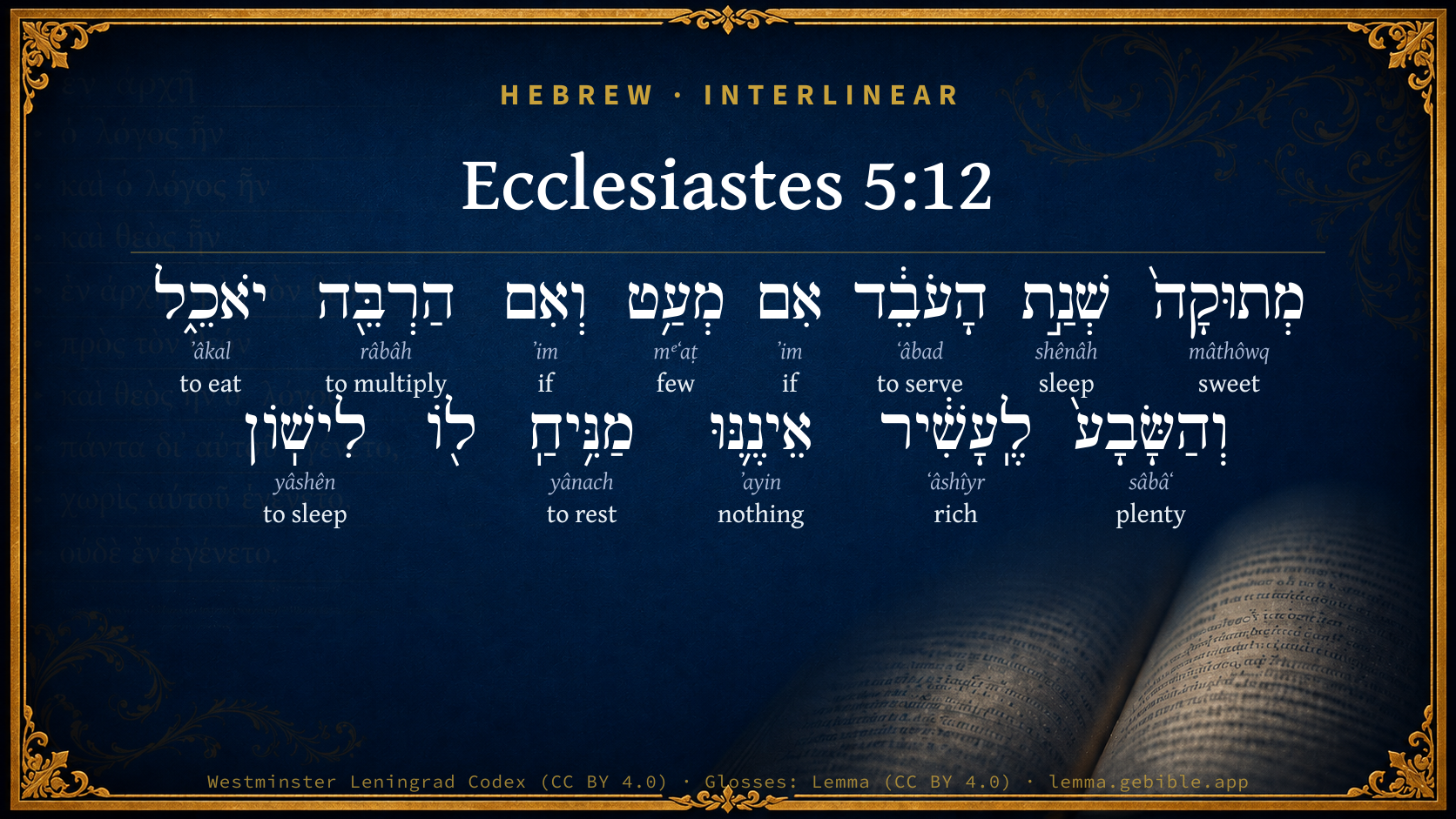
Hebrew (Westminster Leningrad Codex) Ecclesiastes 5:12 appears in the Hebrew Old Testament. The text above is from the Westminster Leningrad Codex. Each word links to its Strong’s number, a concise gloss, and parsing drawn from the Open Scriptures Hebrew Bible morphology. Click any word for its full Brown-Driver-Briggs (BDB) entry.
Download image
Cite this verse

Ecclesiastes 5:12 (World English Bible). Public Domain. Lemma interlinear Bible study tool, https://lemma.gebible.app/v/ecclesiastes/5/12.

Show BibTeX & RIS
BibTeX
RIS
English Translation
The sleep of a laboring man is sweet, whether he eats little or much; but the abundance of the rich will not allow him to sleep.
World English Bible · Public Domain
Download a study sheet

One document with this verse’s original text, its word-by-word gloss line, the meaning frame, cross-references with their text, attributed commentary, and full source and license credits — printable, and it pastes into notes with its structure intact.

This verse Autodidact and up

Study sheet (.html) Plain text (.txt)

A passage Seminary Student

Up to 50 verses in one chapter. A passage sheet keeps up to 6 commentary sources and 12 cross-references per verse, in the order this page ranks them, and says so on the sheet whenever that leaves anything out. Ask for a single verse and you get the Autodidact verse sheet above.

Everything on this page stays free to read, with no account — the sheet is a download of what is already on screen, not access to it.

Want to remove ads? Support Godless Engineer
Compare translations 3

The same verse in 3 English versions, stacked beneath the original-language interlinear above. Click any original word for its lexicon entry.

Each is an independent rendering of the whole verse — the interlinear is not word-aligned to these translations.

Highlighted words mark where these versions differ — a whole-verse word diff, not a word-by-word alignment.

  • World English Bible Public Domain
    The sleep of a laboring man is sweet, whether he eats little or much; but the abundance of the rich will not allow him to sleep.
  • King James Version Public Domain
    The sleep of a labouring man is sweet, whether he eat little or much: but the abundance of the rich will not suffer him to sleep.
  • unfoldingWord Literal Text CC BY-SA 4.0
    Sweet is the sleep of the worker, however little or however much he eats, but the satisfaction of a rich person— it is not allowing him to sleep.

unfoldingWord Literal Text — © unfoldingWord, licensed CC BY-SA 4.0. Word-aligned USFM3 via Door43 (git.door43.org/unfoldingWord/en_ult).

Versions to compare (up to 4)

3 of 4 selected

Show all 18 translations

Every available English version of this verse, each an independent rendering of the whole verse.

  • World English Bible Public Domain
    The sleep of a laboring man is sweet, whether he eats little or much; but the abundance of the rich will not allow him to sleep.
  • Berean Standard Bible Public Domain
    The sleep of the worker is sweet, whether he eats little or much, but the abundance of the rich man permits him no sleep.
  • Majority Standard Bible Public Domain
    The sleep of the worker is sweet, whether he eats little or much, but the abundance of the rich man permits him no sleep.
  • King James Version Public Domain
    The sleep of a labouring man is sweet, whether he eat little or much: but the abundance of the rich will not suffer him to sleep.
  • American Standard Version (1901) Public Domain
    The sleep of a laboring man is sweet, whether he eat little or much; but the fulness of the rich will not suffer him to sleep.
  • Revised Version (1885) Public Domain
    The sleep of a labouring man is sweet, whether he eat little or much: but the fulness of the rich will not suffer him to sleep.
  • Geneva Bible (1599) Public Domain
    There is an euill sickenes that I haue seene vnder the sunne: to wit, riches reserued to the owners thereof for their euill.
  • Douay-Rheims (1899) Public Domain
    There is also another grievous evil, which I have seen under the sun: riches kept to the hurt of the owner.
  • Young's Literal Translation Public Domain
    Sweet `is' the sleep of the labourer whether he eat little or much; and the sufficiency of the wealthy is not suffering him to sleep.
  • Literal Standard Version CC BY-SA 4.0
    Sweet [is] the sleep of the laborer whether he eat little or much; and the sufficiency of the wealthy is not permitting him to sleep.
  • Unlocked Literal Bible CC BY-SA 4.0
    The sleep of a working man is sweet, whether he eats little or a lot, but the wealth of a rich person does not allow him to sleep well.
  • unfoldingWord Literal Text CC BY-SA 4.0
    Sweet is the sleep of the worker, however little or however much he eats, but the satisfaction of a rich person— it is not allowing him to sleep.
  • Darby Bible Public Domain
    The sleep of the labourer is sweet, whether he have eaten little or much; but the fulness of the rich doth not suffer him to sleep.
  • World Messianic Bible Public Domain
    The sleep of a laboring man is sweet, whether he eats little or much; but the abundance of the rich will not allow him to sleep.
  • Webster's Bible Public Domain
    \\5:13\\There is a grievous evil which I have seen under the sun, namely, riches kept for the owners of them to their hurt.
  • Free Bible Version CC BY-SA 4.0
    Those who work hard sleep well, whether they have a little to eat or plenty, but the rich own so much they don't get any rest.
  • Bible in Basic English Public Domain
    There is a great evil which I have seen under the sun--wealth kept by the owner to be his downfall.
  • JPS Tanakh (1917) Public Domain
    (5-11) Sweet is the sleep of a labouring man, whether he eat little or much; but the satiety of the rich will not suffer him to sleep.

Literal Standard Version (2020), Covenant Press — licensed CC BY-SA 4.0. Text via the HelloAO Bible API (eBible.org). Unlocked Literal Bible (unfoldingWord) — licensed CC BY-SA 4.0. Text via the HelloAO Bible API (eBible.org). unfoldingWord Literal Text — © unfoldingWord, licensed CC BY-SA 4.0. Word-aligned USFM3 via Door43 (git.door43.org/unfoldingWord/en_ult). Free Bible Version, Dr. Jonathan Gallagher — licensed CC BY-SA 4.0. Text via the HelloAO Bible API (eBible.org).

Word by word

More ways to search: Search by grammar → Find every occurrence → Compare this word →

Practice this passage: Drill this verse → Learn its vocabulary →

וְהַשָּׂבָע֙
sâbâʻ
H7647
“and · the · plenty”
Conjunction + Particle, Definite Article + Noun, Common, Masculine, Singular, Absolute
Part of Speech
Conjunction + Particle + Noun
Type
Common
Gender
Masculine
Number
Singular
State
Absolute
Full BDB Definition

Origin: from H7646

TWOT: 2231c

plenty, satiety - plenty (of breadstuffs) - satiety
  1. מְתוּקָה֙ mâthôwq H4966 “sweet” Adjective, Adjective, Feminine, Singular, Absolute
  2. שְׁנַ֣ת shênâh H8142 “sleep of” Noun, Common, Feminine, Singular, Construct
  3. הָעֹבֵ֔ד ʻâbad H5647 “the · serving” Particle, Definite Article + Verb, Qal, Participle Active, Masculine, Singular, Absolute
  4. אִם ʼim H518 “if” Conjunction
  5. מְעַ֥ט mᵉʻaṭ H4592 “few” Noun, Common, Masculine, Singular, Absolute
  6. וְאִם ʼim H518 “and · if” Conjunction + Conjunction
  7. הַרְבֵּ֖ה râbâh H7235 “to multiply” Verb, Hiphil, Infinitive Absolute
  8. יֹאכֵ֑ל ʼâkal H398 “to eat” Verb, Qal, Imperfect, 3rd Person, Masculine, Singular
  9. לֶֽעָשִׁ֔יר ʻâshîyr H6223 “to/for the · rich” Preposition, Determined + Adjective, Adjective, Masculine, Singular, Absolute
  10. אֵינֶ֛נּוּ ʼayin H369 “nothing · him” Particle, Negative + Suffix, Personal, 3rd Person, Masculine, Singular
  11. מַנִּ֥יחַֽ yânach H3240 “resting” Verb, Hiphil, Participle Active, Masculine, Singular, Absolute
  12. לִישֽׁוֹן yâshên H3462 “to sleep” Preposition + Verb, Qal, Infinitive Construct

About this verse

These counts appear in no published source. They are computed here, from the morphology-tagged text and Lemma’s own curated glosses. What Lemma adds →

14
words
12
distinct lemmas
Wisdom
section

Notable vocabulary

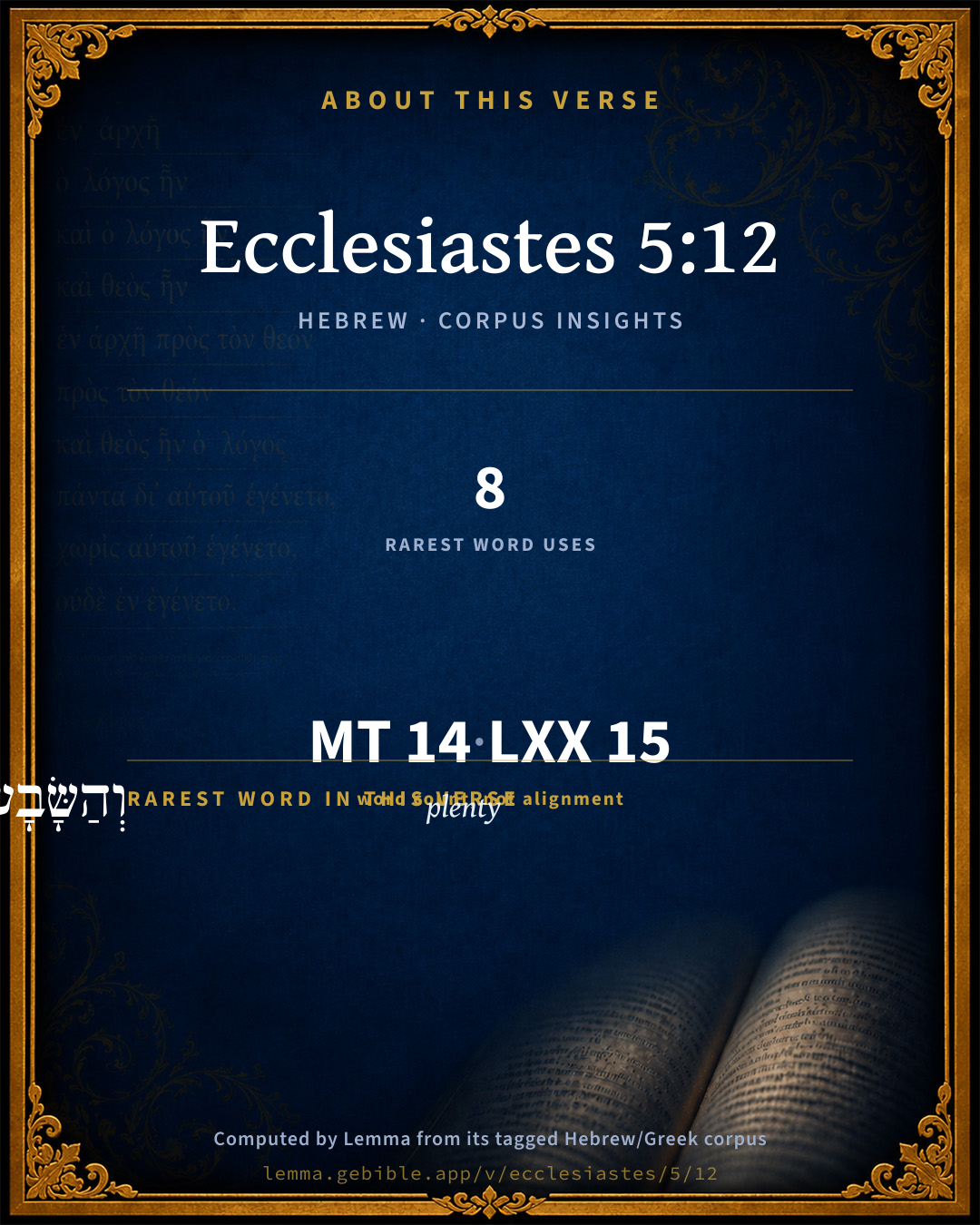
The rarest word here is וְהַשָּׂבָע֙ plenty H7647 — appearing just 8 times in the whole Hebrew Bible.

Shared distinctive vocabulary

וְהַשָּׂבָע֙ plenty H7647 occurs in 8 verses of the Hebrew Bible. Also found in:

Grammatical profile

  • 5 verbs
  • 3 nouns
  • 2 adjectives
  • 1 preposition
  • 2 conjunctions
  • 1 particle

Verb forms

  • הָעֹבֵ֔ד Qal · Participle Active
  • הַרְבֵּ֖ה Hiphil · Infinitive Absolute
  • יֹאכֵ֑ל Qal · Imperfect
  • מַנִּ֥יחַֽ Hiphil · Participle Active
  • לִישֽׁוֹן Qal · Infinitive Construct

Repetition

A word recurs within this verse — often emphatic in Hebrew:

  • אִם if H518 ×2

Hebrew & Septuagint length

In English translation the verse runs 26 words from the Hebrew and 20 from the Septuagint (LXX English) — closely comparable.

A rough comparison of the two English renderings, which tokenize alike — not a word-level alignment.

Word counts can differ between the Hebrew and the Greek without any difference in meaning — e.g. the Hebrew direct-object marker אֵת has no separate Greek word, and Greek often adds the article ὁ.

In the original languages it is 14 Hebrew tokens and 15 Greek tokens — but the two are counted differently (Hebrew bundles its prefixes and suffixes into one token; the Greek is in lemma form), so that isn’t a like-for-like length.

Cross-references

4

Topical passages linked to Ecclesiastes 5:12 in the Treasury of Scripture Knowledge — connected by theme and wording, ordered by reader-vote popularity; previews shown in the World English Bible.

  • Proverbs 3:24 When you lie down, you will not be afraid. Yes, you will lie down, and your sleep will be sweet.
  • Psalms 4:8 In peace I will both lay myself down and sleep, For you, Yahweh alone, make me live in safety.
  • Psalms 127:2 It is vain for you to rise up early, To stay up late, Eating the bread of toil; For he gives sleep to his loved ones.
  • Jeremiah 31:26 On this I awakened, and saw; and my sleep was sweet to me.

Cross-references courtesy of OpenBible.info (CC BY 4.0).

Hebrew and Greek witnesses Masoretic Hebrew ↔ Greek Septuagint

The same verse in the two great witnesses to the Old Testament, shown verse-for-verse.

These are two independent witnesses, not word-aligned to each other, and the Septuagint is shown in lemma (dictionary) form.

Hebrew Ecclesiastes 5:12 Masoretic · Westminster Leningrad Codex

מְתוּקָה֙ שְׁנַ֣ת הָעֹבֵ֔ד אִם מְעַ֥ט וְאִם הַרְבֵּ֖ה יֹאכֵ֑ל וְהַשָּׂבָע֙ לֶֽעָשִׁ֔יר אֵינֶ֛נּוּ מַנִּ֥יחַֽ ל֖וֹ לִישֽׁוֹן

The sleep of a laboring man is sweet, whether he eats little or much; but the abundance of the rich will not allow him to sleep.

World English Bible · Public Domain

Greek LXX Ecclesiastes 5:12 Septuagint · lemma form

εἰμί ἀρρωστία ὅς ὁράω ὑπό ὁ ἥλιος πλοῦτος φυλάσσω ὁ παρά αὐτός εἰς κακία αὐτός

There is an infirmity which I have seen under the sun, namely, wealth kept for its owner to his hurt.

LXX2012 (modern English Septuagint) · Public Domain

On this verse, Albert Barnes' Notes on the Bible discusses the Septuagint’s reading. Read the note in Commentary ↓

Hebrew: Westminster Leningrad Codex (CC BY 4.0). Greek: Septuagint (public domain); English from LXX2012 (modern English Septuagint) (Public Domain). How the Septuagint differs from the Hebrew →

Commentary

Notes on Ecclesiastes 5:12 from classic Christian and Jewish commentators (each source and its license shown beneath its notes). The classic Christian expositions comment on the surrounding passage and are grouped to its opening verse, so a note may address several verses; the Jewish commentaries on the Tanakh (Rashi and others) are per-verse, so they appear only where the commentator wrote on this verse.

Lemma curates 59 commentaries, every one of them public domain or Creative Commons licensed, each selected and text-cleaned for this edition rather than reprinted as found. About our sources →

Trapp's Complete Commentary

John Trapp

Ecc 5:12 The sleep of a labouring man [is] sweet, whether he eat little or much: but the abundance of the rich will not suffer him to sleep.

Ver. 12. The sleep of a labouring man is sweet.] Sleep is the nurse of nature, the wages that she pays the poor man for his incessant pains. His fare is not so high, his care is not so great, but that without distemper or distraction he can hug his rest most sweetly, and feel no disturbance, until the due time of rising awakeneth him. {a} These labouring men are as sound as a rock, as hungry as hunters, as weary as ever was dog of day, as they say, and therefore no sooner laid in their beds but fast asleep, their hard labour causing easy digestion, and uninterrupted rest. Whereas the restless spirit of the rich wretch rides his body day and night; care of getting, fear of keeping, grief of losing, these three vultures feed upon him continually. He rolls a Sisyphus’ stone; his abundance, like a lump of lead, lies heavy upon his heart, and breaks his sleep. Much like the disease called the nightmare, or ephialtes, in which men in their slumber think they feel a thing as large as a mountain lying upon their breasts, which they can no way remove. His evil conscience soon lasheth and lanceth him, as it did our Richard III, after the murder of his two innocent nephews, and Charles IX of France, after the bloody massacre. God also terrifies him with dreams, throws handfuls of hell fire in his face, interpellat cogitantem, excitat dormientem, as Ambrose hath it, interrupts him while he is thinking, awakeneth him while he is sleeping, rings that doleful peal in his ears, that makes him start and stare, "Thou fool, this night shall thy soul be taken from thee." Veni miser in iudicium, Come, thou wretch, receive thy judgment.

{a} Somni finis est salus animantis. - Magir.

John Trapp, A Commentary or Exposition upon All the Books of the Old and New Testament (1647–1656) — public domain. Text from a community e-Sword module.

Joseph Benson's Commentary

Ecc 5:12. The sleep of a labouring man is sweet — Because he is free from those cares and fears wherewith the minds of rich men are often distracted, and their sleep disturbed; whether he eat little — For his weariness disposes him to sleep; or much — In which case his healthful constitution, and laborious course of life, prevent those crudities and indigestions which ofttimes break the sleep of rich men: but the abundance of the rich — Hebrew, השׂבע, the fullness, either, 1st, Of his diet, which commonly discomposes the rich man’s stomach, and hinders his rest: or, 2d, Of his wealth, which is generally attended with many perplexing cares, both by day and night. The Hebrew word is used in Scripture both ways, and probably is here intended to include both significations.

Joseph Benson's Commentary on the Old and New Testaments (1811–1818) — public domain. Text from a community e-Sword module.

Tyndale Open Study Notes

Tyndale Open Resources

5:12 People who work hard sleep well: Hard work and moderation yield the formula for a peaceful, productive life. Pursuing wealth leads to unnecessary anxieties (5:3).

Tyndale Open Study Notes — © Tyndale Open Resources, licensed CC BY-SA 4.0. Text via the HelloAO Bible API.

Geneva Bible (1599)

Geneva Bible translators

When covetous men heap up riches, which turn to their destruction.

Geneva Bible (1599) marginal notes — public domain. Text via Bolls.life.

Jamieson, Fausset & Brown

Robert Jamieson, A. R. Fausset & David Brown

Another argument against anxiety to gain riches. "Sleep . . . sweet" answers to "quietness" (Ecc 4:6); "not suffer . . . sleep," to "vexation of spirit." Fears for his wealth, and an overloaded stomach without "laboring" (compare Ecc 4:5), will not suffer the rich oppressor to sleep.

Jamieson, Fausset & Brown — Commentary Critical and Explanatory on the Whole Bible (1871) — public domain (CC PDM 1.0). Text via the HelloAO Bible API.

Adam Clarke's Commentary

Verse 12. The sleep of a labouring man is sweet] His labour is healthy exercise. He is without possessions, and without cares; his sleep, being undisturbed, is sound and refreshing.

Adam Clarke's Commentary on the Bible (1810–1826) — public domain. Text from a community e-Sword/MySword module.

The Cambridge Bible for Schools and Colleges

gen. ed. J. J. S. Perowne

12. The sleep of a labouring man is sweet] We may probably, as suggested in the “Ideal Biography” of the Introduction ch. iii., see in this reflection the reminiscence of a state with which the writer had once been familiar, and after which, now that it had passed away, he yearned regretfully. Again we get on the track of the maxims of Epicurean teachers. So Horace;

“Somnus agrestium

Lenis virorum non humiles domos

Fastidit umbrosamque ripam,

Non Zephyris agitata Tempe.”

“Gentle slumber scorneth not

The ploughman’s poor and lowly cot,

Nor yet the bank with sheltering shade,

Nor Tempe with its breezy glade.”

Od. iii. 1. 21–24.

See the passage from Virgil, Georg. iv., already quoted in the note on ch. Ecc_2:24, and

“Gives not the hawthorn-bush a sweeter shade

To shepherds looking on their silly sheep,

Than doth a rich embroider’d canopy

To kings that fear their subjects’ treachery?

O, yes, it doth; a thousand-fold it doth.

And to conclude, the shepherd’s homely curds,

His cold thin drink out of his leather bottle,

His wonted sleep under a fresh tree’s shade,

All which secure and sweetly he enjoys,

Is far beyond a prince’s delicates,

His viands sparkling in a golden cup,

His body couched in a curious bed,

When care, mistrust, and treason wait on him.”

Shakespeare, Henry VI. Act ii. Sc. 5.

The Cambridge Bible for Schools and Colleges (gen. ed. J. J. S. Perowne; Cambridge University Press, 1878–1918) — public domain. Text from a community e-Sword module.

John Gill's Exposition

The sleep of a labouring man is sweet, whether he eat little or much,.... Or "of a servant" (i), who enjoys sleep equally as a king; a tiller of the ground, as Jarchi; who also interprets it of one that serves the Lord, as likewise the Targum; a beloved one of his, to whom he gives sleep, Psa 127:2. A refreshing sleep is always reckoned a great mercy and blessing, and which labouring men enjoy with sweetness (k); for if they have but little to eat at supper, yet coming weary from their work, sleep is easily brought on when they lie down, and sound sleep they have, and rise in the morning lively and active, and fit for business; or, if they eat more plentifully, yet through their labour they have a good digestion, and their sleep is not hindered: so that should it be answered to the above question, what has the master more than the servant, though he eats and drinks more freely, and of the best, and lives voluptuously? yet it may be replied, that, in the business of sleep, the labouring man has the preference to him; which must be owned to be a great blessing of life, and is often interrupted by excessive eating and drinking;

but the abundance of the rich will not suffer him to sleep; either the abundance of food which he eats, which loads his stomach, and fills his head with vapours, and makes him restless, so that he can get no sleep, or what he does get is very uncomfortable: or the abundance of his riches fills him with cares, what he shall do with them, and how to keep and increase them; and with fears, lest thieves should break in and take them away from him, so that he cannot sleep quietly (l). The Targum is,

"sweet is the sleep of a man that serves the Lord of the world with a perfect heart; and he shall have rest in the house of his grave, whether he lives a few years or more, &c.''

and much to the same purpose Jarchi; and who says, it is thus interpreted in an ancient book of theirs, called Tanchuma.

(i) , Sept. "servi", Arab. "i.e. agricolae", Drusius, Rambachius; "qui par regi famuloque venis", Senec. Hercul. Fur. v. 1073. (k) "Somnus agrestium lenis", &c. Horat. Carmin. l. 3. Ode 1. v. 21, 22. (l) "Ne noctu, nec diu quietus unquam eam", Plauti Aulularia, Act. 1. Sc. 1. v. 23. "Aurea rumpunt tecta quietem", Senec. Hercul. Oet. v. 646.

John Gill's Exposition of the Whole Bible (1746–1763) — public domain (CC PDM 1.0). Text via the HelloAO Bible API.

Albert Barnes' Notes on the Bible

Labouring man - Not a slave (Septuagint), but everyone who, according to the divine direction, earns his bread in the sweat of his brow.

Albert Barnes' Notes on the Bible (1834–1885) — public domain. Text from a community e-Sword/MySword module.

Haydock's Catholic Bible Commentary

Owner. When they are taken away, they bring greater sorrow, (Calmet) and even when present, they fill the mind with anxiety. (Haydock)

George Leo Haydock (1774–1849), Haydock's Catholic Family Bible and Commentary, 1859 edition — public domain. Excludes Psalms (Douay-Rheims chapter numbering differs from Protestant) and Deuterocanonical books (Catholic canon only).

Matthew Poole's English Annotations

Is sweet; because he is free from those cares and fears, wherewith the minds of rich men are oft distracted, and their sleep disturbed.

Whether he eat little, then his weariness disposeth him to sleep, or much, in which case his healthful constitution and laborious course of life prevents those crudities and indigestions which ofttimes break the sleep of rich men.

The abundance, Heb. the fulness, either,

1. Of his diet, which commonly discomposeth their stomachs, and hinders their rest; or,

2. Of wealth, which is commonly attended with many perplexing cares, which disquiet men both by day and by night. The Hebrew word is used in Scripture both ways, and possibly it is thus generally expressed to include both significations.

Matthew Poole's English Annotations on the Holy Bible (1683–1685) — public domain. Text from a community e-Sword/MySword module.

Whedon's Commentary on the Bible

Daniel D. Whedon

12. Sleep of a labouring man — That is, of the husbandman, or farmer.

Is sweet — Freedom from carking care has often, and even beyond what is true, been imputed to the plain tillers of the soil. Certainly sleep, “chief nourisher at life’s feast,” is induced by their activities in the open air. The amount which they have at risk at any one time is small, and so their anxieties are not intense. Men pressed with heavy cares of trade, finance, and office, look to the quiet of rural life with longing, and make to themselves fictitious conceptions of it, as if the human heart were tamed in fields and cottages. Wealth, with its risks and its opportunities, creates much anxious reckoning, and he must be very weary, or of well-poised temper, who can sleep sweetly when he is aware of great hazards impending over his estate.

Daniel D. Whedon (gen. ed.), Commentary on the Old and New Testaments (1874–1909) — public domain. Text from a community e-Sword module.

The Pulpit Commentary

Another inconvenience of great wealth it robs a man of his sleep. The sleep of a laboring man is sweet, whether he eat little or much. The laborer is the husbandman, the tiller of the ground. (Gen_4:2) The Septuagint, with a different pointing, renders doulou, "slave," which is less appropriate, the fact being generally true of free or bond man. Whether his fare be plentiful or scanty, the honest laborer earns and enjoys his night"s rest. But the abundance of the rich will not suffer him to sleep. The allusion is not to the overloading of the stomach, which might occasion sleeplessness in the case of the poor equally with the rich man, but to the cares and anxieties which wealth brings. "Not a soft couch, nor a bedstead overlaid with silver, nor the quietness that exists throughout the house, nor any other circumstance of this nature, are so generally wont to make sleep sweet and pleasant, as that of laboring, and growing weary, and lying down with a disposition to sleep, and very greatly needing it .... Not so the rich. On the contrary, whilst lying on their beds, they are frequently without sleep through the whole night; and, though they devise many schemes, they do not obtain such pleasure" (St. Chrysostom, "Hom. on Stat.," 22). The contrast between the grateful sleep of the tired worker and the disturbed rest of the avaricious and moneyed and luxurious has formed a fruitful theme for poets. Thus Horace, "Carm.," 3:1.21

Somnus agrestium Lenis virorum non humiles domes Fastidit umbrosamque ripam, Non Zephyris agitata Tempe.

Yet sleep turns never from the lowly shed Of humbler-minded men, nor from the eaves In Tempe"s graceful vale is banished, Where only Zephyrs stir the murmuring leaves. (Stanley. )

And the reverse, "Sat.," 1:1.76, sqq.

An vigilare metu exanimem, noctesque diesque Formidare males fures, inccndia, serves, Ne to compilent fugientes, hoc juvat?

But what are your indulgencies? All day, All night, to watch and shudder with dismay, Lest ruffians fire your house, or slaves by stealth Rifle your coffers, and abstract your wealth? If this be affluence this her boasted fruit, Of all such joys may I live destitute. (Howes. )

Comp. Juvenal, "Sat.," 10:12, sqq.; 14:304. Shakespeare, "Henry IV," Pt. ii,ac 3. sc. 1

Why rather, sleep, liest thou in smoky cribs, Upon uneasy pallets stretching thee, And hush"d with buzzing night-flies to thy slumber, Than in the perfumed chambers of the great, Under the canopies of costly state, And lulled with sounds of sweetest melody?

The Pulpit Commentary (1880–1919), ed. H.D.M. Spence-Jones & Joseph S. Exell — public domain. Text from a community e-Sword module.

Keil & Delitzsch

C. F. Keil & F. Delitzsch

He can also eat that which is good, and can eat much; but he does not on that account sleep more quietly than the labourer who lives from hand to mouth: "Sweet is the sleep of the labourer, whether he eats little or much; but, on the contrary, the abundance of the rich does not permit him to sleep." The lxx, instead of "labourer," uses the word "slave" (δούλου), as if the original were העבד. But, as a rule, sound sleep is the reward of earnest labour; and since there are idle servants as well as active masters, there is no privilege to servants. The Venet. renders rightly by "of the husbandman" (ἐργάτου), the האדמה עבד; the "labourer" in general is called עמל, Ecc 4:8 and Jdg 5:26, post-bibl. פּעל. The labourer enjoys sweet, i.e., refreshing, sound sleep, whether his fare be abundant of scanty - the labour rewards him by sweet sleep, notwithstanding his poverty; while, on the contrary, the sleep of the rich is hindered and disturbed by his abundance, not: by his satiety, viz., repletion, as Jerome remarks: incocto cibo in stomachi angustiis aestuante; for the labourer also, if he eats much, eats his fill; and why should sufficiency have a different result in the one from what is has in the other? As שׂבע means satiety, not over-satiety; so, on the other hand, it means, objectively, sufficient and plentifully existing fulness to meet the wants of man, Pro 3:10, and the word is meant thus objectively here: the fulness of possession which the rich has at his disposal does not permit him to sleep, for all kinds of projects, cares, anxieties regarding it rise within him, which follow him into the night, and do not suffer his mind to be at rest, which is a condition of sleep. The expression השּׂ לע is the circumlocutio of the genit. relation, like לב ... חל, Rut 2:3; נע ... אם (lxx Αμνὼν τῆσ ̓Αχινόαμ), Sa2 3:2. Heiligstedt remarks that it stands for שׂבע העשׁיר; but the nouns צמא, רעב ,צמא snuon, שׂבע form no const., for which reason the circumloc. was necessary; שׂבע is the constr. of שׂבע. Falsely, Ginsburg: "aber der Ueberfluss den Reichen - er lsst ihn nicht schlafen" but superabundance the rich - it doth not suffer him to sleep; but this construction is neither in accordance with the genius of the German nor of the Heb. language. Only the subject is resumed in איננּוּ (as in Ecc 1:7); the construction of הניח is as at Ch1 16:21; cf. Psa 105:14. Of the two Hiphil forms, the properly Heb. הניח and the Aramaizing הנּיח, the latter is used in the weakened meaning of ἐᾶν, sinere.

After showing that riches bring to their possessor no real gain, but, instead of that, dispeace, care, and unrest, the author records as a great evil the loss, sometimes suddenly, of wealth carefully amassed.

Keil & Delitzsch — Biblical Commentary on the Old Testament (1861–1891) — public domain (CC PDM 1.0). Text via the HelloAO Bible API. (Old Testament only.)

unfoldingWord translationNotes

Door43 World Missions Community

The sleep of a working man is sweet

This speaks of a person's sleep being fulfilling and peaceful as if it were sweet like something he eats. AT: "The sleep of a working man is peaceful" (See: Metaphor)

whether he eats little or a lot

"whether he eats a little bit of food or a lot of food"

but the wealth of a rich person does not allow him to sleep well

"but the wealth of a rich person keeps him awake at night." This speaks of a rich person not being able to sleep because he is worried about his money as if his money were a person that would not allow him to sleep. AT: "but rich people do not sleep well because they worry about their money" (See: Personification)

unfoldingWord translationNotes — © Distant Shores Media and the Door43 World Missions Community, licensed CC BY-SA 4.0. Source: git.door43.org/Door43/en_tn.

Rashi

Rabbi Shlomo Yitzchaki (Rashi)

riches kept by their owner for his harm like the riches of Korah, because of which he became haughty and descended into the grave.

Rashi on the Tanakh — English translations: “The Judaica Press complete Tanach with Rashi, translated by A. J. Rosenberg” (CC BY 4.0); “Pentateuch with Rashi's commentary by M. Rosenbaum and A.M. Silbermann, 1929-1934” (public domain); “The Metsudah Tanach series, Lakewood, N.J” (CC BY 4.0); and “The Book of Joshua, Metsudah Publications, 1997” (CC BY 4.0). Text via Sefaria.

Lesson kit

Teaching starters — assembled from the data on this page, not authored interpretation. Every prompt links to the verse data it draws on. Edit before teaching.

Ecclesiastes, in the Wisdom, opens this verse with 14 words (12 distinct Hebrew lemmas). Its most distinctive word is sâbâʻ (“plenty”). A historical commentator’s framing appears above. Read the whole chapter for the surrounding context.

Discussion questions

  1. What does “plenty” (sâbâʻ) contribute to the verse as a whole?
  2. Genesis 41:29 shares the word «plenty» with this verse. How do the two illuminate each other?
  3. “if” occurs 2× in this one verse. What is the effect of the repetition?
  4. The translations on this page render this verse differently — a whole-verse word diff, not a word-by-word alignment. What might account for the different wordings?
  5. The verb «הָעֹבֵ֔ד» is Qal Participle Active. How does its form color the action?
  6. Reading how Trapp's Complete Commentary and Joseph Benson's Commentary read this verse, where do the two commentators agree and where do they part?

Things to notice

Reading settings

Reading text

Shown beneath each verse's original-language words.

Old Testament
Old Testament edition

Read the OT as the Masoretic Hebrew (MT) or the Greek Septuagint (LXX).

English shown for the Greek Septuagint (in the Hebrew ↔ Greek comparison).

Comparing translations? Open the Compare panel on any verse page to stack up to four side by side.