
Nehemiah 4:19

Hebrew (Westminster Leningrad Codex) Nehemiah 4:19 appears in the Hebrew Old Testament. The text above is from the Westminster Leningrad Codex. Each word links to its Strong’s number, a concise gloss, and parsing drawn from the Open Scriptures Hebrew Bible morphology. Click any word for its full Brown-Driver-Briggs (BDB) entry.
Download image
Cite this verse

Nehemiah 4:19 (World English Bible). Public Domain. Lemma interlinear Bible study tool, https://lemma.gebible.app/v/nehemiah/4/19.

Show BibTeX & RIS
BibTeX
RIS
English Translation
I said to the nobles, and to the rulers and to the rest of the people, The work is great and large, and we are separated on the wall, one far from another:
World English Bible · Public Domain
Download a study sheet

One document with this verse’s original text, its word-by-word gloss line, the meaning frame, cross-references with their text, attributed commentary, and full source and license credits — printable, and it pastes into notes with its structure intact.

This verse Autodidact and up

Study sheet (.html) Plain text (.txt)

A passage Seminary Student

Up to 50 verses in one chapter. A passage sheet keeps up to 6 commentary sources and 12 cross-references per verse, in the order this page ranks them, and says so on the sheet whenever that leaves anything out. Ask for a single verse and you get the Autodidact verse sheet above.

Everything on this page stays free to read, with no account — the sheet is a download of what is already on screen, not access to it.

Want to remove ads? Support Godless Engineer
Compare translations 3

The same verse in 3 English versions, stacked beneath the original-language interlinear above. Click any original word for its lexicon entry.

Each is an independent rendering of the whole verse — the interlinear is not word-aligned to these translations.

Highlighted words mark where these versions differ — a whole-verse word diff, not a word-by-word alignment.

  • World English Bible Public Domain
    I said to the nobles, and to the rulers and to the rest of the people, The work is great and large, and we are separated on the wall, one far from another:
  • King James Version Public Domain
    And I said unto the nobles, and to the rulers, and to the rest of the people, The work is great and large, and we are separated upon the wall, one far from another.
  • unfoldingWord Literal Text CC BY-SA 4.0
    And I said to the nobles and to the prefects and to the rest of the people, “The work is great and vast, and we are separated on the wall, a man far from his brother.

unfoldingWord Literal Text — © unfoldingWord, licensed CC BY-SA 4.0. Word-aligned USFM3 via Door43 (git.door43.org/unfoldingWord/en_ult).

Versions to compare (up to 4)

3 of 4 selected

Show all 18 translations

Every available English version of this verse, each an independent rendering of the whole verse.

  • World English Bible Public Domain
    I said to the nobles, and to the rulers and to the rest of the people, The work is great and large, and we are separated on the wall, one far from another:
  • Berean Standard Bible Public Domain
    Then I said to the nobles, the officials, and the rest of the people: “The work is great and extensive, and we are spread out far from one another along the wall.
  • Majority Standard Bible Public Domain
    Then I said to the nobles, the officials, and the rest of the people: “The work is great and extensive, and we are spread out far from one another along the wall.
  • King James Version Public Domain
    And I said unto the nobles, and to the rulers, and to the rest of the people, The work is great and large, and we are separated upon the wall, one far from another.
  • American Standard Version (1901) Public Domain
    And I said unto the nobles, and to the rulers and to the rest of the people, The work is great and large, and we are separated upon the wall, one far from another:
  • Revised Version (1885) Public Domain
    And I said unto the nobles, and to the rulers and to the rest of the people, The work is great and large, and we are separated upon the wall, one far from another:
  • Geneva Bible (1599) Public Domain
    Then saide I vnto the Princes, and to the rulers, and to the rest of the people, The worke is great and large, and we are separated vpon the wall, one farre from another.
  • Douay-Rheims (1899) Public Domain
    And I said to the nobles, and to the magistrates, and to the rest of the common people: The work is great and wide, and we are separated on the wall one far from another:
  • Young's Literal Translation Public Domain
    And I say unto the freemen, and unto the prefects, and unto the rest of the people, `The work is abundant, and large, and we are separated on the wall, far off one from another;
  • Literal Standard Version CC BY-SA 4.0
    And I say to the nobles, and to the prefects, and to the rest of the people, “The work is abundant, and large, and we are separated on the wall, far off from one another;
  • Unlocked Literal Bible CC BY-SA 4.0
    I said to the nobles and to the officials and to the rest of the people, “The work is great and extensive, and we are separated on the wall, far from one another.
  • unfoldingWord Literal Text CC BY-SA 4.0
    And I said to the nobles and to the prefects and to the rest of the people, “The work is great and vast, and we are separated on the wall, a man far from his brother.
  • Darby Bible Public Domain
    And I said to the nobles, and to the rulers, and to the rest of the people, The work is great and extended, and we are scattered upon the wall, one far from another:
  • World Messianic Bible Public Domain
    I said to the nobles, and to the rulers and to the rest of the people, “The work is great and widely spread out, and we are separated on the wall, far from one another.
  • Webster's Bible Public Domain
    And I said to the nobles, and to the rulers, and to the rest of the people, The work is great and large, and we are separated upon the wall, one far from another.
  • Free Bible Version CC BY-SA 4.0
    Then I told the nobles, the officials, and the rest of the people: “We have a lot to do everywhere, so we're very spread out along the wall.
  • Bible in Basic English Public Domain
    And I said to the great ones and the chiefs and the rest of the people, The work is great and widely spaced and we are far away from one another on the wall:
  • JPS Tanakh (1917) Public Domain
    (4-13) And I said unto the nobles, and to the rulers and to the rest of the people: 'The work is great and large, and we are separated upon the wall, one far from another;

Literal Standard Version (2020), Covenant Press — licensed CC BY-SA 4.0. Text via the HelloAO Bible API (eBible.org). Unlocked Literal Bible (unfoldingWord) — licensed CC BY-SA 4.0. Text via the HelloAO Bible API (eBible.org). unfoldingWord Literal Text — © unfoldingWord, licensed CC BY-SA 4.0. Word-aligned USFM3 via Door43 (git.door43.org/unfoldingWord/en_ult). Free Bible Version, Dr. Jonathan Gallagher — licensed CC BY-SA 4.0. Text via the HelloAO Bible API (eBible.org).

Word by word

More ways to search: Search by grammar → Find every occurrence → Compare this word →

Practice this passage: Drill this verse → Learn its vocabulary →

הַחֹרִ֤ים
chôr
H2715
“the · nobles”
Particle, Definite Article + Noun, Common, Masculine, Plural, Absolute
Part of Speech
Particle + Noun
Type
Common
Gender
Masculine
Number
Plural
State
Absolute
Full BDB Definition

Origin: from H2787

TWOT: 757a

a noble, freeborn one
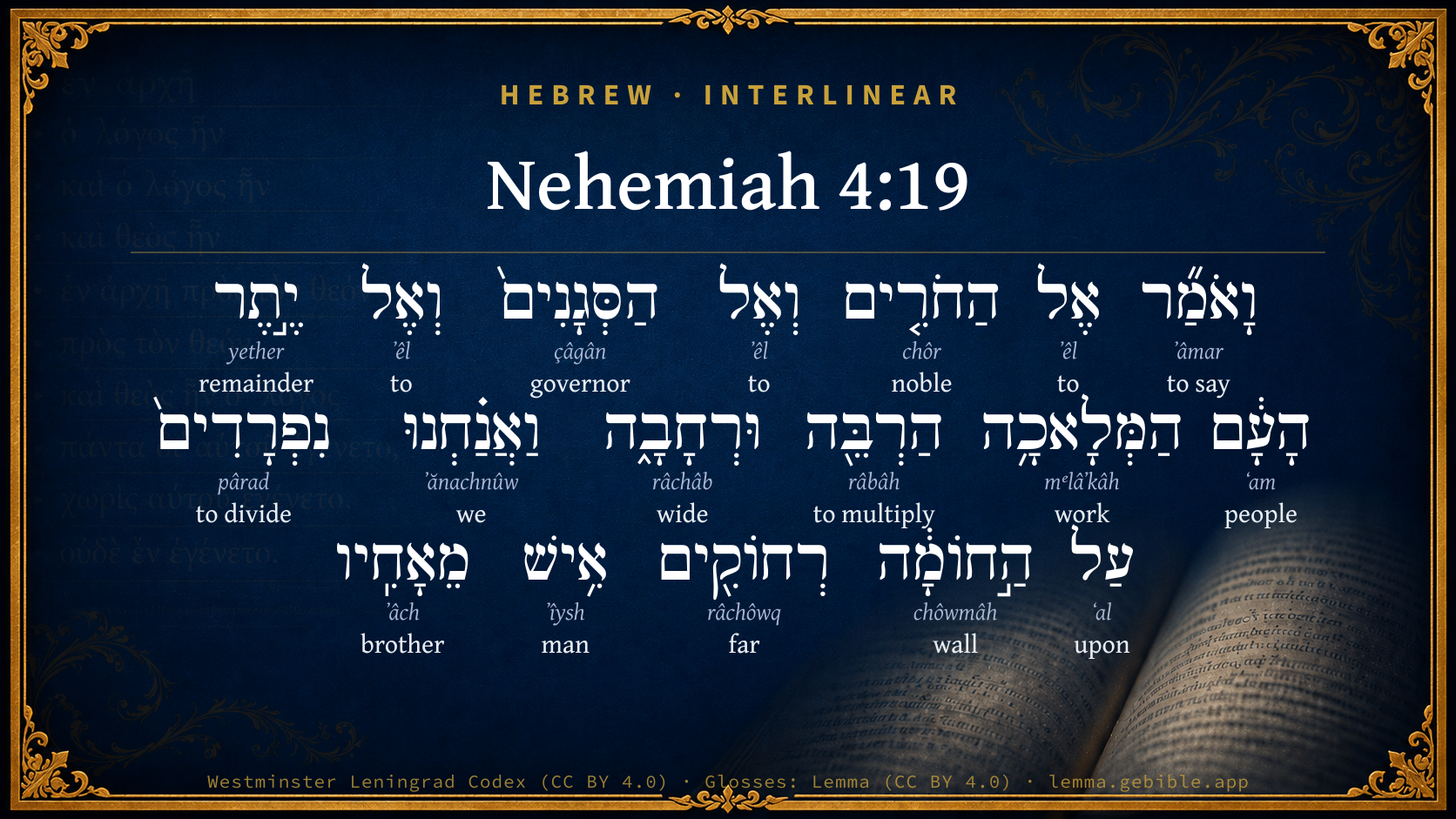
  1. וָאֹמַ֞ר ʼâmar H559 “and · to say” Conjunction + Verb, Qal, Sequential Imperfect, 1st Person, Common, Singular
  2. אֶל ʼêl H413 “to” Preposition
  3. וְאֶל ʼêl H413 “and · to” Conjunction + Preposition
  4. הַסְּגָנִים֙ çâgân H5461 “the · governors” Particle, Definite Article + Noun, Common, Masculine, Plural, Absolute
  5. וְאֶל ʼêl H413 “and · to” Conjunction + Preposition
  6. יֶ֣תֶר yether H3499 “remainder of” Noun, Common, Masculine, Singular, Construct
  7. הָעָ֔ם ʻam H5971 “the · people” Particle, Definite Article + Noun, Common, Masculine, Singular, Absolute
  8. הַמְּלָאכָ֥ה mᵉlâʼkâh H4399 “the · work” Particle, Definite Article + Noun, Common, Feminine, Singular, Absolute
  9. הַרְבֵּ֖ה râbâh H7235 “to multiply” Verb, Hiphil, Infinitive Absolute
  10. וּרְחָבָ֑ה râchâb H7342 “and · wide” Conjunction + Adjective, Adjective, Feminine, Singular, Absolute
  11. וַאֲנַ֗חְנוּ ʼănachnûw H587 “and · we” Conjunction + Pronoun, Personal, 1st Person, Common, Plural
  12. נִפְרָדִים֙ pârad H6504 “dividing” Verb, Niphal, Participle Active, Masculine, Plural, Absolute
  13. עַל ʻal H5921 “upon” Preposition
  14. הַ֣חוֹמָ֔ה chôwmâh H2346 “the · wall” Particle, Definite Article + Noun, Common, Feminine, Singular, Absolute
  15. רְחוֹקִ֖ים râchôwq H7350 “far” Adjective, Adjective, Masculine, Plural, Absolute
  16. אִ֥ישׁ ʼîysh H376 “man” Noun, Common, Masculine, Singular, Absolute
  17. מֵאָחִֽיו ʼâch H251 “from · brother · his” Preposition + Noun, Common, Masculine, Singular, Construct + Suffix, Personal, 3rd Person, Masculine, Singular

About this verse

These counts appear in no published source. They are computed here, from the morphology-tagged text and Lemma’s own curated glosses. What Lemma adds →

18
words
16
distinct lemmas
Historical
section

Notable vocabulary

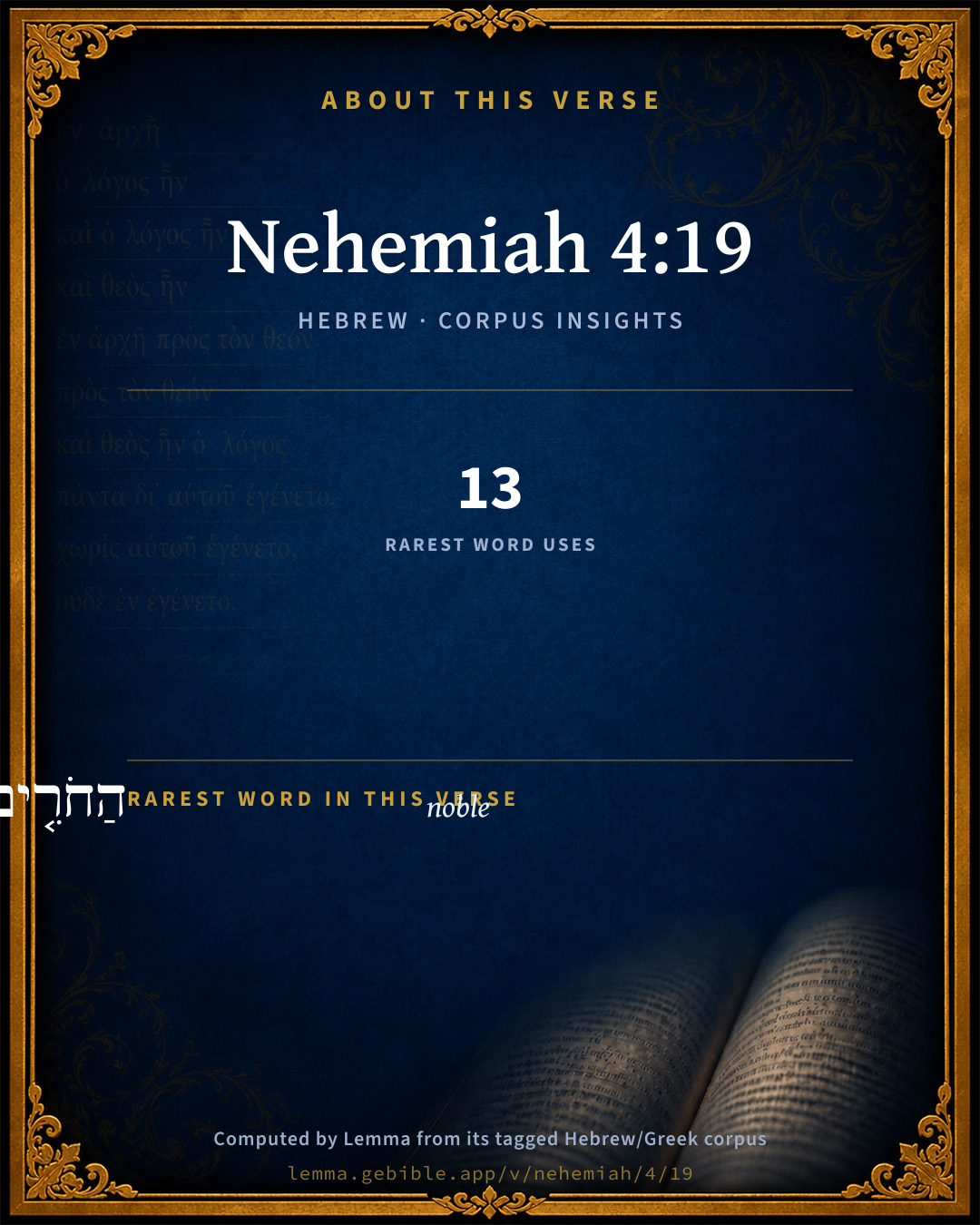
The rarest word here is הַחֹרִ֤ים noble H2715 — appearing just 13 times in the whole Hebrew Bible.

Shared distinctive vocabulary

הַחֹרִ֤ים noble H2715 occurs in 13 verses of the Hebrew Bible. Also found in:

Grammatical profile

  • 3 verbs
  • 8 nouns
  • 2 adjectives
  • 1 pronoun
  • 4 prepositions

Verb forms

  • וָאֹמַ֞ר Qal · Sequential Imperfect
  • הַרְבֵּ֖ה Hiphil · Infinitive Absolute
  • נִפְרָדִים֙ Niphal · Participle Active

Repetition

A word recurs within this verse — often emphatic in Hebrew:

  • אֶל to H413 ×3
Hebrew and Greek witnesses Masoretic Hebrew ↔ Greek Septuagint

The same verse in the two great witnesses to the Old Testament, shown verse-for-verse.

These are two independent witnesses, not word-aligned to each other, and the Septuagint is shown in lemma (dictionary) form.

Hebrew Nehemiah 4:19 Masoretic · Westminster Leningrad Codex

וָאֹמַ֞ר אֶל הַחֹרִ֤ים וְאֶל הַסְּגָנִים֙ וְאֶל יֶ֣תֶר הָעָ֔ם הַמְּלָאכָ֥ה הַרְבֵּ֖ה וּרְחָבָ֑ה וַאֲנַ֗חְנוּ נִפְרָדִים֙ עַל הַ֣חוֹמָ֔ה רְחוֹקִ֖ים אִ֥ישׁ מֵאָחִֽיו

I said to the nobles, and to the rulers and to the rest of the people, The work is great and large, and we are separated on the wall, one far from another:

World English Bible · Public Domain

Greek LXX Structure differs

The Septuagint has no separate book of Nehemiah. Its Greek text is the second half of Esdras B (2 Esdras), chapters 11–23; Ezra is the first half (1–10).

A verse-for-verse comparison isn’t shown here because the chapters and verses don’t line up. Switch to the LXX edition with the MT / LXX toggle above to read the Greek directly.

Hebrew: Westminster Leningrad Codex (CC BY 4.0). Greek: Septuagint (public domain); English from a public-domain English Septuagint. How the Septuagint differs from the Hebrew →

Commentary

Notes on Nehemiah 4:19 from classic Christian and Jewish commentators (each source and its license shown beneath its notes). The classic Christian expositions comment on the surrounding passage and are grouped to its opening verse, so a note may address several verses; the Jewish commentaries on the Tanakh (Rashi and others) are per-verse, so they appear only where the commentator wrote on this verse.

Lemma curates 59 commentaries, every one of them public domain or Creative Commons licensed, each selected and text-cleaned for this edition rather than reprinted as found. About our sources →

Trapp's Complete Commentary

John Trapp

Neh 4:19 And I said unto the nobles, and to the rulers, and to the rest of the people, The work [is] great and large, and we are separated upon the wall, one far from another.

Ver. 19. And I said unto the nobles, &c.] Nehemiah, the more a man observeth him the more he shall admire him. Surely he was (as Velleius saith of Cato Major) homo virtuti simillimus, a man as like virtue as might be; he was (as Pliny saith of the same Cato) optimus Orator, optimus Imperator, optimus Senator, omniumque bonarum artium Magister, an excellent orator, an exeellent general, an excellent statesman, a master of all good arts whatsoever. He had cropped off the very tops of all virtues, as Pindarus saith of Jerome (δρεπων κορνφας αρετων απο πασων), and as Melancthon saith of Frederick, the elector of Saxony. From the builders here he turneth him to the nobles and rulers, &c., whom he would not have to be carpet knights, fitter for a canopy than a camp, for language than a lance, &c., but active in their orb, and ready pressed to serve in watching, warding, and preparing things necessary for the workmen.

The work is great and large] The compass of the walls at this time is thought by good writers to be certain miles about; and yet was enlarged as much afterwards by Herod.

And we are separated upon the wall] According to our divisions, noted Neh 3:1, &c., and this is a weapon in the hand of our enemies; for dum pugnamus singuli, vincimur universi, being dispersed, we are much disadvantaged.

John Trapp, A Commentary or Exposition upon All the Books of the Old and New Testament (1647–1656) — public domain. Text from a community e-Sword module.

The Biblical Illustrator

Joseph S. Exell

Neh_4:19-20

The work is great . . . and we are separated upon the wall.

The common work of the Master

In time of war you visit the camp. There is flying from the flagpole in the sun the stars and stripes. You look upon the men in their scattered avocations. A few men are playing, a few men are cleaning their guns, a few men are cooking, here and there a sentry is pacing back and forth, some men are lying on the grass asleep, there is no common life, there seems to be no common purpose, there appears to be no common endeavour, or action. But suddenly the bugle sounds the call, or the drum its roll, and instantly the men spring to their feet, drop their cards, awake from their slumber, leave their cooking utensils, anal stand ready to meet the enemy, ready to do the bidding of their commander. Deep down in their hearts there is a common purpose, and that flag that floats at the topmost pole and over their camp indicates what that purpose is. So Christians are to gather in the name of Christ--you, merchant--you, lawyer--you, physician--you, minister--you, teacher--you, parent, each in your several place, each doing your several work. Whenever the drum shall beat its roll-call, you are to be ready, not merely to do your own work, but to stand shoulder to shoulder in serried ranks, to do the common work of the Master, in fulfilment of the common aim which has really united you. (Lyman Abbott.)

The Biblical Illustrator, edited by Joseph S. Exell (c. 1880s–1900s) — public domain. Text from a community e-Sword module.

The Cambridge Bible for Schools and Colleges

gen. ed. J. J. S. Perowne

19. nobles … rulers &c.] as in Neh_4:14, and Neh_2:16, where see note.

large] literally ‘wide,’ referring to the extensive character of the building operations, which caused the defenders to be so scattered.

The Cambridge Bible for Schools and Colleges (gen. ed. J. J. S. Perowne; Cambridge University Press, 1878–1918) — public domain. Text from a community e-Sword module.

John Gill's Exposition

And I said unto the nobles, and to the rulers, and to the rest of the people,.... See Gill on Neh 4:14,

the work is great and large; the building of the wall all around the city of Jerusalem:

and we are separated upon the wall one far from another; some at work on one part of it, and some at another, so that the distance between one another, at least in the further part, was very considerable.

John Gill's Exposition of the Whole Bible (1746–1763) — public domain (CC PDM 1.0). Text via the HelloAO Bible API.

Whedon's Commentary on the Bible

Daniel D. Whedon

19. We are separated — Being grouped by families at the more exposed places along the city wall. See on Neh_4:13. Hence the necessity of having a concerted signal to call them together in case of attack.

Daniel D. Whedon (gen. ed.), Commentary on the Old and New Testaments (1874–1909) — public domain. Text from a community e-Sword module.

unfoldingWord translationNotes

Door43 World Missions Community

I said

Here "I" refers to Nehemiah.

the nobles ... the officials

These are the leaders referred to in Nehemiah 4:16.

The work is great

Here the word "great" means "large-scale" or "huge."

the trumpet sound

This refers to someone blowing a trumpet. AT: "someone blowing a trumpet" (See: Metonymy)

translationWords

trumpet

assembly

God

unfoldingWord translationNotes — © Distant Shores Media and the Door43 World Missions Community, licensed CC BY-SA 4.0. Source: git.door43.org/Door43/en_tn.

Lesson kit

Teaching starters — assembled from the data on this page, not authored interpretation. Every prompt links to the verse data it draws on. Edit before teaching.

Nehemiah, in the Historical, opens this verse with 18 words (16 distinct Hebrew lemmas). Its most distinctive word is chôr (“noble”). A historical commentator’s framing appears above. Read the whole chapter for the surrounding context.

Discussion questions

  1. What does “noble” (chôr) contribute to the verse as a whole?
  2. How does 1 Kings 21:8, which shares the word «noble», read alongside this verse?
  3. What does the repetition of “to” (3× in this one verse) do in this verse?
  4. These translations render this verse differently; the difference is in the English rendering, not the original. What questions does that raise?
  5. «וָאֹמַ֞ר» is a Qal Sequential Imperfect verb. How does that grammatical form shape the action described?
  6. Compare how Trapp's Complete Commentary and The Biblical Illustrator read this verse. Where do they agree or differ?

Things to notice

Reading settings

Reading text

Shown beneath each verse's original-language words.

Old Testament
Old Testament edition

Read the OT as the Masoretic Hebrew (MT) or the Greek Septuagint (LXX).

English shown for the Greek Septuagint (in the Hebrew ↔ Greek comparison).

Comparing translations? Open the Compare panel on any verse page to stack up to four side by side.