

Proverbs 13:11

Hebrew (Westminster Leningrad Codex) Proverbs 13:11 appears in the Hebrew Old Testament. The text above is from the Westminster Leningrad Codex. Each word links to its Strong’s number, a concise gloss, and parsing drawn from the Open Scriptures Hebrew Bible morphology. Click any word for its full Brown-Driver-Briggs (BDB) entry.
Download image
Cite this verse

Proverbs 13:11 (World English Bible). Public Domain. Lemma interlinear Bible study tool, https://lemma.gebible.app/v/proverbs/13/11.

Show BibTeX & RIS
BibTeX
RIS
English Translation
Wealth gained dishonestly dwindles away, But he who gathers by hand makes it grow.
World English Bible · Public Domain
Download a study sheet

One document with this verse’s original text, its word-by-word gloss line, the meaning frame, cross-references with their text, attributed commentary, and full source and license credits — printable, and it pastes into notes with its structure intact.

This verse Autodidact and up

Study sheet (.html) Plain text (.txt)

A passage Seminary Student

Up to 50 verses in one chapter. A passage sheet keeps up to 6 commentary sources and 12 cross-references per verse, in the order this page ranks them, and says so on the sheet whenever that leaves anything out. Ask for a single verse and you get the Autodidact verse sheet above.

Everything on this page stays free to read, with no account — the sheet is a download of what is already on screen, not access to it.

Want to remove ads? Support Godless Engineer
Compare translations 3

The same verse in 3 English versions, stacked beneath the original-language interlinear above. Click any original word for its lexicon entry.

Each is an independent rendering of the whole verse — the interlinear is not word-aligned to these translations.

Highlighted words mark where these versions differ — a whole-verse word diff, not a word-by-word alignment.

  • World English Bible Public Domain
    Wealth gained dishonestly dwindles away, But he who gathers by hand makes it grow.
  • King James Version Public Domain
    Wealth gotten by vanity shall be diminished: but he that gathereth by labour shall increase.
  • unfoldingWord Literal Text CC BY-SA 4.0
    Wealth from emptiness will dwindle, but one gathering by hand will increase.

unfoldingWord Literal Text — © unfoldingWord, licensed CC BY-SA 4.0. Word-aligned USFM3 via Door43 (git.door43.org/unfoldingWord/en_ult).

Versions to compare (up to 4)

3 of 4 selected

Show all 18 translations

Every available English version of this verse, each an independent rendering of the whole verse.

  • World English Bible Public Domain
    Wealth gained dishonestly dwindles away, But he who gathers by hand makes it grow.
  • Berean Standard Bible Public Domain
    Dishonest wealth will dwindle, but what is earned through hard work will be multiplied.
  • Majority Standard Bible Public Domain
    Dishonest wealth will dwindle, but what is earned through hard work will be multiplied.
  • King James Version Public Domain
    Wealth gotten by vanity shall be diminished: but he that gathereth by labour shall increase.
  • American Standard Version (1901) Public Domain
    Wealth gotten by vanity shall be diminished; But he that gathereth by labor shall have increase.
  • Revised Version (1885) Public Domain
    Wealth gotten by vanity shall be diminished: but he that gathereth by labour shall have increase.
  • Geneva Bible (1599) Public Domain
    The riches of vanitie shall diminish: but he that gathereth with the hand, shall increase them.
  • Douay-Rheims (1899) Public Domain
    Substance got in haste shall be diminished: but that which by little and little is gathered with the hand shall increase.
  • Young's Literal Translation Public Domain
    Wealth from vanity becometh little, And whoso is gathering by the hand becometh great.
  • Literal Standard Version CC BY-SA 4.0
    Wealth from vanity becomes little, || And whoever is gathering by the hand becomes great.
  • Unlocked Literal Bible CC BY-SA 4.0
    Wealth dwindles away when there is too much vanity, but the one who makes money by working with his hand will make his money grow.
  • unfoldingWord Literal Text CC BY-SA 4.0
    Wealth from emptiness will dwindle, but one gathering by hand will increase.
  • Darby Bible Public Domain
    Wealth [gotten] by vanity diminisheth; but he that gathereth by manual-labour shall increase [it].
  • World Messianic Bible Public Domain
    Wealth gained dishonestly dwindles away, but he who gathers by hand makes it grow.
  • Webster's Bible Public Domain
    Wealth gotten by vanity shall be diminished: but he that gathereth by labor shall increase.
  • Free Bible Version CC BY-SA 4.0
    Wealth gained by fraud quickly disappears, but those who gather bit by bit prosper.
  • Bible in Basic English Public Domain
    Wealth quickly got will become less; but he who gets a store by the work of his hands will have it increased.
  • JPS Tanakh (1917) Public Domain
    Wealth gotten by vanity shall be diminished; but he that gathereth little by little shall increase.

Literal Standard Version (2020), Covenant Press — licensed CC BY-SA 4.0. Text via the HelloAO Bible API (eBible.org). Unlocked Literal Bible (unfoldingWord) — licensed CC BY-SA 4.0. Text via the HelloAO Bible API (eBible.org). unfoldingWord Literal Text — © unfoldingWord, licensed CC BY-SA 4.0. Word-aligned USFM3 via Door43 (git.door43.org/unfoldingWord/en_ult). Free Bible Version, Dr. Jonathan Gallagher — licensed CC BY-SA 4.0. Text via the HelloAO Bible API (eBible.org).

Word by word

More ways to search: Search by grammar → Find every occurrence → Compare this word →

Practice this passage: Drill this verse → Learn its vocabulary →

About this verse

These counts appear in no published source. They are computed here, from the morphology-tagged text and Lemma’s own curated glosses. What Lemma adds →

7
words
7
distinct lemmas
Wisdom
section

Notable vocabulary

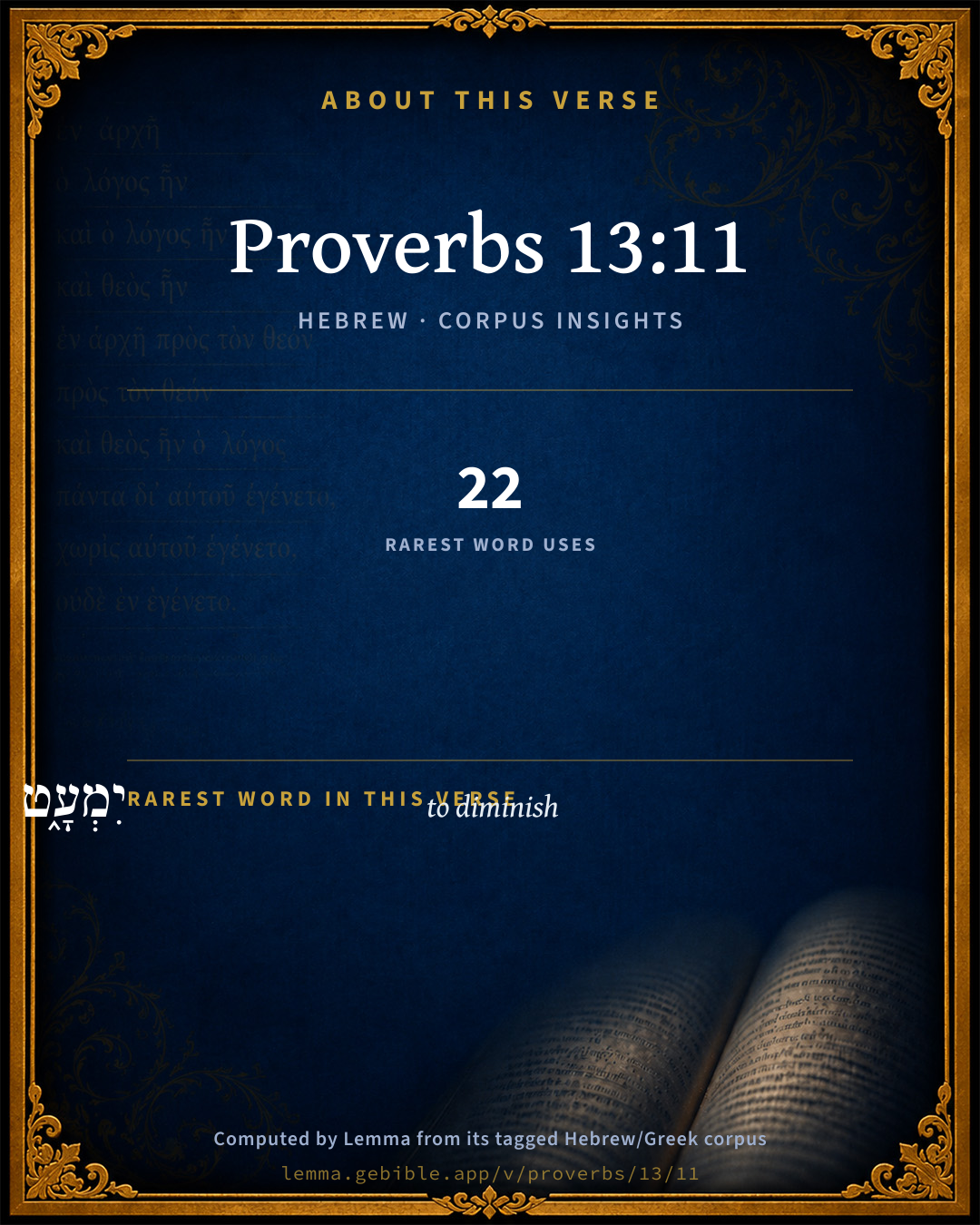
The rarest word here is יִמְעָ֑ט to diminish H4591 — appearing just 22 times in the whole Hebrew Bible.

Shared distinctive vocabulary

יִמְעָ֑ט to diminish H4591 occurs in 21 verses of the Hebrew Bible. Also found in:

Grammatical profile

  • 3 verbs
  • 3 nouns
  • 1 preposition

Verb forms

  • יִמְעָ֑ט Qal · Imperfect
  • וְקֹבֵ֖ץ Qal · Participle Active
  • יַרְבֶּֽה Hiphil · Imperfect

Hebrew & Septuagint length

In English translation the verse runs 14 words from the Hebrew and 24 from the Septuagint (LXX English) — the Septuagint runs noticeably longer here. See the side-by-side →

A rough comparison of the two English renderings, which tokenize alike — not a word-level alignment.

Word counts can differ between the Hebrew and the Greek without any difference in meaning — e.g. the Hebrew direct-object marker אֵת has no separate Greek word, and Greek often adds the article ὁ.

Cross-references

16

Topical passages linked to Proverbs 13:11 in the Treasury of Scripture Knowledge — connected by theme and wording, ordered by reader-vote popularity; previews shown in the World English Bible.

  • Proverbs 20:21 An inheritance quickly gained at the beginning, Won't be blessed in the end.
  • Proverbs 10:2 Treasures of wickedness profit nothing, But righteousness delivers from death.
  • James 5:1–5 Come now, you rich, weep and howl for your miseries that are coming on you.
  • Proverbs 28:8 He who increases his wealth by excessive interest Gathers it for one who has pity on the poor.
  • Job 27:16–17 Though he heap up silver as the dust, And prepare clothing as the clay;
  • Proverbs 13:22–23 A good man leaves an inheritance to his children's children, But the wealth of the sinner is stored for the righteous.
  • Proverbs 27:23–27 Know well the state of your flocks, And pay attention to your herds:
  • Proverbs 28:20 A faithful man is rich with blessings; But one who is eager to be rich will not go unpunished.
  • Proverbs 28:22 A stingy man hurries after riches, And doesn't know that poverty waits for him.
  • Psalms 128:2 For you will eat the labor of your hands. You will be happy, and it will be well with you.
  • Jeremiah 17:11 As the partridge that sits on [eggs] which she has not laid, so is he who gets riches, and not by right; in the midst of his days they shall leave him, and at his end he shall be a fool.
  • Habakkuk 2:6–7 Won't all these take up a parable against him, and a taunting proverb against him, and say, 'Woe to him who increases that which is not his, and who enriches himself by extortion! How long?'
  • Job 20:15 He has swallowed down riches, and he shall vomit them up again. God will cast them out of his belly.
  • Job 15:28–29 He has lived in desolate cities, In houses which no one inhabited, Which were ready to become heaps.
  • Job 20:19–22 For he has oppressed and forsaken the poor. He has violently taken away a house, and he shall not build it up.
  • Ecclesiastes 5:14 Those riches perish by misfortune, and if he has fathered a son, there is nothing in his hand.

Cross-references courtesy of OpenBible.info (CC BY 4.0).

Hebrew and Greek witnesses Masoretic Hebrew ↔ Greek Septuagint

The same verse in the two great witnesses to the Old Testament, shown verse-for-verse.

Here the Septuagint runs noticeably longer than the Hebrew — LXX2012 (modern English Septuagint) 24 words vs World English Bible 14. A rough length comparison of the two English translations, not a word-level alignment — read both below.

These are two independent witnesses, not word-aligned to each other, and the Septuagint is shown in lemma (dictionary) form.

Hebrew Proverbs 13:11 Masoretic · Westminster Leningrad Codex

ה֭וֹן מֵהֶ֣בֶל יִמְעָ֑ט וְקֹבֵ֖ץ עַל יָ֣ד יַרְבֶּֽה

Wealth gained dishonestly dwindles away, But he who gathers by hand makes it grow.

World English Bible · Public Domain

Greek LXX Proverbs 13:11 Septuagint · lemma form

ὕπαρξις ἐπισπουδάζω μετά ἀνομία ἐλαχύς γίγνομαι ὁ δέ συνἄγω ἑαυτοῦ μετά εὐσέβεια πληθύνω δίκαιος οἰκτείρω καί κιχράω

Wealth gotten hastily with iniquity is diminished: but he that gathers for himself with godliness shall be increased. The righteous is merciful, and lends.

LXX2012 (modern English Septuagint) · Public Domain

On this verse, The Cambridge Bible for Schools and Colleges discusses the Septuagint’s reading. Read the note in Commentary ↓

Hebrew: Westminster Leningrad Codex (CC BY 4.0). Greek: Septuagint (public domain); English from LXX2012 (modern English Septuagint) (Public Domain). How the Septuagint differs from the Hebrew →

Commentary

Notes on Proverbs 13:11 from classic Christian and Jewish commentators (each source and its license shown beneath its notes). The classic Christian expositions comment on the surrounding passage and are grouped to its opening verse, so a note may address several verses; the Jewish commentaries on the Tanakh (Rashi and others) are per-verse, so they appear only where the commentator wrote on this verse.

Lemma curates 59 commentaries, every one of them public domain or Creative Commons licensed, each selected and text-cleaned for this edition rather than reprinted as found. About our sources →

Trapp's Complete Commentary

John Trapp

Pro 13:11 Wealth [gotten] by vanity shall be diminished: but he that gathereth by labour shall increase.

Ver. 11. Wealth gotten by vanity shall be diminished.] De male quaesitis vix gaudet tertius haeres, {a} Ill-gotten goods fly away without taking leave of the owner; leaving nothing but the print of talons to torment him. {Pro 23:5} Many when they have a loss in their riches, it is as it were raked out of their bellies. {Job 20:15} A piece of their very heart goes with it.

But he that gathereth by labour shall increase.] Howbeit sometimes it is otherwise: "Master, we have laboured all night and taken nothing." {Luk 5:5} "Behold, is it not of the Lord of hosts that the people shall labour in the very fire, and the people shall weary themselves for very vanity?" {Hab 2:13} There is a curse upon unlawful practices, though men be industrious, as in Jehoiakim. {Jer 22:24-30}

{a} Horat.

John Trapp, A Commentary or Exposition upon All the Books of the Old and New Testament (1647–1656) — public domain. Text from a community e-Sword module.

The Biblical Illustrator

Joseph S. Exell

Pro_13:11

Wealth gotten by vanity shall be diminished: but he that gathereth by labour shall increase.

Right methods of obtaining wealth

The text implies three things.

I. That wealth in itself is a good thing.

1. All men strive for it, in obedience to the original command--to possess the earth and subdue it.

2. The services it can render are evidences of its value.

3. The Word of God approves it. Not money, but the love of it, is a root of evil.

II. Wealth may be obtained in different ways. The two ways mentioned in the text.

1. The way of vanity, which may represent fraud, gambling, reckless speculation, etc.

2. The way of labour, in all which there is profit (Pro_14:23). See frequent commendations of diligence in the Scriptures.

III. The increase or decrease of wealth is affected by the mode of its acqusition. Gotten by vanity, it diminishes; procured by labour, it shall increase. Two considerations as to the constitution of human nature help us to understand how this comes about.

1. What a man does not work for he seldom appreciates. Difficulty of attaining augments value. Easy got, soon spent, has passed into a proverb.

2. What one does not value he is apt to squander. Spendthrifts are those who value money slightly. (F. Wagstaff.)

Ill-gotten national wealth

What is true of private is no less true of public possessions. When such possessions are obtained, on the part of any country, by self-aggrandising and unprovoked aggression, extermination and conquest, what are such means but injustice, oppression, and murder, on an extended scale? Gathering possessions by a violation of the rights of others, of the principles of equity and honour and good faith, or, in one word, of the royal law, is turning a countrys glory into shame, and under the righteous and retributive administration of Heaven the extension of dominion is but an extension of danger. (R. Wardlaw.)

Wealth gotten by vanity

When the famous M. Blanc, who founded the Monte Carlo Casino, was proprietor of a gambling establishment at Homburg, it was his custom to bring down 300,000 francs every morning to meet the banks losses. When this sum was exhausted the bank was said to be broke, and the doors were closed for the day, and it is recorded that the unique feat of breaking the bank was accomplished three days in succession by the notorious South American Spaniard, Garcia. After this his luck began to turn, and six weeks later he was obliged to ask M. Blanc for a few louis with which to return to Paris. (Daily Mail.)

The Biblical Illustrator, edited by Joseph S. Exell (c. 1880s–1900s) — public domain. Text from a community e-Sword module.

Joseph Benson's Commentary

Pro 13:11. Wealth gotten by vanity — By vain, or deceitful, or wicked practices; shall be diminished — Because the curse of God attends it, and the same corrupt dispositions which incline men to sinful ways of getting riches will incline them to the like sinful ways of spending them. Wealth gotten by vanity will be bestowed upon vanity, and then it will be diminished. That which is obtained by such employments as are not lawful, or not becoming Christians; as by gaming, by the stage, or by any employment which only serves to feed the pride and luxury of mankind, may as truly be said to be gotten by vanity, as that which is got by fraud and lying, and will be diminished; but he that gathereth by labour — By diligence in an honest calling; shall increase — Through the divine blessing, and his property and influence will become greater instead of growing less.

Joseph Benson's Commentary on the Old and New Testaments (1811–1818) — public domain. Text from a community e-Sword module.

The Preacher's Complete Homiletical Commentary

Joseph S. Exell (gen. ed.)

CRITICAL NOTES.—

Pro_13:11. Vanity, rather “fraud.” By labour, literally “by the hand.” or “handful after handful.”

MAIN HOMILETICS OF Pro_13:11

TWO WAYS OF GROWING RICH

I. Wealth can be gotten. Wealth may be acquired by those who have it not. The wealth of the sea is within the reach of the fisherman. If he put down his net, sooner or later he will probably be rewarded with some gain. There is wealth in the sea of human life. Although the experience of some may be “to toil all night and to take nothing,” yet the rule is that men who make an effort will succeed in bringing into their nets more or less of worldly gain. Some degree of skill and toil are needed to do this, but probably there was never a time when talent of any kind, or patient endeavour, was more certain to meet with a reward than in the present day. Aptitude for business will probably make a man a thriving tradesman if it does not make him a merchant prince. Intellectual power and artistic skill have a wide field in which to work, and are generally sure of liberal reward. Probably there never was an age when those who have nothing but the net of genius to spread upon the sea of life were so certain to land gold upon the shore.

II. But there are two ways of growing rich. There is the way of vanity. Some men come into a fortune by a single throw of the dice—by a fortunate speculation—a lucky hit. They may not be dishonest as men generally understand the word, although as a rule such transactions will not bear too much exposure to the sunlight, but it is not the best way to get money. Then there are others who for a lifetime have nibbled at the lawful gains of other men, and have thus become rich. And others have gotten their wealth by some one act of dishonesty, of which society is ignorant or is unable to punish. All these ways of making money are vain in comparison with that of patient, honest, daily toil. The reaper gathers in the golden grain in the sweat of his face, an armful at each stroke of the sickle; step by step, “hand by hand,” he makes himself master of the field and gathers the wheat into the garner. So patient daily toil is the Divinely-ordained way to grow rich. The daily practice of industrious habits and the exercise of patience, which are thus rendered necessary, are beneficial to a man’s moral nature.

III. The possession of wealth will be permanent or short-lived according to the way in which it has been acquired. l. Wealth gotten at a leap is generally “diminished” by the man who gained it. Such men are generally reckless in their expenditure, and squander a fortune in almost as short a time as they gained it. Such a sudden acquisition of wealth has been unfavourable to the formation of thrifty habits, and the man is not equal to his position. Many a gold-digger who has found in a day a nugget worth many thousands, has been a poor man again in a few months, and the experience of most men furnishes them with some similar illustration of the truth although not perhaps so striking.

2. Wealth gotten by dishonesty will be diminished by God. Time only is needed to make manifest the righteous judgment of God upon wealth gotten by such “vanity.” Like the prophet’s gourd, although it affords pleasant shelter to those who sit under it now, there is a worm at the root which will certainly bring it to nothing. Did we but know how some fortunes have been acquired, we should be less surprised at their possessors being suddenly reduced to beggary. It may be that those who are thus brought low are not the makers, but the possessors only, of wealth gotten by vanity, yet they have to pay the penalty. On the contrary, the man who has patiently and honestly gathered, little by little, a sufficiency, or even more, has gathered at the same time wisdom to use it, and has not forfeited the blessing of the Lord (chap. Pro_10:22).

OUTLINES AND SUGGESTIVE COMMENTS

“It is easier to make a fortune than to keep it.” So say the worldly. Specially forbidden is the keeping of the bread of heaven (Exo_16:19). It was to be gathered every morning. A man who keeps gathering on the hand is the man to stay rich. But the saint who hoards up the past, and lives upon the fortune that he had, is the Israelite who kept the manna, and who found that it “bred worms and stank.” Even happiness is not promoted by over-guard. “Things won are done; joy’s soul lies in the doing.” … Continuing to work not only keeps wealth, but “increases it,” most particularly spiritual wealth.—Miller.

The words admit of three renderings

(1) That of the A.V. “Wealth gotten by vanity,” i.e., by a windfall, or sudden stroke of fortune, not by honest labour, is soon diminished; or

(2) wealth is diminished by vanity, by empty and hollow ostentation; or

(3) wealth is diminished quicker than a breath. Of these

(1) is believed to be the best. In any case the general meaning seems to be that the mere possession of riches is as nothing; they come and go; but the power to gain by skill of hand is everything. By labour, “or by the hand,” has three possible meanings

(1), as in the A.V.;

(2) in proportion to his strength;

(3) “in due measure.”—Plumptre.

Ill-gotten goods fly away without taking leave of the owner; leaving nothing but the print of talons to torment him (chap. Pro_23:5). “But he that gathereth by labour shall increase.” Howbeit, sometimes, it is otherwise. “Master, we have toiled all night, and taken nothing” (Luk_5:5).—Trapp.

The Preacher's Complete Homiletical Commentary (gen. ed. Joseph S. Exell; Funk & Wagnalls, c. 1892) — public domain (pre-1929). A full-Bible homiletical/sermon-outline anthology covering 65 of 66 books (2 John is absent from the source module). Text from a community e-Sword module.

Geneva Bible (1599)

Geneva Bible translators

That is, with his own labor.

That is, goods evil gotten.

Geneva Bible (1599) marginal notes — public domain. Text via Bolls.life.

Matthew Henry's Commentary

This shows that riches wear as they are won and woven. 1. That which is won ill will never wear well, for a curse attends it which will waste it, and the same corrupt dispositions which incline men to the sinful ways of getting well incline them to the like sinful ways of spending: Wealth gotten by vanity will be bestowed upon vanity, and then it will be diminished. That which is got by such employments as are not lawful, or not becoming Christians, such as only serve to feed pride and luxury, that which is got by gaming or by the stage, may as truly be said to be gotten by vanity as that which is got by fraud and lying, and will be diminished. De male quaesitis vix gaudet tertius haeres - Ill-gotten wealth will scarcely be enjoyed by the third generation. 2. That which is got by industry and honesty will grow more, instead of growing less; it will be a maintenance; it will be an inheritance; it will be an abundance. He that labours, working with his hands, shall so increase as that he shall have to give to him that needs (Eph 4:28); and, when it comes to that, it will increase yet more and more.

Matthew Henry's Commentary on the Whole Bible (1708–1710) — public domain (CC PDM 1.0). Text via the HelloAO Bible API.

Jamieson, Fausset & Brown

Robert Jamieson, A. R. Fausset & David Brown

by vanity--or, "nothingness," that is, which is vain or useless to the public (as card playing or similar vices).

gathereth . . . labour--(Compare Margin), little by little, laboriously.

Jamieson, Fausset & Brown — Commentary Critical and Explanatory on the Whole Bible (1871) — public domain (CC PDM 1.0). Text via the HelloAO Bible API.

Adam Clarke's Commentary

Verse 11. Wealth gotten by vanity] Wealth that is not the result of honest industry and hard labour is seldom permanent. All fortunes acquired by speculation, lucky hits, and ministering to the pride or luxury of others, &c., soon become dissipated. They are not gotten in the way of Providence, and have not God's blessing, and therefore are not permanent.

Adam Clarke's Commentary on the Bible (1810–1826) — public domain. Text from a community e-Sword/MySword module.

Ellicott's Commentary for English Readers

(11) Wealth gotten by vanity.—As we should say, “in an unsatisfactory manner,” that is to say, by dishonesty.

A Bible Commentary for English Readers, edited by Charles John Ellicott (1878–1897) — public domain. Text from a community e-Sword module.

The Cambridge Bible for Schools and Colleges

gen. ed. J. J. S. Perowne

11. by vanity] i.e. by untrustworthy methods, such as speculation, gambling, high rate of interest with poor security (comp. Pro_21:6), in contrast to hard work, by labour (lit. with the hand). The word vanity in this sense of what is unreliable and transitory is a key-word of the Book of Ecclesiastes.

The LXX. and Vulg. render in haste, quick returns, ἐπισπουδαζομένη (with the addition μετὰ ἀνομίας), festinata.

The Cambridge Bible for Schools and Colleges (gen. ed. J. J. S. Perowne; Cambridge University Press, 1878–1918) — public domain. Text from a community e-Sword module.

John Gill's Exposition

Wealth gotten by vanity shall be diminished,.... In an unjust or unlawful way, either by robbery and theft, as Aben Ezra; or by fraud and tricking, by overreaching and circumventing others; or by vain practices, as by cards or dice, and by stage playing and the like; or by curious and illicit arts, as necromancy, judiciary astrology, and such like things; whatever is gotten in a wicked way very seldom lasts long; it lessens by little and little till it comes to nothing (f); see Jer 17:11; and sometimes very quickly and suddenly, all at once; thus that mass of riches which the church of Rome has got together by her vain and wicked practices, by her idolatry, pardons, and indulgences, will in one hour come to nought, Rev 18:17;

but he that gathereth by labour shall increase, or "that gathereth by the hand" or "in it" (g); by hand labour in an honest way, or with the diligent hand, which maketh rich; who labours with his hand and gets by in sufficient to support himself and his family, and to give to the necessities of others; who does not lay it up in coffers, but keeps it in his hand to distribute; such generally thrive and flourish: some copies read it, "he that gathereth, unto the hand" (h), that gathers and puts it into the hands of others; that liberally communicates to the poor; he shall increase, as commonly liberal persons do; so the Targum,

"he that gathereth and giveth to the poor shall increase in substance.''

(f) "De malo quaesitis vix gaudet tertius baeres", Herat. (g) "in manu", Pagninus, Junius & Tremellius, Piscator; "super manu", Gussetius, p. 310. "super manum", Michaelis, Schultens. (h) "Usque ad manum", Montantus.

John Gill's Exposition of the Whole Bible (1746–1763) — public domain (CC PDM 1.0). Text via the HelloAO Bible API.

Albert Barnes' Notes on the Bible

By vanity - literally, “by a breath,” i. e., by a windfall, or sudden stroke of fortune, not by honest labor. The general meaning seems to be that the mere possession of riches is as nothing; they come and go, but the power to gain by skill of hand (“labor”) is everything.

Albert Barnes' Notes on the Bible (1834–1885) — public domain. Text from a community e-Sword/MySword module.

Haydock's Catholic Bible Commentary

Haste. Hebrew, "by vanity," and injustice. Those who become rich on a sudden fall under suspicion, as a Roman objected to Sylla, who had inherited nothing. (Plut.[Plutarch?]) --- By little. Hebrew, "he that gathereth by labour, (Septuagint, piety) shall increase." (Protestants) (Haydock)

George Leo Haydock (1774–1849), Haydock's Catholic Family Bible and Commentary, 1859 edition — public domain. Excludes Psalms (Douay-Rheims chapter numbering differs from Protestant) and Deuterocanonical books (Catholic canon only).

Matthew Poole's English Annotations

By vanity; by vain, or deceitful, or wicked practices. Shall be diminished, because the curse of God attends upon it.

By labour; by diligence in an honest calling.

Matthew Poole's English Annotations on the Holy Bible (1683–1685) — public domain. Text from a community e-Sword/MySword module.

Whedon's Commentary on the Bible

Daniel D. Whedon

11. Wealth… by vanity — Hebrew, from nothing, or without effort, “by fraud or impatient dishonesty.” — Zockler.

Shall be diminished — Waste away.

Gathereth by labour — Hebrew, by, with, or upon the hand, as we say, by the handful. It is, however, procured by slow and toilsome effort, as by honest labour.

Shall increase — This agrees with the general observation of mankind, as is witnessed by the many proverbial sayings expressive of it. The “hand” above represents all honest ways of industry, and is opposed to “vanity.” Comp. Pro_10:2; Pro_10:4; Pro_20:21; Jer_17:11; Psa_128:2. On wealth gotten by vanity, comp. Job_15:28-29; Job_20:15; Job_19:22; and “with the hand,” Pro_22:29; Pro_27:23; Pro_27:27.

Daniel D. Whedon (gen. ed.), Commentary on the Old and New Testaments (1874–1909) — public domain. Text from a community e-Sword module.

The Pulpit Commentary

Wealth gotten by vanity shall be diminished; literally, wealth by a breath; i.e. wealth obtained without labour and exertion, or by illegitimate and dishonest means, is soon dissipated, is not blessed by God, and has no stability. Vulgate, "riches acquired hastily;" Septuagint, "substance gotten hastily with iniquity." This makes the antithesis more marked, the contrast being between wealth gotten hastily and that acquired by diligent labour. Cito nata, cito pereunt, "Quickly won, quickly gone". (see on Pro_20:21 Pro_21:5) Says the Greek maxim Mh speude ploutein mh tacunhv genh . "Haste not for wealth, lest thou be quickly poor.

He that gathereth by labour; literally, with the hand, handful after handful. Vulgate, paulatim, "little by little," by patient industry. Labor improbus omnia vincit. Septuagint, "He that gathereth for himself with piety shall be increased." Then is added, "A good man is merciful and lendeth," from Psa_37:26. The Septuagint here uses the term eusebeia , which is received in St. Paul"s pastoral Epistles and St. Peter"s, taking the place of the earlier phrase, fobov Kuriou .

Fraudulent gain.

I THE DELUSIVE APPEARANCE OF FRAUDULENT GAIN. This looks very different from coarse, vulgar robbery. The sleek swindler owns no common brotherhood with the brutal burglar. Fraudulent gain is got in the way of business; it is not at all like the money directly stolen from a man"s pocket. The process is so very roundabout that it is difficult to trace the transition from fair dealing to cheating. The decorous thief would be horrified at hearing his true name. He knows his actions are not quite straightforward, but the crookedness of them is almost hidden from himself by neat contrivances. Now, all this makes the pursuit of fraudulent gain the more treacherous and dangerous. A man who follows such a course is lost before he owns himself to be dishonest.

II THE TEMPTATIONS TO MAKE FRAUDULENT GAIN. They spring from various sources.

1. Keen competition. It is so hard to make a living in the fierce contest of business life, when every rival is treated as an enemy, that any extra advantage is eagerly sought after.

2. Large promises. As the margin of profits shrink while the requirements of energy and alertness grow, any expedient that promises more speedy and remunerative returns is likely to present a fascinating appearance.

3. Compromising customs. Business is not always conducted on perfectly honest grounds, and the dishonesty that is prevalent claims to be sanctioned by usage. Moreover, if some departure from absolute fight is permitted, a greater degree of dishonesty is but another step in the same direction.

4. Hopes of secrecy. The man of business cannot afford to lose his good name, and therefore plain self interest holds him back from open theft. But the subtle pursuit of a more refined form of dishonesty appears to be possible without any less of character. Thus as the pressure of the opinion of society is eluded, the only conscience which some men recognize ceases to operate.

III THE RUINOUS RESULTS OF MAKING FRAUDULENT GAIN.

1. It is a great sin. The delusive appearance of the pursuit blinds people to its true character. But theft cannot be made honest by becoming refined. All the laws of righteousness bristle up in front of the man who pursues dishonesty, and threaten his ruin. Even though social and civil retribution be evaded, there is a higher court of justice than any of man"s jurisdiction, and before its awful bar the wealthy, respected thief must ultimately stand condemned.

2. It is likely to lead to earthly ruin. The man whose life is one huge lie lives in a frail shell, which may be broken at any moment to expose him to pitiless punishments. Then what has he to fall back upon? He who has laid up treasures in heaven can afford to lose his poor, earthly stores; but one who has sold his prospects of heaven for brief earthly profits loses all when the gains of this life are snatched from him. The way of peace and safety can never be any other than the way of right.

The Pulpit Commentary (1880–1919), ed. H.D.M. Spence-Jones & Joseph S. Exell — public domain. Text from a community e-Sword module.

John Wesley's Explanatory Notes

Vanity - By wicked practices.

John Wesley, Explanatory Notes Upon the Whole Bible (1754–1765) — public domain. Text via the GEBible commentary corpus.

Keil & Delitzsch

C. F. Keil & F. Delitzsch

11 Wealth by means of fraud always becomes less;

But he that increaseth it by labour gains always more.

We punctuate הון־מהבל (with Makkeph, as in Ven. 1521, Antw. 1582, Frank.-on-the-Oder 1595, Gen. 1618, Leyden 1662), not הון מהבל (as other editions, and e.g., also Lwenstein); for the meaning is not that the wealth becomes less by הבל (Targ., but not the Syr.), or that it is less than הבל (Umbreit), but הון־מהבל is one idea: wealth proceeding from הבל; but הבל tub ;הב, properly a breath (Theod. ἀπὸ ἀτμοῦ or ἀτμίδος), then appearance without reality (Aquila, ἀπὸ ματαιότητος), covers itself here by that which we call swindle, i.e., by morally unrestrained fraudulent and deceitful speculation in contrast to solid and real gain. The translations: ἐπισπουδαζομένη μετὰ ἀνομίας (lxx), ὑπερσπουδαζομένη (Symmachus, Quinta),

(Note: A fragment of an anonymous translation, so called from the place it holds in Origen's Hexapla.)

festinata (Jerome), do not necessarily suppose the phrase מהבּל = מבהל, Pro 20:21 Kerı̂, for wealth which comes מהבל is obtained in a windy (unsubstantial) manner and as if by storm, of which the proverb holds good: "so gewonnen so zerronnen" (= quickly come, quickly go). מהבל needs neither to be changed into that unhebraic מהבּל (Hitzig) nor into the cognate מבהל (Ewald), but yet inferior to מהבל in the content of its idea. The contrast of one who by fraud and deception quickly arrives at wealth is one who brings it together in his hand, ἐπὶ χειρός (Venet.), i.e., always as often as he can bear it in his hand and bring it forth (Ewald, Bertheau, Elster, and Lagarde), or according to the measure of the hand, κατὰ χεῖρα (which means "according to external ability"), so that על, which is applied to the formation of adverbs, e.g., Psa 31:24 (Hitzig) - by both explanations על־יד has the meaning of "gradually," - is used as in the post-bibl. Hebr. על יד על יד = מעט מעט, e.g., Schabbath 156a (vid., Aruch under על) (distinguish from ביד = with thought, intentionally, Berachoth 52b). There is scarcely a word having more significations that יד. Connected with על, it means at one time side or place, at another mediation or direction; that which is characteristic here is the omission of the pronoun (על־ידו, על־ידיו). The lxx translates על יד with the unrestrained freedom which it allows to itself by μετ ̓ εὐσεβείας, and has following πληθυνθήσεται another line, δίκαιος οἰκτείρει καὶ κιχρᾷ (from Psa 37:26).

Keil & Delitzsch — Biblical Commentary on the Old Testament (1861–1891) — public domain (CC PDM 1.0). Text via the HelloAO Bible API. (Old Testament only.)

Bridges on Proverbs

Charles Bridges

This Proverb does not imply the means, by which wealth has been gotten;†1 but the impoverishing use, to which it is applied. However large, by vanity it will soon be diminished. Frivolous and expensive pursuits, empty amusements, and the vain pomp and shew of dress, will soon prove, that "riches certainly make themselves wings" (Pro 23:5 ); that the treasure is "put into a bag with holes" (Hag 1:6 ); and that nothing remains but the awful account of unfaithfulness to a solemn trust.

On the other hand — God’s blessing is upon Christian industry; and, so far as is good, he that gathereth with his labour shall increase. Only let him remember, that the security for his increasing wealth is the dedication of himself and his substance to the Lord; the ready acknowledgment, that he "is not his own," but God’s property for God’s glory. (1Co 6:19-20 .) ’All that man can have, we have it on this condition; to use it, to have it, to lay it out, to lay it down unto the honour of our Master, from whose bounty we received it.’†2 The Lord deliver us from the guilt of wasting on vanity what is due to Himself!

Footnotes:

†1 The interpolation of our translators is uncalled for, and misleads the reader. The word ’vain’ is of very frequent occurrence, and always implies, not what is sinful, but what is empty and unsubstantial. — See Parkhurst.

†2 Swinnock’s True Christian, 4to. 1663, p. 169.

Charles Bridges, An Exposition of the Book of Proverbs (1846) — public domain. Text from a community e-Sword module.

Kretzmann's Popular Commentary

Paul E. Kretzmann

v. 11. Wealth gotten by vanity, gained by deceit and fraud, shall be diminished, since the blessing of the Lord does not rest upon it; but he that gathereth by labor, by hard, steady, and honest work, shall increase.

Paul E. Kretzmann, Popular Commentary of the Bible (1921–1924) — public domain. Text from a community e-Sword module.

unfoldingWord translationNotes

Door43 World Missions Community

Wealth dwindles away

"Wealth decreases" or "Wealth slowly disappears"

working with his hand

The phrase "working with his hand" refers to physical work instead of only mental or other types of work. Many people give physical work a low value. AT: "working with physical strength" (See: Metonymy)

make his money grow

Money is compared to a tree that grows. AT: "make his money increase" (See: Metaphor)

When hope is postponed

Here "hope" represents the thing a person hopes for. This can be stated in active form. AT: "When a person hopes for something but does not receive it for a very long time" (See: Metonymy and Active or Passive)

it breaks the heart

Breaking a person's heart represents overwhelming that person with sadness. AT: "it causes intense sadness" (See: Idiom)

a longing fulfilled is a tree of life

Someone receiving what they hoped for and becoming very happy is spoken of as if the fulfillment of their hope were a tree that gives life. AT: "a longing fulfilled is like a tree of life" (See: Metaphor)

tree of life

"a tree that gives life" or "a tree whose fruit sustains life." See how you translated this in Proverbs 3:18.

translationWords

vain

hope

heart

fulfill

life

unfoldingWord translationNotes — © Distant Shores Media and the Door43 World Missions Community, licensed CC BY-SA 4.0. Source: git.door43.org/Door43/en_tn.

Rashi

Rabbi Shlomo Yitzchaki (Rashi)

Wealth gotten by vanity One who makes his study in bundles. shall be diminished For he will forget it little by little.

Rashi on the Tanakh — English translations: “The Judaica Press complete Tanach with Rashi, translated by A. J. Rosenberg” (CC BY 4.0); “Pentateuch with Rashi's commentary by M. Rosenbaum and A.M. Silbermann, 1929-1934” (public domain); “The Metsudah Tanach series, Lakewood, N.J” (CC BY 4.0); and “The Book of Joshua, Metsudah Publications, 1997” (CC BY 4.0). Text via Sefaria.

Lesson kit

Teaching starters — assembled from the data on this page, not authored interpretation. Every prompt links to the verse data it draws on. Edit before teaching.

Proverbs, in the Wisdom, opens this verse with 7 words (7 distinct Hebrew lemmas). Its most distinctive word is mâʻaṭ (“to diminish”). The Greek Septuagint runs longer here. A historical commentator’s framing appears above. Read the whole chapter for the surrounding context.

Discussion questions

  1. What does “to diminish” (mâʻaṭ) contribute to the verse as a whole?
  2. How does Exodus 12:4, which shares the word «to diminish», read alongside this verse?
  3. The Septuagint runs longer here than the Hebrew. What might account for the difference?
  4. The translations on this page render this verse differently — a whole-verse word diff, not a word-by-word alignment. What might account for the different wordings?
  5. «יִמְעָ֑ט» is a Qal Imperfect verb. How does that grammatical form shape the action described?
  6. Compare how Trapp's Complete Commentary and The Biblical Illustrator read this verse. Where do they agree or differ?

Things to notice

Reading settings

Reading text

Shown beneath each verse's original-language words.

Old Testament
Old Testament edition

Read the OT as the Masoretic Hebrew (MT) or the Greek Septuagint (LXX).

English shown for the Greek Septuagint (in the Hebrew ↔ Greek comparison).

Comparing translations? Open the Compare panel on any verse page to stack up to four side by side.